SURGE: Approximation and Training Free Particle Filter for Diffusion Surrogate
Pith reviewed 2026-05-20 07:46 UTC · model grok-4.3
The pith
URGE performs unbiased path-wise resampling for diffusion guidance by attaching Girsanov multiplicative weights to trajectories and resampling periodically without any score or gradient evaluations.
A machine-rendered reading of the paper's core claim, the machinery that carries it, and where it could break.
Core claim
The central claim is that path-wise importance reweighting via the Girsanov change of measure is equivalent to particle-wise sequential Monte Carlo for diffusion processes: the Girsanov path weight admits a backward conditional expectation that recovers the previous particle-level weights exactly, so that both schemes produce the same unbiased terminal law. This equivalence underpins URGE, which requires no score, Hessian, or PDE evaluation and is implemented by attaching multiplicative weights to trajectories followed by periodic resampling.
What carries the argument
The Girsanov path weight under a change of measure on diffusion trajectories, which supplies multiplicative importance weights that admit a backward conditional expectation recovering particle weights.
If this is right
- URGE produces the same unbiased terminal distribution as gradient-based particle filters while requiring only trajectory simulation and simple multiplicative weighting.
- No score, Hessian, or PDE solves are needed at inference time, removing the main sources of bias and overhead in prior guidance methods.
- The method applies to any diffusion satisfying the regularity conditions and can be combined with mixture-of-experts or drift adjustments for task-specific objectives.
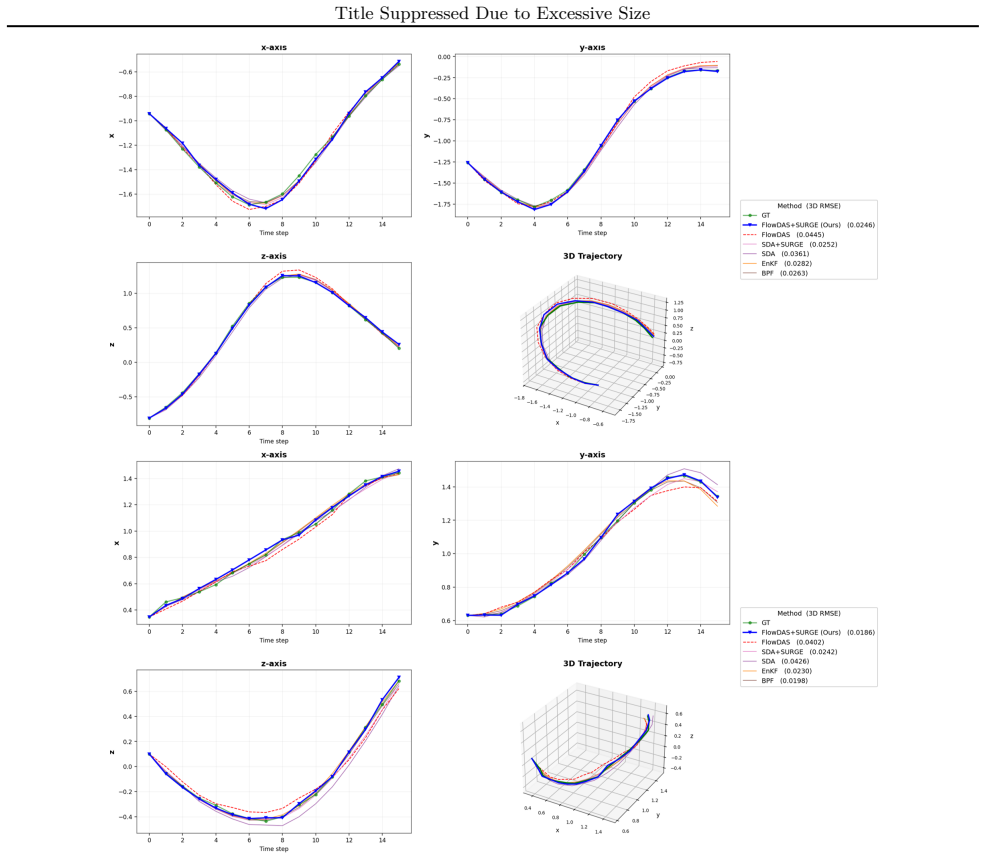
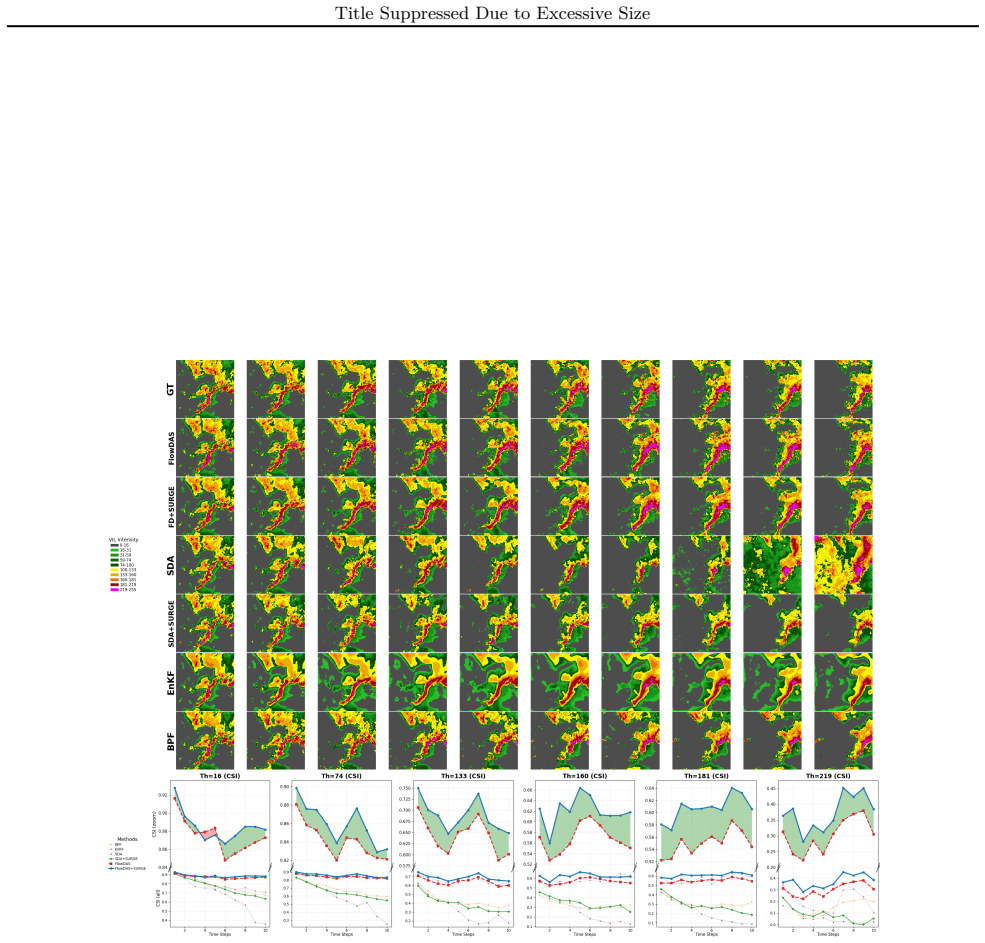
- Empirical tests show improved generation quality over existing inference-time baselines on both synthetic tasks and standard diffusion-model benchmarks.
Where Pith is reading between the lines
- The equivalence may allow swapping path-wise and particle-wise implementations interchangeably in other stochastic sampling settings where Girsanov weights can be computed.
- Because the method is fully gradient-free, it could be integrated into black-box simulators or non-differentiable forward models that still admit a Girsanov representation.
- Extensions could explore whether approximate Girsanov weights (e.g., via learned estimators) preserve unbiasedness up to controllable error in high dimensions.
Load-bearing premise
The diffusion process and the Girsanov change of measure must satisfy regularity conditions such as the Novikov condition so that the path weights are well-defined and the backward conditional expectation recovers the particle weights exactly.
What would settle it
Running both URGE and a standard particle-wise SMC sampler on the same diffusion model and target objective, then checking whether their empirical terminal distributions differ in total variation or in any moment that the theory predicts must match.
Figures








read the original abstract
Data assimilation (DA) addresses the problem of sequentially estimating the state of a dynamical system from noisy and incomplete observations. In this work, we employ a diffusion model as a world model to simulate and predict the system's dynamics. Recently, score-based diffusion models have learned global diffusion priors that effectively model (stochastic) dynamics, revealing strong potential for data assimilation. In this paper, we investigate how information from noisy observations can be incorporated to enable continuous correction and refinement of the predicted system state when using a diffusion prior. Motivated by particle filtering methods, we represent the posterior distribution using a set of particles. After receiving noisy observations, the diffusion model is guided using the observation likelihood to steer the generation process toward observation-consistent states. Nevertheless, such guidance does not guarantee sampling from the true posterior. We therefore employ a Sequential Monte Carlo approach over the diffusion trajectory, viewed as a path measure, to reweight and resample particles, thereby correcting the generation process and ensuring convergence toward the desired posterior distribution. This leads to an unbiased particle filtering method that rigorously fuses observational data with diffusion model simulations.
Editorial analysis
A structured set of objections, weighed in public.
Referee Report
Summary. The manuscript introduces SURGE (also referred to as URGE), an approximation-free, training-free particle filter for diffusion surrogates. It performs path-wise importance reweighting via a Girsanov change of measure, attaching multiplicative weights to simulated trajectories and resampling periodically without any score, gradient, or PDE evaluations. The central claim is an equivalence between path-wise and particle-wise SMC: the Girsanov path weight admits a backward conditional expectation that recovers the previous particle-level weights, guaranteeing both schemes produce the same unbiased terminal law. Empirical results show outperformance over existing inference-time guidance baselines on synthetic tests and diffusion-model benchmarks.
Significance. If the equivalence holds, the work provides a simple gradient-free alternative for inference-time scaling in diffusion models, eliminating bias and overhead from repeated score evaluations. The derivation from established stochastic calculus and the empirical gains are strengths that could influence practical generative modeling pipelines.
major comments (1)
- [Theoretical equivalence derivation (continuous-time Girsanov application)] The equivalence between Girsanov path weights and particle-wise SMC weights is derived in the continuous-time semimartingale setting. Diffusion sampling uses discrete-time schemes (Euler–Maruyama or similar) with finite steps; the manuscript does not show that the discrete Radon–Nikodym derivative equals the backward conditional expectation of the continuous Girsanov exponential or bound the resulting O(Δt) discrepancy. This is load-bearing for the exact unbiasedness and approximation-free claims.
minor comments (2)
- [Title and abstract] Title uses SURGE while abstract introduces URGE; ensure acronym consistency and expand it on first use.
- [Abstract and introduction] Hyphenate 'Training Free' as 'training-free' and check for similar compound-adjective issues throughout.
Simulated Author's Rebuttal
We thank the referee for their careful reading and constructive feedback. Below we address the single major comment point by point, with a commitment to strengthen the presentation of the discrete-time case.
read point-by-point responses
-
Referee: [Theoretical equivalence derivation (continuous-time Girsanov application)] The equivalence between Girsanov path weights and particle-wise SMC weights is derived in the continuous-time semimartingale setting. Diffusion sampling uses discrete-time schemes (Euler–Maruyama or similar) with finite steps; the manuscript does not show that the discrete Radon–Nikodym derivative equals the backward conditional expectation of the continuous Girsanov exponential or bound the resulting O(Δt) discrepancy. This is load-bearing for the exact unbiasedness and approximation-free claims.
Authors: We appreciate the referee identifying this important clarification. The continuous-time derivation is presented to exploit standard results from stochastic calculus and to make the connection to Girsanov’s theorem transparent. In the discrete-time setting actually used for sampling, the path-wise weight is exactly the product, over Euler–Maruyama steps, of the Radon–Nikodym derivatives between the two Gaussian transition kernels. This product is the natural discrete counterpart of the continuous Girsanov exponential. By the tower property of conditional expectation, the backward conditional expectation of these discrete weights recovers the particle-wise weights exactly (no additional approximation). The only O(Δt) discrepancy appears when one compares the discrete weights to their continuous-time limit; however, because the underlying diffusion sampler itself is already an O(Δt) approximation, the terminal measure produced by URGE remains unbiased relative to the discrete particle filter that would be obtained by direct particle-wise reweighting. We will add a short subsection (or appendix paragraph) that (i) states the discrete Radon–Nikodym form explicitly, (ii) verifies the tower-property equivalence in discrete time, and (iii) notes that any remaining discretization error is of the same order as the numerical scheme already employed by all competing methods. This revision will be included in the next manuscript version. revision: yes
Circularity Check
No circularity: equivalence derived from external Girsanov theorem and conditional expectation identity
full rationale
The paper's central derivation establishes an equivalence between path-wise Girsanov reweighting and particle-wise SMC by invoking the standard Girsanov change of measure and a backward conditional expectation that recovers prior particle weights. This step relies on established stochastic calculus results (Girsanov theorem under Novikov-type regularity) rather than any self-definitional loop, fitted parameter renamed as prediction, or load-bearing self-citation. No equations reduce the claimed unbiased terminal law to the paper's own inputs by construction; the argument is self-contained against external mathematical benchmarks and does not smuggle ansatzes or rename known empirical patterns.
Axiom & Free-Parameter Ledger
axioms (1)
- domain assumption The underlying stochastic differential equation satisfies the regularity conditions required for Girsanov's theorem to define a valid change of measure.
Lean theorems connected to this paper
-
IndisputableMonolith/Cost/FunctionalEquation.leanwashburn_uniqueness_aczel unclear?
unclearRelation between the paper passage and the cited Recognition theorem.
the Girsanov path weight admits a backward conditional expectation that recovers the previous particle-level weights, guaranteeing that both schemes produce the same unbiased terminal law
-
IndisputableMonolith/Foundation/AlexanderDuality.leanalexander_duality_circle_linking unclear?
unclearRelation between the paper passage and the cited Recognition theorem.
Euler–Maruyama scheme for the computation of the integrals in (6)
What do these tags mean?
- matches
- The paper's claim is directly supported by a theorem in the formal canon.
- supports
- The theorem supports part of the paper's argument, but the paper may add assumptions or extra steps.
- extends
- The paper goes beyond the formal theorem; the theorem is a base layer rather than the whole result.
- uses
- The paper appears to rely on the theorem as machinery.
- contradicts
- The paper's claim conflicts with a theorem or certificate in the canon.
- unclear
- Pith found a possible connection, but the passage is too broad, indirect, or ambiguous to say the theorem truly supports the claim.
discussion (0)
Sign in with ORCID, Apple, or X to comment. Anyone can read and Pith papers without signing in.