Mass Generation from Embedding Geometry in Surface Nematics
Pith reviewed 2026-05-20 07:00 UTC · model grok-4.3
The pith
A nematic field on a curved embedded surface acquires a geometric mass from extrinsic curvature.
A machine-rendered reading of the paper's core claim, the machinery that carries it, and where it could break.
Core claim
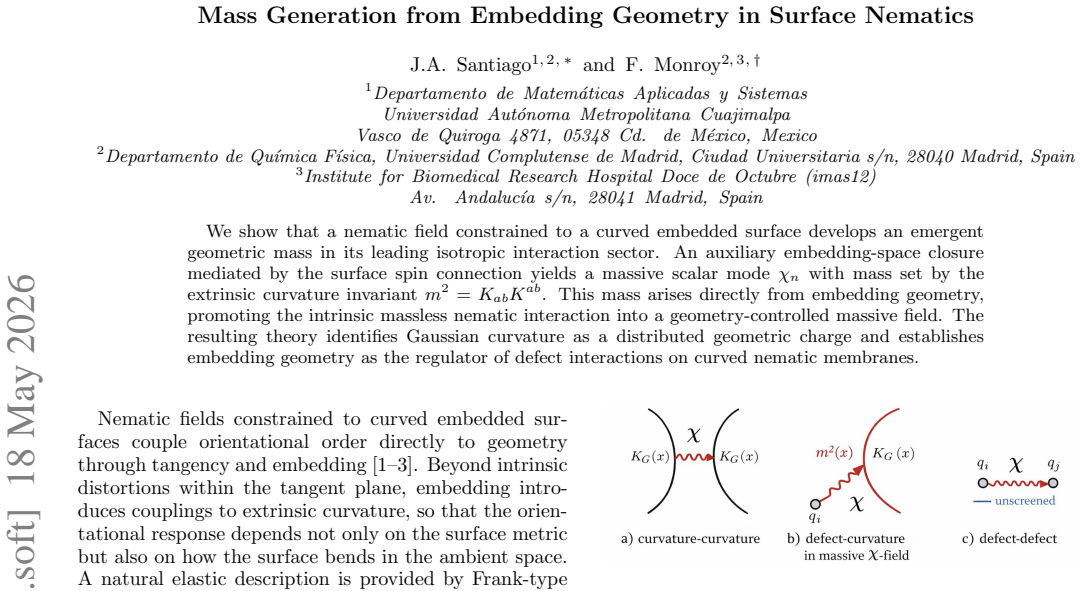
A nematic field constrained to a curved embedded surface develops an emergent geometric mass in its leading isotropic interaction sector. An auxiliary embedding-space closure mediated by the surface spin connection yields a massive scalar mode χ_n with mass set by the extrinsic curvature invariant m² = K_ab K^ab. This mass arises directly from embedding geometry, promoting the intrinsic massless nematic interaction into a geometry-controlled massive field. The resulting theory identifies Gaussian curvature as a distributed geometric charge and establishes embedding geometry as the regulator of defect interactions on curved nematic membranes.
What carries the argument
the auxiliary embedding-space closure mediated by the surface spin connection, which converts the intrinsic massless nematic interaction into a massive scalar field whose mass is fixed by the square of the extrinsic curvature tensor
If this is right
- Gaussian curvature functions as a distributed geometric charge sourcing defect interactions.
- Defect energetics and screening on curved nematic membranes become controlled by the embedding geometry.
- The originally massless nematic interaction is promoted to a massive scalar mode whose range is set by extrinsic curvature.
- The mass term appears in the leading isotropic sector without extra parameters or fields.
Where Pith is reading between the lines
- The same closure mechanism could be tested on biological membranes where nematic order and curvature coexist.
- The construction suggests a route to geometric mass generation in other two-dimensional ordered systems with embedding freedom.
- One could look for signatures of this mass in the spectrum of fluctuations around defect cores on surfaces of varying extrinsic curvature.
Load-bearing premise
The auxiliary embedding-space closure can be imposed without introducing additional dynamical degrees of freedom or violating the intrinsic nematic constraints on the surface.
What would settle it
Direct measurement on a curved nematic membrane showing that the inverse correlation length of the isotropic sector scales exactly as the square root of K_ab K^ab while remaining insensitive to intrinsic curvature alone.
Figures

read the original abstract
We show that a nematic field constrained to a curved embedded surface develops an emergent geometric mass in its leading isotropic interaction sector. An auxiliary embedding-space closure mediated by the surface spin connection yields a massive scalar mode \(\chi_n\) with mass set by the extrinsic curvature invariant \(m^2=K_{ab}K^{ab}\). This mass arises directly from embedding geometry, promoting the intrinsic massless nematic interaction into a geometry-controlled massive field. The resulting theory identifies Gaussian curvature as a distributed geometric charge and establishes embedding geometry as the regulator of defect interactions on curved nematic membranes.
Editorial analysis
A structured set of objections, weighed in public.
Referee Report
Summary. The manuscript claims that a nematic field constrained to a curved embedded surface develops an emergent geometric mass in its leading isotropic interaction sector. An auxiliary embedding-space closure mediated by the surface spin connection produces a massive scalar mode χ_n whose mass squared is set by the extrinsic curvature invariant m² = K_ab K^ab. The resulting theory is said to identify Gaussian curvature as a distributed geometric charge and to establish embedding geometry as the regulator of defect interactions on curved nematic membranes.
Significance. If the auxiliary closure can be shown to preserve the intrinsic nematic constraints and introduce no new propagating degrees of freedom, the result would supply a purely geometric, parameter-free mechanism for mass generation in surface nematics. This could unify the treatment of defect energetics on curved membranes with extrinsic curvature invariants and offer falsifiable predictions for how membrane shape controls nematic ordering. The approach is conceptually economical and aligns with existing geometric formulations in soft-matter physics.
major comments (2)
- [Abstract / closure procedure] Abstract and the paragraph describing the closure procedure: the central claim that the auxiliary embedding-space closure mediated by the surface spin connection can be imposed without introducing additional dynamical degrees of freedom or violating the intrinsic director constraints is load-bearing. The manuscript must explicitly verify that the closure is a pure geometric identification rather than a dynamical constraint that alters the phase space or equations of motion for the nematic order parameter.
- [Derivation of the massive mode] The derivation of m² = K_ab K^ab: without the explicit Lagrangian, the auxiliary construction, and the check that the closure preserves the original nematic symmetry, it remains unclear whether the mass term is independently derived or follows tautologically once the closure is imposed. The manuscript should supply the intermediate steps that demonstrate the mass arises from the embedding geometry rather than by construction.
minor comments (2)
- [Introduction] The notation χ_n for the massive scalar mode should be introduced with an explicit definition and relation to the original nematic director field in the main text.
- [Figures] Figure captions and axis labels should be expanded to indicate which quantities are plotted (e.g., the extrinsic curvature invariant versus the emergent mass) and whether any fitting or normalization has been applied.
Simulated Author's Rebuttal
We thank the referee for the positive evaluation of our work and for the detailed comments, which highlight important points for clarification. We respond to each major comment below and will revise the manuscript to address the concerns raised.
read point-by-point responses
-
Referee: [Abstract / closure procedure] Abstract and the paragraph describing the closure procedure: the central claim that the auxiliary embedding-space closure mediated by the surface spin connection can be imposed without introducing additional dynamical degrees of freedom or violating the intrinsic director constraints is load-bearing. The manuscript must explicitly verify that the closure is a pure geometric identification rather than a dynamical constraint that alters the phase space or equations of motion for the nematic order parameter.
Authors: We agree that explicit verification of the closure is necessary to establish it as a geometric identification. In the revised manuscript we will add a dedicated subsection that derives the auxiliary closure directly from the embedding geometry. This will include an explicit demonstration that the procedure enforces the surface constraints without introducing new propagating degrees of freedom, preserves the director normalization n·n = 1, and leaves the original equations of motion for the nematic order parameter unchanged except for the geometric contributions arising from the spin connection. We will also confirm that the phase space remains unaltered by showing that the auxiliary field is non-dynamical and can be eliminated algebraically. revision: yes
-
Referee: [Derivation of the massive mode] The derivation of m² = K_ab K^ab: without the explicit Lagrangian, the auxiliary construction, and the check that the closure preserves the original nematic symmetry, it remains unclear whether the mass term is independently derived or follows tautologically once the closure is imposed. The manuscript should supply the intermediate steps that demonstrate the mass arises from the embedding geometry rather than by construction.
Authors: We acknowledge that the intermediate steps require expansion for clarity. The revised manuscript will present the explicit Lagrangian before and after imposition of the closure, together with the step-by-step calculation that isolates the contribution of the extrinsic curvature. We will trace the origin of the mass term m² = K_ab K^ab to the coupling between the nematic director and the surface spin connection induced by the embedding, and we will verify that this term survives after the auxiliary field is integrated out while preserving the intrinsic nematic symmetry. This will show that the mass is generated by the geometry rather than imposed by fiat. revision: yes
Circularity Check
Mass term set directly to extrinsic curvature invariant via auxiliary closure
specific steps
-
self definitional
[Abstract]
"An auxiliary embedding-space closure mediated by the surface spin connection yields a massive scalar mode χ_n with mass set by the extrinsic curvature invariant m²=K_ab K^ab."
The mass parameter is explicitly defined as m² equal to the extrinsic curvature invariant K_ab K^ab, which is an input quantity of the embedding geometry. The closure procedure therefore equates the effective mass of the nematic mode to a geometric term already supplied by the surface embedding, rendering the 'emergent' mass a direct renaming of the input rather than a derived dynamical feature.
full rationale
The central derivation imposes an auxiliary embedding-space closure mediated by the spin connection and then identifies the resulting scalar mode mass with the extrinsic curvature invariant already present in the surface embedding. This step reduces the claimed emergence of a geometry-controlled mass to a direct geometric identification rather than an independent dynamical consequence of the nematic field equations. The abstract presents the mass as yielded by the closure, but the explicit setting m² = K_ab K^ab makes the result tautological once the closure is enforced. No independent verification or external benchmark is quoted to separate the construction from the input geometry.
Axiom & Free-Parameter Ledger
axioms (2)
- domain assumption The nematic field is strictly constrained to the surface with no out-of-plane component.
- ad hoc to paper An auxiliary embedding-space closure mediated by the surface spin connection is admissible.
invented entities (1)
-
massive scalar mode χ_n
no independent evidence
Reference graph
Works this paper leans on
-
[1]
R. D. Kamien, Rev. Mod. Phys.74, 953 (2002)
work page 2002
-
[2]
V. Vitelli, A. M. Turner, and D. R. Nelson, Rev. Mod. Phys.82, 1301 (2010)
work page 2010
- [3]
-
[4]
F. C. Frank, Discuss. Faraday Soc.25, 19 (1958)
work page 1958
-
[5]
J. A. Santiago, G. Chac´ on-Acosta, and F. Monroy, Phys. Rev. E100, 012704 (2019)
work page 2019
-
[6]
J. A. Santiago and F. Monroy, J. Phys. A: Math. Theor. 53, 365202 (2020)
work page 2020
-
[7]
J. A. Santiago, Phys. Rev. E97, 052706 (2018)
work page 2018
-
[8]
M. P. do Carmo,Differential Geometry of Curves and Surfaces(Prentice-Hall, Englewood Cliffs, 1976)
work page 1976
- [9]
-
[10]
M. J. Bowick and L. Giomi, Adv. Phys.58, 449 (2009)
work page 2009
-
[11]
B. L. Mbanga, G. M. Grason, and C. D. Santangelo, Phys. Rev. Lett.108, 017801 (2012)
work page 2012
-
[12]
P. W. Anderson, Phys. Rev.130, 439 (1963)
work page 1963
-
[13]
P. W. Higgs, Phys. Rev. Lett.13, 508 (1964)
work page 1964
- [14]
- [15]
-
[16]
Grigor’yan,Heat Kernel and Analysis on Manifolds (American Mathematical Society, 2009)
A. Grigor’yan,Heat Kernel and Analysis on Manifolds (American Mathematical Society, 2009)
work page 2009
discussion (0)
Sign in with ORCID, Apple, or X to comment. Anyone can read and Pith papers without signing in.