Precision probing of ionic-core transitions in alkaline-earth Rydberg atoms
Pith reviewed 2026-05-20 02:12 UTC · model grok-4.3
The pith
Dynamical control of the Rydberg electron orbit narrows ionic-core transition linewidths by more than two orders of magnitude.
A machine-rendered reading of the paper's core claim, the machinery that carries it, and where it could break.
Core claim
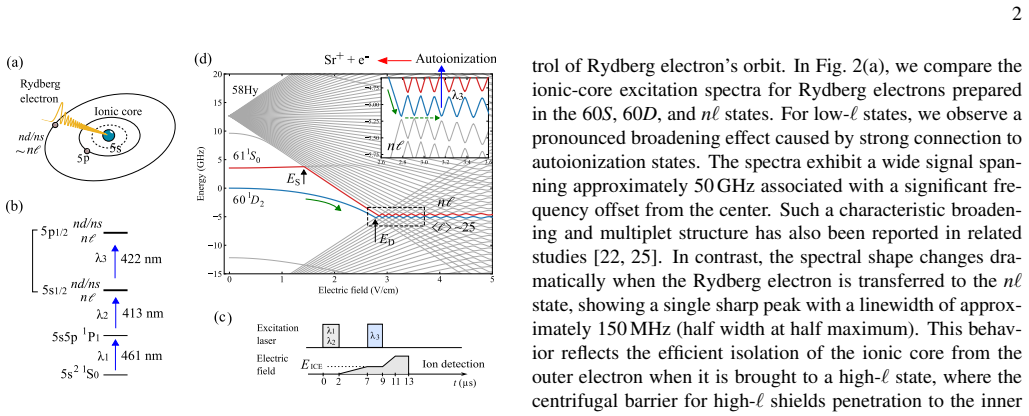
We report precision spectroscopy of ionic-core transitions in alkaline-earth Rydberg atoms. High-resolution measurements of previously unexplored isotope shifts and hyperfine splittings of core dipole transitions are achieved. The key advance is a reduction of the transition linewidth by more than two orders of magnitude through dynamical control of the Rydberg electron orbit. Direct comparison of the core spectrum against a single trapped ion acting as an absolute frequency reference removes ambiguity in the measured shifts. This establishes a foundation for quantum control of inner-core transitions and for using them as sensitive probes of electron-core interactions.
What carries the argument
Dynamical control of the Rydberg electron's orbit, which suppresses the effective linewidth of ionic-core transitions by more than two orders of magnitude while preserving spectral accuracy.
If this is right
- Inner-core transitions become usable for quantum control of Rydberg atoms.
- Core transitions can serve as a sensitive probe of electron-core interactions in atomic systems.
- The same technique extends to molecular systems for studying electron-core coupling.
- Precision data on core isotope shifts and hyperfine structure become available for previously inaccessible transitions.
Where Pith is reading between the lines
- The method may allow Rydberg-based sensors to operate at higher principal quantum numbers without core-induced decoherence.
- Integration with optical clocks or quantum networks could use controlled core states as auxiliary qubits.
- Similar orbit-control ideas might apply to other Rydberg species or to ions in Penning traps for broader metrology applications.
Load-bearing premise
The orbit control reduces core-transition linewidth without introducing uncontrolled frequency shifts or extra broadening that would invalidate the isotope-shift and hyperfine data.
What would settle it
A direct side-by-side measurement in which the linewidth remains unchanged or broadens when the dynamical orbit control is applied, or in which the Rydberg-atom core frequencies disagree with the trapped-ion reference by more than the claimed precision.
Figures



read the original abstract
We report precision spectroscopy of ionic-core transitions in alkaline-earth Rydberg atoms. We demonstrate high-resolution measurements of isotope shifts and hyperfine splitting of dipole transitions in ionic cores which have not been explored so far. A key element of this work is the reduction of the linewidth by more than two orders of magnitude enabled by dynamical control of Rydberg electron's orbit which significantly enhances the spectral resolution. Furthermore, to unambiguously identify the frequency shift, we directly compare core ion's spectrum with a signal from a single trapped ion serving as an ultimate frequency reference. This work provides an important foundation for quantum control of inner-core transitions, which offer an useful tool in manipulating Rydberg atom as well as a sensitive probe for electron-core interactions in atomic and molecular systems.
Editorial analysis
A structured set of objections, weighed in public.
Referee Report
Summary. The manuscript reports precision spectroscopy of ionic-core transitions in alkaline-earth Rydberg atoms. It claims high-resolution measurements of previously unexplored isotope shifts and hyperfine splittings in dipole transitions, enabled by dynamical control of the Rydberg electron orbit that reduces the core-transition linewidth by more than two orders of magnitude. Absolute frequency calibration is provided by direct comparison to the spectrum of a single trapped ion serving as reference.
Significance. If the central claims are substantiated, the work establishes a new route to high-resolution probing of ionic-core transitions that combines Rydberg-atom techniques with trapped-ion metrology. This could enable quantum control of inner-shell transitions and furnish sensitive tests of electron-core interactions, with potential extensions to molecular systems.
major comments (2)
- [Section 3] Section 3 and the supplementary material describe the dynamical-control sequence but omit a quantitative error budget for residual AC-Stark shifts, motional shifts, or differential light shifts between isotopes. Without this budget it is impossible to confirm that the reported >100× linewidth reduction is achieved without line-center offsets at the level required for the stated isotope-shift and hyperfine precision.
- [Section 3] The direct comparison to the trapped-ion reference calibrates the absolute scale after the fact, yet the manuscript does not present data showing that the Rydberg-atom line centers (with and without dynamical control) agree with the ion reference to within the claimed uncertainty; such a test is load-bearing for the claim that the control method itself does not introduce uncontrolled frequency shifts.
minor comments (2)
- The abstract should explicitly name the alkaline-earth species and the specific core transitions under study.
- Figure captions and axis labels in the main text would benefit from clearer indication of which data sets correspond to the Rydberg-atom versus trapped-ion measurements.
Simulated Author's Rebuttal
We thank the referee for the positive evaluation of the significance of our work and for the constructive comments on the presentation of the dynamical-control method and its validation. We address each major comment below and will revise the manuscript to incorporate additional quantitative details.
read point-by-point responses
-
Referee: [Section 3] Section 3 and the supplementary material describe the dynamical-control sequence but omit a quantitative error budget for residual AC-Stark shifts, motional shifts, or differential light shifts between isotopes. Without this budget it is impossible to confirm that the reported >100× linewidth reduction is achieved without line-center offsets at the level required for the stated isotope-shift and hyperfine precision.
Authors: We agree that an explicit quantitative error budget is necessary to fully substantiate the claimed precision and the absence of line-center offsets. In the revised manuscript we will expand Section 3 and the supplementary material with a detailed error budget that quantifies residual AC-Stark shifts, motional shifts, and differential light shifts between isotopes. This analysis will show that all contributions remain well below the level that would affect the reported isotope-shift and hyperfine measurements, thereby confirming that the >100× linewidth reduction is achieved without compromising the line-center accuracy. revision: yes
-
Referee: [Section 3] The direct comparison to the trapped-ion reference calibrates the absolute scale after the fact, yet the manuscript does not present data showing that the Rydberg-atom line centers (with and without dynamical control) agree with the ion reference to within the claimed uncertainty; such a test is load-bearing for the claim that the control method itself does not introduce uncontrolled frequency shifts.
Authors: We acknowledge that explicit side-by-side data comparing Rydberg-atom line centers (both with and without dynamical control) to the trapped-ion reference would provide stronger validation. Although the manuscript already describes the direct comparison to the single trapped ion as the absolute frequency reference, we will add in the revision a supplementary figure or table that directly overlays the measured line centers obtained with and without orbit control against the ion reference. This will demonstrate agreement within the stated uncertainty and confirm that the dynamical-control sequence does not introduce uncontrolled shifts. revision: yes
Circularity Check
No circularity: experimental measurements validated by external trapped-ion reference
full rationale
The paper reports experimental precision spectroscopy of ionic-core transitions in alkaline-earth Rydberg atoms, with the central results being measured isotope shifts and hyperfine splittings. The linewidth reduction via dynamical control of the Rydberg orbit is presented as an observed experimental outcome, not a derived quantity obtained by fitting or self-definition. Frequency calibration is performed against an independent single trapped ion acting as an external reference, providing an absolute scale that does not loop back to the Rydberg data itself. No equations, ansatzes, or uniqueness theorems are invoked that reduce to self-citations or fitted inputs by construction. The work is therefore self-contained against external benchmarks.
Axiom & Free-Parameter Ledger
Lean theorems connected to this paper
-
IndisputableMonolith/Cost/FunctionalEquation.leanwashburn_uniqueness_aczel unclear?
unclearRelation between the paper passage and the cited Recognition theorem.
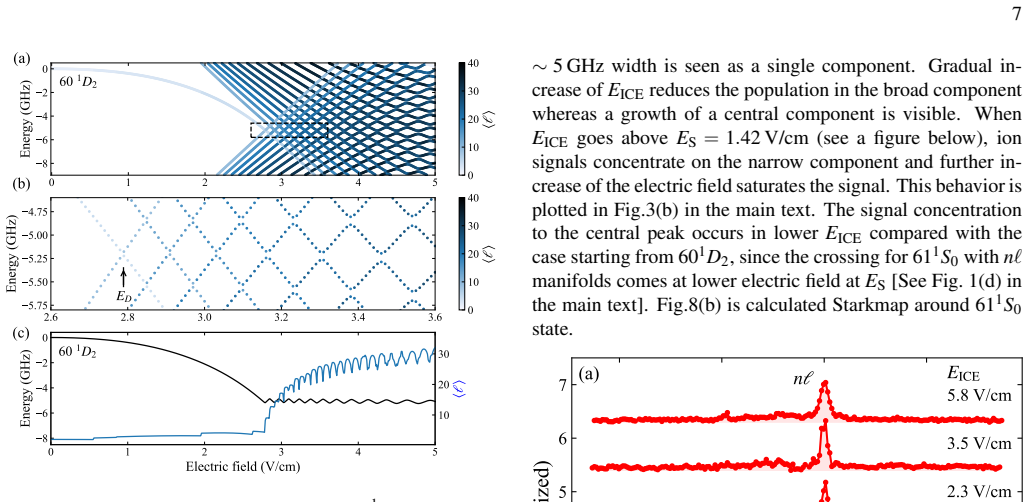
reduction of the linewidth by more than two orders of magnitude enabled by dynamical control of Rydberg electron's orbit... population transfer to high-ℓ states with ⟨ℓ⟩>30 via electric field control inspired by Stark switching
-
IndisputableMonolith/Foundation/AlexanderDuality.leanalexander_duality_circle_linking unclear?
unclearRelation between the paper passage and the cited Recognition theorem.
scaling law of autoionization rate, n^{-3} and ℓ^{-5}
What do these tags mean?
- matches
- The paper's claim is directly supported by a theorem in the formal canon.
- supports
- The theorem supports part of the paper's argument, but the paper may add assumptions or extra steps.
- extends
- The paper goes beyond the formal theorem; the theorem is a base layer rather than the whole result.
- uses
- The paper appears to rely on the theorem as machinery.
- contradicts
- The paper's claim conflicts with a theorem or certificate in the canon.
- unclear
- Pith found a possible connection, but the passage is too broad, indirect, or ambiguous to say the theorem truly supports the claim.
Reference graph
Works this paper leans on
-
[1]
M. Takamoto, I. Ushijima, N. Ohmae, T. Yahagi, K. Kokado, H. Shinkai, and H. Katori, Nature Photonics14, 411 (2020)
work page 2020
- [2]
-
[3]
A. D. Ludlow, M. M. Boyd, J. Ye, E. Peik, and P. O. Schmidt, Rev. Mod. Phys.87, 637 (2015)
work page 2015
- [4]
-
[5]
M. C. Marshall, D. A. R. Castillo, W. J. Arthur-Dworschack, A. Aeppli, K. Kim, D. Lee, W. Warfield, J. Hinrichs, N. V . Nardelli, T. M. Fortier, J. Ye, D. R. Leibrandt, and D. B. Hume, Phys. Rev. Lett.135, 033201 (2025)
work page 2025
- [6]
-
[7]
J. B. M. Warntjes, C. Wesdorp, F. Robicheaux, and L. D. Noor- dam, Phys. Rev. Lett.83, 512 (1999)
work page 1999
- [8]
-
[9]
G. Lochead, D. Boddy, D. P. Sadler, C. S. Adams, and M. P. A. Jones, Phys. Rev. A87, 053409 (2013)
work page 2013
-
[10]
I. S. Madjarov, J. P. Covey, A. L. Shaw, J. Choi, A. Kale, A. Cooper, H. Pichler, V . Schkolnik, J. R. Williams, and M. En- dres, Nature Physics16, 857 (2020)
work page 2020
-
[11]
P. McQuillen, X. Zhang, T. Strickler, F. B. Dunning, and T. C. Killian, Phys. Rev. A87, 013407 (2013)
work page 2013
-
[12]
A. P. Burgers, S. Ma, S. Saskin, J. Wilson, M. A. Alarcón, C. H. Greene, and J. D. Thompson, PRX Quantum3, 020326 (2022)
work page 2022
-
[13]
K.-L. Pham, T. F. Gallagher, P. Pillet, S. Lepoutre, and P. Cheinet, PRX Quantum3, 020327 (2022)
work page 2022
-
[14]
A. Bouillon, E. Marin-Bujedo, and M. Génévriez, Phys. Rev. Lett.132, 193402 (2024)
work page 2024
-
[15]
A. Muni, L. Lachaud, A. Couto, M. Poirier, R. C. Teixeira, J.- M. Raimond, M. Brune, and S. Gleyzes, Nature Physics18, 502 (2022)
work page 2022
-
[16]
W. E. Cooke, T. F. Gallagher, S. A. Edelstein, and R. M. Hill, Phys. Rev. Lett.40, 178 (1978)
work page 1978
-
[17]
W. E. Cooke and T. F. Gallagher, Phys. Rev. A19, 2151 (1979)
work page 1979
- [18]
-
[19]
R. R. Jones and T. F. Gallagher, Phys. Rev. A38, 2846 (1988). 6
work page 1988
-
[20]
L. Pruvost, P. Camus, J. M. Lecomte, C. R. Mahon, and P. Pillet, Journal of Physics B: Atomic, Molecular and Optical Physics 24, 4723 (1991)
work page 1991
-
[21]
E. Y . Xu, Y . Zhu, O. C. Mullins, and T. F. Gallagher, Phys. Rev. A33, 2401 (1986)
work page 1986
- [22]
- [23]
- [24]
-
[25]
S. Yoshida, J. Burgdörfer, R. Brienza, G. Fields, and F. B. Dun- ning, Phys. Rev. A107, 043112 (2023)
work page 2023
- [26]
- [27]
-
[28]
R. C. Teixeira, A. Larrouy, A. Muni, L. Lachaud, J.-M. Rai- mond, S. Gleyzes, and M. Brune, Phys. Rev. Lett.125, 263001 (2020)
work page 2020
- [29]
- [30]
-
[31]
G. P. Barwood, K. Gao, P. Gill, G. Huang, and H. A. Klein, Phys. Rev. A67, 013402 (2003)
work page 2003
-
[32]
J. R. Rubbmark, M. M. Kash, M. G. Littman, and D. Kleppner, Phys. Rev. A23, 3107 (1981)
work page 1981
-
[33]
H. Sunaoshi, Y . Fukashiro, M. Furukawa, M. Yamauchi, S. Hayashibe, T. Shinozuka, M. Fujioka, I. Satoh, M. Wada, and S. Matsuki, Hyperfine Interactions78, 241 (1993)
work page 1993
- [34]
-
[35]
Martensson-Pendrill, Journal of Physics B: Atomic, Molecular and Optical Physics35, 917 (2002)
A.-M. Martensson-Pendrill, Journal of Physics B: Atomic, Molecular and Optical Physics35, 917 (2002)
work page 2002
-
[36]
The concentration discussed here sets a lower bound for frac- tion in the central component.since we accumulate the ion sig- nal in the whole frequency range to obtaina tot for all data to maintain fair analysis, the concentration is influenced by the width considered in the evaluation
-
[37]
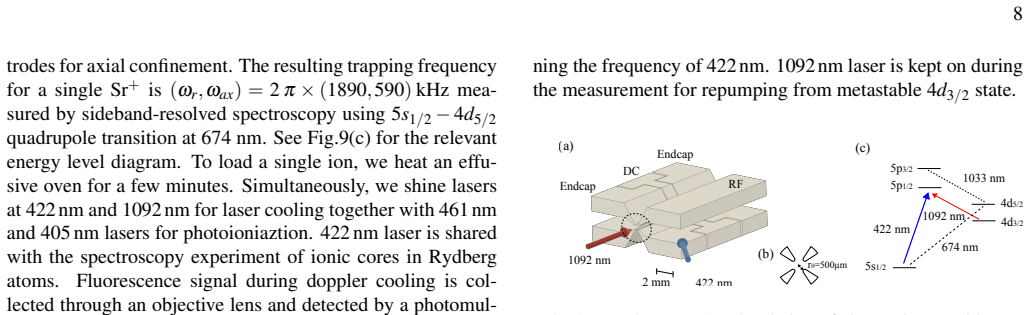
N. Šibali ´c, J. Pritchard, C. Adams, and K. Weatherill, Computer Physics Communications220, 319 (2017). SUPPLEMENTAL MATERIAL Experimental setup Strontium isotopes, 88Sr, 87Sr, 86Sr, and 84Sr, are laser cooled and selectively loaded in a magneto-optical trap. The experimental setup is shown in Fig. 5. For cooling, the 1S0 → 1P1 transition at 461 nm is us...
work page 2017
discussion (0)
Sign in with ORCID, Apple, or X to comment. Anyone can read and Pith papers without signing in.