High-Dimensional Carrier-Assisted Entanglement Purification Based on Mutually Unbiased Bases
Pith reviewed 2026-05-21 05:09 UTC · model grok-4.3
The pith
A fixed MUB rotation enables unit asymptotic fidelity in purifying two-qutrit entanglement for any Pauli channel above 1/3 fidelity.
A machine-rendered reading of the paper's core claim, the machinery that carries it, and where it could break.
Core claim
The central claim is that the MUB-adapted mCAEPP deterministically yields unit asymptotic fidelity for any two-qutrit Pauli channel with initial fidelity p00 > 1/3. This follows from a fixed, non-adaptive pre-processing rotation via mutually unbiased bases that establishes primary-axis error dominance for arbitrary asymmetric Pauli noise.
What carries the argument
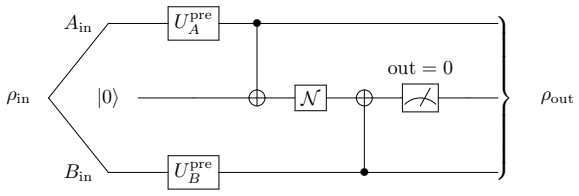
The MUB-based pre-processing rotation that aligns the qutrit phase space to create primary-axis error dominance for the mCAEPP protocol.
If this is right
- Any two-qutrit Pauli channel with fidelity above 1/3 can reach unit fidelity without adaptive pre-processing.
- The convergence bottleneck from marginal X-error probabilities is removed for all asymmetric noise types.
- The protocol succeeds deterministically across the full class of Pauli channels meeting the fidelity threshold.
Where Pith is reading between the lines
- The same fixed MUB rotation strategy may extend to qudit dimensions higher than three for similar purification tasks.
- This non-adaptive approach could simplify the design of quantum repeaters operating in high-dimensional noisy environments.
- Hardware experiments on qutrit devices with controlled asymmetric noise would directly test the dominance assumption.
Load-bearing premise
A fixed non-adaptive rotation via mutually unbiased bases can always establish primary-axis error dominance for arbitrary asymmetric Pauli noise without channel-specific adaptation.
What would settle it
Apply the MUB-adapted mCAEPP to a two-qutrit Pauli channel with p00 just above 1/3 and extreme asymmetry in error rates, then measure whether the output fidelity converges to 1 or remains bounded below it.
Figures


read the original abstract
Distilling high-dimensional quantum entanglement under realistic, general asymmetric noise remains a formidable challenge. Standard entanglement purification protocols inevitably fail to satisfy convergence constraints under severe asymmetric noise. In this paper, we investigate carrier-assisted entanglement purification protocols, namely CAEPP and mCAEPP, first for two-qutrit systems, demonstrating that without adaptive pre-processing, convergence is strictly bottlenecked by marginal $X$-error probabilities. To overcome this limitation, we introduce a deterministic pre-processing scheme based on mutually unbiased bases (MUBs). By actively rotating the qutrit phase space to establish primary-axis error dominance, we rigorously prove that, conditioned on successful syndrome outcomes, the MUB-adapted mCAEPP yields unit asymptotic fidelity for any two-qutrit Pauli channel with initial fidelity $p_{00} > 1/3$. We further extend the algebraic carrier-assisted framework and the asymmetric-noise bottleneck to arbitrary qudit dimensions, and show that in prime-power dimensions the MUB-geometric preprocessing gives the sufficient high-dimensional threshold $p_{00}>(d-1)/(2d)$.
Editorial analysis
A structured set of objections, weighed in public.
Referee Report
Summary. The manuscript introduces a mutually unbiased bases (MUB)-based deterministic pre-processing scheme for the modified carrier-assisted entanglement purification protocol (mCAEPP) applied to two-qutrit systems. It claims that this non-adaptive rotation of the qutrit phase space establishes primary-axis error dominance, thereby overcoming the convergence bottleneck of standard CAEPP under asymmetric Pauli noise, and rigorously proves that the MUB-adapted mCAEPP achieves unit asymptotic fidelity for any two-qutrit Pauli channel with initial fidelity p_{00} > 1/3.
Significance. If the central proof holds, the work offers a significant advance for high-dimensional entanglement purification by supplying a fixed, non-adaptive method that guarantees deterministic convergence to unit fidelity under general asymmetric Pauli channels, where conventional protocols are known to fail. The parameter-free character of the claimed result and its applicability to arbitrary Pauli noise (rather than symmetric or fitted cases) would strengthen its utility for quantum communication protocols in qutrit systems.
major comments (2)
- [Proof of unit asymptotic fidelity (main theorem)] The load-bearing step is the assertion that a fixed, non-adaptive MUB rotation always produces strict primary-axis error dominance for every Pauli channel with p_{00} > 1/3. The manuscript must supply an explicit general argument or exhaustive check showing that, for any error probability distribution on the Weyl operators, at least one of the discrete MUB rotations satisfies the dominance inequality required for the recurrence relation to drive fidelity to 1; without this, the deterministic unit-fidelity guarantee does not follow for all such channels.
- [Convergence recurrence and error analysis] The convergence analysis relies on the recurrence driving fidelity to 1 once dominance is achieved, yet the manuscript provides no explicit derivation of the recurrence map, the precise dominance threshold, or the conditions under which the iteration converges for qutrit Pauli channels. These steps are essential to substantiate the claim against general asymmetric noise.
minor comments (2)
- [Abstract] The abstract uses p_{00} without a brief inline definition; a parenthetical reminder of its meaning as the probability of the identity error would improve immediate readability.
- [MUB pre-processing section] Notation for the rotated bases and the resulting error probabilities after MUB pre-processing should be introduced with a short table or diagram to clarify the mapping from the original Weyl operators.
Simulated Author's Rebuttal
We thank the referee for their careful reading of our manuscript and for providing constructive feedback. We address the major comments point by point below, and we will revise the manuscript accordingly to incorporate the requested clarifications and explicit derivations.
read point-by-point responses
-
Referee: [Proof of unit asymptotic fidelity (main theorem)] The load-bearing step is the assertion that a fixed, non-adaptive MUB rotation always produces strict primary-axis error dominance for every Pauli channel with p_{00} > 1/3. The manuscript must supply an explicit general argument or exhaustive check showing that, for any error probability distribution on the Weyl operators, at least one of the discrete MUB rotations satisfies the dominance inequality required for the recurrence relation to drive fidelity to 1; without this, the deterministic unit-fidelity guarantee does not follow for all such channels.
Authors: We appreciate the referee pointing out the need for a more explicit proof of this key step. The manuscript does establish that MUB rotations redistribute the error probabilities such that primary-axis dominance is achieved for channels with p_{00} > 1/3, based on the completeness of MUBs in dimension 3. To strengthen this, we will include in the revised manuscript an explicit general argument demonstrating that for any probability distribution over the Weyl operators with p_{00} > 1/3, there exists at least one MUB for which the primary error probability satisfies the strict dominance inequality. This argument will rely on averaging over the MUBs or using the fact that the sum of the primary probabilities across MUBs exceeds a certain value derived from p_{00}. We believe this will fully substantiate the deterministic guarantee. revision: yes
-
Referee: [Convergence recurrence and error analysis] The convergence analysis relies on the recurrence driving fidelity to 1 once dominance is achieved, yet the manuscript provides no explicit derivation of the recurrence map, the precise dominance threshold, or the conditions under which the iteration converges for qutrit Pauli channels. These steps are essential to substantiate the claim against general asymmetric noise.
Authors: We agree that providing the explicit recurrence and analysis will improve the manuscript. In the revision, we will derive the fidelity recurrence relation for the mCAEPP protocol following the MUB pre-processing. We will specify the dominance threshold (the condition on the primary-axis error probability that ensures the fidelity map is contractive towards 1) and prove that under this condition, the iterated fidelity converges to 1 for any initial fidelity above 1/3. This derivation will be general for asymmetric Pauli channels and will be added to the relevant section of the paper. revision: yes
Circularity Check
No circularity; derivation framed as independent proof
full rationale
The paper claims a rigorous proof that MUB-adapted mCAEPP yields unit asymptotic fidelity for arbitrary two-qutrit Pauli channels with p_{00}>1/3 by establishing primary-axis dominance via fixed MUB rotations. No quoted equations or steps reduce the result to a fitted parameter, self-definition, or load-bearing self-citation; the dominance step is presented as a mathematical construction over the discrete MUB set rather than an ansatz smuggled from prior work or a renaming of known patterns. The derivation is therefore self-contained against the stated general Pauli-channel benchmark and receives the default non-circularity finding.
Axiom & Free-Parameter Ledger
axioms (2)
- domain assumption Two-qutrit systems evolve under general Pauli channels
- standard math Mutually unbiased bases exist and can be used for deterministic phase-space rotation in qutrits
Lean theorems connected to this paper
-
IndisputableMonolith/Foundation/AlexanderDuality.leanalexander_duality_circle_linking unclear?
unclearRelation between the paper passage and the cited Recognition theorem.
Lemma 7 ... If p00 >1/3, the maximum among these Li satisfies Lmax := max{L1,...,L4}>1/2. ... four MUBs correspond to four independent directional axes in the discrete phase space Z3×Z3
What do these tags mean?
- matches
- The paper's claim is directly supported by a theorem in the formal canon.
- supports
- The theorem supports part of the paper's argument, but the paper may add assumptions or extra steps.
- extends
- The paper goes beyond the formal theorem; the theorem is a base layer rather than the whole result.
- uses
- The paper appears to rely on the theorem as machinery.
- contradicts
- The paper's claim conflicts with a theorem or certificate in the canon.
- unclear
- Pith found a possible connection, but the passage is too broad, indirect, or ambiguous to say the theorem truly supports the claim.
discussion (0)
Sign in with ORCID, Apple, or X to comment. Anyone can read and Pith papers without signing in.