Interaction Controlled Molecular Probing of Length Scale Dependent Glassy Dynamics in Polymer Melts
Pith reviewed 2026-05-21 03:54 UTC · model grok-4.3
The pith
The interaction strength between molecular probes and a polymer melt determines which heterogeneous environments the probes sample.
A machine-rendered reading of the paper's core claim, the machinery that carries it, and where it could break.
Core claim
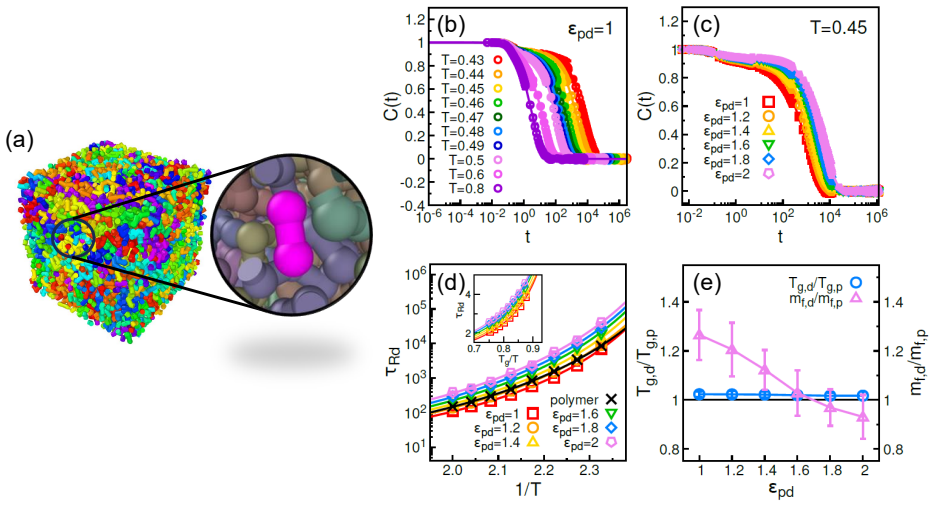
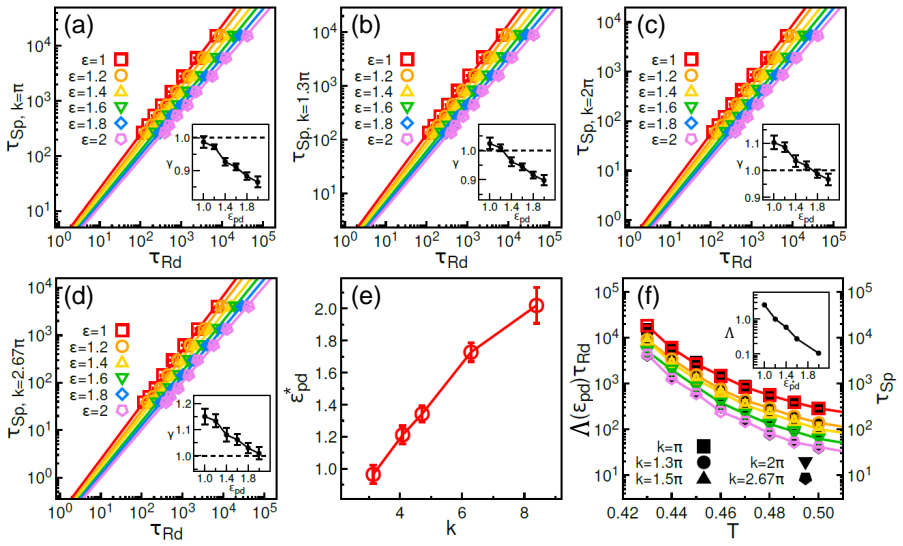
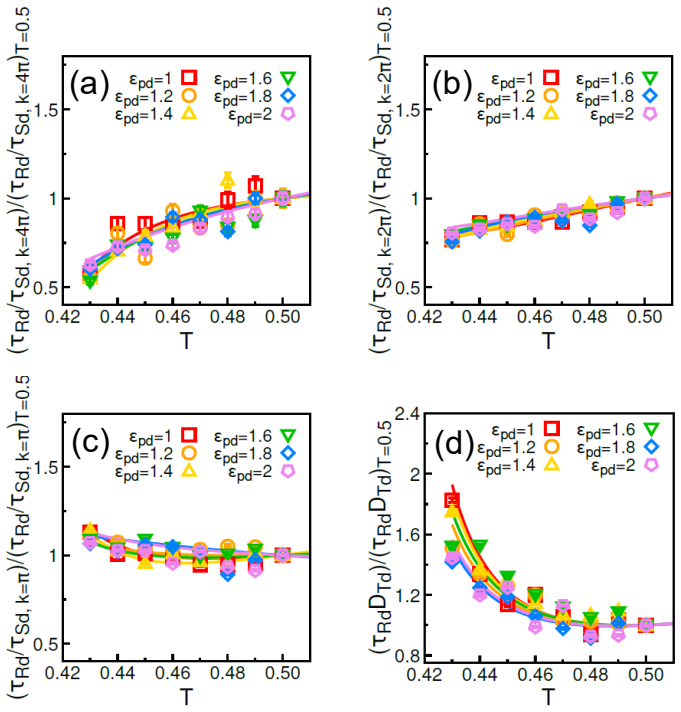
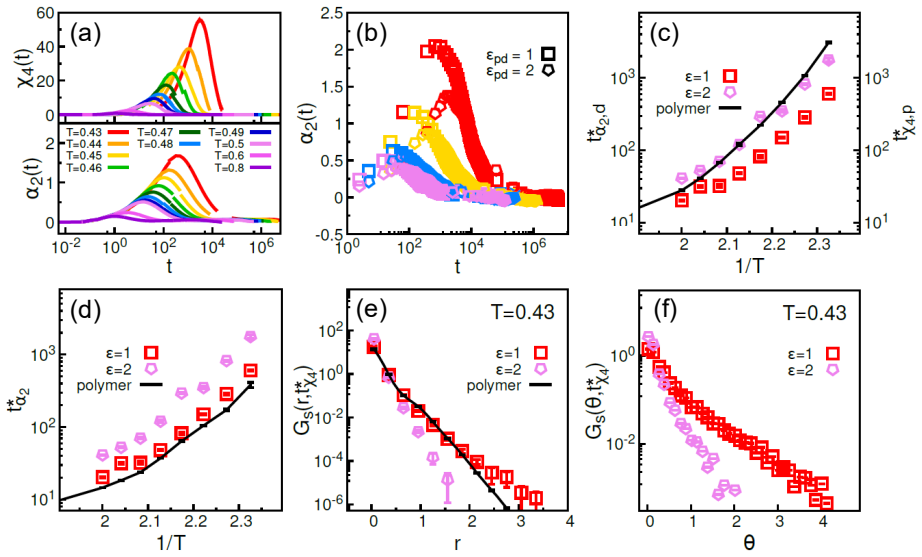
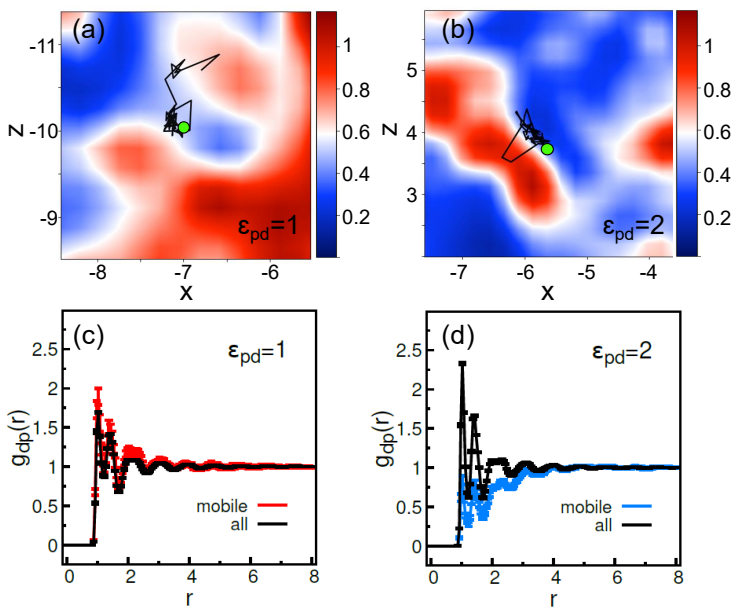
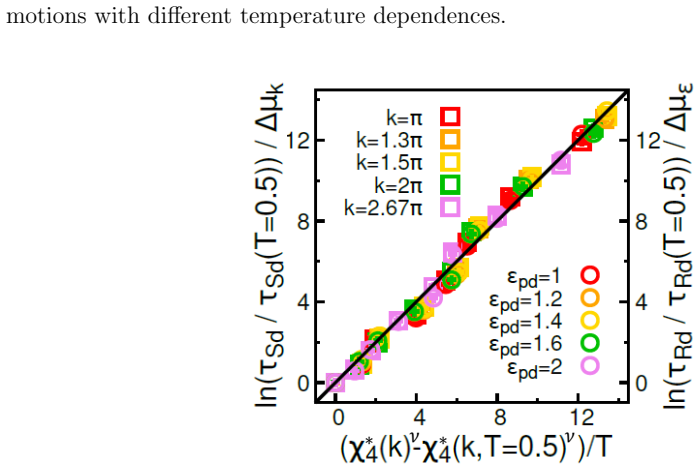
In simulations of probe dimers embedded in a supercooled polymer melt, the probe-host interaction strength controls whether the probe dynamics reflect more mobile or less mobile heterogeneous environments in the host matrix. Weak probes partially decouple from local cages and sample active regions, while strong probes are constrained in immobile cages. Comparing the probe rotational relaxation to the wavevector-dependent host relaxation reveals a scale-dependent mapping where the effective length scale probed depends on the interaction.
What carries the argument
The interaction-dependent selection of heterogeneous environments, which creates a scale-dependent correspondence between probe rotational relaxation and host dynamic susceptibility.
Load-bearing premise
The molecular dynamics simulations and interaction potentials used accurately model real probe-host coupling without introducing simulation artifacts that distort the observed environment sampling.
What would settle it
An experiment or simulation where varying the probe-host interaction strength produces no change in the probe's reported relaxation times or apparent heterogeneity, while the host's dynamic susceptibility remains the same, would contradict the central claim.
Figures
read the original abstract
Single molecule probes are widely used to characterize dynamic heterogeneity in glass forming liquids, but interpreting probe dynamics remains challenging because the measured response depends on how the probe couples to its host environment. Using molecular dynamics simulations of dilute probe dimers embedded in a supercooled polymer melt, we show that the probe--host interaction strength determines which heterogeneous environment of the host matrix is reflected in the probe dynamics. Weakly interacting probes partially decouple from their local cages and remain able to access dynamically active environments, whereas strongly interacting probes are more constrained within less mobile, cage-like environments. This interaction-dependent response provides a microscopic basis for the variation in fragility inferred from the probe dynamics, even though the intrinsic host dynamics remains essentially unperturbed. By comparing probe rotational relaxation with the wavevector-dependent structural relaxation and dynamic susceptibility of the host, we establish a scale-dependent correspondence between probe dynamics and host dynamic heterogeneity. Our results show that molecular probes do not simply report the bulk host relaxation, but instead encode the spatial scale and heterogeneous environment associated with the probe--host interaction.
Editorial analysis
A structured set of objections, weighed in public.
Referee Report
Summary. The manuscript presents molecular dynamics simulations of dilute probe dimers in a supercooled polymer melt to examine how probe-host interaction strength controls which aspects of the host's dynamic heterogeneity are reflected in the probe's rotational relaxation. Weakly interacting probes are shown to partially decouple from local cages and sample more mobile regions, while strongly interacting probes remain trapped in less mobile environments; this interaction dependence is linked to variations in apparent fragility. By direct comparison of probe relaxation times to the host's wavevector-dependent structural relaxation and four-point dynamic susceptibility χ₄(q), the authors establish a scale-dependent mapping between probe dynamics and host heterogeneity, concluding that probes encode the spatial scale set by their coupling rather than reporting bulk host behavior. The host matrix dynamics is stated to remain essentially unperturbed.
Significance. If the central results hold, the work supplies a microscopic mechanism for the well-known variability in probe-reported fragility and heterogeneity in glass-forming systems. It demonstrates that probe dynamics can be tuned to specific length scales via interaction strength, offering a route to interpret single-molecule experiments and to design probes that selectively report on particular dynamic environments. The direct comparison to host χ₄(q) at multiple wavevectors is a strength, as is the use of dilute probes to minimize global perturbation.
major comments (1)
- [Results] Results section (discussion of unperturbed host dynamics and fragility variation): The central claim that interaction strength selects among pre-existing heterogeneous environments without confounding local host structure requires explicit verification that monomer density, cage statistics, and local dynamic susceptibility around the probe remain statistically independent of the probe-host attraction depth. If radial distribution functions g(r) between host monomers and probe sites, or spatially resolved χ₄ near the probe, are not reported for the range of interaction strengths studied, the selective-sampling interpretation cannot be cleanly distinguished from the alternative that stronger attractions induce local compression or ordering.
minor comments (2)
- [Abstract] Abstract: quantitative measures (e.g., relaxation time ratios, χ₄ peak heights, system sizes, or error bars) are absent, making it difficult for readers to assess the magnitude of the reported effects before reaching the figures.
- [Methods] Figure captions and methods: the precise functional form and parameter values used for the probe-host Lennard-Jones or similar potentials should be stated explicitly so that the interaction-strength variation can be reproduced.
Simulated Author's Rebuttal
We thank the referee for their thorough review and valuable suggestions. We address the major comment below and have incorporated additional analysis to strengthen the manuscript.
read point-by-point responses
-
Referee: [Results] Results section (discussion of unperturbed host dynamics and fragility variation): The central claim that interaction strength selects among pre-existing heterogeneous environments without confounding local host structure requires explicit verification that monomer density, cage statistics, and local dynamic susceptibility around the probe remain statistically independent of the probe-host attraction depth. If radial distribution functions g(r) between host monomers and probe sites, or spatially resolved χ₄ near the probe, are not reported for the range of interaction strengths studied, the selective-sampling interpretation cannot be cleanly distinguished from the alternative that stronger attractions induce local compression or ordering.
Authors: We agree that explicit verification of local structural and dynamic independence is necessary to support the selective-sampling interpretation. In the original manuscript we reported that global host dynamics (e.g., overall MSD and relaxation times of monomers distant from probes) remain essentially unperturbed, but we did not present local measures such as g(r) or spatially resolved χ₄ around the probes. We have now computed these quantities for the full range of interaction strengths. The radial distribution functions g(r) between host monomers and probe sites show no statistically significant changes in local density or ordering with attraction depth. Similarly, the local four-point susceptibility χ₄ evaluated in shells around the probes is independent of interaction strength within error bars. These new results will be added as a supplementary figure with accompanying discussion in the revised manuscript, confirming that the observed probe behavior arises from selective sampling of pre-existing environments rather than probe-induced local restructuring. revision: yes
Circularity Check
No significant circularity; claims rest on direct simulation comparisons
full rationale
The paper establishes its central claims via molecular dynamics simulations of probe dimers in a polymer melt, followed by explicit comparisons between probe rotational relaxation and the host's wavevector-dependent relaxation times plus dynamic susceptibility χ4(q). No fitted parameters are redefined as predictions, no self-definitional loops appear in the described observables, and no load-bearing uniqueness theorems or ansatzes are imported via self-citation. The scale-dependent correspondence is presented as an outcome of these side-by-side measurements rather than a quantity forced by construction from the inputs. The derivation chain is therefore self-contained against the reported simulation data.
Axiom & Free-Parameter Ledger
free parameters (1)
- probe-host interaction strength
axioms (1)
- domain assumption Dilute probe dimers leave the intrinsic host dynamics essentially unperturbed
Lean theorems connected to this paper
-
IndisputableMonolith/Cost/FunctionalEquation.leanwashburn_uniqueness_aczel unclear?
unclearRelation between the paper passage and the cited Recognition theorem.
probe–host interaction strength (ε_pd) varied from 1ε to 2ε … scale-dependent correspondence between probe rotational relaxation and host dynamic susceptibility χ4(k,t)
-
IndisputableMonolith/Foundation/RealityFromDistinction.leanreality_from_one_distinction unclear?
unclearRelation between the paper passage and the cited Recognition theorem.
VFT fits … fragility mf = B·Tg / [ln(10)·(Tg−T0)²]
What do these tags mean?
- matches
- The paper's claim is directly supported by a theorem in the formal canon.
- supports
- The theorem supports part of the paper's argument, but the paper may add assumptions or extra steps.
- extends
- The paper goes beyond the formal theorem; the theorem is a base layer rather than the whole result.
- uses
- The paper appears to rely on the theorem as machinery.
- contradicts
- The paper's claim conflicts with a theorem or certificate in the canon.
- unclear
- Pith found a possible connection, but the passage is too broad, indirect, or ambiguous to say the theorem truly supports the claim.
Reference graph
Works this paper leans on
-
[1]
Vall. Probe molecules in polymer melts near the glass transition: A molecular dynamics study of chain length effects , journal =
- [2]
-
[3]
Zhu, Yuwen and Giuntoli, Andrea and Zhang, Wengang and Lin, Zhongqin and Keten, Sinan and Starr, Francis W. and Douglas, Jack F. , title =. J. Chem. Phys. , volume =
- [4]
-
[5]
Leone, Lindsay M. and Kaufman, Laura J. , title =. J. Chem. Phys. , volume =
-
[6]
Mackowiak, Stephan A. and Noble, Jade M. and Kaufman, Laura J. , title =. J. Chem. Phys. , volume =
-
[7]
Popova, Hristina and Egorov, Sergei A. and Milchev, Andrey , title =. J. Chem. Phys. , volume =
- [8]
-
[9]
Carmer, James and Goel, Gaurav and Pond, Mark J. and Errington, Jeffrey R. and Truskett, T. M. , title =. Soft Matter , volume =
-
[10]
Fragility and cooperative motion in a glass-forming polymer–nanoparticle composite , journal =
Pazmi. Fragility and cooperative motion in a glass-forming polymer–nanoparticle composite , journal =
- [11]
-
[12]
Cho, Hyun Woo and Sung, Bong June , title =. Soft Matter , volume =
- [13]
-
[14]
Mutneja, Anoop and Karmakar, Smarajit , title =. Phys. Rev. Appl. , volume =
-
[15]
Stein, Richard S. L. and Andersen, Hans C. , title =. Phys. Rev. Lett. , volume =
-
[16]
Starr, Francis W. and Douglas, Jack F. , title =. Phys. Rev. Lett. , volume =
-
[17]
Liu, Qihan and Huang, Shicheng and Suo, Zhigang , title =. Phys. Rev. Lett. , volume =
-
[18]
and Giovambattista, Nicolas and Starr, Francis W
Mazza, Marco G. and Giovambattista, Nicolas and Starr, Francis W. and Stanley, H. Eugene , title =. Phys. Rev. Lett. , volume =
-
[19]
Becker, S. R. and Starr, F. W. and Poole, P. H. , title =. Phys. Rev. Lett. , volume =
-
[20]
and Poling-Skutvik, Ryan and Palmer, Jeremy C
Roberts, Ryan C. and Poling-Skutvik, Ryan and Palmer, Jeremy C. and Conrad, Jacinta C. , title =. J. Phys. Chem. Lett. , volume =
-
[21]
Li, Xiguang and McKenna, Gregory. B. , title =. Macromolecules , volume =
-
[22]
Choi, Jiwon and Lee, Soohyun and Choe, Jongwon and Chung, Yura and Lee, Yae Eun and Kim, Jisu and Kim, Myungwoong and Paeng, Keewook , title =. ACS Macro Lett. , volume =
-
[23]
Layding, S. J. and Riggleman, R. A. , title =. Soft Matter , volume =
-
[24]
Qiu, XiaoHua and Ediger, M. D. , title =. J. Phys. Chem. B , volume =
-
[25]
Blackburn, F. R. and Wang, Chia-Ying and Ediger, M. D. , title =. J. Phys. Chem. , volume =
-
[26]
Bormuth, A. and Henritzi, P. and Vogel, M. , title =. Macromolecules , volume =
-
[27]
Vall. Single Molecules Probing the Freezing of Polymer Melts: A Molecular Dynamics Study for Various Molecule-Chain Linkages , journal =
-
[28]
Hall, David B. and Hamilton, Kenneth E. and Miller, Robert D. and Torkelson, John M. , title =. Macromolecules , volume =
- [29]
-
[30]
Khan, Raja Azhar Ashraaf and Alsaad, A. M. and Zulfqar, Afsheen and Mateen, Muhammad and Al Bataineh, Qais M. and Al-Anzi, Bader S. and Abd-Rabboh, Hisham S. M. and Ashraf, Ghulam Abbas and Telfah, Ahmad and Luo, Meng-Bo , title =. J. Mater. Sci. , volume =
-
[31]
Godey, Francois and Fleury, Alexandre and Soldera, Armand , title =. Sci. Rep. , volume =
-
[32]
Heterogeneous dynamics and dynamic heterogeneities at the glass transition probed with single molecule spectroscopy , author=. J. Chem. Phys. , volume=. 2007 , publisher=
work page 2007
-
[33]
Single molecules reveal the dynamics of heterogeneities in a polymer at the glass transition , author=. J. Chem. Phys. , volume=. 2011 , publisher=
work page 2011
-
[34]
Direct measurement of molecular mobility in actively deformed polymer glasses , author=. Science , volume=. 2009 , publisher=
work page 2009
-
[35]
Heterogeneous dynamics during deformation of a polymer glass , author=. Soft Matter , volume=. 2010 , publisher=
work page 2010
-
[36]
Single molecule fluorescence microscopy investigations on heterogeneity of translational diffusion in thin polymer films , author=. Phys. Chem. Chem. Phys. , volume=. 2011 , publisher=
work page 2011
-
[37]
Molecular motions in polymer films near the glass transition: A single molecule study of rotational dynamics , author=. J. Phys. Chem. B , volume=. 2001 , publisher=
work page 2001
-
[38]
Deformation-induced mobility in polymer glasses during multistep creep experiments and simulations , author=. Macromolecules , volume=. 2009 , publisher=
work page 2009
-
[39]
Polymers and single molecule fluorescence spectroscopy, what can we learn? , author=. Chem. Soc. Rev. , volume=. 2009 , publisher=
work page 2009
-
[40]
Single molecules as optical nanoprobes for soft and complex matter , author=. Angew. Chem. Int. Ed. , volume=. 2010 , publisher=
work page 2010
-
[41]
Direct measurement of molecular motion in freestanding polystyrene thin films , author=. J. Am. Chem. Soc. , volume=. 2011 , publisher=
work page 2011
-
[42]
Molecular motion in free-standing thin films of poly (methyl methacrylate), poly (4-tert-butylstyrene), poly ( -methylstyrene), and poly (2-vinylpyridine) , author=. Macromolecules , volume=. 2011 , publisher=
work page 2011
-
[43]
Single molecule experiments reveal the dynamic heterogeneity and exchange time scales of polystyrene near the glass transition , author=. Macromolecules , volume=. 2016 , publisher=
work page 2016
-
[44]
Single molecule demonstration of Debye--Stokes--Einstein breakdown in polystyrene near the glass transition temperature , author=. Nat. Commun. , volume=. 2022 , publisher=
work page 2022
-
[45]
Manifestations of static and dynamic heterogeneity in single molecule translational measurements in glassy systems , author=. J. Chem. Phys. , volume=. 2022 , page=
work page 2022
-
[46]
Anomalous translational dynamics of molecular probes near the polymer glass transition , author=. Phys. Rev. E , volume=. 2026 , publisher=
work page 2026
-
[47]
Determination of glass transition temperatures in bulk and micellar nanoconfined polymers using fluorescent molecular rotors as probes for changes in free volume , author=. Macromolecules , volume=. 2023 , publisher=
work page 2023
-
[48]
Correlating fragility and heterogeneous dynamics in polystyrene through single molecule studies , author=. J. Chem. Phys. , volume=. 2019 , publisher=
work page 2019
-
[49]
Reversing strain deformation probes mechanisms for enhanced segmental mobility of polymer glasses , author=. Macromolecules , volume=. 2017 , publisher=
work page 2017
-
[50]
Single molecule studies reveal temperature independence of lifetime of dynamic heterogeneity in polystyrene , author=. J. Chem. Phys. , volume=. 2018 , page=
work page 2018
-
[51]
Experimental study of substrate roughness on the local glass transition of polystyrene , author=. J. Chem. Phys. , volume=. 2020 , publisher=
work page 2020
-
[52]
The temperature dependence of relaxation mechanisms in amorphous polymers and other glass-forming liquids , author=. J. Am. Chem. Soc. , volume=. 1955 , publisher=
work page 1955
-
[53]
Glass transition of polymer melts: test of theoretical concepts by computer simulation , author=. Prog. Polym. Sci. , volume=. 2003 , publisher=
work page 2003
-
[54]
Growing range of correlated motion in a polymer melt on cooling towards the glass transition , author=. Nature , volume=. 1999 , publisher=
work page 1999
-
[55]
Spatially heterogeneous dynamics in supercooled liquids , author=. Annu. Rev. Phys. Chem. , volume=. 2000 , publisher=
work page 2000
-
[56]
Temperature dependence of the segmental relaxation time of polymers revisited , author=. Macromolecules , volume=. 2015 , publisher=
work page 2015
-
[57]
The temperature dependence of the viscoelastic behavior of poly (vinyl acetate) , author=. Polym. J. , volume=. 1980 , publisher=
work page 1980
-
[58]
Influence of cohesive energy on relaxation in a model glass-forming polymer melt , author=. Macromolecules , volume=. 2016 , publisher=
work page 2016
-
[59]
Polymer glass formation: Role of activation free energy, configurational entropy, and collective motion , author=. Macromolecules , volume=. 2021 , publisher=
work page 2021
-
[60]
Thermodynamic--dynamic interrelations in glass-forming polymer fluids , author=. Macromolecules , volume=. 2022 , publisher=
work page 2022
-
[61]
Physical origin of the mass dependence of glass transition temperature and fragility of polymer liquids , author=. Macromolecules , volume=. 2025 , publisher=
work page 2025
-
[62]
Microscopic theory of dynamically heterogeneous activated relaxation as the origin of decoupling of segmental and chain relaxation in supercooled polymer melts , author=. Macromolecules , volume=. 2020 , publisher=
work page 2020
-
[63]
Dynamic heterogeneity in homogeneous polymer melts , author=. Soft Matter , volume=. 2021 , publisher=
work page 2021
- [64]
-
[65]
Effect of penetrant–polymer interactions and shape on the motion of molecular penetrants in dense polymer networks , author=. J. Chem. Phys. , volume=. 2024 , publisher=
work page 2024
-
[66]
Connection between the time distribution and length scale of dynamic heterogeneity explored by probe reorientations of different sizes , author=. J. Chem. Phys. , volume=. 2022 , publisher=
work page 2022
-
[67]
Perylene dye as a measure of dynamic free Volume, fragility, and dynamic glass transition in thin polystyrene films , author=. Macromolecules , volume=. 2026 , publisher=
work page 2026
-
[68]
Zhang, Hao and Tao, Kao and Liu, Di and Wu, Kui and Wang, Fuyi and Yang, Jingfa and Zhao, Jiang , title =. Soft Matter , volume =
-
[69]
Thompson, Aidan P. and Aktulga, H. Metin and Berger, Richard and Bolintineanu, Dan S. and Brown, W. Michael and Crozier, Paul S. and. Comput. Phys. Commun. , volume =
-
[70]
Zhang, Hao and Li, Desheng and Wu, Kui and Wang, Fuyi and Yang, Jingfa and Zhao, Jiang , title =. Polymer , volume =
- [71]
-
[72]
Dynamics in Polydimethylsiloxane: The Effect of Solute Polarity , author=. J. Am. Chem. Soc. , volume=. 1994 , publisher=
work page 1994
-
[73]
and Meenakshisundaram, Venkatesh and Mangalara, Jayachandra Hari and Simmons, David S
Hung, Jui-Hsiang and Patra, Tarak K. and Meenakshisundaram, Venkatesh and Mangalara, Jayachandra Hari and Simmons, David S. , title =. Soft Matter , volume =
-
[74]
Hsu, Hsiao-Ping and Kremer, Kurt , title =. J. Chem. Phys. , volume =
-
[75]
Kwon, Taejin and Sung, Bong June , title =. Phys. Rev. E , volume =
-
[76]
and Yoshimoto, Kenji and Douglas, Jack F
Riggleman, Robert A. and Yoshimoto, Kenji and Douglas, Jack F. and de Pablo, Juan J. , title =. Phys. Rev. Lett. , volume =
-
[77]
Simmons, David S. and Douglas, Jack F. , title =. Soft Matter , volume =
- [78]
-
[79]
Fulcher, G. S. , title =. J. Am. Ceram. Soc. , volume =
- [80]
discussion (0)
Sign in with ORCID, Apple, or X to comment. Anyone can read and Pith papers without signing in.