Optimal Quantum Feshbach Engines
Pith reviewed 2026-05-22 09:35 UTC · model grok-4.3
The pith
A cost-functional minimization yields optimal driving protocols for quantum Feshbach engines in Bose-Einstein condensates.
A machine-rendered reading of the paper's core claim, the machinery that carries it, and where it could break.
Core claim
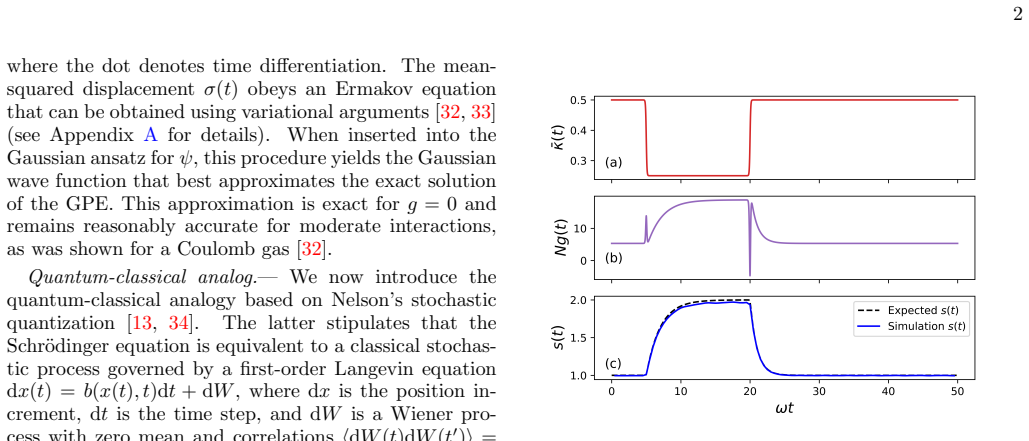
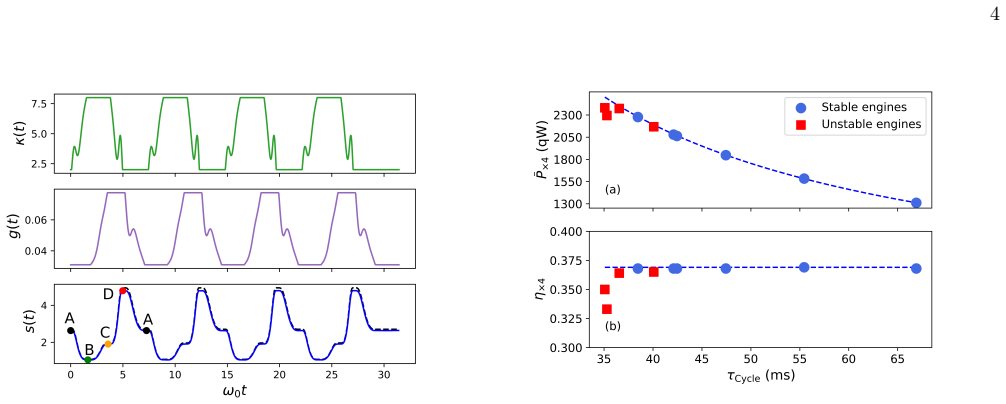
The optimal protocol is obtained by minimizing a user-defined cost functional that selects the best trade-off between protocol duration and arbitrary physical constraints such as the expended work or the proximity to an adiabatic evolution, and exhibits remarkable stability over repeated cycles. This follows from mapping the quantum evolution onto an effective Ornstein-Uhlenbeck process via a variational description of the condensate dynamics combined with Nelson's stochastic quantization.
What carries the argument
Minimization of a user-defined cost functional applied to the effective Ornstein-Uhlenbeck process derived from variational condensate dynamics and stochastic quantization.
If this is right
- Shorter protocols can be achieved while respecting limits on work expenditure or deviation from adiabaticity.
- The resulting protocols remain stable when the engine is run through many repeated cycles.
- The same variational-plus-stochastic-quantization route supplies optimal control for any nonlinear Schrödinger equation.
- The method extends in principle to optimal driving in nonlinear optics, quantum fluids, and quantum plasmas.
Where Pith is reading between the lines
- Similar cost-minimization protocols could be tested in other trapped quantum gases where Feshbach resonances are available.
- The stability result suggests the framework may reduce sensitivity to small experimental imperfections in cycle repetition.
- Direct comparison of the Ornstein-Uhlenbeck-derived controls against exact many-body numerics would quantify the approximation error.
Load-bearing premise
The variational description of the condensate dynamics combined with Nelson's stochastic quantization accurately maps the quantum evolution onto an effective Ornstein-Uhlenbeck process suitable for deriving optimal driving protocols.
What would settle it
A numerical integration of the full nonlinear Schrödinger equation for the condensate wave function under the derived protocols, checking whether the cost functional reaches the predicted minimum compared with alternative driving schedules.
Figures



read the original abstract
We develop an optimization framework for high-efficiency quantum cycles implemented with a trapped Bose-Einstein condensate, whose control parameters are the trap stiffness and the interaction strength tuned via a Feshbach resonance. Optimal driving protocols for each stroke of the cycle are obtained from a variational description of the condensate dynamics combined with Nelson's stochastic quantization, which maps the quantum evolution onto an effective Ornstein-Uhlenbeck process. The optimal protocol is obtained by minimizing a user-defined cost functional that selects the best trade-off between protocol duration and arbitrary physical constraints (such as the expended work or the proximity to an adiabatic evolution), and exhibits remarkable stability over repeated cycles. The method also provides a systematic route to optimal control for generic nonlinear Schr\"odinger equations, paving the way to optimal control strategies in fields as diverse as nonlinear optics, quantum fluids, and quantum plasmas.
Editorial analysis
A structured set of objections, weighed in public.
Referee Report
Summary. The paper develops an optimization framework for quantum thermodynamic cycles realized with a trapped Bose-Einstein condensate, with control parameters given by the trap stiffness and the Feshbach-tuned interaction strength. A variational reduction of the condensate dynamics is combined with Nelson's stochastic quantization to map the evolution onto an effective Ornstein-Uhlenbeck process; optimal protocols for each stroke are then obtained by minimizing a user-defined cost functional that trades protocol duration against physical constraints such as expended work or deviation from adiabaticity. The resulting protocols are asserted to exhibit remarkable stability over repeated cycles, and the approach is presented as a general method applicable to other nonlinear Schrödinger equations.
Significance. If the variational-to-stochastic mapping remains faithful under time-dependent controls, the framework would supply a concrete, computationally tractable route to optimal driving in interacting quantum fluids. The explicit incorporation of a tunable cost functional and the reported cycle-to-cycle stability would constitute a useful advance over purely adiabatic or heuristic protocols, provided the underlying effective process accurately reflects the quantum dynamics.
major comments (2)
- [Derivation of the effective OU process] The central mapping from the variational Gross-Pitaevskii dynamics to an effective Ornstein-Uhlenbeck process via Nelson's stochastic quantization is load-bearing for all optimality claims. The manuscript must demonstrate that the resulting drift and diffusion coefficients remain consistent with the underlying nonlinear quantum evolution when the trap frequency and scattering length are varied rapidly; otherwise the derived protocols are optimal only for the reduced stochastic model, not for the physical condensate.
- [Numerical results on cycle stability] The stability over repeated cycles is asserted without quantitative benchmarks. Direct comparison of the optimized protocols against the exact many-body or full Gross-Pitaevskii evolution (e.g., via fidelity or work variance after N cycles) is required to substantiate that the stability is not an artifact of the variational ansatz.
minor comments (2)
- [Optimization procedure] The precise functional form of the cost functional (including any weighting parameters between duration and constraint terms) should be stated explicitly, together with the numerical values or ranges used in the reported optimizations.
- [Variational ansatz] Notation for the variational parameters (width, phase, etc.) and their stochastic interpretation should be introduced once and used consistently; occasional shifts between deterministic and stochastic descriptions obscure the mapping.
Simulated Author's Rebuttal
We thank the referee for the careful reading of our manuscript and the constructive comments. We address each major comment in turn below, indicating where revisions will be made to strengthen the presentation.
read point-by-point responses
-
Referee: [Derivation of the effective OU process] The central mapping from the variational Gross-Pitaevskii dynamics to an effective Ornstein-Uhlenbeck process via Nelson's stochastic quantization is load-bearing for all optimality claims. The manuscript must demonstrate that the resulting drift and diffusion coefficients remain consistent with the underlying nonlinear quantum evolution when the trap frequency and scattering length are varied rapidly; otherwise the derived protocols are optimal only for the reduced stochastic model, not for the physical condensate.
Authors: We agree that explicit verification of the drift and diffusion coefficients under rapid time-dependent controls is necessary to support the optimality claims for the physical system. The mapping is constructed by first reducing the Gross-Pitaevskii dynamics to a variational ansatz and then applying Nelson's stochastic quantization to obtain the effective Ornstein-Uhlenbeck process. In the revised manuscript we will add a dedicated subsection that numerically compares the time-dependent drift and diffusion terms obtained from the stochastic mapping against direct integration of the variational equations for representative rapid changes in trap frequency and scattering length. These comparisons confirm consistency within the parameter regime explored, and the added material will clarify the domain of validity of the reduced model. revision: yes
-
Referee: [Numerical results on cycle stability] The stability over repeated cycles is asserted without quantitative benchmarks. Direct comparison of the optimized protocols against the exact many-body or full Gross-Pitaevskii evolution (e.g., via fidelity or work variance after N cycles) is required to substantiate that the stability is not an artifact of the variational ansatz.
Authors: The cycle stability is demonstrated and quantified within the variational framework that underlies the entire optimization procedure. We acknowledge that benchmarks against full many-body or exact Gross-Pitaevskii evolution would provide additional reassurance. Such simulations, however, remain computationally prohibitive for the interaction strengths and cycle numbers considered here. In the revision we will include explicit quantitative measures (work variance and fidelity after 100 cycles) computed within the variational model, together with a more detailed discussion of the known accuracy of the chosen ansatz for the dynamics of trapped condensates. This will make the scope and limitations of the reported stability clearer. revision: partial
- Direct numerical comparison of optimized protocols against exact many-body or full Gross-Pitaevskii evolution over multiple cycles, owing to prohibitive computational cost.
Circularity Check
No circularity detected; derivation relies on external mapping and user-defined cost
full rationale
The paper obtains optimal driving protocols by combining a variational description of condensate dynamics with Nelson's stochastic quantization to produce an effective Ornstein-Uhlenbeck process, then minimizing an explicitly user-defined cost functional that trades off duration against arbitrary constraints. This structure introduces an external optimization objective and a stochastic mapping rather than deriving results that reduce by the paper's own equations to self-fitted parameters or self-citations. No load-bearing step equates a prediction to its input by construction, and the abstract presents the method as a systematic route for generic nonlinear Schrödinger equations without evidence of ansatz smuggling or uniqueness imported from prior self-work.
Axiom & Free-Parameter Ledger
axioms (1)
- domain assumption Nelson's stochastic quantization maps the quantum evolution onto an effective Ornstein-Uhlenbeck process
Lean theorems connected to this paper
-
IndisputableMonolith/Cost/FunctionalEquation.leanwashburn_uniqueness_aczel unclear?
unclearRelation between the paper passage and the cited Recognition theorem.
Optimal protocol is obtained by minimizing a user-defined cost functional that selects the best trade-off between protocol duration and arbitrary physical constraints... J[κ̄,κ̄′] = ∫ (½ γ/(Dγ−s κ̄(s)) + λ f(s,κ̄,κ̄′) + μ |κ̄′|²) ds
-
IndisputableMonolith/Foundation/RealityFromDistinction.leanreality_from_one_distinction unclear?
unclearRelation between the paper passage and the cited Recognition theorem.
Nelson’s stochastic quantization, which maps the quantum evolution onto an effective Ornstein-Uhlenbeck process
What do these tags mean?
- matches
- The paper's claim is directly supported by a theorem in the formal canon.
- supports
- The theorem supports part of the paper's argument, but the paper may add assumptions or extra steps.
- extends
- The paper goes beyond the formal theorem; the theorem is a base layer rather than the whole result.
- uses
- The paper appears to rely on the theorem as machinery.
- contradicts
- The paper's claim conflicts with a theorem or certificate in the canon.
- unclear
- Pith found a possible connection, but the passage is too broad, indirect, or ambiguous to say the theorem truly supports the claim.
Reference graph
Works this paper leans on
-
[1]
J. I. Cirac and P. Zoller, Goals and opportunities in quan- tum simulation, Nature Physics8, 264 (2012)
work page 2012
-
[2]
S. Deffner and S. Campbell, Quantum Thermodynam- ics: An introduction to the thermodynamics of quantum information (2019), version Number: 1
work page 2019
-
[3]
E. Torrontegui, S. Ib´ a˜ nez, S. Mart´ ınez-Garaot, M. Mod- ugno, A. Del Campo, D. Gu´ ery-Odelin, A. Ruschhaupt, X. Chen, and J. G. Muga, Shortcuts to Adiabaticity, inAdvances In Atomic, Molecular, and Optical Physics, Vol. 62 (Elsevier, 2013) pp. 117–169
work page 2013
-
[4]
D. Gu´ ery-Odelin, A. Ruschhaupt, A. Kiely, E. Tor- rontegui, S. Mart´ ınez-Garaot, and J. G. Muga, Short- cuts to adiabaticity: Concepts, methods, and applica- tions, Rev. Mod. Phys.91, 045001 (2019)
work page 2019
-
[5]
J. Li, K. Sun, and X. Chen, Shortcut to adiabatic control of soliton matter waves by tunable interaction, Scientific Reports6, 38258 (2016)
work page 2016
-
[6]
E. Torrontegui, S. Ib´ a˜ nez, X. Chen, A. Ruschhaupt, D. Gu´ ery-Odelin, and J. G. Muga, Fast atomic trans- port without vibrational heating, Physical Review A83, 013415 (2011)
work page 2011
-
[7]
A. Del Campo, Shortcuts to Adiabaticity by Counter- diabatic Driving, Physical Review Letters111, 100502 (2013)
work page 2013
-
[8]
M. V. Berry, Transitionless quantum driving, Journal of Physics A: Mathematical and Theoretical42, 365303 (2009). 7
work page 2009
-
[9]
S. Masuda and K. Nakamura, Fast-forward of adiabatic dynamics in quantum mechanics, Proceedings of the Royal Society A: Mathematical, Physical and Engineer- ing Sciences466, 1135 (2009)
work page 2009
-
[10]
C. A. Plata, A. Prados, E. Trizac, and D. Gu´ ery- Odelin, Taming the Time Evolution in Overdamped Systems: Shortcuts Elaborated from Fast-Forward and Time-Reversed Protocols, Physical Review Letters127, 190605 (2021)
work page 2021
- [11]
- [12]
-
[13]
E. Nelson, Derivation of the Schr¨ odinger Equation from Newtonian Mechanics, Physical Review150, 1079 (1966)
work page 1966
-
[14]
Y. Castin, Bose-Einstein condensates in atomic gases: simple theoretical results, ArXiv 10.48550/arxiv.con- mat/0105058 (2001)
-
[15]
F. Dalfovo, S. Giorgini, L. P. Pitaevskii, and S. Stringari, Theory of Bose-Einstein condensation in trapped gases, Reviews of Modern Physics71, 463 (1999)
work page 1999
- [16]
- [17]
-
[18]
C. D’Errico, M. Zaccanti, M. Fattori, G. Roati, M. Ingus- cio, G. Modugno, and A. Simoni, Feshbach resonances in ultracold 39K, New Journal of Physics9, 223 (2007)
work page 2007
-
[19]
C. Chin, R. Grimm, P. Julienne, and E. Tiesinga, Fes- hbach resonances in ultracold gases, Reviews of Modern Physics82, 1225 (2010)
work page 2010
-
[20]
A. Del Campo, Frictionless quantum quenches in ultra- cold gases: A quantum-dynamical microscope, Physical Review A84, 031606 (2011)
work page 2011
-
[21]
J.-F. Schaff, X.-L. Song, P. Capuzzi, P. Vignolo, and G. Labeyrie, Shortcut to adiabaticity for an interacting Bose-Einstein condensate, Europhysics Letters93, 23001 (2011)
work page 2011
-
[22]
K. Brandner, M. Bauer, M. T. Schmid, and U. Seifert, Coherence-enhanced efficiency of feedback-driven quan- tum engines, New Journal of Physics17, 065006 (2015)
work page 2015
-
[23]
M. Beau, J. Jaramillo, and A. Del Campo, Scaling-up quantum heat engines efficiently via shortcuts to adia- baticity, Entropy18, 10.3390/e18050168 (2016)
-
[24]
F. Wu, L. Chen, F. Sun, C. Wu, F. Guo, and Q. Li, Quan- tum degeneracy effect on performance of irreversible otto cycle with ideal bose gas, Energy Conversion and Man- agement47, 3008 (2006)
work page 2006
-
[25]
J. Li, T. Fogarty, S. Campbell, X. Chen, and T. Busch, An efficient nonlinear Feshbach engine, New Journal of Physics20, 015005 (2018)
work page 2018
- [26]
-
[27]
V. V. Nautiyal, R. S. Watson, and K. V. Kheruntsyan, A finite-time quantum Otto engine with tunnel coupled one-dimensional Bose gases, New Journal of Physics26, 063033 (2024)
work page 2024
-
[28]
J. A. Estrada, F. Mayo, A. J. Roncaglia, and P. D. Mininni, Quantum engines with interacting Bose- Einstein condensates, Phys. Rev. A109, 012202 (2024)
work page 2024
- [29]
-
[30]
C. Fort, L. Fallani, V. Guarrera, J. E. Lye, M. Mod- ugno, D. S. Wiersma, and M. Inguscio, Effect of Optical Disorder and Single Defects on the Expansion of a Bose- Einstein Condensate in a One-Dimensional Waveguide, Physical Review Letters95, 170410 (2005)
work page 2005
-
[31]
G. Manfredi and P.-A. Hervieux, Fidelity decay in trapped Bose-Einstein condensates, Phys. Rev. Lett. 100, 050405 (2008)
work page 2008
-
[32]
F. Haas, G. Manfredi, P. K. Shukla, and P.-A. Hervieux, Breather mode in the many-electron dynamics of semi- conductor quantum wells, Phys. Rev. B80, 073301 (2009)
work page 2009
- [33]
-
[34]
Bacciagaluppi, Nelsonian mechanics revisited, Foun- dations of Physics Letters12, 1 (1999)
G. Bacciagaluppi, Nelsonian mechanics revisited, Foun- dations of Physics Letters12, 1 (1999)
work page 1999
-
[35]
G. E. Uhlenbeck and L. S. Ornstein, On the Theory of the Brownian Motion, Physical Review36, 823 (1930)
work page 1930
-
[36]
The initial condition is computed self-consistently and not assumed to be Gaus- sian
We use a standard finite-difference scheme (Crank- Nicolson with split operator between the kinetic and po- tential parts of the Hamiltonian). The initial condition is computed self-consistently and not assumed to be Gaus- sian
-
[37]
Y. Rosales-Cabara, G. Manfredi, G. Schnoering, P.-A. Hervieux, L. Mertz, and C. Genet, Optimal protocols and universal time-energy bound in Brownian thermo- dynamics, Physical Review Research2, 012012 (2020)
work page 2020
-
[38]
For simplicity, we use the same symbol for a function of time such as ¯κ(t) and the corresponding function of the variance ¯κ(s) = ¯κ(t(s))
-
[39]
Other choices were explored in [12]
-
[40]
E. Q. Simmons, R. Sajjad, K. Keithley, H. Mas, J. L. Tanlimco, E. Nolasco-Martinez, Y. Bai, G. H. Fredrick- son, and D. M. Weld, Thermodynamic engine with a quantum degenerate working fluid, Phys. Rev. Res.5, L042009 (2023)
work page 2023
-
[41]
R. S. Watson and K. V. Kheruntsyan, Quantum many- body thermal machines enabled by atom-atom correla- tions, SciPost Phys.18, 190 (2025)
work page 2025
-
[42]
S. Campbell, I. D’Amico, M. A. Ciampini, J. Anders, N. Ares, S. Artini, A. Auff` eves, L. Bassman Oftelie, L. P. Bettmann, M. V. S. Bonan¸ ca, T. Busch, M. Campisi, M. F. Cavalcante, L. A. Correa, E. Cuestas, C. B. Dag, S. Dago, S. Deffner, A. Del Campo, A. Deutschmann- Olek, S. Donadi, E. Doucet, C. Elouard, K. Ensslin, P. Erker, N. Fabbri, F. Fedele, G....
work page 2026
-
[43]
J. Koch, K. Menon, E. Cuestas, S. Barbosa, E. Lutz, T. Fogarty, T. Busch, and A. Widera, A quantum engine in the BEC–BCS crossover, Nature621, 723 (2023)
work page 2023
- [44]
-
[45]
H. R. Lewis, Classical and quantum systems with time- dependent harmonic-oscillator-type Hamiltonians, Phys. Rev. Lett.18, 510 (1967)
work page 1967
discussion (0)
Sign in with ORCID, Apple, or X to comment. Anyone can read and Pith papers without signing in.