Format-Constraint Coupling in Knowledge Graph Construction from Statistical Tables
Pith reviewed 2026-05-22 06:38 UTC · model grok-4.3
The pith
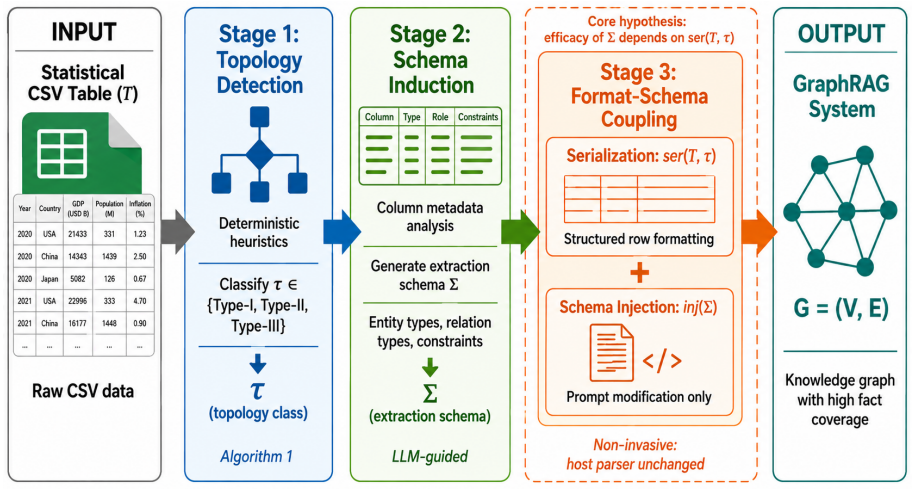
Serialization format and schema constraints interact super-additively in knowledge graph construction from statistical CSV tables, with mismatches sometimes reducing fact coverage below the unconstrained baseline.
A machine-rendered reading of the paper's core claim, the machinery that carries it, and where it could break.
Core claim
Serialization format and schema constraints interact super-additively in LLM-driven knowledge graph construction from statistical tables. Their combined effect exceeds the sum of independent contributions by up to +1.180, and applying a schema to a mismatched serialization format produces catastrophic mismatch, lowering fact coverage below the unconstrained baseline on four of six datasets through entity inflation or refusal. Probing and token ablation point to surface-form anchoring on column-name references as the mechanism. Three standard retrieval modes mask these gaps (delta at most 1pp), while direct graph access exposes differences up to +47.6pp.
What carries the argument
format-constraint coupling: the observed super-additive interaction between CSV serialization choices and schema constraints that produces entity inflation or extraction refusal when the two are misaligned.
If this is right
- Direct graph access must be used for faithful evaluation of table-to-knowledge-graph pipelines because retrieval modes conceal construction defects up to 47.6pp.
- Schema application should be conditioned on serialization format to avoid entity inflation and coverage loss below the no-schema baseline.
- CSVFidelity-Bench provides a controlled testbed with 15 datasets and 1,892 gold facts for measuring fidelity in statistical table extraction.
- Surface-form anchoring on column names explains why mismatched schema-format pairs trigger refusal or inflation.
Where Pith is reading between the lines
- Prompt design for table extraction should explicitly encode expected column-name surface forms to reduce anchoring failures when formats vary.
- Open-data portals that publish statistical matrices may improve downstream graph quality by enforcing consistent serialization formats before schema application.
- RAG systems built on table-derived graphs risk overestimating completeness when they rely on vector or graph retrieval that masks extraction gaps.
- The coupling may appear in non-statistical tabular data if column-name references remain the dominant anchoring cue for the extractor.
Load-bearing premise
The evaluation requires direct access to the constructed graph to reveal quality differences, since standard retrieval modes largely hide them.
What would settle it
A replication on new wide Type-II matrices that applies the same format-schema pairings and finds no super-additive joint effect larger than +0.3 or no below-baseline coverage drop on mismatched pairs would falsify the coupling claim.
Figures


read the original abstract
An extraction schema should not reduce knowledge graph fidelity. On statistical CSV, however, it can. We study country-by-year time-series matrices, a common layout on open-data portals. In this setting, serialization format and schema constraints interact super-additively. Their joint effect exceeds the sum of independent effects by up to +1.180 (2x2 factorial, 6 datasets). Bootstrap 95% CIs are strictly positive on 4/6 datasets, with strongest evidence on wide Type-II matrices. More critically, a schema applied to a mismatched format can trigger catastrophic mismatch. Fact coverage falls below the unconstrained baseline on 4/6 datasets through entity inflation or extraction refusal. We call this observed pattern format-constraint coupling. Probing and token ablation support a surface-form anchoring explanation centred on column-name references. Controlled variants across format-schema pairings, GraphRAG hosts, and LLM families show the same direction within the measured scope; one LLM family shows only partial activation. The observation also has a diagnostic consequence. Three standard retrieval modes largely mask construction quality (delta <= 1pp), whereas direct graph access exposes gaps up to +47.6pp (p < 0.0001). To support fidelity-aware evaluation, we release CSVFidelity-Bench. It contains 15 datasets, 11 Type-II matrices, 4 Type-III tables, and 1,892 Gold Standard facts across 6 domains.
Editorial analysis
A structured set of objections, weighed in public.
Referee Report
Summary. The paper claims that serialization format and schema constraints interact super-additively in knowledge graph construction from statistical CSV tables (country-by-year time-series matrices). In a 2x2 factorial design across 6 datasets with bootstrap 95% CIs, their joint effect on fact coverage exceeds the sum of independent effects by up to +1.180. A schema on a mismatched format reduces coverage below the unconstrained baseline on 4/6 datasets via entity inflation or refusal, attributed to surface-form anchoring on column names. Standard retrieval modes mask differences (delta <=1pp), while direct graph access reveals gaps up to +47.6pp. The authors release CSVFidelity-Bench containing 15 datasets, 11 Type-II matrices, and 1,892 gold standard facts.
Significance. If the format-constraint coupling is robustly demonstrated without measurement artifacts, the result is significant for automated KG extraction from open tabular data. The controlled 2x2 factorial design, ablation probes, multi-LLM and multi-host variants, and release of a benchmark with explicit gold facts provide a reproducible foundation for fidelity-aware evaluation. The diagnostic observation on retrieval modes also has practical value for downstream KG applications.
major comments (2)
- [CSVFidelity-Bench description] CSVFidelity-Bench and gold-fact construction: The central claim that fact coverage measures construction fidelity across format-schema pairings requires the 1,892 gold facts to be demonstrably independent of any serialization's surface forms (column-name strings or matrix layout). The manuscript does not provide explicit details on their derivation process or normalization steps. If the facts embed references from a default format, then mismatched schema-format pairs would produce lower coverage through non-matching surface forms, generating the reported super-additive term (+1.180) and 4/6 below-baseline drops as an artifact rather than evidence of coupling. This assumption is load-bearing for the surface-form anchoring explanation.
- [Experimental setup] § on experimental setup and LLM controls: The 2x2 design reports directional support, but exact prompt templates for each format-schema combination, temperature settings, and number of stochastic samples per condition are not fully specified. Without these, the bootstrap CIs and interaction magnitudes cannot be fully reproduced or isolated from prompt sensitivity, weakening attribution of the observed super-additivity specifically to format-constraint coupling.
minor comments (2)
- [Results] Clarify the exact definition and computation of the interaction term (joint minus sum of marginals) in the results section, including how the +1.180 maximum is obtained across datasets.
- [Figures] Ensure all figures include explicit axis labels, legend for format-schema pairings, and bootstrap CI shading for readability.
Simulated Author's Rebuttal
We thank the referee for the constructive and detailed feedback. The two major comments raise important points about reproducibility and the independence of our evaluation resources. We address each below and indicate the revisions we will make to strengthen the manuscript.
read point-by-point responses
-
Referee: CSVFidelity-Bench and gold-fact construction: The central claim that fact coverage measures construction fidelity across format-schema pairings requires the 1,892 gold facts to be demonstrably independent of any serialization's surface forms (column-name strings or matrix layout). The manuscript does not provide explicit details on their derivation process or normalization steps. If the facts embed references from a default format, then mismatched schema-format pairs would produce lower coverage through non-matching surface forms, generating the reported super-additive term (+1.180) and 4/6 below-baseline drops as an artifact rather than evidence of coupling. This assumption is load-bearing for the surface-form anchoring explanation.
Authors: We agree that explicit documentation of gold-fact construction is necessary to substantiate independence from surface forms. The 1,892 facts were derived in two stages: (1) direct extraction of all numeric values from the raw CSV files as (country, year, variable, value) quadruples using only the underlying data matrix, and (2) normalization of entity and variable identifiers to canonical forms drawn from external references (ISO 3166-1 alpha-3 codes and standardized statistical variable names) with no retention of original column headers or layout. This process was performed by two annotators with adjudication, yielding Cohen's kappa of 0.92. We will add a dedicated subsection under CSVFidelity-Bench describing the full pipeline, including examples of normalization and the exact canonical schema used. revision: yes
-
Referee: § on experimental setup and LLM controls: The 2x2 design reports directional support, but exact prompt templates for each format-schema combination, temperature settings, and number of stochastic samples per condition are not fully specified. Without these, the bootstrap CIs and interaction magnitudes cannot be fully reproduced or isolated from prompt sensitivity, weakening attribution of the observed super-additivity specifically to format-constraint coupling.
Authors: We acknowledge that complete specification of prompts and sampling parameters is required for full reproducibility. In the revised version we will append all four prompt templates (one per format-schema cell) verbatim. Temperature was fixed at 0.0 across all conditions to eliminate sampling variance; five independent generations were collected per cell to support the reported bootstrap (1,000 resamples). We will also list the precise model versions, host configurations, and any system-level settings. These additions will permit exact reproduction and allow readers to isolate prompt effects from the format-constraint interaction. revision: yes
Circularity Check
No circularity: claims rest on direct empirical measurements
full rationale
The paper reports experimental results from controlled 2x2 factorial designs measuring fact coverage across serialization formats and extraction schemas on statistical CSV tables. Central observations (super-additive interaction up to +1.180, below-baseline drops on 4/6 datasets, retrieval-mode masking) are presented as outcomes of direct graph access evaluations against 1,892 gold-standard facts, with bootstrap CIs and ablation probes. No derivation chain, fitted parameters renamed as predictions, self-citation load-bearing uniqueness theorems, or ansatz smuggling appear in the provided text. The work is self-contained as an empirical benchmark study (CSVFidelity-Bench release) whose validity can be checked externally; any concern about gold-fact surface-form dependence is a measurement-validity issue, not a reduction of the reported quantities to their own inputs by construction.
Axiom & Free-Parameter Ledger
axioms (2)
- standard math Bootstrap resampling yields valid 95% confidence intervals for the reported interaction effects
- domain assumption Fact coverage is a valid proxy for knowledge graph fidelity
Reference graph
Works this paper leans on
-
[1]
From Local to Global: A Graph RAG Approach to Query-Focused Summarization
Edge, Darren and Trinh, Ha and Cheng, Newman and Bradley, Joshua and Chao, Alex and Mody, Apurva and Truitt, Steven and Larson, Jonathan , title =. arXiv preprint arXiv:2404.16130 , year =
work page internal anchor Pith review Pith/arXiv arXiv
-
[2]
LightRAG: Simple and Fast Retrieval-Augmented Generation
Guo, Zirui and Xia, Lianghao and Yu, Yanhua and Tu, Tu and Huang, Chao , title =. arXiv preprint arXiv:2410.05779 , year =
work page internal anchor Pith review Pith/arXiv arXiv
-
[3]
Advances in Neural Information Processing Systems (NeurIPS) , year =
Guti. Advances in Neural Information Processing Systems (NeurIPS) , year =
-
[4]
Retrieval-Augmented Generation for Knowledge-Intensive
Lewis, Patrick and Perez, Ethan and Piktus, Aleksandra and Petroni, Fabio and Karpukhin, Vladimir and Goyal, Naman and K. Retrieval-Augmented Generation for Knowledge-Intensive. Advances in Neural Information Processing Systems , year =
-
[5]
Proceedings of the 58th Annual Meeting of the Association for Computational Linguistics , year =
Herzig, Jonathan and Nowak, Pawel Krzysztof and M. Proceedings of the 58th Annual Meeting of the Association for Computational Linguistics , year =
-
[6]
International Conference on Learning Representations , year =
Liu, Qian and Chen, Bei and Guo, Jiaqi and Ziyadi, Morteza and Lin, Zeqi and Chen, Weizhu and Lou, Jian-Guang , title =. International Conference on Learning Representations , year =
-
[7]
Advances in Neural Information Processing Systems , volume =
Chen, Si-An and Miculicich, Lesly and Eisenschlos, Julian Martin and Wang, Zifeng and Wang, Zilong and Chen, Yanfei and Fujii, Yasuhisa and Lin, Hsuan-Tien and Lee, Chen-Yu and Pfister, Tomas , title =. Advances in Neural Information Processing Systems , volume =. 2024 , note =
work page 2024
-
[8]
arXiv preprint arXiv:2504.01346 , year =
Zou, Jiaru and Fu, Dongqi and Chen, Sirui and He, Xinrui and Li, Zihao and Zhu, Yada and Han, Jiawei and He, Jingrui , title =. arXiv preprint arXiv:2504.01346 , year =
-
[9]
arXiv preprint arXiv:2510.12323 , year =
Guo, Zirui and Ren, Xubin and Xu, Lingrui and Zhang, Jiahao and Huang, Chao , title =. arXiv preprint arXiv:2510.12323 , year =
-
[10]
arXiv preprint arXiv:2505.23628 , year =
Bai, Jiaxin and Fan, Wei and Hu, Qi and Zong, Qing and Li, Chunyang and Tsang, Hong Ting and Luo, Hongyu and Yim, Yauwai and Huang, Haoyu and Zhou, Xiao and Qin, Feng and Zheng, Tianshi and Peng, Xi and Yao, Xin and Yang, Huiwen and Wu, Leijie and Ji, Yi and Zhang, Gong and Chen, Renhai and Song, Yangqiu , title =. arXiv preprint arXiv:2505.23628 , year =
-
[11]
Harry and Hegde, Harshad and Emonet, Vincent and Harris, Nomi L
Caufield, J. Harry and Hegde, Harshad and Emonet, Vincent and Harris, Nomi L. and Joachimiak, Marcin P. and Matentzoglu, Nicolas and Kim, HyeongSik and Moxon, Sierra and Reese, Justin T. and Haendel, Melissa A. and Robinson, Peter N. and Mungall, Christopher J. , title =. Bioinformatics , year =
-
[12]
Findings of the Association for Computational Linguistics: EMNLP 2021 , year =
Cabot, Pere-Llu. Findings of the Association for Computational Linguistics: EMNLP 2021 , year =
work page 2021
-
[13]
arXiv preprint arXiv:2411.02059 , year =
Su, Aofei and others , title =. arXiv preprint arXiv:2411.02059 , year =
-
[14]
Proceedings of the 17th ACM International Conference on Web Search and Data Mining , year =
Sui, Yuan and Zhou, Mengyu and Zhou, Mingjie and Han, Shi and Zhang, Dongmei , title =. Proceedings of the 17th ACM International Conference on Web Search and Data Mining , year =
-
[15]
arXiv preprint arXiv:2406.14550 , year =
Li, Shilong and others , title =. arXiv preprint arXiv:2406.14550 , year =
-
[16]
Workshop on Linked Data on the Web (LDOW) , year =
Dimou, Anastasia and Vander Sande, Miel and Colpaert, Pieter and Verborgh, Ruben and Mannens, Erik and Van de Walle, Rik , title =. Workshop on Linked Data on the Web (LDOW) , year =
-
[17]
arXiv preprint arXiv:2010.12537 , year =
Shraga, Roee and Gal, Avigdor and Sagi, Tomer , title =. arXiv preprint arXiv:2010.12537 , year =
- [18]
- [19]
-
[20]
Soman, Kaveh and Rose, Stone and Morris, Adrian and Callahan, Sean P. and Baranzini, Sergio E. , title =. arXiv preprint arXiv:2311.17330 , year =
-
[21]
Graph retrieval-augmented generation: A survey.arXiv preprint arXiv:2408.08921,
Peng, Boci and Zhu, Yun and Liu, Yongchao and Bo, Xiaohe and Shi, Haizhou and Hong, Chuntao and Zhang, Yan and Tang, Siliang , title =. arXiv preprint arXiv:2408.08921 , year =
-
[22]
arXiv preprint arXiv:2311.09206 , year =
Zhang, Tianshu and Yue, Xiang and Li, Yifei and Sun, Huan , title =. arXiv preprint arXiv:2311.09206 , year =
-
[23]
IEEE Transactions on Knowledge and Data Engineering , volume =
Pan, Shirui and Luo, Linhao and Wang, Yufei and Chen, Chen and Wang, Jiawei and Wu, Xindong , title =. IEEE Transactions on Knowledge and Data Engineering , volume =
-
[24]
and Zgraggen, Emanuel and Satyanarayan, Arvind and Kraska, Tim and Doshi-Velez, Finale and Cali
Hulsebos, Madelon and Hu, Kevin and Bakker, Michiel A. and Zgraggen, Emanuel and Satyanarayan, Arvind and Kraska, Tim and Doshi-Velez, Finale and Cali. Sherlock: A Deep Learning Approach to Semantic Data Type Detection , booktitle =
-
[25]
Proceedings of the VLDB Endowment , volume =
Zhang, Dan and Suhara, Yoshihiko and Li, Jinfeng and Hulsebos, Madelon and Demiralp,. Proceedings of the VLDB Endowment , volume =
-
[26]
Deng, Xiang and Sun, Huan and Lees, Alyssa and Wu, You and Yu, Cong , title =. ACM SIGMOD Record , volume =
-
[27]
Proceedings of the ACM Web Conference , pages =
Dong, Haixing and Mao, Junwen and Lin, Qingnan and Wang, Zhichao and Yu, Yongkang and Zhou, Junwei , title =. Proceedings of the ACM Web Conference , pages =
- [28]
-
[29]
Proceedings of the 58th Annual Meeting of the Association for Computational Linguistics , year =
Yin, Pengcheng and Neubig, Graham and Yih, Wen-tau and Riedel, Sebastian , title =. Proceedings of the 58th Annual Meeting of the Association for Computational Linguistics , year =
-
[30]
International Conference on Learning Representations , year =
Wang, Zilong and Zhang, Hao and Li, Chun-Liang and Eisenschlos, Julian Martin and Perot, Vincent and Wang, Zifeng and Miculicich, Lesly and Fujii, Yasuhisa and Shang, Jingbo and Lee, Chen-Yu and Pfister, Tomas , title =. International Conference on Learning Representations , year =
-
[31]
International Conference on Artificial Intelligence and Statistics , year =
Hegselmann, Stefan and Buendia, Alejandro and Lang, Hunter and Agrawal, Monica and Jiang, Xiaoyi and Sontag, David , title =. International Conference on Artificial Intelligence and Statistics , year =
-
[32]
Spreadsheetllm: Encodi ng spreadsheets for large language models
Ma, Haoyu and Dong, Junyu and Wu, Haochen and Feng, Shi and Zhang, Yongfeng , title =. arXiv preprint arXiv:2407.09025 , year =
-
[33]
Proceedings of the 2023 Conference on Empirical Methods in Natural Language Processing , year =
Jiang, Jinhao and Zhou, Kun and Dong, Zican and Ye, Keming and Zhao, Wayne Xin and Wen, Ji-Rong , title =. Proceedings of the 2023 Conference on Empirical Methods in Natural Language Processing , year =
work page 2023
-
[34]
Survey on Semantic Interpretation of Tabular Data: Challenges and Directions , journal =
Cremaschi, Marco and Spahiu, Blerina and Palmonari, Matteo and Jim. Survey on Semantic Interpretation of Tabular Data: Challenges and Directions , journal =
-
[35]
Metadata and Semantic Research (MTSR 2020) , series =
Fiorelli, Manuel and Stellato, Armando , title =. Metadata and Semantic Research (MTSR 2020) , series =. 2021 , publisher =
work page 2020
-
[36]
Zhu, Yuqi and Wang, Xiaohan and Chen, Jing and Qiao, Shuofei and Ou, Yixin and Yao, Yunzhi and Deng, Shumin and Chen, Huajun and Zhang, Ningyu , title =. World Wide Web , volume =
-
[37]
Beurer-Kellner, Luca and Fischer, Marc and Vechev, Martin , title =. Proceedings of the ACM SIGPLAN Conference on Programming Language Design and Implementation , pages =
-
[38]
2023 , howpublished =
work page 2023
-
[39]
Willard, Brandon T. and Louf, R. Efficient Guided Generation for Large Language Models , journal =
-
[40]
SGLang: Efficient Execution of Structured Language Model Programs
Zheng, Lianmin and Yin, Liangsheng and Xie, Zhiqiang and Huang, Jeff and Sun, Chuyue and Yu, Cody Hao and Cao, Siyuan and Kober, Christos and Gonzalez, Joseph E. and Barrett, Clark and Sheng, Ying and Stoica, Ion , title =. arXiv preprint arXiv:2312.07104 , year =
work page internal anchor Pith review Pith/arXiv arXiv
-
[41]
Transactions on Machine Learning Research , year =
Fang, Xi and Xu, Weijie and Tan, Fiona Anting and Zhang, Jiani and Hu, Ziqing and Qi, Yanjun and Nickleach, Scott and Socolinsky, Diego and Sengamedu, Srinivasan and Faloutsos, Christos , title =. Transactions on Machine Learning Research , year =
-
[42]
International Conference on Learning Representations , year =
Sainz, Oscar and de Lacalle, Oier Lopez and Garc. International Conference on Learning Representations , year =
-
[43]
Proceedings of the 2022 Conference on Empirical Methods in Natural Language Processing , year =
Min, Sewon and Lyu, Xinxi and Holtzman, Ari and Artetxe, Mikel and Lewis, Mike and Hajishirzi, Hannaneh and Zettlemoyer, Luke , title =. Proceedings of the 2022 Conference on Empirical Methods in Natural Language Processing , year =
work page 2022
-
[44]
arXiv preprint arXiv:2303.03846 , year =
Wei, Jerry and Wei, Jason and Tay, Yi and Tran, Dustin and Webson, Albert and Lu, Yifeng and Chen, Xinyun and Liu, Hanxiao and Huang, Da and Zhou, Denny and Ma, Tengyu , title =. arXiv preprint arXiv:2303.03846 , year =
-
[45]
ACM Transactions on Asian and Low-Resource Language Information Processing , year =
Bi, Zhen and Chen, Jing and Jiang, Yinuo and Xiong, Feiyu and Bosselut, Antoine and Chen, Huajun and Zhang, Ningyu , title =. ACM Transactions on Asian and Low-Resource Language Information Processing , year =
-
[46]
Khattab, Omar and Singhvi, Arnav and Maheshwari, Paridhi and Zhang, Zhiyuan and Santhanam, Keshav and Vardhamanan, Sri and Haq, Saiful and Sharma, Ashutosh and Joshi, Thomas T. and Mober, Hanna and Shah, Dilara Soylu and Schlegel, Viktor and Potts, Christopher and Zaharia, Matei , title =. International Conference on Learning Representations , year =
- [47]
-
[48]
International Conference on Learning Representations , year =
Sclar, Melanie and Choi, Yejin and Tsvetkov, Yulia and Suhr, Alane , title =. International Conference on Learning Representations , year =
-
[49]
Lu, Yao and Bartolo, Max and Moore, Alastair and Riedel, Sebastian and Stenetorp, Pontus , title =. Proceedings of the 60th Annual Meeting of the Association for Computational Linguistics (Volume 1: Long Papers) , year =
-
[50]
World Development Indicators , year =
-
[51]
Ye, Yunhu and Hui, Binyuan and Yang, Min and Li, Binhua and Huang, Fei and Li, Yongbin , title =. Proceedings of the 46th International ACM SIGIR Conference on Research and Development in Information Retrieval , pages =
-
[52]
arXiv preprint arXiv:2403.03636 , year =
Li, Yibin and others , title =. arXiv preprint arXiv:2403.03636 , year =
discussion (0)
Sign in with ORCID, Apple, or X to comment. Anyone can read and Pith papers without signing in.