PIC simulations of nonrelativistic high-Mach-number oblique shocks propagating in a turbulent medium
Pith reviewed 2026-05-22 03:06 UTC · model grok-4.3
The pith
Pre-existing compressive turbulence makes non-thermal electrons more numerous, higher-energy, and more energetic at oblique collisionless shocks.
A machine-rendered reading of the paper's core claim, the machinery that carries it, and where it could break.
Core claim
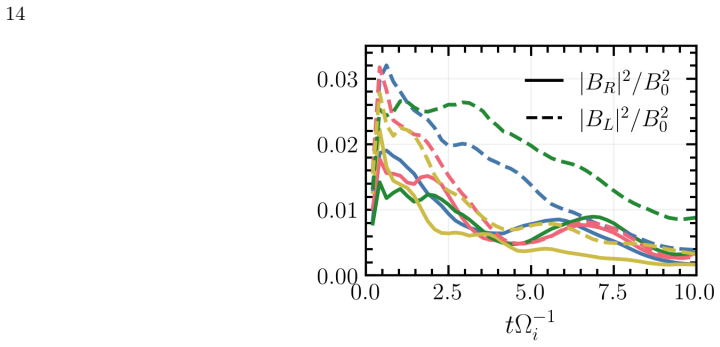
In the presence of pre-existing upstream compressive turbulence the foreshock-driven whistler instability grows to larger amplitudes and forms bigger nonlinear structures; the reflected-electron population therefore experiences stronger scattering and acceleration, producing a shorter and hotter electron foreshock in which, at late times, non-thermal electrons are more numerous, reach higher energies, and carry a larger fraction of the total energy.
What carries the argument
The interaction of foreshock-reflected electrons with pre-existing 15-percent compressive turbulence, which amplifies magnetic-field fluctuations and alters the whistler-wave instability that scatters those electrons.
If this is right
- The electron foreshock region contracts in length when upstream turbulence is present.
- The maximum energy reached by non-thermal electrons increases.
- A larger fraction of the total energy is carried by the non-thermal electron population.
- Magnetic-field fluctuations in the foreshock reach higher amplitudes and form larger coherent structures.
Where Pith is reading between the lines
- If the same turbulence-assisted acceleration persists in three-dimensional runs it could revise estimates of electron injection efficiency at supernova-remnant shocks.
- Observational signatures of a shorter, hotter foreshock might appear in the radio or X-ray morphology of high-Mach-number shocks.
- The result suggests that models of cosmic-ray electron spectra should incorporate the effects of upstream density and magnetic fluctuations rather than assuming uniform conditions.
Load-bearing premise
That a 15 percent amplitude compressive turbulence together with two-dimensional three-velocity particle-in-cell runs is enough to capture the essential interaction between the foreshock and the upstream turbulence.
What would settle it
A follow-up simulation with identical shock parameters but zero upstream turbulence that still produces the same number, maximum energy, and energy fraction of non-thermal electrons would falsify the claim that the turbulence is responsible for the enhancement.
Figures


read the original abstract
Collisionless shocks are common in astrophysical systems and stand as sites of particle acceleration. While particles at perpendicular shocks may not return to the upstream region, at oblique shocks a fraction of energetic electrons manage to escape the shock and travel upstream. An extended region known as the electron foreshock is formed, where these reflected particles drive various instabilities that may promote electron acceleration. Here we present the first 2D3V particle-in-cell (PIC) simulations of electron-ion non-relativistic oblique shocks that explore the interaction of the foreshock with pre-existing compressive turbulence with relative amplitude of 15% based on interstellar medium estimates. We find that pre-existing turbulence influences the emergence and behavior of the whistler-wave instability, as it enhances the amplitudes of the magnetic-field fluctuations and leads to larger nonlinear structures. This impacts the dynamics of the reflected electrons, resulting in a shorter and hotter electron foreshock. At the end of our simulations, with pre-existing upstream turbulence we observe non-thermal electrons that are more numerous, reach higher energies, and carry a larger portion of the total energy.
Editorial analysis
A structured set of objections, weighed in public.
Referee Report
Summary. The manuscript presents the first 2D3V PIC simulations of nonrelativistic high-Mach-number oblique shocks propagating into an upstream medium containing pre-existing compressive turbulence with 15% relative amplitude, motivated by interstellar-medium estimates. The central claim is that this turbulence modifies the whistler-wave instability by enhancing magnetic-field fluctuation amplitudes and producing larger nonlinear structures, which in turn shortens and heats the electron foreshock and yields a non-thermal electron population that is more numerous, reaches higher energies, and carries a larger fraction of the total energy compared with the laminar upstream case.
Significance. If robust, the result would bear on models of electron injection and acceleration at astrophysical collisionless shocks embedded in turbulent media. The work rests on direct numerical integration of the Vlasov-Maxwell system with no fitted parameters or self-referential definitions, which is a methodological strength. The turbulence amplitude is chosen from observational estimates rather than tuned to produce a desired outcome.
major comments (2)
- [Simulation setup] Simulation setup (abstract and methods): the headline result that turbulence produces more numerous and higher-energy non-thermal electrons rests on the assumption that 2D3V geometry faithfully captures the foreshock-turbulence interaction. In 2D the compressive modes are restricted to wave-vectors lying in the simulation plane, suppressing out-of-plane propagation and limiting the resonant scattering channels available to reflected electrons. The reported shorter, hotter foreshock and enhanced whistler activity could therefore be geometry artifacts; no dimensionality test or explicit justification for 2D sufficiency is provided.
- [Results] Results section: the abstract and main text assert clear qualitative differences in non-thermal electron number, maximum energy, and energy fraction, yet supply no quantitative error bars, resolution studies, or comparisons against known analytic limits for the electron spectra. Without these, the statistical significance of the reported enhancement cannot be assessed and the central comparative claim remains difficult to evaluate.
minor comments (2)
- [Abstract] The justification for selecting a 15% relative turbulence amplitude could be strengthened by citing the specific interstellar-medium reference or observational constraint used.
- [Figures] Figure captions and axis labels should explicitly distinguish the turbulent and non-turbulent runs and state any normalization applied to the particle energy spectra.
Simulated Author's Rebuttal
We thank the referee for the careful reading of our manuscript and for the positive assessment of its potential significance. We respond to each major comment below and indicate the revisions we will implement.
read point-by-point responses
-
Referee: Simulation setup (abstract and methods): the headline result that turbulence produces more numerous and higher-energy non-thermal electrons rests on the assumption that 2D3V geometry faithfully captures the foreshock-turbulence interaction. In 2D the compressive modes are restricted to wave-vectors lying in the simulation plane, suppressing out-of-plane propagation and limiting the resonant scattering channels available to reflected electrons. The reported shorter, hotter foreshock and enhanced whistler activity could therefore be geometry artifacts; no dimensionality test or explicit justification for 2D sufficiency is provided.
Authors: We acknowledge that restricting wave vectors to the simulation plane is a limitation of 2D3V geometry and that out-of-plane propagation could in principle affect resonant scattering. Full 3D simulations at the necessary resolution and duration remain computationally prohibitive for the parameter regime studied. Nevertheless, 2D3V has been the standard approach in prior PIC studies of oblique shocks and electron foreshocks precisely because it captures the dominant in-plane dynamics of electron reflection and whistler generation. In revision we will expand the methods section with an explicit justification for the 2D choice, citing relevant literature, and will discuss the possible impact of suppressed out-of-plane modes on the reported foreshock properties. revision: partial
-
Referee: Results section: the abstract and main text assert clear qualitative differences in non-thermal electron number, maximum energy, and energy fraction, yet supply no quantitative error bars, resolution studies, or comparisons against known analytic limits for the electron spectra. Without these, the statistical significance of the reported enhancement cannot be assessed and the central comparative claim remains difficult to evaluate.
Authors: We agree that quantitative support would strengthen the comparative claims. In the revised manuscript we will add statistical error bars to the electron energy spectra (derived from particle counts and, where feasible, from multiple realizations) and include a short resolution-convergence appendix demonstrating that the differences in foreshock extent, temperature, and non-thermal tail are robust. We will also insert brief comparisons of the measured foreshock length and whistler amplitudes against analytic estimates in the discussion section. revision: yes
Circularity Check
Direct PIC integration yields results with no circular derivation chain
full rationale
The reported electron spectra and foreshock properties are generated by numerical integration of the Vlasov-Maxwell equations in 2D3V geometry with imposed 15% compressive turbulence. No parameters are fitted to the target observables and then relabeled as predictions; no self-citation supplies a uniqueness theorem or ansatz that the central claim depends upon; and no equation reduces to its own input by construction. The simulation outputs are therefore independent of the reported conclusions.
Axiom & Free-Parameter Ledger
free parameters (1)
- turbulence relative amplitude
axioms (1)
- standard math Standard Maxwell-Vlasov equations govern the collisionless plasma evolution
Lean theorems connected to this paper
-
IndisputableMonolith/Foundation/AlexanderDuality.leanalexander_duality_circle_linking unclear?
unclearRelation between the paper passage and the cited Recognition theorem.
We present the first 2D3V particle-in-cell (PIC) simulations of electron-ion non-relativistic oblique shocks that explore the interaction of the foreshock with pre-existing compressive turbulence with relative amplitude of 15%.
What do these tags mean?
- matches
- The paper's claim is directly supported by a theorem in the formal canon.
- supports
- The theorem supports part of the paper's argument, but the paper may add assumptions or extra steps.
- extends
- The paper goes beyond the formal theorem; the theorem is a base layer rather than the whole result.
- uses
- The paper appears to rely on the theorem as machinery.
- contradicts
- The paper's claim conflicts with a theorem or certificate in the canon.
- unclear
- Pith found a possible connection, but the passage is too broad, indirect, or ambiguous to say the theorem truly supports the claim.
Reference graph
Works this paper leans on
-
[1]
Axford, W. I. and Leer, E. and Skadron, G. , year =. The. 15th International Cosmic Ray Conference , volume =
-
[2]
Generation of Subion Scale Magnetic Holes from Electron Shear Flow Instabilities in Plasma Turbulence. , keywords =. doi:10.3847/1538-4357/acf12e , archivePrefix =. 2306.05874 , primaryClass =
-
[3]
Magnetohydrodynamic Turbulence Revisited. , keywords =. doi:10.1086/304442 , archivePrefix =. astro-ph/9612243 , primaryClass =
work page internal anchor Pith review Pith/arXiv arXiv doi:10.1086/304442
-
[4]
A Regular Mechanism for the Acceleration of Charged Particles on the Front of a Shock Wave , author =. 1977 , journal =
work page 1977
-
[5]
Leptonic origin of TeV gamma-rays from Supernova Remnants
Leptonic origin of TeV gamma-rays from supernova remnants. , keywords =. doi:10.48550/arXiv.astro-ph/9602115 , archivePrefix =. astro-ph/9602115 , primaryClass =
work page internal anchor Pith review Pith/arXiv arXiv doi:10.48550/arxiv.astro-ph/9602115
-
[6]
Physics of Plasmas , keywords =
Criteria for ion acceleration in laboratory magnetized quasi-perpendicular collisionless shocks: When are 2D simulations enough?. Physics of Plasmas , keywords =. doi:10.1063/5.0269035 , archivePrefix =. 2503.00163 , primaryClass =
-
[7]
Theory of Stochastic Shock Drift Acceleration for Electrons in the Shock Transition Region
Katou, Takuma and Amano, Takanobu , year =. Theory of. The Astrophysical Journal , volume =. doi:10.3847/1538-4357/ab0d8a , abstract =. arXiv , file =:1903.02277 , pages =
work page internal anchor Pith review Pith/arXiv arXiv doi:10.3847/1538-4357/ab0d8a 1903
-
[8]
Fulat, Karol and Bohdan, Artem and Torralba Paz, Gabriel and Pohl, Martin , year =. Kinetic. The Astrophysical Journal , volume =. doi:10.3847/1538-4357/ad04dc , urldate =
-
[9]
Supernova Remnants at High Energy
Reynolds, Stephen P. Supernova Remnants at High Energy. Annual Review of Astronomy and Astrophysics. 2008. doi:https://doi.org/10.1146/annurev.astro.46.060407.145237
-
[10]
Morris and Artem Bohdan and Martin S
Paul J. Morris and Artem Bohdan and Martin S. Weidl and Michelle Tsirou and Karol Fulat and Martin Pohl , title =. The Astrophysical Journal , abstract =. 2023 , month =. doi:10.3847/1538-4357/acaec8 , url =
-
[11]
Electron acceleration in supernova remnants , volume =
Artem Bohdan , doi =. Electron acceleration in supernova remnants , volume =. Plasma Physics and Controlled Fusion , keywords =
-
[12]
Nonthermal electron acceleration at collisionless quasi-perpendicular shocks , volume =
Takanobu Amano and Yosuke Matsumoto and Artem Bohdan and Oleh Kobzar and Shuichi Matsukiyo and Mitsuo Oka and Jacek Niemiec and Martin Pohl and Masahiro Hoshino , doi =. Nonthermal electron acceleration at collisionless quasi-perpendicular shocks , volume =. Reviews of Modern Plasma Physics , month =
-
[13]
Artem Bohdan and Martin S. Weidl and Paul J. Morris and Martin Pohl , doi =. The electron foreshock at high-Mach-number non-relativistic oblique shocks , volume =. Physics of Plasmas , month =
-
[14]
Morris and Artem Bohdan and Martin S
Paul J. Morris and Artem Bohdan and Martin S. Weidl and Martin Pohl , doi =. Preacceleration in the Electron Foreshock. I. Electron Acoustic Waves , volume =. The Astrophysical Journal , month =
-
[15]
Recent Developments in Particle Acceleration at Shocks: Theory and Observations , volume =
Silvia Perri and Andrei Bykov and Hans Fahr and Horst Fichtner and Joe Giacalone , doi =. Recent Developments in Particle Acceleration at Shocks: Theory and Observations , volume =. Space Science Reviews , keywords =
-
[16]
Kim and Jens Kleimann and Sean Oughton and Nikolai V
Federico Fraternale and Laxman Adhikari and Horst Fichtner and Tae K. Kim and Jens Kleimann and Sean Oughton and Nikolai V. Pogorelov and Vadim Roytershteyn and Charles W. Smith and Arcadi V. Usmanov and Gary P. Zank and Lingling Zhao , doi =. Turbulence in the Outer Heliosphere , volume =. Space Science Reviews , keywords =
-
[18]
Relativistic Collisionless Shocks in Inhomogeneous Magnetized Plasmas , volume =
Camilia Demidem and Joonas Nättilä and Alexandra Veledina , doi =. Relativistic Collisionless Shocks in Inhomogeneous Magnetized Plasmas , volume =. The Astrophysical Journal Letters , month =
-
[19]
Stone and Alex Lazarian , doi =
Yue Hu and Siyao Xu and James M. Stone and Alex Lazarian , doi =. Turbulent Magnetic Field Amplification by the Interaction of a Shock Wave and Inhomogeneous Medium , volume =. The Astrophysical Journal , month =
-
[20]
Fan Guo and Joe Giacalone and Lulu Zhao , doi =. Shock Propagation and Associated Particle Acceleration in the Presence of Ambient Solar-Wind Turbulence , volume =. Frontiers in Astronomy and Space Sciences , month =
-
[21]
Phase space transport in the interaction between shocks and plasma turbulence , volume =
Domenico Trotta and Francesco Valentini and David Burgess and Sergio Servidio , doi =. Phase space transport in the interaction between shocks and plasma turbulence , volume =. Proceedings of the National Academy of Sciences of the United States of America , keywords =
-
[22]
Morris and Yosuke Matsumoto and Takanobu Amano and Masahiro Hoshino and Ali Sulaiman , doi =
Artem Bohdan and Martin Pohl and Jacek Niemiec and Paul J. Morris and Yosuke Matsumoto and Takanobu Amano and Masahiro Hoshino and Ali Sulaiman , doi =. Magnetic Field Amplification by the Weibel Instability at Planetary and Astrophysical Shocks with High Mach Number , volume =. Physical Review Letters , month =
-
[23]
F. Carbone and L. Sorriso-Valvo and Yu V. Khotyaintsev and K. Steinvall and A. Vecchio and D. Telloni and E. Yordanova and D. B. Graham and N. J.T. Edberg and A. I. Eriksson and E. P.G. Johansson and C. L. Vásconez and M. Maksimovic and R. Bruno and R. D'amicis and S. D. Bale and T. Chust and V. Krasnoselskikh and M. Kretzschmar and E. Lorfèvre and D. Ple...
-
[24]
Cordes and Shami Chatterjee and Timothy Dolch , doi =
Stella Koch Ocker and James M. Cordes and Shami Chatterjee and Timothy Dolch , doi =. An In Situ Study of Turbulence near Stellar Bow Shocks , volume =. The Astrophysical Journal , month =
-
[25]
Vladimir Zhdankin , doi =. Particle Energization in Relativistic Plasma Turbulence: Solenoidal versus Compressive Driving , volume =. The Astrophysical Journal , month =
-
[26]
Kinetic Simulations of Nonrelativistic Perpendicular Shocks of Young Supernova Remnants
Artem Bohdan and Martin Pohl and Jacek Niemiec and Sergei Vafin and Yosuke Matsumoto and Takanobu Amano and Masahiro Hoshino , doi =. Kinetic Simulations of Nonrelativistic Perpendicular Shocks of Young Supernova Remnants. III. Magnetic Reconnection , volume =. The Astrophysical Journal , month =
-
[27]
Morris and Yosuke Matsumoto and Takanobu Amano and Masahiro Hoshino , doi =
Artem Bohdan and Martin Pohl and Jacek Niemiec and Paul J. Morris and Yosuke Matsumoto and Takanobu Amano and Masahiro Hoshino , doi =. Kinetic Simulation of Nonrelativistic Perpendicular Shocks of Young Supernova Remnants. IV. Electron Heating , volume =. The Astrophysical Journal , month =
-
[28]
M. Pohl and M. Hoshino and J. Niemiec , doi =. PIC simulation methods for cosmic radiation and plasma instabilities , volume =. Progress in Particle and Nuclear Physics , keywords =
-
[29]
K. H. Lee and L. C. Lee , doi =. Turbulence Spectra of Electron Density and Magnetic Field Fluctuations in the Local Interstellar Medium , volume =. The Astrophysical Journal , keywords =
-
[30]
Kinetic Simulations of Nonrelativistic Perpendicular Shocks of Young Supernova Remnants
Artem Bohdan and Jacek Niemiec and Martin Pohl and Yosuke Matsumoto and Takanobu Amano and Masahiro Hoshino , doi =. Kinetic Simulations of Nonrelativistic Perpendicular Shocks of Young Supernova Remnants. II. Influence of Shock-surfing Acceleration on Downstream Electron Spectra , volume =. The Astrophysical Journal , month =
-
[31]
Kinetic Simulations of Nonrelativistic Perpendicular Shocks of Young Supernova Remnants
Artem Bohdan and Jacek Niemiec and Martin Pohl and Yosuke Matsumoto and Takanobu Amano and Masahiro Hoshino , doi =. Kinetic Simulations of Nonrelativistic Perpendicular Shocks of Young Supernova Remnants. I. Electron Shock-surfing Acceleration , volume =. The Astrophysical Journal , month =
-
[32]
Weibel-mediated Shocks Propagating into Inhomogeneous Electron–Positron Plasmas , volume =
Sara Tomita and Yutaka Ohira and Ryo Yamazaki , doi =. Weibel-mediated Shocks Propagating into Inhomogeneous Electron–Positron Plasmas , volume =. The Astrophysical Journal , month =
-
[33]
Fully kinetic simulations of microscale turbulence in space and astrophysical plasmas , year =
Daniel Grošelj , institution =. Fully kinetic simulations of microscale turbulence in space and astrophysical plasmas , year =
-
[34]
Electron Pre-acceleration at Nonrelativistic High-Mach-number Perpendicular Shocks , volume =
Artem Bohdan and Jacek Niemiec and Oleh Kobzar and Martin Pohl , doi =. Electron Pre-acceleration at Nonrelativistic High-Mach-number Perpendicular Shocks , volume =. The Astrophysical Journal , month =
-
[35]
Volkmar Wieland and Martin Pohl and Jacek Niemiec and Iman Rafighi and Ken-Ichi Nishikawa , doi =. Nonrelativistic Perpendicular Shocks Modeling Young Supernova Remnants: Nonstationary Dynamics and Particle Acceleration At Forward and Reverse Shocks , volume =. The Astrophysical Journal , keywords =
-
[36]
J. M. Tenbarge and G. G. Howes and W. Dorland and G. W. Hammett , doi =. An oscillating Langevin antenna for driving plasma turbulence simulations , volume =. Computer Physics Communications , keywords =
-
[37]
Yosuke Mizuno and Martin Pohl and Jacek Niemiec and Bing Zhang and Ken Ichi Nishikawa and Philip E. Hardee , doi =. Magnetic field amplification and saturation in turbulence behind a relativistic shock , volume =. Monthly Notices of the Royal Astronomical Society , keywords =
-
[38]
The origin of radially aligned magnetic fields in young supernova remnants , volume =
Tsuyoshi Inoue and Jiro Shimoda and Yutaka Ohira and Ryo Yamazaki , doi =. The origin of radially aligned magnetic fields in young supernova remnants , volume =. Astrophysical Journal Letters , keywords =
-
[39]
Fan Guo and Joe Giacalone , doi =. Particle acceleration at a flare termination shock: Effect of large-scale magnetic turbulence , volume =. Astrophysical Journal , keywords =
-
[40]
Fan Guo and Joe Giacalone , doi =. The effect of large-scale magnetic turbulence on the acceleration of electrons by perpendicular collisionless shocks , volume =. Astrophysical Journal , keywords =
-
[41]
Fan Guo and Shengtai Li and Hui Li and Joe Giacalone and J. R. Jokipii and David Li , doi =. On the amplification of magnetic field by a supernova blast shock wave in a turbulent medium , volume =. Astrophysical Journal , keywords =
-
[42]
Jacek Niemiec and Martin Pohl and Thomas Stroman and Ken‐Ichi Nishikawa , doi =. Production of Magnetic Turbulence by Cosmic Rays Drifting Upstream of Supernova Remnant Shocks , volume =. The Astrophysical Journal , month =
-
[43]
J. Giacalone and J. R. Jokipii , doi =. Magnetic Field Amplification by Shocks in Turbulent Fluids , volume =. The Astrophysical Journal , pages =
-
[44]
ACE Observations of Energetic Particles Associated with Transient Interplanetary Shocks , volume =
D Lario and G C Ho and R B Decker and E C Roelof and M I Desai and C W Smith , doi =. ACE Observations of Energetic Particles Associated with Transient Interplanetary Shocks , volume =. AIP Conference Proceedings , pages =
-
[45]
J. Giacalone and J. R. Jokipii , doi =. The Transport of Cosmic Rays across a Turbulent Magnetic Field , volume =. The Astrophysical Journal , pages =
-
[46]
Toward a Theory of Interstellar Turbulence
P Goldreich and S Sridhar , doi =. Toward a Theory of Interstellar Turbulence. II. Strong Alfvenic Turbulence , volume =. 1995 , journal =
work page 1995
-
[47]
Toward a Theory of Interstellar Turbulence
S Sridhar and P Goldreich , doi =. Toward a Theory of Interstellar Turbulence. I. Weak Alfvenic Turbulence , volume =. 1994 , journal =
work page 1994
-
[48]
Kato and Hideaki Takabe , doi =
Tsunehiko N. Kato and Hideaki Takabe , doi =. Nonrelativistic collisionless shocks in weakly magnetized electron-ion plasmas: Two-dimensional particle-in-cell simulation of perpendicular shock , volume =. Astrophysical Journal , keywords =
-
[49]
Y. Matsumoto and T. Amano and M. Hoshino , doi =. Electron acceleration in a nonrelativistic shock with very high Alfvén mach number , volume =. Physical Review Letters , month =
-
[50]
Y Matsumoto and T Amano and T. N. Kato and M Hoshino , doi =. Stochastic electron acceleration during spontaneous turbulent reconnection in a strong shock wave , volume =. Science , keywords =
-
[51]
Siyao Xu and A. Lazarian , title =. The Astrophysical Journal , abstract =. 2016 , month =. doi:10.3847/1538-4357/833/2/215 , url =
-
[52]
J Giacalone and J. R. Jokipii , doi =. Charged-Particle Motion in Multidimensional Magnetic Field Turbulence , volume =. 1994 , journal =
work page 1994
-
[53]
Man Zhang and Xueshang Feng , doi =. A Comparative Study of Divergence Cleaning Methods of Magnetic Field in the Solar Coronal Numerical Simulation , volume =. Frontiers in Astronomy and Space Sciences , keywords =
-
[54]
Vladimir Zhdankin and Gregory R. Werner and Dmitri A. Uzdensky and Mitchell C. Begelman , doi =. Kinetic Turbulence in Relativistic Plasma: From Thermal Bath to Nonthermal Continuum , volume =. Physical Review Letters , month =
-
[55]
Press and Teukolsky, Saul and Vetterling, William and Flannery, Brian and Press, W.H
William H. Press and Teukolsky, Saul and Vetterling, William and Flannery, Brian and Press, W.H. and Metcalf, M. , publisher =. Numerical Recipes in Fortran 90: The Art of Parallel Scientific Computing , year =
-
[56]
Press, William H. and Vetterling, William T. and Teukolsky, Saul A. and Flannery, Brian P. , title =. 1992 , pages =
work page 1992
-
[57]
M. Nakanotani and G. P. Zank and L.-L. Zhao , doi =. Turbulence-dominated Shock Waves: 2D Hybrid Kinetic Simulations , volume =. The Astrophysical Journal , keywords =
-
[58]
Particle acceleration at magnetized, relativistic, turbulent shock fronts , author =. Phys. Rev. Res. , volume =. 2023 , month =. doi:10.1103/PhysRevResearch.5.023194 , url =
-
[59]
R. D. Blandford and J. P. Ostriker , doi =. Particle acceleration by astrophysical shocks. , volume =. Astrophysical Journal , keywords =
-
[60]
L O'C Drury , doi =. An introduction to the theory of diffusive shock acceleration of energetic particles in tenuous plasmas , volume =. Reports on Progress in Physics , month =
-
[61]
A. R. Bell , doi =. The acceleration of cosmic rays in shock fronts - I. , volume =. Monthly Notices of the Royal Astronomical Society , keywords =
-
[62]
Particle acceleration at astrophysical shocks: A theory of cosmic ray origin , volume =
Roger Blandford and David Eichler , issue =. Particle acceleration at astrophysical shocks: A theory of cosmic ray origin , volume =. Physics Reports , pages =. 1987 , issn =
work page 1987
-
[63]
F. Aharonian and A. G. Akhperjanian and A. R. Bazer-Bachi and M. Beilicke and W. Benbow and D. Berge and K. Bernlöhr and C. Boisson and O. Bolz and V. Borrel and I. Braun and E. Brion and A. M. Brown and R. Bühler and I. Büsching and S. Carrigan and P. M. Chadwick and L. M. Chounet and G. Coignet and R. Cornils and L. Costamante and B. Degrange and H. J. ...
-
[64]
Evidence for shock acceleration of high-energy electrons in the supernova remnant SN1006 , volume =
K Koyama and R Petre and E V Gotthelf and U Hwang and M Matsuura and M Ozaki and S S Holt , doi =. Evidence for shock acceleration of high-energy electrons in the supernova remnant SN1006 , volume =. Nature , pages =
-
[65]
Yosuke Matsumoto and Takanobu Amano and Masahiro Hoshino , doi =. Electron accelerations at high mach number shocks: Two-dimensional particle-in-cell simulations in various parameter regimes , volume =. Astrophysical Journal , keywords =
-
[66]
Takanobu Amano and Masahiro Hoshino , doi =. Physics of Plasmas , title =
-
[67]
F. Fraschetti , doi =. Turbulent amplification of a magnetic field driven by the dynamo effect at rippled shocks , volume =. Astrophysical Journal , keywords =
-
[68]
Liege International Astrophysical Colloquia , title = "
-
[69]
M. Hoshino and N. Shimada , doi =. Nonthermal Electrons at High Mach Number Shocks: Electron Shock Surfing Acceleration , volume =. The Astrophysical Journal , month =
-
[70]
N. Shimada and M. Hoshino , doi =. Strong Electron Acceleration at High Mach Number Shock Waves: Simulation Study of Electron Dynamics , volume =. The Astrophysical Journal , month =
-
[71]
O. Buneman , doi =. Instability, Turbulence, and Conductivity in Current-Carrying Plasma , volume =. Physical Review Letters , month =
-
[72]
Burton D. Fried , doi =. Mechanism for Instability of Transverse Plasma Waves , volume =. Physics of Fluids , pages =
-
[73]
Physics of Fluids , year = 1974, month = feb, volume =
Two-dimensional study of electron-ion streaming instabilities. Physics of Fluids , year = 1974, month = feb, volume =. doi:10.1063/1.1694733 , adsurl =
-
[74]
Monthly Notices of the Royal Astronomical Society , volume =
Trotta, D and Pezzi, O and Burgess, D and Preisser, L and Blanco-Cano, X and Kajdic, P and Hietala, H and Horbury, T S and Vainio, R and Dresing, N and Retinò, A and Marcucci, M F and Sorriso-Valvo, L and Servidio, S and Valentini, F , title = ". Monthly Notices of the Royal Astronomical Society , volume =. 2023 , month =. doi:10.1093/mnras/stad2384 , url =
-
[75]
Dong Zhang and Roger A. Chevalier , doi =. Numerical simulations of supernova remnants in turbulent molecular clouds , volume =. Monthly Notices of the Royal Astronomical Society , keywords =
-
[76]
Qiyong Peng and Biwen Bao and Chuyuan Yang and Li Zhang , doi =. Simulations of Young Type Ia Supernova Remnants Undergoing Shock Acceleration in a Turbulent Medium , volume =. The Astrophysical Journal , month =
-
[77]
Biwen Bao and Qiyong Peng and Chuyuan Yang and Li Zhang , doi =. Evolutions of Young Type Ia Supernova Remnants with Two Initial Density Profiles in a Turbulent Medium , volume =. The Astrophysical Journal , month =
-
[78]
THE EVOLUTION OF ADIABATIC SUPERNOVA REMNANTS IN A TURBULENT, MAGNETIZED MEDIUM , volume =
Dinshaw Balsara and Robert A Benjamin and Donald P Cox , journal =. THE EVOLUTION OF ADIABATIC SUPERNOVA REMNANTS IN A TURBULENT, MAGNETIZED MEDIUM , volume =
-
[79]
Supernova remnants: The X-ray perspective , volume =
Jacco Vink , doi =. Supernova remnants: The X-ray perspective , volume =. Astronomy and Astrophysics Review , keywords =
-
[80]
Radio emission from supernova remnants , volume =
Gloria Dubner and Elsa Giacani , doi =. Radio emission from supernova remnants , volume =. Astronomy and Astrophysics Review , keywords =
-
[81]
S. Orlando and M. Miceli and S. Ustamujic and A. Tutone and E. Greco and O. Petruk and F. Bocchino and G. Peres , doi =. Modeling particle acceleration and non-thermal emission in supernova remnants , volume =. New Astronomy , keywords =
discussion (0)
Sign in with ORCID, Apple, or X to comment. Anyone can read and Pith papers without signing in.