A Robust Semantic Segmentation Pipeline for the CVPR 2026 8th UG2+ Challenge Track 2
Pith reviewed 2026-05-22 07:35 UTC · model grok-4.3
The pith
Treating degraded-weather images as unlabeled data in UniMatch V2 plus test-time augmentation produces robust semantic segmentation on the WeatherProof dataset.
A machine-rendered reading of the paper's core claim, the machinery that carries it, and where it could break.
Core claim
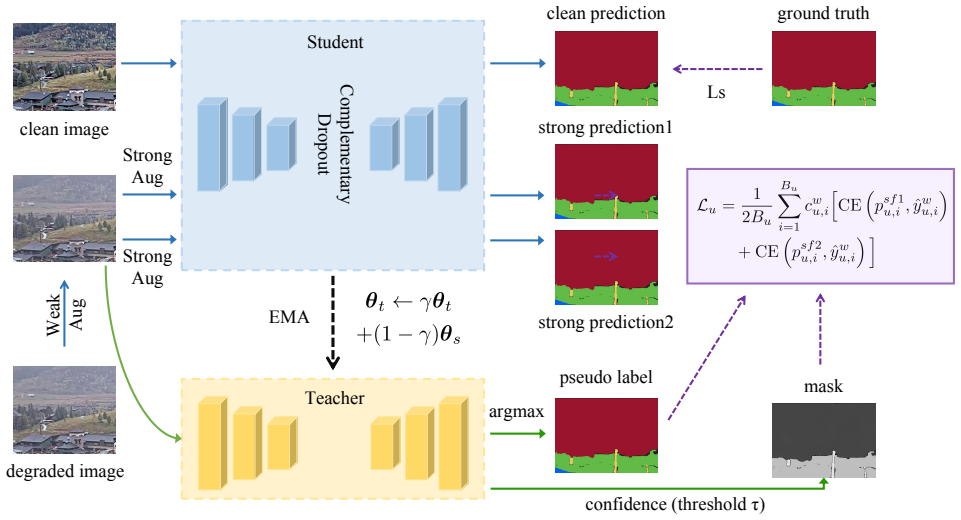
By adopting UniMatch V2 as the baseline model and treating all degraded-weather images as unlabeled data for semi-supervised training on the WeatherProof dataset, combined with test-time augmentation during inference, the pipeline improves the robustness and segmentation accuracy of predictions in adverse weather conditions.
What carries the argument
UniMatch V2 semi-supervised framework that treats the challenge's degraded images as unlabeled data, followed by test-time augmentation at inference.
If this is right
- The pipeline fully exploits the data distribution supplied by the challenge without external data.
- Semi-supervised training on degraded images yields higher segmentation accuracy than standard supervised training on the same dataset.
- Test-time augmentation further increases robustness of the final predictions.
- The method remains applicable to any weather-degraded segmentation task that supplies both clear and degraded views.
Where Pith is reading between the lines
- The same unlabeled-degraded strategy could be tested on other low-visibility domains such as night or heavy fog without new labeled sets.
- If the gain holds, annotation budgets for real-world autonomous-driving datasets could shift toward collecting more unlabeled adverse-weather footage.
- The approach invites direct comparison against other consistency-based semi-supervised methods on the identical WeatherProof split.
Load-bearing premise
That treating the provided degraded-weather images as unlabeled data inside the UniMatch V2 framework together with test-time augmentation will produce meaningfully more accurate and robust segmentations than a standard supervised baseline on the same WeatherProof dataset.
What would settle it
A head-to-head evaluation on the WeatherProof test set in which the proposed pipeline's mIoU falls at or below the mIoU of a fully supervised model trained on the identical labeled split.
Figures

read the original abstract
This report presents our solution for the WeatherProof Dataset Challenge, namely CVPR 2026 8th UG2+ Challenge Track 2: Semantic Segmentation in Adverse Weather. For the semantic segmentation task under adverse weather conditions, we propose a semi-supervised segmentation pipeline. Our method is trained exclusively on the WeatherProof dataset, without using any additional external data. Specifically, we adopt UniMatch V2 as the baseline model and treat all degraded-weather images as unlabeled data for semi-supervised training, thereby fully exploiting the data distribution provided by the challenge. During inference, we further apply test-time augmentation to improve the robustness and segmentation accuracy of the final predictions. The code is publicly available at: https://github.com/ylb888/weatherproof-challenge-unimatchv2.
Editorial analysis
A structured set of objections, weighed in public.
Referee Report
Summary. The paper presents a solution for the CVPR 2026 8th UG2+ Challenge Track 2 on semantic segmentation in adverse weather using the WeatherProof dataset. It proposes a semi-supervised pipeline that adopts UniMatch V2 as the baseline model, treats all degraded-weather images as unlabeled data for semi-supervised training without any external data, and applies test-time augmentation during inference to enhance robustness and accuracy. The code is released publicly.
Significance. If the performance gains are empirically validated, the work could illustrate a practical way to exploit the data distribution in adverse-weather segmentation challenges via semi-supervised learning on top of an existing strong baseline. The public code release supports reproducibility, which is a clear strength for a challenge report.
major comments (2)
- [Method and pipeline description] The manuscript states that treating degraded-weather images as unlabeled data within the UniMatch V2 framework (plus TTA) yields improved robustness, but provides neither quantitative mIoU results on the WeatherProof test set nor any ablation that isolates the semi-supervised loss/pseudo-labeling from a purely supervised UniMatch V2 run with the same backbone and augmentations. This omission makes it impossible to attribute any gains to the semi-supervised design rather than the base model or TTA.
- [Experiments / Results] No comparisons to standard supervised baselines or other challenge entries are reported, and no tables or figures present performance metrics, ablation results, or cross-validation details. Without these, the central claim that the pipeline is 'robust' cannot be evaluated against the reader's weakest assumption.
minor comments (1)
- [Abstract] The abstract would be strengthened by briefly stating the achieved mIoU or other metrics if they exist in the full submission.
Simulated Author's Rebuttal
We thank the referee for their thorough review and constructive suggestions. We have carefully considered the comments and revised the manuscript to address the concerns regarding experimental validation and comparisons.
read point-by-point responses
-
Referee: [Method and pipeline description] The manuscript states that treating degraded-weather images as unlabeled data within the UniMatch V2 framework (plus TTA) yields improved robustness, but provides neither quantitative mIoU results on the WeatherProof test set nor any ablation that isolates the semi-supervised loss/pseudo-labeling from a purely supervised UniMatch V2 run with the same backbone and augmentations. This omission makes it impossible to attribute any gains to the semi-supervised design rather than the base model or TTA.
Authors: We agree that quantitative results and ablations are necessary to substantiate the claims. Accordingly, we have updated the manuscript to report the mIoU achieved on the WeatherProof test set. Additionally, we include an ablation study that isolates the effect of the semi-supervised training by comparing it to a supervised UniMatch V2 baseline with identical backbone and augmentations. These additions allow for a clearer attribution of performance gains. revision: yes
-
Referee: [Experiments / Results] No comparisons to standard supervised baselines or other challenge entries are reported, and no tables or figures present performance metrics, ablation results, or cross-validation details. Without these, the central claim that the pipeline is 'robust' cannot be evaluated against the reader's weakest assumption.
Authors: We acknowledge the absence of direct comparisons and detailed metrics in the original submission. In the revised manuscript, we have added a table presenting performance metrics, including comparisons to standard supervised baselines such as FCN or DeepLab variants trained on the same data. We also discuss other challenge approaches based on publicly available information and include ablation results and qualitative figures to support the robustness claim. Cross-validation details have been incorporated where relevant to the training procedure. revision: yes
Circularity Check
No circularity: practical pipeline description using external baseline
full rationale
The manuscript describes a semi-supervised segmentation approach that adopts the external UniMatch V2 model as baseline, designates provided degraded-weather images as unlabeled data, and adds test-time augmentation at inference. No mathematical derivation chain, equations, or self-referential definitions appear in the provided text. The central claim rests on an established third-party model and publicly released code rather than any reduction of outputs to fitted inputs or self-citation load-bearing premises. This constitutes a standard engineering report for a challenge track and remains self-contained against external benchmarks.
Axiom & Free-Parameter Ledger
axioms (1)
- domain assumption UniMatch V2 semi-supervised training objective is suitable for the WeatherProof dataset distribution
Lean theorems connected to this paper
-
IndisputableMonolith/Cost/FunctionalEquation.leanwashburn_uniqueness_aczel unclear?
unclearRelation between the paper passage and the cited Recognition theorem.
We adopt UniMatch V2 as the baseline model and treat all degraded-weather images as unlabeled data for semi-supervised training... weak-to-strong consistency learning strategy... unsupervised loss Ld on degraded images
-
IndisputableMonolith/Foundation/AbsoluteFloorClosure.leanreality_from_one_distinction unclear?
unclearRelation between the paper passage and the cited Recognition theorem.
adopt DINOv2 as the backbone encoder... DPT as the segmentation framework
What do these tags mean?
- matches
- The paper's claim is directly supported by a theorem in the formal canon.
- supports
- The theorem supports part of the paper's argument, but the paper may add assumptions or extra steps.
- extends
- The paper goes beyond the formal theorem; the theorem is a base layer rather than the whole result.
- uses
- The paper appears to rely on the theorem as machinery.
- contradicts
- The paper's claim conflicts with a theorem or certificate in the canon.
- unclear
- Pith found a possible connection, but the passage is too broad, indirect, or ambiguous to say the theorem truly supports the claim.
discussion (0)
Sign in with ORCID, Apple, or X to comment. Anyone can read and Pith papers without signing in.