Learning sequence timing and control of replay speed in networks of spiking neurons
Pith reviewed 2026-05-22 01:55 UTC · model grok-4.3
The pith
Sequential activation of element-specific neuron populations encodes the timing of sequence elements while preserving order in spiking networks.
A machine-rendered reading of the paper's core claim, the machinery that carries it, and where it could break.
Core claim
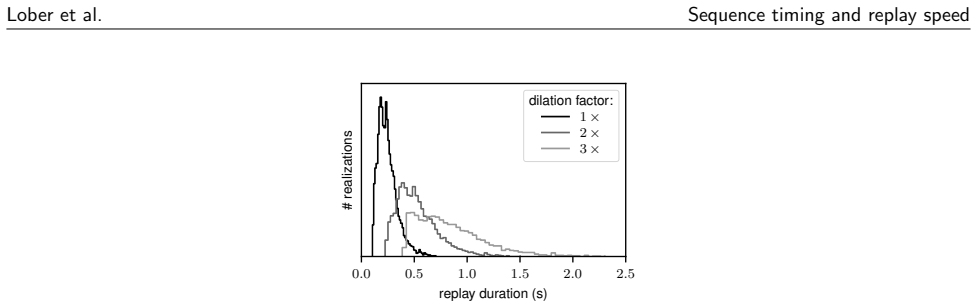
In the extended sTM model the duration of each sequence element is represented by sequential activation of element-specific neuronal populations rather than by a single synchronous volley. This representation encodes sequences across a wide range of timescales while the original context-dependent identity coding remains intact. Oscillatory background inputs function as a clock signal that provides a robust and flexible mechanism for controlling the speed of sequence replay. The resulting activity produces unique sparse spatiotemporal patterns that encode elapsed time.
What carries the argument
Sequential activation inside element-specific neuronal populations, which separates duration coding from the synchronous firing used for identity and sequential context in the base sTM model.
If this is right
- Sequences with widely varying element durations can be learned and replayed using the same network structure.
- Replay speed can be modulated by changing the frequency or amplitude of background oscillations without retraining synaptic weights.
- Elapsed time during sequence processing is carried by unique sparse spatiotemporal firing patterns.
- The speed of replay observed during wakefulness and sleep should correlate with measurable properties of global oscillatory activity in EEG or LFP recordings.
Where Pith is reading between the lines
- The same populations could support context-dependent timing adjustments, such as speaking the same sentence faster or slower.
- Disrupting the oscillatory clock signal should selectively impair timing control while leaving sequence order intact.
- Recordings of LFP oscillations during hippocampal replay could be tested for direct correlation with measured replay speed.
Load-bearing premise
Adding sequential activation of element-specific populations leaves the original sTM context-dependent representations unchanged and introduces no interference between timing and identity coding.
What would settle it
Simulations of the extended model that show either loss of context-dependent identity coding when sequential timing is added or failure of oscillatory inputs to produce stable, controllable changes in replay speed.
Figures




read the original abstract
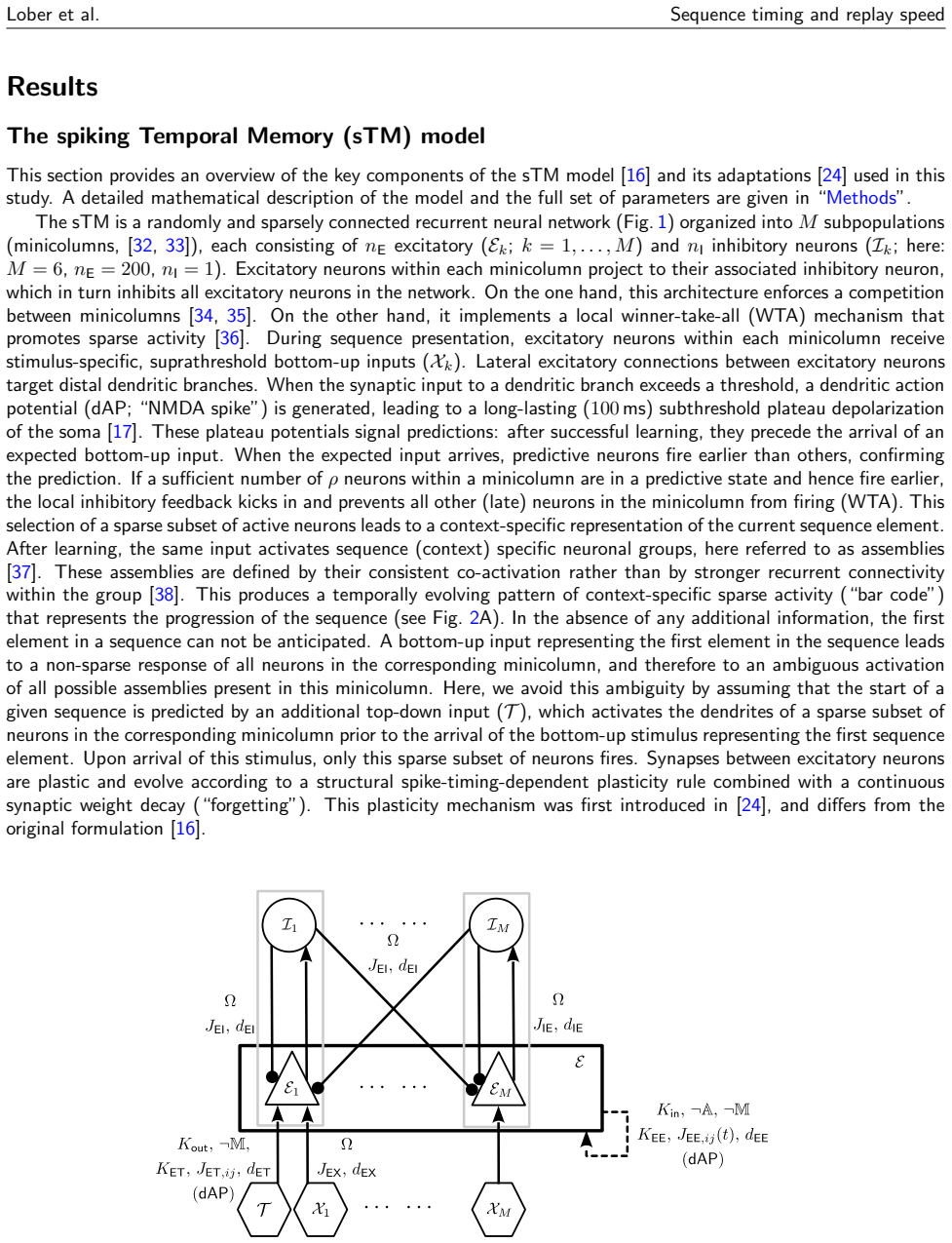
Processing sequential inputs is a fundamental brain function, underlying tasks such as sensory perception, language, and motor control. A challenge in sequence processing is to represent not only the order of events, but also their precise timing. While existing computational models can learn sequential structure, many lack biologically plausible mechanisms to encode element-specific timing and to flexibly control the speed of sequence replay. The spiking Temporal Memory (sTM) model, a biologically inspired network model, provides a framework for key aspects of sequence processing. In the sTM model, each sequence element is represented by a small set of neurons firing synchronously, where the set of active neurons encodes the element's identity in its sequential context. In its original version, however, the sTM model learns the order but not the timing of sequence elements. Further, it remains an open question in neuroscience how the speed of sequence replay can be flexibly modulated. We propose a mechanism where the duration of sequence elements is represented by a sequential activation of element specific neuronal populations, enabling the model to encode sequences across a wide range of timescales. This provides a biologically plausible basis for learning and replaying complex temporal patterns. Additionally, we show that oscillatory background inputs can serve as a clock signal and provide a robust and flexible mechanism for controlling the speed of sequence replay. Our findings suggest that elapsed time is encoded by unique and sparse spatiotemporal patterns of neural activity, and that the speed of sequence replay during wakefulness and sleep is correlated to the characteristics of global oscillatory activity observed in EEG or LFP recordings.
Editorial analysis
A structured set of objections, weighed in public.
Referee Report
Summary. The paper extends the spiking Temporal Memory (sTM) model by representing sequence element durations via sequential activation of element-specific neuronal populations, enabling encoding across wide timescales while preserving context-dependent representations. It further shows that oscillatory background inputs act as a clock signal for flexible, robust control of replay speed. Simulations demonstrate stable sequence recall and speed modulation, with implications for linking to EEG/LFP oscillatory characteristics during wakefulness and sleep.
Significance. If the mechanisms hold, the work supplies a biologically plausible extension to sTM for timing and speed control without altering core Hebbian or context-update rules, addressing open questions in sequence processing. The simulations provide concrete, falsifiable predictions for sparse spatiotemporal activity patterns and replay-oscillation correlations; this is a strength for the field of computational neuroscience.
major comments (2)
- [§3.2] §3.2 (extension of sTM): the claim that sequential population activation preserves original context representations without interference is stated at a high level; explicit metrics (e.g., context-decoding accuracy before/after extension) or equations showing unchanged context-update dynamics are needed to confirm the central assumption.
- [Results (oscillatory inputs)] Results section on oscillatory control: the robustness of speed modulation is asserted but lacks quantitative detail such as error bars, statistical tests across oscillation frequencies/amplitudes, or failure cases; this is load-bearing for the 'robust and flexible' claim.
minor comments (2)
- [Methods/Figures] Figure legends and Methods: clarify notation distinguishing the new element-specific populations from the original sTM neuron sets to avoid reader confusion.
- [Abstract] Abstract: the phrase 'unique and sparse spatiotemporal patterns' should be tied more explicitly to the simulation outputs shown later in the paper.
Simulated Author's Rebuttal
We thank the referee for their constructive comments and positive recommendation for minor revision. We address each major comment below, making revisions to enhance the clarity and quantitative support in the manuscript.
read point-by-point responses
-
Referee: [§3.2] §3.2 (extension of sTM): the claim that sequential population activation preserves original context representations without interference is stated at a high level; explicit metrics (e.g., context-decoding accuracy before/after extension) or equations showing unchanged context-update dynamics are needed to confirm the central assumption.
Authors: We agree that the original description was at a high level. In the revised manuscript, we have expanded §3.2 to include the relevant equations demonstrating that the context-update dynamics remain identical to the original sTM model, as the sequential activations of element-specific populations do not interfere with the context-dependent neuron sets. We also report new simulation results with context-decoding accuracy metrics, showing no degradation (accuracy of 0.96 ± 0.02 before vs. 0.95 ± 0.03 after, with no statistical difference). revision: yes
-
Referee: [Results (oscillatory inputs)] Results section on oscillatory control: the robustness of speed modulation is asserted but lacks quantitative detail such as error bars, statistical tests across oscillation frequencies/amplitudes, or failure cases; this is load-bearing for the 'robust and flexible' claim.
Authors: We acknowledge the need for more rigorous quantification. The revised Results section now includes error bars representing standard deviation across multiple simulation runs, statistical analyses (including ANOVA for effects of frequency and amplitude), and an explicit discussion of boundary conditions where speed modulation becomes unreliable, such as at very high oscillation amplitudes leading to desynchronization. These changes provide a more robust foundation for our claims. revision: yes
Circularity Check
No significant circularity; derivation is self-contained
full rationale
The paper proposes novel extensions to the sTM model by introducing sequential activation of element-specific neuronal populations to encode element durations and oscillatory background inputs as a clock signal for replay speed control. These mechanisms are implemented on top of the existing Hebbian and context-update rules without altering their core structure, and the claims are supported by simulation results showing stable sequence recall across timescales and speed modulations. No step reduces by construction to a fitted parameter renamed as a prediction, a self-definitional loop, or a load-bearing self-citation chain; the central results derive from the new model components and their explicit dynamical behavior rather than re-expressing inputs.
Axiom & Free-Parameter Ledger
axioms (1)
- domain assumption Sequential activation of element-specific neuronal populations can represent element durations without disrupting context-dependent sequence representations.
Reference graph
Works this paper leans on
-
[1]
The problem of serial order in behavior
Lashley KS. The problem of serial order in behavior. vol. 21. Bobbs-Merrill; 1951
work page 1951
-
[2]
Clegg BA, DiGirolamo GJ, Keele SW. Sequence learning. Trends Cogn Sci. 1998;2(8):275–281
work page 1998
-
[3]
Hawkins J, Blakeslee S. On intelligence: How a new understanding of the brain will lead to the creation of truly intelligent machines. Macmillan; 2007
work page 2007
-
[4]
Dehaene S, Meyniel F, Wacongne C, Wang L, Pallier C. The neural representation of sequences: from transition probabilities to algebraic patterns and linguistic trees. Neuron. 2015;88(1):2–19
work page 2015
-
[5]
Memory for musical tempo: Additional evidence that auditory memory is absolute
Levitin DJ, Cook PR. Memory for musical tempo: Additional evidence that auditory memory is absolute. Perception & Psychophysics. 1996;58(6):927–935
work page 1996
-
[6]
Rate and duration memory of naturalistic sounds
Boltz MG. Rate and duration memory of naturalistic sounds. Acta Psychologica. 2010;135(2):168–181. Available from:https://www.sciencedirect.com/science/article/pii/S0001691810001113
work page 2010
-
[7]
Emergence of dynamic memory traces in cortical microcircuit models through STDP
Klampfl S, Maass W. Emergence of dynamic memory traces in cortical microcircuit models through STDP. J Neurosci. 2013;33(28):11515–11529. Available from:https://doi.org/10.1523/jneurosci.5044-12. 2013
-
[8]
Klos C, Miner D, Triesch J. Bridging structure and function: A model of sequence learning and prediction in primary visual cortex. PLOS Comput Biol. 2018;14(6):e1006187. Available from:https://doi.org/10. 1371/journal.pcbi.1006187
work page 2018
-
[9]
Learning spatiotemporal signals using a recurrent spiking network that discretizes time
Maes A, Barahona M, Clopath C. Learning spatiotemporal signals using a recurrent spiking network that discretizes time. PLOS Comput Biol. 2020;16(1):e1007606. Available from:https://doi.org/10.1371/ journal.pcbi.1007606
work page 2020
-
[10]
Cone I, Shouval HZ. Learning precise spatiotemporal sequences via biophysically realistic learning rules in a modular, spiking network. eLife. 2021;10:e63751. Available from:https://doi.org/10.7554/elife.63751
-
[11]
Neural circuit mechanisms of hierarchical sequence learning tested on large-scale recording data
Asabuki T, Kokate P, Fukai T. Neural circuit mechanisms of hierarchical sequence learning tested on large-scale recording data. PLOS Computational Biology. 2022 06;18:e1010214
work page 2022
-
[12]
Thunderstruck: The ACDC model of flexible sequences and rhythms in recurrent neural circuits
Calderon CB, Verguts T, Frank MJ. Thunderstruck: The ACDC model of flexible sequences and rhythms in recurrent neural circuits. PLoS Computational Biology. 2022;18. Available from:https://api. semanticscholar.org/CorpusID:233245482
work page 2022
-
[13]
ELiSe: Efficient Learning of Sequences in Structured Recurrent Networks
Kriener L, V¨ olk K, von H¨ unerbein B, Benitez F, Senn W, Petrovici MA. ELiSe: Efficient Learning of Sequences in Structured Recurrent Networks. arXiv. 2024;p. 2402.16763
-
[14]
Cortical learning algorithm and Hierarchical Temporal Memory
Hawkins J, Ahmad S, Dubinsky D, et al. Cortical learning algorithm and Hierarchical Temporal Memory. Numenta Whitepaper. 2011;1(68):2
work page 2011
-
[15]
Why neurons have thousands of synapses, a theory of sequence memory in neocortex
Hawkins J, Ahmad S. Why neurons have thousands of synapses, a theory of sequence memory in neocortex. Front Neural Circuits. 2016;10:23. Available from:https://doi.org/10.3389/fncir.2016.00023
-
[16]
Sequence learning, prediction, and replay in networks of spiking neurons
Bouhadjar Y, Wouters DJ, Diesmann M, Tetzlaff T. Sequence learning, prediction, and replay in networks of spiking neurons. PLOS Comput Biol. 2022;18(6):e1010233. Available from:https://doi.org/10.1371/ journal.pcbi.1010233
work page 2022
-
[17]
The decade of the dendritic NMDA spike
Antic SD, Zhou WL, Moore AR, Short SM, Ikonomu KD. The decade of the dendritic NMDA spike. J Neurosci Res. 2010;88(14):2991–3001
work page 2010
-
[18]
Experimental evidence for sparse firing in the neocortex
Barth AL, Poulet JF. Experimental evidence for sparse firing in the neocortex. Trends Neurosci. 2012;35(6):345–355
work page 2012
-
[19]
M¨ ullner FE, Wierenga CJ, Bonhoeffer T. Precision of inhibition: dendritic inhibition by individual GABAergic synapses on hippocampal pyramidal cells is confined in space and time. Neuron. 2015;87(3):576–589
work page 2015
-
[20]
Liao D, Hessler NA, Malinow R. Activation of postsynaptically silent synapses during pairing-induced LTP in CA1 region of hippocampal slice. Nature. 1995;375(6530):400–404
work page 1995
-
[21]
Synaptic plasticity and dynamic modulation of the postsynaptic membrane
L¨ uscher C, Noicoll RA, Malenka RC, Muller D. Synaptic plasticity and dynamic modulation of the postsynaptic membrane. Nat Neurosci. 2000 june;3(6):545–550. 24 Lober et al. Sequence timing and replay speed
work page 2000
-
[22]
Deger M, Helias M, Rotter S, Diesmann M. Spike-Timing Dependence of Structural Plasticity Explains Cooperative Synapse Formation in the Neocortex. PLOS Comput Biol. 2012;8(9):e1002689
work page 2012
-
[23]
Coherent noise enables probabilistic sequence replay in spiking neuronal networks
Bouhadjar Y, Wouters DJ, Diesmann M, Tetzlaff T. Coherent noise enables probabilistic sequence replay in spiking neuronal networks. PLOS Comput Biol. 2023;19(5):e1010989. Available from:https://doi.org/ 10.1371/journal.pcbi.1010989
-
[24]
Unsupervised online learning of complex sequences in spiking neuronal networks
Bouhadjar Y, Lober M, Neftci E, Diesmann M, Tetzlaff T. Unsupervised online learning of complex sequences in spiking neuronal networks. In: Proceedings of the International Conference on Neuromorphic Systems (ICONS’25); 2025. p. 202–207. Available from:https://dl.acm.org/doi/10.1109/ICONS69015.2025. 00038
-
[25]
Coordinated memory replay in the visual cortex and hippocampus during sleep
Ji D, Wilson M. Coordinated memory replay in the visual cortex and hippocampus during sleep. Nature neuroscience. 2007 02;10:100–7
work page 2007
-
[26]
Fast-Forward Playback of Recent Memory Sequences in Prefrontal Cortex During Sleep
Euston D, Tatsuno M, Mcnaughton B. Fast-Forward Playback of Recent Memory Sequences in Prefrontal Cortex During Sleep. Science (New York, NY). 2007 12;318:1147–50
work page 2007
-
[27]
Human Replay Spontaneously Reorganizes Experience
Liu Y, Dolan RJ, Kurth-Nelson Z, Behrens TEJ. Human Replay Spontaneously Reorganizes Experience. Cell. 2019;178(3):640–652.e14. Available from:https://www.sciencedirect.com/science/article/ pii/S0092867419306403
work page 2019
-
[28]
Consolidation of human skill linked to wak- ing hippocampo-neocortical replay
Buch ER, Claudino L, Quentin R, B¨ onstrup M, Cohen LG. Consolidation of human skill linked to wak- ing hippocampo-neocortical replay. Cell Reports. 2021;35(10):109193. Available from:https://www. sciencedirect.com/science/article/pii/S2211124721005398
work page 2021
-
[29]
A model of temporal scaling correctly predicts that motor timing improves with speed
Hardy NF, Goudar V, Romero-Sosa JL, Buonomano DV. A model of temporal scaling correctly predicts that motor timing improves with speed. Nature Communications. 2018;9(1):4732. Available from:https: //www.nature.com/articles/s41467-018-07161-6
work page 2018
-
[30]
A mechanism for cognitive dynamics: neuronal communication through neuronal coherence
Fries P. A mechanism for cognitive dynamics: neuronal communication through neuronal coherence. Trends Cogn Sci. 2005;9(10):474–480
work page 2005
-
[31]
Buzs´ aki G. Rhythms of the Brain. Oxford University Press; 2006. Available from:https://doi.org/10. 1093/acprof:oso/9780195301069.001.0001
-
[32]
The columnar organization of the neocortex
Mountcastle VB. The columnar organization of the neocortex. Brain. 1997;120:701–722
work page 1997
-
[33]
The minicolumn hypothesis in neuroscience
Buxhoeveden DP, Casanova MF. The minicolumn hypothesis in neuroscience. Brain. 2002 05;125(5):935–951. Available from:https://doi.org/10.1093/brain/awf110
-
[34]
Attractor Dynamics in a Modular Network Model of Neocor- tex
Lundqvist M, Rehn M, Djurfeldt M, Lansner A. Attractor Dynamics in a Modular Network Model of Neocor- tex. Netw Comput Neural Syst. 2006 January;17(3):253–276. Available from:https://doi.org/10.1080/ 09548980600774619
work page 2006
-
[35]
Imposing Biological Constraints onto an Abstract Neocortical Attractor Network Model
Johansson C, Lansner A. Imposing Biological Constraints onto an Abstract Neocortical Attractor Network Model. Neural Comput. 2007;19:1871–1896
work page 2007
-
[36]
On the computational power of winner-take-all
Maass W. On the computational power of winner-take-all. Neural Comput. 2000;12(11):2519–2535
work page 2000
-
[37]
Palm G. Neural Assemblies. An Alternative Approach to Artificial Intelligence. vol. 7 of Studies of Brain Function. Berlin: Springer-Verlag-Verlag; 1982
work page 1982
-
[38]
Hebb’s Vision: The Structural Underpinnings of Hebbian Assemblies
Wagner-Carena J, Kate S, Riordan T, Abbasi-Asl R, Aman J, Amster A, et al. Hebb’s Vision: The Structural Underpinnings of Hebbian Assemblies. bioRxiv. 2025;Available from:https://www.biorxiv.org/content/ early/2025/04/24/2025.04.24.649900
work page 2025
-
[39]
Connectivity Concepts in Neuronal Network Modeling
Senk J, Kriener B, Djurfeldt M, Voges N, Jiang HJ, Sch¨ uttler L, et al. Connectivity Concepts in Neuronal Network Modeling. PLOS Comput Biol. 2022;18(9):e1010086
work page 2022
-
[40]
NMDA spikes in basal dendrites of cortical pyramidal neurons
Schiller J, Major G, Koester HJ, Schiller Y. NMDA spikes in basal dendrites of cortical pyramidal neurons. Nature. 2000 Mar;404(6775):285–289. Available from:http://doi.org/10.1038/35005094
-
[41]
Milojkovic BA. A Strict Correlation between Dendritic and Somatic Plateau Depolarizations in the Rat Prefrontal Cortex Pyramidal Neurons. J Neurosci. 2005 April;25(15):3940–3951. Available from:https: //doi.org/10.1523/jneurosci.5314-04.2005. 25 Lober et al. Sequence timing and replay speed
-
[42]
Synaptic Integration in Tuft Dendrites of Layer 5 Pyramidal Neurons: A New Unifying Principle
Larkum ME, Nevian T, Sandler M, Polsky A, Schiller J. Synaptic Integration in Tuft Dendrites of Layer 5 Pyramidal Neurons: A New Unifying Principle. Science. 2009 August;325(5941):756–760. Available from: https://doi.org/10.1126/science.1171958
-
[43]
Hippocampal sharp wave-ripple: A cognitive biomarker for episodic memory and planning
Buzs´ aki G. Hippocampal sharp wave-ripple: A cognitive biomarker for episodic memory and planning. Hip- pocampus. 2015;25(10):1073–1188. Available from:https://onlinelibrary.wiley.com/doi/abs/10. 1002/hipo.22488
work page 2015
-
[44]
Mechanisms of systems memory consolidation during sleep
Klinzing JG, Niethard N, Born J. Mechanisms of systems memory consolidation during sleep. Nature Neuro- science. 2019;22:1598 – 1610. Available from:https://api.semanticscholar.org/CorpusID:201657155
work page 2019
-
[45]
Reliability of Spike Timing in Neocortical Neurons
Mainen ZF, Sejnowski TJ. Reliability of Spike Timing in Neocortical Neurons. Science. 1995;268:1503–1506
work page 1995
-
[46]
Interaction of Synchronous Input Activity and Subthreshold Oscillatons of Membrane Potential
Mohns M, Diesmann M, Gr¨ un S, Aertsen A. Interaction of Synchronous Input Activity and Subthreshold Oscillatons of Membrane Potential. In: Elsner N, Eysel U, editors. From Molecular Neurobiology to Clinical Neuroscience, Proceedings of the 27th G¨ ottingen Neurobiology Conference. vol. I. Stuttgart: Thieme; 1999. p. 100
work page 1999
-
[47]
The mechanism of synchronization in feed-forward neuronal networks
Goedeke S, Diesmann M. The mechanism of synchronization in feed-forward neuronal networks. New J Phys. 2008;10:015007
work page 2008
-
[48]
Fragmented replay of very large environments in the hippocampus of bats
Eliav T, Maimon SR, Sarel A, Palgi S, Las L, Ulanovsky N. Fragmented replay of very large environments in the hippocampus of bats. Cell. 2025;188(15):4091–4105.e16. Available from:https://www.sciencedirect. com/science/article/pii/S0092867425005744
work page 2025
-
[49]
Time at the center, or time at the side? Assessing current models of time perception
Hass J, Durstewitz D. Time at the center, or time at the side? Assessing current models of time perception. Current Opinion in Behavioral Sciences. 2016;8:238–244. Time in perception and action. Available from: https://www.sciencedirect.com/science/article/pii/S2352154616300535
work page 2016
-
[50]
Using temperature to analyze the neural basis of a time-based decision
Monteiro T, Rodrigues F, Pexirra M, Cruz B, Gon¸ calves A, Rueda-Orozco P, et al. Using temperature to analyze the neural basis of a time-based decision. Nature Neuroscience. 2023 07;26:1–10
work page 2023
-
[51]
Scalar expectancy theory and Weber’s law in animal timing
Gibbon J. Scalar expectancy theory and Weber’s law in animal timing. Psychological Review. 1977;84(3):279– 325
work page 1977
-
[52]
The failure of Weber’s law in time perception and production
Bizo L, Chu J, Sanabria F, Killeen P. The failure of Weber’s law in time perception and production. Behavioural processes. 2006 03;71:201–10
work page 2006
-
[53]
The Local Field Potential Reflects Surplus Spike Synchrony
Denker M, Roux S, Lind´ en H, Diesmann M, Riehle A, Gr¨ un S. The Local Field Potential Reflects Surplus Spike Synchrony. Cereb Cortex. 2011 December;21:2681–2695. Available from:https://doi.org/10.1093/ cercor/bhr040
work page 2011
-
[54]
Spike-Phase Coding Boosts and Stabilizes Information Carried by Spatial and Temporal Spike Patterns
Kayser C, Montemurro MA, Logothetis NK, Panzeri S. Spike-Phase Coding Boosts and Stabilizes Information Carried by Spatial and Temporal Spike Patterns. Neuron. 2009;61(4):597–608. Available from:https: //www.sciencedirect.com/science/article/pii/S0896627309000750
work page 2009
-
[55]
Burns SP, Xing D, Shapley RM. Is Gamma-band activity in the local field potential of V1 cortex a ”clock” or filtered noise? J Neurosci. 2011;31(26):9658–9664. Available from:https://www.jneurosci.org/lookup/ doi/10.1523/JNEUROSCI.0660-11.2011
-
[56]
Xing D, Shen Y, Burns S, Yeh CI, Shapley R, Li W. Stochastic generation of Gamma-band activity in primary visual cortex of awake and anesthetized monkeys. J Neurosci. 2012;32(40):13873–13880
work page 2012
-
[57]
Self-sustained activity in a small-world network of excitable neurons
Roxin A, Riecke H, Solla SA. Self-sustained activity in a small-world network of excitable neurons. Phys Rev Lett. 2004;92(19):198101
work page 2004
-
[58]
Signal propagation and logic gating in networks of integrate-and-fire neurons
Vogels TP, Abbott LF. Signal propagation and logic gating in networks of integrate-and-fire neurons. J Neurosci. 2005;25(46):10786–10795
work page 2005
-
[59]
A network of spiking neurons that can represent interval timing: mean field analysis
Gavornik JP, Shouval HZ. A network of spiking neurons that can represent interval timing: mean field analysis. J Comput Neurosci. 2011;30(2):501–513. Available from:http://link.springer.com/10.1007/ s10827-010-0275-y
work page 2011
-
[60]
Kriener B, Enger H, Tetzlaff T, Plesser HE, Gewaltig MO, Einevoll GT. Dynamics of self-sustained asynchronous-irregular activity in random networks of spiking neurons with strong synapses. Front Comput Neurosci. 2014;8:136. Available from:https://doi.org/10.3389/fncom.2014.00136. 26 Lober et al. Sequence timing and replay speed
-
[61]
A neurocomputational model for optimal temporal processing
Haß J, Blaschke S, Rammsayer T, Herrmann JM. A neurocomputational model for optimal temporal processing. J Comput Neurosci. 2008;25(3):449–464
work page 2008
-
[62]
Liang Q, Zeng Y, Xu B. Temporal-Sequential Learning With a Brain-Inspired Spiking Neural Network and Its Application to Musical Memory. Frontiers in Computational Neuroscience. 2020;Volume 14 - 2020. Available from:https://www.frontiersin.org/journals/computational-neuroscience/articles/10.3389/ fncom.2020.00051
-
[63]
Neural networks with dynamical thresholds
Horn D, Usher M. Neural networks with dynamical thresholds. Phys Rev A. 1989;40(2):1036. Available from: https://link.aps.org/doi/10.1103/PhysRevA.40.1036
-
[64]
Syntactic sequencing in Hebbian cell assemblies
Wennekers T, Palm G. Syntactic sequencing in Hebbian cell assemblies. Cogn Neurodyn. 2009;3(4):429–441. Available from:http://link.springer.com/10.1007/s11571-009-9095-z
-
[65]
Multi-Scale Modeling in Morphogenesis: A Critical Analysis of the Cellular Potts Model
Lansner A, Marklund P, Sikstr¨ om S, Nilsson LG. Reactivation in working memory: an attractor network model of free recall. PLOS One. 2013;8(8):e73776. Available from:https://dx.plos.org/10.1371/journal. pone.0073776
-
[66]
Martinez RH, Lansner A, Herman P. Probabilistic associative learning suffices for learning the temporal structure of multiple sequences. PLOS One. 2019;14(8):e0220161. Available from:https://dx.plos.org/ 10.1371/journal.pone.0220161
-
[67]
Unsupervised learning of persistent and sequential activity
Pereira U, Brunel N. Unsupervised learning of persistent and sequential activity. Front Comput Neurosci. 2020;13:97. Available from:https://www.frontiersin.org/article/10.3389/fncom.2019.00097/ full
-
[68]
Vehicles, Experiments in Synthetic Psychology
Braitenberg V. Vehicles, Experiments in Synthetic Psychology. Cambridge, Mass.: MIT Press; 1984
work page 1984
-
[69]
A neurocomputational model for optimal temporal processing
Hass J, Blaschke S, Rammsayer T, Herrmann J. A neurocomputational model for optimal temporal processing. Journal of Computational Neuroscience. 2008 05;25:449–64
work page 2008
-
[70]
Time cells in the hippocampus: a new dimension for mapping memories
Eichenbaum H. Time cells in the hippocampus: a new dimension for mapping memories. Nat Rev Neurosci. 2014;15(11):732–744
work page 2014
-
[71]
Sequential firing codes for time in rodent medial prefrontal cortex
Tiganj Z, Jung MW, Kim J, Howard MW. Sequential firing codes for time in rodent medial prefrontal cortex. Cereb Cortex. 2017;27(9):5663–5671
work page 2017
-
[72]
Internally generated time in the rodent hippocampus is logarithmically compressed
Cao R, Bladon JH, Charczynski SJ, Hasselmo ME, Howard MW. Internally generated time in the rodent hippocampus is logarithmically compressed. eLife. 2022 oct;11:e75353. Available from:https://doi.org/ 10.7554/eLife.75353
-
[73]
Cortical oscillations support sampling-based computations in spiking neural networks
Korcsak-Gorzo A, M¨ uller MG, Baumbach A, Leng L, Breitwieser OJ, van Albada SJ, et al. Cortical oscillations support sampling-based computations in spiking neural networks. PLOS Comput Biol. 2022;18(3):e1009753
work page 2022
-
[74]
Phase-of-Firing Coding of Natural Visual Stimuli in Primary Visual Cortex
Montemurro M, Rasch M, Murayama Y, Logothetis N, Panzeri S. Phase-of-Firing Coding of Natural Visual Stimuli in Primary Visual Cortex. Current biology. 2008;18(5):375–380
work page 2008
-
[75]
Kayser C, Ince RAA, Panzeri S. Analysis of Slow (Theta) Oscillations as a Potential Temporal Reference Frame for Information Coding in Sensory Cortices. PLoS Computational Biology. 2012;8. Available from: https://api.semanticscholar.org/CorpusID:694105
work page 2012
-
[76]
Transient slow gamma synchrony underlies hippocampal memory replay
Carr MF, Karlsson MP, Frank LM. Transient slow gamma synchrony underlies hippocampal memory replay. Neuron. 2012;75 4:700–13. Available from:https://api.semanticscholar.org/CorpusID:15574688
work page 2012
-
[77]
Hippocampal Replay Is Not a Simple Function of Experience
Gupta AS, van der Meer MAA, Touretzky DS, Redish AD. Hippocampal Replay Is Not a Simple Function of Experience. Neuron. 2010;65(5):695–705. Available from:https://www.sciencedirect.com/science/ article/pii/S0896627310000607
work page 2010
-
[78]
Hippocampal place cell sequences depict future paths to remembered goals
Pfeiffer BE, Foster DJ. Hippocampal place cell sequences depict future paths to remembered goals. Nature. 2013;497:74 – 79. Available from:https://api.semanticscholar.org/CorpusID:175756
work page 2013
-
[79]
Lober M, Bouhadjar Y, Diesmann M, Tetzlaff T. Code and data for Lober et al. (2026), Learning sequence timing and control of replay speed in networks of spiking neurons. Zenodo; 2026. Available from:https: //doi.org/10.5281/zenodo.20290700
-
[80]
Scikit-learn: Machine Learning in Python
Pedregosa F, Varoquaux G, Gramfort A, Michel V, Thirion B, Grisel O, et al. Scikit-learn: Machine Learning in Python. Journal of Machine Learning Research. 2011;12:2825–2830. 27 Lober et al. Sequence timing and replay speed
work page 2011
discussion (0)
Sign in with ORCID, Apple, or X to comment. Anyone can read and Pith papers without signing in.