900 worms of C
Resampled calcium traces and consensus connectomes let labs compare activity across animals and studies.
· “Homogenized textit{C. elegans} Neural Activity and Connectivity Data”
Neurons and Cognition
Synapse, cortex, neuronal dynamics, neural network, sensorimotor control, behavior, attention
sort pith recommended most recent
Resampled calcium traces and consensus connectomes let labs compare activity across animals and studies.
· “Homogenized textit{C. elegans} Neural Activity and Connectivity Data”
Reformulating dynamics on the circle shows the Cauchy law is the sole rotation-invariant measure, unifying exact mean-field reductions.
· “Geometric Origin of Exact Mean-Field Reductions: M{\"o}bius Symmetry and the Lorentzian Ansatz”
A curvature-sensing spinal loop times tail beats to a neighbor's wake; removing it dissolves the school.
On a new 18-item GenAI exam, teens who used chatbots most often scored lowest, while perceived usefulness tracked nothing.
Temporal integration alone fails; only predictive world models approach the brain's appearance-invariant motion coding.
· “Primate vision reveals a missing principle for robust dynamic AI”
Without compartments, synapses lack local error signals for deep learning without separate phases.
Filling blank intervals in a visual metronome with a colored disk improved tapping stability and was associated with reduced visual…
· “Temporal filling-in reduces attentional fluctuations in sustained visual attention”
A delay-coupled ring model replays forward and backward at quantized speeds, without symmetric plasticity.
· “Forward and reverse delay-driven hippocampal replay without symmetric plasticity”
Governed agentic neuroimaging: sealed plans, audited claims, and verified evidence grounding up nearly fivefold.
A periodic internal spatial code disambiguates visually identical locations that boundary cues alone confuse.
· “The Role of Grid Cells in Reducing Spatial Aliasing in Hippocampal Place Representations”
Counting connections and loops in a network of possible experiences yields structural markers for unity, self, and time.
Method adapts to streaming EEG and ECoG without labels, beating all tested baselines on three four-class datasets.
A four-part dynamical signature locates mediating subnetworks and separates gain from organization in real brain recordings.
· “A Control-Theoretic Formulation of Global Workspace Theory”
A two-population model shows receiver-leads-sender phases and bistable switching survive bidirectional coupling.
A 90-degree drop created the clearest injury signal, doubling oxidative stress and causing focal cell drift.
Valhalla wraps files, entities, and relations in stable layers so teams can hand off knowledge states, not just prompts.
Repeated pulses aimed at the amplitude-suppressing phase gradually weaken synchronized oscillations.
In a simulated PING network, longer delays also reshape how transient inputs alter oscillation timing and amplitude.
Statistics, geometry, AI, and dynamics all aim at one goal: early, individual-specific detection.
· “Data-driven techniques for translational neuroscience and personalized neuro-health”
Epidemic model: firing neurons shift the threshold and course of pathology, and PET scans back the prediction.
A delay drawn after the endpoint is fixed becomes a probe; a surviving ordering rejects past-adapted sufficiency.
The paper maps two structural theories of consciousness onto a four-level categorical ladder from complete dictionary to no inference.
· “The Rosetta Stone and Levels of Principled Inference to the Experience of Another Mind”
Phase Locking Value beats power and entropy features for cross-subject learning-style recognition, but only when brain networks differ.
When a prompt rule clashes with the stored same-color default, the two routes compete and incongruent trials suffer.
Each felt spot, moment, and object maps one-to-one to brain causal structure, yielding testable predictions.
· “Consciousness as Intrinsic Structure: Towards a Chemistry of Experience”
A biophysical mean-field chain links synaptic receptors to whole-brain dynamics, validated on anesthesia.
· “A class of mean-field models to bridge molecular to brain scales”
A Fisher-transform null model estimates significance at any window length and ranks EEG features on one scale.
The same bound, M ≤ Q, rules out the proposed 30 GHz cortical microwave label and leaves low-frequency rhythms standing.
Adding within-partition between-condition distances yields more accurate Euclidean and correlation estimates in MEG pattern analysis.
· “Improved cross-validated distances for multivariate pattern analysis”
Model links falling ATP energy to shorter-lived protein solitons and hyperexcitable neurons.
· “Reduced Gibbs free energy supply hinders brain information processing during mental fatigue”
Graph-theory scores computed on reservoir-computed connectivity track spiking, bursting, and interval statistics electrode by electrode.
· “Graph Analysis of Neuronal-Culture Connectivity Derived from a Reservoir-Computing Model”
The same person could land on different sides of a clinical threshold depending on what task came first.
The same predictive-coding machinery yields surprisal, N400/P600 effects, bistable perception, and falsifiable contrasts with transformers.
· “A Hierarchical Energy-Based Model for Multimodal Cognition”
Separating disease, phenotype, and scanner signals gets multi-site accuracy within 2 percent of centralized training.
Fine-tuning lifts the detection score to 0.848; using the model as-is still hits 0.815.
· “International Transfer of Stochastic Cortical Self-Reconstruction”
Two experiments strip the task bare and the bias survives; one auto-associative model unifies all three procedures.
Deeper unsupervised layers sharpen the class boundaries hidden in the data, until a few hard pairs erode accuracy.
· “Convergent Evolution in Neural Representation Space: Emergent Order in Deep Belief Networks”
Matching hidden neurons by permutation shows the task, not chance, decides where training lands in weight space.
EEG geometry links richer neural codes to less stability, a possible early signpost for MCI and Alzheimer's.
· “Complexity and Stability of Neural Activity Across Aging and Neurodegenerative Disease”
The cue's own frequency is a second correction learners can skip, and a rating experiment can separate it.
· “Two base rates, two weights: base-rate neglect has a second axis”
Walking narrows measurably under stimulation, and feedback training reverses the sensory disruption.
Inverted Forward-Forward model cancels expected inputs bottom-up, mirroring mouse visual cortex dynamics.
· “From Local Learning to Global Prediction Through Layered Surprise Cascades”
A local, unsupervised rule keeps more task accuracy through 80% pruning, rivaling costlier second-order methods.
Which sleep operation fails, at which boundary, and why—a three-axis framework for subtyping insomnia.
AI ethics is human ethics: ground it in the brain's reward cycle and global workspace, not in new machine rules
A new model treats rigid routines as the only way to cut surprise when abstract learning is closed off.
· “An entropic explanation of insistence on sameness in autism”
Separating stimulus and processing time lets one experiment test oscillation, prediction, and coarse-to-fine accounts.
· “Time²: A framework for the neural dynamics of visual perception”
Choosing drivers by persistent cycles, not degree, changes which brain states are cheap to reach—at no extra energy.
· “Persistent homology broadens the controllable subspace in human structural connectomes”
One noisy neural-field potential generates all four signature classes, each with its own EEG test.
· “A Landau-Ginzburg Phenomenology of Sleep-Stage Transitions”
NSSI makes trajectories riskier and less predictable, so apparent recovery deserves continued monitoring.
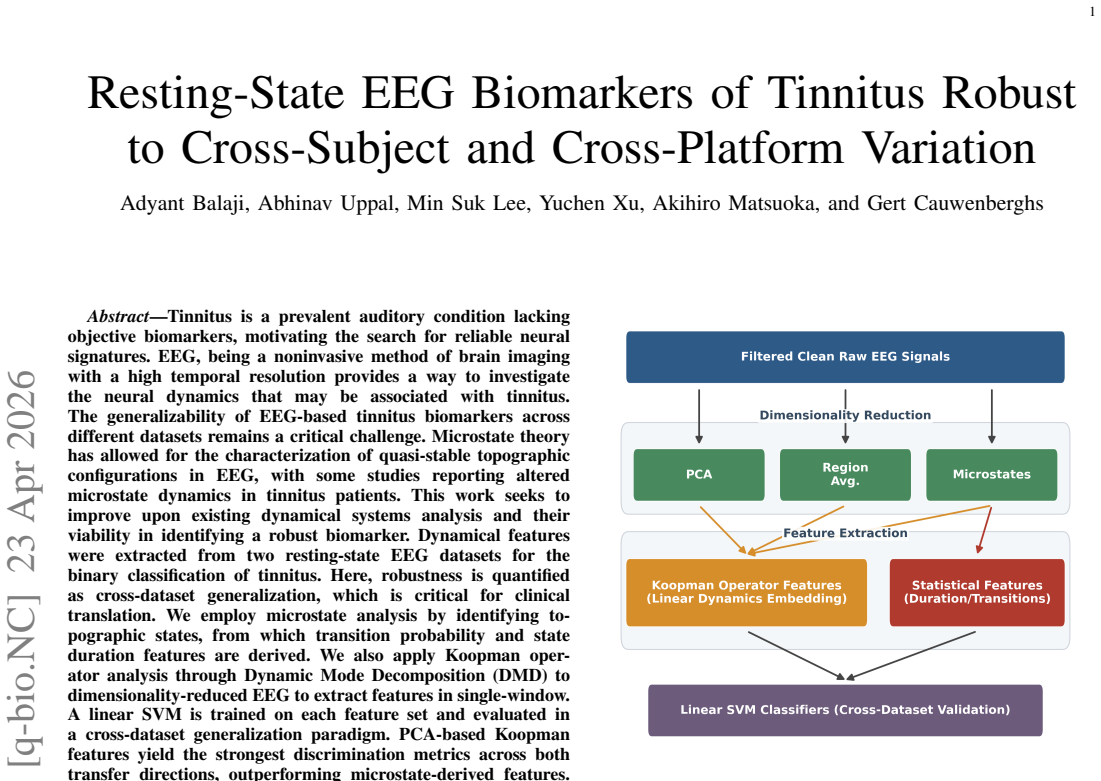
A Rayleigh filter keeps only non-random trials; the trial-level split still leaves cross-subject generalization untested.
· “Detecting high-frequency brain disorder signals using dynamic mode decomposition from EEG”
A set-theoretic derivation shows that any deterministic planner already maximizes its own output as the standard
Two-stage latent model predicts whole-brain fMRI up to 100 TRs ahead and beats regression baselines on 3 benchmarks.
· “NeuroWorld: A Latent Brain World Model for Stimulus-Conditioned Human Brain Dynamics”
The decoder's weights map to cortical sources; occlusion shows silence, loudness, vowels, and onsets drive it.
Treating weight distributions as geodesic flow improves generalization and mitigates barren plateaus.
· “Statistical Mechanics of Learning on Product Wasserstein Manifolds”
A perspective turns theories of memory into models that learn from the same sensory input as animals.
· “Data augmentation as a framework for modeling hippocampal contributions to generalization”
Combining alpha and gamma bands with recurrence plots beats single-signal models on held-out subjects.
· “Deep Learning CNN and Recurrence Analysis for Alpha Gamma EEG Biomarkers in Fragile X Syndrome”
A formal bridge maps a single GP with layer-index input onto the cortical microcircuit's predictions and prediction errors.
Master-equation mean fields keep synaptic kinetics and adaptation manipulable across scales, provided every reduction step is validated.
One model can look adult on perspective-taking but not intention attribution; single benchmarks miss the split.
· “Cross-Task Dissociation in Frontier Vision-Language Model Theory of Mind”
Nonlinearity is a structural requirement; one leaky memory plus a static nonlinear readout suffices for the core hallmarks.
· “Dynamical principles of habituation across substrates and scales”
Control-theoretic cost landscape also explains sensory vs association cortex and how training sculpts neural networks.
Jointly aligning three fMRI connectivity views and two source sites beats single-source baselines by nearly six points.
Falling encounter intervals reveal a patch's initial yield, while the mix of patch types is learned one visit at a time.
· “Resource depletion accelerates rate learning but not composition learning in patch foraging”
Non-model-based measures match the reference pipeline to numerical precision, so labs can switch without losing comparability.
· “metasignal: A Python Package for Comprehensive Metacognitive Analysis and Decision-Making”
A stable perceptual clock would explain why temporal acuity resists training and may limit working memory.
Neuroscience should pick behaviors by survival and reproduction, not naturalness
A utility model that mentalizes about goals matches human observe-or-explore choices across four games
· “Using Theory of Mind to Arbitrate between Social and Non-social Learning”
A first-stimulation control at matched age shows the collapse is from stimulation history, not maturation
Learned communities match canonical brain networks and expose a dedifferentiation pattern in Alzheimer's disease.
· “MPP-GNN: Subject-Adaptive Community Detection for fMRI-Based Alzheimer's Disease Classification”
A 380M-parameter diffusion autoencoder matches a fixed-window specialist and beats spherical spline interpolation on corrupted EEG.
· “ZUNA1.1: A more flexible EEG foundation model for Denoising and Super-resolution”
Review of 239 studies finds external validation in only 5.9% and no system in routine clinical use.
A cooperative-game model predicts human design placements at r≈0.95, versus 0.32 for efficiency-only baselines.
Three failure modes need different fixes; a fourth hidden error sits in the report itself.
One metric built from reactive and active information flow ranks performance in bacteria, worms, flies, and AI agents.
· “A behavior-environment information loop drives sensory navigation”
Human and machine intelligence converge on shared inference, architecture, representation, learning, and control.
· “Cognitive Convergence: Deep Similarities Between Large Language Models and Human Cognition”
When convincing fakes become cheap, the share of true published findings falls back to the base rate.
· “Phantom Evidence: How and Why Generative AI Manufactures False Positives in Science”
A Python reimplementation makes the model's learned memories inspectable as graphs for analysis and interaction.
· “GraphIDyOM: A graph-native Python reimplementation of IDyOM for musical expectation modelling”
Fast and Slow agents predict tick bias vs memory decay before you run the user study
· “Beyond the Post Hoc User Study: Modeling Visual Decision-Making with Active Inference”
Commit-then-confirm harness blocks fishing and lifecycle reuse while still answering registered ERP questions