Recognition: unknown
Information as Maximum-Caliber Deviation: A bridge between Integrated Information Theory and the Free Energy Principle
Pith reviewed 2026-05-14 21:07 UTC · model grok-4.3
The pith
Information is the deviation of realized dynamics from a constrained maximum-caliber path ensemble, from which IIT 3.0's cause-effect repertoires emerge via variational principles.
A machine-rendered reading of the paper's core claim, the machinery that carries it, and where it could break.
Core claim
The central claim is that information can be defined as the deviation ψ of realized dynamics from a constrained maximum-caliber path ensemble, from which each of the cause/effect repertoires central to IIT 3.0 emerge directly from MaxCal variational principles. This re-derives IIT's phenomenological calculus from constrained entropy-maximization, supplies a theoretical bridge to active inference which is mathematically dual under Langevin dynamics, and shows that ψ equals prediction error under the central limit theorem for Markov chains and large deviations theory for Ising models.
What carries the argument
The deviation ψ of realized dynamics from a constrained maximum-caliber path ensemble, which acts as the definition of information and generates IIT's cause-effect structures from variational entropy maximization.
If this is right
- IIT 3.0's integrated information measures can be obtained from constrained entropy maximization alone.
- The information measure ψ is equivalent to prediction error in predictive coding models for Markov chains and Ising models.
- The framework supplies a principled route for extending IIT to dynamical regimes beyond its current scope.
- It provides a rationale for studying convergence among FEP, IIT, and thermodynamic accounts of cognition such as fluctuation-dissipation violations.
Where Pith is reading between the lines
- The unification may predict that integrated information follows a hill-shaped trajectory during adaptation to sensory inputs in neural systems.
- The approach could be tested by comparing ψ values computed from observed trajectories against empirical measures of information integration in biological preparations.
- Consciousness-related quantities might be re-interpreted as measurable deviations from maximum-entropy path ensembles in physical systems.
Load-bearing premise
The proposed definition of information as maximum-caliber deviation is sufficient to recover the full set of IIT 3.0 cause-effect repertoires and measures without additional unstated constraints.
What would settle it
A direct computation on a small Markov chain or Ising model in which the cause-effect repertoires obtained from the maximum-caliber deviation do not match the repertoires produced by standard IIT 3.0 procedures.
Figures





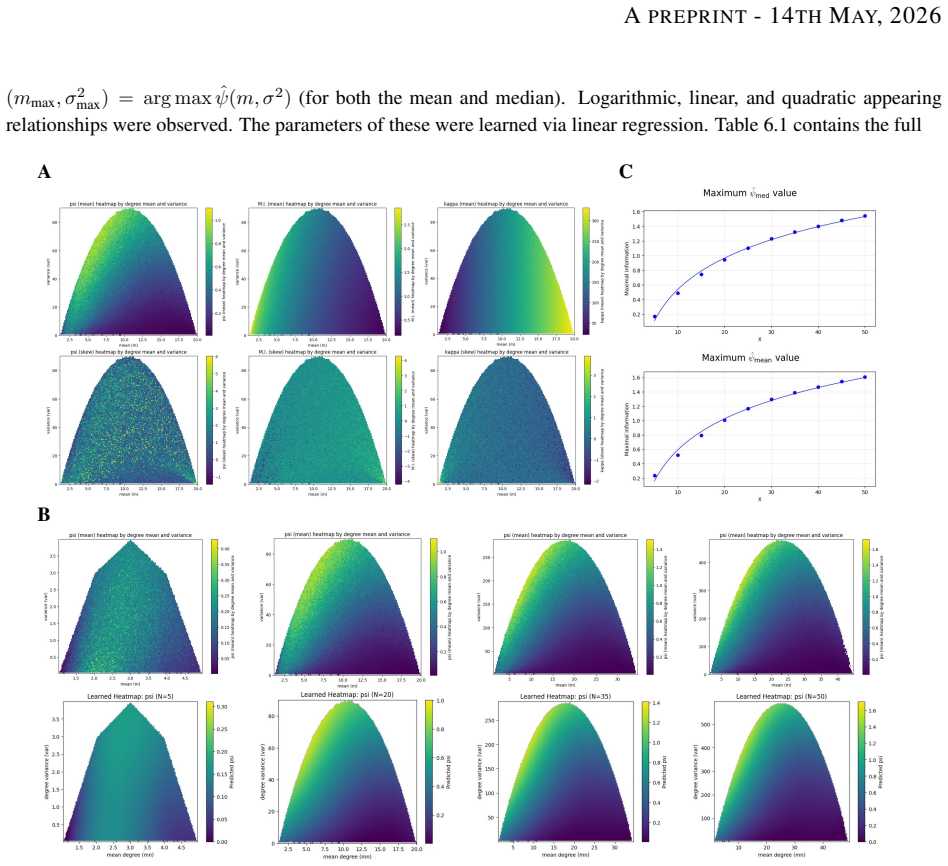


read the original abstract
The Free Energy Principle (FEP) is a leading framework for mathematically modeling self-organization and learning, while Integrated Information Theory (IIT) is a computational ontology of consciousness oriented around irreducible cause and effect. While conceptual unifications have been proposed and appear to be supported by empirical findings, the absence of a rigorous mathematical mapping places upper bounds on their precision and testability. This work proposes that information can be defined as the deviation $\psi$ of realized dynamics from a constrained maximum-caliber (MaxCal) path ensemble over a finite time horizon. Under this definition, each of the cause/effect repertoires central to IIT 3.0 emerge directly from MaxCal variational principles, allowing IIT's phenomenological calculus to be re-derived from constrained entropy-maximization (CMEP). This framework supplies a theoretical bridge to active inference, which is mathematically dual to CMEP under Langevin dynamics, and offers a principled route for extending IIT to new dynamical regimes. When the approach is applied under the Central Limit Theorem (CLT) for Markov chains and via large deviations theory (LDT) to Ising models, information $\psi$ is shown to be equivalent to prediction error under accompanying predictive coding models. This may hold relevance to the ``hill-shaped trajectory'' of $\Phi$ observed in neuronal cultures adapting to sensory inputs. Together, these results provide a physically and mathematically grounded rationale for studying the convergence of FEP, IIT, and thermodynamic frameworks of cognition such as recent work grounding consciousness in violations of the Fluctuation-Dissipation Theorem (FDT).
Editorial analysis
A structured set of objections, weighed in public.
Referee Report
Summary. The paper proposes defining information as the deviation ψ of realized dynamics from a constrained maximum-caliber (MaxCal) path ensemble over a finite time horizon. Under this definition, each of the cause/effect repertoires central to IIT 3.0 emerge directly from MaxCal variational principles, re-deriving IIT's phenomenological calculus from constrained entropy-maximization (CMEP). The framework bridges to active inference (dual to CMEP under Langevin dynamics) and shows ψ equivalent to prediction error under CLT for Markov chains and LDT for Ising models, with potential relevance to the hill-shaped trajectory of Φ in neuronal cultures.
Significance. If the claimed mappings hold without auxiliary constraints, the work supplies a physically grounded unification of IIT and FEP, grounding consciousness measures in thermodynamic path ensembles and offering a route to extend IIT beyond current regimes. The special-case equivalences to prediction error and the link to FDT violations are notable strengths if supported by explicit derivations.
major comments (2)
- [Abstract] Abstract: the central claim that IIT 3.0 repertoires 'emerge directly' from MaxCal variational principles is asserted without visible supporting equations, explicit mapping, or verification steps; this is load-bearing for the equivalence to prediction error and the bridge to FEP.
- [Abstract] Abstract: the definition of ψ is introduced as a proposal and then used to recover IIT quantities, but the equivalence to prediction error under CLT/LDT appears to depend on the specific form of the constraints on the path ensemble; without showing the general case is free of unstated auxiliary assumptions, the claimed generality risks circularity.
Simulated Author's Rebuttal
We thank the referee for the constructive and detailed comments. We address each major point below and have revised the manuscript to improve the clarity and explicitness of the abstract and derivations where appropriate.
read point-by-point responses
-
Referee: [Abstract] Abstract: the central claim that IIT 3.0 repertoires 'emerge directly' from MaxCal variational principles is asserted without visible supporting equations, explicit mapping, or verification steps; this is load-bearing for the equivalence to prediction error and the bridge to FEP.
Authors: We agree the abstract is concise and does not display the full equations. The manuscript derives the repertoires explicitly in Sections 3–4 by applying the MaxCal variational principle to the constrained path measure and showing that the resulting marginals recover the IIT cause-effect repertoires. To address the concern, we have revised the abstract to include a one-sentence outline of the variational step and added a forward reference to the relevant sections and equations. revision: partial
-
Referee: [Abstract] Abstract: the definition of ψ is introduced as a proposal and then used to recover IIT quantities, but the equivalence to prediction error under CLT/LDT appears to depend on the specific form of the constraints on the path ensemble; without showing the general case is free of unstated auxiliary assumptions, the claimed generality risks circularity.
Authors: The definition of ψ is the general deviation from the MaxCal ensemble under the observed constraints; the CLT and LDT equivalences follow from the standard statements of those theorems applied to the fluctuation statistics of the path measure, without further auxiliary constraints. We have added a clarifying paragraph in the revised discussion that states the assumptions explicitly and sketches the derivation steps to remove any appearance of circularity. revision: yes
Circularity Check
No significant circularity; derivation proceeds from an explicit definitional proposal.
full rationale
The paper explicitly proposes a new definition of information as the deviation ψ from a constrained maximum-caliber path ensemble and then derives the IIT 3.0 cause/effect repertoires as consequences of the MaxCal variational principles applied to that definition. The claimed equivalence to prediction error is restricted to specific limiting cases (CLT for Markov chains and LDT for Ising models) rather than asserted as a general identity. No equations are presented in which an IIT quantity is shown to equal a fitted parameter or a self-referential constraint by construction, and no load-bearing self-citation chain is invoked to justify the central mapping. The argument is therefore self-contained as a theoretical re-expression rather than a tautological reduction of outputs to inputs.
Axiom & Free-Parameter Ledger
free parameters (2)
- finite time horizon
- constraints on the path ensemble
axioms (3)
- standard math Variational principles of maximum caliber (CMEP)
- standard math Central Limit Theorem for Markov chains
- standard math Large deviations theory for Ising models
invented entities (1)
-
information ψ
no independent evidence
Reference graph
Works this paper leans on
-
[1]
TONONI, G. (2004) An information integration theory of consciousness.BMC Neuroscience(2004)5(42)https://doi.org/10.1186/1471-2202-5-42
-
[2]
TONONI, G. (2008) Consciousness as integrated information: a provisional manifesto.The Biological Bulletin(2008)215(3): 216–242,https://doi.org/ 10.2307/25470707
-
[3]
and Gosseries, Olivia and Rosanova, Mario and Boly, M
CASALI, A. G., GOSSERIES, O., ROSANOVA, M., BOLY, M., SARASSO, S., CASALI, K. R., CASAROTTO, S., BRUNO, M.-A., LAUREYS, S., TONONI, G., MASSIMINI, M. (2013) A Theoretically Based Index of Consciousness Independent of Sensory Processing and Behavior.Science Translational Medicine. 5(198)https://doi.org/10.1126/scitranslmed.3006294
-
[4]
M. OIZUMI, L.IS,ANDG. TONONI. (2014) From the phenomenology to the mechanisms of consciousness: integrated information theory 3.0.PLOS Compu- tational Biology10(5):e1003588, May 2014.https://doi.org/10.1371/journal.pcbi.1003588
-
[5]
BARRETT, A. B. (2014) An integration of integrated information theory with fundamental physics.Front. Psychol.5:63.https://doi.org/10.3389/fpsyg. 2014.00063
-
[6]
CERULLO, M. A. (2015). The Problem with Phi: A Critique of Integrated Information Theory.PLoS Computational Biology11(9), e1004286.https://doi. org/10.1371/journal.pcbi.1004286
-
[7]
TONONI, G. (2015). Integrated information theory.Scholarpedia,10(1), 4164.http://www.scholarpedia.org/article/Integrated_information_ theory
work page 2015
-
[8]
KREMNIZER, K., RANCHIN, A. (2015) Integrated information-induced quantum collapse,Foundations of Physics45889-899https://doi.org/10.1007/ s10701-015-9905-6
work page 2015
-
[9]
TEGMARK, M. (2016) Improved Measures of Integrated Information.PLOS Computational Biology,12(11), e1005123.https://doi.org/10.1371/ journal.pcbi.1005123
work page 2016
-
[10]
ZANARDI, P., TOMKA, M., VENUTI, L. C. (2018) Towards Quantum Integrated Information Theoryhttps://doi.org/10.48550/arXiv.1806.01421
work page internal anchor Pith review Pith/arXiv arXiv doi:10.48550/arxiv.1806.01421 2018
-
[11]
MEDIANO, P. A. M., SETH, A. K., BARRETT, A. B. (2018) Measuring Integrated Information: Comparison of Candidate Measures in Theory and Simulation, https://doi.org/10.48550/arXiv.1806.09373
work page internal anchor Pith review Pith/arXiv arXiv doi:10.48550/arxiv.1806.09373 2018
-
[12]
MEDIANO, P. A. M., ROSAS, F., CARHART-HARRIS, R. L., SETH, A. K., BARRETT, A. B. (2019) Beyond integrated information: A taxonomy of information dynamics phenomenahttps://doi.org/10.48550/arXiv.1909.02297
-
[13]
DOERIG, A., SCHURGER, A., HESS, K., HERZOG, M. H. (2019) The unfolding argument: Why IIT and other causal structure theories cannot explain consciousness,Consciousness and Cognition7249–59https://doi.org/10.1016/j.concog.2019.04.002
-
[14]
COHEN, D., SASAI, S., TSUCHIYA, N., OIZUMI, M. (2020) A general spectral decomposition of causal influences applied to integrated information.Journal of Neuroscience Methods3002020https://doi.org/10.1016/j.jneumeth.2019.108443
-
[15]
KLEINER, J., TULL, S. (2021) The Mathematical Structure of Integrated Information Theory.Frontiers in Applied Mathematics and Statistics6https: //doi.org/10.3389/fams.2020.602973
-
[16]
MEDIANO, P. A. M., FERNANDO, E. R., FARAH, J. C., SHANAHAN, M., BOR, D., BARRETT, A. B. (2022) Integrated information as a common signature of dynamical and information-processing complexity,Chaos32013115,https://doi.org/10.1063/5.0063384
-
[17]
NORTHOFF, G., ZILIO, F. (2022) From Shorter to Longer Timescales: Converging Integrated Information Theory (IIT) with the Temporo-Spatial Theory of Consciousness (TTC).Entropy (Basel).24(2): 270.https://doi.org/10.3390/e24020270
-
[18]
MEDIANO, P. A. M., ROSAS, F. E., BOR, D., SETH, A. K, BARRETT, A. B. (2022) The strength of weak integrated information theory.Trends in Cognitive Sciences26(8): 646–655https://doi.org/10.1016/j.tics.2022.04.008
-
[19]
LEUNG, A., TSUCHIYA, N. (2023) Separating weak integrated information theory into inspired and aspirational approachesNeurosci Conscious.2023(1) https://doi.org/10.1093/nc/niad012
-
[20]
TONONI, G., ALBANTAKIS, L., BOLY, M., CIRELLI, C., KOCH, C. (2023) Only what exists can cause: An intrinsic view of free will.https://doi.org/ 10.48550/arXiv.2206.02069 75 APREPRINT- 14THMAY, 2026
-
[21]
CEA, I., NEGRO, N., SIGNORELI, C. M. (2023) The Fundamental Tension in Integrated Information Theory 4.’s Realist Idealism.Entropy25(10), 1453 https://doi.org/10.3390/e25101453
-
[22]
(2023) Computing the Integrated Information of a Quantum Mechanism.Entropy25: 449https://doi
ALBANTAKIS, L.; PRENTNER, R.; DURHAM, I. (2023) Computing the Integrated Information of a Quantum Mechanism.Entropy25: 449https://doi. org/10.3390/e25030449
-
[23]
L. ALBANTAKIS, L. BARBOSA, G. FINDLAY, M. GRASSO, A. M. HAUN, W. MARSHALL, W. G. P. MAYNER, A. ZAEEMZADEH, M. BOLY, B. E. JUEL, S. SASAI, K. FUJII, I. DAVID, J. HENDREN, J. P. LANG,ANDG. TONONI. (2023) Integrated information theory (IIT) 4.0: Formulating the properties of phenomenal existence in physical terms.PLOS Comput. Biol.19(10):e1011465,https://doi...
-
[24]
TONONI, G., BOLY, M. (2025) Integrated Information Theory: A Consciousness-First Approach to What Exists.https://doi.org/10.48550/arXiv.2510. 25998
-
[25]
COGITATECONSORTIUM ET AL. Adversarial testing of global neuronal workspace and integrated information theories of consciousness.Nature642, 133–142 (2025).https://doi.org/10.1038/s41586-025-08888-1
-
[26]
BAILEY, M. M., SCHNEIDER, S. L. (2026) When Wholes Resist Decomposition: A Spectral Measure of Epistemic EmergenceEntropy28(4): 380https: //doi.org/10.3390/e28040380 Predictive Coding, the Free Energy Principle, and Active Inference
-
[27]
RAO, P. N. R., BALLARD, D. H. (1999) Predictive coding in the visual cortex: a functional interpretation of some extra-classical receptive-field effects.Nat Neurosci.2(1): 79–87https://doi.org/10.1038/4580
-
[28]
FRISTON, K. (2003) Learning and inference in the brain.Neural Netw.16(9) 1325–1352https://doi.org/10.1016/j.neunet.2003.06.005
-
[29]
KNILL, D. C., POUGET, A. (2004) The Bayesian brain: the role of uncertainty in neural coding and computation,Trends in Neurosciences.27(12): 712–719 https://doi.org/10.1016/j.tins.2004.10.007
-
[30]
FRISTON, K. (2005) A theory of cortical responses.Philos Trans R Soc Lond B Biol Sci.360(1456), 815–836https://doi.org/10.1098/rstb.2005.1622
-
[31]
Quantum processor-inspired machine learning in the biomedical sciences
FRISTON, K., KILNER, J., HARRISON, L. (2006) A free energy principle for the brain.J Physiol Paris.100(1-3): 70–87https://doi.org/10.1016/j. jphysparis.2006.10.001
work page doi:10.1016/j 2006
-
[32]
FRISTON, K. (2010) The free-energy principle: a unified brain theory?.Nat Rev Neurosci11127–138https://doi.org/10.1038/nrn2787
-
[33]
FRISTON, K., MATTOUT, J., KILNER, J. (2011) Action understanding and active inferenceBiol Cybern.104(1-2): 137–160https://doi.org/10.1007/ s00422-011-0424-z
work page 2011
-
[34]
Journal of The Royal Society Interface , year =
FRISTON, K. (2013) Life as we know it.J R Soc Interface10(86)https://doi.org/10.1098/rsif.2013.0475
-
[35]
FRISTON, K., FITZGERALD, T., RIGOLI, F., SCHWARTENBECK, P., O’DOHERTY, J., PEZZULO, G. (2016) Active inference and learning.Neuroscience & Biobehavioral Reviews68862–879https://doi.org/10.1016/j.neubiorev.2016.06.022
-
[36]
MIRZA, M. B., ADAMS, R. A., MATHYS, C. D., FRISTON, K. J. (2016) Scene Construction, Visual Foraging, and Active Inference.Front. Comput. Neurosci. 10https://doi.org/10.3389/fncom.2016.00056
-
[37]
ADAMS, R. A., STEPHAN, K. E., BROWN, H. R., FRITH, C. D., FRISTON, K. J. (2016) The computational anatomy of psychosisFront. Psychiatry.4 https://doi.org/10.3389/fpsyt.2013.00047
-
[38]
PIO-LOPEZ, L., NIZARD, A., FRISTON, K., PEZZULO, G. (2016) Active inference and robot control: a case studyJ R Soc Interface13(122): 20160616 https://doi.org/10.1098/rsif.2016.0616
-
[39]
BUCKLEY, C. L., KIM, C. S., MCGREGOR, S., SETH, A. K. (2017) The free energy principle for action and perception: A mathematical reviewJournal of Mathematical Psychology(2017)81: 55–79https://doi.org/10.1016/j.jmp.2017.09.004
-
[40]
FRISTON, K., LIN, M., FRITH, C. D., PEZZULO, G., HOBSON, J. A., ONDOBAKA, S. (2017) Active Inference, Curiosity and Insight.Neural Computation 29(10): 2633–2683https://doi.org/10.1162/neco_a_00999
-
[41]
Deep Active Inference as Variational Policy Gradients
MILLIDGEB. (2019) Deep Active Inference as Variational Policy Gradients.arXiv:1907.03876https://doi.org/10.48550/arXiv.1907.03876
work page internal anchor Pith review Pith/arXiv arXiv doi:10.48550/arxiv.1907.03876 2019
-
[42]
PARR, T., DACOSTA, L., FRISTON, K. (2020) Markov blankets, information geometry and stochastic thermodynamics.Philos Trans A Math Phys Eng Sci378 (2164): 20190159https://doi.org/10.1098/rsta.2019.0159
-
[43]
TSCHANTZ, A., MILLIDGE, B., SETH, A., BUCKLEY, C. (2020) Reinforcement Learning through Active Inference.Bridging AI and Cognitive Science Workshop (BAICS), ICLR 2020https://baicsworkshop.github.io/pdf/BAICS_37.pdf
work page 2020
-
[44]
GOTTWALD, S., BRAUN, D. A. (2020) The two kinds of free energy and the Bayesian revolutionPLoS Comput Biol16(12): e1008420.https://doi.org/ 10.1371/journal.pcbi.1008420
-
[45]
DACOSTA, L., PARR, T., SAJID, N., VESELIC, S., NEACSU, V., FRISTON, K. (2020) Active inference on discrete state-spaces: A synthesis.Journal of Mathematical Psychology(2020)99https://doi.org/10.1016/j.jmp.2020.102447
-
[46]
PEZZATO, C., FERRARI, R., CORBATO, C. H. (2020) A Novel Adaptive Controler for Robot Manipulators Based on Active InferenceIEEE Robotics and Automation Letters5(2): 2973–2980https://doi.org/10.1109/LRA.2020.2974451
-
[47]
MILLIDGE, B., SETH, A., BUCKLEY, C. L. (2021) Predictive Coding: a Theoretical and Experimental Review,https://doi.org/10.48550/arXiv.2107. 12979
-
[48]
BIEHL, M., POLLOCK, F. A., KANAI, R. (2021) A Technical Critique of Some Parts of the Free Energy Principle.Entropy (Basel)https://doi.org/10. 3390/e23030293 76 APREPRINT- 14THMAY, 2026
work page 2021
-
[49]
KAWAHARA, D., OZEKI, A., MIZUUCHI, I. (2022) A Curiosity Algorithm for Robots Based on the Free Energy Principle.2022 IEEE/SICE International Symposium on System Integration (SII), Narvik, Norway, 2022, pp 53-59doi:10.1109/SII52469.2022.9708819https://ieeexplore.ieee.org/document/ 9708819
work page doi:10.1109/sii52469.2022.9708819https://ieeexplore.ieee.org/document/ 2022
-
[50]
DACOSTA, L., LANILLOS, P., SAJID, N., FRISTON, K., KHAN, S. (2022) How Active Inference Could Help Revolutionise RoboticsEntropy (Basel)24(3): 361https://doi.org/10.3390/e24030361
-
[51]
KAWAHARA, D., OZEKI, S., MIZUUCHI, I. (2022) A Curiosity Algorithm for Robots Based on the Free Energy Principle2022 IEEE/SICE Internatinoal Symposium on System Integration (SII)pp 53–59https://doi.org/10.1109/SII52469.2022.9708819
-
[52]
BAIOUMY, M., PEZZATO, C., FERRARI, R., HAWES, N. (2022) Unbiased Active Inference for Classical Control2022 International Conference on Intelligent Robots and Systemshttps://doi.org/10.48550/arXiv.2207.13409
-
[53]
SAKTHIVADIVEL, D. A. R. (2022) Towards a Geometry and Analysis for Bayesian Mechanics.https://doi.org/10.48550/arXiv.2204.11900
-
[54]
BETTINGER, J. S., FRISTON, K. J. (2023) Conceptual foundations of physiological regulation incorporating the free energy principle and self-organized criticalityNeuroscience and Biobehavioral Reviews,155, Dec23, 105459,https://doi.org/10.1016/j.neubiorev.2023.105459
-
[55]
SAKTHIVADIVEL, D. A. R. (2023). A Worked Example of the Bayesian Mechanics of Classical Objects. In: Buckley, C. L.,et al.Active Inference.IWAI 2022. Communications in Computer and Information Science, vol 1721(Springer, Cham.)https://doi.org/10.1007/978-3-031-28719-0_21
-
[56]
RAMSTEAD, M. J. D., SAKITHIVADEL, D. A. R., HEINS, C., KOUDAHL, M., MILLIDGE, B., DACOSTA, L., KLEIN, B., FRISTON, K. J. (2023) On Bayesian Mechanics: A Physics of and by Beliefs.Interface Focus13(3): 20220029https://doi.org/10.1098/rsfs.2022.0029
-
[57]
FRISTON, K., DACOSTA, L., SAKTHIVADIVEL, D. A. R., HEINS, C., PAVLIOTIS, G. A., RAMSTEAD, M., PARR, T. (2023) Path integrals, particular kinds, and strange thingsPhysics of Life Reviews(2023)4732–62https://doi.org/10.1016/j.plrev.2023.08.016
-
[58]
CAUCHETEUX, C., GRAMFORT, A., KING, J. R. (2023) EVIDENCE OF A PREDICTIVE CODING HIERARCHY IN THE HUMAN BRAIN LISTENING TO SPEECH Nat Hum Behav7, 430–441c
work page 2023
-
[59]
PEZZULO, G., THOMAS, P., FRISTON, K. (2024) Active inference as a theory of sentient behaviourBiological Psychology,186Feb2024 108741,https: //doi.org/10.1016/j.biopsycho.2023.108741
-
[60]
PAZEM, J., KRUMM, M., VINING, A. Q., FIDERER, L. J., BRIEGEL, H. J. (2024) Free Energy Projective Simulation (FEPS): Active inference with inter- pretability.https://doi.org/10.48550/arXiv.2411.14991
-
[61]
HODSON, R., MEHTA, M., SMITH, R. (2024) The empirical status of predictive coding and active inference.Neuroscience & Biobehavioral Reviews157: 105473https://doi.org/10.1016/j.neubiorev.2023.105473
-
[62]
KUHN, N. (2025) Addressing the Subsumption Thesis: A Formal Bridge between Microeconomics and Active Inferencehttps://doi.org/10.48550/ arXiv.2503.05048
-
[63]
ADRA, S. (2025) The Free Energy Principle in Financial Markets: In PRaise of “Noise Trading”Review of Behavioral Economics12(2): 173–190https: //doi.org/10.1561/105.00000208
-
[64]
LAGEMAN, J., FAHRENFORT, J. J., SLAGTER, H. A. (2026) Prediction in action: toward an empirical science of active inference.PsyArXivhttps://doi. org/10.31234/osf.io/jg372_v1 IIT-FEP unification
-
[65]
ALBANTAKISL., HINTZE, A., KOCH, C., ADAMI, C., TONONI, G. (2014) Evolution of Integrated Causal Structures in Animats Exposed to Environments of Increasing ComplexityPLOS Comput Biol.https://doi.org/10.1371/journal.pcbi.1003966
-
[66]
SAFRON, A. (2020) An Integrated World Modeling Theory (IWMT) of Consciousness: Combining Integrated Information and Global Neuronal Workspace Theories With the Free Energy Principle and Active Inference Framework; Toward Solving the Hard Problem and Characterizing Agentic Causation.Front. Artif. Intell.3https://doi.org/10.3389/frai.2020.00030
-
[67]
SAFRONA. (2022) Integrated world modeling theory expanded: Implications for the future of consciousness,Frontiers in Computational Neuroscience,16 https://doi.org/10.3389/fncom.2022.642397
-
[68]
OLESEN, C.L., WAADE, P.T., ALBANTAKIS, L., MATHYS, C. (2023) Phi fluctuates with surprisal: An empirical pre-study for the synthesis of the free energy principle and integrated information theoryPLOS Computational Biologyhttps://doi.org/10.1371/journal.pcbi.1011346
-
[69]
MAYAMA, T., SHIMIZU, S., TAKANO, Y., AKITA, D., TAKAHASHI, H. (2025) Bridging integrated information theory and the free-energy principle in living neuronal networks.https://doi.org/10.48550/arXiv.2510.04084
-
[70]
INTREPID CONSORTRIUM: CORCORAN, A. W., HAUN, A. M., DORMAN, R., TONONI, G., FRISTON, K. J., PENNARTZ, C. M. A. (2026) Integrated information and predictive processing theories of consciousness: An adversarial collaborative reviewhttps://doi.org/10.48550/arXiv.2509.00555 Consciousness
-
[71]
HELMHOLTZ, H., (PUBLISHED BY) PRATT, C. C. (1926)Helmholtz’s treatise on physiological optics, vols. i–iii Journal of Applied Psychology10(2)https: //psycnet.apa.org/doi/10.1037/h0068555
-
[72]
WHITEHEAD, A. N. (1929) Process and reality.Macmillan
work page 1929
-
[73]
NAGEL, T. (1974) What Is It Like to Be a Bat?The Philosophical Review83(4): 430–450https://doi.org/10.2307/2183914 77 APREPRINT- 14THMAY, 2026
-
[74]
BAARS, B. J. (1988) A Cognitive Theory of Consciousness. (Cambridge University Press, New York, 1988)
work page 1988
-
[75]
CHALMERS, D. J. (1995) Facing up to the problem of consciousness.Journal of Consciousness Studies2(3):200–219, 1995.https://philpapers.org/rec/ CHAFUT
work page 1995
-
[76]
DAHAENE, S., NACCACHE, L. (2001) Towards a cognitive neuroscience of consciousness: basic evidence and a workspace frameworkCognition79(1–2): 1–37 https://doi.org/10.1016/S0010-0277(00)00123-2
-
[77]
BAARS, B. J. (2005) Global workspace theory of consciousness: toward a cognitive neuroscience of human experienceProg Brain Res.150: 45–53https: //doi.org/10.1016/s0079-6123(05)50004-9
-
[78]
Consciousness in the universe: A review of the ‘Orch OR’ theory , journal =
HAMEROFF, S., PENROSE, R. (2014) Consciousness in the universe: A review of the ‘Orch OR’ theoryPhysics of Life Reviews,11(1), 39-78.https: //doi.org/10.1016/j.plrev.2013.08.002
-
[80]
FRISTON, K. J. (2018) Of woodlice and men: A Bayesian account of cognition, life and consciousnessALIUS Interdisciplinary research group on the diversity of consciousnesshttps://doi.org/10.34700/h460-nz89
-
[81]
CHALMERS, D. J. (2018) The meta-problem of consciousness.Journal of Consciousness Studies,25(9-10), 6–61https://philpapers.org/archive/ chatmo-32.pdf
work page 2018
discussion (0)
Sign in with ORCID, Apple, or X to comment. Anyone can read and Pith papers without signing in.