L-FAME: Longitudinal Focused Attention Meditation EEG Dataset and Benchmark
Pith reviewed 2026-05-25 05:45 UTC · model grok-4.3
The pith
A new EEG dataset from 74 participants across two sessions supports benchmarks for decoding meditation states, identifying specific techniques, and adapting models over six weeks of training.
A machine-rendered reading of the paper's core claim, the machinery that carries it, and where it could break.
Core claim
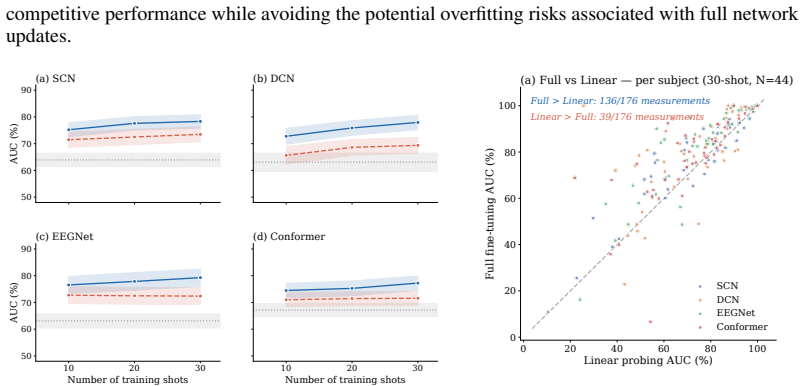
The authors introduce the L-FAME dataset containing pre-intervention and post-intervention EEG recordings from 74 participants randomly assigned to SA-TA-NA-MA, Hare Krishna, or Breath Focus meditation, together with a benchmark suite of three classification tasks: cognitive state decoding between resting and meditation, fine-grained identification of the specific meditation technique, and cross-session adaptation across the six-week interval, along with baseline performance numbers obtained from a range of classical and deep learning classifiers.
What carries the argument
The L-FAME dataset and its three-task benchmark, which uses the longitudinal pre/post design and the three distinct meditation groups to create labeled EEG examples for state decoding, technique classification, and temporal generalization.
If this is right
- Researchers can evaluate new models on their ability to decode cognitive states from EEG during meditation versus rest.
- The fine-grained task allows direct comparison of how well algorithms distinguish between specific mantra and breath practices.
- The cross-session task measures whether models trained on pre-intervention data generalize to post-intervention recordings after training.
- Public release of the full dataset and code creates a shared testbed for new preprocessing methods and classifiers in meditation EEG research.
Where Pith is reading between the lines
- If the benchmarks prove solvable, the dataset could support development of real-time neurofeedback systems that guide users toward particular meditation states.
- Longitudinal labels may enable studies of how neural signatures of a given practice change with repeated training.
- The three-group design could be extended to test whether models trained on one meditation type transfer to another.
Load-bearing premise
The three chosen meditation practices and the two-session design produce distinguishable EEG patterns that the classification tasks can meaningfully separate.
What would settle it
Baseline models achieving only chance-level accuracy on all three tasks, or statistical tests showing no reliable EEG differences between rest and meditation or between the three techniques, would show the dataset does not support the intended benchmarks.
Figures


read the original abstract
We introduce a novel Longitudinal Focused Attention Meditation Electroencephalography (L-FAME) dataset and an accompanying benchmark, designed to foster research into the neural effects of various meditation practices and the evolution of these effects over a six-week training period. The dataset contains EEG recordings and psychological assessments from 74 healthy college participants, collected at two distinct time points: pre-intervention and post-intervention. Participants were randomly assigned to one of three distinct meditation groups: two mantra-based techniques (SA-TA-NA-MA and Hare Krishna) and one Breath Focus practice. Leveraging this unique longitudinal and comparative dataset, we propose a benchmark suite comprising three distinct classification tasks: (1) cognitive state decoding to distinguish between resting and meditation states, (2) fine-grained classification of the specific meditation techniques, and (3) cross-session adaptation to evaluate model generalization across the longitudinal time gap. We provide comprehensive baseline results for these tasks utilizing a range of classical machine learning algorithms and deep learning architectures. The complete dataset, preprocessing pipelines, and benchmark evaluation code will be publicly released, offering a valuable resource and a standardized framework for the development and comparison of new analytical methods in computational meditation research and EEG-based machine learning. The dataset is available at https://huggingface.co/datasets/L-FAME-Dataset-Benchmark/L-FAME
Editorial analysis
A structured set of objections, weighed in public.
Referee Report
Summary. The paper introduces the L-FAME dataset consisting of EEG recordings and psychological assessments from 74 healthy college participants at two time points (pre- and post-intervention) across three meditation groups (SA-TA-NA-MA, Hare Krishna, and Breath Focus). It defines a benchmark suite with three tasks—cognitive state decoding (rest vs. meditation), fine-grained technique classification, and cross-session adaptation—and supplies baseline results using classical ML algorithms and deep learning architectures. The dataset, preprocessing pipelines, and evaluation code are to be publicly released.
Significance. If the dataset and baselines hold as described, this provides a valuable standardized resource for longitudinal and comparative studies of focused attention meditation in EEG, addressing a gap in public multi-technique longitudinal data. The explicit public release of data, pipelines, and code is a clear strength that supports reproducibility and community use in computational meditation research and EEG ML.
major comments (2)
- [Benchmark suite definition] The section defining the benchmark suite does not explicitly detail how the three meditation states were segmented from continuous recordings or how labels were assigned for the state-decoding and technique-classification tasks; this information is load-bearing for interpreting the baseline results and ensuring the tasks evaluate the claimed distinctions.
- [Methods / Dataset description] Participant allocation is described as random assignment to groups, but no per-group counts, demographic stratification, or power analysis is provided; this affects assessment of whether the fine-grained technique classification task has sufficient balance to support the reported baselines.
minor comments (2)
- [Abstract] The abstract states that comprehensive baseline results are supplied but includes no numerical accuracies, error bars, or key findings; adding a sentence with headline metrics would improve the standalone readability of the abstract.
- [Figures] Figure captions for any EEG topoplots or performance plots should explicitly state the number of participants and sessions contributing to each panel.
Simulated Author's Rebuttal
We thank the referee for the constructive review and positive recommendation of minor revision. We address each major comment below and will revise the manuscript accordingly to improve clarity and completeness.
read point-by-point responses
-
Referee: [Benchmark suite definition] The section defining the benchmark suite does not explicitly detail how the three meditation states were segmented from continuous recordings or how labels were assigned for the state-decoding and technique-classification tasks; this information is load-bearing for interpreting the baseline results and ensuring the tasks evaluate the claimed distinctions.
Authors: We agree that explicit segmentation and labeling details are necessary for full interpretability. The current manuscript describes the three tasks at a high level in the benchmark suite section. In the revision we will add a dedicated subsection that specifies the use of event markers to segment meditation periods from continuous recordings, the exact temporal windows extracted for each state, and the label assignment rules for both the cognitive-state (rest vs. meditation) and technique-classification tasks. revision: yes
-
Referee: [Methods / Dataset description] Participant allocation is described as random assignment to groups, but no per-group counts, demographic stratification, or power analysis is provided; this affects assessment of whether the fine-grained technique classification task has sufficient balance to support the reported baselines.
Authors: We acknowledge the value of these details for evaluating task balance. The manuscript states that participants were randomly assigned; we will expand the participant section to report the exact per-group counts, summarize available demographic variables, and include a brief note on sample-size considerations drawn from prior EEG meditation literature. revision: yes
Circularity Check
No significant circularity
full rationale
The paper is a dataset release and benchmark paper whose central claim is the public introduction of the L-FAME EEG recordings, psychological assessments, preprocessing pipelines, and three defined classification tasks (cognitive state decoding, meditation technique classification, cross-session adaptation) together with baseline ML/DL results. No mathematical derivations, equations, fitted parameters, or predictions appear in the provided text. The baseline results are empirical evaluations on the released data rather than quantities that reduce to the inputs by construction. None of the six enumerated circularity patterns apply; the work is self-contained as a resource contribution whose validity does not depend on internal self-definition or self-citation chains.
Axiom & Free-Parameter Ledger
Reference graph
Works this paper leans on
-
[1]
Ahmad Chaddad, Yihang Wu, Reem Kateb, and Ahmed Bouridane. Electroencephalography signal processing: A comprehensive review and analysis of methods and techniques.Sensors, 23(14):6434, 2023
work page 2023
-
[2]
Tarik S Bel-Bahar, Anam A Khan, Riaz B Shaik, and Muhammad A Parvaz. A scoping review of electroencephalographic (eeg) markers for tracking neurophysiological changes and predicting outcomes in substance use disorder treatment.Frontiers in human neuroscience, 16:995534, 2022
work page 2022
-
[3]
Robert H Logie, Annalena Venneri, Sergio Della Sala, Thomas W Redpath, and Ian Marshall. Brain activation and the phonological loop: The impact of rehearsal.Brain and Cognition, 53(2):293–296, 2003
work page 2003
-
[4]
A deep learning approach for mental fatigue state assessment.Sensors, 25(2):555, 2025
Jiaxing Fan, Lin Dong, Gang Sun, and Zhize Zhou. A deep learning approach for mental fatigue state assessment.Sensors, 25(2):555, 2025
work page 2025
-
[5]
Automated classification of eeg signals for predicting students’ cognitive state during learning
Xi Liu, Pang-Ning Tan, Lei Liu, and Steven J Simske. Automated classification of eeg signals for predicting students’ cognitive state during learning. InProceedings of the international conference on web intelligence, pages 442–450, 2017
work page 2017
-
[6]
Shaohua Tang, Yutong Liang, and Zheng Li. Mind wandering state detection during video-based learning via eeg.Frontiers in human neuroscience, 17:1182319, 2023
work page 2023
-
[7]
Julio Rodriguez-Larios, Kian Foong Wong, and Julian Lim. Assessing the effects of an 8-week mindfulness training program on neural oscillations and self-reports during meditation practice. Plos one, 19(6):e0299275, 2024
work page 2024
-
[8]
Zongpai Zhang, Wen-Ming Luh, Wenna Duan, Grace D Zhou, George Weinschenk, Adam K Anderson, and Weiying Dai. Longitudinal effects of meditation on brain resting-state functional connectivity.Scientific reports, 11(1):11361, 2021
work page 2021
-
[9]
Angqi Li, Julio Rodriguez-Larios, Mengsen Zhang, Taosheng Liu, Barry H Cohen, and Saiprasad Ravishankar. Not all mantra meditations are equal: Emergence of divergent al- pha oscillatory dynamics across mantras.bioRxiv, pages 2026–02, 2026
work page 2026
-
[10]
Emilee E Burgess, Steven Selchen, Benjamin D Diplock, and Neil A Rector. A brief mindfulness- based cognitive therapy (mbct) intervention as a population-level strategy for anxiety and depression.International Journal of Cognitive Therapy, 14(2):380–398, 2021
work page 2021
-
[11]
Bassam Khoury, Manoj Sharma, Sarah E Rush, and Claude Fournier. Mindfulness-based stress reduction for healthy individuals: A meta-analysis.Journal of psychosomatic research, 78(6):519–528, 2015
work page 2015
-
[12]
RuiFang Lyu. Deep learning approaches for eeg-based healthcare applications: a comprehensive review.Frontiers in Human Neuroscience, 19:1689073, 2026
work page 2026
-
[13]
Zixiang Liu and Juan Zhao. Leveraging deep learning for robust eeg analysis in mental health monitoring.Frontiers in neuroinformatics, 18:1494970, 2025
work page 2025
-
[14]
Tracy Brandmeyer, Arnaud Delorme, and Helané Wahbeh. The neuroscience of meditation: classification, phenomenology, correlates, and mechanisms.Progress in Brain Research, 244:1– 29, 2019
work page 2019
-
[15]
Leonardo Novelli, Devon Stoliker, Tamrin Barta, Matthew D Greaves, Sidhant Chopra, James Jackson, Jessica Kwee, Martin L Williams, and Adeel Razi. Psiconnect: A multimodal neuroimaging study of psilocybin-induced changes in brain and behaviour.bioRxiv, pages 2025–04, 2025
work page 2025
-
[16]
The neuroscience of mindfulness meditation.Nature Reviews Neuroscience, 16(4):213–225, 2015
Yi-Yuan Tang, Britta K Hölzel, and Michael I Posner. The neuroscience of mindfulness meditation.Nature Reviews Neuroscience, 16(4):213–225, 2015
work page 2015
-
[17]
Moabb: trustworthy algorithm benchmarking for bcis
Vinay Jayaram and Alexandre Barachant. Moabb: trustworthy algorithm benchmarking for bcis. Journal of neural engineering, 15(6):066011, 2018. 11
work page 2018
-
[18]
Fabien Lotte, Marco Congedo, Anatole Lécuyer, Fabrice Lamarche, and Bruno Arnaldi. A review of classification algorithms for eeg-based brain–computer interfaces.Journal of neural engineering, 4(2):R1–R13, 2007
work page 2007
-
[19]
Baoxiang Shang, Feiyan Duan, Ruiqi Fu, Junling Gao, Hinhung Sik, Xianghong Meng, and Chunqi Chang. Eeg-based investigation of effects of mindfulness meditation training on state and trait by deep learning and traditional machine learning.Frontiers in human neuroscience, 17:1033420, 2023
work page 2023
-
[20]
Attention regulation and monitoring in meditation.Trends in cognitive sciences, 12(4):163–169, 2008
Antoine Lutz, Heleen A Slagter, John D Dunne, and Richard J Davidson. Attention regulation and monitoring in meditation.Trends in cognitive sciences, 12(4):163–169, 2008
work page 2008
-
[21]
Brain computer interfaces, a review
Luis Fernando Nicolas-Alonso and Jaime Gomez-Gil. Brain computer interfaces, a review. sensors, 12(2):1211–1279, 2012
work page 2012
-
[22]
Sander Koelstra, Christian Muhl, Mohammad Soleymani, Jong-Seok Lee, Ashkan Yazdani, Touradj Ebrahimi, Thierry Pun, Anton Nijholt, and Ioannis Patras. Deap: A database for emotion analysis; using physiological signals.IEEE transactions on affective computing, 3(1):18–31, 2011
work page 2011
-
[23]
Wei-Long Zheng and Bao-Liang Lu. Investigating critical frequency bands and channels for eeg-based emotion recognition with deep neural networks.IEEE Transactions on autonomous mental development, 7(3):162–175, 2015
work page 2015
-
[24]
Gan Huang, Zhiheng Zhao, Shaorong Zhang, Zhenxing Hu, Jiaming Fan, Meisong Fu, Jiale Chen, Yaqiong Xiao, Jun Wang, and Guo Dan. Discrepancy between inter-and intra-subject variability in eeg-based motor imagery brain-computer interface: Evidence from multiple perspectives.Frontiers in neuroscience, 17:1122661, 2023
work page 2023
-
[25]
Dean J Krusienski, Moritz Grosse-Wentrup, Ferran Galán, Damien Coyle, Kai J Miller, Elliott Forney, and Charles W Anderson. Critical issues in state-of-the-art brain–computer interface signal processing.Journal of neural engineering, 8(2):025002, 2011
work page 2011
-
[26]
Tracy Brandmeyer and Arnaud Delorme. Reduced mind wandering in experienced meditators and associated eeg correlates.Experimental brain research, 236:2519–2528, 2018
work page 2018
-
[27]
Peera Wongupparaj. Eeg absolute and relative powers during mindfulness meditation: Data from thai buddhist monks.Mendeley Data V1, 2024
work page 2024
-
[28]
Krzysztof J Gorgolewski, Tibor Auer, Vince D Calhoun, R Cameron Craddock, Samir Das, Eugene P Duff, Guillaume Flandin, Satrajit S Ghosh, Tristan Glatard, Yaroslav O Halchenko, et al. The brain imaging data structure, a format for organizing and describing outputs of neuroimaging experiments.Scientific data, 3(1):1–9, 2016
work page 2016
-
[29]
Andreas Widmann, Erich Schröger, and Burkhard Maess. Digital filter design for electrophysio- logical data – a practical approach.Journal of Neuroscience Methods, 250:34–46, 2015
work page 2015
-
[30]
Alain de Cheveigné. Zapline-plus: a flexible and easy-to-use tool for automatic and robust removal of power line artifacts.NeuroImage, 216:116561, 2020
work page 2020
-
[31]
Cleanrawdata: Artifact subspace reconstruction on matlab
Tim Mullen. Cleanrawdata: Artifact subspace reconstruction on matlab. EEGLAB plugin, 2012
work page 2012
-
[32]
Laura Pion-Tonachini, Ken Kreutz-Delgado, and Scott Makeig. Iclabel: an automated elec- troencephalographic independent component classifier, dataset, and website.NeuroImage, 198:181–197, 2019
work page 2019
-
[33]
Eeg is better left alone.Scientific reports, 13(1):2372, 2023
Arnaud Delorme. Eeg is better left alone.Scientific reports, 13(1):2372, 2023
work page 2023
-
[34]
How eeg preprocessing shapes decoding performance.Communications Biology, 8(1):1039, 2025
Roman Kessler, Alexander Enge, and Michael A Skeide. How eeg preprocessing shapes decoding performance.Communications Biology, 8(1):1039, 2025. 12
work page 2025
-
[35]
Deep learning with convolutional neural networks for eeg decoding and visualization
Robin Tibor Schirrmeister, Jost Tobias Springenberg, Lukas Dominique Josef Fiederer, Martin Glasstetter, Katharina Eggensperger, Michael Tangermann, Frank Hutter, Wolfram Burgard, and Tonio Ball. Deep learning with convolutional neural networks for eeg decoding and visualization. Human brain mapping, 38(11):5391–5420, 2017
work page 2017
-
[36]
Vernon J Lawhern, Amelia J Solon, Nicholas R Waytowich, Stephen M Gordon, Chou P Hung, and Brent J Lance. Eegnet: a compact convolutional neural network for eeg-based brain–computer interfaces.Journal of neural engineering, 15(5):056013, 2018
work page 2018
-
[37]
Yonghao Song, Qingqing Zheng, Bingchuan Liu, and Xiaorong Gao. Eeg conformer: Convolu- tional transformer for eeg decoding and visualization.IEEE Transactions on Neural Systems and Rehabilitation Engineering, 31:710–719, 2022
work page 2022
-
[38]
Inter-and intra-individual variability in alpha peak frequency.Neuroimage, 92:46–55, 2014
Saskia Haegens, Helena Cousijn, George Wallis, Paul J Harrison, and Anna C Nobre. Inter-and intra-individual variability in alpha peak frequency.Neuroimage, 92:46–55, 2014
work page 2014
-
[39]
Bianca Ventura, Yasir Çatal, Angelika Wolman, Andrea Buccellato, Austin Clinton Cooper, and Georg Northoff. Intrinsic neural timescales exhibit different lengths in distinct meditation techniques.Neuroimage, 297:120745, 2024
work page 2024
-
[40]
Julio Rodriguez-Larios, Eduardo A Bracho Montes de Oca, and Kaat Alaerts. The eeg spectral properties of meditation and mind wandering differ between experienced meditators and novices. NeuroImage, 245:118669, 2021
work page 2021
-
[41]
Frontal theta as a mechanism for cognitive control
James F Cavanagh and Michael J Frank. Frontal theta as a mechanism for cognitive control. Trends in cognitive sciences, 18(8):414–421, 2014
work page 2014
-
[42]
Tim Lomas, Itai Ivtzan, and Cynthia HY Fu. A systematic review of the neurophysiology of mindfulness on eeg oscillations.Neuroscience & Biobehavioral Reviews, 57:401–410, 2015
work page 2015
-
[43]
Mea- suring phase synchrony in brain signals.Human brain mapping, 8(4):194–208, 1999
Jean-Philippe Lachaux, Eugenio Rodriguez, Jacques Martinerie, and Francisco J Varela. Mea- suring phase synchrony in brain signals.Human brain mapping, 8(4):194–208, 1999
work page 1999
-
[44]
Perceived stress in a probability sample of the united states
Sheldon Cohen. Perceived stress in a probability sample of the united states. 1988
work page 1988
-
[45]
Ernst Bohlmeijer, Peter M Ten Klooster, Martine Fledderus, Martine Veehof, and Ruth Baer. Psychometric properties of the five facet mindfulness questionnaire in depressed adults and development of a short form.Assessment, 18(3):308–320, 2011
work page 2011
-
[46]
Wolf E Mehling, Michael Acree, Anita Stewart, Jonathan Silas, and Alexander Jones. The multidimensional assessment of interoceptive awareness, version 2 (maia-2).PloS one, 13(12):e0208034, 2018. 13 Appendix This appendix provides supplementary material organized into four sections. The first section presents comprehensive dataset documentation adhering to...
work page 2018
-
[47]
Eyes-Open Resting State (restOE) - 2 mins:For this initial baseline, participants were instructed to keep their eyes open and maintain a relaxed state
-
[48]
close your eyes and let your mind wander
Eyes-Closed Resting State 1 (restCE01) - 4 mins:For this pre-task baseline, participants were instructed to“close your eyes and let your mind wander."
-
[49]
close your eyes throughout the task, chant the assigned mantra out loud, and focus on the mantra
Active Meditation (Medita) - 8 mins:The instructions for this block were dependent on the assigned group. Participants in the mantra groups (SA and HK) were instructed to“close your eyes throughout the task, chant the assigned mantra out loud, and focus on the mantra." Participants in the BF group were instructed to“close their eyes and perform alternate ...
-
[50]
Eyes-Closed Resting State 2 (restCE02) - 4 mins:This post-meditation resting interval utilized instructions identical to those of restCE01
-
[51]
Silent Meditation (slMedita) - 8 mins:Participants in the SA and HK groups were instructed to“repeat the mantra in your mind, like inner speech, and focus on that with eyes closed throughout the task time."Participants in the BF group were instructed to“close your eyes and focus on your breathing". 19 B.4 Psychometric Questionnaires To establish a compreh...
discussion (0)
Sign in with ORCID, Apple, or X to comment. Anyone can read and Pith papers without signing in.