HiFAST: An HI data calibration and imaging pipeline for the FAST IV: The stray-radiation correction
Pith reviewed 2026-05-25 02:36 UTC · model grok-4.3
The pith
Stray radiation from side lobes in FAST L-band data can be corrected using measured beam patterns, adjusting fluxes of extended sources like M33 by up to 20 percent.
A machine-rendered reading of the paper's core claim, the machinery that carries it, and where it could break.
Core claim
The central claim is that the observed beam patterns enable a module that subtracts stray radiation from side lobes within the HiFAST pipeline, and that this correction changes measured fluxes of extended sources such as M33 by as much as 20 percent while main-beam efficiency remains above 90 percent across the L band.
What carries the argument
The measured beam patterns of the L-band receiver, used to model and subtract side-lobe stray radiation.
If this is right
- Side-lobe flux must be evaluated for any extended source with significant surface density gradients.
- Main beam efficiency exceeds 90 percent but decreases slowly with frequency.
- The correction module integrates directly into the standard HI data reduction process.
- Beam pattern data across 15 frequency bins enables high-redshift HI intensity map studies.
- The module and pattern data are released publicly with the HiFAST pipeline.
Where Pith is reading between the lines
- The frequency-dependent efficiency values could be used to test how well the correction holds when the telescope points at different elevations or in different weather.
- Similar side-lobe modeling might reduce systematic errors in intensity-mapping surveys on other large single-dish telescopes.
- Public release of the beam patterns allows other groups to apply the same correction to archival FAST data or to simulate future observations.
- For high-redshift work the correction reduces the risk that side-lobe leakage mimics large-scale structure signals.
Load-bearing premise
The beam patterns measured in recent observations are assumed to stay stable and representative of the telescope response in all science data.
What would settle it
Independent total-flux measurements of M33 from another telescope, compared before and after applying the HiFAST correction, would show whether the 20 percent adjustment is required.
Figures



read the original abstract
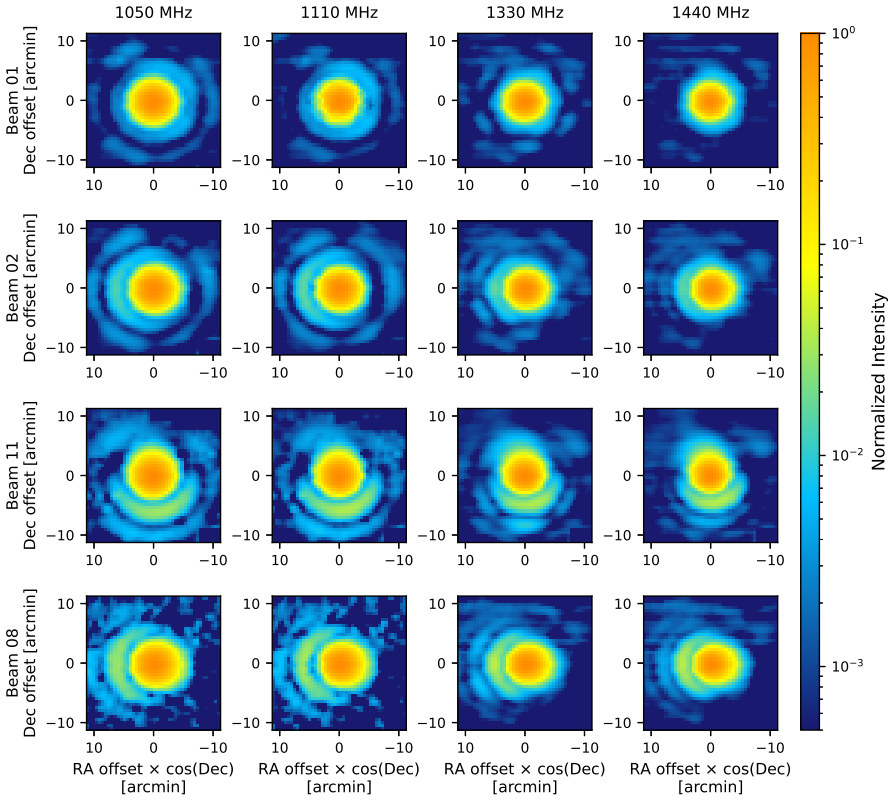
Stray radiation is a considerable challenge for radio telescopes, requiring careful assessment due to its effects. This is crucial when the strong background flux from side lobes significantly affects the total flux, especially for extended sources. In this study, we introduced the beam pattern of the L-band receiver on the Five-hundred-meter Aperture Spherical Telescope (FAST), covering various frequencies based on recent observations. We discovered that the main beam efficiency of all beams exceeds 90\% throughout the L band frequencies, with efficiency decreasing slowly as frequency increases. Subsequently, we developed a module to mitigate stray radiation effects, incorporating it into FAST's standard \HI data reduction process, referred to as \texttt{HiFAST}. Our analysis shows that side lobe flux's influence, particularly for extended sources with significant surface density gradients, necessitates detailed evaluation. Corrections for the extended M33 galaxy can reach up to 20\%. Moreover, the pattern data presented here is vital for studying HI intensity maps at high redshift. The module, along with HiFAST and beam pattern data across 15 frequency bins, can be accessed at \textrm{https://hifast.readthedocs.io}. The datasets of beam pattern presented in this paper, are openly available at \textrm{https://doi.org/10.57760/sciencedb.j00113.00266} (https://www.scidb.cn/s/bqQRNv).
Editorial analysis
A structured set of objections, weighed in public.
Referee Report
Summary. The paper measures L-band beam patterns of the FAST telescope from recent observations, reporting main-beam efficiencies above 90% across the band with a slow frequency decline. It implements a stray-radiation correction module within the HiFAST pipeline and shows that the correction can reach 20% for the extended source M33; the beam-pattern data (15 frequency bins) and module are released publicly.
Significance. If the reported beam patterns are stable and representative, the work supplies a concrete, reusable correction tool for FAST HI observations of extended sources and high-redshift intensity mapping. The public release of the beam-pattern datasets and the HiFAST module is a clear strength that enables community reuse and reproducibility.
major comments (2)
- Abstract: The headline claims (main-beam efficiency >90% and up to 20% stray-radiation correction for M33) rest on beam patterns measured in recent observations, yet the manuscript provides no description of the measurement method, error propagation, or any validation against independent data (e.g., holography) or earlier epochs. Without these details the quantitative results cannot be assessed and the correction module's reliability remains unverified.
- Beam-pattern application section: The correction is applied uniformly to all science data by assuming the recently measured far-sidelobe patterns are stable across epochs, elevation, and temperature. No comparative measurements or stability tests are shown; if the sidelobe response drifts, both the efficiency numbers and the 20% M33 correction become time-dependent, undermining the claim that the module can be used uniformly within HiFAST.
minor comments (1)
- The abstract and data-release statements would benefit from explicit statements of the frequency range covered by the 15 bins and the exact DOI landing page for the beam-pattern data.
Simulated Author's Rebuttal
We thank the referee for the detailed and constructive review. We address each major comment below and indicate where revisions will be made to the manuscript.
read point-by-point responses
-
Referee: Abstract: The headline claims (main-beam efficiency >90% and up to 20% stray-radiation correction for M33) rest on beam patterns measured in recent observations, yet the manuscript provides no description of the measurement method, error propagation, or any validation against independent data (e.g., holography) or earlier epochs. Without these details the quantitative results cannot be assessed and the correction module's reliability remains unverified.
Authors: We agree that the original manuscript lacks a dedicated description of the beam-pattern measurement procedure, error analysis, and external validation. In the revised version we will insert a new subsection detailing the observational strategy, source selection, data reduction steps, and basic error estimates used to derive the 15 frequency-bin patterns. Independent cross-checks against holography or prior epochs are not available within the present dataset; we will therefore explicitly note this limitation and qualify the efficiency and correction values accordingly. revision: partial
-
Referee: Beam-pattern application section: The correction is applied uniformly to all science data by assuming the recently measured far-sidelobe patterns are stable across epochs, elevation, and temperature. No comparative measurements or stability tests are shown; if the sidelobe response drifts, both the efficiency numbers and the 20% M33 correction become time-dependent, undermining the claim that the module can be used uniformly within HiFAST.
Authors: We acknowledge that the current text presents the correction as generally applicable without demonstrating stability. The revised manuscript will add an explicit statement of the stability assumption together with a brief discussion of its implications for users. No multi-epoch or multi-condition comparative measurements exist in our current observations, so we cannot supply stability tests; the assumption will therefore be flagged as a caveat for the community. revision: partial
- Absence of independent validation (holography or earlier epochs) for the reported beam patterns
- Lack of any stability tests across epochs, elevation, or temperature
Circularity Check
No circularity: empirical beam measurements and software module are self-contained
full rationale
The paper reports direct measurements of L-band beam patterns from recent observations, states the resulting main-beam efficiencies (>90% with slow frequency decline), and describes a practical stray-radiation correction module applied to M33 data (up to 20% correction). No equations, predictions, or uniqueness claims reduce by construction to fitted parameters defined from the same dataset, nor do any load-bearing steps rely on self-citations whose content is itself unverified. The work is a measurement-plus-implementation pipeline; the stability assumption noted by the skeptic is an external limitation, not a circular reduction inside the derivation chain.
Axiom & Free-Parameter Ledger
Reference graph
Works this paper leans on
-
[1]
Introduction A single-dish radio telescope responds to a point source as a point spread function (PSF). The ideal PSF is an Airy disc featuring a central maximum and diffraction rings, referred to as the main beam and sidelobes in a radio telescope. In practice, the side lobes of a real telescope are higher due to obstructions from the feed cabin and the ...
-
[2]
Observations and Method 2.1.Observational Data The data used in this paper include the scan data of the strong continuum point source to measure the beam patterns of the 19 beam receivers and the data to evaluate the performance of our algorithm, examining both the accuracy and the effect of stray radiation correction on extended sources. To map the beam ...
work page 2023
-
[3]
Results In this section, we will explain how correcting stray radiation affects observational results. We evaluated the impact of stray radiation correction on typical point sources, such as galaxies or other compact objects whose angular diameters are smaller than the beam size of the F AST. Stray radiation tends to scatter a portion of the incoming sign...
-
[4]
Conclusions and Discussion Stray radiation from radio telescopes can be received through both the main beam and the sidelobes. When a telescope is pointed away from a source, that source may still align with the telescope’s sidelobes. Consequently, the flux from the source is incorrectly recorded as coming from the main beam ns current (off-source) positi...
-
[5]
Jiang P, Yue Y, Gan H, Yao R, Li H, Pan G F, Sun J, Yu D, Liu H, Tang N Y, Qian L, Lu J, Su Y, Peng B, Zhang S X, Wang Q, Li Q and Li D 2019 Sci. China Phys. Mech. Astron. 62 959502
work page 2019
-
[6]
Gan H Q, Jiang P, Zhu K, Sun J H, Yao R and Yu D J 2020 Res. Astron. Astrophys. 20 069
work page 2020
-
[7]
Jiang P, Tang N Y, Hou L G, Liu M T, Krčo M, Qian L, Sun J H, Ching T C, Liu B, Duan Y, Yue Y L, Gan H Q, Yao R, Li H, Pan G F, Yu D J, Liu H F, Li D, Peng B and Yan J 2020 Res. Astron. Astrophys. 20 064
work page 2020
- [8]
- [9]
- [10]
- [11]
-
[12]
Higgs L A, Landecker T L, Asgekar A, Davison O S, Rothwell T A and Yar-Uyaniker A 2005 Astron. J. 129 2750
work page 2005
- [13]
- [14]
- [15]
-
[16]
Xu C K, Cheng C, Appleton P N, Duc P A, Gao Y, Tang N Y, Yun M, Dai Y S, Huang J S, Lisenfeld U and Renaud F 2022 Nature 610 461 https://hifast.readthedocs.io/en/v1.3/hifast.sr.html https://www.scidb.cn/s/bqQRNv 13
work page 2022
-
[17]
Jing Y, Wang J, Xu C, Liu Z, Chen Q, Liang T, Xu J, Cao Y, Wang J, Hu H, Zhang C P, Guo Q, Gao L, Ai M, Gan H, Gao X, Han J, Hou L, Hou Z, Jiang P, Kong X, Li F, Liu Z, Shao L, Pan H, Pan J, Qian L, Sun J, Tang N, Yang Q, Zhang B, Zhang Z and Zhu M 2024 Sci. China Phys. Mech. Astron. 67 5
work page 2024
-
[18]
Xu C, Wang J, Jing Y, Li F, Gan H, Liu Z, Liang T, Chen Q, Liu Z, Hou Z, Hu H, Hu H, Huang S, Jiang P, Zhang C P and Zhu Y 2025 Res. Astron. Astrophys. 25 015011
work page 2025
-
[19]
Liu Z, Wang J, Jing Y, Zhang Z Y, Xu C, Liang T, Chen Q, Tang N and Yang Q 2024 Res. Astron. Astrophys. 24 085009
work page 2024
-
[20]
Condon J J, Cotton W D, Greisen E W, Yin Q F, Perley R A, Taylor G B and Broderick J J 1998 Astron. J. 115 1693
work page 1998
- [21]
discussion (0)
Sign in with ORCID, Apple, or X to comment. Anyone can read and Pith papers without signing in.