Learning Dynamic Stability Landscapes in Synchronization Networks
Pith reviewed 2026-05-25 05:02 UTC · model grok-4.3
The pith
Stability landscapes in synchronization networks can be learned directly from graph topology via a graph-to-image task.
A machine-rendered reading of the paper's core claim, the machinery that carries it, and where it could break.
Core claim
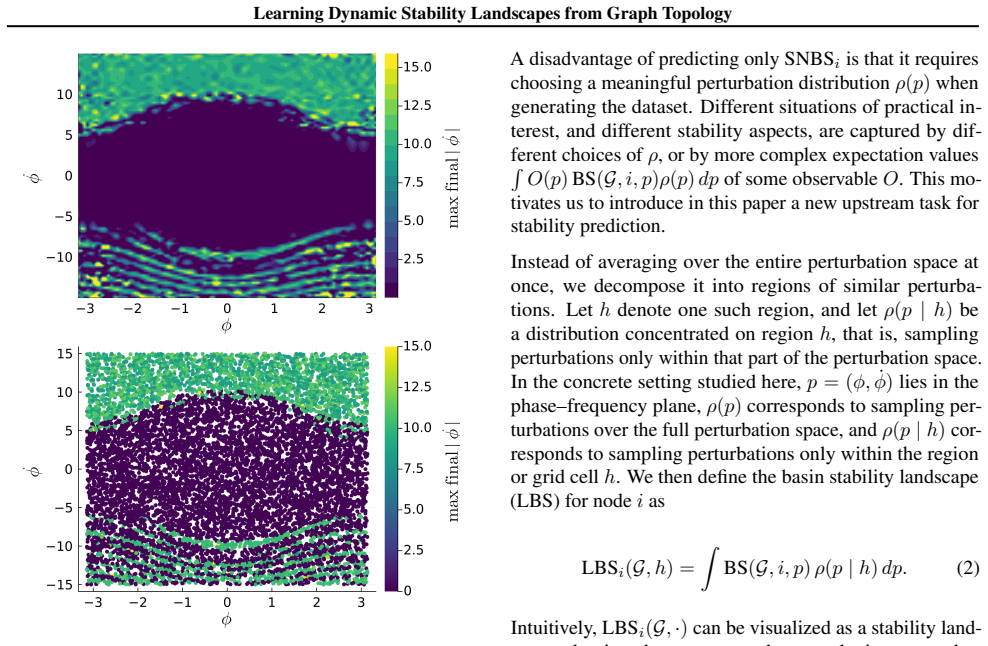
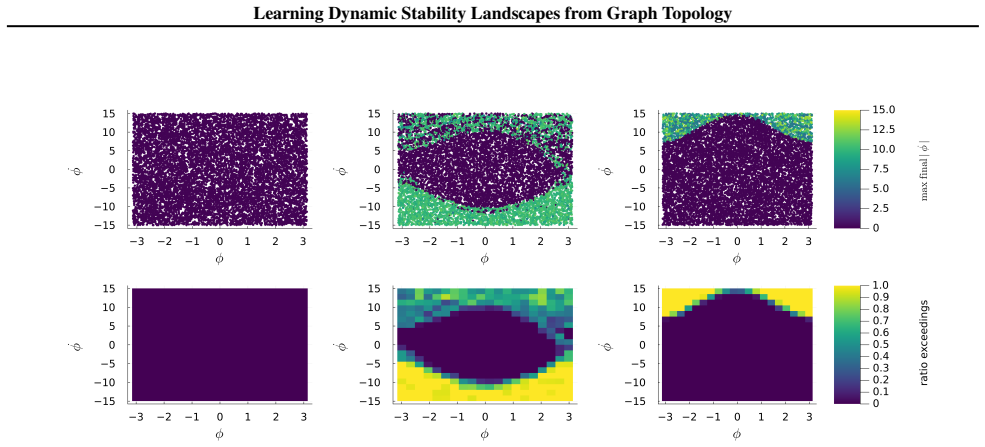
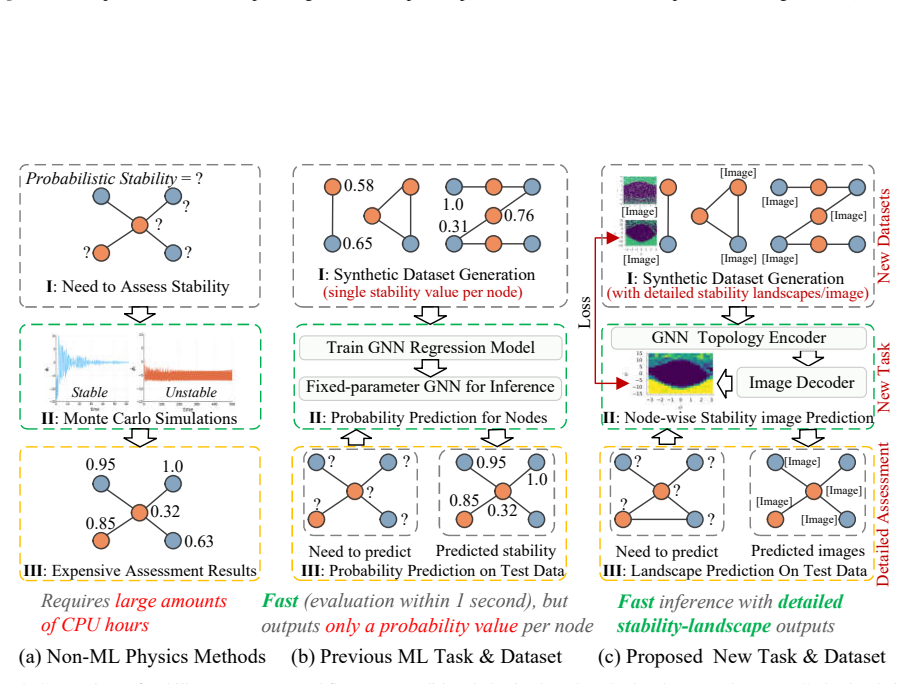
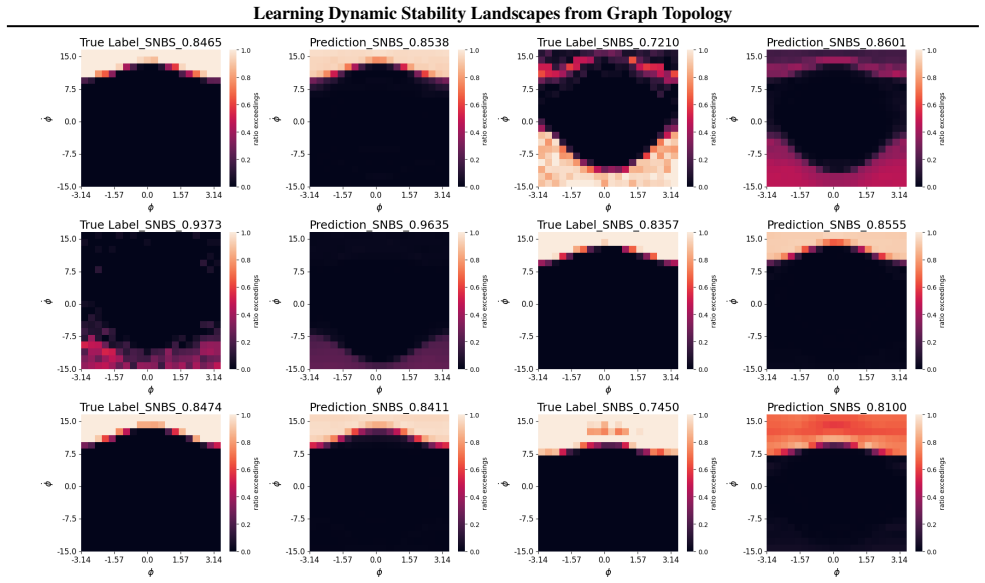
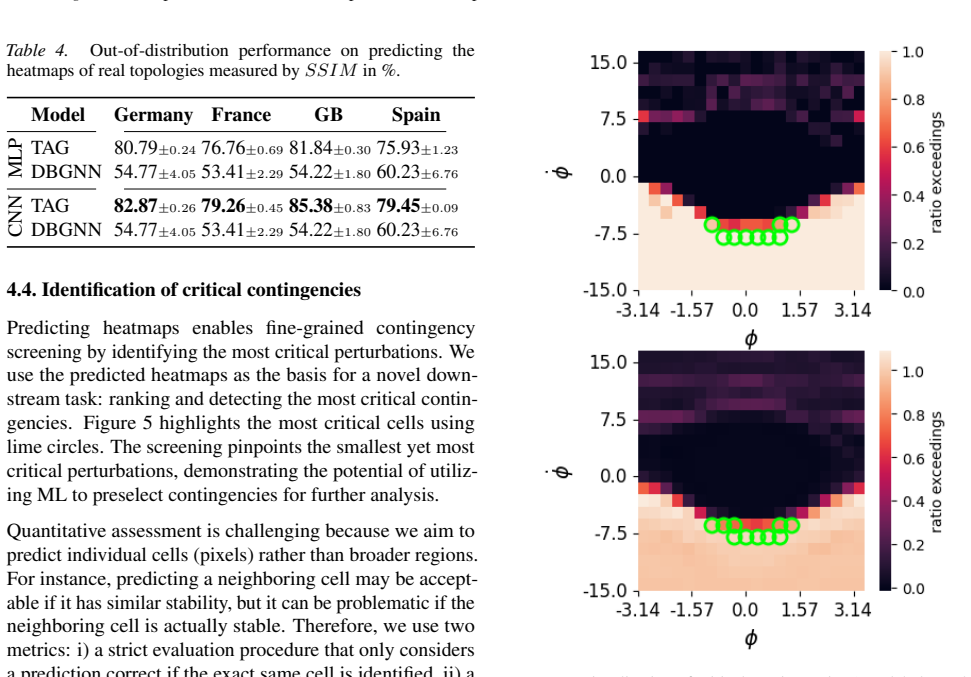
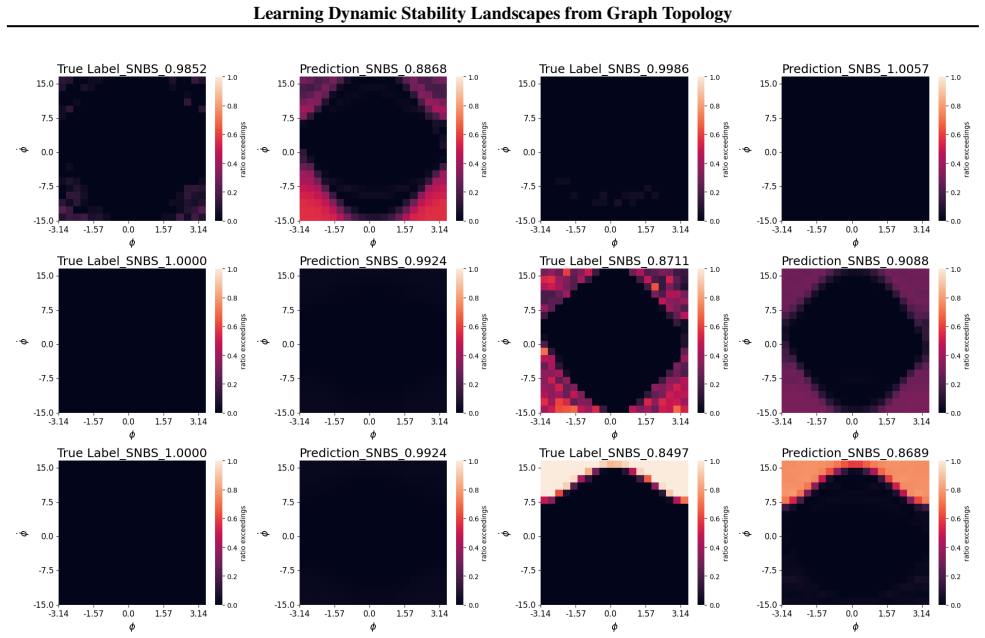
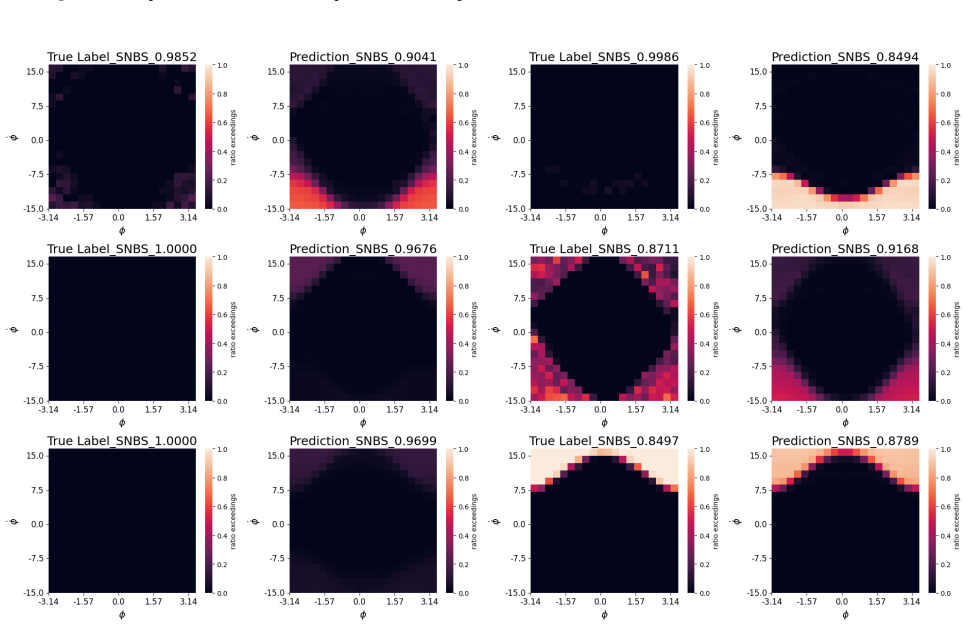
We pioneer a graph-to-image prediction paradigm in which a GNN encodes network topology and a CNN decoder renders per-node image-like stability landscapes; trained on 10,000-graph datasets at 20 and 100 nodes generated from a conceptual oscillator model, the model attains good accuracy within distribution, generalizes across sizes, and transfers to realistic power-grid topologies, showing that stability landscapes are learnable from topology.
What carries the argument
The graph-to-image prediction paradigm, in which a GNN encodes topology and a CNN decoder produces per-node landscape images as targets.
If this is right
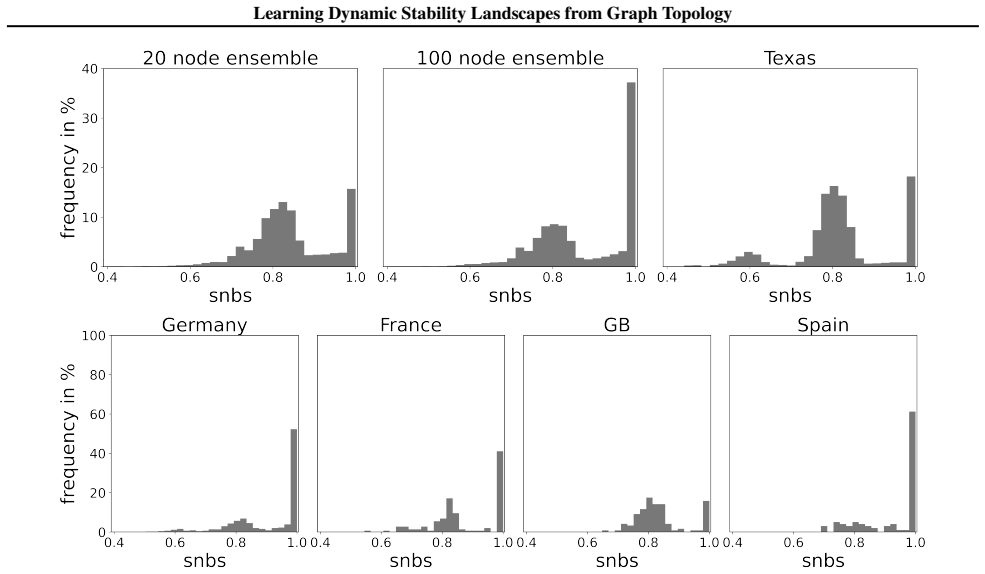
- Many scalar per-node stability indices can be derived from the learned landscape images.
- The approach generalizes across graph sizes from 20 to 100 nodes.
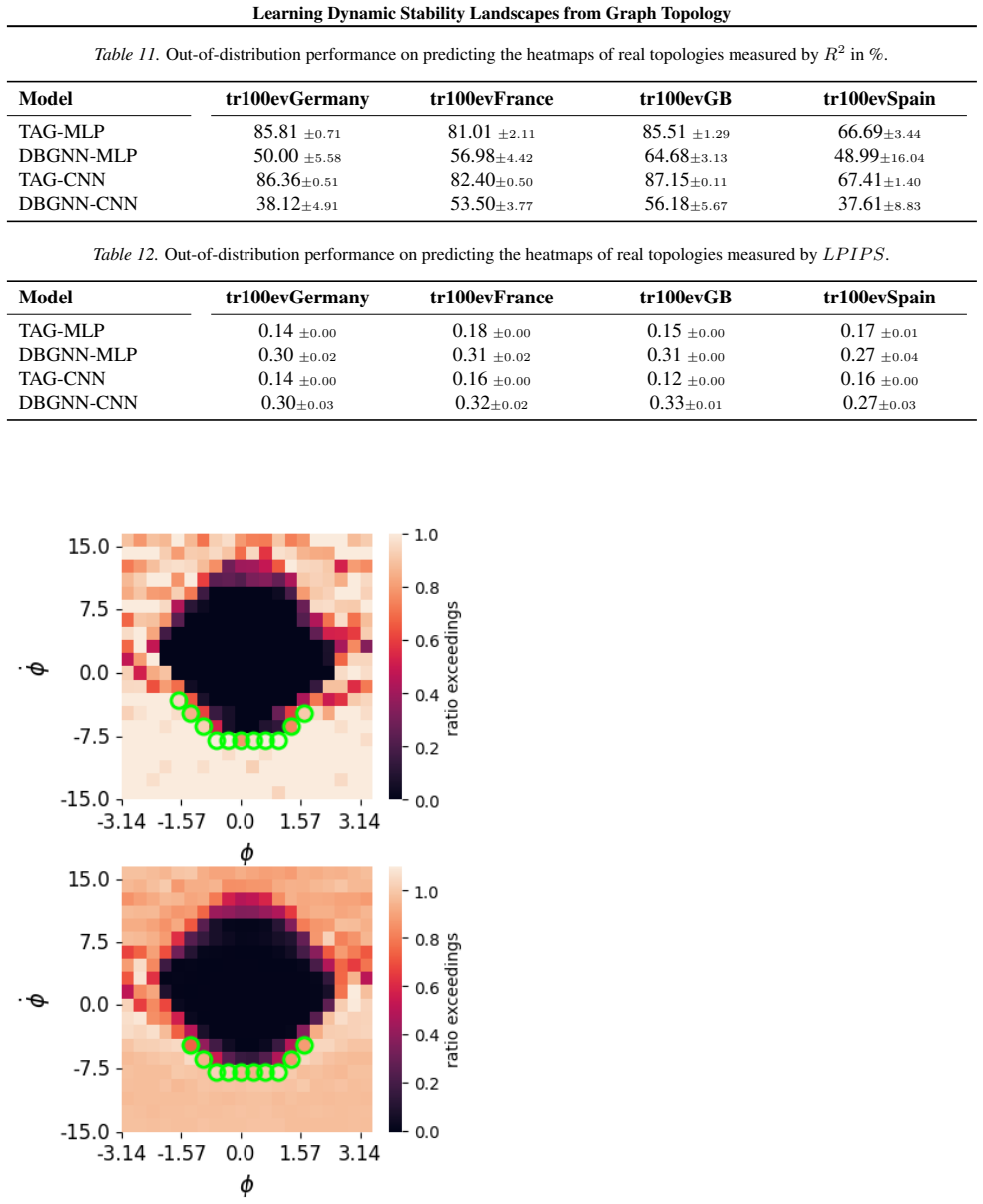
- The model transfers to realistic power-grid topologies outside the training distribution.
- The method opens avenues for moving beyond scalar indices in biology, neuroscience, and power grids.
Where Pith is reading between the lines
- If the learned landscapes prove reliable on real grids, operators could use them to identify nodes whose stability is most sensitive to specific topological changes.
- The same graph-to-image framing might be tested on other dynamical properties such as transient response or basin structure in networked oscillators.
- Topology optimization routines could be coupled to the model to search for graphs that produce desired landscape shapes rather than single scalar targets.
Load-bearing premise
The conceptual oscillator model used to generate the per-node landscape labels accurately represents the synchronization dynamics of interest in real power grids and other systems.
What would settle it
Direct numerical simulation of the oscillator dynamics on a held-out realistic power-grid topology, followed by comparison of the resulting per-node stability landscapes against those predicted by the trained GNN-CNN model.
Figures
read the original abstract
The robustness of synchronization is typically characterized by scalar, per-node stability indices whose dependence on topology is studied via network science or graph neural networks (GNNs). We propose a novel upstream task, learning stability landscapes, which provide deeper insights into synchronization behavior and from which many such scalar indices can be derived. Crucially, we pioneer a graph-to-image prediction paradigm: learning image-like landscapes as per-node targets directly from graph topology, a formulation we are not aware of having been established elsewhere in the literature. To support this task, we release two datasets of 10,000 graphs each at 20 and 100 nodes with per-node landscape labels, based on a conceptual oscillator model, capturing power grid synchronization behavior. A GNN encodes topology and a CNN decoder renders per-node images, learned end-to-end with good in-distribution accuracy, generalizing across graph sizes and to realistic power grid topologies. This demonstrates that stability landscapes, while beyond the reach of conventional network science, are learnable from topology and open new avenues for moving beyond scalar stability indices in biology, neuroscience, and power grids.
Editorial analysis
A structured set of objections, weighed in public.
Referee Report
Summary. The manuscript proposes a graph-to-image prediction task to learn per-node stability landscapes in synchronization networks directly from topology. A GNN encodes the graph and a CNN decoder produces image-like per-node landscape targets, trained end-to-end on two released datasets of 10,000 graphs each (20-node and 100-node) whose labels are generated by a conceptual oscillator model claimed to capture power-grid synchronization. The approach is reported to achieve good in-distribution accuracy, to generalize across graph sizes, and to extend to realistic power-grid topologies, thereby enabling derivation of scalar stability indices and providing deeper insight than conventional network-science methods.
Significance. If the empirical results and model assumptions hold, the work establishes a new upstream task that moves synchronization analysis beyond scalar per-node indices and demonstrates that topology-to-landscape mappings are learnable. The public release of the two 10,000-graph datasets constitutes a concrete, reusable contribution. The significance is limited, however, by the absence of any reported validation that the conceptual oscillator labels match the structural properties of established higher-fidelity models (swing equation, Kuramoto with measured parameters) on benchmark grids.
major comments (2)
- [Abstract, dataset construction paragraph] Abstract, dataset-construction paragraph: the claim that the datasets 'capture power grid synchronization behavior' and that the method generalizes 'to realistic power grid topologies' rests on an unverified assumption that the conceptual oscillator model produces landscapes structurally consistent with swing-equation or Kuramoto dynamics. No comparison to measured-parameter Kuramoto, no sensitivity analysis to coupling form or damping, and no quantitative match to known stability indices on benchmark grids are supplied. This assumption is load-bearing for the central claim that the learned mapping addresses the synchronization phenomenon of interest rather than an artifact of the label generator.
- [Abstract] Abstract: the assertion of 'good in-distribution accuracy' and generalization is presented without any quantitative metrics, baselines, error bars, ablation studies, or cross-validation details. Because the soundness of the empirical demonstration cannot be assessed from the supplied information, the strength of the central learnability result remains unevaluable.
Simulated Author's Rebuttal
We thank the referee for the constructive comments. We address each major point below, indicating planned revisions where the manuscript requires clarification or additional discussion.
read point-by-point responses
-
Referee: [Abstract, dataset construction paragraph] Abstract, dataset-construction paragraph: the claim that the datasets 'capture power grid synchronization behavior' and that the method generalizes 'to realistic power grid topologies' rests on an unverified assumption that the conceptual oscillator model produces landscapes structurally consistent with swing-equation or Kuramoto dynamics. No comparison to measured-parameter Kuramoto, no sensitivity analysis to coupling form or damping, and no quantitative match to known stability indices on benchmark grids are supplied. This assumption is load-bearing for the central claim that the learned mapping addresses the synchronization phenomenon of interest rather than an artifact of the label generator.
Authors: We acknowledge that the manuscript relies on a conceptual oscillator model for label generation without providing direct comparisons to the swing equation or Kuramoto models fitted to measured parameters on benchmark grids, nor sensitivity analyses. The model was chosen to enable scalable dataset creation while capturing core synchronization features. We will add an explicit limitations section stating that all results are with respect to this conceptual model, revise phrasing in the abstract and dataset section to avoid implying direct equivalence to higher-fidelity power-grid models, and note that empirical validation against established models remains future work. revision: partial
-
Referee: [Abstract] Abstract: the assertion of 'good in-distribution accuracy' and generalization is presented without any quantitative metrics, baselines, error bars, ablation studies, or cross-validation details. Because the soundness of the empirical demonstration cannot be assessed from the supplied information, the strength of the central learnability result remains unevaluable.
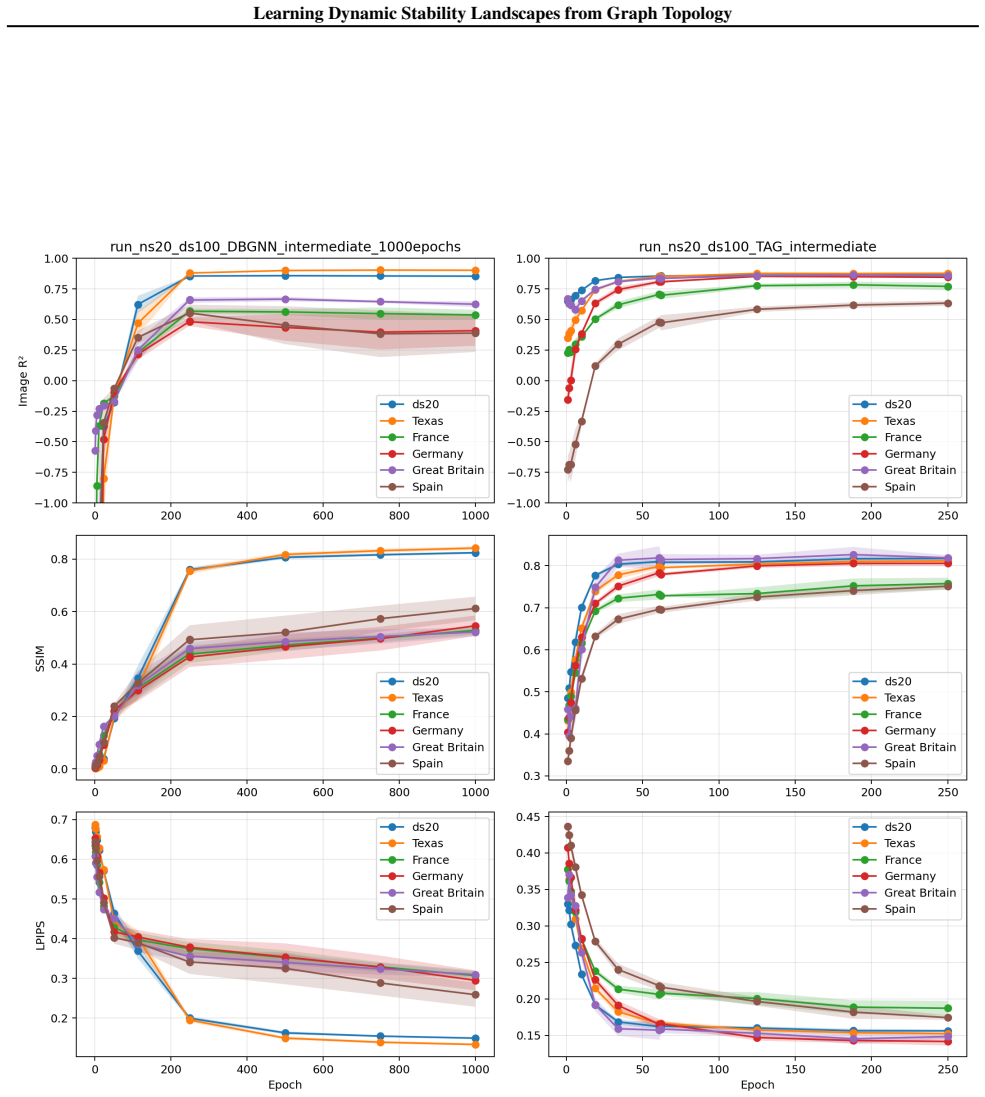
Authors: We agree the abstract is too high-level. The body of the manuscript reports specific metrics (MSE on predicted landscapes, derived scalar index accuracy), comparisons against baselines (e.g., topology-only predictors and non-CNN decoders), error bars across random seeds, and cross-size / cross-topology generalization results with the described train/validation splits. We will revise the abstract to include the key quantitative figures and a brief statement of the evaluation protocol. revision: yes
Circularity Check
No circularity; empirical ML task on externally generated labels
full rationale
The paper defines an upstream ML task of predicting per-node stability landscape images from graph topology using a GNN encoder and CNN decoder, trained end-to-end on two synthetic datasets of 10,000 graphs each. Labels are produced by a separate conceptual oscillator model whose outputs serve as fixed targets; the learned mapping is evaluated by in-distribution accuracy and generalization, with no equations or claims that reduce a derived quantity to a fitted parameter or self-citation by construction. No self-definitional steps, fitted-input predictions, or load-bearing self-citations appear in the provided text. The result is a standard supervised prediction experiment whose validity rests on the external label generator rather than internal tautology.
Axiom & Free-Parameter Ledger
axioms (1)
- domain assumption The conceptual oscillator model captures relevant power-grid synchronization behavior for generating landscape labels
Lean theorems connected to this paper
-
Cost/FunctionalEquationwashburn_uniqueness_aczel unclear?
unclearRelation between the paper passage and the cited Recognition theorem.
We model each node ... as a paradigmatic second-order Kuramoto model (Eq. 4) ... fix ... alpha=0.1 ... K=9 ... Pi in {-1,+1}
-
Foundation/DimensionForcingreality_from_one_distinction unclear?
unclearRelation between the paper passage and the cited Recognition theorem.
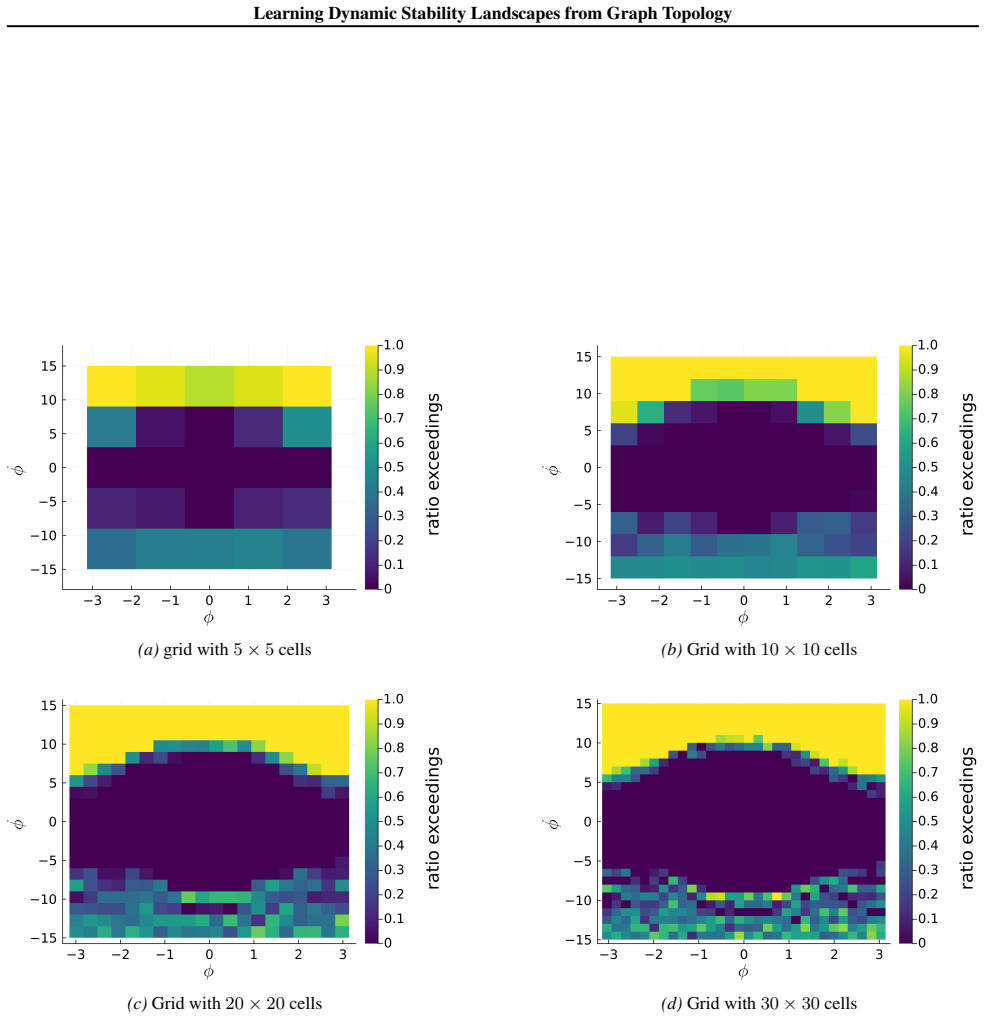
LBSi,m,n ... 20x20 grid ... SNBSi = sum wi,m,n LBSi,m,n
What do these tags mean?
- matches
- The paper's claim is directly supported by a theorem in the formal canon.
- supports
- The theorem supports part of the paper's argument, but the paper may add assumptions or extra steps.
- extends
- The paper goes beyond the formal theorem; the theorem is a base layer rather than the whole result.
- uses
- The paper appears to rely on the theorem as machinery.
- contradicts
- The paper's claim conflicts with a theorem or certificate in the canon.
- unclear
- Pith found a possible connection, but the passage is too broad, indirect, or ambiguous to say the theorem truly supports the claim.
Reference graph
Works this paper leans on
-
[1]
Need to Develop Grid-Forming Statcom Systems -
50Hertz and Amprion and Tennet and Transnet BW , year = 2020, url =. Need to Develop Grid-Forming Statcom Systems -
work page 2020
-
[2]
Abujubbeh, Mohammad and Munikoti, Sai and Pahwa, Anil and Natarajan, Balasubramaniam , year = 2023, month = may, journal =. Probabilistic. doi:10.1109/TPWRS.2022.3186349 , urldate =
-
[3]
Acebr. The. Reviews of Modern Physics , volume =. doi:10.1103/RevModPhys.77.137 , urldate =
-
[4]
Synchronization in Populations of Globally Coupled Oscillators with Inertial Effects , author =. Physical Review. E, Statistical Physics, Plasmas, Fluids, and Related Interdisciplinary Topics , volume =. doi:10.1103/physreve.62.3437 , abstract =
-
[5]
Achleitner, Franz and Arnold, Anton and Mehrmann, Volker , year = 2023, month = dec, journal =. Hypocoercivity in. doi:10.1007/s10884-023-10327-6 , urldate =
-
[6]
Ackerman, Frank and Stanton, Elizabeth , year = 2013, publisher =. Climate Economics:
work page 2013
-
[7]
Distributed Generation: A Definition1 , shorttitle =
Ackermann, Thomas and Andersson, G. Distributed Generation: A Definition1 , shorttitle =. Electric Power Systems Research , volume =. doi:10.1016/S0378-7796(01)00101-8 , urldate =
-
[8]
Adachi, Ryosuke and Yamashita, Yuh and Kobayashi, Koichi , year = 2020, month = jan, journal =. Design of. doi:10.1016/j.ifacol.2020.12.1496 , urldate =
- [9]
-
[10]
, year = 2012, month = mar, journal =
Agresti, Alan and Coull, Brent A. , year = 2012, month = mar, journal =. Approximate Is
work page 2012
-
[11]
Ainsworth, Nathan and Grijalva, Santiago , year = 2013, month = nov, journal =. A. doi:10.1109/TPWRS.2013.2257887 , urldate =
-
[12]
Aka, Julius and Brunnemann, Johannes and Eiden, J. Balanced. doi:10.48550/arXiv.2410.10174 , urldate =. arXiv , keywords =:2410.10174 , primaryclass =
-
[13]
Aka, Julius and Brunnemann, Johannes and Freund, Svenne and Speerforck, Arne , year = 2023, month = dec, journal =. Efficient. doi:10.3384/ecp204107 , urldate =
-
[14]
Akiba, Takuya and Sano, Shotaro and Yanase, Toshihiko and Ohta, Takeru and Koyama, Masanori , year = 2019, month = jul, number =. Optuna:. doi:10.48550/arXiv.1907.10902 , urldate =. arXiv , keywords =:1907.10902 , primaryclass =
work page internal anchor Pith review Pith/arXiv arXiv doi:10.48550/arxiv.1907.10902 2019
-
[15]
A New Flexible Model for Generation Scheduling in a Smart Grid , author =. Energy , volume =. doi:10.1016/j.energy.2019.116438 , urldate =
-
[16]
Nature Climate Change , volume =
Decentralized Energy Systems for Clean Electricity Access , author =. Nature Climate Change , volume =. doi:10.1038/nclimate2512 , urldate =
-
[17]
Anbar, A. D. and Romaniello, S. J. and Allenby, B. R. and Broecker, W. S. , year = 2016, journal =. Addressing the
work page 2016
-
[18]
Chaos: An Interdisciplinary Journal of Nonlinear Science , volume =
Multiscale Dynamics in Communities of Phase Oscillators , author =. Chaos: An Interdisciplinary Journal of Nonlinear Science , volume =. doi:10.1063/1.3672513 , urldate =
-
[19]
The European Physical Journal Special Topics , volume =
Moving the Epidemic Tipping Point through Topologically Targeted Social Distancing , author =. The European Physical Journal Special Topics , volume =. doi:10.1140/epjs/s11734-021-00138-5 , urldate =
-
[20]
Nature Communications , volume =
Data-Driven Load Profiles and the Dynamics of Residential Electricity Consumption , author =. Nature Communications , volume =. doi:10.1038/s41467-022-31942-9 , urldate =
-
[21]
Anvari, Mehrnaz and Hellmann, Frank and Zhang, Xiaozhu , year = 2021, month = apr, journal =. Erratum: ``. doi:10.1063/5.0052803 , urldate =
-
[22]
Anvari, Mehrnaz and Hellmann, Frank and Zhang, Xiaozhu , year = 2020, month = jun, journal =. Introduction to. doi:10.1063/5.0016372 , urldate =
-
[23]
Synchronization in Complex Networks , author =. Physics Reports , volume =. doi:10.1016/j.physrep.2008.09.002 , urldate =
-
[24]
Arghir, Catalin and D. The. IEEE Transactions on Power Electronics , volume =. doi:10.1109/TPEL.2019.2939710 , urldate =
-
[25]
Linear Algebra and its Applications , volume =
On Sectorial Matrices , author =. Linear Algebra and its Applications , volume =. doi:10.1016/S0024-3795(03)00388-4 , urldate =
-
[26]
Communications Physics , volume =
Emergence of Explosive Synchronization Bombs in Networks of Oscillators , author =. Communications Physics , volume =. doi:10.1038/s42005-022-01039-2 , urldate =
-
[27]
Review of Existing Literature on Methodologies to Model Non-Linearity, Thresholds and Irreversibility in High-Impact Climate Change Events in the Presence of Environmental Tipping Points , author =
-
[28]
Nature Machine Intelligence , volume =
Geometric Deep Learning on Molecular Representations , author =. Nature Machine Intelligence , volume =. doi:10.1038/s42256-021-00418-8 , urldate =
-
[29]
The European Physical Journal Special Topics , volume =
The Impact of Model Detail on Power Grid Resilience Measures , author =. The European Physical Journal Special Topics , volume =. doi:10.1140/epjst/e2015-50265-9 , urldate =
-
[30]
Chaos: An Interdisciplinary Journal of Nonlinear Science , volume =
Stability of Synchrony against Local Intermittent Fluctuations in Tree-like Power Grids , author =. Chaos: An Interdisciplinary Journal of Nonlinear Science , volume =. doi:10.1063/1.5001818 , urldate =
-
[31]
Avelar, Pedro and Lemos, Henrique and Prates, Marcelo and Lamb, Luis , editor =. Multitask. Artificial. doi:10.1007/978-3-030-30493-5_63 , abstract =
-
[32]
Baesens, Claude and MacKay, Robert S. , year = 2013, month = dec, journal =. Interaction of Two Systems with Saddle-Node Bifurcations on Invariant Circles. doi:10.1088/0951-7715/26/12/3043 , urldate =. arXiv , langid =:1309.6954 , primaryclass =
work page internal anchor Pith review Pith/arXiv arXiv doi:10.1088/0951-7715/26/12/3043 2013
-
[33]
Structure Motif--Centric Learning Framework for Inorganic Crystalline Systems , author =. Science Advances , volume =. doi:10.1126/sciadv.abf1754 , urldate =
-
[34]
Linear and Multilinear Algebra , volume =
Generalized Matrix Tree Theorem for Mixed Graphs , author =. Linear and Multilinear Algebra , volume =. doi:10.1080/03081089908818623 , urldate =
-
[35]
Network Science , author =
-
[36]
Disciplinarity, Epistemic Friction, and the `
Barber, Jacob , year = 2018, publisher =. Disciplinarity, Epistemic Friction, and the `
work page 2018
-
[37]
Bardi, Ugo and Falsini, Sara and Perissi, Ilaria , year = 2019, month = mar, journal =. Toward a. doi:10.1007/s41247-018-0049-0 , urldate =
-
[38]
Bardi, Ugo , year = 2013, month = mar, journal =. Mind. doi:10.3390/su5030896 , urldate =
-
[39]
doi:10.48550/arXiv.2603.13922 , urldate =
On the. doi:10.48550/arXiv.2603.13922 , urldate =. arXiv , keywords =:2603.13922 , primaryclass =
-
[40]
doi:10.48550/arXiv.2503.13367 , urldate =
Mixed. doi:10.48550/arXiv.2503.13367 , urldate =. arXiv , keywords =:2503.13367 , primaryclass =
-
[41]
Dynamical Processes on Complex Networks , author =
-
[42]
Relational inductive biases, deep learning, and graph networks
Relational Inductive Biases, Deep Learning, and Graph Networks , author =. doi:10.48550/arXiv.1806.01261 , urldate =. arXiv , keywords =:1806.01261 , primaryclass =
work page internal anchor Pith review Pith/arXiv arXiv doi:10.48550/arxiv.1806.01261
-
[43]
Networks beyond Pairwise Interactions:
Battiston, Federico and Cencetti, Giulia and Iacopini, Iacopo and Latora, Vito and Lucas, Maxime and Patania, Alice and Young, Jean-Gabriel and Petri, Giovanni , year = 2020, month = aug, journal =. Networks beyond Pairwise Interactions:. doi:10.1016/j.physrep.2020.05.004 , urldate =
-
[44]
Bauer, Frank , year = 2012, month = jun, journal =. Normalized Graph. doi:10.1016/j.laa.2012.01.020 , urldate =
-
[45]
Bechhoefer, John , year = 2021, month = feb, edition =. Control. doi:10.1017/9780511734809 , urldate =
-
[46]
Power Flow Forecasts at Transmission Grid Nodes Using
Beinert, Dominik and Holzh. Power Flow Forecasts at Transmission Grid Nodes Using. Energy and AI , volume =. doi:10.1016/j.egyai.2023.100262 , urldate =
-
[47]
Electric Power Systems Research , volume =
A Causality Based Feature Selection Approach for Data-Driven Dynamic Security Assessment , author =. Electric Power Systems Research , volume =. doi:10.1016/j.epsr.2021.107537 , urldate =
-
[48]
Synchronization in Asymmetrically Coupled Networks with Node Balance , author =. Chaos , volume =. doi:10.1063/1.2146180 , abstract =
-
[49]
Bento, Nuno and Rebelo, Joana and Barandas, Mar. Comparing. Sensors (Basel, Switzerland) , volume =. doi:10.3390/s22197324 , urldate =
-
[50]
Benzaouia, Abdellah , year = 2012, series =. Saturated. doi:10.1007/978-1-4471-2900-4 , urldate =
-
[51]
Bergen, A.R. and Hill, D.J. , year = 1981, month = jan, journal =. A. doi:10.1109/TPAS.1981.316883 , abstract =
-
[52]
Improving Voltage and Frequency Control of
Bernal, Rodrigo and Milano, Federico , year = 2024, month = oct, journal =. Improving Voltage and Frequency Control of. doi:10.1016/j.epsr.2024.110768 , urldate =
-
[53]
Berner, Rico and Gross, Thilo and Kuehn, Christian and Kurths, J. Adaptive. doi:10.48550/arXiv.2304.05652 , urldate =. arXiv , keywords =:2304.05652 , primaryclass =
-
[54]
Physical Review Letters , volume =
Desynchronization Transitions in Adaptive Networks , author =. Physical Review Letters , volume =
-
[55]
Chaos: An Interdisciplinary Journal of Nonlinear Science , volume =
Generalized Splay States in Phase Oscillator Networks , author =. Chaos: An Interdisciplinary Journal of Nonlinear Science , volume =. doi:10.1063/5.0056664 , urldate =
-
[56]
The European Physical Journal Special Topics , volume =
Solitary States in Adaptive Nonlocal Oscillator Networks , author =. The European Physical Journal Special Topics , volume =. doi:10.1140/epjst/e2020-900253-0 , urldate =
-
[57]
Frontiers in Applied Mathematics and Statistics , volume =
Synchronization in Networks with Heterogeneous Adaptation Rules and Applications to Distance-Dependent Synaptic Plasticity , author =. Frontiers in Applied Mathematics and Statistics , volume =
-
[58]
What Adaptive Neuronal Networks Teach Us about Power Grids , author =. Physical Review E , volume =. doi:10.1103/PhysRevE.103.042315 , urldate =
-
[59]
Besard, Tim and Foket, Christophe and De Sutter, Bjorn , year = 2019, month = apr, journal =. Effective. doi:10.1109/TPDS.2018.2872064 , abstract =
-
[60]
Bezanson, Jeff and Edelman, Alan and Karpinski, Stefan and Shah, Viral B. , year = 2017, journal =. Julia:. doi:10.1137/141000671 , abstract =
-
[61]
Bianchi, Filippo Maria and Grattarola, Daniele and Livi, Lorenzo and Alippi, Cesare , year = 2021, month = jan, journal =. Graph. doi:10.1109/TPAMI.2021.3054830 , urldate =
-
[62]
Bianchi, Filippo Maria and Gallicchio, Claudio and Micheli, Alessio , year = 2021, month = apr, number =. Pyramidal. doi:10.48550/arXiv.2104.04710 , urldate =. arXiv , langid =:2104.04710 , primaryclass =
-
[63]
Bianconi, Ginestra , year = 2021, month = sep, journal =. The Topological. doi:10.1088/2632-072X/ac19be , urldate =
-
[64]
Bick, Christian and Gross, Elizabeth and Harrington, Heather A. and Schaub, Michael T. , year = 2023, month = aug, journal =. What. doi:10.1137/21M1414024 , urldate =
-
[65]
Biehl, Juliane and Missbach, Leonard and Riedel, Franziska and Stemmle, Ruben and J. Wicked Facets of the. International Journal of Sustainable Energy , volume =. doi:10.1080/14786451.2023.2244602 , urldate =
-
[66]
and Ceriotti, Michele , year = 2023, month = mar, number =
Bigi, Filippo and Pozdnyakov, Sergey N. and Ceriotti, Michele , year = 2023, month = mar, number =. Wigner Kernels: Body-Ordered Equivariant Machine Learning without a Basis , shorttitle =. arXiv , langid =:2303.04124 , primaryclass =
-
[67]
Billinton, Roy and Li, Wenyuan , year = 1994, publisher =. Reliability. doi:10.1007/978-1-4899-1346-3 , urldate =
-
[68]
Birchfield, Adam , year = 2021, url =
work page 2021
-
[69]
and Xu, Ti and Gegner, Kathleen M
Birchfield, Adam B. and Xu, Ti and Gegner, Kathleen M. and Shetye, Komal S. and Overbye, Thomas J. , year = 2017, month = jul, journal =. Grid. doi:10.1109/TPWRS.2016.2616385 , abstract =
- [70]
-
[71]
Boccaletti, S and Latora, V and Moreno, Y and Chavez, M and Hwang, D , year = 2006, month = feb, journal =. Complex Networks:. doi:10.1016/j.physrep.2005.10.009 , urldate =
-
[72]
Bodnar, Cristian and Giovanni, Francesco Di , abstract =. Neural
-
[73]
Bodnar, Cristian and Di Giovanni, Francesco and Chamberlain, Benjamin and Li. Neural. Advances in Neural Information Processing Systems , volume =
-
[74]
Bodnar, Cristian and Frasca, Fabrizio and Wang, Yuguang and Otter, Nina and Montufar, Guido F. and Li. Weisfeiler and. Proceedings of the 38th
-
[75]
Bodnar, Cristian and Frasca, Fabrizio and Wang, Yu Guang and Otter, Nina and Mont. Weisfeiler and. doi:10.48550/arXiv.2103.03212 , urldate =. arXiv , keywords =:2103.03212 , primaryclass =
-
[76]
Bolz, Valentin and Rue. Power. 2019 18th. doi:10.1109/ICMLA.2019.00274 , abstract =
-
[78]
Borkowska, Barbara , year = 1974, month = may, journal =. Probabilistic. doi:10.1109/TPAS.1974.293973 , urldate =
-
[79]
Physical Review Research , volume =
Delay Master Stability of Inertial Oscillator Networks , author =. Physical Review Research , volume =. doi:10.1103/PhysRevResearch.2.023409 , urldate =
-
[80]
Dynamic Stability of Electric Power Grids:
B. Dynamic Stability of Electric Power Grids:. Chaos: An Interdisciplinary Journal of Nonlinear Science , volume =. doi:10.1063/5.0082712 , urldate =
-
[81]
B. Stability. IEEE Access , volume =. doi:10.1109/ACCESS.2023.3320944 , urldate =
discussion (0)
Sign in with ORCID, Apple, or X to comment. Anyone can read and Pith papers without signing in.