Depth Peeling for High-Fidelity Gaussian-Enhanced Surfel Rendering
Pith reviewed 2026-06-29 20:02 UTC · model grok-4.3
The pith
Augmenting Gaussian-enhanced surfels with semi-transparent boundaries and applying depth peeling yields correct per-pixel ordering for sort-free rendering.
A machine-rendered reading of the paper's core claim, the machinery that carries it, and where it could break.
Core claim
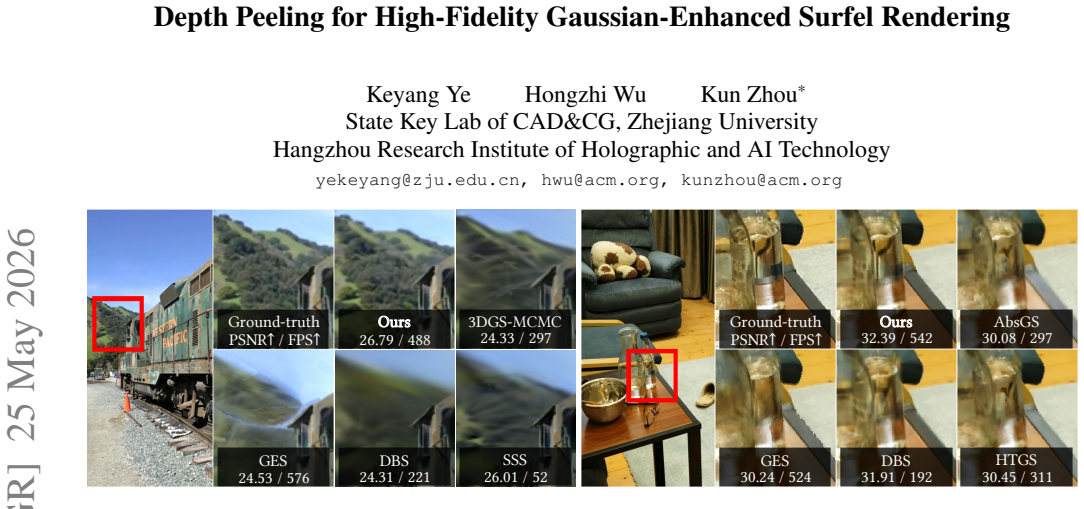
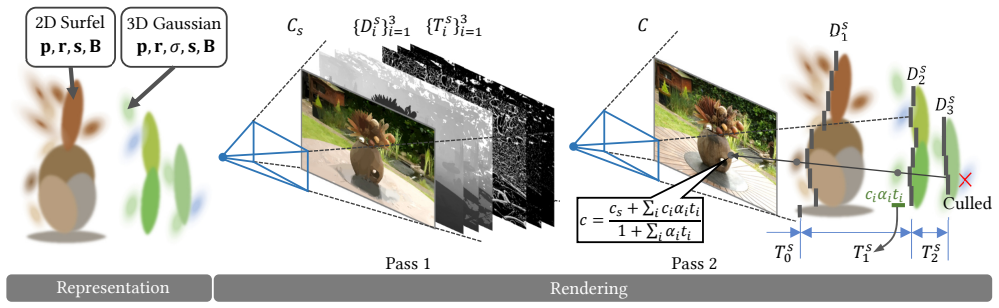
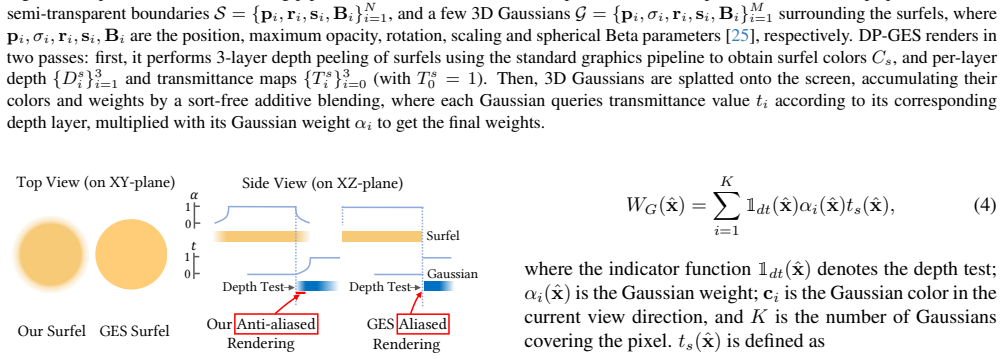
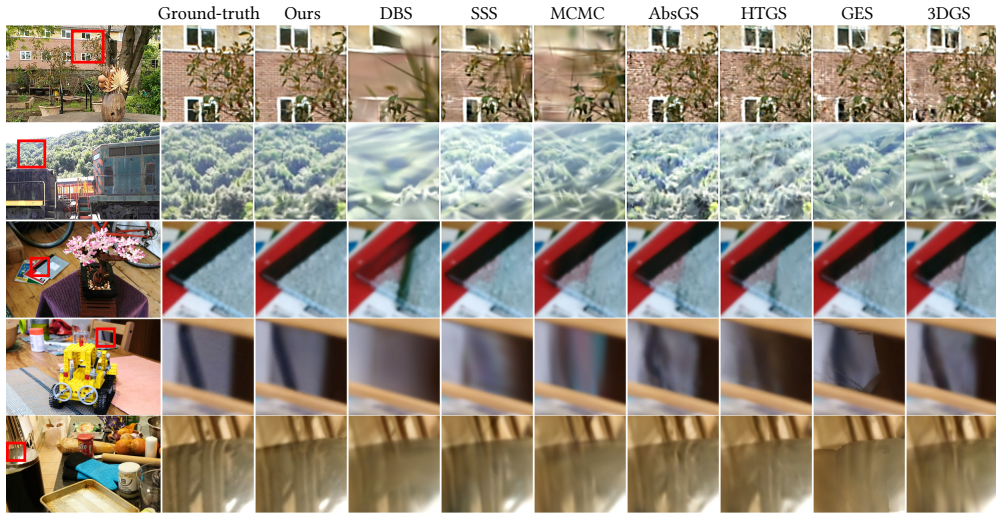
DP-GES augments opaque surfels with semi-transparent boundaries and leverages Depth Peeling to establish accurate per-pixel ordering. This design enables sort-free Gaussian splatting with correct transmittance modulation, effectively eliminating aliasing and popping artifacts while facilitating a fully differentiable joint optimization.
What carries the argument
Depth Peeling applied to semi-transparent surfel boundaries to compute per-pixel ordering and transmittance
If this is right
- Correct transmittance modulation without sorting primitives
- Removal of aliasing and popping artifacts in rendered views
- Support for fully differentiable joint optimization of the representation
- Higher reconstruction quality than previous sort-free approaches across tested scenes
Where Pith is reading between the lines
- The per-pixel ordering step could be adapted to other point or surfel representations that currently rely on approximate blending.
- Differentiability may allow tighter coupling with gradient-based reconstruction pipelines that optimize both geometry and appearance.
- Reduced popping could improve temporal stability when the method is applied to video or dynamic scene capture.
Load-bearing premise
Depth peeling on semi-transparent surfel boundaries will produce accurate per-pixel ordering and transmittance modulation without new artifacts or costs that offset the sort-free advantage.
What would settle it
Side-by-side renders of the same scene showing visible aliasing or popping artifacts in DP-GES output, or quantitative metrics such as PSNR no higher than the baseline GES method.
Figures



read the original abstract
Novel view synthesis has been significantly advanced by NeRFs and 3D Gaussian Splatting (3DGS), which require ordering volumetric samples or primitives for correct color blending. While the recent Gaussian-Enhanced Surfels (GES) enable high-performance, sort-free rendering, they suffer from aliasing artifacts and suboptimal reconstruction. To address these limitations, we propose DP-GES, a novel representation that augments opaque surfels with semi-transparent boundaries and leverages Depth Peeling to establish accurate per-pixel ordering. This design enables sort-free Gaussian splatting with correct transmittance modulation, effectively eliminating aliasing and popping artifacts while facilitating a fully differentiable joint optimization. Extensive experiments demonstrate that our method achieves superior reconstruction quality and compares favorably against state-of-the-art techniques across a wide range of scenes.
Editorial analysis
A structured set of objections, weighed in public.
Referee Report
Summary. The paper proposes DP-GES, a novel representation that augments Gaussian-Enhanced Surfels (GES) with semi-transparent boundaries and applies depth peeling to obtain accurate per-pixel ordering. This enables sort-free Gaussian splatting with correct transmittance modulation, claimed to eliminate aliasing and popping artifacts while supporting fully differentiable joint optimization. Extensive experiments are said to show superior reconstruction quality relative to state-of-the-art methods across diverse scenes.
Significance. If the depth-peeling construction delivers the claimed ordering and transmittance accuracy without offsetting costs, the work would meaningfully advance high-performance novel-view synthesis by reconciling the performance benefits of sort-free surfel methods with the blending correctness previously requiring explicit sorting or volumetric ordering.
Simulated Author's Rebuttal
We thank the referee for their review of our manuscript on DP-GES. We appreciate the positive framing of the work's potential significance in reconciling sort-free rendering with correct blending. No specific major comments were listed in the report, so we provide no point-by-point responses below.
Circularity Check
No significant circularity detected
full rationale
The abstract and description contain no equations, derivations, self-citations, or load-bearing steps that reduce predictions or results to fitted inputs by construction. The method is presented at a conceptual level without any claimed derivation chain, uniqueness theorems, or ansatzes that could be inspected for circularity. This matches the default case of a self-contained high-level description with no identifiable reduction to its own inputs.
Axiom & Free-Parameter Ledger
Reference graph
Works this paper leans on
-
[1]
Mip-nerf 360: Unbounded anti-aliased neural radiance fields
Jonathan T Barron, Ben Mildenhall, Dor Verbin, Pratul P Srinivasan, and Peter Hedman. Mip-nerf 360: Unbounded anti-aliased neural radiance fields. InProceedings of the IEEE/CVF CVPR, pages 5470–5479, 2022. 5, 7
2022
-
[2]
Barron, Ben Mildenhall, Dor Verbin, Pratul P
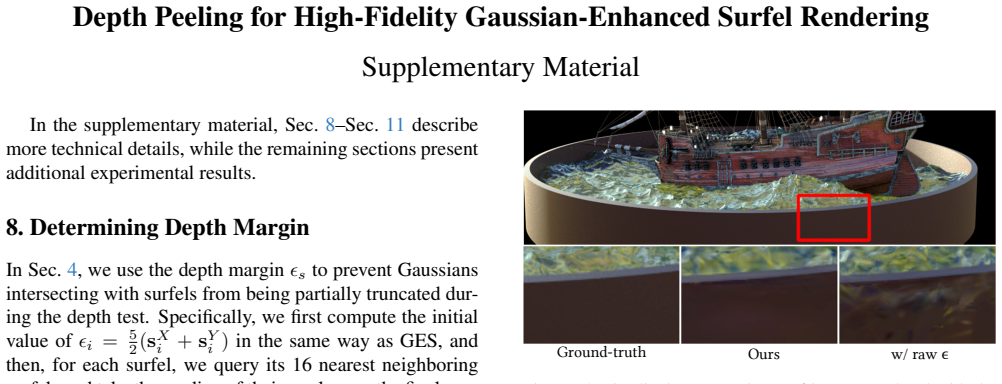
Jonathan T. Barron, Ben Mildenhall, Dor Verbin, Pratul P. Srinivasan, and Peter Hedman. Mip-nerf 360: Unbounded anti-aliased neural radiance fields. In2022 IEEE/CVF Conference on Computer Vision and Pattern Recognition (CVPR), pages 5460–5469, 2022. 2, 8
2022
-
[3]
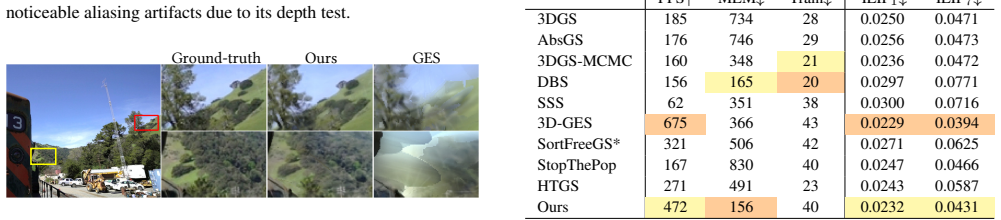
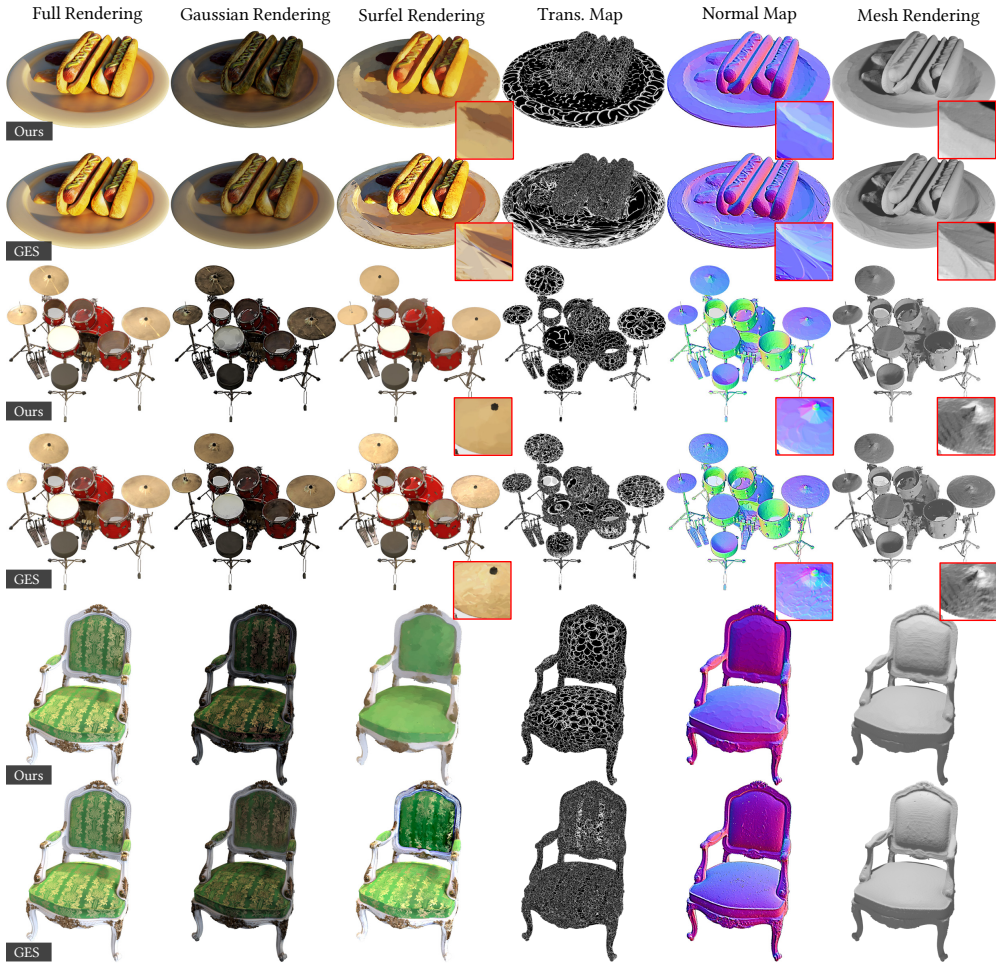
Textured gaussians for en- hanced 3d scene appearance modeling
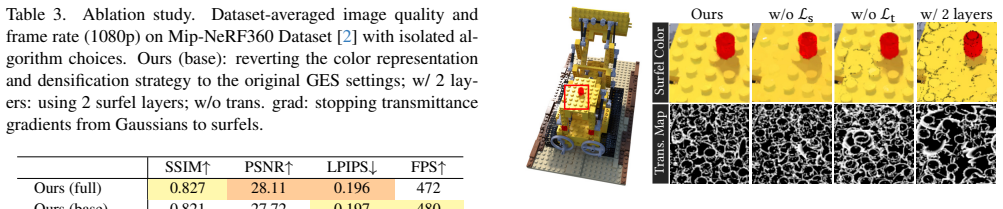
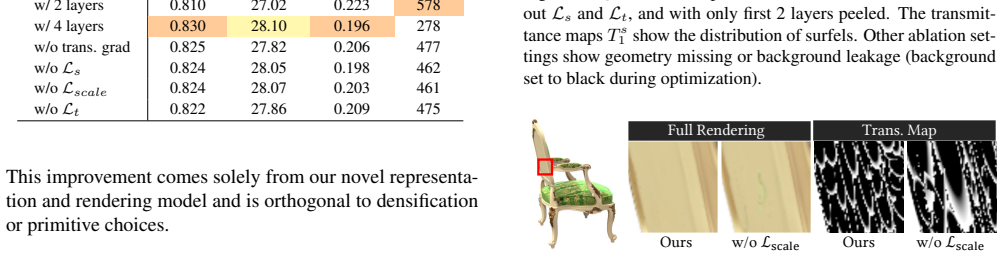
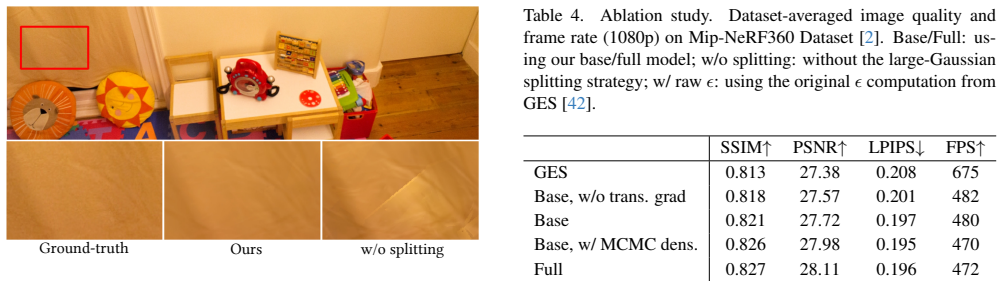
Brian Chao, Hung-Yu Tseng, Lorenzo Porzi, Chen Gao, Tuotuo Li, Qinbo Li, Ayush Saraf, Jia-Bin Huang, Johannes Kopf, Gordon Wetzstein, et al. Textured gaussians for en- hanced 3d scene appearance modeling. InProceedings of the Computer Vision and Pattern Recognition Conference, pages 8964–8974, 2025. 2
2025
-
[4]
A survey on 3d gaussian splatting, 2024
Guikun Chen and Wenguan Wang. A survey on 3d gaussian splatting, 2024. 2
2024
-
[5]
Be- yond gaussians: Fast and high-fidelity 3d splatting with lin- ear kernels, 2024
Haodong Chen, Runnan Chen, Qiang Qu, Zhaoqing Wang, Tongliang Liu, Xiaoming Chen, and Yuk Ying Chung. Be- yond gaussians: Fast and high-fidelity 3d splatting with lin- ear kernels, 2024. 2
2024
-
[6]
Interactive order-independent transparency
Cass Everitt. Interactive order-independent transparency. White paper, nVIDIA, 2(6):7, 2001. 3
2001
-
[7]
Nerf: Neural radiance field in 3d vision, a comprehensive review.arXiv preprint arXiv:2210.00379,
Kyle Gao, Yina Gao, Hongjie He, Dening Lu, Linlin Xu, and Jonathan Li. Nerf: Neural radiance field in 3d vision, a comprehensive review.arXiv preprint arXiv:2210.00379,
-
[8]
Gortler, Radek Grzeszczuk, Richard Szeliski, and Michael F
Steven J. Gortler, Radek Grzeszczuk, Richard Szeliski, and Michael F. Cohen. The lumigraph. InProceedings of SIG- GRAPH ’96, page 43–54, New York, NY , USA, 1996. ACM. 1
1996
-
[9]
The accumulation buffer: hardware support for high-quality rendering.SIGGRAPH Comput
Paul Haeberli and Kurt Akeley. The accumulation buffer: hardware support for high-quality rendering.SIGGRAPH Comput. Graph., 24(4):309–318, 1990. 3
1990
-
[10]
Efficient perspective-correct 3d gaussian splatting using hybrid trans- parency, 2024
Florian Hahlbohm, Fabian Friederichs, Tim Weyrich, Li- nus Franke, Moritz Kappel, Susana Castillo, Marc Stam- minger, Martin Eisemann, and Marcus Magnor. Efficient perspective-correct 3d gaussian splatting using hybrid trans- parency, 2024. 2
2024
-
[11]
Efficient perspective-correct 3d gaussian splatting using hybrid trans- parency.Computer Graphics Forum, 44(2), 2025
Florian Hahlbohm, Fabian Friederichs, Tim Weyrich, Li- nus Franke, Moritz Kappel, Susana Castillo, Marc Stam- minger, Martin Eisemann, and Marcus Magnor. Efficient perspective-correct 3d gaussian splatting using hybrid trans- parency.Computer Graphics Forum, 44(2), 2025. 1, 5, 7
2025
-
[12]
Ges: Generalized exponential splatting for efficient radiance field rendering
Abdullah Hamdi, Luke Melas-Kyriazi, Jinjie Mai, Guocheng Qian, Ruoshi Liu, Carl V ondrick, Bernard Ghanem, and Andrea Vedaldi. Ges: Generalized exponential splatting for efficient radiance field rendering. InProceedings of the IEEE/CVF Conference on Computer Vision and Pattern Recognition, pages 19812–19822, 2024. 2
2024
-
[13]
Deep blending for free-viewpoint image-based rendering.ACM Trans
Peter Hedman, Julien Philip, True Price, Jan-Michael Frahm, George Drettakis, and Gabriel Brostow. Deep blending for free-viewpoint image-based rendering.ACM Trans. Graph., 37(6):1–15, 2018. 5
2018
-
[14]
3d convex splatting: Radiance field rendering with 3d smooth convexes
Jan Held, Renaud Vandeghen, Abdullah Hamdi, Adrien Deliege, Anthony Cioppa, Silvio Giancola, Andrea Vedaldi, Bernard Ghanem, and Marc Van Droogenbroeck. 3d convex splatting: Radiance field rendering with 3d smooth convexes. InProceedings of the IEEE/CVF Conference on Computer Vision and Pattern Recognition (CVPR), 2025. 2
2025
-
[15]
Sort-free gaussian splatting via weighted sum rendering
Qiqi Hou, Randall Rauwendaal, Zifeng Li, Hoang Le, Farzad Farhadzadeh, Fatih Porikli, Alexei Bourd, and Amir Said. Sort-free gaussian splatting via weighted sum rendering. arXiv preprint arXiv:2410.18931, 2024. 5
arXiv 2024
-
[16]
Sort-free gaussian splatting via weighted sum rendering,
Qiqi Hou, Randall Rauwendaal, Zifeng Li, Hoang Le, Farzad Farhadzadeh, Fatih Porikli, Alexei Bourd, and Amir Said. Sort-free gaussian splatting via weighted sum rendering,
-
[17]
2d gaussian splatting for geometrically ac- curate radiance fields
Binbin Huang, Zehao Yu, Anpei Chen, Andreas Geiger, and Shenghua Gao. 2d gaussian splatting for geometrically ac- curate radiance fields. InACM SIGGRAPH 2024 Conference Papers, 2024. 2, 8, 1
2024
-
[18]
Deformable radial kernel splatting
Yi-Hua Huang, Ming-Xian Lin, Yang-Tian Sun, Ziyi Yang, Xiaoyang Lyu, Yan-Pei Cao, and Xiaojuan Qi. Deformable radial kernel splatting. InProceedings of the Computer Vision and Pattern Recognition Conference, pages 21513– 21523, 2025. 2
2025
-
[19]
3d gaussian splatting for real-time radiance field rendering.ACM Trans
Bernhard Kerbl, Georgios Kopanas, Thomas Leimk ¨uhler, and George Drettakis. 3d gaussian splatting for real-time radiance field rendering.ACM Trans. Graph., 42(4), 2023. 1, 2, 3, 5
2023
-
[20]
3d gaussian splat- ting as markov chain monte carlo.Advances in Neural In- formation Processing Systems, 37:80965–80986, 2024
Shakiba Kheradmand, Daniel Rebain, Gopal Sharma, Wei- wei Sun, Yang-Che Tseng, Hossam Isack, Abhishek Kar, Andrea Tagliasacchi, and Kwang Moo Yi. 3d gaussian splat- ting as markov chain monte carlo.Advances in Neural In- formation Processing Systems, 37:80965–80986, 2024. 1, 2, 5
2024
-
[21]
Shakiba Kheradmand, Delio Vicini, George Kopanas, Dmitry Lagun, Kwang Moo Yi, Mark Matthews, and An- drea Tagliasacchi. Stochasticsplats: Stochastic rasteriza- tion for sorting-free 3d gaussian splatting.arXiv preprint arXiv:2503.24366, 2025. 2
arXiv 2025
-
[22]
Tanks and temples: Benchmarking large-scale scene reconstruction.ACM Trans
Arno Knapitsch, Jaesik Park, Qian-Yi Zhou, and Vladlen Koltun. Tanks and temples: Benchmarking large-scale scene reconstruction.ACM Trans. Graph., 36(4):1–13, 2017. 5
2017
-
[23]
Light field rendering
Marc Levoy and Pat Hanrahan. Light field rendering. In Proceedings of SIGGRAPH ’96, page 31–42, New York, NY , USA, 1996. Association for Computing Machinery. 1
1996
-
[24]
A survey on neural radiance fields
Yun Liao, Yide Di, Hao Zhou, Kaijun Zhu, Mingyu Lu, Qing Duan, and Junhui Liu. A survey on neural radiance fields. ACM Comput. Surv., 58(2), 2025. 2
2025
-
[25]
Deformable beta splatting
Rong Liu, Dylan Sun, Meida Chen, Yue Wang, and Andrew Feng. Deformable beta splatting. InProceedings of the Spe- cial Interest Group on Computer Graphics and Interactive Techniques Conference Conference Papers, New York, NY , USA, 2025. Association for Computing Machinery. 1, 2, 3, 4, 5, 8
2025
-
[26]
Weihang Liu, Yuke Li, Yuxuan Li, Jingyi Yu, and Xin Lou. Duplex-gs: Proxy-guided weighted blending for real- time order-independent gaussian splatting.arXiv preprint arXiv:2508.03180, 2025. 3
arXiv 2025
-
[27]
Ever: Exact volu- metric ellipsoid rendering for real-time view synthesis
Alexander Mai, Peter Hedman, George Kopanas, Dor Verbin, David Futschik, Qiangeng Xu, Falko Kuester, Jonathan T Barron, and Yinda Zhang. Ever: Exact volu- metric ellipsoid rendering for real-time view synthesis. In Proceedings of the IEEE/CVF International Conference on Computer Vision, pages 4930–4939, 2025. 2
2025
-
[28]
Weighted blended order- independent transparency.Journal of Computer Graphics Techniques, 2(4), 2013
Morgan McGuire and Louis Bavoil. Weighted blended order- independent transparency.Journal of Computer Graphics Techniques, 2(4), 2013. 3
2013
-
[29]
Srinivasan, Matthew Tancik, Jonathan T
Ben Mildenhall, Pratul P. Srinivasan, Matthew Tancik, Jonathan T. Barron, Ravi Ramamoorthi, and Ren Ng. Nerf: Representing scenes as neural radiance fields for view syn- thesis. InProceedings of ECCV, pages 405–421, 2020. 1, 5, 3
2020
-
[30]
3d gaussian ray trac- ing: Fast tracing of particle scenes.ACM Trans
Nicolas Moenne-Loccoz, Ashkan Mirzaei, Or Perel, Ric- cardo de Lutio, Janick Martinez Esturo, Gavriel State, Sanja Fidler, Nicholas Sharp, and Zan Gojcic. 3d gaussian ray trac- ing: Fast tracing of particle scenes.ACM Trans. Graph., 43 (6):1–19, 2024. 2
2024
-
[31]
Gaussian-plus-sdf slam: High-fidelity 3d reconstruction at 150+ fps.Computa- tional Visual Media, 2025
Zhexi Peng, Kun Zhou, and Tianjia Shao. Gaussian-plus-sdf slam: High-fidelity 3d reconstruction at 150+ fps.Computa- tional Visual Media, 2025. 1
2025
-
[32]
Stopthepop: Sorted gaussian splatting for view-consistent real-time rendering.ACM Trans
Lukas Radl, Michael Steiner, Mathias Parger, Alexan- der Weinrauch, Bernhard Kerbl, and Markus Steinberger. Stopthepop: Sorted gaussian splatting for view-consistent real-time rendering.ACM Trans. Graph., 43(4), 2024. 2, 5, 7
2024
-
[33]
Sch ¨onberger and Jan-Michael Frahm
Johannes L. Sch ¨onberger and Jan-Michael Frahm. Structure- from-motion revisited. In2016 IEEE Conference on Com- puter Vision and Pattern Recognition (CVPR), pages 4104– 4113, 2016. 5
2016
-
[34]
Layered depth images
Jonathan Shade, Steven Gortler, Li-wei He, and Richard Szeliski. Layered depth images. InProceedings of the 25th annual conference on Computer graphics and interac- tive techniques, pages 231–242, 1998. 2, 3
1998
-
[35]
Zhuowen Shen, Yuan Liu, Zhang Chen, Zhong Li, Jiepeng Wang, Yongqing Liang, Zhengming Yu, Jingdong Zhang, Yi Xu, Scott Schaefer, Xin Li, and Wenping Wang. Solidgs: Consolidating gaussian surfel splatting for sparse-view sur- face reconstruction.arXiv preprint arXiv:2412.15400, 2024. 2
arXiv 2024
-
[36]
Hdgs: Textured 2d gaussian splatting for enhanced scene rendering.arXiv preprint arXiv:2412.01823,
Yunzhou Song, Heguang Lin, Jiahui Lei, Lingjie Liu, and Kostas Daniilidis. Hdgs: Textured 2d gaussian splatting for enhanced scene rendering.arXiv preprint arXiv:2412.01823,
-
[37]
Billboard splatting (bbsplat): Learnable textured primitives for novel view synthesis
David Svitov, Pietro Morerio, Lourdes Agapito, and Alessio Del Bue. Billboard splatting (bbsplat): Learnable textured primitives for novel view synthesis. InProceedings of the IEEE/CVF International Conference on Computer Vision, pages 25029–25039, 2025. 2
2025
-
[39]
Recent advances in 3d gaussian splatting.Computational Visual Media, 10(4):613– 642, 2024
Tong Wu, Yu-Jie Yuan, Ling-Xiao Zhang, Jie Yang, Yan- Pei Cao, Ling-Qi Yan, and Lin Gao. Recent advances in 3d gaussian splatting.Computational Visual Media, 10(4):613– 642, 2024. 2
2024
-
[40]
Spec-gaussian: Anisotropic view-dependent ap- pearance for 3d gaussian splatting.Advances in Neural In- formation Processing Systems, 37:61192–61216, 2024
Ziyi Yang, Xinyu Gao, Yang-Tian Sun, Yihua Huang, Xi- aoyang Lyu, Wen Zhou, Shaohui Jiao, Xiaojuan Qi, and Xi- aogang Jin. Spec-gaussian: Anisotropic view-dependent ap- pearance for 3d gaussian splatting.Advances in Neural In- formation Processing Systems, 37:61192–61216, 2024. 2
2024
-
[41]
3d gaussian splat- ting with deferred reflection
Keyang Ye, Qiming Hou, and Kun Zhou. 3d gaussian splat- ting with deferred reflection. InACM SIGGRAPH 2024 Con- ference Papers, 2024. 2
2024
-
[42]
When gaussian meets surfel: Ultra-fast high-fidelity radiance field render- ing.ACM Trans
Keyang Ye, Tianjia Shao, and Kun Zhou. When gaussian meets surfel: Ultra-fast high-fidelity radiance field render- ing.ACM Trans. Graph., 44(4), 2025. 1, 3, 4, 5, 7, 2
2025
-
[43]
Absgs: Recovering fine details in 3d gaussian splat- ting
Zongxin Ye, Wenyu Li, Sidun Liu, Peng Qiao, and Yong Dou. Absgs: Recovering fine details in 3d gaussian splat- ting. InProceedings of the 32nd ACM International Confer- ence on Multimedia, pages 1053–1061, 2024. 1, 2, 5, 7
2024
-
[44]
Mip-splatting: Alias-free 3d gaussian splat- ting
Zehao Yu, Anpei Chen, Binbin Huang, Torsten Sattler, and Andreas Geiger. Mip-splatting: Alias-free 3d gaussian splat- ting. In2024 IEEE/CVF Conference on Computer Vision and Pattern Recognition (CVPR), pages 19447–19456, 2024. 5
2024
-
[45]
Neural shell texture splatting: More details and fewer primitives
Xin Zhang, Anpei Chen, Jincheng Xiong, Pinxuan Dai, Yu- jun Shen, and Weiwei Xu. Neural shell texture splatting: More details and fewer primitives. InProceedings of the IEEE/CVF International Conference on Computer Vision, pages 25229–25238, 2025. 2
2025
-
[46]
3d stu- dent splatting and scooping
Jialin Zhu, Jiangbei Yue, Feixiang He, and He Wang. 3d stu- dent splatting and scooping. InProceedings of the Computer Vision and Pattern Recognition Conference (CVPR), pages 21045–21054, 2025. 1, 2, 5, 7 Depth Peeling for High-Fidelity Gaussian-Enhanced Surfel Rendering Supplementary Material In the supplementary material, Sec. 8–Sec. 11 describe more te...
2025
-
[47]
4, we use the depth marginϵ s to prevent Gaussians intersecting with surfels from being partially truncated dur- ing the depth test
Determining Depth Margin In Sec. 4, we use the depth marginϵ s to prevent Gaussians intersecting with surfels from being partially truncated dur- ing the depth test. Specifically, we first compute the initial value ofϵ i = 5 2 (sX i +s Y i )in the same way as GES, and then, for each surfel, we query its 16 nearest neighboring surfels and take the median o...
-
[48]
Specifically, for surfels, we prune surfels that are either heavily occluded or extremely small, determined by the number of pixels they cover in the first peeled layer
Training Details Joint Optimization.During this stage, we adopt the den- sification and pruning strategies of GES with minor modi- fications. Specifically, for surfels, we prune surfels that are either heavily occluded or extremely small, determined by the number of pixels they cover in the first peeled layer. The pruning thresholds are the same as GES. F...
2000
-
[49]
OpenGL Implementation As demonstrated in Sec. 5, we develop an OpenGL-based renderer for real-time rendering after training, fully leverag- ing the efficiency of our sort-free rendering scheme within the traditional graphics pipeline. The OpenGL-based ren- derer also consists of two main passes: In the first pass, we perform depth peeling for the nearest ...
-
[50]
Geometry Regularization To enable the surfel representation to better capture the scene geometry, which is essential for downstream tasks such as mesh extraction, we optionally adopt a geometry regularization lossL geo =λ 4Lsd +λ5Lsn +λ6Lsdn, where λ4 = 0.1,λ 5 = 0.05andλ 6 = 0.05, respectively. Lsd =L 1(Dsupv, Ds),(6) Lsn = 1 HW X ˆx (1−N supv(ˆx)·N s(ˆx...
-
[51]
14, we visualize the surfel-Gaussian decomposition rendering compared with GES
Additional Comparisons with GES Surfel-Gaussian Decomposition Rendering.In the left- most 3 columns of Fig. 14, we visualize the surfel-Gaussian decomposition rendering compared with GES. InChair, GES preserves high-frequency texture in surfel colors be- cause its image-loss-based surfel initialization inevitably embeds appearance details, deviating from ...
-
[52]
The additive study demonstrates a clear and continuous improvement as we progressively upgrade the original GES to our full model
Additional Ablations We present quantitative additive ablations and additional re- sults in Table 4. The additive study demonstrates a clear and continuous improvement as we progressively upgrade the original GES to our full model. Applying our render- ing model to GES while disabling the new gradient path (Base, w/o trans. grad) alleviates the aliasing i...
discussion (0)
Sign in with ORCID, Apple, or X to comment. Anyone can read and Pith papers without signing in.