Anomalous Subsurface Vacancy Stabilization Dictated by Geometry-Electronic Decoupling on Metal Surfaces
Pith reviewed 2026-06-29 22:08 UTC · model grok-4.3
The pith
Subsurface vacancies are more stable than surface vacancies on close-packed Ir, Pt, Au, Be, Zn and Cd surfaces.
A machine-rendered reading of the paper's core claim, the machinery that carries it, and where it could break.
Core claim
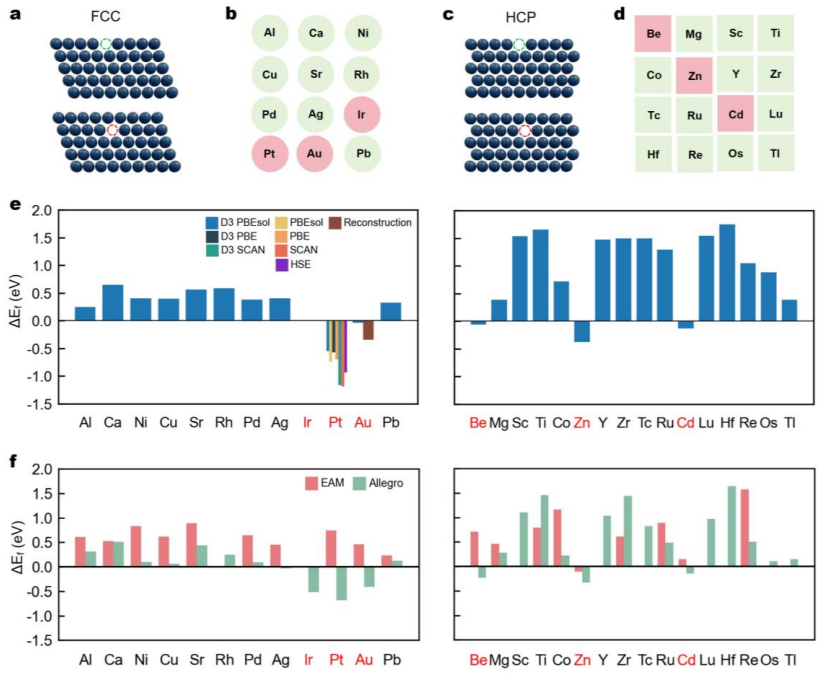
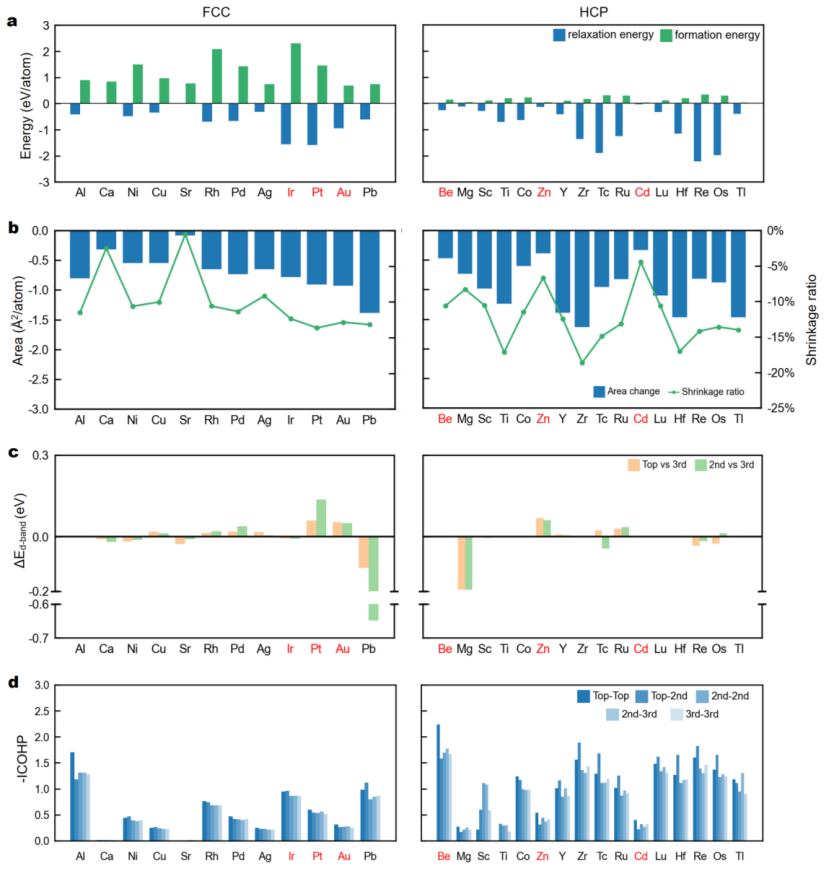
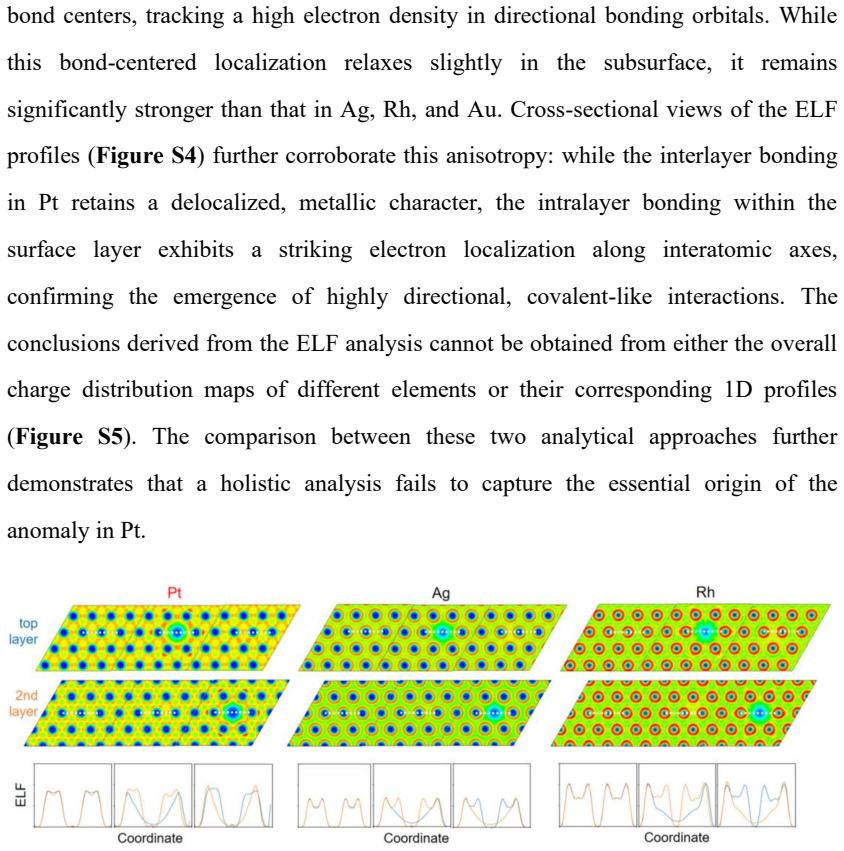
Contrary to conventional coordination-dependent broken-bond models, an anomalous thermodynamic inversion occurs on close-packed surfaces across Ir, Pt, Au with FCC lattice and Be, Zn, Cd with HCP lattice, where subsurface vacancies are intrinsically more stable than surface ones. For the FCC trio, pronounced surface relaxation and real-space electronic localization induce directional, covalent-like intralayer bonding that realizes a geometry-electronic decoupling mechanism.
What carries the argument
Geometry-electronic decoupling: surface relaxation and electronic localization that produce directional covalent-like intralayer bonding and thereby invert vacancy stability.
If this is right
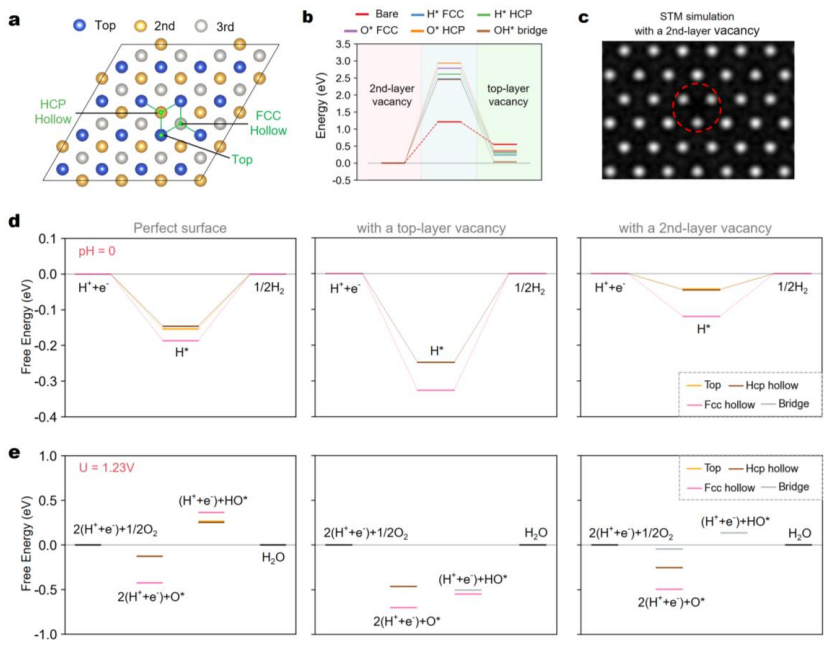
- A dynamic self-healing process on Pt(111) keeps the topmost layer intact and prevents catalytic degradation during hydrogen evolution and oxygen reduction.
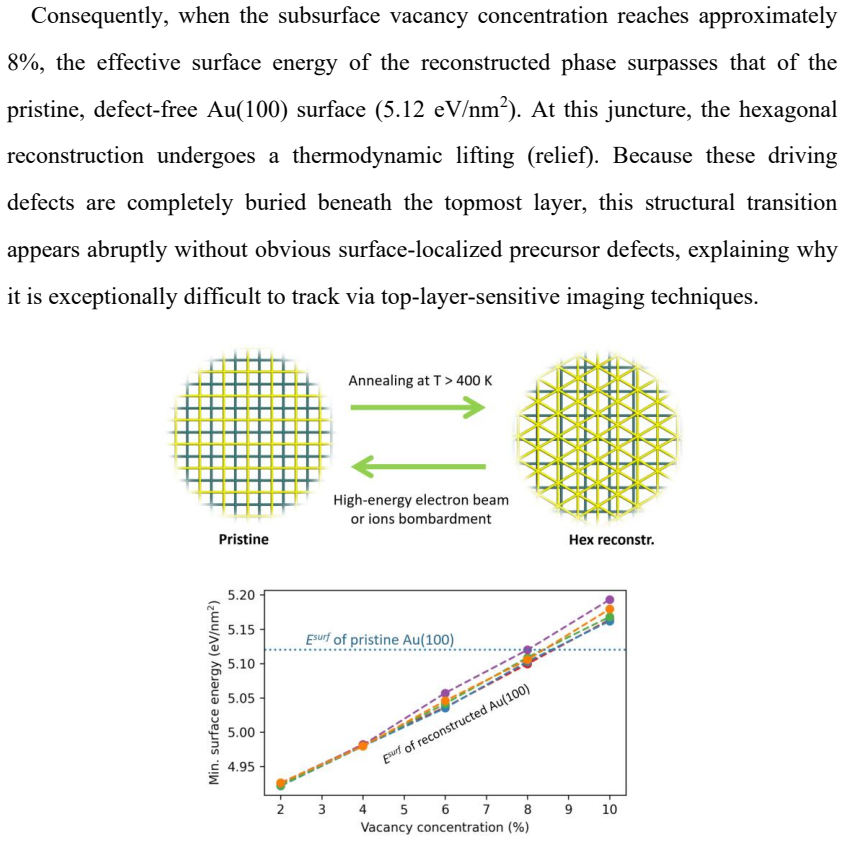
- The inversion accounts for the critical defect threshold of roughly 8 percent that lifts the Au(100) surface reconstruction.
- Classical scalar defect models are insufficient for predicting surface integrity on these metals.
Where Pith is reading between the lines
- The same decoupling logic might be tested on alloy surfaces or under applied potential to see whether the stability ordering persists during operation.
- If the mechanism holds, surface-preparation protocols could deliberately populate subsurface sites to maintain catalytic activity longer.
- Analogous inversions could appear in other close-packed systems once surface relaxation and localization are mapped at comparable accuracy.
Load-bearing premise
The high-throughput DFT calculations and machine learning force fields accurately capture real-space electronic localization and surface relaxation effects without functional or convergence errors that would reverse the stability ordering.
What would settle it
An experimental determination, for example by low-temperature STM or positron annihilation spectroscopy, that surface-vacancy formation energy on Pt(111) is lower than subsurface-vacancy formation energy would falsify the claimed inversion.
Figures
read the original abstract
Vacancy formation energetics fundamentally govern the structural integrity and catalytic behavior of metal surfaces. Contrary to conventional coordination-dependent broken-bond models, we identify an anomalous thermodynamic inversion on close-packed surfaces across Ir, Pt, Au with face-centered cubic (FCC) lattice and Be, Zn, Cd with hexagonal close-packed (HCP) lattice, where subsurface vacancies are intrinsically more stable than surface ones. Using high-throughput DFT calculations and machine learning force fields, we demonstrate that the physical origins of this anomaly are fundamentally decoupled between the two crystal systems. For the FCC trio, pronounced surface relaxation and a profound real-space electronic localization induce directional, covalent-like intralayer bonding, materializing a "geometry-electronic decoupling" mechanism. Crucially, this unconventional thermodynamic hierarchy enables a dynamic "self-healing" mechanism on Pt(111) that preserves an intact topmost layer and prevents catalytic degradation during hydrogen evolution and oxygen reduction reactions. It also successfully decoding the critical defect threshold (~8%) for lifting the Au(100) surface reconstruction. Our work challenges classical scalar defect models and provides a fresh paradigm for engineering catalyst surface integrity.
Editorial analysis
A structured set of objections, weighed in public.
Referee Report
Summary. The manuscript claims that, contrary to conventional coordination-dependent broken-bond models, subsurface vacancies are thermodynamically more stable than surface vacancies on close-packed surfaces of FCC metals (Ir, Pt, Au) and HCP metals (Be, Zn, Cd). This anomalous inversion is attributed to a geometry-electronic decoupling mechanism: for FCC systems it arises from pronounced surface relaxation and real-space electronic localization producing directional covalent-like intralayer bonding; for HCP systems the origins are stated to be distinct. The claim is supported by high-throughput DFT calculations supplemented by machine-learning force fields. The work further asserts that the inversion enables a self-healing mechanism on Pt(111) during HER/ORR and explains the ~8% defect threshold for lifting the Au(100) reconstruction.
Significance. If the reported stability ordering is robust, the result would challenge scalar broken-bond models of surface defects and supply a new conceptual framework for controlling vacancy distributions on catalyst surfaces. The high-throughput DFT + MLFF workflow is a methodological strength that enables systematic comparison across multiple metals and lattices; however, the absence of any mention of code or data release limits immediate reproducibility.
major comments (3)
- [Computational Methods] Computational Methods (or equivalent section): the central stability inversion is established solely by DFT total-energy differences whose magnitude is not quantified in the abstract and is expected to be small. No information is supplied on the exchange-correlation functional, plane-wave cutoff, k-point sampling, slab thickness, or relaxation protocol. Because semi-local functionals are known to misrepresent surface relaxation and localized bonding, these parameters must be shown to be converged before the inversion can be accepted as physical rather than numerical.
- [Results (FCC subsection)] Results section on FCC metals: the 'geometry-electronic decoupling' mechanism is invoked to explain the inversion via 'profound real-space electronic localization' and 'directional covalent-like intralayer bonding.' Without explicit charge-density difference plots, projected DOS, or Wannier-function analysis tied to specific equations or figures, it remains unclear whether the electronic effect is independent of the geometric relaxation or is simply a consequence of it.
- [Results (HCP subsection)] Results on HCP metals: the manuscript states that the physical origins of the anomaly are 'fundamentally decoupled' between FCC and HCP lattices, yet provides no comparative table or figure quantifying the separate contributions (e.g., relaxation energy vs. electronic energy) for Be, Zn, and Cd. This decoupling claim is load-bearing for the generality of the proposed paradigm.
minor comments (2)
- [Abstract] The abstract refers to 'machine learning force fields' but does not specify the training protocol, validation error, or how the MLFF was used to confirm the DFT ordering; a brief methods paragraph would improve clarity.
- [Discussion] The phrase 'successfully decoding the critical defect threshold (~8%)' should be accompanied by a direct citation to the relevant figure or table showing the threshold calculation.
Simulated Author's Rebuttal
We thank the referee for the constructive and detailed comments. We address each major point below and have revised the manuscript to incorporate additional methodological details, electronic structure analyses, and quantitative comparisons.
read point-by-point responses
-
Referee: [Computational Methods] Computational Methods (or equivalent section): the central stability inversion is established solely by DFT total-energy differences whose magnitude is not quantified in the abstract and is expected to be small. No information is supplied on the exchange-correlation functional, plane-wave cutoff, k-point sampling, slab thickness, or relaxation protocol. Because semi-local functionals are known to misrepresent surface relaxation and localized bonding, these parameters must be shown to be converged before the inversion can be accepted as physical rather than numerical.
Authors: We agree that explicit computational parameters and convergence data are required. The revised manuscript now includes a dedicated Computational Methods section specifying the PBE functional, 500 eV plane-wave cutoff, 12×12×1 k-point sampling, 7-layer slabs (bottom three fixed), and force convergence to 0.01 eV/Å. Convergence tests with respect to cutoff, k-points, and slab thickness are added, confirming energy differences stable to within 5 meV. Calculations with RPBE and optB88-vdW functionals are included and preserve the inversion, with magnitudes (0.1–0.3 eV) now stated in the abstract and main text. revision: yes
-
Referee: [Results (FCC subsection)] Results section on FCC metals: the 'geometry-electronic decoupling' mechanism is invoked to explain the inversion via 'profound real-space electronic localization' and 'directional covalent-like intralayer bonding.' Without explicit charge-density difference plots, projected DOS, or Wannier-function analysis tied to specific equations or figures, it remains unclear whether the electronic effect is independent of the geometric relaxation or is simply a consequence of it.
Authors: We appreciate the request for explicit supporting analysis. The revised Supplementary Information now contains charge-density difference plots and projected DOS for both relaxed and fixed-geometry (unrelaxed) configurations on Ir(111), Pt(111), and Au(111). These demonstrate that directional electronic localization persists in the absence of relaxation, although it is enhanced by geometry changes, thereby supporting independence of the electronic contribution. A quantitative energy decomposition separating geometric relaxation from electronic terms is also added. revision: yes
-
Referee: [Results (HCP subsection)] Results on HCP metals: the manuscript states that the physical origins of the anomaly are 'fundamentally decoupled' between FCC and HCP lattices, yet provides no comparative table or figure quantifying the separate contributions (e.g., relaxation energy vs. electronic energy) for Be, Zn, and Cd. This decoupling claim is load-bearing for the generality of the proposed paradigm.
Authors: We agree that a side-by-side quantification strengthens the decoupling claim. The revised manuscript adds Table S3, which tabulates relaxation versus electronic energy contributions for Be, Zn, and Cd. The table shows that HCP inversion is dominated by electronic effects with negligible relaxation contribution, in clear contrast to the balanced geometric-electronic contributions in FCC systems, thereby substantiating the distinct origins. revision: yes
Circularity Check
No circularity detected; claim rests on independent DFT computations
full rationale
The paper establishes its central claim of anomalous subsurface vacancy stability inversion solely via high-throughput DFT calculations and machine learning force fields on Ir, Pt, Au, Be, Zn, and Cd surfaces. No derivation equations, parameter fitting to target quantities, self-citations as load-bearing premises, or ansatz smuggling appear in the provided text. The result is obtained by direct numerical evaluation of formation energies under stated computational protocols, which are falsifiable against external benchmarks and do not reduce to the claimed inversion by construction or renaming.
Axiom & Free-Parameter Ledger
axioms (1)
- domain assumption Standard DFT approximations (exchange-correlation functional, k-point sampling, slab thickness) are sufficient to determine relative vacancy stabilities without qualitative reversal.
invented entities (1)
-
geometry-electronic decoupling mechanism
no independent evidence
Reference graph
Works this paper leans on
-
[1]
Hybrid Functionals Based on a Screened Coulomb Potential
(1) Medford, A. J.; Vojvodic, A.; Hummelshøj, J. S.; Voss, J.; Abild -Pedersen, F.; Studt, F.; Bligaard, T.; Nilsson, A.; Nørskov, J. K. From the Sabatier Principle to a Predictive Theory of Transition-Metal Heterogeneous Catalysis. Journal of Catalysis 2015, 328, 36 –42. https://doi.org/10.1016/j.jcat.2014.12.033. (2) Cui, X.; Li, W.; Ryabchuk, P .; Jung...
-
[2]
(27) Musaelian, A.; Batzner, S.; Johansson, A.; Sun, L.; Owen, C
https://doi.org/10.1038/s41467-022-29939-5. (27) Musaelian, A.; Batzner, S.; Johansson, A.; Sun, L.; Owen, C. J.; Kornbluth, M.; Kozinsky, B. Learning Local Equivariant Representations for Large -Scale Atomistic Dynamics. Nat Commun 2023, 14 (1),
-
[3]
(28) Hammer, R.; Meinel, K.; Krahn, O.; Widdra, W
https://doi.org/10.1038/s41467-023-36329-y. (28) Hammer, R.; Meinel, K.; Krahn, O.; Widdra, W. Surface Reconstruction of Pt(001) Quantitatively Revisited. Phys. Rev. B 2016, 94 (19), 195406. https://doi.org/10.1103/PhysRevB.94.195406. (29) Shiihara, Y .; Kohyama, M.; Ishibashi, S. Origin of Surface Stress on Late Transition Metal Surfaces: Ab Initio Local...
-
[4]
(47) Wang, H.; Zhang, L.; Han, J.; E, W
https://doi.org/10.48550/ARXIV.2504.16068. (47) Wang, H.; Zhang, L.; Han, J.; E, W. DeePMD -Kit: A Deep Learning Package for Many -Body Potential Energy Representation and Molecular Dynamics. Computer Physics Communications 2018, 228, 178–184. https://doi.org/10.1016/j.cpc.2018.03.016. (48) Li, P .; Ding, F. Origin of the Herringbone Reconstruction of Au(...
discussion (0)
Sign in with ORCID, Apple, or X to comment. Anyone can read and Pith papers without signing in.