Wave-particle duality of unpolarized photons
Pith reviewed 2026-06-29 21:34 UTC · model grok-4.3
The pith
A generalized distinguishability measure makes the wave-particle duality relation hold with equality for mixed photon states.
A machine-rendered reading of the paper's core claim, the machinery that carries it, and where it could break.
Core claim
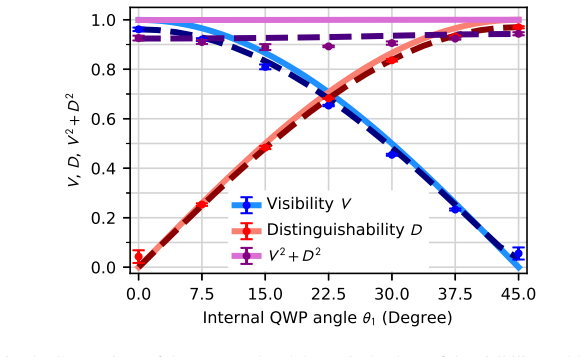
Within a purification framework the mixed which-way marker is regarded as the reduced state of an entangled pure state, and the generalized distinguishability D is defined to include the full which-path information carried jointly by the marker and the environment. This D is experimentally accessible from the photon alone and yields the saturated relation V squared plus D squared equals one for both pure and mixed marker states.
What carries the argument
The purification-based generalized distinguishability D that incorporates which-path information shared between the mixed which-way marker and its purifying environment.
If this is right
- The duality relation becomes an equality for every state of the which-way marker, including the completely mixed case.
- Distinguishability can be quantified from the photon system without any direct access to the environment.
- The same definition of D applies uniformly whether the marker begins in a pure or mixed state.
- Single-photon experiments with unpolarized light now confirm the saturated relation.
Where Pith is reading between the lines
- The same purification construction could be applied to other internal degrees of freedom that become mixed through interaction with uncontrolled surroundings.
- The result indicates that any apparent shortfall in duality for mixed markers stems from an incomplete accounting of information rather than a change in the underlying quantum limit.
- The framework supplies a concrete operational procedure that could be checked in multi-particle or higher-dimensional interferometers.
Load-bearing premise
Any mixed which-way marker state can be treated as the reduced state of a pure entangled state that includes an external environment.
What would settle it
A measurement of visibility V and the new D on unpolarized photons in which V squared plus D squared is found to be less than one would show that the saturation does not hold.
Figures
read the original abstract
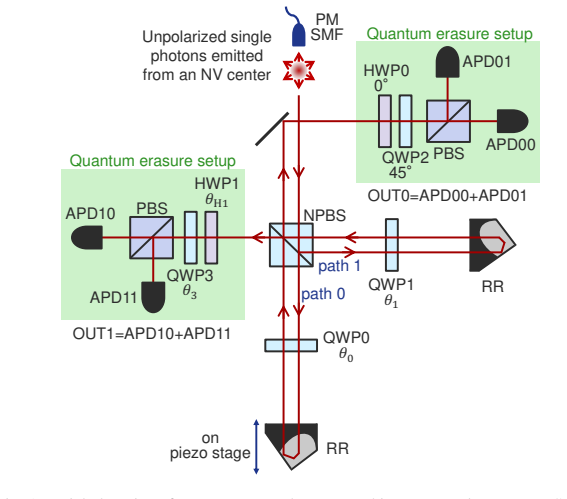
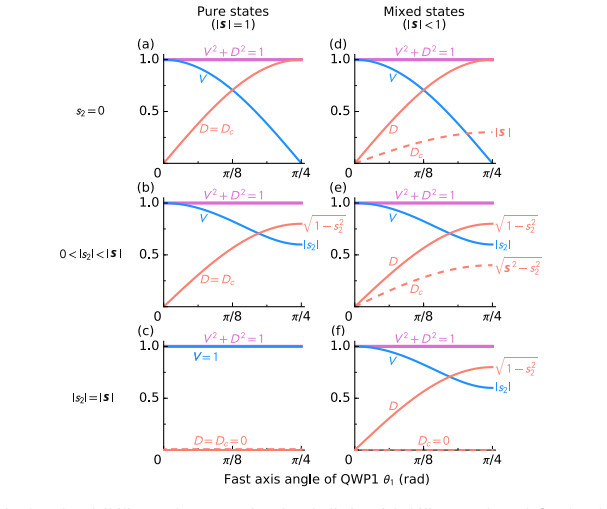
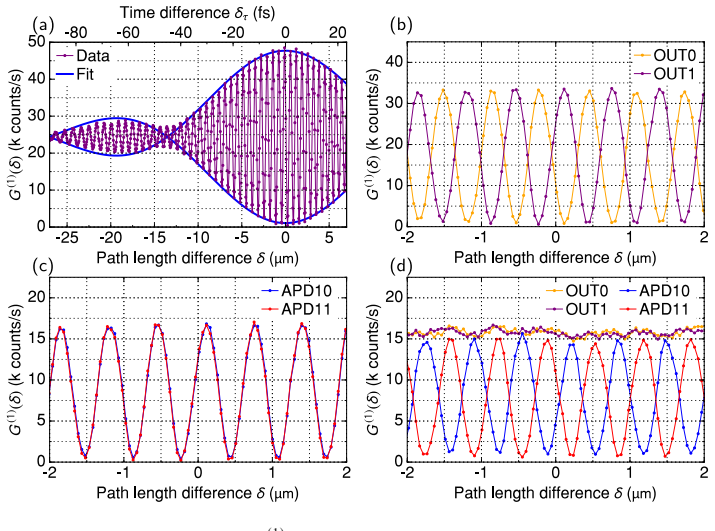
Photons in a two-path interferometer best embody wave-particle duality (WPD), which is a core concept of quantum theory. So far, the WPD relation is commonly written as $V^2+D^2 \leq 1$, where $V$ is the interference fringe visibility and $D$ is path distinguishability, i.e., the distinguishability of which path a photon passed. This inequality is saturated only when the which-way marker (WWM), which embodies which-path information (WPI) via an internal degree of freedom of photons, such as polarization, is in a pure state. For mixed-state WWM, conventionally defined distinguishability underestimates the amount of WPI and thus does not saturate the WPD relation. Here, we introduce a generalized measure of distinguishability $D$ that properly quantifies the WPI and saturates the WPD relation for all pure- and mixed-state WWM within a purification-based framework. To this end, mixed-state WWM is treated as a result of entanglement formation between the WWM and an external degree of freedom, e.g., environment, and $D$ is defined so that it incorporates the total WPI shared between the WWM and the environment. We show that $D$ thus defined is experimentally quantifiable, independently of $V$, without access to the environment. We experimentally evaluate $V$ and $D$ using true single photons generated in the completely mixed (unpolarized) state, and thus verify the saturated WPD relation.
Editorial analysis
A structured set of objections, weighed in public.
Referee Report
Summary. The manuscript claims that the standard wave-particle duality relation V² + D² ≤ 1 is not saturated for mixed-state which-way markers (WWM) because conventional D underestimates which-path information (WPI). It introduces a generalized distinguishability D within a purification framework, treating the mixed WWM as the reduced state of an entangled pure state with an environment, such that D incorporates the total WPI shared with the environment and saturates V² + D² = 1 for all pure and mixed WWMs. The authors further assert that this D is experimentally measurable from the photon alone (without environment access) and verify the saturated relation using true single photons prepared in the completely mixed (unpolarized) state.
Significance. A well-defined, purification-independent D that saturates the duality for mixed states and is measurable from the system alone would meaningfully extend the quantitative WPD relation beyond pure-state WWMs. The manuscript does not yet demonstrate invariance under choice of purification or supply the explicit experimental protocol and data needed to substantiate the measurement claim.
major comments (3)
- [Abstract] Abstract: D is explicitly 'defined so that it incorporates the total WPI shared between the WWM and the environment' in order to saturate the WPD relation. This construction makes saturation follow from the definition rather than an independent derivation; an explicit formula for D (presumably in the main text) must be shown to be invariant under non-unique purifications of the mixed WWM.
- [Abstract] Abstract (experimental claim): The verification that 'V and D [are] experimentally evaluate[d] using true single photons generated in the completely mixed (unpolarized) state' is asserted without any reported data, error bars, measurement protocol, or section reference. Because the central claim is the saturation for mixed states, the absence of these details is load-bearing.
- The purification-based definition of D must be shown to yield the same numerical value for any choice of environment (i.e., any purification of the same reduced WWM state). No argument or equation establishing this invariance is referenced in the provided text, leaving open whether D is uniquely defined.
minor comments (1)
- [Abstract] The abstract would be clearer if it stated the explicit functional form of the new D (e.g., in terms of the joint pure-state entanglement) rather than only describing its intended property.
Simulated Author's Rebuttal
We thank the referee for the thorough review and valuable feedback on our manuscript. We address each major comment below, clarifying the structure of our arguments and indicating where revisions will strengthen the presentation. We agree that explicit demonstrations of invariance and clearer experimental pointers are needed.
read point-by-point responses
-
Referee: [Abstract] Abstract: D is explicitly 'defined so that it incorporates the total WPI shared between the WWM and the environment' in order to saturate the WPD relation. This construction makes saturation follow from the definition rather than an independent derivation; an explicit formula for D (presumably in the main text) must be shown to be invariant under non-unique purifications of the mixed WWM.
Authors: We agree that the saturation property follows directly from the purification-based construction of D. The central technical contribution is therefore the demonstration that this D is uniquely determined by the reduced state of the WWM alone. In the main text we derive an explicit expression for D in terms of the eigenvalues of the WWM density operator; because this expression depends only on the reduced state, it is automatically invariant under choice of purification. To make the argument fully self-contained we will add a short subsection that explicitly verifies invariance by comparing two distinct purifications of the same mixed WWM and showing that the numerical value of D is identical. revision: yes
-
Referee: [Abstract] Abstract (experimental claim): The verification that 'V and D [are] experimentally evaluate[d] using true single photons generated in the completely mixed (unpolarized) state' is asserted without any reported data, error bars, measurement protocol, or section reference. Because the central claim is the saturation for mixed states, the absence of these details is load-bearing.
Authors: The experimental protocol, raw visibility and distinguishability data, and error analysis are contained in Section IV together with the associated figures. The abstract statement is therefore a summary rather than a standalone claim. To improve accessibility we will insert a parenthetical reference to Section IV in the abstract and add a concise one-paragraph summary of the measurement procedure (including how D is extracted from polarization tomography on the photon alone) at the end of the abstract. revision: yes
-
Referee: [—] The purification-based definition of D must be shown to yield the same numerical value for any choice of environment (i.e., any purification of the same reduced WWM state). No argument or equation establishing this invariance is referenced in the provided text, leaving open whether D is uniquely defined.
Authors: We acknowledge that the provided text does not contain an explicit cross-reference or dedicated equation block proving invariance. As noted above, the explicit formula for D is written solely in terms of the WWM reduced density matrix, which guarantees uniqueness. We will add both the formula and a short invariance proof (comparing two purifications) with an equation reference in the abstract and introduction so that readers can locate the argument immediately. revision: yes
Circularity Check
Generalized D defined to saturate V² + D² = 1 by incorporating total WPI with environment
specific steps
-
self definitional
[Abstract]
"Here, we introduce a generalized measure of distinguishability D that properly quantifies the WPI and saturates the WPD relation for all pure- and mixed-state WWM within a purification-based framework. To this end, mixed-state WWM is treated as a result of entanglement formation between the WWM and an external degree of freedom, e.g., environment, and D is defined so that it incorporates the total WPI shared between the WWM and the environment."
D is constructed inside the purification framework specifically so that it includes the joint WPI with the environment, thereby forcing V² + D² = 1 to hold for mixed states. The saturation is therefore true by the definition of D rather than derived from an independent argument about the interferometer or the reduced state.
full rationale
The paper's core claim is that a new distinguishability D saturates the WPD relation for mixed-state WWMs. However, the abstract explicitly states that D is introduced within a purification framework and 'defined so that it incorporates the total WPI shared between the WWM and the environment' precisely in order to achieve saturation. This reduces the saturation result to a definitional choice rather than an independent derivation from the physics of the interferometer or the mixed state. No quoted equation demonstrates that the same numerical D emerges invariantly from multiple purifications or from a measurement protocol independent of the definition's intent to saturate.
Axiom & Free-Parameter Ledger
axioms (1)
- standard math Any mixed state of the which-way marker can be realized as the partial trace of a pure entangled state with an ancillary environment system
invented entities (1)
-
generalized distinguishability D
no independent evidence
Reference graph
Works this paper leans on
-
[1]
Single-photon wavefront-splitting interference,
V. Jacques, E. Wu, T. Toury,et al., “Single-photon wavefront-splitting interference,” Eur. Phys. J. D35, 561–565 (2005)
2005
-
[2]
Observingmomentumdisturbanceindouble-slit‘which-way’measurements,
Y.Xiao,H.M.Wiseman,J.-S.Xu,et al.,“Observingmomentumdisturbanceindouble-slit‘which-way’measurements,” Sci. Adv.5, eaav9547 (2019)
2019
-
[3]
Controlled double-slit electron diffraction,
R. Bach, D. Pope, S.-H. Liou, and H. Batelaan, “Controlled double-slit electron diffraction,” New J. Phys.15, 033018 (2013)
2013
-
[4]
Single-and double-slit diffraction of neutrons,
A. Zeilinger, R. Gähler, C. Shull,et al., “Single-and double-slit diffraction of neutrons,” Rev. Mod. Phys.60, 1067–1073 (1988)
1988
-
[5]
Young’s double-slit experiment with atoms: A simple atom interferometer,
O. Carnal and J. Mlynek, “Young’s double-slit experiment with atoms: A simple atom interferometer,” Phys. Rev. Lett.66, 2689–2692 (1991)
1991
-
[6]
Quantum interference experiments with large molecules,
O. Nairz, M. Arndt, and A. Zeilinger, “Quantum interference experiments with large molecules,” Am. J. Phys.71, 319–325 (2003)
2003
-
[7]
Fringe visibility and which-way information: An inequality,
B.-G. Englert, “Fringe visibility and which-way information: An inequality,” Phys. Rev. Lett.77, 2154–2157 (1996)
1996
-
[8]
Remarks on some basic issues in quantum mechanics,
B.-G. Englert, “Remarks on some basic issues in quantum mechanics,” Zeitschrift für Naturforschung A54, 11–32 (1999)
1999
-
[9]
On the connection between complementarity and uncertainty principles in the Mach-Zehnder interferometric setting,
G. Bosyk, M. Portesi, F. Holik, and A. Plastino, “On the connection between complementarity and uncertainty principles in the Mach-Zehnder interferometric setting,” Phys. Scr.87, 065002 (2013)
2013
-
[10]
Hidden coherences and two-state systems,
F. De Zela, “Hidden coherences and two-state systems,” Optica5, 243–250 (2018)
2018
-
[11]
Experimental display of generalized wave-particle duality,
M. Jara, J. Marrou, M. Uria,et al., “Experimental display of generalized wave-particle duality,” Opt. Express30, 34740–34749 (2022)
2022
-
[12]
Experimental display of the extended polarization coherence theorem,
P. Sánchez, J. Gonzales, V. Avalos,et al., “Experimental display of the extended polarization coherence theorem,” Opt. Lett.44, 1052–1055 (2019)
2019
-
[13]
Quantitative wave-particle duality and nonerasing quantum erasure,
P. D. Schwindt, P. G. Kwiat, and B.-G. Englert, “Quantitative wave-particle duality and nonerasing quantum erasure,” Phys. Rev. A60, 4285–4290 (1999)
1999
-
[14]
Relation between wave-particle duality and quantum uncertainty,
H.-Y. Liu, J.-H. Huang, J.-R. Gao,et al., “Relation between wave-particle duality and quantum uncertainty,” Phys. Rev. A85, 022106 (2012)
2012
-
[15]
ExperimentalrealizationofWheeler’sdelayed-choicegedankenexperiment,
V.Jacques,E.Wu,F.Grosshans,et al.,“ExperimentalrealizationofWheeler’sdelayed-choicegedankenexperiment,” Science315, 966–968 (2007)
2007
-
[16]
Delayed-choice test of quantum complementarity with interfering single photons,
V. Jacques, E. Wu, F. Grosshans,et al., “Delayed-choice test of quantum complementarity with interfering single photons,” Phys. Rev. Lett.100, 220402 (2008)
2008
-
[17]
Entanglement-enabled delayed-choice experiment,
F. Kaiser, T. Coudreau, P. Milman,et al., “Entanglement-enabled delayed-choice experiment,” Science338, 637–640 (2012)
2012
-
[18]
Delayed-choice gedanken experiments and their realizations,
X.-s. Ma, J. Kofler, and A. Zeilinger, “Delayed-choice gedanken experiments and their realizations,” Rev. Mod. Phys. 88, 015005 (2016)
2016
-
[19]
Afshar’s experiment does not show a violation of complementarity,
O. Steuernagel, “Afshar’s experiment does not show a violation of complementarity,” Found. Phys.37, 1370–1385 (2007)
2007
-
[20]
Illustration of quantum complementarity using single photons interfering on a grating,
V. Jacques, N. Lai, A. Dréau,et al., “Illustration of quantum complementarity using single photons interfering on a grating,” New J. Phys.10, 123009 (2008)
2008
-
[21]
Fringe visibility and which-way information in an atom interferometer,
S. Dürr, T. Nonn, and G. Rempe, “Fringe visibility and which-way information in an atom interferometer,” Phys. Rev. Lett.81, 5705–5709 (1998)
1998
-
[22]
Measurement of geometric phase for mixed states using single photon interferometry,
M. Ericsson, D. Achilles, J. T. Barreiro,et al., “Measurement of geometric phase for mixed states using single photon interferometry,” Phys. Rev. Lett.94, 050401 (2005)
2005
-
[23]
Predictability, distinguishability, and entanglement,
T. Qureshi, “Predictability, distinguishability, and entanglement,” Opt. Lett.46, 492–495 (2021)
2021
-
[24]
Dynamically unpolarized single-photon source in diamond with intrinsic randomness,
N. Abe, Y. Mitsumori, M. Sadgrove, and K. Edamatsu, “Dynamically unpolarized single-photon source in diamond with intrinsic randomness,” Sci. Rep.7, 46722 (2017)
2017
-
[25]
Polarization coherence theorem,
J. Eberly, X.-F. Qian, and A. Vamivakas, “Polarization coherence theorem,” Optica4, 1113–1114 (2017)
2017
-
[26]
Entanglement limits duality and vice versa,
X.-F. Qian, A. Vamivakas, and J. Eberly, “Entanglement limits duality and vice versa,” Optica5, 942–947 (2018)
2018
-
[27]
Experimental observation of the polarization coherence theorem,
B. Kanseri and K. R. Sethuraj, “Experimental observation of the polarization coherence theorem,” Opt. Lett.44, 159–162 (2019)
2019
-
[28]
Turning off quantum duality,
X.-F. Qian, K. Konthasinghe, S. K. Manikandan,et al., “Turning off quantum duality,” Phys. Rev. Res.2, 012016 (2020)
2020
-
[29]
Entanglement of a pair of quantum bits,
S. A. Hill and W. K. Wootters, “Entanglement of a pair of quantum bits,” Phys. Rev. Lett.78, 5022–5025 (1997)
1997
-
[30]
Entanglement of formation of an arbitrary state of two qubits,
W. K. Wootters, “Entanglement of formation of an arbitrary state of two qubits,” Phys. Rev. Lett.80, 2245–2248 (1998)
1998
-
[31]
Universal state inversion and concurrence in arbitrary dimensions,
P. Rungta, V. Bužek, C. M. Caves,et al., “Universal state inversion and concurrence in arbitrary dimensions,” Phys. Rev. A64, 042315 (2001)
2001
-
[32]
Relationship between entanglement and polarization in tripartite states,
C. R. M. Montenegro La Torre, Y. Yugra, and F. De Zela, “Relationship between entanglement and polarization in tripartite states,” J. Opt.24, 105202 (2022)
2022
-
[33]
Wave–particle duality in tripartite systems,
J. P. Marrou, C. M. L. Torre, M. Jara, and F. D. Zela, “Wave–particle duality in tripartite systems,” J. Opt. Soc. Am. A40, C22–C29 (2023)
2023
-
[34]
Quantification and observation of genuine three-party coherence: A solution based on classical optics,
X.-F. Qian, S. A. Wadood, A. N. Vamivakas, and J. H. Eberly, “Quantification and observation of genuine three-party coherence: A solution based on classical optics,” Phys. Rev. A102, 062424 (2020)
2020
-
[35]
Coherence constraints and the last hidden optical coherence,
X.-F. Qian, T. Malhotra, A. N. Vamivakas, and J. H. Eberly, “Coherence constraints and the last hidden optical coherence,” Phys. Rev. Lett.117, 153901 (2016)
2016
-
[36]
Precise creation, characterization, and manipulation of single optical qubits,
N. Peters, J. Altepeter, E. Jeffrey,et al., “Precise creation, characterization, and manipulation of single optical qubits,” Quantum Inf. Comput.3, 503–517 (2003)
2003
-
[37]
I. V. Hertel and C.-P. Schulz,Atoms, Molecules and Optical Physics 2(Springer, 2015), Chap. 2
2015
-
[38]
Coherence length of photons from a single quantum system,
F. Jelezko, A. Volkmer, I. Popa,et al., “Coherence length of photons from a single quantum system,” Phys. Rev. A 67, 041802 (2003)
2003
-
[39]
Experimental demonstration of complementarity with single photons,
C. Braig, P. Zarda, C. Kurtsiefer, and H. Weinfurter, “Experimental demonstration of complementarity with single photons,” Appl. Phys. B76, 113–116 (2003)
2003
-
[40]
Coherence properties of a single dipole emitter in diamond,
G. D. Marshall, T. Gaebel, J. C. Matthews,et al., “Coherence properties of a single dipole emitter in diamond,” New J. Phys.13, 055016 (2011)
2011
-
[41]
Delayed “choice
Y.-H. Kim, R. Yu, S. P. Kulik,et al., “Delayed “choice” quantum eraser,” Phys. Rev. Lett.84, 1–5 (2000)
2000
-
[42]
Double-slit quantum eraser,
S. Walborn, M. T. Cunha, S. Pádua, and C. Monken, “Double-slit quantum eraser,” Phys. Rev. A65, 033818 (2002)
2002
-
[43]
Comparing quantum and classical correlations in a quantum eraser,
A. Gogo, W. D. Snyder, and M. Beck, “Comparing quantum and classical correlations in a quantum eraser,” Phys. Rev. A71, 052103 (2005)
2005
-
[44]
Multipath wave-particle duality in classical optics,
B. Paul, S. Kamal, and T. Qureshi, “Multipath wave-particle duality in classical optics,” Opt. Lett.45, 3204–3207 (2020)
2020
discussion (0)
Sign in with ORCID, Apple, or X to comment. Anyone can read and Pith papers without signing in.