Mutual information and mutual correlation: their spin-free formulations and comparison
Pith reviewed 2026-06-29 19:31 UTC · model grok-4.3
The pith
Spin-free versions of orbital entropy and mutual information are invariant to spin projection Ms and separate spin-coupling correlation from multiconfigurational effects.
A machine-rendered reading of the paper's core claim, the machinery that carries it, and where it could break.
Core claim
The central claim is that modified spin-free orbital entropy, pair entropy, and mutual information provide an Ms-invariant framework for analyzing electron correlation patterns; comparison with the standard versions separates correlation due to spin couplings from multiconfigurational strong correlation, while a parallel spin-free mutual correlation derived from the two-body cumulant enables direct comparison of entropy-based and cumulant-based measures on the same systems.
What carries the argument
Modified spin-free orbital entropy, pair entropy, and mutual information (together with their cumulant-based counterpart), which achieve Ms invariance by reformulation that removes dependence on the spin projection component.
If this is right
- Correlation patterns become simpler to interpret for large active spaces because the measures no longer vary with Ms.
- Direct comparison of spin-free and original mutual information isolates the contribution of spin couplings to the observed correlation.
- The spin-free cumulant-based mutual correlation supplies an alternative that is computationally lighter for certain electronic structure methods.
- Both entropy-based and cumulant-based measures can be evaluated side-by-side in their spin-free and original forms on the same wave function.
- The framework applies directly to the analysis of iron-sulfur complexes containing one or two metal centers.
Where Pith is reading between the lines
- The Ms-invariant measures could be used to compare correlation across different spin states of the same molecule without additional adjustments.
- Routine use of these quantities might guide the choice of active space by highlighting orbitals whose correlation is independent of spin projection.
- The distinction between the two types of correlation may help decide when a single-reference method suffices versus when a multireference treatment is required.
Load-bearing premise
Comparing the spin-free and original quantities on iron-sulfur complexes reliably separates spin-coupling correlation from multiconfigurational correlation without the separation depending on the specific active space or method chosen.
What would settle it
Observing that the patterns distinguishing spin-coupling from multiconfigurational correlation change substantially when the same iron-sulfur complex is recomputed with a different active space or different method would falsify the reliability of the distinction.
Figures




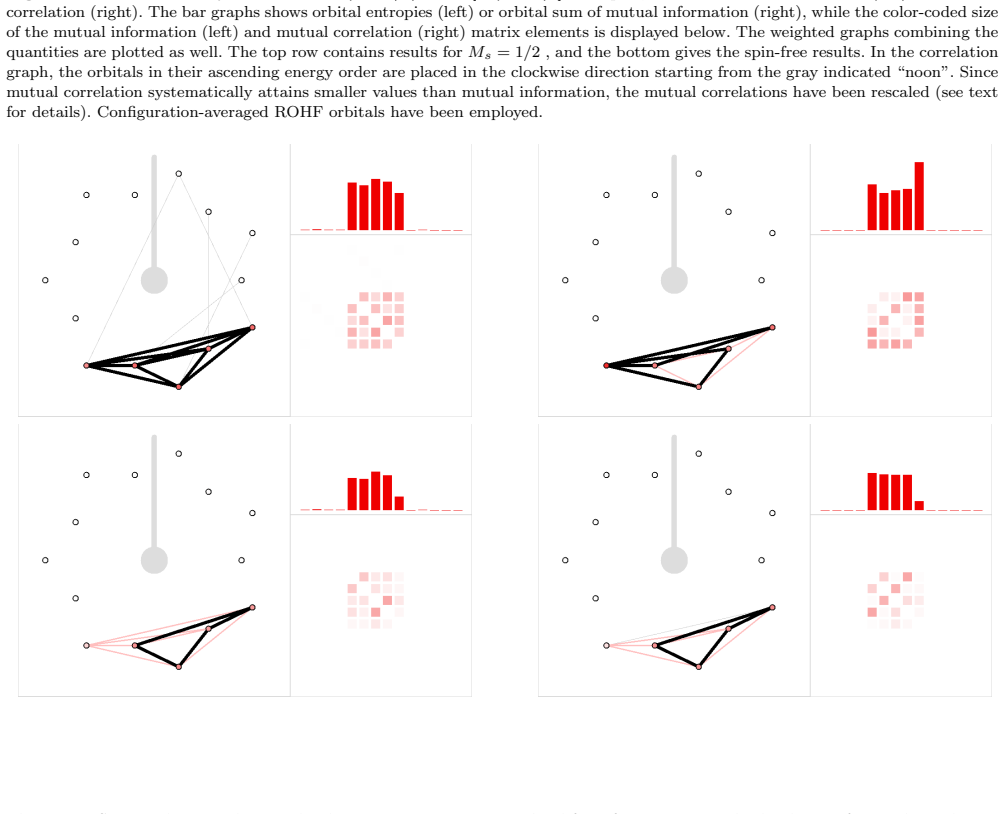

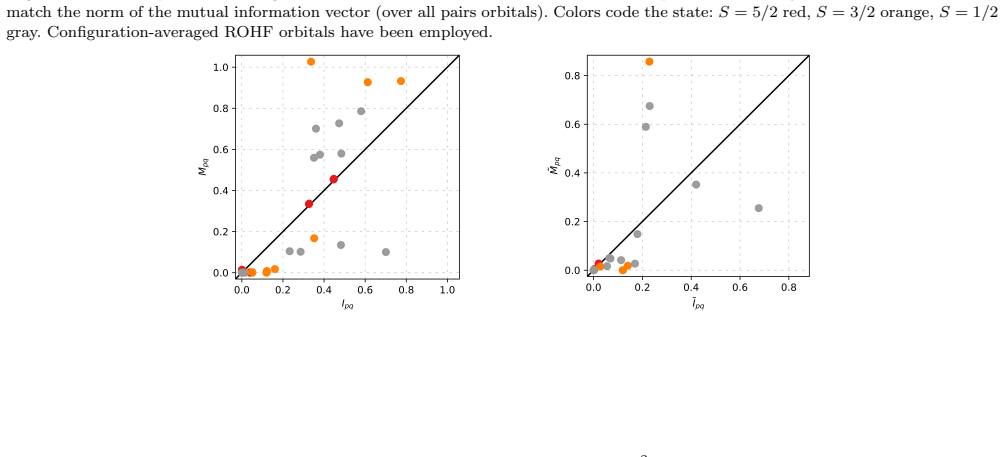






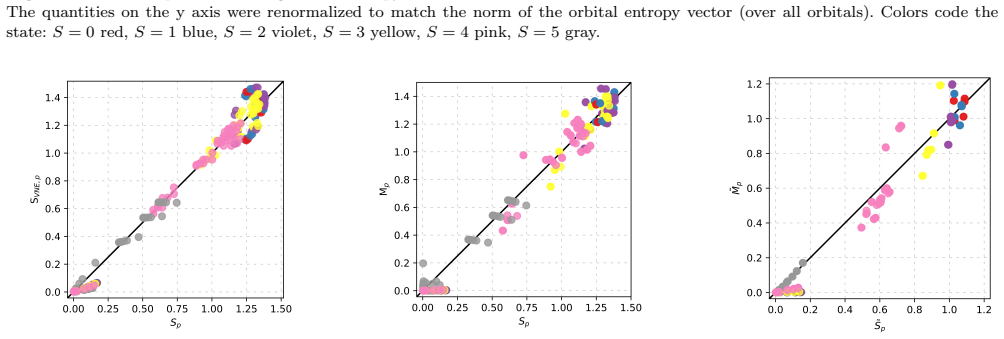
read the original abstract
Orbital entropies, pair entropies, and mutual information have become popular tools for analysis of strongly correlated wave functions. They can quantitatively measure how strongly an orbital participates in the electron correlation and reveal the correlation pattern between different orbitals. However, this pattern can become rather complicated and sometimes difficult to interpret for large active spaces and is not invariant with respect to the spin projection ($M_s$) component of the spin multiplet state. We introduce a modified spin-free orbital entropy, pair entropy, and mutual information, which simplify the correlation analysis and are invariant with respect to $M_s$. By comparison of these quantities with their "original" spin-including counterparts one can distinguish static correlation due to spin couplings from the "genuine" strong correlation due to a multiconfigurational character of the wave function. Recently, Evangelista introduced mutual correlation computed from the two-body cumulant as an alternative correlation measure, which is easier to compute for some methods. We present here a spin-free analogue of this quantity, which is $M_s$ invariant, and perform a comparison of the entropy-based and cumulant-based correlation measures in both spin-free and original variants. We illustrate the approaches on iron-sulfur bound complexes with one and two iron atoms.
Editorial analysis
A structured set of objections, weighed in public.
Referee Report
Summary. The manuscript introduces Ms-invariant spin-free formulations of orbital entropy, pair entropy, and mutual information, along with a spin-free analogue of Evangelista's cumulant-based mutual correlation. It claims that differences between these quantities and their original spin-dependent counterparts distinguish static correlation arising from spin couplings from genuine strong correlation due to multiconfigurational character, with numerical illustrations on iron-sulfur complexes containing one or two Fe atoms.
Significance. If the interpretive distinction holds, the work supplies a practical, Ms-invariant tool for simplifying correlation analysis in open-shell systems with large active spaces, which is relevant to transition-metal and bioinorganic chemistry. The explicit comparison between entropy-based and cumulant-based measures, together with the spin-free reformulations, adds a useful diagnostic layer beyond existing entropy tools.
major comments (2)
- [§5] §5 (applications to [Fe(SCH3)4]− and [Fe2S2] clusters): the numerical differences between spin-free and original mutual information are presented for fixed active spaces and CASSCF/DMRG wave functions, but no systematic variation of active-space size or orbital selection is reported; this leaves open whether the claimed separation of spin-coupling versus multiconfigurational effects is robust or depends on the specific active-space choice.
- [§3] §3 (spin-free definitions): while the Ms-invariant expressions for orbital/pair entropy and mutual information are given, the manuscript does not derive or prove that the numerical difference between spin-free and original quantities isolates spin-coupling effects independently of the underlying 1- and 2-RDMs; a short algebraic argument or counter-example test would strengthen the central interpretive claim.
minor comments (2)
- [Table 1, Figure 3] Table 1 and Figure 3: the reported mutual-information values would benefit from explicit error bars or convergence checks with respect to DMRG bond dimension to confirm numerical stability.
- [§2–3] Notation: the symbol for the spin-free pair entropy is introduced without a clear cross-reference to its spin-dependent counterpart; adding an explicit side-by-side definition table would improve readability.
Simulated Author's Rebuttal
We thank the referee for their constructive feedback and positive evaluation of the significance of our work. We address each major comment point by point below.
read point-by-point responses
-
Referee: [§5] §5 (applications to [Fe(SCH3)4]− and [Fe2S2] clusters): the numerical differences between spin-free and original mutual information are presented for fixed active spaces and CASSCF/DMRG wave functions, but no systematic variation of active-space size or orbital selection is reported; this leaves open whether the claimed separation of spin-coupling versus multiconfigurational effects is robust or depends on the specific active-space choice.
Authors: The examples in §5 are selected as representative cases from bioinorganic chemistry to illustrate the distinction in practice. We agree that the absence of systematic active-space variation leaves the robustness open to question. In the revised manuscript we will add a paragraph discussing the rationale for the chosen active spaces, report results for one alternative orbital selection per complex where computationally feasible, and explicitly note the limitations of the current numerical evidence. revision: partial
-
Referee: [§3] §3 (spin-free definitions): while the Ms-invariant expressions for orbital/pair entropy and mutual information are given, the manuscript does not derive or prove that the numerical difference between spin-free and original quantities isolates spin-coupling effects independently of the underlying 1- and 2-RDMs; a short algebraic argument or counter-example test would strengthen the central interpretive claim.
Authors: We accept the referee’s point that the interpretive claim requires explicit justification. The spin-free quantities are obtained from spin-averaged RDMs, which by construction remove Ms-dependent spin-coupling contributions. We will insert a short algebraic derivation in the revised §3 showing that the difference vanishes identically for any closed-shell (spin-singlet) state and is nonzero precisely when the wave function belongs to a spin multiplet with static spin correlation, independent of the concrete numerical values of the 1- and 2-RDMs. revision: yes
Circularity Check
No significant circularity; spin-free reformulations are direct modifications of existing quantities
full rationale
The paper derives spin-free orbital entropy, pair entropy, mutual information, and mutual correlation by explicit algebraic modifications of standard definitions (e.g., averaging over Ms components or removing spin-dependent terms) to enforce Ms invariance. These steps are self-contained mathematical re-expressions with no fitted parameters renamed as predictions, no load-bearing self-citations, and no uniqueness theorems imported from prior author work. The comparison to original quantities and illustration on iron-sulfur complexes is presented as an empirical demonstration rather than a derivation that reduces to its own inputs by construction. The work remains independent of any circular reduction.
Axiom & Free-Parameter Ledger
Reference graph
Works this paper leans on
-
[1]
Many-Electron Theory of Atoms and Molecules
Sinanoglu, O.; tai Tuan, F. Many-Electron Theory of Atoms and Molecules. m. Effect of Correlation on Orbitals.J. Chem. Phys.1963,38, 1740
1963
-
[2]
Correlation strength and information entropy.Int
Ziesche, P. Correlation strength and information entropy.Int. J. Quant. Chem.1995,56, 363–369
1995
-
[3]
Nagy, A.; Parr, R. G. Information entropy as a measure of the quality of an approximate electronic wave function.Int. J. Quant. Chem.1996,58, 323–327
1996
-
[4]
Nalewajski, R. F. Entropic Measures of Bond Multiplicity from the Information Theory.J. Phys. Chem. A 2000,104, 11940–11951
2000
-
[5]
Szalay, S.; Zimbor´ as, Z.; M´ at´ e, M.; Barcza, G.; Schilling, C.;¨Ors Legeza Fermionic systems for quantum information people.J. Phys. A: Math. Theor.2021,54, 393001
2021
-
[6]
Correlation Paradox of the Dissociation Limit: A Quantum Information Perspective.J
Ding, L.; Schilling, C. Correlation Paradox of the Dissociation Limit: A Quantum Information Perspective.J. Chem. Theory Comput.2020,16, 4159
2020
-
[7]
Concept of Orbital Entanglement and Correlation in Quantum Chemistry.J
Ding, L.; Mardazad, S.; Das, S.; Szalay, S.; Schollw¨ ock, U.; Zimbor´ as, Z.; Schilling, C. Concept of Orbital Entanglement and Correlation in Quantum Chemistry.J. Chem. Theory Comput.2021,17, 79–95. 14
2021
-
[8]
Physical entanglement between localized orbitals.Quantum Sci
Ding, L.; D¨ unnweber, G.; Schilling, C. Physical entanglement between localized orbitals.Quantum Sci. Tech- nol.2024,9, 015005
2024
-
[9]
Optimizing the density-matrix renormalization group method using quantum informa- tion entropy.Phys
Legeza, O.; S´ olyom, J. Optimizing the density-matrix renormalization group method using quantum informa- tion entropy.Phys. Rev. B2003,68, 195116
-
[10]
Optimizing density-matrix renormalization group method using quantum information entropy
Legeza, O.; S´ olyom, J. Optimizing density-matrix renormalization group method using quantum information entropy. International Workshop on Recent Progress and Prospects in Density-Matrix Renormalization. 2004
2004
-
[11]
Quantum data compression, quantum information generation, and the density-matrix renormalization-group method.Phys
Legeza, O.; S´ olyom, J. Quantum data compression, quantum information generation, and the density-matrix renormalization-group method.Phys. Rev. B2004,70, 205118
-
[12]
Two-Site Entropy and Quantum Phase Transitions in Low-Dimensional Models.Phys
Legeza, ¨O.; S´ olyom, J. Two-Site Entropy and Quantum Phase Transitions in Low-Dimensional Models.Phys. Rev. Lett.2006,96, 116401
2006
-
[13]
M.; White, S
Rissler, J.; Noack, R. M.; White, S. R. Measuring orbital interaction using quantum information theory.Chem. Phys.2006,323, 519 – 531
2006
-
[14]
H.; Reiher, M
Barcza, G.; Legeza, ¨O.; Marti, K. H.; Reiher, M. Quantum-information analysis of electronic states of different molecular structures.Phys. Rev. A2011,83, 012508
-
[15]
Entanglement Measures for Single- and Multireference Correlation Effects.J
Boguslawski, K.; Tecmer, P.; Legeza, O.; Reiher, M. Entanglement Measures for Single- and Multireference Correlation Effects.J. Phys. Chem. Lett.2012,3, 3129–3135
2012
-
[16]
Orbital Entanglement in Bond-Formation Processes.J
Boguslawski, K.; Tecmer, P.; Barcza, G.; Legeza, O.; Reiher, M. Orbital Entanglement in Bond-Formation Processes.J. Chem. Theory Comput.2013,9, 2959–2973
2013
-
[17]
M.; S´ olyom, J.; Legeza,¨O
Barcza, G.; Noack, R. M.; S´ olyom, J.; Legeza,¨O. Entanglement patterns and generalized correlation functions in quantum many-body systems.Phys. Rev. B2015,92, 125140
-
[18]
Orbital entanglement in quantum chemistry.Int
Boguslawski, K.; Tecmer, P. Orbital entanglement in quantum chemistry.Int. J. Quant. Chem.2015,115, 1289–1295
2015
-
[19]
Boguslawski, K.; Tecmer, P.; ¨Ors Legeza Analysis of two-orbital correlations in wave functions restricted to electron-pair states.Phys. Rev. B2016,94, 155126
-
[20]
Orbital entanglement and correlation from pCCD-tailored coupled cluster wave functions.J
Nowak, A.; ¨Ors Legeza; Boguslawski, K. Orbital entanglement and correlation from pCCD-tailored coupled cluster wave functions.J. Chem. Phys.2021,154, 084111
2021
-
[21]
Resolving theπ-assisted U-Nσ f-bond formation using quantum information theory.Phys
Leszczyk, A.; Dome, T.; Tecmer, P.; Kedziera, D.; Boguslawski, K. Resolving theπ-assisted U-Nσ f-bond formation using quantum information theory.Phys. Chem. Chem. Phys.2022,24, 21296–21307
2022
-
[22]
S.; Chan, G
Verstraete, F.; Nishino, T.; amd Mari Carmen Ba´ nuls, U. S.; Chan, G. K.-L.; Stoudenmire, M. E. Density matrix renormalization group, 30 years on.Nat. rev. phys.2023,5, 273–276
2023
-
[23]
H.; Ond´ ık, I
Marti, K. H.; Ond´ ık, I. M.; Moritz, G.; Reiher, M. Density matrix renormalization group calculations on relative energies of transition metal complexes and clusters.J. Chem. Phys.2008,128, 014104
2008
-
[24]
K.-L.; Sharma, S
Chan, G. K.-L.; Sharma, S. The Density Matrix Renormalization Group in Quantum Chemistry.Ann. Rev. Phys. Chem.2011,62, 465–481, PMID: 21219144
2011
-
[25]
Chan, G. K.-L. Low entanglement wavefunctions.Wiley Int. Revs.: Comp. Mol. Sci.2012,2, 907–920
2012
-
[26]
V.; Kurashige, Y.; Yanai, T.; Morokuma, K
Harris, T. V.; Kurashige, Y.; Yanai, T.; Morokuma, K. Ab initio density matrix renormalization group study of magnetic coupling in dinuclear iron and chromium complexes.J. Chem. Phys.2014,140, 054303
2014
-
[27]
Sharma, S.; Sivalingam, K.; Neese, F.; Chan, G. K.-L. Low-energy spectrum of iron-sulfur clusters directly from many-particle quantum mechanics.Nat. Chem.2014,6, 927–933
2014
-
[28]
Duperrouzel, C.; Tecmer, P.; Boguslawski, K.; Barcza, G.; ¨Ors Legeza; Ayers, P. W. A quantum informational approach for dissecting chemical reactions.Chem. Phys. Lett.2015,621, 160–164
2015
-
[29]
F.; Delcey, M
Freitag, L.; Knecht, S.; Keller, S. F.; Delcey, M. G.; Aquilante, F.; Pedersen, T. B.; Lindh, R.; Reiher, M.; Gonz´ alez, L. Orbital entanglement and CASSCF analysis of the Ru-NO bond in a Ruthenium nitrosyl complex. Phys. Chem. Chem. Phys.2015,17, 14383–14392
2015
-
[30]
Tzeli, D.; Golub, P.; Brabec, J.; Matouˇ sek, M.; Pernal, K.; Veis, L.; Raugei, S.; Xantheas, S. S. Importance of Electron Correlation on the Geometry and Electronic Structure of [2Fe-2S] Systems: A Benchmark Study of the [Fe 2S2(SCH3)4]2−,3−,4−, [Fe2S2(SCys)4]2−, [Fe2S2(S-p-tol)4]2−, and [Fe 2S2(S-o-xyl)4]2− Complexes.J. Chem. Theory Comput.2024,20, 10406–10423
2024
-
[31]
S.; Ganahl, M.; Menczer, A.; Leg- eza, O
Brower, C.; Rodriguez Bernabeu, S.; Hammond, J.; Gunnels, J.; Xantheas, S. S.; Ganahl, M.; Menczer, A.; Leg- eza, O. Mixed-Precision Ab Initio Tensor Network State Methods Adapted for NVIDIA Blackwell Technology via Emulated FP64 Arithmetic.J. Chem. Theory Comput.2026,
2026
-
[32]
A.; Reiher, M
Moritz, G.; Hess, B. A.; Reiher, M. Convergence behavior of the density-matrix renormalization group algo- rithm for optimized orbital orderings.The Journal of Chemical Physics2005,122, 024107
-
[33]
J.; Reiher, M
Stein, C. J.; Reiher, M. Automated Selection of Active Orbital Spaces.J. Chem. Theory Comput.2016,12, 15 1760–1771
2016
-
[34]
Quantum Information-Assisted Complete Active Space Optimization (QI- CAS).J
Ding, L.; Knecht, S.; Schilling, C. Quantum Information-Assisted Complete Active Space Optimization (QI- CAS).J. Phys. Chem. Lett.2023,14, 11022–11029
2023
-
[35]
Quantum correlations in molecules: from quantum resourcing to chemical bonding.Quantum Sci
Ding, L.; Knecht, S.; Zimbor´ as, Z.; Schilling, C. Quantum correlations in molecules: from quantum resourcing to chemical bonding.Quantum Sci. Technol.2023,8, 015015
2023
-
[36]
What can quantum information theory offer to quantum chemistry?Faraday Discuss.2024,254, 76
Aliverti-Piuri, D.; Chatterjee, K.; Ding, L.; Liao, K.; Liebert, J.; Schilling, C. What can quantum information theory offer to quantum chemistry?Faraday Discuss.2024,254, 76
2024
-
[37]
Entanglement and Mutual Information in Molecules: Comparing Localized and Delocalized Orbitals.J
Tenti, L.; Peeters, S.; Giner, E.; Angeli, C. Entanglement and Mutual Information in Molecules: Comparing Localized and Delocalized Orbitals.J. Chem. Theory Comput.2024,20, 10861–10874
2024
-
[38]
Quantum information-based analysis of electron-deficient bonds.J
Brandejs, J.; Veis, L.; Szalay, S.; Barcza, G.; Pittner, J.; Legeza, O. Quantum information-based analysis of electron-deficient bonds.J. Chem. Phys.2019,150, 204117
2019
-
[39]
Quantum Theory of Many-Particle Systems
L¨ owdin, P.-O. Quantum Theory of Many-Particle Systems. I. Physical Interpretations by Means of Density Matrices, Natural Spin-Orbitals, and Convergence Problems in the Method of Configurational Interaction. Phys. Rev.1955,97, 1474–1489
1955
-
[40]
Fermionic Orbital Optimization in Tensor Network States.Phys
Krumnow, C.; Veis, L.; Legeza, O.; Eisert, J. Fermionic Orbital Optimization in Tensor Network States.Phys. Rev. Lett.2016,117, 210402
2016
-
[41]
M´ at´ e, M.; Petrov, K.; Szalay, S.; ¨Ors Legeza Compressing multireference character of wave functions via fermionic mode optimization.J. Math. Chem.2023,61, 362–375
2023
-
[42]
Resolution of Electronic States in Heisenberg Cluster Models within the Unitary Group Approach.J
Li Manni, G.; Kats, D.; Liebermann, N. Resolution of Electronic States in Heisenberg Cluster Models within the Unitary Group Approach.J. Chem. Theory Comput.2023,19, 1218–1230
2023
-
[43]
M.; Bogdanov, N
Dobrautz, W.; Katukuri, V. M.; Bogdanov, N. A.; Kats, D.; Li Manni, G.; Alavi, A. Combined unitary and symmetric group approach applied to low-dimensional Heisenberg spin systems.Phys. Rev. B2022,105, 195123
-
[44]
Modeling magnetic interactions in high-valent trinuclear [Mn 3(IV)O4]4+ complexes through highly compressed multi-configurational wave functions.Phys
Li Manni, G. Modeling magnetic interactions in high-valent trinuclear [Mn 3(IV)O4]4+ complexes through highly compressed multi-configurational wave functions.Phys. Chem. Chem. Phys.2021,23, 19766
2021
-
[45]
Compression of Spin-Adapted Multiconfgurational Wave Functions in Exchange-Coupled Polynuclear Spin Systems.J
Li Manni, G.; Dobrautz, W.; Alavi, A. Compression of Spin-Adapted Multiconfgurational Wave Functions in Exchange-Coupled Polynuclear Spin Systems.J. Chem. Theory Comput.2020,16, 2202–2215
2020
-
[46]
A.; Guther, K.; Alavi, A
Li Manni, G.; Dobrautz, W.; Bogdanov, N. A.; Guther, K.; Alavi, A. Resolution of Low-Energy States in Spin- Exchange Transition-Metal Clusters: Case Study of Singlet States in [Fe(III) 4S4] Cubanes.J. Phys. Chem. A 2021,125, 4727–4740
2021
-
[47]
A.; Alavi, A.; Li Manni, G
Dobrautz, W.; Weser, O.; Bogdanov, N. A.; Alavi, A.; Li Manni, G. Spin-Pure Stochastic-CASSCF via GUGA- FCIQMC Applied to Iron-Sulfur Clusters.J. Chem. Theory Comput.2021,17, 5684–5703
2021
-
[48]
Quantum Information Orbitals (QIO): Unveiling Intrinsic Many-Body Com- plexity by Compressing Single-Body Triviality.J
Liao, K.; Ding, L.; Schilling, C. Quantum Information Orbitals (QIO): Unveiling Intrinsic Many-Body Com- plexity by Compressing Single-Body Triviality.J. Phys. Chem. Lett.2024,15, 6782–6790
2024
-
[49]
Entanglement-minimized orbitals enable faster quantum simulation of molecules.arXiv2025, 2506.13386
Li, Z. Entanglement-minimized orbitals enable faster quantum simulation of molecules.arXiv2025, 2506.13386
-
[50]
The nature of electron correlation in molecules.Int
McWeeny, R. The nature of electron correlation in molecules.Int. J. Quant. Chem.1967,1, 351–359
1967
-
[51]
Cumulant expansion of the reduced density matrices.J
Kutzelnigg, W.; Mukherjee, D. Cumulant expansion of the reduced density matrices.J. Chem. Phys.1999, 110, 2800–2809
1999
-
[52]
Mazziotti, D. A. Two-Electron Reduced Density Matrix as the Basic Variable in Many-Electron Quantum Chemistry and Physics.Chem. Rev.2012,112, 244–262
2012
-
[53]
The complexity of the local Hamiltonian problem.SIAM J
Kempe, J.; Kitaev, A.; Regev, O. The complexity of the local Hamiltonian problem.SIAM J. Comp.2006, 35, 1070–1097
2006
-
[54]
Kutzelnigg, W.; Mukherjee, D.J. Chem. Phys.1997,107, 432
1997
-
[55]
Normal ordering and a Wick-like reduction theorem for fermions with respect to a multi- determinantal reference state.Chemical Physics Letters1997,274, 561 – 566
Mukherjee, D. Normal ordering and a Wick-like reduction theorem for fermions with respect to a multi- determinantal reference state.Chemical Physics Letters1997,274, 561 – 566
-
[56]
n-Electron Problem and Its Formulation in Terms of k-Particle Density Cumulants.Int
Kutzelnigg, W. n-Electron Problem and Its Formulation in Terms of k-Particle Density Cumulants.Int. J. Quant. Chem.2003,95, 404–423
2003
-
[57]
P.; Turney, J
Misiewicz, J. P.; Turney, J. M.; III, H. F. S. Reduced Density Matrix Cumulants: The Combinatorics of Size-Consistency and Generalized Normal Ordering.J. Chem. Theory Comput.2020,16, 6150–6164
2020
-
[58]
Juh´ ash, T.; Mazziotti, D. A. The cumulant two-particle reduced density matrix as a measure of electron correlation and entanglement.J. Chem. Phys.2006,125, 174105
2006
-
[59]
Kong, L.; Valeev, E. F. A novel interpretation of reduced density matrix and cumulant for electronic structure theories.J. Chem. Phys.2011,134, 214109. 16
2011
-
[60]
Mutual Correlation.J. Chem. Theory Comput.2025,21, 7471–7484
2025
-
[61]
G.; DeBeer, S.; Neese, F
Chilkuri, V. G.; DeBeer, S.; Neese, F. Revisiting the Electronic Structure of FeS Monomers Using Ab Initio Ligand Field Theory and the Angular Overlap Model.Inorg. Chem.2017,56, 10418–10436
2017
-
[62]
G.; DeBeer, S.; Neese, F
Chilkuri, V. G.; DeBeer, S.; Neese, F. Ligand Field Theory and Angular Overlap Model Based Analysis of the Electronic Structure of Homovalent Iron-Sulfur Dimers.Inorg. Chem.2020,59, 984–995
2020
-
[63]
L.; Maganas, D.; Neese, F
da Costa Gouveia, T. L.; Maganas, D.; Neese, F. Restricted Open-Shell Hartree-Fock Method for a General Configuration State Function Featuring Arbitrarily Complex Spin-Couplings.J. Phys. Chem. A2024,128, 5041
-
[64]
The density-matrix renormalization group in the age of matrix product states.Annals of Physics2011,326, 96 – 192, January 2011 Special Issue
Schollw¨ ock, U. The density-matrix renormalization group in the age of matrix product states.Annals of Physics2011,326, 96 – 192, January 2011 Special Issue
2011
-
[65]
Spin-free orbital entropy, mutual information and correlation analysis.Mol
Pittner, J. Spin-free orbital entropy, mutual information and correlation analysis.Mol. Phys.2025,123, e2500632
2025
-
[66]
Huang, Z.; Kais, S.Chem. Phys. Lett.2005,413, 1
2005
-
[67]
Neese, F.WIREs Comput. Mol. Sci.2012,2, 73–78
2012
-
[68]
Massively parallel quantum chemical density matrix renormalization group method.J
Brabec, J.; Brandejs, J.; Kowalski, K.; Xantheas, S.; Legeza, O.; Veis, L. Massively parallel quantum chemical density matrix renormalization group method.J. Comp. Chem.2021,42, 534–544
2021
-
[69]
R.; Lee, S.; Cui, Z.; Zhu, T.; Sun, C.; Peng, L.; Peng, R.; Liao, K.; T¨ olle, J.; Yang, J.; Li, S.; Chan, G
Zhai, H.; Larsson, H. R.; Lee, S.; Cui, Z.; Zhu, T.; Sun, C.; Peng, L.; Peng, R.; Liao, K.; T¨ olle, J.; Yang, J.; Li, S.; Chan, G. K.-L. Block2: a comprehensive open source framework to develop and apply state-of-the-art DMRG algorithms in electronic structure and beyond.J. Chem. Phys.2023,159, 234801. 17 Figure 2.Correlation analysis for the ground stat...
2023
discussion (0)
Sign in with ORCID, Apple, or X to comment. Anyone can read and Pith papers without signing in.