From streamers to stars: overcoming mass loss in protoplanetary disks
Pith reviewed 2026-07-01 16:41 UTC · model grok-4.3
The pith
Angular-momentum mismatch from late infall can drive inward gas transport and sustain stellar accretion even without strong MHD winds.
A machine-rendered reading of the paper's core claim, the machinery that carries it, and where it could break.
Core claim
When the effective torque is included, the angular-momentum mismatch itself can promote inward gas transport and enhance stellar accretion, even without strong MHD disk winds. By contrast, if the Lupus accretion-density correlation is caused by late infall without an effective infall torque, efficient angular-momentum removal by MHD disk winds is required.
What carries the argument
The effective torque arising from the angular-momentum difference between infalling gas and Keplerian disk gas, added as an additional term in the angular-momentum equation of 1D long-term evolution models.
If this is right
- Much of the gas supplied by late infall is lost through photoevaporation from the outer disk.
- Strong viscosity without the effective torque produces excessive disk spreading inconsistent with Lupus observations.
- MHD disk winds remove angular momentum without significant outward expansion, allowing compact disks to sustain accretion.
- Inclusion of the effective torque enables enhanced stellar accretion rates without requiring strong MHD winds.
Where Pith is reading between the lines
- Multidimensional simulations would be needed to check whether the modeled torque term reproduces the actual radial and vertical flows induced by streamers.
- Kinematic maps of streamer-disk interfaces could reveal direct signatures of the angular-momentum mismatch driving inward transport.
- Regions with different ambient densities could be surveyed for systematic differences in inner-disk accretion signatures to distinguish torque-driven from wind-driven scenarios.
Load-bearing premise
The 1D simulations assume photoevaporation dominates gas loss from the outer disk and that the effective torque from infalling gas can be modeled as an additional term in the angular momentum equation without full 2D or 3D effects.
What would settle it
Measurement of disk radii in high-ambient-density regions of Lupus that are substantially larger than the compact sizes predicted by the no-torque models would indicate that the assumed torque or wind physics is insufficient.
Figures





read the original abstract
Recent high-resolution observations have revealed filamentary accretion flows (``streamers'') in protoplanetary disks older than 1 Myr, suggesting that late-stage interstellar gas infall (late infall) may affect disk evolution and stellar accretion. In Lupus, observations report a positive correlation between ambient gas density and stellar accretion rate. However, it remains unclear whether infall can truly boost stellar accretion, because incoming gas may instead be lost through photoevaporation or magnetically driven disk winds, or remain trapped in the outer disk. We perform one-dimensional long-term ($\sim$1--10 Myr) disk evolution simulations. We first treat late infall as a mass source and then include the effective torque arising from the angular-momentum difference between the infalling gas and Keplerian disk gas. We find that even if substantial gas reaches the outer disk ($\sim 10^{2}$ au), much of it is eventually lost through photoevaporation. Sustained stellar accretion therefore requires efficient inward gas delivery by mechanisms that locally remove angular momentum. Without an effective infall torque, strong viscosity can provide this transport, but it also drives outward angular-momentum transport and excessive disk spreading, inconsistent with the compact disk sizes observed in Lupus. In contrast, MHD disk winds can remove angular momentum without significantly expanding the disk, allowing late infall to sustain stellar accretion while keeping disks compact. Thus, if the Lupus accretion--density correlation is caused by late infall without an effective infall torque, efficient angular-momentum removal by MHD disk winds is required. By contrast, when the effective torque is included, the angular-momentum mismatch itself can promote inward gas transport and enhance stellar accretion, even without strong MHD disk winds.
Editorial analysis
A structured set of objections, weighed in public.
Referee Report
Summary. The manuscript uses one-dimensional long-term (1-10 Myr) disk evolution simulations to study late infall from streamers in protoplanetary disks. It treats infall first as a mass source and then adds an effective torque from the angular-momentum difference between infalling and Keplerian gas. The central finding is that substantial outer-disk gas is lost to photoevaporation; without the torque, strong MHD winds (rather than viscosity) are required to sustain stellar accretion while preserving the compact disk sizes seen in Lupus, whereas inclusion of the torque enables inward transport and enhanced accretion even without strong winds.
Significance. If the modeling holds, the work clarifies how late infall can contribute to the observed Lupus accretion-density correlation and distinguishes the roles of angular-momentum transport mechanisms in keeping disks compact. The long-term evolutionary timescale explored is a strength for connecting streamers to stellar accretion.
major comments (2)
- [Methods (effective torque implementation)] The headline distinction (torque enables accretion without strong MHD winds; no-torque case requires winds for compact Lupus disks) rests on adding a single effective torque term to the 1D angular-momentum equation, constructed from the specific angular-momentum difference. The 1D radial averaging cannot capture whether the mismatch produces shocks, vertical redistribution, or non-local torques that would alter the net radial mass flux (see skeptic note on streamer-disk interaction).
- [Results (photoevaporation and inward delivery)] The claim that photoevaporation dominates outer-disk gas loss while the torque still delivers enough mass to the star inherits the same untested 1D closure; no independent check against 2D/3D hydro or multi-wavelength streamer kinematics is reported, yet this underpins the conclusion that late infall can boost accretion.
minor comments (2)
- [Abstract] The abstract provides no details on numerical implementation, specific values of the viscosity parameter or MHD wind efficiency, convergence tests, or direct comparisons to data.
- [Methods] Notation for the effective torque term and its insertion into the angular-momentum equation should be defined explicitly with an equation number for reproducibility.
Simulated Author's Rebuttal
We thank the referee for their careful reading and insightful comments, which help clarify the scope and limitations of our 1D modeling approach. We respond to each major comment below and have revised the manuscript to better articulate the assumptions and caveats of the effective torque implementation.
read point-by-point responses
-
Referee: [Methods (effective torque implementation)] The headline distinction (torque enables accretion without strong MHD winds; no-torque case requires winds for compact Lupus disks) rests on adding a single effective torque term to the 1D angular-momentum equation, constructed from the specific angular-momentum difference. The 1D radial averaging cannot capture whether the mismatch produces shocks, vertical redistribution, or non-local torques that would alter the net radial mass flux (see skeptic note on streamer-disk interaction).
Authors: We acknowledge that a 1D radial model cannot resolve multidimensional effects such as shocks, vertical mixing, or non-local torques that may arise from the angular-momentum mismatch between streamers and the disk. The effective torque term we adopt is a first-order closure based on the specific angular-momentum difference, chosen to permit Myr-timescale integrations that are currently inaccessible to 2D/3D simulations. In the revised manuscript we have expanded Section 2.3 to explicitly state this limitation, to describe the torque as an approximation, and to note that future multidimensional work will be required to test whether the net radial mass flux is altered by these processes. revision: partial
-
Referee: [Results (photoevaporation and inward delivery)] The claim that photoevaporation dominates outer-disk gas loss while the torque still delivers enough mass to the star inherits the same untested 1D closure; no independent check against 2D/3D hydro or multi-wavelength streamer kinematics is reported, yet this underpins the conclusion that late infall can boost accretion.
Authors: The conclusion that photoevaporation removes most of the outer-disk gas follows directly from the adopted EUV/FUV mass-loss prescriptions and the long integration times; the torque term then determines how much of the remaining gas reaches the star. We agree that direct validation against 2D/3D hydrodynamical simulations or observed streamer kinematics is absent. Because the paper’s primary goal is to explore evolutionary outcomes over 1–10 Myr, such comparisons lie outside its scope. We have added a paragraph in the discussion section that reiterates the 1D framework’s limitations and calls for future work that couples the torque prescription to multidimensional streamer–disk simulations. revision: partial
Circularity Check
No circularity: forward 1D simulations with explicit torque term yield independent outputs
full rationale
The paper performs explicit one-dimensional disk evolution simulations over 1-10 Myr, first adding late infall as a mass source and then adding an effective torque term constructed from the angular-momentum difference between infalling and Keplerian gas. The reported outcomes (photoevaporation removing most outer gas, torque enabling inward transport without strong MHD winds, or the requirement for winds in the no-torque case to match compact Lupus disks) are numerical results of integrating those equations forward in time. No step renames a fitted parameter as a prediction, no self-citation supplies a uniqueness theorem or load-bearing premise, and no ansatz is smuggled via prior work; the torque term is stated as an added model ingredient whose consequences are then computed. The derivation chain therefore remains self-contained against external benchmarks.
Axiom & Free-Parameter Ledger
free parameters (2)
- viscosity parameter
- MHD wind efficiency
axioms (2)
- domain assumption Photoevaporation removes infalling gas from the outer disk before it can accrete onto the star.
- domain assumption The 1D radial model captures the essential dynamics of long-term disk evolution with late infall.
Reference graph
Works this paper leans on
-
[1]
Adams, F. C., Lada, C. J., & Shu, F. H. 1987, ApJ, 312, 788 Ansdell, M., Williams, J. P., Trapman, L., et al. 2018, ApJ, 859, 21 Ardila, D. R., Golimowski, D. A., Krist, J. E., et al. 2007, ApJ, 665, 512 Bai, X.-N. 2013, ApJ, 772, 96 Benisty, M., Dominik, C., Follette, K., et al. 2023, in Astronomical Society of the Pacific Conference Series, V ol. 534, P...
-
[2]
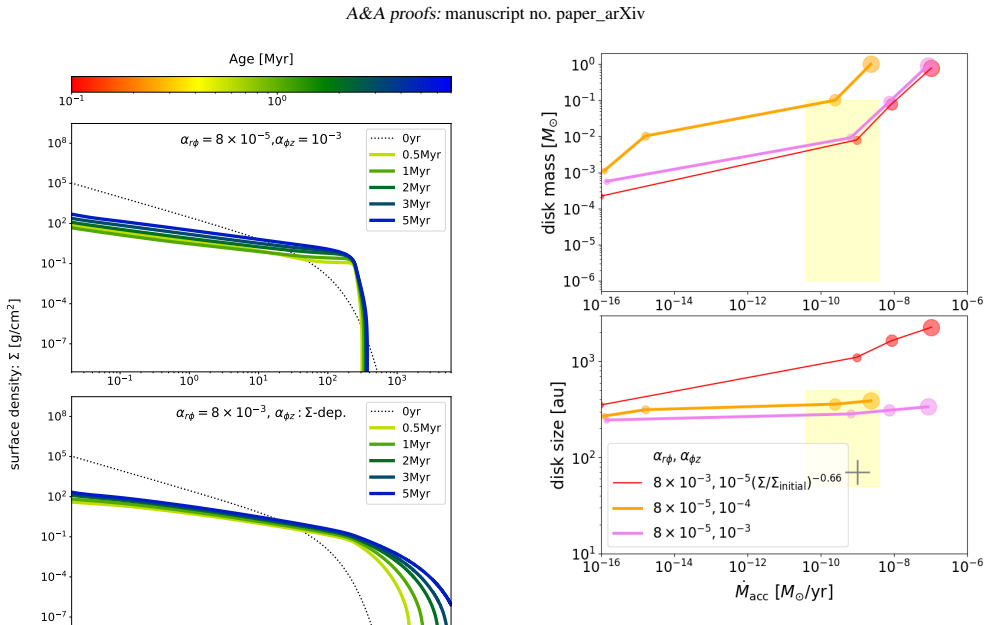
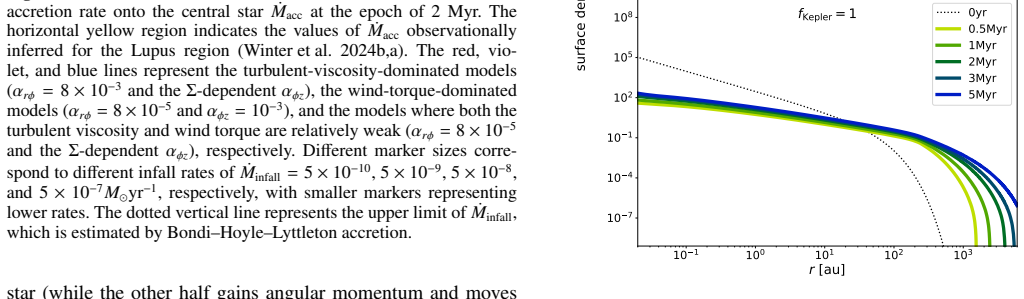
The circles represent different infall rates of˙Minfall =5×10 −10, 5×10 −9, 5×10 −8, and 5×10 −7 M⊙yr−1, respectively, in order of increasing circle size. Appendix A: Parameter dependencies As a complement to Section 3.1, we present the parameter de- pendencies of the results in more detail, with a particular focus on the models without the effective torq...
2025
discussion (0)
Sign in with ORCID, Apple, or X to comment. Anyone can read and Pith papers without signing in.