A universal geometric mechanism for chaos-bound violations in black hole spacetimes
Pith reviewed 2026-06-29 16:07 UTC · model grok-4.3
The pith
A geometric criterion based on photon-sphere and horizon locations decides whether the MSS chaos bound holds or is violated in black hole spacetimes.
A machine-rendered reading of the paper's core claim, the machinery that carries it, and where it could break.
Core claim
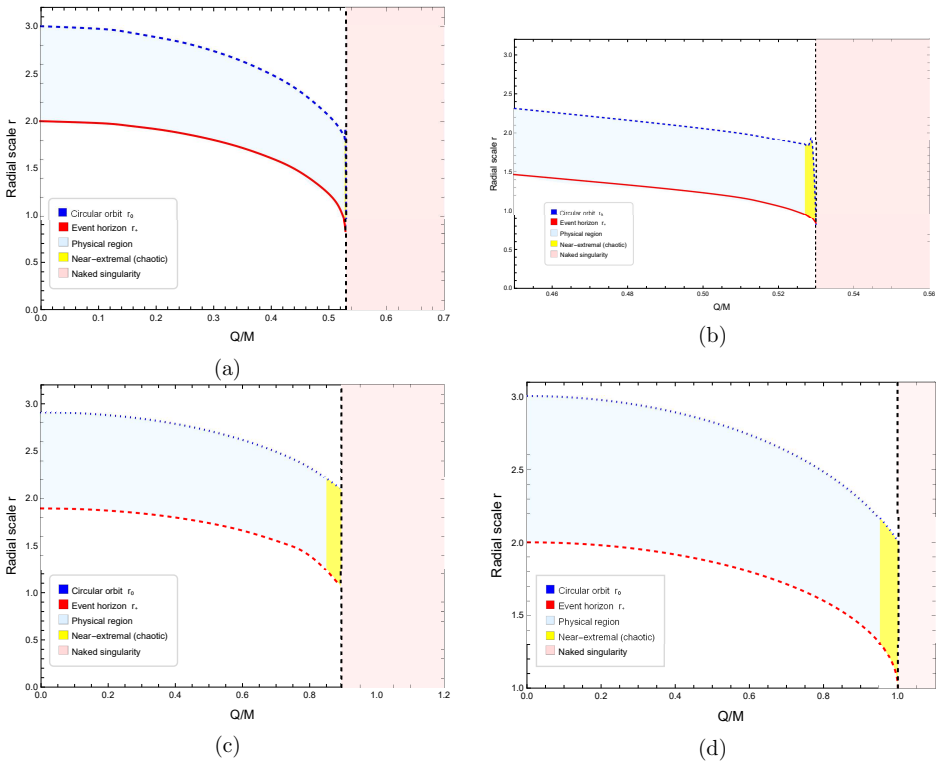
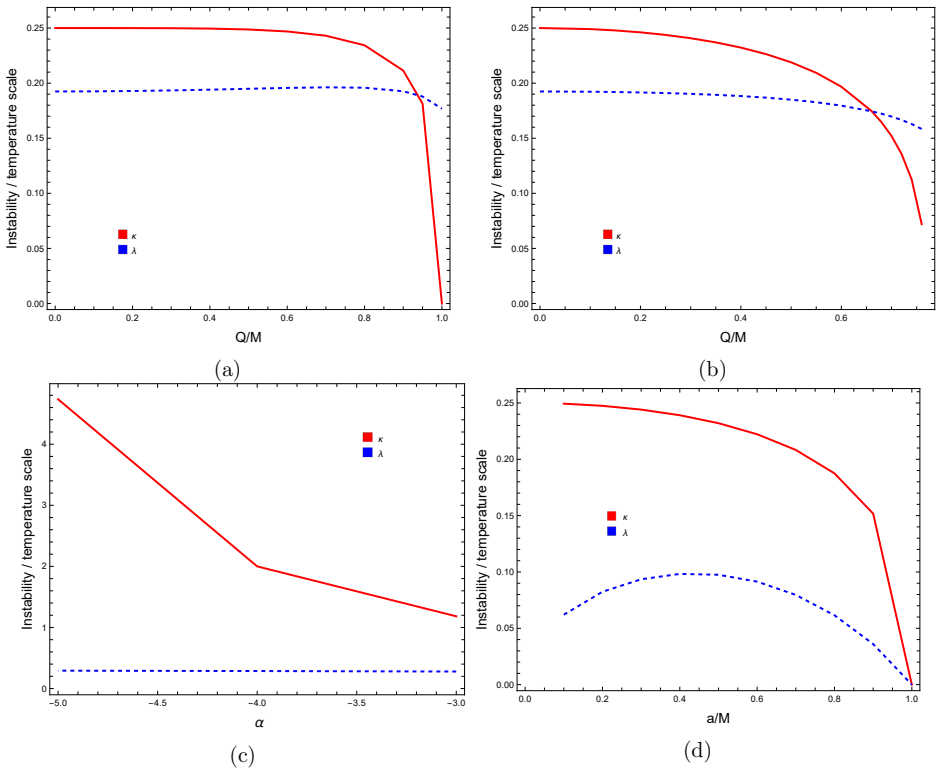
The applicability of the MSS bound is governed by the relative behavior of unstable circular orbits and the horizon structure in near-extremal regimes. When the relevant orbit remains outside the horizon as surface gravity vanishes, the instability scale persists and the chaos bound is violated. When the orbit approaches the degenerate horizon, the instability is suppressed by divergent gravitational time dilation, leading to saturation of the bound. This yields a universal geometric conjecture that determines the bound's validity from the photon-sphere and horizon structure alone.
What carries the argument
The relative location of the unstable circular photon orbit with respect to the event horizon in the near-extremal limit, which controls whether the Lyapunov exponent remains finite or is damped by time dilation.
If this is right
- Black hole solutions in which the photon sphere stays exterior to the horizon at extremality violate the MSS bound.
- Solutions in which the photon sphere merges with the horizon saturate the bound through time-dilation suppression.
- The same geometric test applies uniformly across Einstein gravity, scalar-tensor theories, and higher-curvature gravity.
- Violations observed in the literature arise from this spacetime geometry rather than from any specific modification of general relativity.
Where Pith is reading between the lines
- The result supplies a quick diagnostic for any new black hole metric: locate the photon sphere and check its position relative to the extremal horizon.
- Classical geodesic calculations may need this geometric filter before they are used to test quantum chaos bounds.
- Similar horizon-orbit comparisons could be applied to other near-horizon bounds that involve Lyapunov exponents.
Load-bearing premise
The Lyapunov exponent entering the chaos bound is set by the instability rate of circular null geodesics.
What would settle it
Calculate the Lyapunov exponent of the unstable circular photon orbit in any near-extremal black hole whose photon sphere is known to lie strictly outside the horizon; if the exponent drops below 2 pi T as T approaches zero, the claimed criterion is false.
Figures
read the original abstract
Violation of the Maldacena-Shenker-Stanford (MSS) chaos bound has been observed in various black hole spacetimes, but its physical origin remains unclear. In particular, it is uncertain whether these violations arise from modifications of general relativity or reflect a more fundamental feature of black hole spacetimes. In this work, we systematically investigate the instability of circular geodesics across a broad class of black hole solutions in Einstein, scalar-tensor, and higher-curvature gravity. We show that the violations are governed by the relative behavior of unstable circular orbits and the horizon structure in near-extremal regimes. When the relevant orbit remains outside the horizon as the surface gravity vanishes, the instability scale persists, and the chaos bound can be violated. On the other hand, as the orbit approaches the degenerate horizon, the instability becomes suppressed by the associated divergent gravitational time dilation, ultimately leading to saturation of the bound. Motivated by these results, we propose a geometric conjecture that determines the applicability of the MSS bound directly from the photon-sphere and horizon structure of the spacetime. Our findings identify a universal geometric criterion that governs the applicability of the MSS bound in black hole spacetimes, revealing a fundamental constraint on extending the quantum chaos bound to classical gravitational settings.
Editorial analysis
A structured set of objections, weighed in public.
Referee Report
Summary. The manuscript claims that violations of the Maldacena-Shenker-Stanford (MSS) chaos bound in black hole spacetimes arise from the relative behavior of unstable circular photon orbits and the horizon structure in near-extremal regimes. When the relevant orbit remains outside the horizon as surface gravity vanishes, the geodesic instability persists and the bound can be violated; when the orbit approaches the degenerate horizon, gravitational time dilation suppresses the instability, leading to saturation. Motivated by systematic analysis across Einstein, scalar-tensor, and higher-curvature gravity solutions, the authors propose a geometric conjecture that determines MSS bound applicability directly from the photon-sphere and horizon structure.
Significance. If the conjecture holds, it supplies a universal geometric criterion, independent of specific modifications to general relativity, that governs when the MSS bound applies or is violated in classical gravitational settings. The systematic investigation across multiple gravity theories provides concrete support for the claim that this is a fundamental feature of black hole spacetimes rather than an artifact of particular solutions.
minor comments (1)
- [Section on relative behavior of unstable circular orbits and horizon structure] Section on relative behavior of unstable circular orbits and horizon structure: an explicit equation for the Lyapunov exponent in terms of the second derivative of the effective potential would make the claimed suppression mechanism due to time dilation fully transparent to readers.
Simulated Author's Rebuttal
We thank the referee for the positive summary, significance assessment, and recommendation of minor revision. No major comments were raised in the report.
Circularity Check
No significant circularity; conjecture motivated by explicit multi-theory calculations
full rationale
The paper performs systematic computations of geodesic instability rates across Einstein, scalar-tensor, and higher-curvature black holes, then observes that MSS-bound violations correlate with whether the photon sphere remains outside the horizon as surface gravity vanishes. The proposed geometric conjecture is presented as an inductive summary of these independent calculations rather than a definitional identity or a fit to a subset of the same data. No load-bearing step reduces to a self-citation chain, a fitted parameter renamed as a prediction, or an ansatz smuggled from prior author work; the central identification of Lyapunov exponent with circular-orbit instability is the standard literature definition, not derived within the paper itself.
Axiom & Free-Parameter Ledger
axioms (2)
- domain assumption The MSS bound is realized through the Lyapunov exponent of unstable circular geodesics in black hole spacetimes.
- domain assumption Black hole solutions exist in Einstein, scalar-tensor, and higher-curvature gravity with well-defined horizons and photon spheres.
Reference graph
Works this paper leans on
-
[1]
Lei and X.-H
Y.-Q. Lei and X.-H. Ge, Phys. Rev. D 105, 084011 (2022)
2022
-
[2]
C. Gao, D. Chen, C. Yu, and P. Wang, Phys. Lett. B 833, 137343 (2022). 26
2022
-
[3]
Jeong, B.-H
S. Jeong, B.-H. Lee, H. Lee, and W. Lee, Phys. Rev. D 107, 104037 (2023)
2023
-
[4]
Dutta, K
P. Dutta, K. L. Panigrahi, and B. Singh, JHEP 2025 (02), 043
2025
-
[5]
Deich, N
A. Deich, N. Yunes, and C. Gammie, Phys. Rev. D 110, 044033 (2024)
2024
-
[6]
Pourkhodabakhshi, Phys
R. Pourkhodabakhshi, Phys. Rev. D 112, 064085 (2025)
2025
-
[7]
McLoughlin and A
T. McLoughlin and A. Spiering, JHEP 2022 (09), 240
2022
-
[8]
R. C. Delgado and S. F¨ orste, Phys. Lett. B 835, 137550 (2022)
2022
-
[9]
de Mello Koch and G
R. de Mello Koch and G. Kemp, JHEP 2022 (12), 095
2022
-
[10]
Malvimat and R
V. Malvimat and R. R. Poojary, JHEP 2023 (03), 099
2023
-
[11]
Hashimoto, K
K. Hashimoto, K. Murata, N. Tanahashi, and R. Watanabe, Phys. Rev. D 106, 126010 (2022)
2022
-
[12]
H. L. Prihadi, F. P. Zen, D. Dwiputra, and S. Ariwahjoedi , Phys. Rev. D 107, 124053 (2023)
2023
-
[13]
Maldacena, S
J. Maldacena, S. H. Shenker, and D. Stanford, JHEP 2016 (8), 106
2016
-
[14]
Hashimoto and N
K. Hashimoto and N. Tanahashi, Phys. Rev. D 95, 024007 (2017)
2017
-
[15]
Addazi, S
A. Addazi, S. Capozziello, and S. Odintsov, Phys. Lett. B 816, 136257 (2021)
2021
-
[16]
J. Xie, J. Wang, and B. Tang, Phys. Dark Univ. 42, 101271 (2023)
2023
-
[17]
Zhao, Y.-Z
Q.-Q. Zhao, Y.-Z. Li, and H. L¨ u, Phys. Rev. D 98, 124001 (2018)
2018
-
[18]
Addazi and S
A. Addazi and S. Capozziello, Phys. Lett. B 839, 137828 (2023)
2023
-
[19]
Lee and B
H. Lee and B. Gwak, Phys. Rev. D 112, 046018 (2025)
2025
-
[20]
C. Yu, D. Chen, B. Mu, and Y. He, Nucl. Phys. B 987, 116093 (2023)
2023
-
[21]
T. V. Targema, R. Babar, M. Atif, M. El-Meligy, T. Xia, an d R. Ali, Int. J. Geom. Methods Mod. Phys. 22, 2550064 (2025)
2025
-
[22]
Kan and B
N. Kan and B. Gwak, Phys. Rev. D 105, 026006 (2022)
2022
-
[23]
B. Gwak, N. Kan, B.-H. Lee, and H. Lee, JHEP 2022 (09), 026
2022
-
[24]
Lei, X.-H
Y.-Q. Lei, X.-H. Ge, and S. Dalui, Phys. Lett. B 856, 138929 (2024)
2024
-
[25]
Fayyaz, G
A. Fayyaz, G. Abbas, M. Bin-Asfour, and D. Chen, Phys. Le tt. B 871, 139965 (2025)
2025
-
[26]
Gallo and T
E. Gallo and T. M¨ adler, Eur. Phys. J. C 85, 1 (2025)
2025
-
[27]
Dalui, C
S. Dalui, C. Singha, and K. Bhattacharya, Phys. Lett. B 874, 140256 (2026)
2026
-
[28]
T. V. Targema, K. Bamba, R. Ali, and U. Zafar, (2025), arX iv:2512.22834 [hep-th]
work page internal anchor Pith review Pith/arXiv arXiv 2025
-
[29]
Cardoso, A
V. Cardoso, A. S. Miranda, E. Berti, H. Witek, and V. T. Za nchin, Phys. Rev. D 79, 064016 (2009)
2009
-
[30]
Chen and C
D. Chen and C. Gao, New J. Phys. 24, 123014 (2022)
2022
-
[31]
Chandrasekhar, The mathematical theory of black holes , Vol
S. Chandrasekhar, The mathematical theory of black holes , Vol. 69 (Oxford university press, 1998)
1998
-
[32]
Touati and S
A. Touati and S. Zaim, Nucl. Phys. B , 117018 (2025)
2025
-
[33]
N. A. Kumara, S. Punacha, and M. S. Ali, JCAP 2024 (07), 061
2024
-
[34]
X. Guo, Y. Lu, B. Mu, and P. Wang, JHEP 2022 (08), 153
2022
-
[35]
Radosz, A
A. Radosz, A. T. Augousti, and A. Siwek, Gen. Relativ. Gr avit. 45, 705 (2013)
2013
-
[36]
Dalang, P
C. Dalang, P. Fleury, and L. Lombriser, Phys. Rev. D 102, 044036 (2020)
2020
-
[37]
Bhattacharya and S
S. Bhattacharya and S. Chakraborty, Phys. Rev. D 95, 044037 (2017)
2017
-
[38]
Pogosian and A
L. Pogosian and A. Silvestri, Phys. Rev. D 94, 104014 (2016)
2016
-
[39]
L¨ u and Y
H. L¨ u and Y. Pang, Phys. Lett. B 809, 135717 (2020)
2020
-
[40]
G. W. Horndeski, Int. J. Theor. Phys. 10, 363 (1974)
1974
-
[41]
Anabalon, A
A. Anabalon, A. Cisterna, and J. Oliva, Phys. Rev. D 89, 084050 (2014)
2014
-
[42]
Babichev, C
E. Babichev, C. Charmousis, and A. Leh´ ebel, JCAP 2017 (04), 027
2017
-
[43]
Bad ´ ıa and E
J. Bad ´ ıa and E. F. Eiroa, Eur. Phys. J. C 77, 779 (2017)
2017
-
[44]
Carvajal, P
D. Carvajal, P. Gonz´ alez, M. Olivares, E. Papantonopo ulos, and Y. V´ asquez, 27 Eur. Phys. J. C 85, 978 (2025)
2025
-
[45]
Y. S. Myung, Phys. Lett. B 866, 139523 (2025)
2025
-
[46]
Liang, Y.-S
X. Liang, Y.-S. An, C.-H. Wu, and Y.-P. Hu, Phys. Lett. B 862, 139303 (2025)
2025
-
[47]
Hui and A
L. Hui and A. Nicolis, Phys. Rev. Lett. 110, 241104 (2013)
2013
-
[48]
Cisterna and C
A. Cisterna and C. Erices, Phys. Rev. D 89, 084038 (2014)
2014
-
[49]
Glavan and C
D. Glavan and C. Lin, Phys. Rev. Lett. 124, 081301 (2020)
2020
-
[50]
Cognola, R
G. Cognola, R. Myrzakulov, L. Sebastiani, and S. Zerbin i, Phys. Rev. D 88, 024006 (2013)
2013
-
[51]
Yang, J.-J
S.-J. Yang, J.-J. Wan, J. Chen, J. Yang, and Y.-Q. Wang, E ur. Phys. J. C 80, 937 (2020)
2020
-
[52]
Guo and P.-C
M. Guo and P.-C. Li, Eur. Phys. J. C 80, 588 (2020)
2020
-
[53]
D. J. Gross and J. H. Sloan, Nucl. Phys. B 291, 41 (1987)
1987
-
[54]
Charmousis and J.-F
C. Charmousis and J.-F. Dufaux, Class. Quantum Grav. 19, 4671 (2002)
2002
-
[55]
Pradhan and P
P. Pradhan and P. Majumdar, Phys. Lett. A 375, 474 (2011)
2011
-
[56]
Wang and D
Z. Wang and D. Chen, Nucl. Phys. B 991, 116212 (2023)
2023
-
[57]
Li, D.-Z
K. Li, D.-Z. Ma, and Z.-M. Xu, Universe 12, 57 (2026)
2026
-
[58]
Bardeen, in Proceedings of the 5th International Conference on Gravitati on and the Theory of Relativity (1968) p
J. Bardeen, in Proceedings of the 5th International Conference on Gravitati on and the Theory of Relativity (1968) p. 87
1968
-
[59]
Fernando and J
S. Fernando and J. Correa, Phys. Rev. D 86, 064039 (2012)
2012
-
[60]
Hod, Phys
S. Hod, Phys. Rev. D 84, 104024 (2011)
2011
-
[61]
Hod, Eur
S. Hod, Eur. Phys. J. C 78, 725 (2018)
2018
-
[62]
R. P. Kerr, Phys. Rev. Lett. 11, 237 (1963)
1963
-
[63]
Hioki and K.-i
K. Hioki and K.-i. Maeda, Phys. Rev. D 80, 024042 (2009)
2009
-
[64]
M. R. Alipour, M. A. S. Afshar, S. Noori Gashti, and J. Sad eghi, Eur. Phys. J. C 85, 138 (2025)
2025
-
[65]
Blagojevi´ c and B
M. Blagojevi´ c and B. Cvetkovi´ c, Phys. Lett. B 824, 136815 (2022)
2022
-
[66]
S. A. Hayward, Phys. Rev. Lett. 96, 031103 (2006). 28
2006
discussion (0)
Sign in with ORCID, Apple, or X to comment. Anyone can read and Pith papers without signing in.