How Students (Mis)understand Conditionals and Loops -- A Taxonomy
Pith reviewed 2026-07-01 16:03 UTC · model grok-4.3
The pith
A taxonomy built from student quizzes and interviews distinguishes specific misconceptions about conditionals and loops.
A machine-rendered reading of the paper's core claim, the machinery that carries it, and where it could break.
Core claim
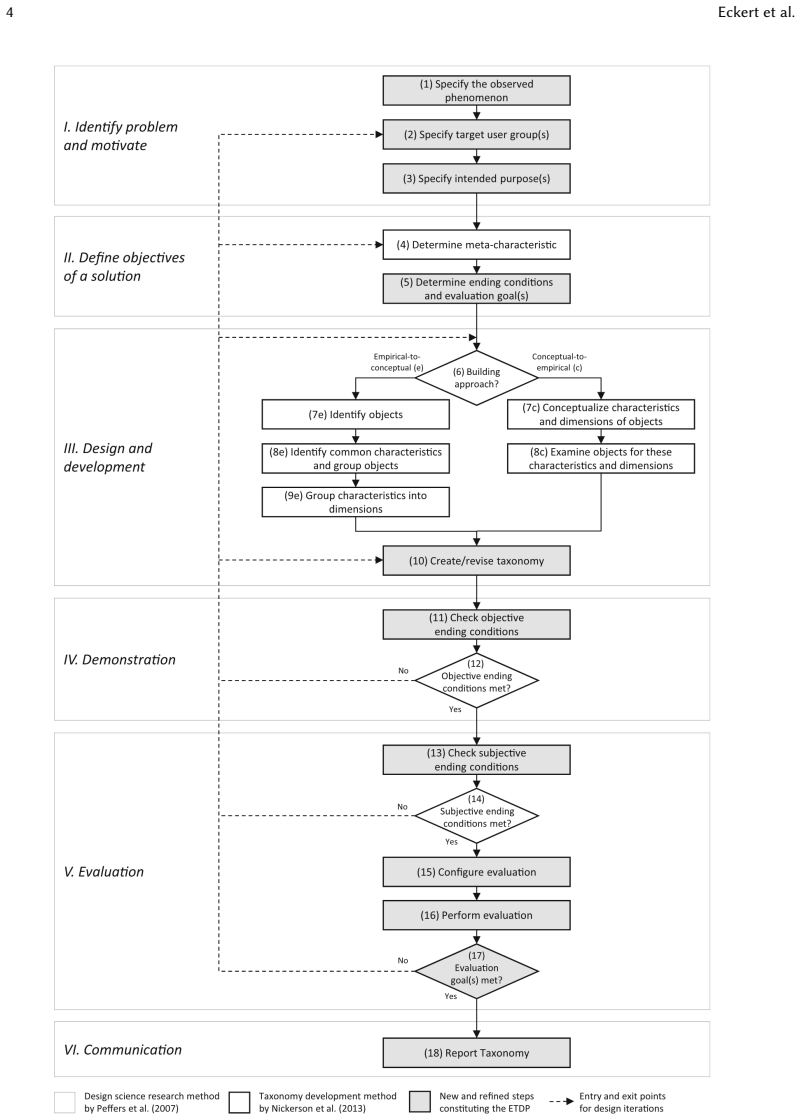
The authors construct a fine-grained taxonomy of novice programmers' difficulties with conditional statements and loops using the Extended Taxonomy Design Process, incorporating prior research and empirical data from quizzes and interviews, to provide distinctions between different types of student misunderstandings and a harmonized framework for classifying errors.
What carries the argument
The taxonomy of novice programmers' difficulties with conditional statements and loops, constructed iteratively via the Extended Taxonomy Design Process.
If this is right
- Researchers can classify and analyze student errors in control flow understanding using a shared set of categories.
- Common misunderstandings identified in the taxonomy can directly inform the design of instructional materials.
- Pedagogical strategies can target specific difficulty types rather than treating all errors uniformly.
- The taxonomy supplies a basis for deeper theoretical work on how novices build mental models of program execution.
Where Pith is reading between the lines
- The same categorization approach might apply to misconceptions in other core programming topics such as functions or recursion.
- Instructors could design short diagnostic quizzes whose items map directly onto the taxonomy categories.
- Longitudinal tracking of individual students against the taxonomy could reveal typical progression paths through the difficulties.
Load-bearing premise
The quiz and interview data from the studied students, together with prior research, is representative enough to support a reliable and complete taxonomy.
What would settle it
Applying the taxonomy to a large independent set of student responses yields many errors that fit no category or require frequent new categories.
Figures
read the original abstract
Understanding student difficulties in programming is a complex challenge due to the wide range of topics and the abundant varieties of misconceptions and errors. This paper presents the design and development of a fine-grained taxonomy that categorizes novice programmers' difficulties specifically related to reading and understanding the control flow constructs selection and iteration. Building upon prior research and our own empirical data from quizzes and interviews with students, the taxonomy is constructed through the iterative methodology of the Extended Taxonomy Design Process (ETDP). Key contributions include clear distinctions between different student difficulties and a detailed analysis of common student misunderstandings concerning conditional statements and loops. The taxonomy aims to aid computing education researchers by providing a harmonized framework to classify and analyze student errors, fostering deeper theoretical insights and informing pedagogical strategies. Future work will involve applying the taxonomy to novel student data and evaluating its usability among educators and researchers.
Editorial analysis
A structured set of objections, weighed in public.
Referee Report
Summary. The paper claims to have developed a fine-grained taxonomy of novice programmers' difficulties with conditionals (selection) and loops (iteration) by applying the Extended Taxonomy Design Process (ETDP) to synthesize prior literature with new empirical data collected via student quizzes and interviews. The resulting taxonomy is presented as providing clear distinctions among misunderstanding types and serving as a harmonized framework to support computing education research and pedagogy.
Significance. If the taxonomy categories prove distinct, reproducible, and broadly applicable beyond the sampled students, the work could supply computing education researchers with a shared classification scheme for analyzing control-flow errors, facilitating cross-study comparisons and targeted instructional interventions. The iterative ETDP approach is a methodological strength when paired with transparent data handling.
major comments (3)
- [Abstract and §3] Abstract and §3 (Data Collection): no sample sizes, participant demographics, institutional contexts, quiz/interview question details, or inter-rater reliability statistics are reported, so it is impossible to judge whether the empirical data are sufficiently broad and representative to ground a generalizable taxonomy rather than reflecting only the authors' local cohort.
- [§4] §4 (ETDP Application): the harmonization steps between existing literature categories and the new quiz/interview responses are not described with sufficient specificity (e.g., how disagreements were resolved, what coding scheme was used, or how saturation was assessed), leaving the claim that the taxonomy is 'harmonized' unsupported by visible process evidence.
- [§5] §5 (Taxonomy Presentation): the paper asserts 'clear distinctions' among difficulty types but supplies neither frequency counts from the collected data nor concrete student-response examples mapped to each category, so the utility of the taxonomy for other researchers cannot be evaluated.
minor comments (2)
- [Abstract] The abstract states that future work will apply the taxonomy to novel data, but the current manuscript should include at least a small pilot validation on held-out responses to demonstrate internal consistency.
- [§5] Notation for taxonomy categories is introduced without an explicit legend or table summarizing all leaf nodes; a compact summary table would improve readability.
Simulated Author's Rebuttal
We thank the referee for the detailed and constructive feedback. We address each major comment below and will revise the manuscript accordingly to improve transparency and support for the claims.
read point-by-point responses
-
Referee: [Abstract and §3] Abstract and §3 (Data Collection): no sample sizes, participant demographics, institutional contexts, quiz/interview question details, or inter-rater reliability statistics are reported, so it is impossible to judge whether the empirical data are sufficiently broad and representative to ground a generalizable taxonomy rather than reflecting only the authors' local cohort.
Authors: We agree that the current version lacks sufficient detail on the empirical data collection. In the revised manuscript we will expand the Abstract and §3 to report sample sizes, participant demographics, institutional contexts, the specific quiz and interview instruments, and inter-rater reliability statistics. revision: yes
-
Referee: [§4] §4 (ETDP Application): the harmonization steps between existing literature categories and the new quiz/interview responses are not described with sufficient specificity (e.g., how disagreements were resolved, what coding scheme was used, or how saturation was assessed), leaving the claim that the taxonomy is 'harmonized' unsupported by visible process evidence.
Authors: The referee is correct that the description of the harmonization process in §4 is insufficiently detailed. We will revise §4 to provide a more explicit account of the ETDP steps, including the mapping procedure between literature categories and empirical responses, disagreement resolution, the coding scheme, and saturation assessment. revision: yes
-
Referee: [§5] §5 (Taxonomy Presentation): the paper asserts 'clear distinctions' among difficulty types but supplies neither frequency counts from the collected data nor concrete student-response examples mapped to each category, so the utility of the taxonomy for other researchers cannot be evaluated.
Authors: We acknowledge that §5 would be strengthened by empirical grounding. In the revision we will add frequency counts derived from the quiz and interview data and include concrete student-response examples mapped to each taxonomy category. revision: yes
Circularity Check
No circularity; taxonomy built from external data and prior literature via ETDP
full rationale
The paper derives its taxonomy of novice difficulties with conditionals and loops through the Extended Taxonomy Design Process applied to the authors' quiz/interview data plus existing literature. No self-definitional reductions, fitted parameters renamed as predictions, or load-bearing self-citations appear in the derivation chain. The result is presented as an empirical synthesis rather than a mathematical or definitional closure on its own inputs, making the construction self-contained against external benchmarks of student errors.
Axiom & Free-Parameter Ledger
axioms (1)
- domain assumption Student difficulties with conditionals and loops can be systematically identified and categorized from quiz and interview responses.
Reference graph
Works this paper leans on
-
[1]
Ella Albrecht and Jens Grabowski. 2020. Sometimes It’s Just Sloppiness - Studying Students’ Programming Errors and Misconceptions. InProceedings of the 51st ACM Technical Symposium on Computer Science Education. ACM, Portland OR USA, 340–345. doi:10.1145/3328778.3366862
-
[2]
Morten Bastian and Andreas Mühling. 2025. Misconceptions in Programming: Intuitive Reasoning and Tracing Task Performance Across Experience Levels. InProceedings of the 2025 ACM Conference on International Computing Education Research V.1 (ICER ’25). Association for Computing Machinery, New York, NY, USA, 141–154. doi:10.1145/3702652. 3744209
-
[3]
Morten Bastian, Yannick Schneider, and Andreas Mühling. 2021. Diagnose von Fehlvorstellungen bei der Ablaufver- folgung von Programmen in einem webbasierten Testsystem.Empirische Pädagogik35, 1 (2021), 72–92. Type: gedruckt
2021
-
[4]
Piraye Bayman and Richard E. Mayer. 1988. Using conceptual models to teach BASIC computer programming.Journal of Educational Psychology80, 3 (1988), 291–298. doi:10.1037/0022-0663.80.3.291 Place: US
-
[5]
Ibrahim Cetin. 2015. Students’ Understanding of Loops and Nested Loops in Computer Programming: An APOS Theory Perspective.Canadian Journal of Science, Mathematics and Technology Education15, 2 (April 2015), 155–170. doi:10.1080/14926156.2015.1014075
-
[6]
Santos, and Matthias Hauswirth
Luca Chiodini, Igor Moreno Santos, Andrea Gallidabino, Anya Tafliovich, André L. Santos, and Matthias Hauswirth
-
[7]
InITiCSE ’21: Proceedings of the 26th ACM Conference on Innovation and Technology in Computer Science Education
A Curated Inventory of Programming Language Misconceptions. InITiCSE ’21: Proceedings of the 26th ACM Conference on Innovation and Technology in Computer Science Education. Dublin, Ireland, 7
-
[8]
Renato Cortinovis, Pablo Frank Bolton, and Ricardo Caceffo. 2023. An Open List of Computer Programming Student’s Common Problems and its Leverage in Teaching Practice. InAnais do III Simpósio Brasileiro de Educação em Computação (EDUCOMP 2023). Sociedade Brasileira de Computação, Brasil, 108–118. doi:10.5753/educomp.2023.228328
-
[9]
Benedict du Boulay. 1986. Some Difficulties of Learning to Program.Journal of educational computing research SAGE2 (1) (1986)
1986
-
[10]
Dimitri Eckert, Dion Timmermann, and Christian Kautz. 2022. Student Misconceptions about Loops in Introductory Programming Courses and the Influence of Representations. In2022 IEEE Frontiers in Education Conference (FIE). IEEE, Uppsala, Sweden, 1–5. doi:10.1109/FIE56618.2022.9962545
-
[11]
Shuchi Grover and Satabdi Basu. 2017. Measuring Student Learning in Introductory Block-Based Programming: Examining Misconceptions of Loops, Variables, and Boolean Logic. InProceedings of the 2017 ACM SIGCSE Technical Symposium on Computer Science Education. ACM, Seattle Washington USA, 267–272. doi:10.1145/3017680.3017723
-
[12]
Dennis Kundisch, Jan Muntermann, Anna Maria Oberländer, Daniel Rau, Maximilian Röglinger, Thorsten Schoormann, and Daniel Szopinski. 2022. An Update for Taxonomy Designers: Methodological Guidance from Information Systems Research.Business & Information Systems Engineering64, 4 (Aug. 2022), 421–439. doi:10.1007/s12599-021-00723-x
-
[13]
Salvatore T. March and Gerald F. Smith. 1995. Design and natural science research on information technology.Decision Support Systems15, 4 (Dec. 1995), 251–266. doi:10.1016/0167-9236(94)00041-2
-
[14]
Tanya J. McGill and Simone E. Volet. 1997. A Conceptual Framework for Analyzing Students’ Knowledge of Program- ming.Journal of Research on Computing in Education29, 3 (March 1997), 276–297. doi:10.1080/08886504.1997.10782199 _eprint: https://doi.org/10.1080/08886504.1997.10782199
-
[15]
Monika Mladenović, Ivica Boljat, and Žana Žanko. 2018. Comparing loops misconceptions in block-based and text- based programming languages at the K-12 level.Education and Information Technologies23, 4 (July 2018), 1483–1500. doi:10.1007/s10639-017-9673-3
-
[16]
Andreas Mühling, Alexander Ruf, and Peter Hubwieser. 2015. Design and First Results of a Psychometric Test for Measuring Basic Programming Abilities. InProceedings of the Workshop in Primary and Secondary Computing Education (WiPSCE ’15). Association for Computing Machinery, New York, NY, USA, 2–10. doi:10.1145/2818314.2818320
-
[17]
Robert C Nickerson, Upkar Varshney, and Jan Muntermann. 2013. A method for taxonomy development and its application in information systems.European Journal of Information Systems22, 3 (May 2013), 336–359. doi:10.1057/ ejis.2012.26
2013
-
[18]
Roy D. Pea. 1986. Language-Independent Conceptual “Bugs” in Novice Programming.Journal of Educational Computing Research2, 1 (Feb. 1986), 25–36. doi:10.2190/689T-1R2A-X4W4-29J2
-
[19]
Putnam, L Sleeman, Juliet Baxter, and Laiani K
Ralph T. Putnam, L Sleeman, Juliet Baxter, and Laiani K. Kuspa. 1986. A Summary of Misconceptions of High School Basic Programmers.Journal Educational Computing Research2, 4 (1986)
1986
-
[20]
Yizhou Qian and James Lehman. 2017. Students’ Misconceptions and Other Difficulties in Introductory Programming: A Literature Review.ACM Transactions on Computing Education18, 1 (Dec. 2017), 1–24. doi:10.1145/3077618
-
[21]
Davorka Radaković and William Steingartner. 2024. Common Errors in High School Novice Programming.IPSI Transactions on Internet Research20, 1 (Jan. 2024), 47–59. doi:10.58245/ipsi.tir.2401.05
-
[22]
Philipp Shah, Marc Berges, and Peter Hubwieser. 2017. Qualitative Content Analysis of Programming Errors. In Proceedings of the 5th International Conference on Information and Education Technology - ICIET ’17. ACM Press, Tokyo, , Vol. 1, No. 1, Article . Publication date: May 2026. 16 Eckert et al. Japan, 161–166. doi:10.1145/3029387.3029399
-
[23]
D. Sleeman, Ralph T. Putnam, Juliet Baxter, and Laiani Kuspa. 1986. Pascal and High School Students: A Study of Errors.Journal of Educational Computing Research2, 1 (Feb. 1986), 5–23. doi:10.2190/2XPP-LTYH-98NQ-BU77
-
[24]
2012.Visual Program Simulation in Introductory Programming Education
Juha Sorva. 2012.Visual Program Simulation in Introductory Programming Education. Ph. D. Dissertation. Aalto Universit, Espoo
2012
-
[25]
1973.Allgemeine Modelltheorie
Herbert Stachowiak. 1973.Allgemeine Modelltheorie. Springer
1973
-
[26]
Alaaeddin Swidan, Felienne Hermans, and Marileen Smit. 2018. Programming Misconceptions for School Students. In Proceedings of the 2018 ACM Conference on International Computing Education Research. ACM, Espoo Finland, 151–159. doi:10.1145/3230977.3230995
-
[27]
Oleg Sychev and Mikhail Denisov. 2023. Explain Trace: Misconceptions of Control-Flow Statements.Computers12, 10 (Sept. 2023), 192. doi:10.3390/computers12100192 , Vol. 1, No. 1, Article . Publication date: May 2026
discussion (0)
Sign in with ORCID, Apple, or X to comment. Anyone can read and Pith papers without signing in.