Probing the Effects of Heat Treatment Atmosphere on the Structural and Electrical Properties of NBT via Eu Photoluminescence
Pith reviewed 2026-06-29 16:02 UTC · model grok-4.3
The pith
Oxygen partial pressure during pre-calcination controls Bi volatilization, grain growth, and oxygen-vacancy concentration in NBT ceramics, with Eu3+ photoluminescence linking these to local structure and conductivity.
A machine-rendered reading of the paper's core claim, the machinery that carries it, and where it could break.
Core claim
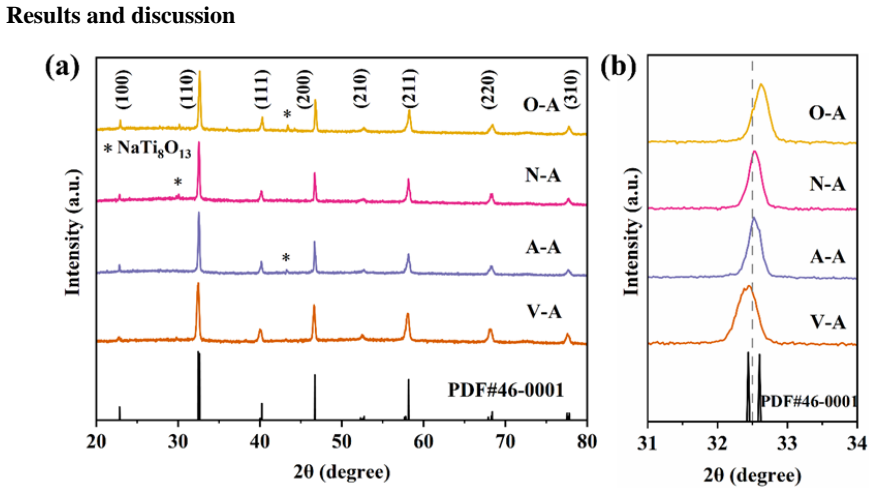
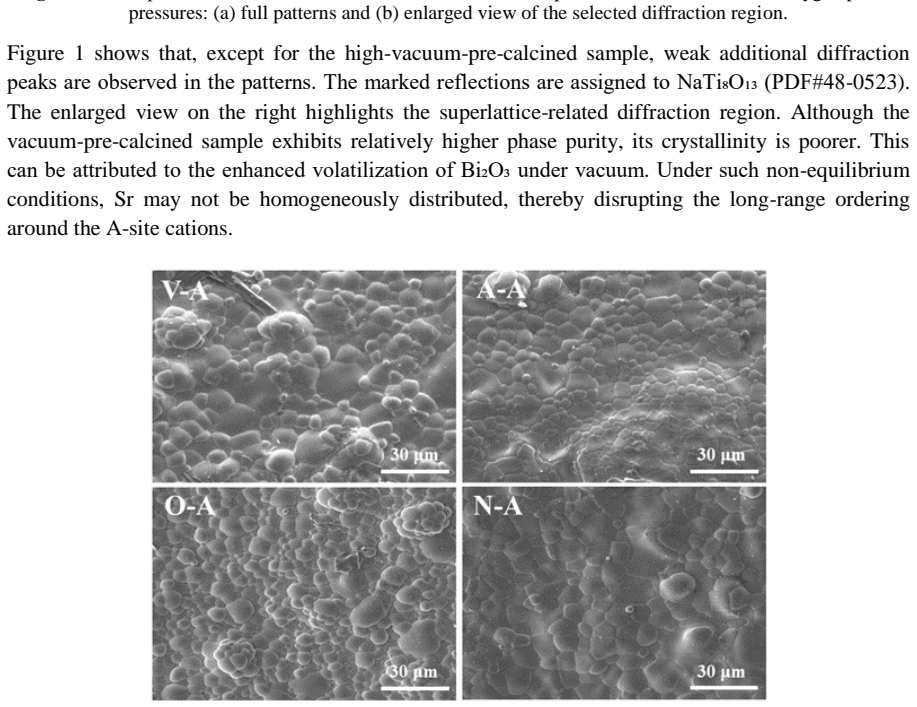
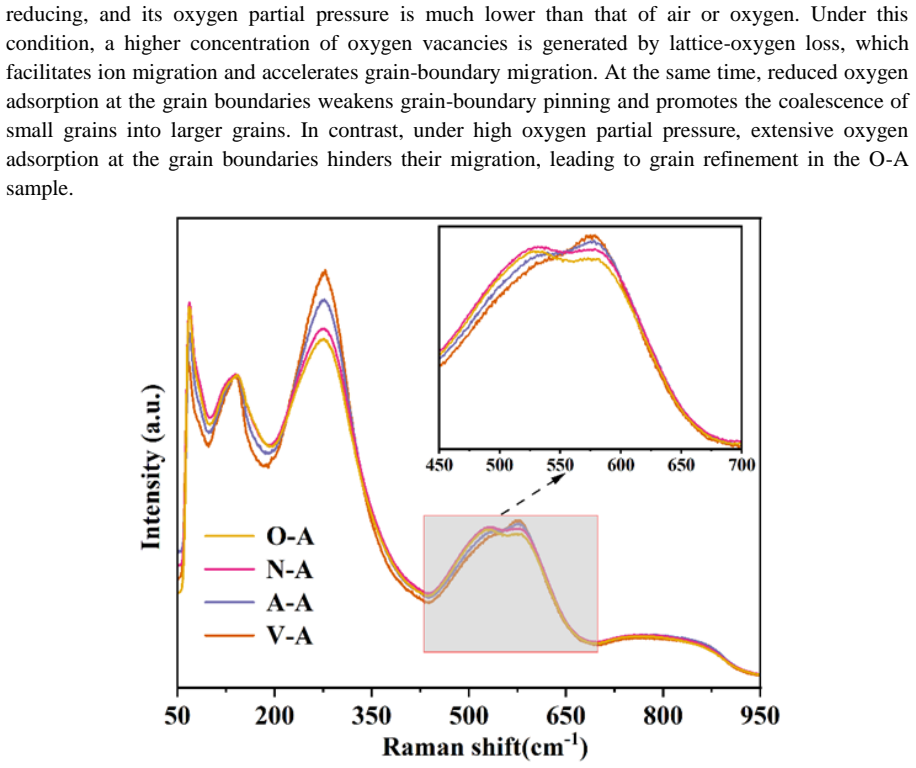
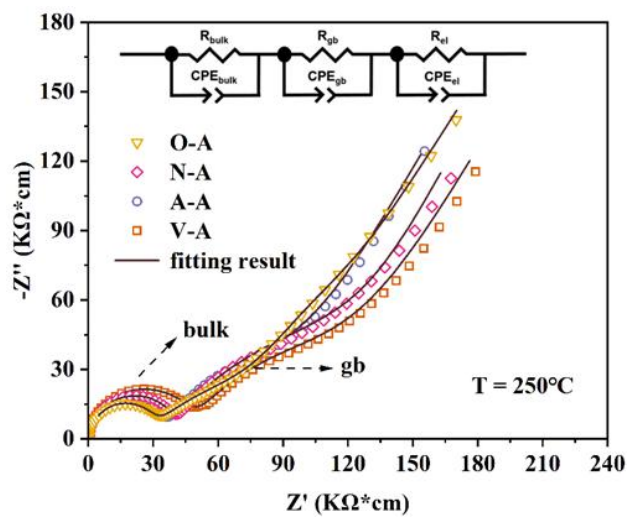
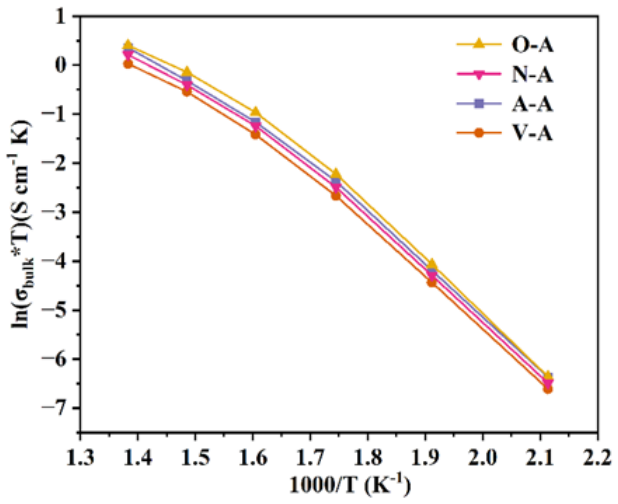
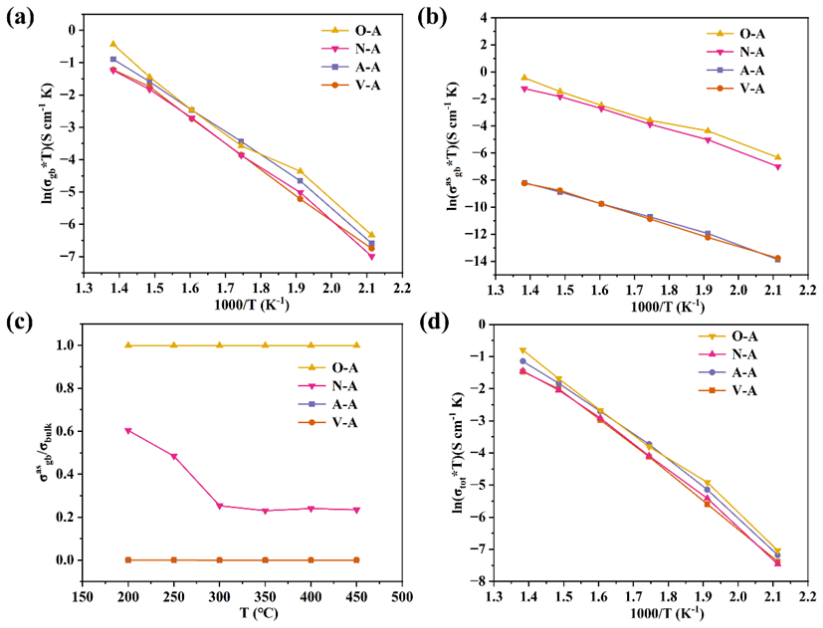
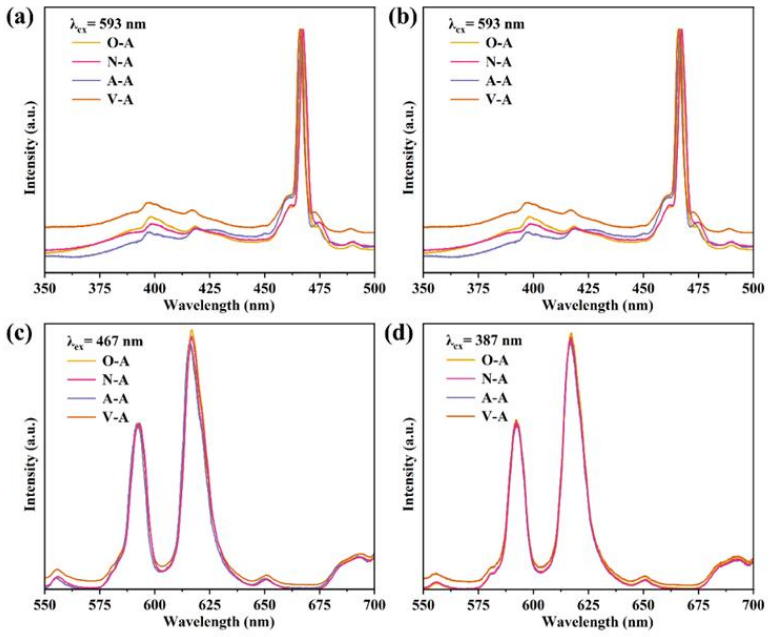
The oxygen partial pressure during the pre-calcination step strongly affects Bi volatilization, grain growth, and oxygen-vacancy concentration. The largest average grain size was obtained for the nitrogen-treated sample, whereas the oxygen-treated sample exhibited the finest grains but the highest grain-boundary conductivity. X-ray diffraction and Raman spectroscopy indicate that low oxygen partial pressure enhances structural disorder, while high oxygen partial pressure stabilizes the lattice and promotes charge-transfer transitions. Eu3+ photoluminescence further reveals the correlation between local structural evolution and oxygen-vacancy concentration. These findings clarify how oxygen p
What carries the argument
Eu3+ photoluminescence revealing the correlation between local structural evolution and oxygen-vacancy concentration
If this is right
- Oxygen partial pressure during pre-calcination strongly affects Bi volatilization, grain growth, and oxygen-vacancy concentration.
- Nitrogen atmosphere produces the largest average grain size while oxygen atmosphere produces the finest grains and highest grain-boundary conductivity.
- Low oxygen partial pressure enhances structural disorder; high oxygen partial pressure stabilizes the lattice.
- The results supply guidance for optimizing total conductivity of polycrystalline NBT-based electrolytes.
Where Pith is reading between the lines
- The same atmosphere-control approach could be tested on other doped perovskite ion conductors to adjust vacancy populations without changing composition.
- Eu photoluminescence might serve as a rapid screening tool for vacancy-related defects in sintered ceramic electrolytes before full electrical testing.
- Minimizing grain-boundary resistance through atmosphere choice could raise usable conductivity in polycrystalline samples closer to single-crystal values.
Load-bearing premise
That differences in measured properties arise primarily from the controlled oxygen partial pressure during pre-calcination rather than from uncontrolled variables in the conventional solid-state reaction route or sample preparation.
What would settle it
Direct quantification of oxygen vacancy concentration (for example by thermogravimetric analysis) across the four atmosphere-treated samples showing no systematic variation would falsify the claimed link between oxygen partial pressure, vacancies, and conductivity.
Figures
read the original abstract
The effect of oxygen partial pressure during the pre-calcination step (high vacuum, air, nitrogen, and oxygen) on the crystal structure, microstructure, and electrical properties of Na0.5Bi0.465Sr0.02Eu0.005TiO3 oxide-ion-conducting ceramics was systematically investigated. Dense ceramic samples were prepared by a conventional solid-state reaction route under different atmospheres. The results show that the oxygen partial pressure strongly affects Bi volatilization, grain growth, and oxygen-vacancy concentration. The largest average grain size was obtained for the nitrogentreated sample, whereas the oxygen-treated sample exhibited the finest grains but the highest grain-boundary conductivity. X-ray diffraction and Raman spectroscopy indicate that low oxygen partial pressure enhances structural disorder, while high oxygen partial pressure stabilizes the lattice and promotes charge-transfer transitions. Eu3+ photoluminescence further reveals the correlation between local structural evolution and oxygen-vacancy concentration. These findings clarify how oxygen partial pressure regulates grain-boundary behavior and ion-transport mechanisms in NBT-based oxide-ion conductors, providing guidance for optimizing the total conductivity of polycrystalline electrolytes.
Editorial analysis
A structured set of objections, weighed in public.
Referee Report
Summary. The manuscript examines how the oxygen partial pressure during the pre-calcination step in the solid-state synthesis of Na0.5Bi0.465Sr0.02Eu0.005TiO3 affects its crystal structure, microstructure, and electrical properties. Using atmospheres of high vacuum, air, nitrogen, and oxygen, it finds that lower pO2 promotes Bi volatilization and structural disorder, nitrogen treatment gives the largest grain size, oxygen treatment the smallest grains but highest grain-boundary conductivity, and Eu3+ photoluminescence indicates correlations between local structure and oxygen-vacancy concentration. The work aims to guide optimization of total conductivity in NBT-based oxide-ion conductors.
Significance. Should the causal attribution to pre-calcination atmosphere hold after addressing experimental controls, the findings would be significant for processing oxide-ion conducting ceramics, demonstrating how atmosphere tunes grain-boundary behavior and ion transport. The integration of photoluminescence as a probe for local structural evolution and vacancies adds a useful characterization tool. The systematic comparison across four atmospheres is a positive aspect of the experimental approach.
major comments (2)
- [Experimental procedure] Experimental procedure: The description does not specify controls for other variables in the solid-state route such as powder homogenization, binder removal, uniaxial pressing pressure, or sintering ramp rates across the different pre-calcination atmospheres. Without evidence that these were locked or that multiple batches were synthesized under each condition, the isolation of pO2 effects on Bi volatilization, grain growth, and conductivity cannot be confirmed, which is load-bearing for the central claims.
- [Results] Results: The abstract and likely results sections report directional effects and correlations without reference to error bars, sample sizes for grain size measurements, number of conductivity measurements, or statistical tests. This weakens the ability to evaluate the strength of the reported differences and the PL-vacancy correlations.
minor comments (2)
- [Abstract] Typo: 'nitrogentreated' should be 'nitrogen-treated'.
- [Abstract] The claim that 'Eu3+ photoluminescence further reveals the correlation' would benefit from a brief indication of the specific PL features used (e.g., intensity ratios or peak shifts) to make the abstract more informative.
Simulated Author's Rebuttal
We thank the referee for the constructive comments. We address each major point below and will revise the manuscript to improve clarity on experimental controls and statistical reporting.
read point-by-point responses
-
Referee: [Experimental procedure] Experimental procedure: The description does not specify controls for other variables in the solid-state route such as powder homogenization, binder removal, uniaxial pressing pressure, or sintering ramp rates across the different pre-calcination atmospheres. Without evidence that these were locked or that multiple batches were synthesized under each condition, the isolation of pO2 effects on Bi volatilization, grain growth, and conductivity cannot be confirmed, which is load-bearing for the central claims.
Authors: We agree that explicit documentation of controls is required. All samples used the same starting powder batch, with identical ball-milling homogenization (12 h), binder content and removal schedule (500 °C), uniaxial pressing pressure (150 MPa), and sintering ramp rates (5 °C min⁻¹ to 1200 °C). The pre-calcination atmosphere was the sole variable. We will expand the Experimental section to state these parameters explicitly and confirm that replicate pellets were prepared and measured for each atmosphere. revision: yes
-
Referee: [Results] Results: The abstract and likely results sections report directional effects and correlations without reference to error bars, sample sizes for grain size measurements, number of conductivity measurements, or statistical tests. This weakens the ability to evaluate the strength of the reported differences and the PL-vacancy correlations.
Authors: We accept that error bars, sample sizes, and measurement counts should be reported. Grain-size statistics were derived from >200 grains per condition via SEM; conductivity values represent averages of at least three independent pellets per atmosphere; PL spectra were averaged over multiple locations. We will add error bars (standard deviations) to all quantitative plots, state the sample sizes in the text, and note that trends are reported as means with observed variability. No formal hypothesis testing was performed, but we will clarify this limitation. revision: yes
Circularity Check
No significant circularity in experimental report
full rationale
This is a purely experimental materials-science study reporting direct measurements of crystal structure, microstructure, photoluminescence, and electrical conductivity on samples prepared under four controlled pre-calcination atmospheres. No equations, fitted parameters, predictions, or derivations appear; claims rest on observed differences in Bi volatilization, grain size, Raman shifts, Eu3+ emission, and grain-boundary conductivity. No self-citations are invoked as load-bearing uniqueness theorems or ansatzes. The work is therefore self-contained against external benchmarks and receives the default non-circularity finding.
Axiom & Free-Parameter Ledger
axioms (1)
- domain assumption Conventional solid-state reaction and standard characterization techniques (XRD, Raman, PL, impedance) produce comparable samples across atmospheres.
Reference graph
Works this paper leans on
-
[1]
Fast firing of bismuth-doped yttria-stabilized zirconia for enhanced densification and ionic conductivity
Li H, Kon A, Chang C H, et al. Fast firing of bismuth-doped yttria-stabilized zirconia for enhanced densification and ionic conductivity. Journal of the Ceramic Society of Japan. 2016;124:370 -374
2016
-
[2]
Nanocrystal engineering of thin-film yttria-stabilized zirconia electrolytes for low-temperature solid oxide fuel cells
Ryu S, Choi I W, Kim Y J, Lee S, et al. Nanocrystal engineering of thin-film yttria-stabilized zirconia electrolytes for low-temperature solid oxide fuel cells. ACS Applied Materials & Interfaces. 2023;15(36):42659-42666
2023
-
[3]
Electrochemical performance of multifuel -based nanocomposite for solid oxide fuel cells
Shaheen K, Suo H, Shah Z, et al. Electrochemical performance of multifuel -based nanocomposite for solid oxide fuel cells. Ceramics International. 2020;46(7):8832-8838
2020
-
[4]
Worldwide SOFC technology overview and benchmark
Ludger B, Wilhelm A, Heinz N, et al. Worldwide SOFC technology overview and benchmark. International Journal of Applied Ceramic Technology. 2005;2(6)
2005
-
[5]
Effects of Sm doping content on the ionic conduction of CeO₂ in SOFCs from first principles
Fu Z, Sun Q, Ma D, et al. Effects of Sm doping content on the ionic conduction of CeO₂ in SOFCs from first principles. Applied Physics Letters. 2017;111(2):023903
2017
-
[6]
Advances in lead-free piezoelectric materials for sensors and actuators
Aksel E, Jones J. Advances in lead-free piezoelectric materials for sensors and actuators. Sensors. 2010;10(3):1935-1954
2010
-
[7]
Thermal depoling process and piezoelectric properties of bismuth sodium titanate ceramics
Hiruma Y, Nagata H, Takenaka T. Thermal depoling process and piezoelectric properties of bismuth sodium titanate ceramics. Journal of Applied Physics. 2009;105(8):084112
2009
-
[8]
A family of oxide ion conductors based on the ferroelectric perovskite Na₀.₅Bi₀.₅TiO₃
Li M, Pietrowski M J, De Souza R A, et al. A family of oxide ion conductors based on the ferroelectric perovskite Na₀.₅Bi₀.₅TiO₃. Nature Materials. 2014;13(1):31-35
2014
-
[9]
Oxygen sensors: materials, methods, designs and applications
Ramamoorthy R, Dutta P, Akbar S. Oxygen sensors: materials, methods, designs and applications. Journal of Materials Science. 2003;38:4271-4282
2003
-
[10]
High-performance solid-electrolyte-based NO₂ sensor based on Co₃V₂O₈ derived from a metal-organic framework
Chen L, Wei M, Xiaodi X, et al. High-performance solid-electrolyte-based NO₂ sensor based on Co₃V₂O₈ derived from a metal-organic framework. Sensors and Actuators B: Chemical. 2020;302
2020
-
[11]
Defect chemistry and electrical properties of sodium bismuth titanate perovskite
Yang F, Li M, Li L, et al. Defect chemistry and electrical properties of sodium bismuth titanate perovskite. Chemistry of Materials. 2018;6(13):5243-5254
2018
-
[12]
High-performance metal-supported solid oxide fuel cells with infiltrated electrodes
Dogdibegovic E, Wang R, Lau G Y, et al. High-performance metal-supported solid oxide fuel cells with infiltrated electrodes. Journal of Power Sources. 2019;410-411:91-98
2019
-
[13]
Ion dynamics of non-stoichiometric Na₀.₅₊ₓBi₀.₅₋ₓTiO₃−δ: a degradation study
Singh P, Jha P K, Sinha A, et al. Ion dynamics of non-stoichiometric Na₀.₅₊ₓBi₀.₅₋ₓTiO₃−δ: a degradation study. Solid State Ionics. 2020;345:115158
2020
-
[14]
Complex impedance and Raman spectroscopy of Na₀.₅(Bi₁₋ₓDyₓ)₀.₅TiO₃ ceramics
Benyoussef M, Zannen M, Belhadi J, et al. Complex impedance and Raman spectroscopy of Na₀.₅(Bi₁₋ₓDyₓ)₀.₅TiO₃ ceramics. Ceramics International. 2020;46(8):10979 -10991
2020
-
[15]
Atomically controlled electrochemical nucleation at superionic solid electrolyte surfaces
Valov I, Ranaweera R, Waser R. Atomically controlled electrochemical nucleation at superionic solid electrolyte surfaces. Nature Materials. 2012;11(6):530-535
2012
-
[16]
A two-dimensional type I superionic conductor
Rettie A J E, et al. A two-dimensional type I superionic conductor. Nature Materials. 2021;20(12):1683 - 1688
2021
-
[17]
Emerging perspectives in microlasers based on rare -earth- ion-activated micro-/nanomaterials
Chen Z, Dong G, Barillaro G, Qiu J, Yang Z. Emerging perspectives in microlasers based on rare -earth- ion-activated micro-/nanomaterials. Progress in Materials Science. 2021;121:100814
2021
-
[18]
High Verdet constant glass for magnetic field sensors
Zhao X, Li W, Xia Q, et al. High Verdet constant glass for magnetic field sensors. ACS Applied Materials & Interfaces. 2022;14(51):57028-57036. Author Contribution Statement Zongxue Wang: performed the experiments, collected and analyzed the data, and drafted and revised the manuscript. Duanting Yan: conceived the research idea and designed the research p...
2022
discussion (0)
Sign in with ORCID, Apple, or X to comment. Anyone can read and Pith papers without signing in.