Identifiable Bayesian Deep Generative Copulas with Unknown Layer Widths for Data with Arbitrary Marginal Distributions
Pith reviewed 2026-06-29 15:22 UTC · model grok-4.3
The pith
The Deep Discrete Encoder Copula makes dependence parameters identifiable in a binary latent hierarchy for data with any marginal distributions.
A machine-rendered reading of the paper's core claim, the machinery that carries it, and where it could break.
Core claim
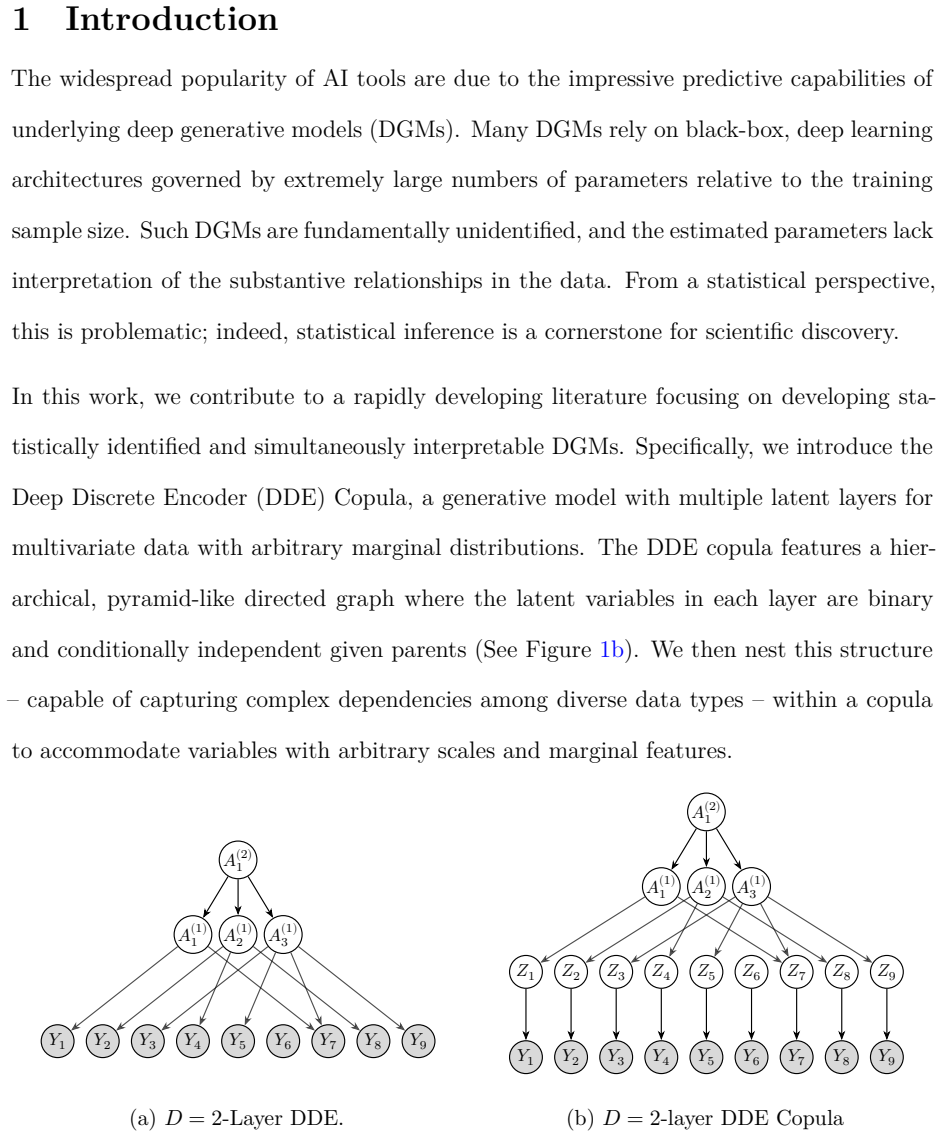
The DDE copula places a hierarchical directed network of binary latent variables inside a copula framework to enable flexible dependence modeling for mixed discrete and continuous data with arbitrary marginals. The model is identifiable, with conditions established to ensure layer-specific parameters provide meaningful summaries of multivariate dependence. The paper proves quotient-space posterior consistency for continuous margins under the exact rank likelihood and treats the extended rank likelihood for tied or mixed margins as a generalized likelihood with concentration under an additional contrast condition. Computation uses a stochastic expectation-maximization algorithm for maximum a
What carries the argument
The Deep Discrete Encoder (DDE) copula, which embeds a hierarchical directed network of binary latent variables inside the copula to capture dependence.
If this is right
- Layer-specific parameters provide meaningful summaries of multivariate dependence.
- The model applies to mixed discrete and continuous data.
- Bayesian priors adaptively determine unknown layer widths.
- The stochastic EM algorithm computes maximum a posteriori estimates efficiently.
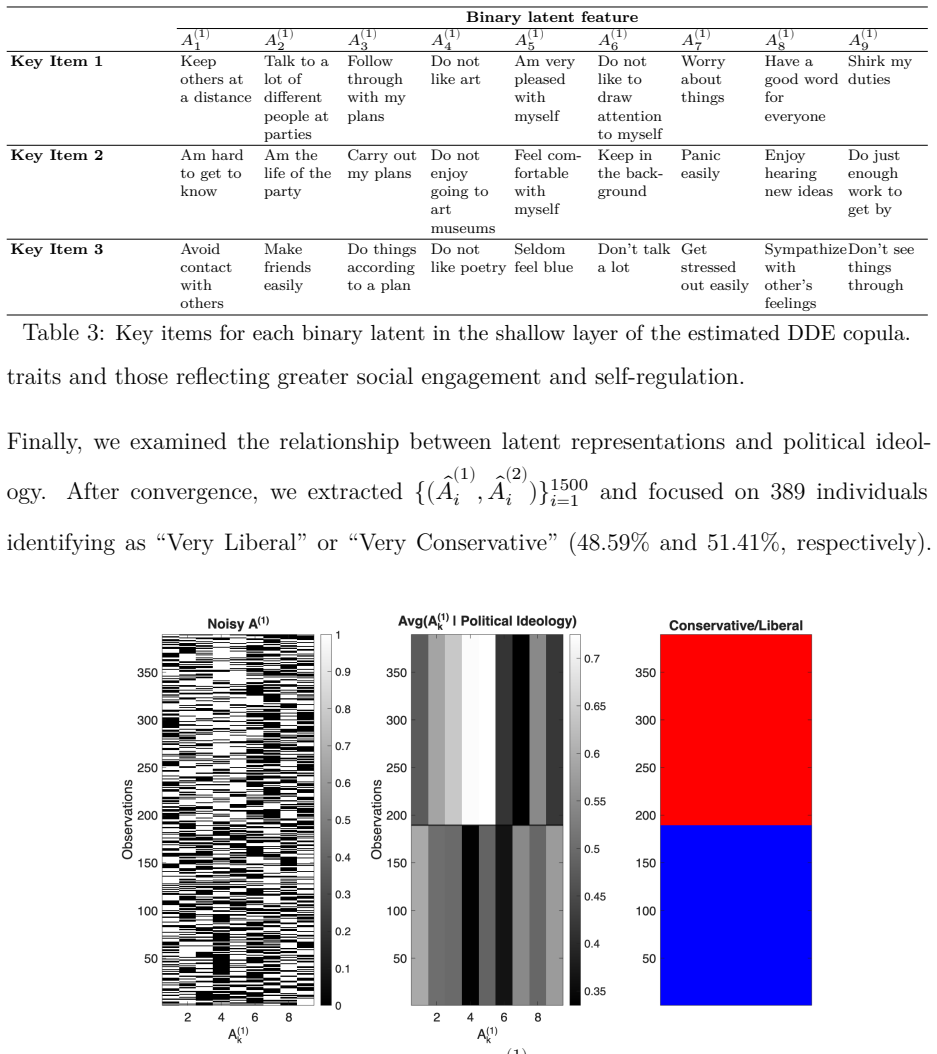
- Applications to personality survey data reveal interpretable hierarchical latent structures.
Where Pith is reading between the lines
- This identification strategy could be applied to other deep generative models to reduce black-box issues.
- The decoupling via rank likelihoods may improve robustness in high-dimensional settings where marginals are hard to specify.
- Testing the contrast condition on real datasets with ties could validate practical use cases.
- The hierarchical structure suggests potential for building tree-like dependence visualizations from the learned layers.
Load-bearing premise
A hierarchical directed network of binary latent variables can flexibly capture the dependence structure for arbitrary marginal distributions, and the rank likelihood fully decouples marginal modeling from inference on the DDE parameters.
What would settle it
A simulation study where the posterior fails to concentrate on the true DDE parameters under the rank likelihood, despite the contrast condition being satisfied, would falsify the consistency result.
Figures
read the original abstract
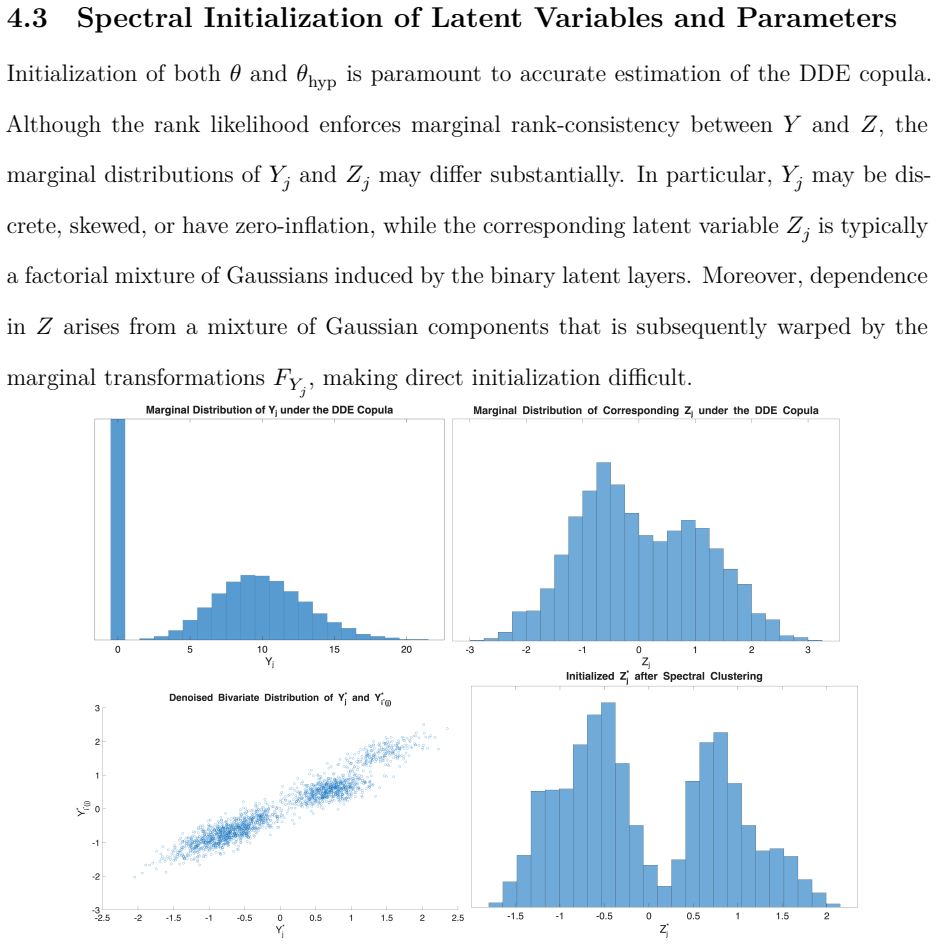
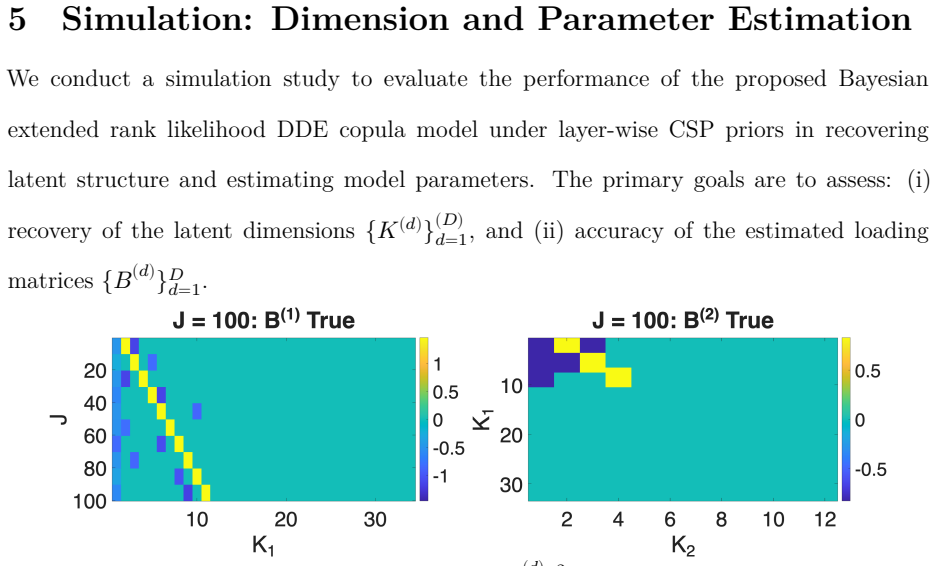
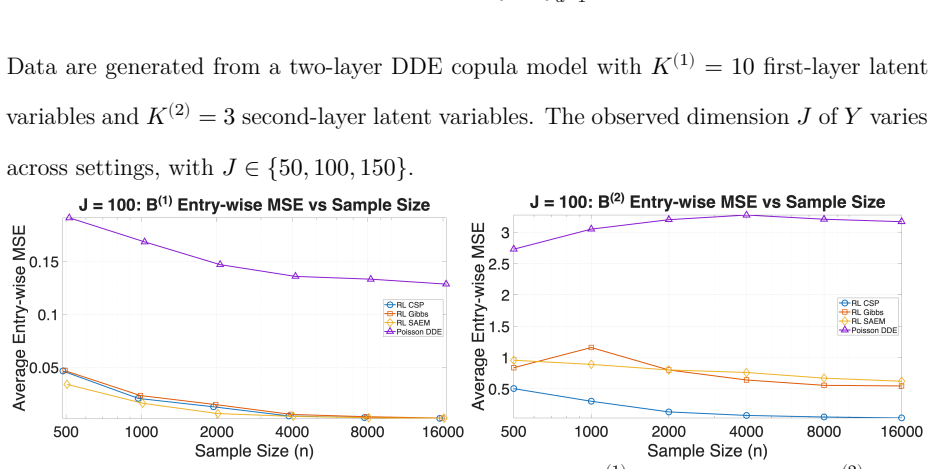
Deep generative models offer powerful tools for multivariate data analysis, but their black-box architectures are often unidentified and difficult to interpret. We introduce the Deep Discrete Encoder (DDE) Copula, an identifiable and interpretable generative model for multivariate data with arbitrary marginal distributions. The model places a hierarchical directed network of binary latent variables inside a copula framework, enabling flexible dependence modeling for mixed discrete and continuous data. Estimation is based on rank likelihoods, which decouple marginal modeling from posterior inference on the DDE parameters and avoid specifying the marginal distributions. We establish conditions for identification of the DDE copula parameters, ensuring that layer-specific parameters provide meaningful summaries of multivariate dependence. We also prove quotient-space posterior consistency for continuous margins under the exact rank likelihood and treat the extended rank likelihood for tied or mixed margins as a generalized likelihood, with concentration under an additional contrast condition. For computation, we propose a stochastic expectation-maximization algorithm for \emph{maximum a posteriori} estimation, together with initialization strategies that improve convergence. To learn network dimension adaptively, we extend Bayesian rank-selection priors to infer layer-specific widths. Simulations show strong finite-sample performance, and a personality-survey analysis reveals interpretable hierarchical latent structure in complex multivariate data.
Editorial analysis
A structured set of objections, weighed in public.
Referee Report
Summary. The manuscript introduces the Deep Discrete Encoder (DDE) Copula, an identifiable generative model placing a hierarchical directed network of binary latent variables inside a copula framework to model multivariate dependence for data with arbitrary (including mixed discrete/continuous) marginal distributions. Estimation relies on rank likelihoods that decouple marginal modeling from inference on the DDE parameters. The paper claims to establish identification conditions ensuring layer-specific parameters meaningfully summarize dependence, prove quotient-space posterior consistency for continuous margins under the exact rank likelihood, and treat the extended rank likelihood (for ties or mixed margins) as a generalized likelihood with concentration under an additional contrast condition. Computation uses a stochastic EM algorithm for MAP estimation with initialization strategies, and Bayesian rank-selection priors are extended to infer layer widths adaptively. Simulations demonstrate finite-sample performance, and a personality-survey application illustrates interpretable hierarchical structure.
Significance. If the identification conditions and quotient-space consistency results hold, the work would provide a theoretically grounded, interpretable alternative to black-box deep generative models for dependence modeling, with the rank-likelihood decoupling and adaptive-width inference as practical strengths for mixed data. The focus on parameter identification and consistency under standard rank-likelihood devices aligns with existing copula literature while extending it to deep hierarchical binary latents.
Simulated Author's Rebuttal
We thank the referee for their detailed summary of the manuscript and for recognizing the potential value of the identification conditions, quotient-space consistency results, rank-likelihood decoupling, and adaptive layer-width inference. We are pleased that these aspects align with existing copula literature while extending it to deep hierarchical binary latents. The recommendation is listed as uncertain, but no specific major comments or concerns were enumerated in the report. We therefore provide no point-by-point responses and stand ready to address any additional questions the referee may have.
Circularity Check
No significant circularity in theoretical derivations
full rationale
The paper's core claims consist of establishing identification conditions for the DDE copula parameters and proving quotient-space posterior consistency for continuous margins under the exact rank likelihood (with an additional contrast condition for the extended case). These are mathematical results derived from the model construction and standard rank-likelihood properties rather than any reduction of predictions to fitted parameters or self-referential definitions. The hierarchical binary-latent network is introduced as the modeling vehicle, the rank-likelihood decoupling is a standard device, and no load-bearing self-citation chain or ansatz smuggling is indicated in the provided material. The derivation chain is therefore self-contained.
Axiom & Free-Parameter Ledger
Reference graph
Works this paper leans on
-
[1]
M., Kucukelbir, A., and McAuliffe, J
Blei, D. M., Kucukelbir, A., and McAuliffe, J. D. (2017). Variational inference: A review for statisticians. Journal of the American Statistical Association , 112(518):859–877. Booth, J. G. and Hobert, J. P. (1999). Maximizing generalized linear mixed model like- lihoods with an automated monte carlo em algorithm. Journal of the Royal Statistical Society ...
2017
-
[2]
Khemakhem, I., Kingma, D., Monti, R., and Hyvarinen, A. (2020). Variational autoen- coders and nonlinear ICA: A unifying framework. In International conference on artificial intelligence and statistics , pages 2207–2217. PMLR. Kingma, D. P. and Welling, M. (2014). Auto-encoding variational bayes. In International Conference on Learning Representations . K...
2020
discussion (0)
Sign in with ORCID, Apple, or X to comment. Anyone can read and Pith papers without signing in.