Robin holography in AdS and BTZ: double-trace RG flow and exceptional points
Pith reviewed 2026-06-29 15:26 UTC · model grok-4.3
The pith
A one-parameter family of Robin boundary conditions realizes the double-trace RG flow and hosts an exceptional point that reorganizes the quasinormal spectrum topology.
A machine-rendered reading of the paper's core claim, the machinery that carries it, and where it could break.
Core claim
The exceptional-point locus along the Robin family acts as a non-Hermitian phase boundary for the double-trace flow itself: crossing it reorganizes the global pole-pairing topology of the spectrum. Unlike holographic exceptional points reached by analytic continuation in momentum or frequency, this transition lives on the interpolation between quantizations and is reachable at finite real momentum and temperature by tuning the physical Robin coupling.
What carries the argument
The one-parameter Robin boundary condition with coupling g, which maps the bulk boundary-value problem directly to the double-trace RG flow and generates the family of quasinormal-mode trajectories.
If this is right
- The UV and IR chain expansions of the kernel intrinsically separate the local data observed by the boundary CFT from finite-bulk-depth structure visible only to bulk probes.
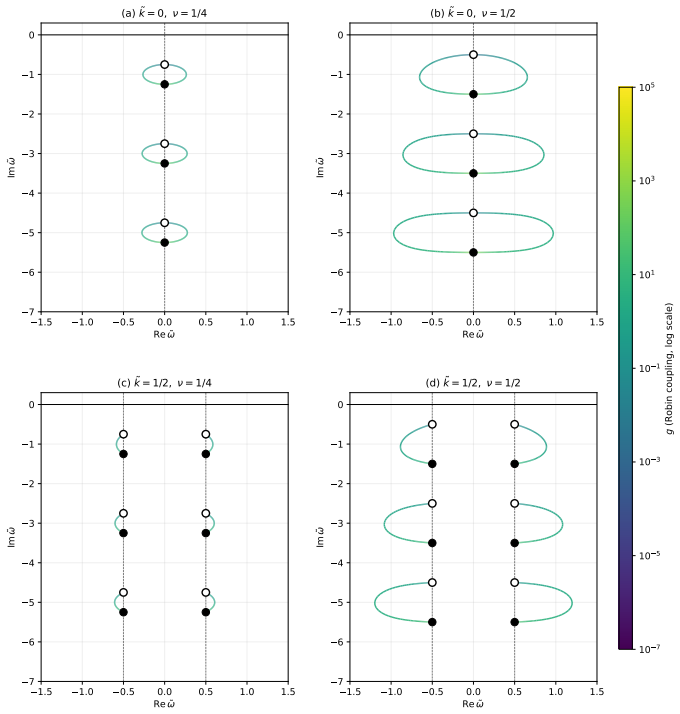
- Each quasinormal-mode trajectory on BTZ connects an alternate-quantization pole at g=0 to a standard-quantization pole at g to infinity.
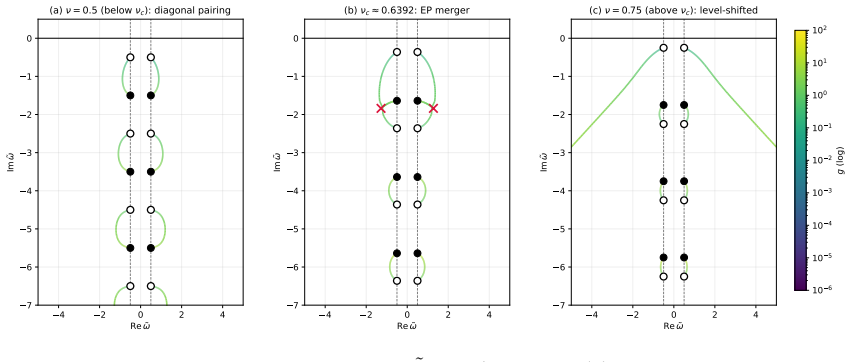
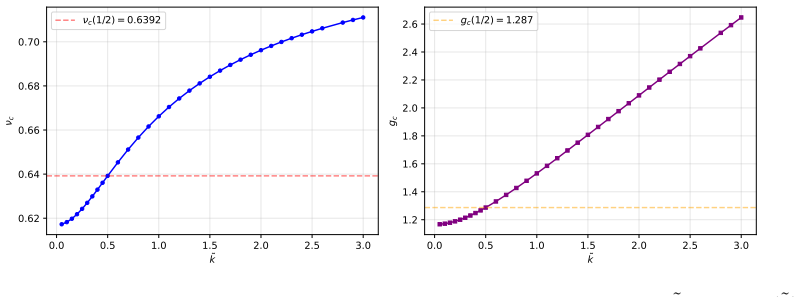
- At the exceptional-point locus two trajectories coalesce into a Jordan block.
- Crossing the exceptional-point locus reorganizes the global pole-pairing topology of the spectrum.
Where Pith is reading between the lines
- Boundary conditions alone may suffice to engineer non-Hermitian phase transitions in holographic RG flows.
- The separation between boundary-visible and bulk-only parts of the kernel could affect holographic reconstruction in deformed theories.
- Analogous exceptional points might appear in other holographic RG flows or in higher-dimensional black-hole backgrounds.
- The construction suggests a route to study spectral topology changes via tunable physical couplings at finite temperature.
Load-bearing premise
The one-parameter Robin boundary condition with coupling g exactly realizes the double-trace deformation of the boundary CFT without additional bulk corrections or operator mixing.
What would settle it
A calculation showing that quasinormal-mode trajectories never coalesce into a Jordan block for any real value of the Robin coupling g, or that the pole-pairing topology remains unchanged when crossing the proposed locus, would falsify the claim.
Figures
read the original abstract
We construct the exact Robin bulk-to-boundary propagator for a Breitenl\"ohner--Freedman scalar on AdS$_{d+1}$ and the BTZ black hole, realizing the double-trace RG flow between standard and alternate quantization geometrically as a one-parameter family of bulk boundary conditions. We derive the UV and IR chain expansions of the kernel intrinsically from the boundary-value problem, without an auxiliary-field decoupling, and identify a branch split at each order that separates the local data the boundary CFT observes from finite-bulk-depth structure visible only to bulk probes -- the part of $K_f$ that distinguishes holographic reconstruction from boundary calculation. On BTZ we obtain the closed-form Robin kernel and the corresponding family of quasinormal-mode trajectories, each connecting an alternate-quantization pole at $g=0$ to a standard one at $g\to\infty$. We locate an exceptional-point locus along this family at which two trajectories coalesce into a Jordan block, and show it acts as a non-Hermitian phase boundary for the double-trace flow itself: crossing it reorganizes the global pole-pairing topology of the spectrum. Unlike holographic EPs reached by analytic continuation in momentum or frequency, this transition lives on the interpolation between quantizations and is reachable at finite real momentum and temperature by tuning the physical Robin coupling.
Editorial analysis
A structured set of objections, weighed in public.
Referee Report
Summary. The paper constructs the exact Robin bulk-to-boundary propagator for a Breitenlöhner-Freedman scalar in AdS_{d+1} and the BTZ black hole, realizing the double-trace RG flow between standard and alternate quantization as a one-parameter family of bulk boundary conditions parameterized by the Robin coupling g. It derives the UV and IR chain expansions of the kernel intrinsically from the boundary-value problem (without auxiliary fields), identifies a branch split separating local boundary-CFT data from finite-bulk-depth structure, and on BTZ obtains closed-form expressions for the kernel together with the family of quasinormal-mode trajectories connecting alternate-quantization poles at g=0 to standard-quantization poles at g o∞. An exceptional-point locus is located along this family at which two trajectories coalesce into a Jordan block; this locus is interpreted as a non-Hermitian phase boundary for the double-trace flow that reorganizes the global pole-pairing topology of the spectrum at finite real momentum and temperature.
Significance. If the central identification of the Robin family with the exact double-trace deformation holds, the work supplies a geometric realization of the RG flow together with closed-form expressions and an explicit exceptional-point transition reachable by tuning a physical boundary coupling. These features would be useful for holographic studies of RG flows and non-Hermitian spectral properties. The intrinsic derivation of the kernel expansions and the exact BTZ results constitute concrete strengths.
major comments (2)
- [Abstract and §1] Abstract and §1 (Introduction): the claim that the one-parameter Robin boundary condition with coupling g exactly realizes the double-trace RG flow (without additional operator mixing or bulk corrections) is invoked to identify the exceptional-point locus as a phase boundary of the flow itself. This mapping is load-bearing for the central claim yet is presented as following from the standard holographic dictionary; an explicit verification (e.g., derivation of the boundary effective action or check against known double-trace correlators) is required to confirm independence from mixing effects.
- [BTZ quasinormal modes] BTZ section (quasinormal-mode trajectories): the reorganization of pole-pairing topology at the exceptional-point locus is asserted to be a property of the double-trace flow. If the Robin-to-double-trace identification requires bulk counterterms not captured by the boundary-value problem alone, the topological claim would not directly apply to the CFT flow; a concrete test against the known alternate/standard quantization spectra is needed.
minor comments (2)
- [Kernel expansions] Notation for the branch split in the kernel expansions should be clarified with an explicit example at low order to distinguish local versus bulk-depth contributions.
- [Figures] Figure captions for the trajectory plots should state the fixed values of momentum and temperature used.
Simulated Author's Rebuttal
We thank the referee for the careful reading and constructive comments on our manuscript. We respond to each major comment below, indicating where revisions will be made to address the concerns.
read point-by-point responses
-
Referee: [Abstract and §1] Abstract and §1 (Introduction): the claim that the one-parameter Robin boundary condition with coupling g exactly realizes the double-trace RG flow (without additional operator mixing or bulk corrections) is invoked to identify the exceptional-point locus as a phase boundary of the flow itself. This mapping is load-bearing for the central claim yet is presented as following from the standard holographic dictionary; an explicit verification (e.g., derivation of the boundary effective action or check against known double-trace correlators) is required to confirm independence from mixing effects.
Authors: The identification follows from the standard holographic dictionary for BF scalars, where the Robin parameter g directly encodes the double-trace deformation without additional mixing for a single scalar (as established in the literature on alternate/standard quantization). Our intrinsic derivation of the propagator and its UV/IR expansions from the boundary-value problem already reproduces the expected structure of the flow. To make the mapping fully explicit, we will add a short derivation of the boundary effective action from the on-shell Robin action in the revised manuscript, confirming the double-trace term and absence of extraneous corrections. revision: yes
-
Referee: [BTZ quasinormal modes] BTZ section (quasinormal-mode trajectories): the reorganization of pole-pairing topology at the exceptional-point locus is asserted to be a property of the double-trace flow. If the Robin-to-double-trace identification requires bulk counterterms not captured by the boundary-value problem alone, the topological claim would not directly apply to the CFT flow; a concrete test against the known alternate/standard quantization spectra is needed.
Authors: The boundary-value problem with Robin conditions fully determines the spectrum, and the endpoints g=0 and g→∞ recover the known alternate- and standard-quantization QNM spectra on BTZ. The continuous trajectories and their coalescence at the exceptional point are properties of this family, which realizes the double-trace flow. No bulk counterterms beyond the boundary condition are required. We will add an explicit comparison of the endpoint spectra to the literature results in the revision to confirm the topological reorganization applies directly to the flow. revision: yes
Circularity Check
No significant circularity; derivations are self-contained from boundary-value problem
full rationale
The paper constructs the Robin propagator and expansions directly from the boundary-value problem on AdS and BTZ, derives QNM trajectories and the EP locus from the closed-form kernel, and interprets the family as realizing double-trace flow via the standard holographic dictionary. No equations reduce by construction to fitted inputs, no self-citations are invoked as load-bearing uniqueness theorems, and no ansatz is smuggled via prior work by the same authors. The mapping of g to the RG flow is an external dictionary assumption, not a self-referential step within the derivation chain.
Axiom & Free-Parameter Ledger
free parameters (1)
- Robin coupling g
axioms (2)
- domain assumption AdS/CFT dictionary maps Robin bulk boundary conditions to double-trace deformations in the boundary CFT
- standard math The wave equation on AdS and BTZ admits exact solutions under Robin boundary conditions
Forward citations
Cited by 1 Pith paper
-
Bouncing Geodesics, Singularities, and the Cavity Thermal Product Formula in Asymptotically Flat and de Sitter Black Holes
Derives a cavity thermal product formula relating bouncing geodesic singularities in the retarded Green's function to the quasinormal mode spectrum for Schwarzschild and Schwarzschild-de Sitter black holes inside a re...
Reference graph
Works this paper leans on
-
[1]
Freedman
Peter Breitenlohner and Daniel Z. Freedman. Positive Energy in anti-De Sitter Back- grounds and Gauged Extended Supergravity.Phys. Lett. B, 115:197–201, 1982
1982
-
[2]
Klebanov and Edward Witten
Igor R. Klebanov and Edward Witten. Ads/cft correspondence and symmetry break- ing.Nuclear Physics B, 556(1–2):89–114, September 1999
1999
-
[3]
Multi-trace operators, boundary conditions, and ads/cft correspon- dence, 2002
Edward Witten. Multi-trace operators, boundary conditions, and ads/cft correspon- dence, 2002
2002
-
[4]
‘double-trace’ deformations, boundary conditions and spacetime singularities.Journal of High Energy Physics, 2002(05):034– 034, May 2002
Micha Berkooz, Amit Sever, and Assaf Shomer. ‘double-trace’ deformations, boundary conditions and spacetime singularities.Journal of High Energy Physics, 2002(05):034– 034, May 2002
2002
-
[5]
I. R. Klebanov and A. M. Polyakov. AdS dual of the critical O(N) vector model.Phys. Lett. B, 550:213–219, 2002
2002
-
[6]
Double-trace deformations, mixed boundary conditions and functional determinants in ads/cft.Journal of High Energy Physics, 2008(01):019–019, January 2008
Thomas Hartman and Leonardo Rastelli. Double-trace deformations, mixed boundary conditions and functional determinants in ads/cft.Journal of High Energy Physics, 2008(01):019–019, January 2008
2008
-
[7]
The black hole in three- dimensional space-time.Phys
Máximo Bañados, Claudio Teitelboim, and Jorge Zanelli. The black hole in three- dimensional space-time.Phys. Rev. Lett., 69:1849–1851, 1992
1992
-
[8]
Son and Andrei O
Dam T. Son and Andrei O. Starinets. Minkowski-space correlators in ads/cft corre- spondence: recipe and applications.Journal of High Energy Physics, 2002(09):042– 042, September 2002
2002
-
[9]
W. D. Heiss. The physics of exceptional points.Journal of Physics A: Mathematical and Theoretical, 45(44):444016, October 2012
2012
-
[10]
Non-hermitian holog- raphy.SciPost Phys., 9(3):032, 2020
Daniel Areán, Karl Landsteiner, and Ignacio Salazar Landea. Non-hermitian holog- raphy.SciPost Phys., 9(3):032, 2020. 29
2020
-
[11]
Kovtun, Andrei O
Sašo Grozdanov, Pavel K. Kovtun, Andrei O. Starinets, and Petar Tadić. The complex life of hydrodynamic modes.JHEP, 11:097, 2019
2019
-
[12]
Quasinormal modes in charged fluids at complex momentum.Journal of High Energy Physics, 2020(10), October 2020
Aron Jansen and Christiana Pantelidou. Quasinormal modes in charged fluids at complex momentum.Journal of High Energy Physics, 2020(10), October 2020
2020
-
[13]
Gubser and Igor R
Steven S. Gubser and Igor R. Klebanov. A universal result on central charges in the presence of double-trace deformations.Nuclear Physics B, 656(1–2):23–36, April 2003
2003
-
[14]
Lecture notes on holographic renormalization.Class
Kostas Skenderis. Lecture notes on holographic renormalization.Class. Quant. Grav., 19:5849–5876, 2002
2002
-
[15]
Setting the boundary free in AdS/CFT.Class
Geoffrey Compère and Donald Marolf. Setting the boundary free in AdS/CFT.Class. Quant. Grav., 25:195014, 2008
2008
-
[16]
Kabat, Gilad Lifschytz, and David A
Alex Hamilton, Daniel N. Kabat, Gilad Lifschytz, and David A. Lowe. Local bulk operators in AdS/CFT: A Boundary view of horizons and locality.Phys. Rev. D, 73:086003, 2006
2006
-
[17]
Kabat, Gilad Lifschytz, and David A
Alex Hamilton, Daniel N. Kabat, Gilad Lifschytz, and David A. Lowe. Holographic representation of local bulk operators.Phys. Rev. D, 74:066009, 2006
2006
-
[18]
A note on multi-trace deformations and ads/cft
Amit Sever and Assaf Shomer. A note on multi-trace deformations and ads/cft. Journal of High Energy Physics, 2002(07):027–027, July 2002
2002
-
[19]
An improved correspondence formula for ads/cft with multi-trace operators.Physics Letters B, 531:301–304, April 2002
Wolfgang Mück. An improved correspondence formula for ads/cft with multi-trace operators.Physics Letters B, 531:301–304, April 2002
2002
-
[20]
Multi-trace deformations in ads/cft: exploring the vacuum structure of the deformed cft.Journal of High Energy Physics, 2007(05):075–075, May 2007
Ioannis Papadimitriou. Multi-trace deformations in ads/cft: exploring the vacuum structure of the deformed cft.Journal of High Energy Physics, 2007(05):075–075, May 2007
2007
-
[21]
Holographic and Wilsonian Renormalization Groups.JHEP, 06:031, 2011
Idse Heemskerk and Joseph Polchinski. Holographic and Wilsonian Renormalization Groups.JHEP, 06:031, 2011
2011
-
[22]
Integrating out geometry: Holographic Wilsonian RG and the membrane paradigm.JHEP, 08:051, 2011
Thomas Faulkner, Hong Liu, and Mukund Rangamani. Integrating out geometry: Holographic Wilsonian RG and the membrane paradigm.JHEP, 08:051, 2011
2011
-
[23]
Real-time gauge/gravityduality: Prescription, renormalization and examples.JHEP, 05:085, 2009
KostasSkenderisandBalt C.vanRees. Real-time gauge/gravityduality: Prescription, renormalization and examples.JHEP, 05:085, 2009
2009
-
[24]
Solodukhin
Danny Birmingham, Ivo Sachs, and Sergey N. Solodukhin. Conformal field theory interpretation of black hole quasinormal modes.Physical Review Letters, 88(15), March 2002
2002
-
[25]
Vitor Cardoso and José P. S. Lemos. Scalar, electromagnetic and Weyl perturbations of BTZ black holes: Quasinormal modes.Phys. Rev. D, 63:124015, 2001
2001
-
[26]
C. L. Kane and Matthew P. A. Fisher. Transmission through barriers and resonant tunneling in an interacting one-dimensional electron gas.Phys. Rev. B, 46(23):15233– 15262, December 1992
1992
-
[27]
X. G. Wen. Chiral luttinger liquid and the edge excitations in the fractional quantum hall states.Phys. Rev. B, 41(18):12838–12844, June 1990. 30
1990
-
[28]
Fendley, A
P. Fendley, A. W. W. Ludwig, and H. Saleur. Exact nonequilibrium dc shot noise in luttinger liquids and fractional quantum hall devices.Phys. Rev. Lett., 75(11):2196– 2199, September 1995
1995
-
[29]
A. M. Chang. Chiral luttinger liquids at the fractional quantum hall edge.Rev. Mod. Phys., 75(4):1449–1505, November 2003
2003
-
[30]
Cobden, Jia Lu, Andrew G
Marc Bockrath, David H. Cobden, Jia Lu, Andrew G. Rinzler, Richard E. Smalley, Leon Balents, and Paul L. McEuen. Luttinger-liquid behaviour in carbon nanotubes. Nature, 397(6720):598–601, February 1999
1999
-
[31]
Exceptional points in optics and photonics
Mohammad-Ali Miri and Andrea Alù. Exceptional points in optics and photonics. Science, 363(6422):eaar7709, 2019
2019
-
[32]
Shenker, and Douglas Stanford
Juan Maldacena, Stephen H. Shenker, and Douglas Stanford. A bound on chaos. Journal of High Energy Physics, 2016(8), August 2016
2016
-
[33]
Eternal traversable wormhole, 2018
Juan Maldacena and Xiao-Liang Qi. Eternal traversable wormhole, 2018
2018
-
[34]
Ping Gao, Daniel Louis Jafferis, and Aron C. Wall. Traversable wormholes via a double trace deformation.Journal of High Energy Physics, 2017(12), December 2017
2017
-
[35]
I. S. Gradshteyn and I. M. Ryzhik.Table of Integrals, Series, and Products. Academic Press, Burlington, MA, 7 edition, 2007
2007
-
[36]
Release 1.2.4 of 2025-03-15, F
NIST Digital Library of Mathematical Functions.https://dlmf.nist.gov/. Release 1.2.4 of 2025-03-15, F. W. J. Olver, A. B. Olde Daalhuis, D. W. Lozier, B. I. Schneider, R. F. Boisvert, C. W. Clark, B. R. Miller, B. V. Saunders, H. S. Cohl, and M. A. McClain, eds. 31
2025
discussion (0)
Sign in with ORCID, Apple, or X to comment. Anyone can read and Pith papers without signing in.