REVIEW 3 major objections 5 minor 46 references
Tensor molecule $J/\psi J/\psi$: A candidate to the resonance $X(6200) $
T0 review · 3 major / 5 minor · reviewed 2026-08-02 · deepseek-v4-flash
Pith's one-line read This paper argues that a tensor molecule composed of two J/ψ mesons, with spin-parity 2++, has mass and width consistent with the X(6200) resonance, making it a viable molecular candidate.
desk verdict First calculation of the 2^{++} J/ψJ/ψ molecule — mass and a 13-channel width budget — proposed as an X(6200) candidate; the interpretation is honest but the width, which does the matching, rests on an unvalidated timelike extrapolation and error bars that understate the real sensitivity. read the letter →
The pith
A machine-rendered reading of the paper's core claim, the machinery that carries it, and where it could break.
The reading
What carries the argument
The central object is the interpolating current J_{µν}(x)= \bar c_a(x)γ_µ c_a(x)\bar c_b(x)γ_ν c_b(x), which creates a J/ψJ/ψ molecule with J^PC=2^{++}. The paper uses two QCD sum-rule tools: a two-point sum rule (relating the current's correlation function to the molecule's mass and current coupling after Borel transformation and continuum subtraction) and three-point sum rules for the form factors at M-meson-meson vertices. Since the sum rules are valid only for spacelike momentum transfer, each form factor is fitted by an exponential ansatz Z(Q^2)=Z_0 exp[z_1 Q^2/m^2 + z_2 (Q^2/m^2)^2] on Q^2 ∈ [2,20] GeV^2 and extrapolated to the on-shell point, producing the strong couplings that set th
What would settle it
A measurement of X(6200) quantum numbers showing J≠2 (or negative C) would immediately refute the assignment. Likewise, a lattice QCD calculation of the J/ψJ/ψ scattering amplitude near threshold that finds no 2^{++} bound state or resonance around 6.29 GeV would undermine the molecular interpretation; a more direct check is an experimental upper bound on the width below ~110 MeV, which would break the overlap the paper relies on.
Extended reading notes
Core claim
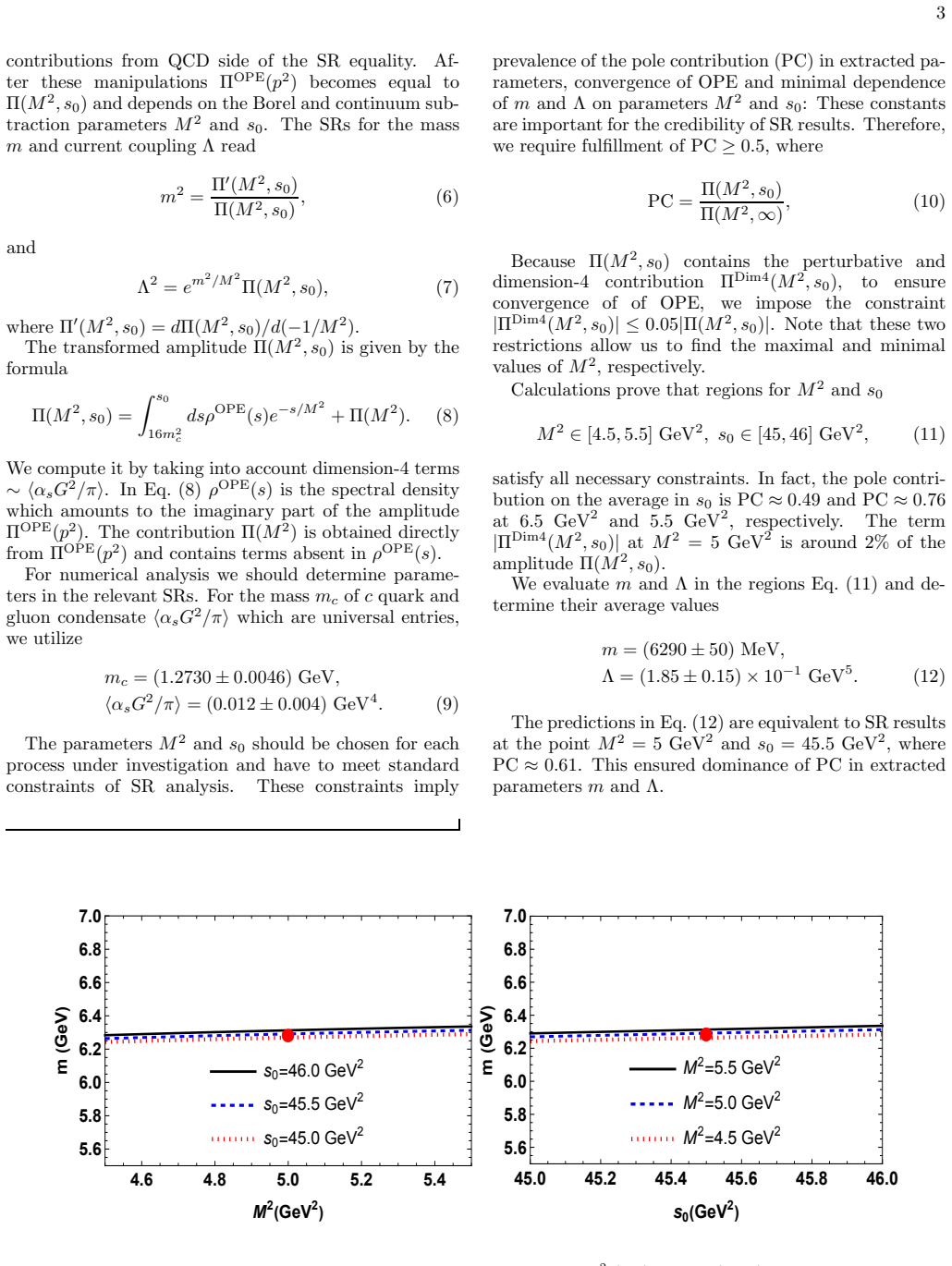
On the paper's own terms, the central claim is that the J^PC=2^{++} tensor molecule M = J/ψJ/ψ has a mass m=(6290±50) MeV and a full width Γ=(149±21) MeV, and that these numbers are compatible with the experimentally observed X(6200). The dominant decay is to a J/ψ pair, with a partial width of about (50.2±18.3) MeV; the remaining width comes from subdominant channels in which the constituent c and \bar c quarks annihilate into light quark-antiquark pairs, producing D^{(*)}D^{(*)}, DD1(2420), and charmed-strange meson pairs. Because the theoretical and experimental widths overlap in the range 110–170 MeV, the paper interprets M as a candidate for X(6200).
Load-bearing premise
The width—and hence the X(6200) match—rests on the assumption that the on-shell strong couplings are correctly given by extrapolating an exponential fit from spacelike Q^2, with no additional pole or threshold structure in the form factor, and on the assumption that dimension-4 truncation of the OPE is adequate for a 6.3 GeV four-charm system.
Editorial extensions
If this is right
- If correct, the X(6200) has J^PC=2^{++} and is dominantly a J/ψJ/ψ molecule rather than a compact tetraquark.
- The predicted branching fraction to J/ψJ/ψ is roughly one third, with the remaining width going to open-charm final states—a pattern that can be tested in amplitude analyses of the di-J/ψ mass spectrum.
- The same calculation suggests that the excited state X(6900) could contain a radially excited J/ψJ/ψ molecular component, while X(6600) is excluded as the 2S molecule.
- A concrete search list follows: the subdominant decays to D^{(*)}D^{(*)}, DD1(2420), and D_sD_s1(2460) pairs should be visible as additional final states of X(6200).
Reading between the lines
- The form-factor extrapolation across the production threshold is the least constrained part of the calculation; the quoted coupling errors do not include model dependence on the exponential ansatz, so a dispersion-relation or lattice QCD check of the on-shell couplings would be a direct test of the width prediction.
- If X(6200) is confirmed as 2^{++}, the same sum-rule machinery could be extended to predict the D^{(*)}D^{(*)} and D_sD_s1 spectra with sharper inputs, offering immediate search targets.
- The molecular interpretation does not exclude an admixture of compact tetraquark components; a precise measurement of the helicity structure in the J/ψJ/ψ decay could discriminate between the molecular and diquark-antidiquark pictures.
- Because the OPE is truncated at dimension-4 for a 6.3 GeV four-charm system, uncalculated α_s corrections could shift the mass beyond the quoted ±50 MeV; if so, the mass overlap with X(6200) would weaken, though the spin and decay pattern might remain.
Editorial analysis
A structured set of objections, weighed in public.
Referee Report
Summary. The paper studies a J^PC=2^{++} J/ψJ/ψ hadronic molecule within the QCD sum-rule framework. Using a two-point sum rule, the authors extract a mass m=(6290±50) MeV and current coupling Λ=(1.85±0.15)×10^{-1} GeV^5. They then use three-point sum rules to compute strong couplings at M-meson-meson vertices, extrapolate the spacelike form factors to the on-shell timelike points with an exponential Ansatz, and sum eight partial widths into J/ψJ/ψ, D^{(*)}D^{(*)}, DD_1(2420), and charmed-strange pairs. The resulting total width Γ[M]=(149±21) MeV, together with the computed mass, is compared with the ATLAS X(6200) parameters (m=6220±50^{+40}_{-50} MeV, Γ=310±120^{+70}_{-80} MeV). Since the theoretical width overlaps the lower tail of the experimental width (110–170 MeV), the authors propose the tensor molecule as a candidate for X(6200), possibly as one component of a mixed physical state.
Significance. If the quoted precision were reliable, the paper would provide a concrete, falsifiable prediction: a 2^{++} J/ψJ/ψ molecule with mass near 6.29 GeV and a total width near 150 MeV, decaying dominantly to J/ψJ/ψ and subdominantly to open-charm pairs. The analysis is transparent and not circular: the mass is extracted from the two-point sum rule using standard pole-dominance and OPE-convergence criteria rather than tuned to X(6200), and the couplings are fitted to computed sum-rule points, not to the measured width. The paper also correctly notes that the experimental width is larger than the predicted one and only overlaps in the tail. The main weaknesses are that the quoted mass error does not reflect the visible Borel/continuum sensitivity, and the total width relies on an unvalidated exponential extrapolation of form factors from spacelike to timelike momenta across the physical production threshold. These issues are local and fixable, but they currently make the numerical support for the X(6200) identification weaker than claimed.
major comments (3)
- [Sec. II, Eq. (12), Fig. 1] The quoted mass m=(6290±50) MeV is not supported by the displayed sensitivity to M² and s0. In Fig. 1 the mass curves vary by roughly 0.5–0.8 GeV across the adopted window M²∈[4.5,5.5] GeV² and s0∈[45,46] GeV², yet Eq. (12) assigns an uncertainty of only ±50 MeV and the text claims ±0.79%. The statement that the prediction is 'equivalent' to the single point M²=5 GeV², s0=45.5 GeV² does not justify such a small error. Since the mass agreement is one of the two pillars of the X(6200) assignment, the uncertainty should be computed from the full variation over the working window, or the window should be narrowed with a clear criterion.
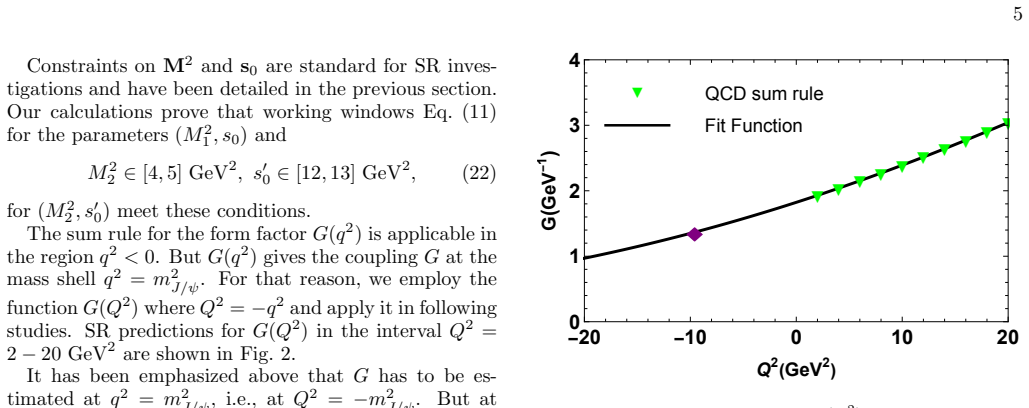
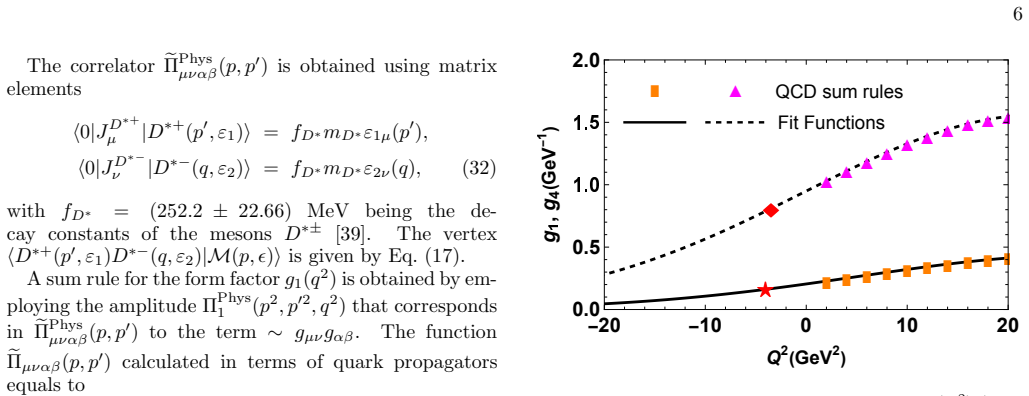
- [Secs. III–IV, Eqs. (23)–(25), (28), (77)] All strong couplings are obtained by fitting the three-parameter exponential Zi(Q²)=Z0 exp[z1 Q²/m² + z2 (Q²/m²)²] to sum-rule data at spacelike Q²∈[2,20] GeV² and then evaluating at the on-shell timelike point Q²=-m_final², e.g., Q²≈-9.6 GeV² for J/ψ. This continuation crosses the physical two-meson production threshold, where the form factor may have poles or cuts, and no alternative functional form or dispersion-relation constraint is tested. The quoted coupling errors (e.g., G=(1.37±0.26) GeV^{-1}) are only parameter-fitting uncertainties and do not include this model dependence. Because the total width Γ=(149±21) MeV overlaps the experimental window only through its upper edge (110–170 MeV), a 20–30% shift in the extrapolated couplings—well within plausible model uncertainty—would move the central value outside the overlap and undermine the identification. The authors should test at
- [Sec. II after Eq. (8), Eq. (10)] The OPE is truncated at dimension-four (perturbative term plus ⟨α_s G²/π⟩) for a four-charm system with mass near 6.3 GeV. The convergence criterion |Π_Dim4(M²,s0)| ≤ 0.05|Π(M²,s0)| only bounds the last included term; it does not estimate α_s corrections or the size of dimension-6 and higher condensates. Such omitted terms could affect both the two-point mass extraction and the three-point form factors. An estimate of the associated systematic error should be provided, for example by varying the renormalization scale or by estimating the magnitude of a representative dimension-6 condensate contribution.
minor comments (5)
- [Throughout] Typos: Sec. III 'will aloow' → 'will allow'; Sec. V.B 'utilizied' → 'utilized'; Sec. I 'thr resonance' → 'the resonance'; Sec. I 'This paper is structures' → 'This paper is structured'.
- [Eq. (46)] The decay constant f_D1=180 MeV is quoted without an uncertainty and without a clear reference. Since the D_1(2420) partial widths depend on this input, please give the source and, if possible, the error.
- [Figs. 2 and 3] The fit functions are drawn over the negative-Q² region, but no sum-rule data exist there. Marking the physical threshold (q²=m_final²) and the on-shell point clearly would make the extrapolation step transparent and help readers assess the model dependence.
- [Sec. II after Eq. (10)] The statement 'PC ≈ 0.49 and PC ≈ 0.76 at 6.5 GeV² and 5.5 GeV²' is confusing because 6.5 GeV² is outside the Borel window stated in Eq. (11). Please clarify which variable is being varied and at what fixed values.
- [Secs. III–V] The partial widths are scattered through the text. A summary table listing each channel, the corresponding coupling, and the partial width would improve readability and make the total in Eq. (77) easier to verify.
Circularity Check
No circularity: the mass and width are extracted from independent sum-rule constraints and only compared with X(6200) after the fact.
full rationale
The central claim is an a posteriori comparison. The mass m = (6290 ± 50) MeV comes from the two-point sum rule Eq. (6), with M^2 and s0 chosen using the pole-dominance and OPE-convergence criteria of Eqs. (10)-(11), not by tuning to the ATLAS mass. The strong couplings entering the width are computed from three-point sum rules at spacelike Q^2 in [2,20] GeV^2 and fitted to the exponential Ansatz Eq. (23); no coupling is fitted to the experimental width or to X(6200). The total width Γ[M] = (149 ± 21) MeV is then formed from partial widths and compared with ATLAS data, with the overlap region identified in Sec. VI. Self-citations in the paper (e.g., Refs. [34], [35], [38]) concern technical machinery or prior applications of the same method, and the annihilation mechanism is also attributed to external Refs. [32,33]. The unvalidated spacelike-to-timelike extrapolation of the form factors is a model risk or correctness concern, but it is not a reduction of the prediction to the input; therefore there is no significant circularity.
Assumptions & free parameters
free parameters (6)
- Continuum threshold s₀ (molecule channel) =
45–46 GeV² (working point 45.5 GeV²)
- Borel parameter M² (molecule channel) =
4.5–5.5 GeV² (working point 5 GeV²)
- Final-meson SR windows (M2², s₀′) per decay channel =
J/ψ: (4–5, 12–13); D*: (3–5, 6–8); D1: (3.5–4.5, 6–8); D: (2.5–3.5, 4.5–5.5); Ds(*): (3–5, 6–8) GeV²
- Fit parameters of Z(Q²) for the coupling G =
Z₀ = 1.823 GeV⁻¹, z₁ = 1.131, z₂ = −0.234
- Fit parameters Z₀, z₁, z₂ for couplings g1–g7 =
g1: (0.205, 2.173, −1.558); g2: (2.047, 3.591, −1.888); g4: (0.949, 1.691, −1.432); g5: (0.187, 2.037, −1.467); g6: (0.6
- D1(2420) decay constant f_D1 =
180 MeV (no error bar)
assumptions (7)
- domain assumption Quark–hadron duality: after Borel transformation and continuum subtraction, the OPE spectral density equals the hadronic spectral density above s₀
- domain assumption The molecule is a single narrow pole with J^PC = 2^{++} coupling ⟨0|J_μν|M⟩ = Λ ε_μν, and the (g_μα g_νβ + g_μβ g_να) structure is uncontaminated by spin-0/spin-1 components
- ad hoc to paper OPE convergence at dimension-4: perturbative term plus ⟨α_sG²/π⟩ suffice; α_s corrections and dimension-6 and higher condensates are negligible
- standard math ⟨cc⟩ ≈ −(1/(12m_c))⟨α_sG²/π⟩
- ad hoc to paper The exponential Ansatz Z(Q²) of Eq. (23) continues form factors from spacelike Q² to the on-shell timelike point with no poles or threshold structure
- domain assumption Vertex parameterizations for tensor→vector+vector (Eq. 17) and tensor→axial+scalar (Eq. 42) exhaust the on-shell couplings
- domain assumption The total width is the incoherent sum of the 13 listed partial widths, with no missing channels and no interference
Cite this review
Pith. "Pith review of Tensor molecule $J/\psi J/\psi$: A candidate to the resonance $X(6200) $." pith.science (2026). https://pith.science/paper/QRQB4CWL
@misc{pith2026260528015,
  author       = {Pith},
  title        = {Pith review of: Tensor molecule $J/\psi J/\psi$: A candidate to the resonance $X(6200) $},
  year         = {2026},
  howpublished = {\url{https://pith.science/paper/QRQB4CWL}},
  note         = {Machine review of arXiv:2605.28015}
}
abstract
The hadronic tensor molecule $\mathcal{M}=J/\psi J/\psi$ is investigated in the framework of QCD sum rule method. We evaluate its mass and current coupling using the two-point SR approach. Our result $m=(6290 \pm 50)~ \mathrm{MeV}$ for the mass of $\mathcal{M}$ indicates that it can decay to a pair of mesons $J/\psi J/\psi$. Apart from this dominant channel there are subdominant modes of the molecule $\mathcal{M}$ generated due to annihilation of constituent $\overline{c}c$ quarks to pairs of light quarks $ \overline{q}q$ and $\overline{s}s$. This mechanism launches processes $ \mathcal{M} \to D_{(s)}^{(\ast )+}D_{(s)}^{(\ast )-}$, $DD_{1}(2420)$, $ D_sD_{s1}(2460)$ and $D_{(s)}^{(\ast )0}\overline{D}_{(s)}^{(\ast )0}$. The decays of $\mathcal{M}$ are explored by applying technical tools of the three-point sum rule approach which is necessary to estimate strong couplings at $\mathcal{M}$-meson-meson vertices. Comparing the mass $m$ of the molecule $\mathcal{M}$ and its decay width $\Gamma[\mathcal{M}]=(149 \pm 21)~ \mathrm{MeV}$ with available experimental data, we discuss the molecule $\mathcal{M}$ as a possible candidate to the tensor resonance $X(6200)$.
Figures
Reference graph
Works this paper leans on
-
[1]
The function Π( M2, s0,q 2) is determined as Π(M2, s0,q 2) = ∫ s0 16m2 c ds ∫ s′ 0 4m2 c ds′ρ(s,s ′,q 2) ×e−s/M2 1 −s′/M2
is related to J/ψ channel. The function Π( M2, s0,q 2) is determined as Π(M2, s0,q 2) = ∫ s0 16m2 c ds ∫ s′ 0 4m2 c ds′ρ(s,s ′,q 2) ×e−s/M2 1 −s′/M2
-
[2]
Our calculations prove that working windows Eq
(21) 5 Constraints on M2 and s0 are standard for SR inves- tigations and have been detailed in the previous section. Our calculations prove that working windows Eq. (11) for the parameters ( M 2 1,s 0) and M 2 2 ∈ [4, 5] GeV 2, s′ 0 ∈ [12, 13] GeV 2, (22) for (M 2 2,s ′
-
[3]
The sum rule for the form factor G(q2) is applicable in the region q2 < 0
meet these conditions. The sum rule for the form factor G(q2) is applicable in the region q2 < 0. But G(q2) gives the coupling G at the mass shell q2 = m2 J/ψ . For that reason, we employ the functionG(Q2) whereQ2 = −q2 and apply it in following studies. SR predictions for G(Q2) in the interval Q2 = 2 − 20 GeV 2 are shown in Fig. 2. It has been emphasized...
2010
-
[4]
Aaij et al
R. Aaij et al. (LHCb Collaboration), Sci. Bull. 65, 1983 (2020)
1983
-
[5]
Aad et al
G. Aad et al. (ATLAS Collaboration), Phys. Rev. Lett. 131, 151902 (2023)
2023
-
[6]
Hayrapetyan et al
A. Hayrapetyan et al. (CMS Collaboration), Phys. Rev. Lett. 132, 111901 (2024)
2024
- [7]
-
[8]
M. A. Bedolla, J. Ferretti, C. D. Roberts and E. San- topinto, Eur. Phys. J. C 80, 1004 (2020)
2020
Show all 46 references
-
[9]
J. R. Zhang, Phys. Rev. D 103, 014018 (2021)
2021
-
[10]
Z. G. Wang, Chin. Phys. C 44, 113106 (2020)
2020
-
[11]
R. M. Albuquerque, S. Narison, A. Rabemananjara, D. Rabetiarivony, and G. Randriamanatrika, Phys. Rev. D 102, 094001 (2020)
2020
-
[12]
B. C. Yang, L. Tang, and C. F. Qiao Eur. Phys. J. C 81, 324 (2021)
2021
-
[13]
M. C. Gordillo, F. De Soto, and J. Segovia, Phys. Rev. D 102, 114007 (2020)
2020
-
[14]
X. K. Dong, V. Baru, F. K. Guo, C. Hanhart, and A. Nefediev, Phys. Rev. Lett. 126, 132001 (2021); 127, 119901(E) (2021)
2021
-
[15]
Z. R. Liang, X. Y. Wu, and D. L. Yao, Phys. Rev. D 104, 034034 (2021)
2021
-
[16]
G. J. Wang, L. Meng, M. Oka, and S. L. Zhu, Phys. Rev. D 104, 036016 (2021)
2021
-
[17]
C. Deng, H. Chen, and J. Ping, Phys. Rev. D 103, 014001 (2021)
2021
-
[18]
Z. G. Wang, Nucl. Phys. B 985, 115983 (2022)
2022
-
[19]
R. N. Faustov, V. O. Galkin, and E. M. Savchenko, Sym- 10 metry 14, 2504 (2022)
2022
-
[20]
P. Niu, Z. Zhang, Q. Wang, and M. L. Du, Sci. Bull. 68, 800 (2023)
2023
-
[21]
W. C. Dong and Z. G. Wang, Phys. Rev. D 107, 074010 (2023)
2023
-
[22]
G. L. Yu, Z. Y. Li, Z. G. Wang, J. Lu, and M. Yan, Eur. Phys. J. C 83, 416 (2023)
2023
-
[23]
H. T. An, S. Q. Luo, Z. W. Liu, and X. Liu, Eur. Phys. J. C 83, 740 (2023)
2023
-
[24]
S. Q. Kuang, Q. Zhou, D. Guo, Q. H. Yang, and L. Y. Dai, Eur. Phys. J. C 83, 383 (2023)
2023
-
[25]
M. S. Liu, F. X. Liu, X. H. Zhong and Q. Zhao, Phys. Rev. D 109, 076017 (2024)
2024
-
[26]
Malekhosseini, S
M. Malekhosseini, S. Rostami, A. R. Olamaei and K. Az- izi, Nucl. Phys. B 1018, 116977 (2025)
2025
-
[27]
S. S. Agaev, K. Azizi, B. Barsbay, and H. Sundu, Phys. Lett. B 844, 138089 (2023)
2023
-
[28]
S. S. Agaev, K. Azizi, B. Barsbay and H. Sundu, Eur. Phys. J. Plus 138, 935 (2023)
2023
-
[29]
S. S. Agaev, K. Azizi, B. Barsbay and H. Sundu, Nucl. Phys. A 844, 122768 (2024)
2024
-
[30]
S. S. Agaev, K. Azizi, B. Barsbay and H. Sundu, Eur. Phys. J. C 83, 994 (2023)
2023
-
[31]
Hayrapetyan et al
A. Hayrapetyan et al. (CMS Collaboration), Nature 648, 58 (2025)
2025
-
[32]
S. S. Agaev, K. Azizi and H. Sundu,
-
[33]
M. A. Shifman, A. I. Vainshtein and V. I. Zakharov, Nucl. Phys. B 147, 385 (1979)
1979
-
[34]
M. A. Shifman, A. I. Vainshtein and V. I. Zakharov, Nucl. Phys. B 147, 448 (1979)
1979
-
[35]
Becchi, A
C. Becchi, A. Giachino, L. Maiani, and E. Santopinto, Phys. Lett. B 806, 135495 (2020)
2020
-
[36]
Becchi, A
C. Becchi, A. Giachino, L. Maiani, and E. Santopinto, Phys. Lett. B 811, 135952 (2020)
2020
-
[37]
S. S. Agaev, K. Azizi, B. Barsbay, and H. Sundu, Phys. Rev. D 109, 014006 (2024)
2024
-
[38]
S. S. Agaev, K. Azizi, and H. Sundu, Turk. J. Phys. 44, 95 (2020)
2020
-
[39]
Navas et al
S. Navas et al. [Particle Data Group], Phys. Rev. D 110, 030001 (2024)
2024
-
[40]
Lakhina, and E
O. Lakhina, and E. S. Swanson, Phys. Rev. D 74, 014012 (2006)
2006
-
[41]
S. S. Agaev, K. Azizi, and H. Sundu, Phys. Lett. B 856, 138886 (2024)
2024
-
[42]
Lucha, D
W. Lucha, D. Melikhov, and S. Simula, EPJ Web Conf. 80, 00043 (2014)
2014
-
[43]
J. L. Rosner, S. Stone, and R. S. Van de Water, arXiv:1509.02220
-
[44]
Gubernari, A
N. Gubernari, A. Khodjamirian, R. Mandal and T. Man- nel, JHEP 05, 029 (2022)
2022
-
[45]
Lubicz, A
V. Lubicz, A. Melis, and S. Simula, PoS LAT- TICE2016, 291 (2017)
2017
-
[46]
Z. G. Wang, Eur. Phys. J. C 75, 427 (2015)
2015
Reviewed August 2, 2026 · model on record in the stance chip above.
Discussion (0). Continue with ORCID to comment.