Order by inertia in spinning active matter: holey fluids and spin-textured crystals
Pith reviewed 2026-06-29 09:51 UTC · model grok-4.3
The pith
Inertial flows in spinning active matter create a percolating holey fluid at low density and a spin-textured crystal at high density.
A machine-rendered reading of the paper's core claim, the machinery that carries it, and where it could break.
Core claim
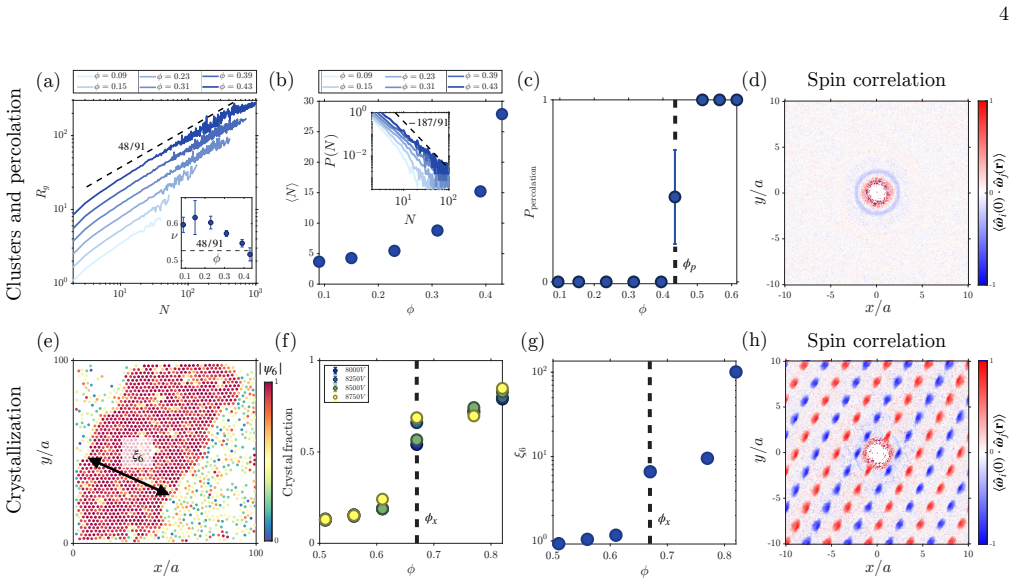
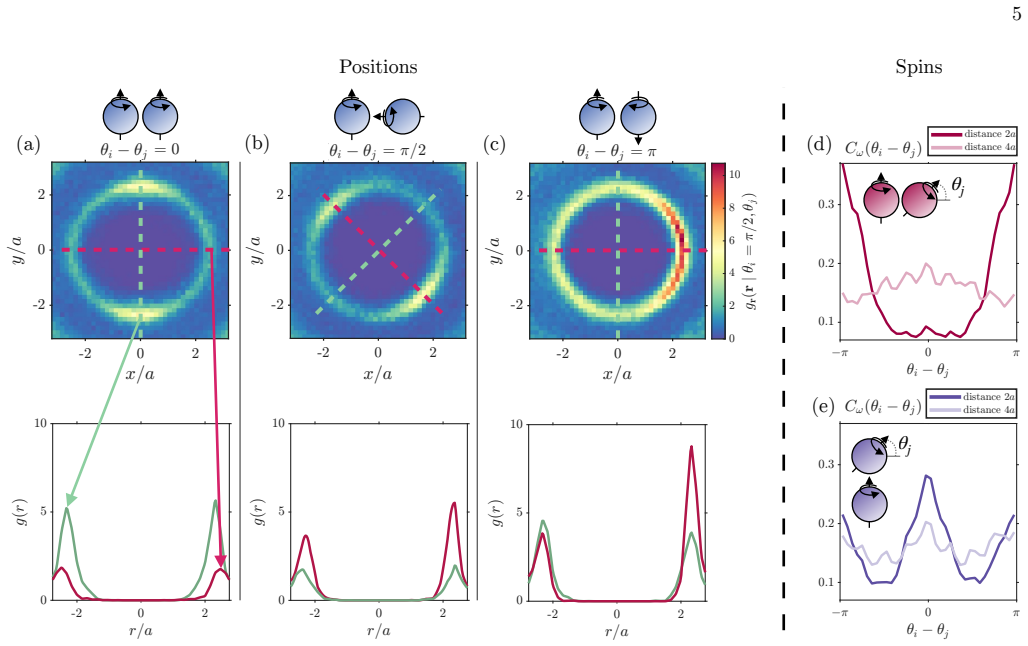
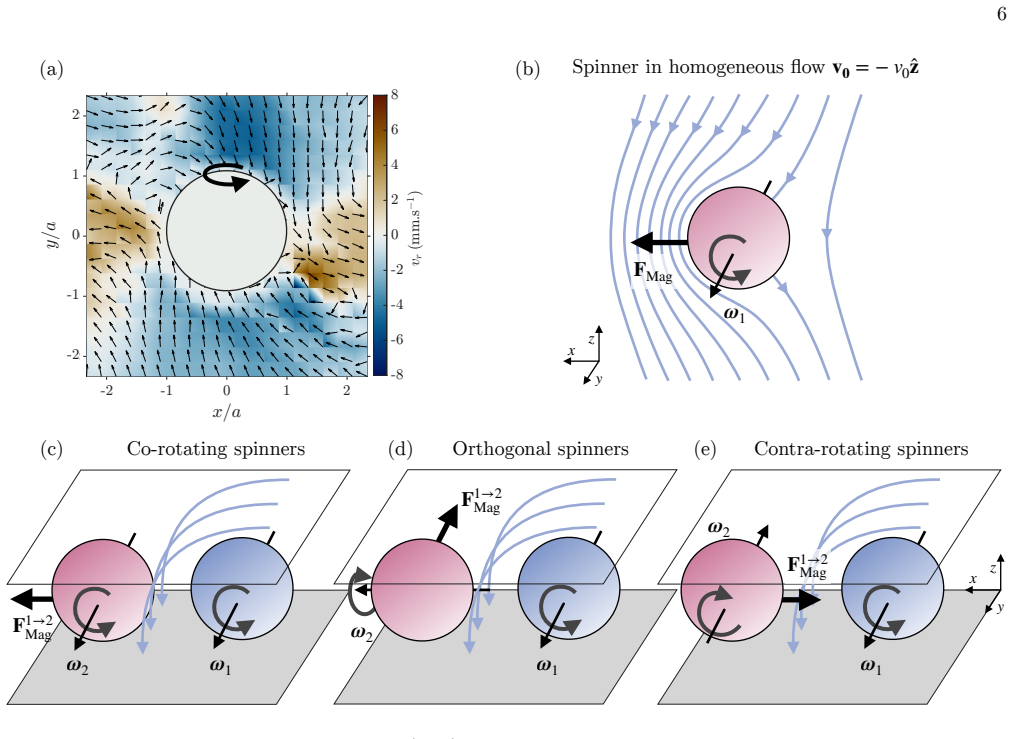
The central claim is that beyond the overdamped limit, hydrodynamic feedback can promote rather than destroy collective order, revealing a distinct regime of many-body active matter governed by inertial flows. At low density, inertial flows generate two competing interactions—anisotropic attractions and transverse Magnus forces—that continuously break and reconfigure bonds, driving a percolation transition toward a dynamically rearranging holey liquid. At high density, the feedback between spin alignment and particle positions suppresses transverse rearrangements and yields a first-order transition toward a spin-ordered crystal.
What carries the argument
Inertial flows that generate anisotropic attractions and transverse Magnus forces, together with spin-position feedback that suppresses rearrangements at high density.
If this is right
- Low-density spinner assemblies undergo a percolation transition to a dynamically rearranging holey liquid.
- High-density assemblies undergo a first-order transition to a spin-ordered crystal.
- Hydrodynamic feedback promotes collective order in many-body active matter instead of disrupting it.
- Many-body active matter can operate in a regime governed by inertial flows.
Where Pith is reading between the lines
- The resemblance of the holey liquid to empty-liquid states in patchy colloids suggests that inertial active systems might be engineered to produce controlled porous or percolating materials.
- Varying the Reynolds number across the overdamped-to-inertial crossover would map the boundary between flow-disrupting and flow-stabilizing regimes.
- Analogous inertial stabilization might appear in three-dimensional or non-spherical active systems once hydrodynamic feedback becomes dominant.
Load-bearing premise
The observed phase transitions are driven specifically by inertial flows, anisotropic attractions, and transverse Magnus forces rather than by boundary effects or intrinsic particle properties.
What would settle it
Experiments that eliminate inertial effects (for example by lowering Reynolds number while holding density and spinner properties fixed) and still observe the same percolation and crystallization transitions would show that the order does not require inertial flows.
Figures

read the original abstract
Active matter sustains emergent flows at the expense of preserving structural order. The feedback between structure and viscous flows typically disrupts crystalline and liquid-crystalline organization by amplifying the very deformations they generate. Yet this destabilizing paradigm has recently been challenged by experiments showing that inertial fluid flows can stabilize few-body bound states of active spinners. Whether inertial active matter can sustain genuine cohesion and order at the many-body level, however, remains elusive. Here we investigate two-dimensional assemblies of macroscopic spinners operating at high Reynolds number and uncover two phase transitions leading to the emergence of a dilute percolating fluid and a dense spin-textured crystal. At low density, inertial flows generate two competing interactions: anisotropic attractions and transverse Magnus forces that continuously break and reconfigure bonds. Together they drive a percolation transition toward a dynamically rearranging holey liquid reminiscent of the empty-liquid states observed in equilibrium patchy colloids. At high density, the feedback between spin alignment and particle positions suppresses transverse rearrangements and yields a first-order transition toward a spin-ordered crystal. Our results demonstrate that, beyond the overdamped limit, hydrodynamic feedback can promote rather than destroy collective order, revealing a distinct regime of many-body active matter governed by inertial flows.
Editorial analysis
A structured set of objections, weighed in public.
Referee Report
Summary. The manuscript investigates 2D assemblies of macroscopic spinners at high Reynolds number and reports two phase transitions: a percolation transition at low density to a dilute, dynamically rearranging 'holey fluid' driven by inertial-flow-induced anisotropic attractions and transverse Magnus forces, and a first-order transition at high density to a dense spin-textured crystal in which spin alignment suppresses transverse rearrangements. The central claim is that inertial hydrodynamic feedback promotes rather than destroys collective order, revealing a distinct many-body regime beyond the overdamped limit.
Significance. If substantiated by controls and data, the result would be significant because it identifies a regime in which inertia stabilizes order through hydrodynamic interactions, extending recent few-body experiments to many-body scales and challenging the standard view that viscous flows destabilize active-matter organization.
major comments (1)
- [Abstract] Abstract (and implied § on methods/results): the central claim that inertial hydrodynamic feedback (anisotropic attractions + transverse Magnus forces at high Re) drives the percolation transition to the holey fluid and the first-order transition to the spin-textured crystal requires explicit isolation of inertia. No control simulations in the overdamped limit (Re→0, Stokesian dynamics, or zero fluid density) with fixed particle properties, spin torques, and boundaries are described, so the observed order could arise from the interaction forms themselves rather than inertial flow feedback. This is load-bearing for the claim that inertia promotes order beyond the overdamped limit.
Simulated Author's Rebuttal
We thank the referee for their careful reading and for highlighting the need to isolate inertial effects. We respond to the single major comment below.
read point-by-point responses
-
Referee: [Abstract] Abstract (and implied § on methods/results): the central claim that inertial hydrodynamic feedback (anisotropic attractions + transverse Magnus forces at high Re) drives the percolation transition to the holey fluid and the first-order transition to the spin-textured crystal requires explicit isolation of inertia. No control simulations in the overdamped limit (Re→0, Stokesian dynamics, or zero fluid density) with fixed particle properties, spin torques, and boundaries are described, so the observed order could arise from the interaction forms themselves rather than inertial flow feedback. This is load-bearing for the claim that inertia promotes order beyond the overdamped limit.
Authors: We agree that the manuscript as submitted does not contain explicit overdamped control simulations, and that such controls are required to substantiate the claim that the reported transitions arise specifically from inertial hydrodynamic feedback rather than from the functional form of the interactions alone. In the revised manuscript we will add Stokesian-dynamics (Re→0) simulations that retain identical particle properties, spin torques, and boundaries. These controls will demonstrate the absence of both the percolation transition to the holey fluid and the first-order transition to the spin-textured crystal in the overdamped limit, thereby isolating the role of inertia. The abstract and methods/results sections will be updated to present the new data. revision: yes
Circularity Check
No circularity; observational claims from inertial spinner simulations lack any derivation chain
full rationale
The provided abstract and context describe phase transitions observed in 2D macroscopic spinner assemblies at high Reynolds number, with no equations, fitting procedures, self-citations, or mathematical derivations presented. The central claims rest on direct simulation or experimental outcomes regarding inertial flows, anisotropic attractions, and Magnus forces driving percolation and crystallization, without any reduction of predictions to fitted inputs or self-referential definitions. This is a standard observational result in active matter physics and scores as fully self-contained against external benchmarks.
Axiom & Free-Parameter Ledger
Reference graph
Works this paper leans on
-
[1]
J. M. Crowley, The Physics of Fluids19, 1296 (1976)
1976
-
[2]
B. A. Grzybowski, H. A. Stone, and G. M. Whitesides, Nature405, 1033 (2000)
2000
-
[3]
Guazzelli and J
É. Guazzelli and J. Hinch, Annual review of fluid me- chanics43, 97 (2011)
2011
-
[4]
Goto and H
Y. Goto and H. Tanaka, Nature communications6, 5994 (2015)
2015
-
[5]
Driscoll, B
M. Driscoll, B. Delmotte, M. Youssef, S. Sacanna, A. Donev, and P. Chaikin, Nature Physics13, 375 (2017)
2017
-
[6]
Oppenheimer, D
N. Oppenheimer, D. B. Stein, and M. J. Shelley, Phys. Rev. Lett.123, 148101 (2019)
2019
-
[7]
Chajwa, N
R. Chajwa, N. Menon, S. Ramaswamy, and R. Govin- darajan, Phys. Rev. X10, 041016 (2020). 8
2020
-
[8]
Massana-Cid, D
H. Massana-Cid, D. Levis, R. J. H. Hernández, I. Pago- nabarraga, and P. Tierno, Physical Review Research3, L042021 (2021)
2021
-
[9]
E. S. Bililign, F. Balboa Usabiaga, Y. A. Ganan, A. Pon- cet, V. Soni, S. Magkiriadou, M. J. Shelley, D. Bartolo, and W. T. Irvine, Nature Physics18, 212 (2022)
2022
-
[10]
T. H. Tan, A. Mietke, J. Li, Y. Chen, H. Higinbotham, P. J. Foster, S. Gokhale, J. Dunkel, and N. Fakhri, Na- ture607, 287 (2022)
2022
-
[12]
Bartolo, Proceedings of the National Academy of Sciences122, e2412993122 (2025)
S.Guillet, A.Poncet, M.LeBlay, W.T.Irvine, V.Vitelli, and D. Bartolo, Proceedings of the National Academy of Sciences122, e2412993122 (2025)
2025
-
[13]
Pedley and J
T. Pedley and J. O. Kessler, Annual Review of Fluid Mechanics24, 313 (1992)
1992
-
[14]
Saintillan and M
D. Saintillan and M. J. Shelley, Physical Review Letters 100, 178103 (2008)
2008
-
[15]
Sanchez, D
T. Sanchez, D. T. Chen, S. J. DeCamp, M. Heymann, and Z. Dogic, Nature491, 431 (2012)
2012
-
[16]
M. C. Marchetti, J.-F. Joanny, S. Ramaswamy, T. B. Liverpool, J. Prost, M. Rao, and R. A. Simha, Reviews of modern physics85, 1143 (2013)
2013
-
[17]
Doostmohammadi, J
A. Doostmohammadi, J. Ignés-Mullol, J. M. Yeomans, and F. Sagués, Nature communications9, 3246 (2018)
2018
-
[20]
Z. Shen, D. Fu, and J. S. Lintuvuori, Soft Matter21, 4021 (2025)
2025
-
[21]
C. P. Royall, M. A. Faers, S. L. Fussell, and J. E. Hallett, JournalofPhysics: CondensedMatter33,453002(2021)
2021
-
[22]
Sciortino and E
F. Sciortino and E. Zaccarelli, Current Opinion in Solid State and Materials Science15, 246 (2011)
2011
-
[26]
Quantum Kicked Top: A Paradigmatic Model
R. Braun, A. Poncet, A. Morin, and D. Bartolo, (2026), arXiv:2604.12345
work page internal anchor Pith review Pith/arXiv arXiv 2026
-
[27]
Buttinoni, J
I. Buttinoni, J. Bialké, F. Kümmel, H. Löwen, C. Bechinger, and T. Speck, Phys. Rev. Lett.110, 238301 (2013)
2013
-
[28]
M. E. Cates and J. Tailleur, Annu. Rev. Condens. Matter Phys.6, 219 (2015)
2015
-
[29]
Ginot, I
F. Ginot, I. Theurkauff, F. Detcheverry, C. Ybert, and C. Cottin-Bizonne, Nature communications9, 696 (2018)
2018
-
[30]
Zaccarelli, Journal of Physics: Condensed Matter19, 323101 (2007)
E. Zaccarelli, Journal of Physics: Condensed Matter19, 323101 (2007)
2007
-
[32]
B.Nienhuis,JournalofStatisticalPhysics34,731(1984)
1984
-
[33]
Bianchi, J
E. Bianchi, J. Largo, P. Tartaglia, E. Zaccarelli, and F. Sciortino, Phys. Rev. Lett.97, 168301 (2006)
2006
-
[34]
Stauffer, Physics reports54, 1 (1979)
D. Stauffer, Physics reports54, 1 (1979)
1979
-
[36]
Melcher and G
J. Melcher and G. Taylor, Annual review of fluid mechan- ics1, 111 (1969)
1969
-
[37]
Bickley, The London, Edinburgh, and Dublin Philo- sophical Magazine and Journal of Science25, 746 (1938)
W. Bickley, The London, Edinburgh, and Dublin Philo- sophical Magazine and Journal of Science25, 746 (1938)
1938
-
[38]
S. I. Rubinow and J. B. Keller, Journal of Fluid Mechan- ics11, 447 (1961)
1961
-
[39]
Guyon, J
E. Guyon, J. P. Hulin, L. Petit, and C. D. Mitescu, Physical hydrodynamics(Oxford university press, 2015)
2015
-
[41]
Gondret and L
P. Gondret and L. Petit, Physics of Fluids8, 2284 (1996)
1996
-
[42]
Russo, F
J. Russo, F. Leoni, F. Martelli, and F. Sciortino, Reports on Progress in Physics85, 016601 (2022). S1 Supplemental Material for: Order by inertia in spinning active matter: holey fluids and spin-textured crystals. Camille Jorge 1,2 and Denis Bartolo 1 1Univ. Lyon, ENS de Lyon, Univ. Claude Bernard, CNRS, Laboratoire de Physique, F-69342, Lyon. 2Institute...
2022
-
[43]
Interacting spinners The experimental setup is very similar to the standard Quincke-roller experiments described in detail, for exam- ple in [1]
Experimental setups a. Interacting spinners The experimental setup is very similar to the standard Quincke-roller experiments described in detail, for exam- ple in [1]. The characteristic length scales, however, dif- fer by three orders of magnitude. Here, the spinners are 6 mmPLA beads (polylactic acid) immersed in a solu- tion of hexadecane and AOT salt...
-
[44]
olBzqF9XA93Dd4AZq7FLjZNAVFM=
Image Acquisition and data analysis a. Image acquisition We illuminate the system using standard desk lamps and adjust the lighting angle to minimize specular reflec- tions as much as possible. The experiments are recorded with a LUX160 (Ximea) camera equipped with a zoom lens. To ensure sufficient temporal resolution when mea- suring the rotation of the ...
-
[45]
Chardac, L
A. Chardac, L. A. Hoffmann, Y. Poupart, L. Giomi, and D. Bartolo, Physical Review X11, 031069 (2021)
2021
-
[46]
Quincke, Annalen der Physik295, 417 (1896)
G. Quincke, Annalen der Physik295, 417 (1896)
-
[47]
Melcher and G
J. Melcher and G. Taylor, Annual review of fluid mechan- S6 ics1, 111 (1969)
1969
-
[48]
Blair and E
D. Blair and E. Dufresne, Particle-tracking code available at http://physics. georgetown. edu/matlab (2008)
2008
-
[49]
J. C. Crocker and D. G. Grier, Journal of colloid and interface science179, 298 (1996)
1996
-
[50]
Thielicke and R
W. Thielicke and R. Sonntag, Journal of Open Research Software9(2021)
2021
-
[51]
Saleur and B
H. Saleur and B. Duplantier, Physical review letters58, 2325 (1987)
1987
-
[52]
Duplantier and H
B. Duplantier and H. Saleur, Nuclear Physics B290, 291 (1987)
1987
-
[53]
Jaubert, M
L. Jaubert, M. Haque, and R. Moessner, Physical review letters107, 177202 (2011)
2011
-
[54]
Shen and J
Z. Shen and J. S. Lintuvuori, Physical Review Letters 130, 188202 (2023)
2023
-
[55]
Gelvan, A
M. Gelvan, A. Chirko, J. Kirpitch, Y. Lavie, N. Israel, and N. Oppenheimer, Nature Communications16, 10368 (2025)
2025
-
[56]
P. Chen, S. Weady, S. Atis, T. Matsuzawa, M. J. Shelley, and W. T. Irvine, Nature Physics21, 146 (2025)
2025
-
[57]
G. E. Pradillo, H. Karani, and P. M. Vlahovska, Soft matter15, 6564 (2019)
2019
-
[58]
Bricard, J.-B
A. Bricard, J.-B. Caussin, N. Desreumaux, O. Dauchot, and D. Bartolo, Nature503, 95 (2013)
2013
-
[59]
Morin and D
A. Morin and D. Bartolo, Phys. Rev. X8, 021037 (2018)
2018
-
[60]
Jeffrey and Y
D. Jeffrey and Y. Onishi, Journal of Fluid Mechanics 139, 261 (1984)
1984
discussion (0)
Sign in with ORCID, Apple, or X to comment. Anyone can read and Pith papers without signing in.