Dark Quest II: A Wide-Coverage Neural Network Emulator of the Nonlinear Matter Power Spectrum Across Extended Cosmologies
Pith reviewed 2026-06-29 10:46 UTC · model grok-4.3
The pith
Neural network emulator matches nonlinear matter power spectra to subpercent accuracy up to the Nyquist scale across nine-dimensional cosmologies.
A machine-rendered reading of the paper's core claim, the machinery that carries it, and where it could break.
Core claim
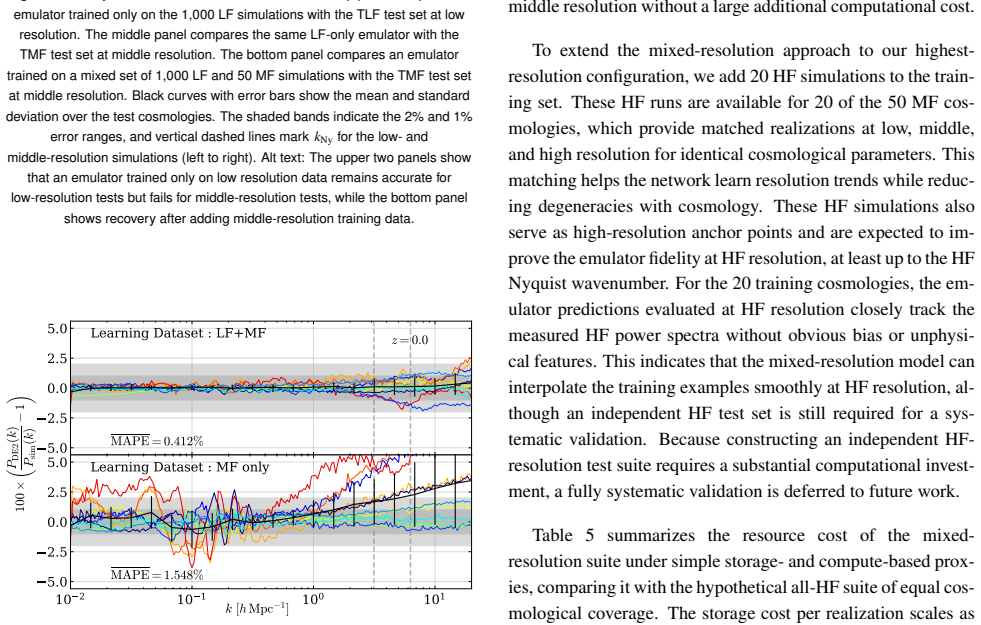
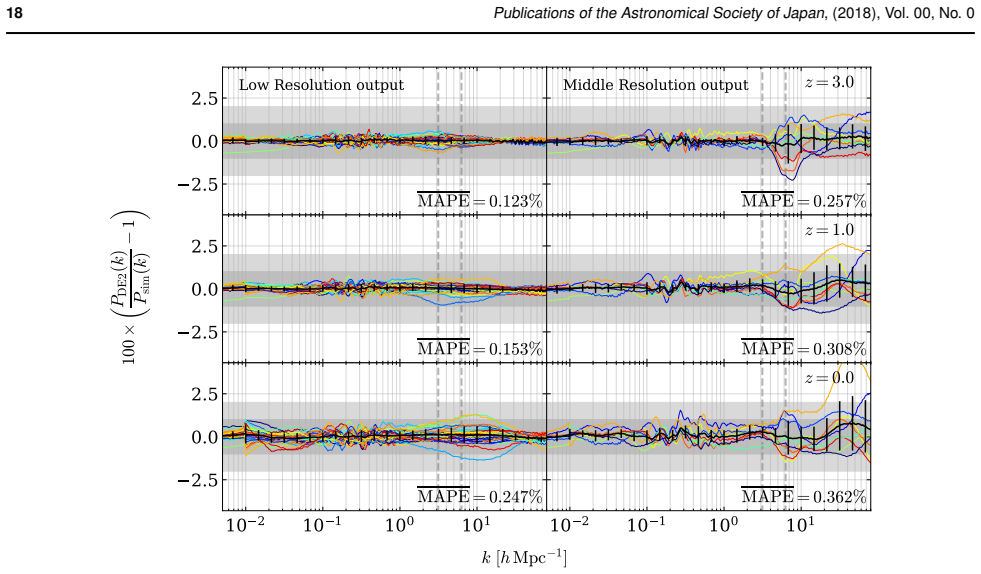
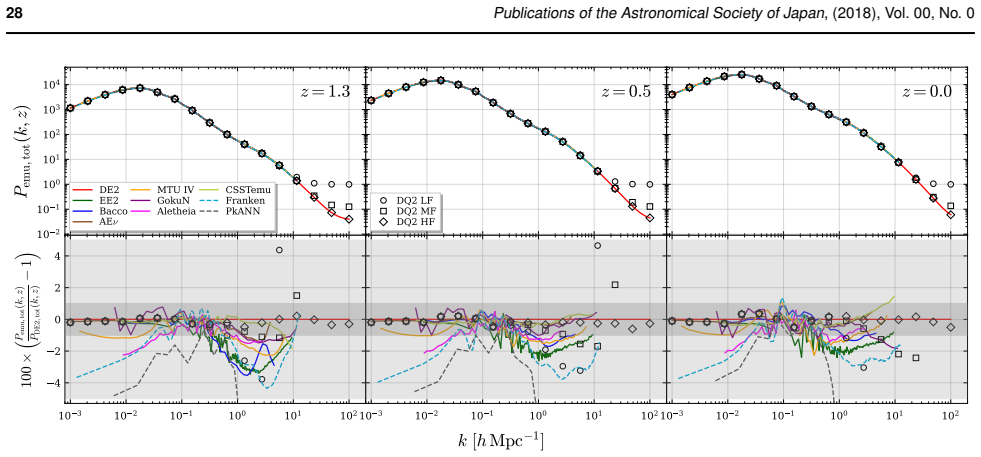
DarkEmulator2 reproduces the simulated matter power spectrum to subpercent accuracy up to the particle Nyquist scale k_Ny ≃ 10 h/Mpc for a 1 Gpc box with 3000^3 particles, remaining accurate over the calibrated wavenumber range while its highest-k predictions depend on simulation resolution and shot noise.
What carries the argument
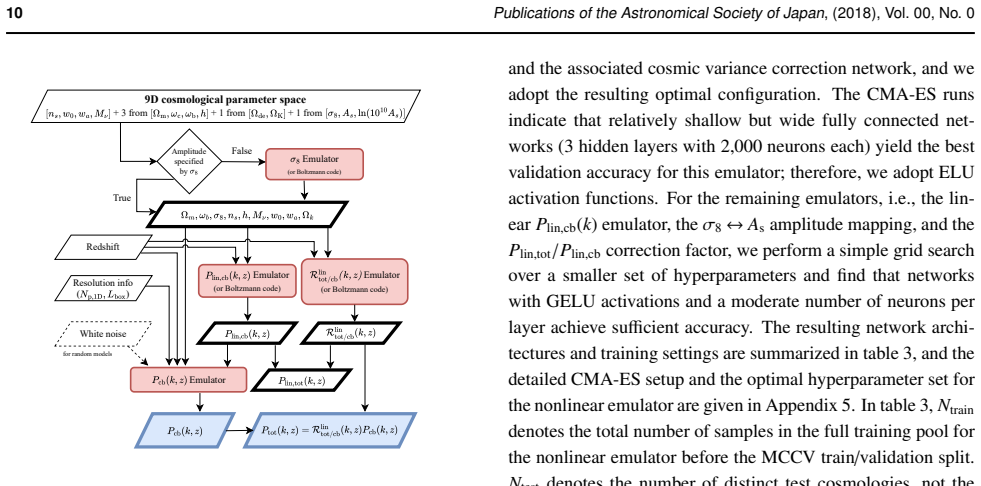
A single neural network trained jointly across three simulation resolution tiers, taking as inputs the cosmological parameter vector supplemented by the linear matter power spectrum, descriptors of simulation resolution, and a low-dimensional summary of the initial Gaussian random field.
Load-bearing premise
Supplementing the neural network inputs with the linear matter power spectrum, descriptors of simulation resolution, and a low-dimensional summary of the initial Gaussian random field will improve generalization across the nine-dimensional parameter space.
What would settle it
Running the emulator on a new independent suite of high-resolution simulations spanning the same nine-dimensional space and checking whether subpercent agreement holds up to k_Ny ≃ 10 h/Mpc.
Figures


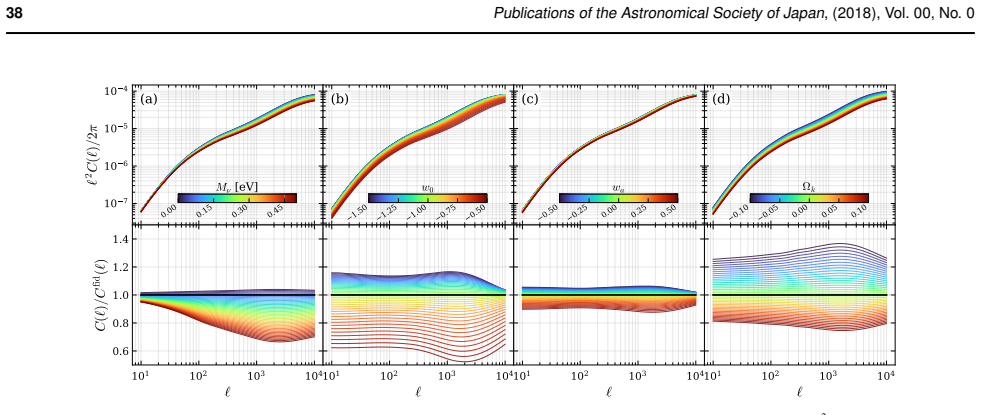
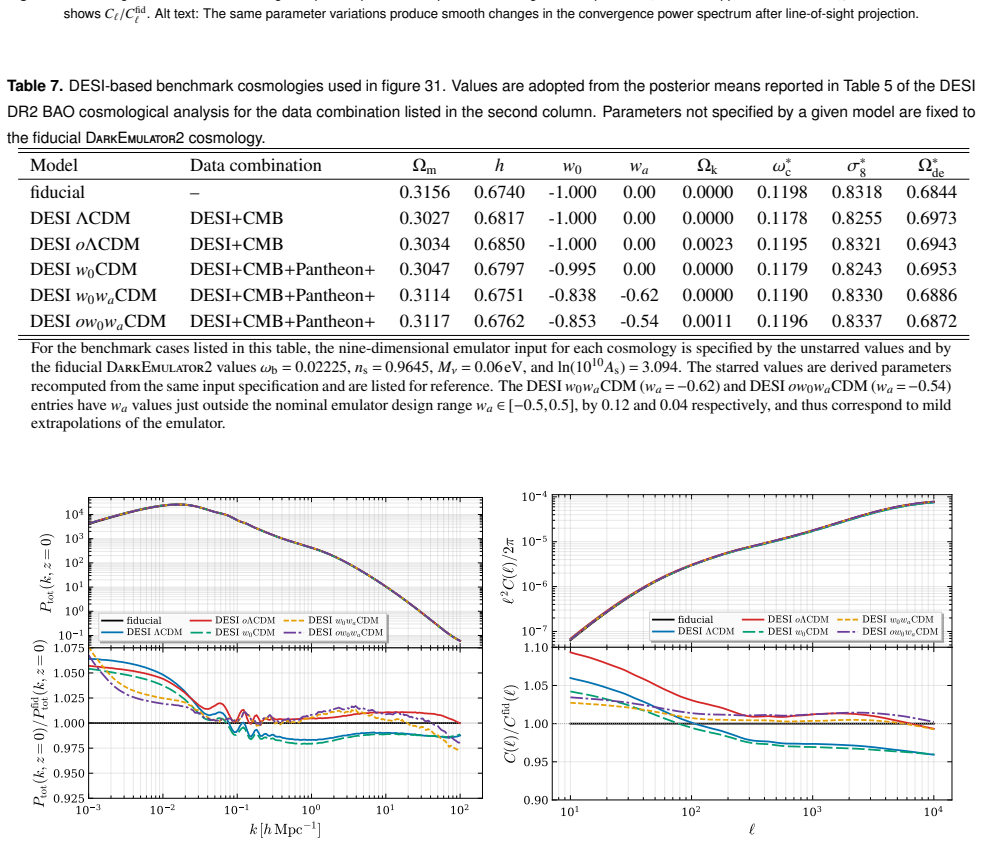
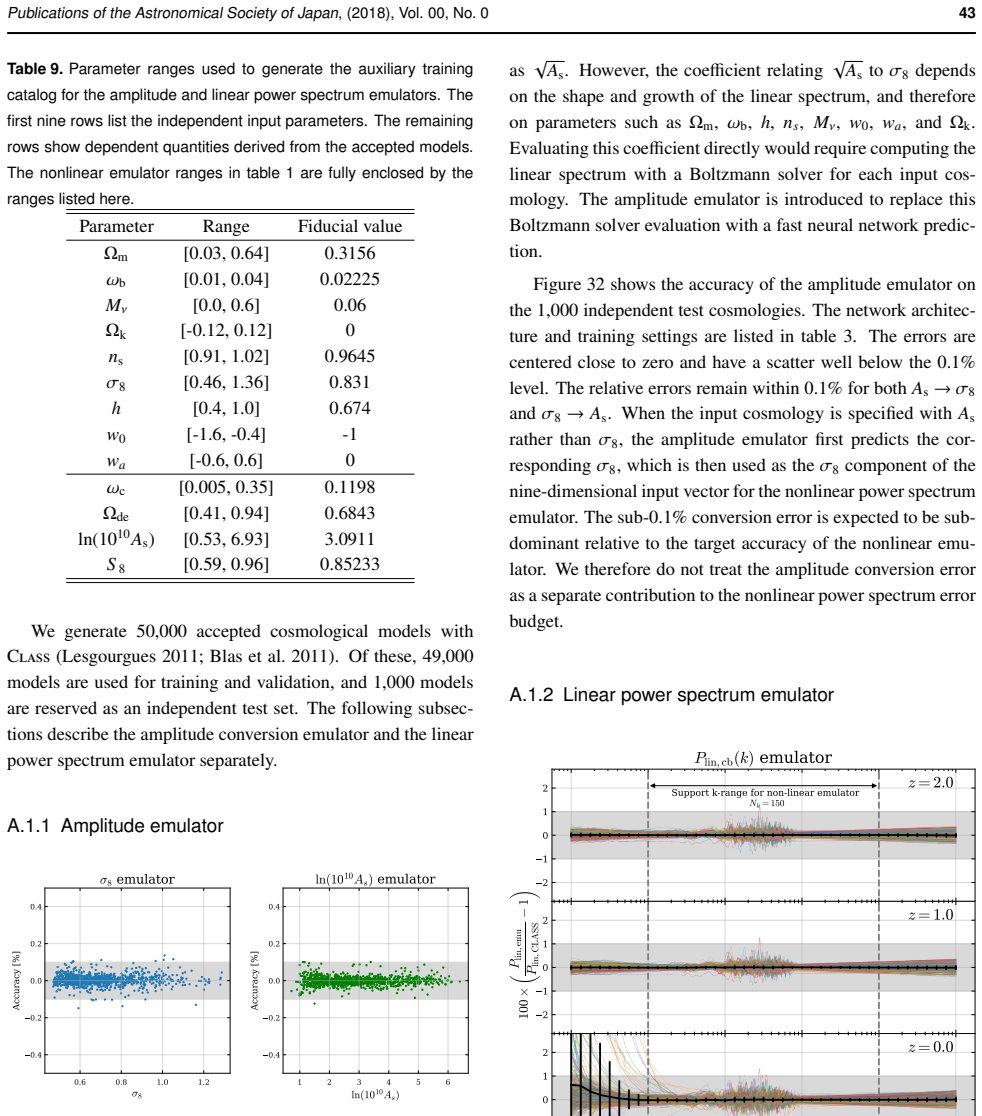
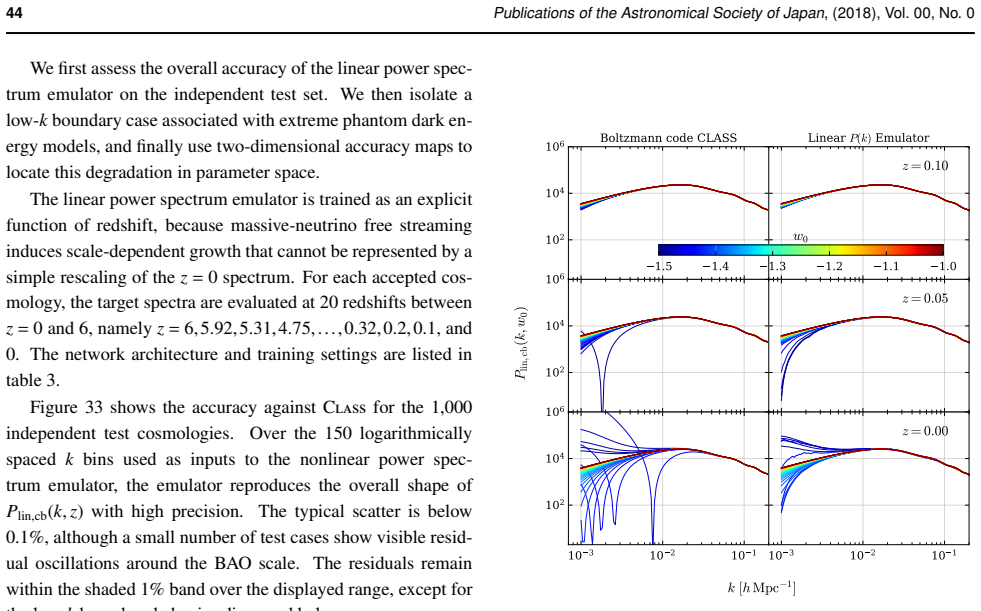
read the original abstract
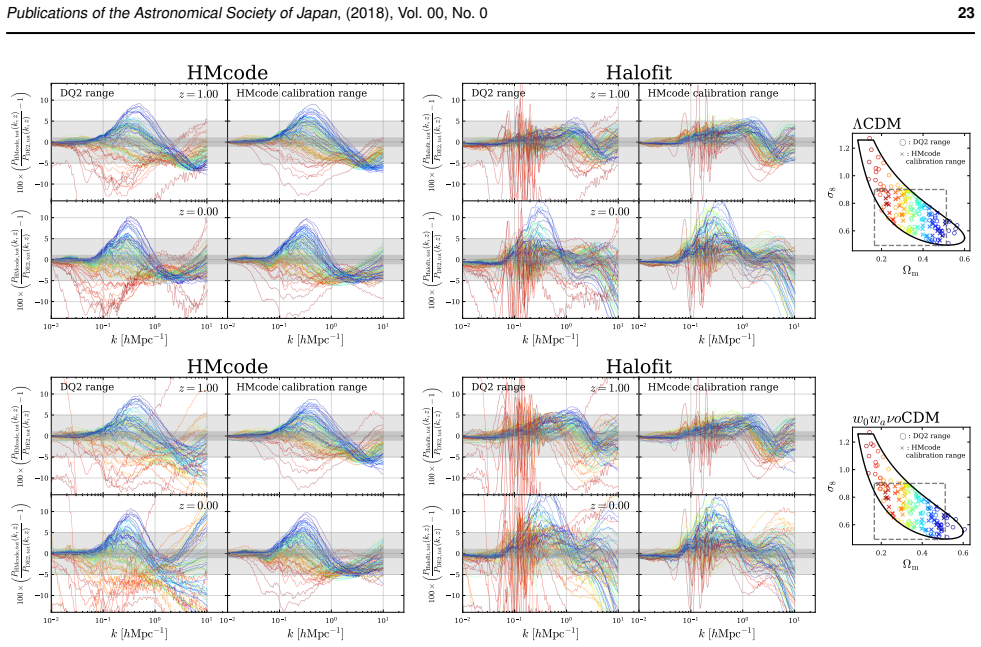
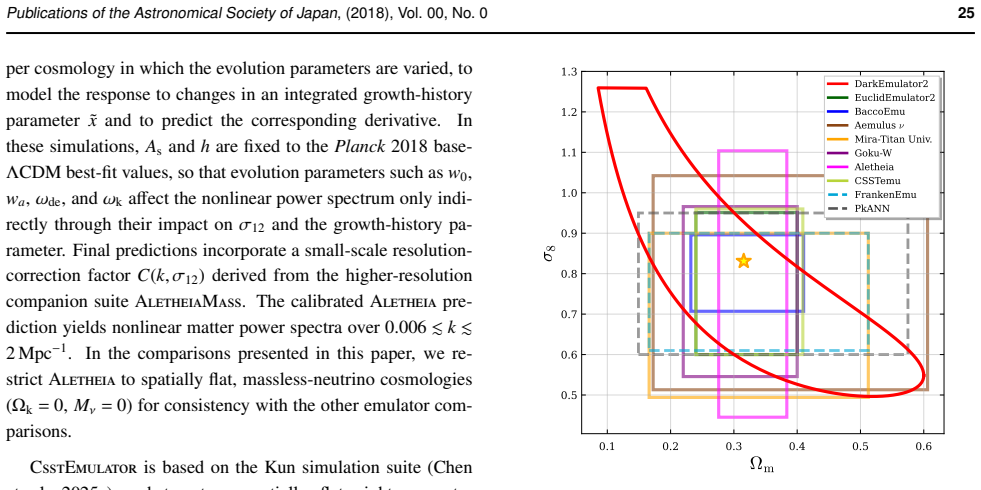
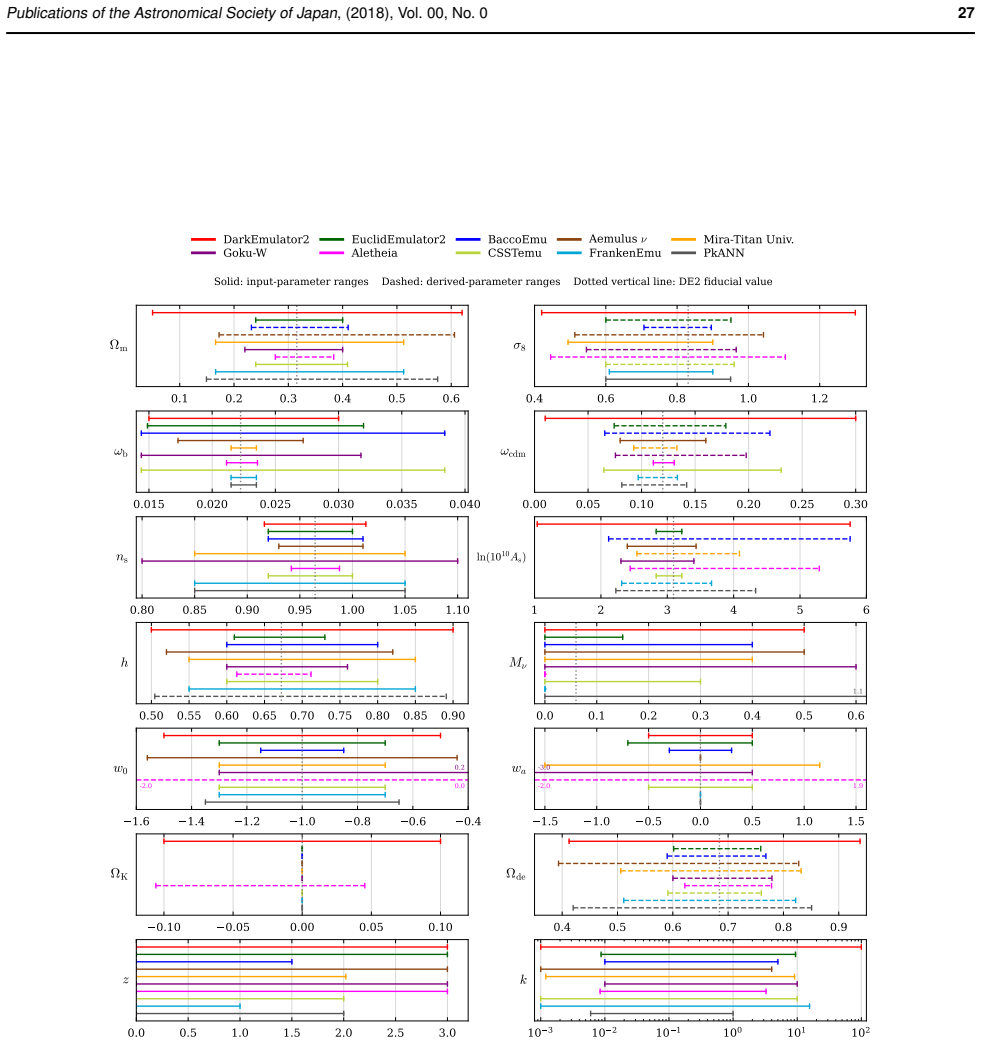
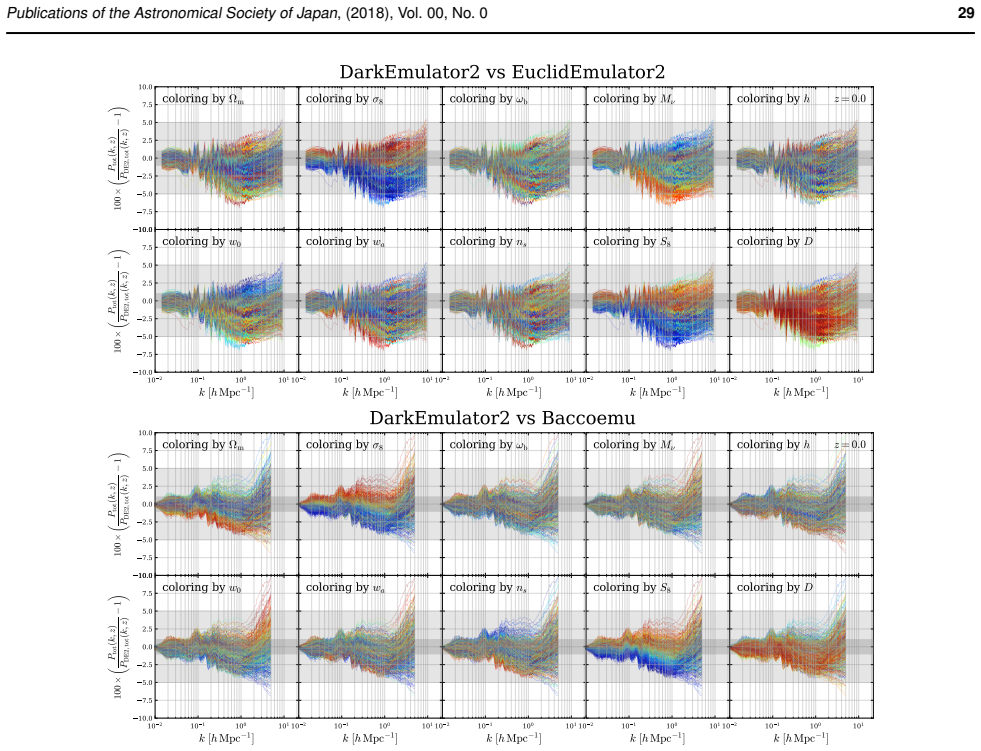
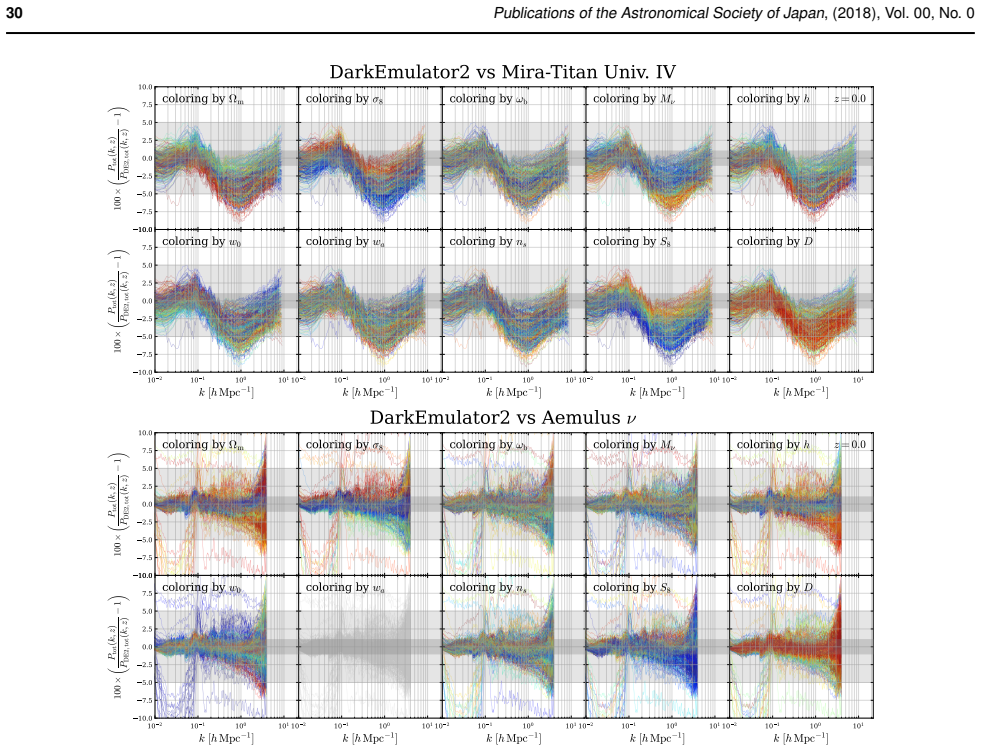
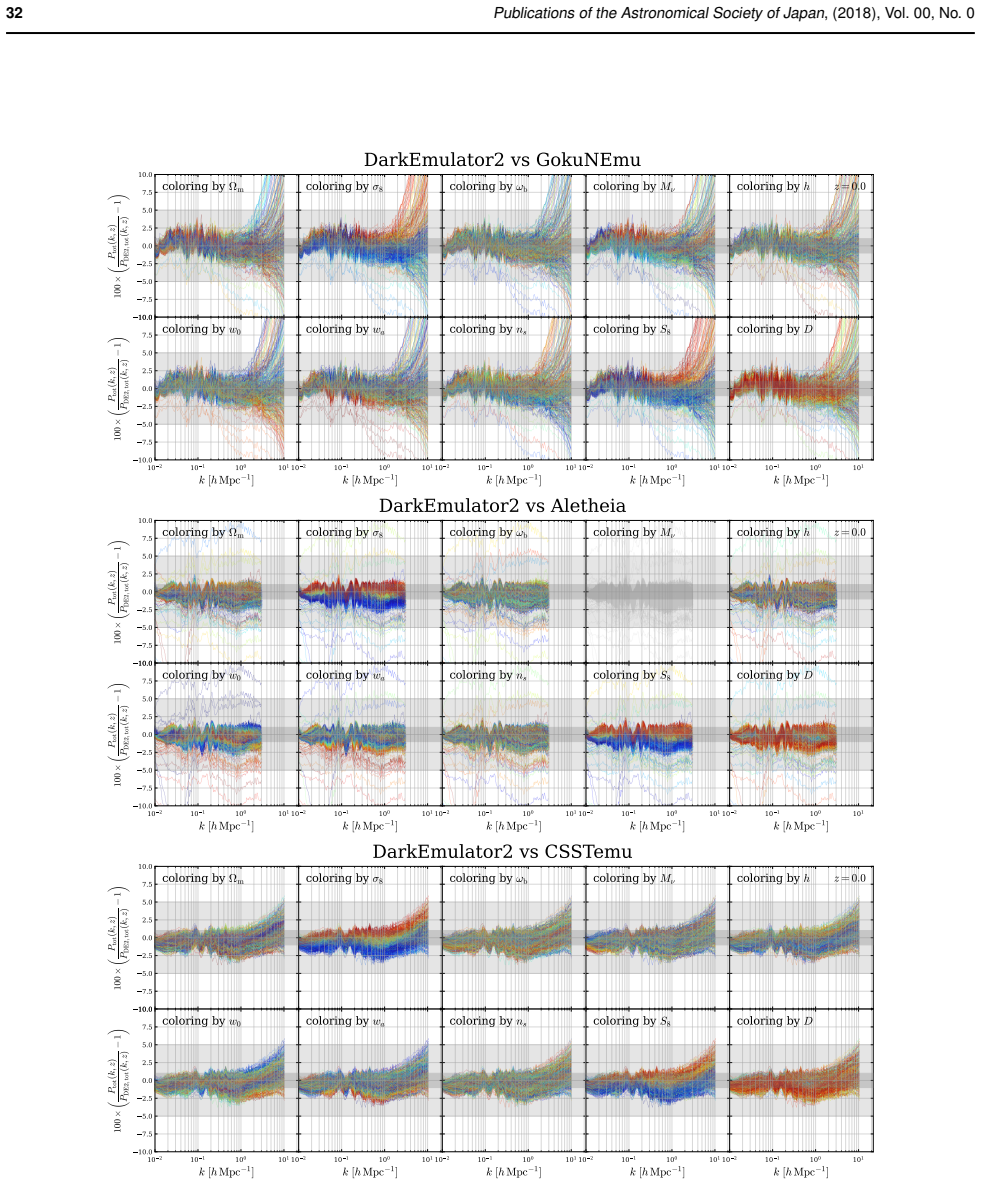
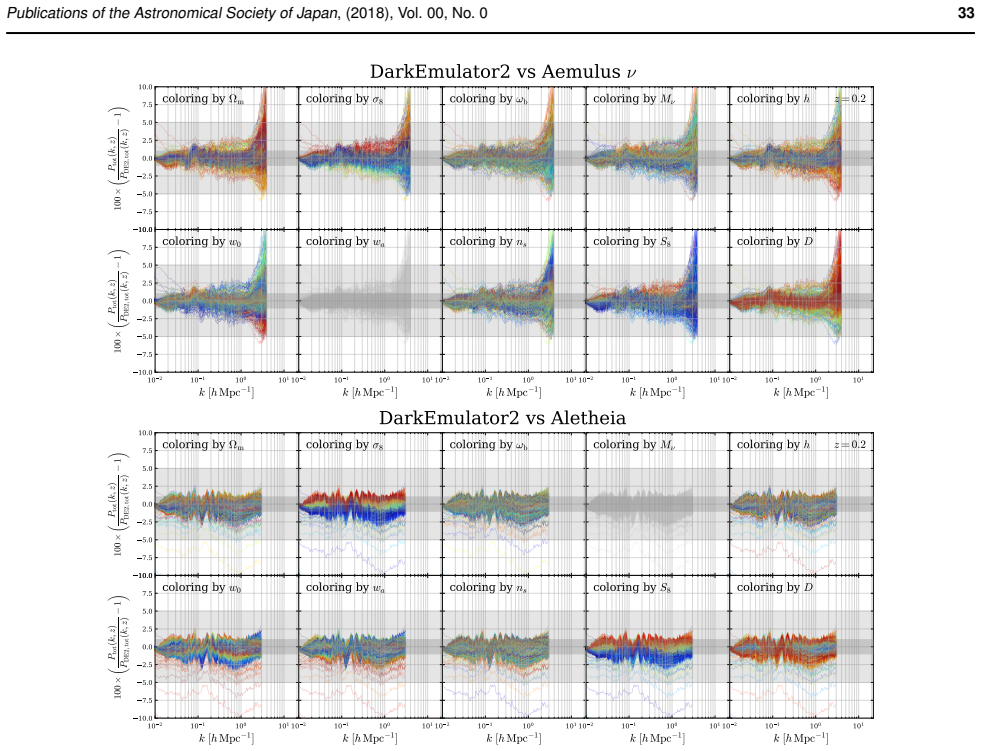
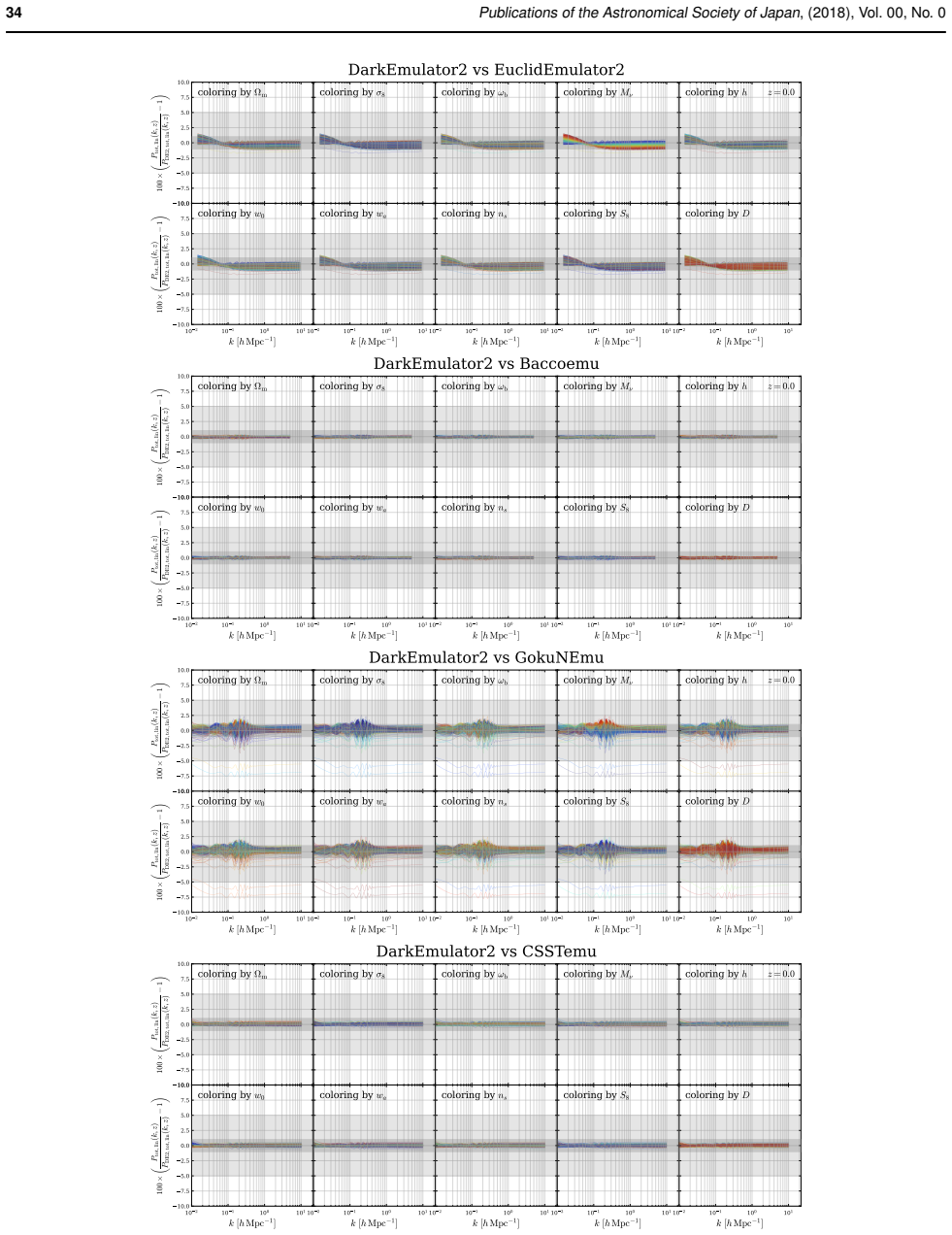
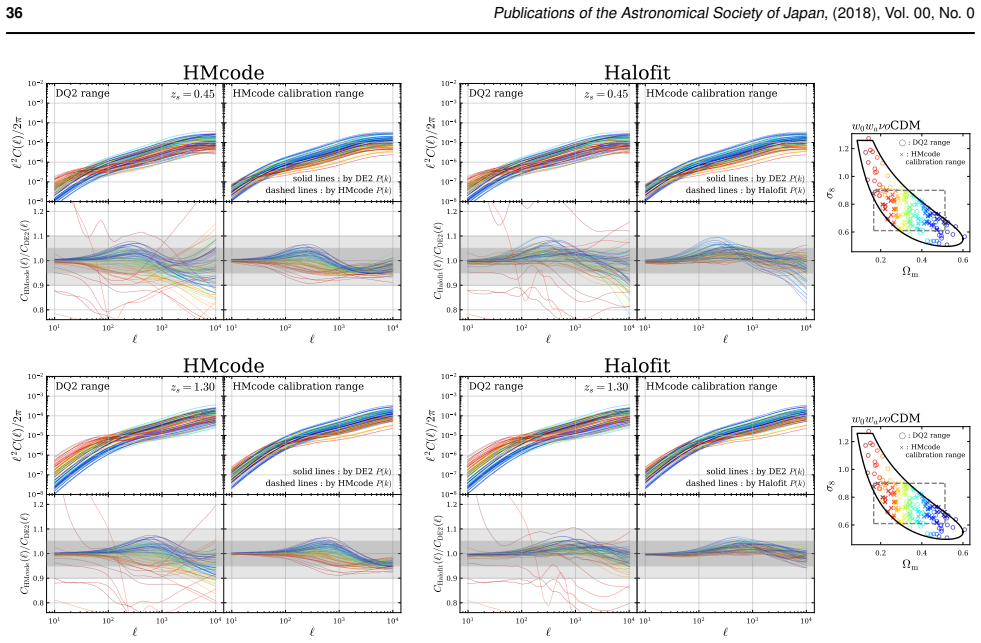
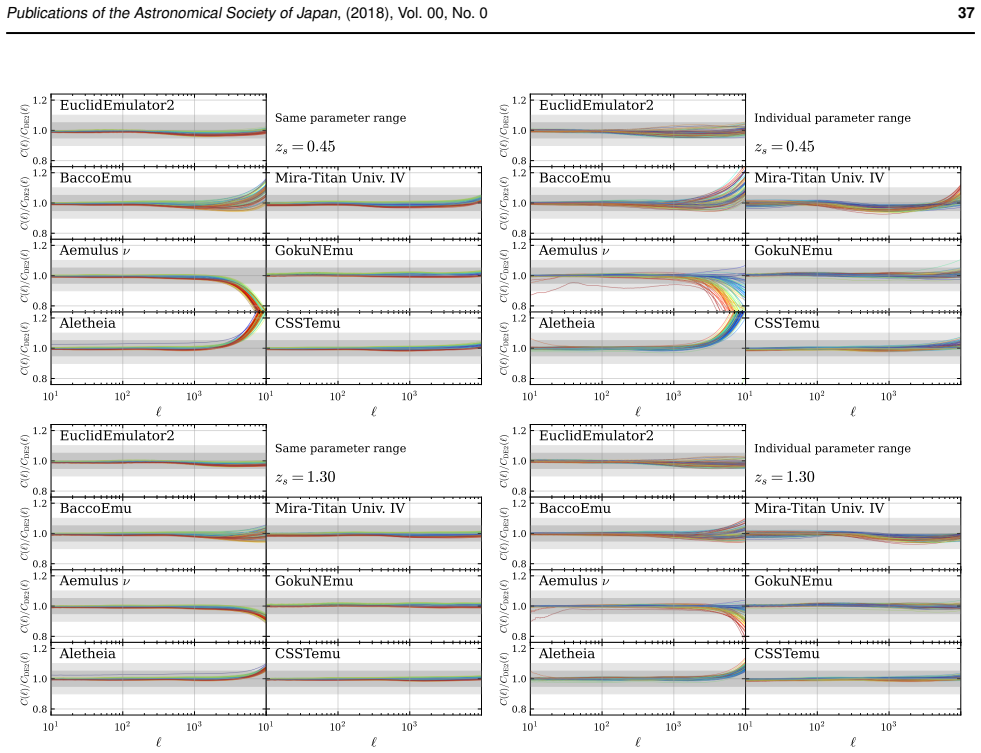
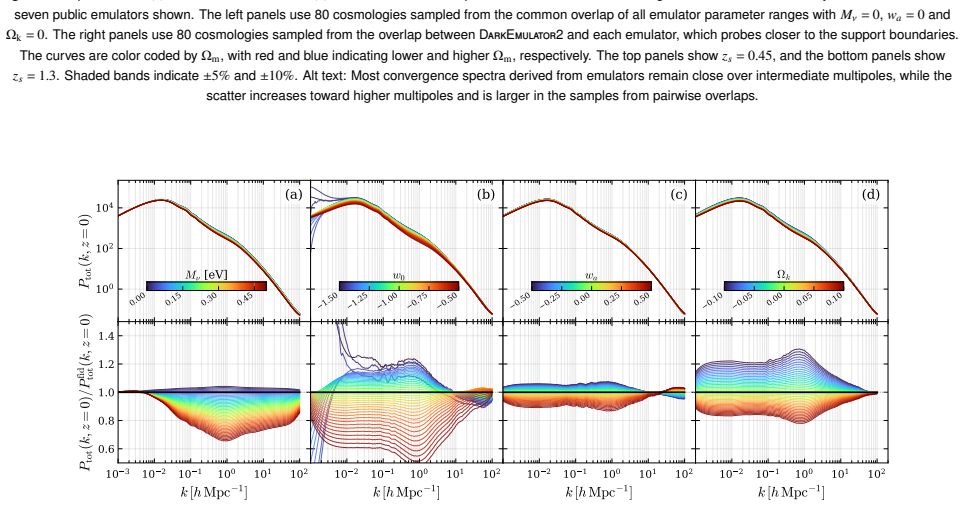
\textsc{DarkEmulator2} is a neural network emulator of the nonlinear matter power spectrum in a nine-dimensional $w_0 w_a \nu o \mathrm{CDM}$ parameter space, developed as the emulator component of the \textsc{Dark Quest II} (DQ2) program. It is trained on simulations generated with the \textsc{Ginkaku} code, whose numerical implementation, accuracy tests, and post-processing pipeline are described in the companion paper. The design follows a unified strategy: in addition to the cosmological parameter vector, we supplement the neural network's inputs with three families of physically motivated auxiliary quantities -- the linear matter power spectrum, descriptors of the simulation resolution, and a low-dimensional summary of the initial Gaussian random field -- that are expected to improve generalization across the parameter space. Training a single network jointly across three simulation resolution tiers allows the emulator to exploit a small number of high-resolution simulations while retaining broad coverage from lower-resolution simulations. For a $L_{\mathrm{box}}=1\,\hiGpc$ box with $N=3000^{3}$ particles, the emulator reproduces the simulated matter power spectrum to subpercent accuracy up to the particle Nyquist scale, $k_{\mathrm{Ny}}\simeq 10\,\hMpci$. The emulator remains accurate over the calibrated wavenumber range, while its highest-$k$ predictions depend on the simulation resolution and shot noise. We validate the emulator on independent test suites and, through a cross-comparison with several public emulators and widely used fitting formulas, characterize the inter-model consistency and the parameter-dependent trends in their residuals.
Editorial analysis
A structured set of objections, weighed in public.
Referee Report
Summary. The manuscript presents DarkEmulator2, a neural network emulator for the nonlinear matter power spectrum in a nine-dimensional w0 wa ν o CDM parameter space. It is trained jointly across three simulation resolution tiers from the Ginkaku code, with the cosmological parameter vector supplemented by the linear matter power spectrum, resolution descriptors, and a low-dimensional summary of the initial Gaussian random field. The central claim is that this single network achieves subpercent accuracy in reproducing the simulated P(k) up to the particle Nyquist scale k_Ny ≃ 10 h/Mpc for L_box=1 Gpc, N=3000^3 runs, remains accurate over the calibrated range, and is validated on independent test suites with comparisons to other emulators.
Significance. If the accuracy and generalization claims hold, the emulator would enable efficient cosmological analyses over extended parameter spaces by leveraging sparse high-resolution simulations together with broad low-resolution coverage. The joint-training strategy across resolution tiers and the use of physically motivated auxiliary inputs represent a practical approach to wide-coverage emulation; the validation on independent suites and cross-comparison with public emulators are explicit strengths that support reproducibility and inter-model assessment.
major comments (2)
- [Abstract] Abstract: the claim that the auxiliary inputs (linear P(k), resolution descriptors, and initial-field summary) 'are expected to improve generalization across the parameter space' is presented without ablation studies, controlled comparisons, or quantitative evidence isolating their contribution to the reported accuracy. This assumption is load-bearing for the joint-training strategy, as the ability to exploit a small number of high-resolution runs while retaining broad coverage from lower-resolution simulations rests on it.
- [Abstract] Abstract: the headline accuracy statement ('reproduces the simulated matter power spectrum to subpercent accuracy up to k_Ny ≃ 10 h/Mpc') supplies no quantitative error metrics (e.g., mean or maximum relative error as a function of k, cosmology, or resolution tier), details on post-hoc choices, or explicit validation statistics on the independent test suites. Without these, the central performance claim cannot be assessed for load-bearing consistency with the joint-training design.
Simulated Author's Rebuttal
We thank the referee for their careful review and constructive feedback. We address each major comment below, indicating where revisions will be made to strengthen the manuscript.
read point-by-point responses
-
Referee: [Abstract] the claim that the auxiliary inputs (linear P(k), resolution descriptors, and initial-field summary) 'are expected to improve generalization across the parameter space' is presented without ablation studies, controlled comparisons, or quantitative evidence isolating their contribution to the reported accuracy. This assumption is load-bearing for the joint-training strategy.
Authors: The auxiliary inputs are motivated by physical considerations (linear power spectrum captures large-scale modes, resolution descriptors account for numerical effects, and initial-field summary encodes phase information), as detailed in the methods. The joint-training performance across tiers provides supporting evidence for their utility in generalization. We did not conduct explicit ablation studies. In revision, we will update the abstract to clarify that these inputs are included to support generalization and add a brief discussion of the training results as indirect evidence. revision: yes
-
Referee: [Abstract] the headline accuracy statement ('reproduces the simulated matter power spectrum to subpercent accuracy up to k_Ny ≃ 10 h/Mpc') supplies no quantitative error metrics (e.g., mean or maximum relative error as a function of k, cosmology, or resolution tier), details on post-hoc choices, or explicit validation statistics on the independent test suites.
Authors: The abstract is a concise overview; full quantitative metrics (mean/max relative errors vs. k, cosmology, and tier), validation statistics on independent suites, and cross-comparisons appear in Sections 4–5 and associated figures/tables. To address the concern, we will revise the abstract to include a brief quantitative qualifier (e.g., typical mean relative error <1% up to k_Ny on test sets) with explicit references to the detailed results. revision: yes
Circularity Check
No significant circularity; emulator trained on external simulations with independent validation
full rationale
The paper trains a neural network on simulations generated by the external Ginkaku code and validates accuracy on independent test suites. Auxiliary inputs (linear P(k), resolution descriptors, initial field summary) are described as physically motivated quantities expected to aid generalization; this is an empirical design choice, not a self-definition or fitted input renamed as prediction. The sub-percent accuracy claim is a direct reproduction metric against held-out simulation data, not a quantity derived from itself by construction. No load-bearing self-citations, uniqueness theorems, or ansatzes imported from prior author work appear in the provided text. The derivation chain remains self-contained against external simulation benchmarks.
Axiom & Free-Parameter Ledger
Reference graph
Works this paper leans on
-
[1]
B., Aleksi ´c, J., et al
Abbott, T., Abdalla, F. B., Aleksi ´c, J., et al. 2016, Mon. Not. R. Astron. Soc., 460, 1270
2016
-
[2]
Abbott, T. M. C., Aguena, M., Alarcon, A., et al. 2022, Phys. Rev. D, 105, 023520 Abdul Karim, M., Aguilar, J., Ahlen, S., et al. 2025, Phys. Rev. D., 112, 083515 Publications of the Astronomical Society of Japan , (2018), Vol. 00, No. 0 51
2022
-
[3]
B., Feldman, H
Agarwal, S., Abdalla, F. B., Feldman, H. A., Lahav, O., & Thomas, S. A. 2012, MNRAS, 424, 1409 —. 2014, MNRAS, 439, 2102
2012
-
[4]
2018, PASJ, 70, S4 Ali-Ha¨ımoud, Y ., & Bird, S
Aihara, H., Arimoto, N., Armstrong, R., et al. 2018, PASJ, 70, S4 Ali-Ha¨ımoud, Y ., & Bird, S. 2013, MNRAS, 428, 3375
2018
-
[5]
2019, Mon
Alsing, J., Charnock, T., Feeney, S., & Wandelt, B. 2019, Mon. Not. R. Astron. Soc., 488, 4440
2019
-
[6]
W., & O’Neil, M
Ambikasaran, S., Foreman-Mackey, D., Greengard, L., Hogg, D. W., & O’Neil, M. 2016, IEEE Trans. Pattern Anal. Mach. Intell., 38, 252
2016
-
[7]
A., et al
Amon, A., Gruen, D., Troxel, M. A., et al. 2022, Phys. Rev. D, 105, 023514
2022
-
[8]
E., & Pontzen, A
Angulo, R. E., & Pontzen, A. 2016, Mon. Not. R. Astron. Soc. Lett., 462, L1
2016
-
[9]
E., Springel, V ., White, S
Angulo, R. E., Springel, V ., White, S. D. M., et al. 2012, Mon. Not. R. Astron. Soc., 426, 2046
2012
-
[10]
E., & White, S
Angulo, R. E., & White, S. D. M. 2010, MNRAS, 405, 143
2010
-
[11]
E., Zennaro, M., Contreras, S., et al
Angulo, R. E., Zennaro, M., Contreras, S., et al. 2021, MNRAS, 507, 5869
2021
-
[12]
L., & Staum, J
Ankenman, B., Nelson, B. L., & Staum, J. 2010, Oper. Res., 58, 371
2010
-
[13]
E., Contreras, S., et al
Aric`o, G., Angulo, R. E., Contreras, S., et al. 2021, MNRAS, 506, 4070
2021
-
[14]
2021, A&A, 645, A104
Asgari, M., Lin, C.-A., Joachimi, B., et al. 2021, A&A, 645, A104
2021
-
[15]
R., & Brenneman, W
Ba, S., Myers, W. R., & Brenneman, W. A. 2015, Technometrics, 57, 479
2015
-
[16]
1961, Adaptive control processes: A guided tour (Princeton, NJ: Princeton University Press)
Bellman, R. 1961, Adaptive control processes: A guided tour (Princeton, NJ: Princeton University Press)
1961
-
[17]
2011, Adv
Bergstra, J., Bardenet, R., Bengio, Y ., & K´egl, B. 2011, Adv. Neural Inf. Process. Syst., 24
2011
-
[18]
Bergstra, J., & Bengio, Y . 2012, J. Mach. Learn. Res., 13, 281
2012
-
[19]
2013, in Proceedings of Machine Learning Research, V ol
Bergstra, J., Yamins, D., & Cox, D. 2013, in Proceedings of Machine Learning Research, V ol. 28, Proceedings of the 30th International Conference on Machine Learning, ed. S. Dasgupta & D. McAllester (Atlanta, Georgia, USA: PMLR), 115–123
2013
-
[20]
B., & Ludkovski, M
Binois, M., Huang, J., Gramacy, R. B., & Ludkovski, M. 2019, Technometrics, 61, 7
2019
-
[21]
2022, MNRAS, 512, 3703
Bird, S., Ni, Y ., Di Matteo, T., et al. 2022, MNRAS, 512, 3703
2022
-
[22]
2011, JCAP, 7, 034
Blas, D., Lesgourgues, J., & Tram, T. 2011, JCAP, 7, 034
2011
-
[23]
2020, ApJ, 901, 5
Bocquet, S., Heitmann, K., Habib, S., et al. 2020, ApJ, 901, 5
2020
-
[24]
2001, Mach
Breiman, L. 2001, Mach. Learn., 45, 5
2001
-
[25]
2021, Mon
Chartier, N., Wandelt, B., Akrami, Y ., & Villaescusa-Navarro, F. 2021, Mon. Not. R. Astron. Soc., 503, 1897
2021
-
[26]
2009, MNRAS, 393, 511
Colombi, S., Ja ffe, A., Novikov, D., & Pichon, C. 2009, MNRAS, 393, 511
2009
-
[27]
2006a, Phys
Crocce, M., & Scoccimarro, R. 2006a, Phys. Rev. D, 73, 063520 —. 2006b, Phys. Rev. D, 73, 063519 —. 2008, Phys. Rev. D, 77, 023533
2008
-
[28]
2023, Mon
Cuesta-Lazaro, C., Nishimichi, T., Kobayashi, Y ., et al. 2023, Mon. Not. R. Astron. Soc., 523, 3219
2023
-
[29]
2023, Phys
Dalal, R., Li, X., Nicola, A., et al. 2023, Phys. Rev. D, 108, 123519 de Jong, J. T. A., Verdoes Kleijn, G. A., Boxhoorn, D. R., et al. 2015, Astron. Astrophys., 582, A62
2023
-
[30]
2000, Astrophys
Dehnen, W. 2000, Astrophys. J., 536, L39 —. 2002, J. Comput. Phys., 179, 27
2000
-
[31]
2023a, J
DeRose, J., Chen, S.-F., Kokron, N., & White, M. 2023a, J. Cosmol. Astropart. Phys., 2023, 008
2023
-
[32]
H., Tinker, J
DeRose, J., Wechsler, R. H., Tinker, J. L., et al. 2019, ApJ, 875, 69
2019
-
[33]
2023b, J
DeRose, J., Kokron, N., Banerjee, A., et al. 2023b, J. Cosmol. Astropart. Phys., 2023, 054 DESI Collaboration, Abareshi, B., Aguilar, J., et al. 2022, Astron. J., 164, 207
2023
-
[34]
C., He, K., & Tang, X
Dong, C., Loy, C. C., He, K., & Tang, X. 2014, in Lecture Notes in Computer Science, Lecture notes in computer science (Cham: Springer International Publishing), 184–199 Euclid Collaboration, Knabenhans, M., Stadel, J., et al. 2019, MNRAS, 484, 5509 —. 2021, MNRAS, 505, 2840 Euclid Collaboration, Mellier, Y ., Abdurro’uf, et al. 2025, Astron. Astrophys., 697, A1
2014
-
[35]
2018, MP-Gadget: a massively parallel cosmological N- body and hydrodynamics code, Software, https://github.com/ MP-Gadget/MP-Gadget
Feng, Y ., Bird, S., Anderson, L., Font-Ribera, A., & Pedersen, C. 2018, MP-Gadget: a massively parallel cosmological N- body and hydrodynamics code, Software, https://github.com/ MP-Gadget/MP-Gadget
2018
-
[36]
2016, Monthly Notices of the Royal Astronomical Society, 463, 2273
Feng, Y ., Chu, M.-Y ., Seljak, U., & McDonald, P. 2016, Monthly Notices of the Royal Astronomical Society, 463, 2273
2016
-
[37]
2015, Phys
Fidler, C., Rampf, C., Tram, T., et al. 2015, Phys. Rev. D, 92, 123517
2015
-
[38]
Greengard, L., & Rokhlin, V . 1987, J. Comput. Phys., 73, 325
1987
-
[39]
U., & Corander, J
Gutmann, M. U., & Corander, J. 2016, J. Mach. Learn. Res., 17, 1
2016
-
[40]
2007, Phys
Habib, S., Heitmann, K., Higdon, D., Nakhleh, C., & Williams, B. 2007, Phys. Rev. D, 76, 083503
2007
-
[41]
2020, Publ Astron Soc Jpn Nihon Tenmon Gakkai, 72, 16
Hamana, T., Shirasaki, M., Miyazaki, S., et al. 2020, Publ Astron Soc Jpn Nihon Tenmon Gakkai, 72, 16
2020
-
[42]
2022, in Proceedings of the Genetic and Evolutionary Computation Conference, GECCO ’22 (New York, NY , USA: Association for Computing Machinery), 639–647
Hamano, R., Saito, S., Nomura, M., & Shirakawa, S. 2022, in Proceedings of the Genetic and Evolutionary Computation Conference, GECCO ’22 (New York, NY , USA: Association for Computing Machinery), 639–647
2022
-
[43]
Hamilton, A. J. S. 2000, MNRAS, 312, 257
2000
-
[44]
The CMA Evolution Strategy: A Tutorial
Hansen, N. 2016, arXiv e-prints, arXiv:1604.00772
work page internal anchor Pith review Pith/arXiv arXiv 2016
-
[45]
D., & Koumoutsakos, P
Hansen, N., M¨uller, S. D., & Koumoutsakos, P. 2003, Evol. Comput., 11, 1
2003
-
[46]
1996, in Proceedings of IEEE International Conference on Evolutionary Computation, 312–317
Hansen, N., & Ostermeier, A. 1996, in Proceedings of IEEE International Conference on Evolutionary Computation, 312–317
1996
-
[47]
2009, in The Elements of Statistical Learning: Data Mining, Inference, and Prediction, ed
Hastie, T., Tibshirani, R., & Friedman, J. 2009, in The Elements of Statistical Learning: Data Mining, Inference, and Prediction, ed. T. Hastie, R. Tibshirani, & J. Friedman (New York, NY: Springer New York), 337–387
2009
-
[48]
2006, ApJL, 646, L1
Heitmann, K., Higdon, D., Nakhleh, C., & Habib, S. 2006, ApJL, 646, L1
2006
-
[49]
2009, ApJ, 705, 156
Heitmann, K., Higdon, D., White, M., et al. 2009, ApJ, 705, 156
2009
-
[50]
2014, ApJ, 780, 111
Heitmann, K., Lawrence, E., Kwan, J., Habib, S., & Higdon, D. 2014, ApJ, 780, 111
2014
-
[51]
2010, ApJ, 715, 104
Heitmann, K., White, M., Wagner, C., Habib, S., & Higdon, D. 2010, ApJ, 715, 104
2010
-
[52]
2016, ApJ, 820, 108
Heitmann, K., Bingham, D., Lawrence, E., et al. 2016, ApJ, 820, 108
2016
-
[53]
2021, A&A, 646, A140
Heymans, C., Tr¨oster, T., Asgari, M., et al. 2021, A&A, 646, A140
2021
-
[54]
2019, PASJ, 71, 43
Hikage, C., Oguri, M., Hamana, T., et al. 2019, PASJ, 71, 43
2019
-
[55]
A., & Shelton, C
Ho, M.-F., Bird, S., Fernandez, M. A., & Shelton, C. R. 2023, Mon. Not. R. Astron. Soc., 526, 2903
2023
-
[56]
Ho, M.-F., Bird, S., & Shelton, C. R. 2021, Mon. Not. R. Astron. Soc., 509, 2551
2021
-
[57]
2007, Phys
Hu, W., & Sawicki, I. 2007, Phys. Rev., 76, 104043 52 Publications of the Astronomical Society of Japan , (2018), Vol. 00, No. 0
2007
-
[58]
2009, PASJ, 61, 1319
Ishiyama, T., Fukushige, T., & Makino, J. 2009, PASJ, 61, 1319
2009
-
[59]
2012, in SC ’12: Proceedings of the International Conference on High Performance Computing,
Ishiyama, T., Nitadori, K., & Makino, J. 2012, in SC ’12: Proceedings of the International Conference on High Performance Computing,
2012
-
[60]
Ishiyama, T., Yoshikawa, K., & Tanikawa, A. 2022, in International Conference on High Performance Computing in Asia-Pacific Region, HPCAsia2022 (New York, NY , USA: Association for Computing Machinery), 10–17 Ivezi´c, ˇZ., Kahn, S. M., Tyson, J. A., et al. 2019, Astrophys. J., 873, 111
2022
-
[61]
2016, PASJ, 68, 54
Iwasawa, M., Tanikawa, A., Hosono, N., et al. 2016, PASJ, 68, 54
2016
-
[62]
Ji, Y ., Mak, S., Soeder, D., Paquet, J.-F., & Bass, S. A. 2021, arXiv [stat.ME]
2021
-
[63]
C., & O’Hagan, A
Kennedy, M. C., & O’Hagan, A. 2001, J. R. Stat. Soc. Series B Stat. Methodol., 63, 425
2001
-
[64]
2015, Rep
Kilbinger, M. 2015, Rep. Prog. Phys., 78, 086901
2015
-
[65]
2020, Mon
Klypin, A., Prada, F., & Byun, J. 2020, Mon. Not. R. Astron. Soc., 496, 3862
2020
-
[66]
2020, Phys
Kobayashi, Y ., Nishimichi, T., Takada, M., Takahashi, R., & Osato, K. 2020, Phys. Rev. D, 102, 063504
2020
-
[67]
Kohavi, R. 1995, in Proceedings of the 14th international joint conference on Artificial intelligence - V olume 2, IJCAI’95 (San Francisco, CA, USA: Morgan Kaufmann Publishers Inc.), 1137–1143
1995
-
[68]
Kokron, N., Chen, S.-F., White, M., DeRose, J., & Maus, M. 2022, J. Cosmol. Astropart. Phys., 2022, 059
2022
-
[69]
2010, ApJ, 713, 1322
Lawrence, E., Heitmann, K., White, M., et al. 2010, ApJ, 713, 1322
2010
-
[70]
2017, ApJ, 847, 50
Lawrence, E., Heitmann, K., Kwan, J., et al. 2017, ApJ, 847, 50
2017
-
[71]
2011, ArXiv e-prints
Lesgourgues, J. 2011, ArXiv e-prints
2011
-
[72]
Lesgourgues, J., Matarrese, S., Pietroni, M., & Riotto, A. 2009, J. Cosmol. Astropart. Phys., 2009, 017
2009
-
[73]
2002, Phys
Lewis, A., & Bridle, S. 2002, Phys. Rev. D Part. Fields, 66, 103511
2002
-
[74]
2023, Phys
Li, X., Zhang, T., Sugiyama, S., et al. 2023, Phys. Rev. D, 108, 123518
2023
-
[75]
Li, Y ., Ni, Y ., Croft, R. A. C., et al. 2021, Proc. Natl. Acad. Sci. U. S. A., 118
2021
-
[76]
2008, Phys
LoVerde, M., & Afshordi, N. 2008, Phys. Rev. D, 78, 123506
2008
-
[77]
2019b, arXiv e-prints, arXiv:1907.13167
McClintock, T., Rozo, E., Banerjee, A., et al. 2019b, arXiv e-prints, arXiv:1907.13167
-
[78]
D., Beckman, R
McKay, M. D., Beckman, R. J., & Conover, W. J. 1979, Technometrics, 21, 239
1979
-
[79]
J., Brieden, S., Tr ¨oster, T., & Heymans, C
Mead, A. J., Brieden, S., Tr ¨oster, T., & Heymans, C. 2021, Mon. Not. R. Astron. Soc., 502, 1401
2021
-
[80]
J., Heymans, C., Lombriser, L., et al
Mead, A. J., Heymans, C., Lombriser, L., et al. 2016, Mon. Not. R. Astron. Soc., 459, 1468
2016
discussion (0)
Sign in with ORCID, Apple, or X to comment. Anyone can read and Pith papers without signing in.