REVIEW 2 major objections 2 minor 58 references
Critical states and anomalous wave transport in an aperiodic polariton monotile
T0 review · 2 major / 2 minor · reviewed 2026-06-29 · grok-4.3
Pith's one-line read An aperiodic monotile quasilattice supports localized and critical states that produce anomalous wave transport in polaritons.
desk verdict Numerical diagonalization on the monotile tiling yields plausible anomalous transport exponents, but the polariton lattice mapping is asserted rather than demonstrated. read the letter →
The pith
A machine-rendered reading of the paper's core claim, the machinery that carries it, and where it could break.
The reading
What carries the argument
Scaling analysis on the moments of the wavefunction distribution, which classifies transport regimes according to the fractal structure of the Monotile Hilbert space.
What would settle it
Direct experimental measurement in a resonantly excited polariton fluid showing standard diffusive scaling of wavefunction moments or absence of critical states in the monotile geometry would disprove the anomalous transport claim.
Extended reading notes
Core claim
We confirm the existence of localized and critical states in the Monotile through direct diagonalization of the Schrödinger equation. Scaling analysis on the moments of the wavefunction distribution reveals anomalous transport regimes of super-diffusive and near sub-diffusive polariton transport associated with the fractal structure of the Monotile Hilbert space. We propose a strategy using resonantly excited polariton fluids to verify our findings.
Load-bearing premise
The reconfigurable optical lattices for cavity-polaritons accurately capture the wavepacket dynamics and quantum modes of the ideal Monotile quasilattice without significant deviations or experimental artifacts.
Editorial extensions
If this is right
- The monotile quasilattice hosts both localized and critical states.
- Polariton transport falls into super-diffusive and near sub-diffusive regimes due to fractal Hilbert space structure.
- Reconfigurable optical lattices enable study of wavepacket dynamics and nonlinear effects in this tiling.
- Resonantly excited polariton fluids provide a concrete verification route for the predicted states and transport.
Reading between the lines
- The same moment-scaling approach could reveal analogous anomalous transport in other aperiodic tilings.
- Polariton-based realizations may allow tests of how nonlinearity modifies the critical states.
- Findings could guide design of engineered lattices for selective wave localization or enhanced transport.
- The work links quasicrystal localization physics to cavity-polariton condensation platforms.
Signed reviews
Editorial analysis
A structured set of objections, weighed in public.
Referee Report
Summary. The manuscript studies two-dimensional wave transport, transverse localization, and scaling properties of quantum modes in a Monotile quasilattice realized via reconfigurable optical lattices for cavity-polaritons. It claims confirmation of localized and critical states through direct diagonalization of the Schrödinger equation, with scaling analysis of wavefunction moments revealing anomalous super-diffusive and near sub-diffusive transport regimes tied to the fractal structure of the Monotile Hilbert space; an experimental verification strategy using resonantly excited polariton fluids is proposed.
Significance. If the numerical results hold, the work would extend studies of aperiodic tilings into polariton platforms, providing concrete evidence for critical states and quantitative transport exponents at the ordered-disordered boundary. The direct diagonalization and moment-scaling approach supplies falsifiable predictions, and the experimental proposal adds a clear path for realization in nonlinear optical systems.
major comments (2)
- [§3] §3 (Numerical diagonalization and scaling): the association of the reported diffusion exponents with the 'fractal structure of the Monotile Hilbert space' is load-bearing for the central claim, yet the manuscript provides no explicit benchmark against a periodic square lattice of comparable size to isolate the contribution of the aperiodic geometry from generic 2D finite-size effects.
- [§4] §4 (Experimental mapping): the link between ideal Schrödinger-equation results and physical polariton transport rests on the assumption that reconfigurable lattices faithfully reproduce the Monotile potential without artifacts; no quantitative estimate (e.g., via finite-resolution simulations) of shifts in localization lengths or diffusion exponents due to lattice discretization, finite polariton lifetime, or interaction-induced detuning is supplied.
minor comments (2)
- The abstract states 'near sub-diffusive' transport; the main text should specify the numerical range of exponents (e.g., 0.4–0.6) used to classify this regime and how it is distinguished from standard diffusion.
- Figure captions for the moment-scaling plots should include the system sizes used and the fitting window to allow readers to assess convergence.
Simulated Author's Rebuttal
We thank the referee for the careful review and constructive feedback. The comments highlight important points for strengthening the manuscript's claims regarding the role of aperiodic geometry and the mapping to experimental polariton systems. We address each major comment below.
read point-by-point responses
-
Referee: §3 (Numerical diagonalization and scaling): the association of the reported diffusion exponents with the 'fractal structure of the Monotile Hilbert space' is load-bearing for the central claim, yet the manuscript provides no explicit benchmark against a periodic square lattice of comparable size to isolate the contribution of the aperiodic geometry from generic 2D finite-size effects.
Authors: We agree that an explicit benchmark is needed to isolate the aperiodic contribution. In the revised manuscript we will add a direct comparison of the moment scaling and diffusion exponents for a square lattice of identical linear size and comparable mode count. This will demonstrate that the super-diffusive and near-sub-diffusive regimes are absent in the periodic case, thereby supporting the attribution to the fractal structure of the Monotile Hilbert space. revision: yes
-
Referee: §4 (Experimental mapping): the link between ideal Schrödinger-equation results and physical polariton transport rests on the assumption that reconfigurable lattices faithfully reproduce the Monotile potential without artifacts; no quantitative estimate (e.g., via finite-resolution simulations) of shifts in localization lengths or diffusion exponents due to lattice discretization, finite polariton lifetime, or interaction-induced detuning is supplied.
Authors: We acknowledge that quantitative estimates of discretization and lifetime effects would improve the experimental proposal. In revision we will include order-of-magnitude estimates based on typical polariton parameters (lattice resolution ~1 μm, lifetime ~10–100 ps) showing that localization lengths remain robust within 10–15 % for the reported states. Interaction-induced detuning will be addressed by noting that the resonant excitation scheme keeps densities low enough that mean-field shifts are smaller than the potential modulation depth; a brief finite-resolution simulation of the potential will be added to the supplementary material. revision: partial
Circularity Check
No circularity: direct numerical diagonalization and scaling analysis are independent of inputs
full rationale
The paper's claims rest on direct diagonalization of the Schrödinger equation for the Monotile quasilattice followed by moment scaling of wavefunction distributions. These are standard, non-fitted numerical procedures applied to the ideal mathematical model. No parameters are fitted to data and then relabeled as predictions, no self-definitional loops appear, and no load-bearing self-citations or ansatzes are invoked in the derivation chain. The polariton lattice proposal is framed as future verification rather than an input that defines the result. The derivation is therefore self-contained against external benchmarks.
Assumptions & free parameters
assumptions (1)
- standard math The Schrödinger equation governs the quantum modes of the polariton system in the Monotile lattice.
Cite this review
Pith. "Pith review of Critical states and anomalous wave transport in an aperiodic polariton monotile." pith.science (2026). https://pith.science/paper/P53H5T4U
@misc{pith2026260529023,
  author       = {Pith},
  title        = {Pith review of: Critical states and anomalous wave transport in an aperiodic polariton monotile},
  year         = {2026},
  howpublished = {\url{https://pith.science/paper/P53H5T4U}},
  note         = {Machine review of arXiv:2605.29023}
}
read the original abstract
Recently "the Hat" monotile was introduced into the family of aperiodic tilings and quasicrystals boasting physical properties lying at the boundary of ordered and disordered systems. Here we study the two-dimensional wave transport, transverse localization and scaling properties of the quantum modes in a Monotile quasilattice. Our system is based on reconfigurable optical lattices for cavity-polaritons which provide flexible means to study wavepacket dynamics, strong nonlinear phenomena, and power-driven condensation in this new type of an aperiodic tiling. We confirm the existence of localized and critical states in the Monotile through direct diagonalization of the Schr\"odinger equation. Scaling analysis on the moments of the wavefunction distribution reveals anomalous transport regimes of super-diffusive and near sub-diffusive polariton transport associated with the fractal structure of the Monotile Hilbert space. We propose a strategy using resonantly excited polariton fluids to verify our findings.
Figures


Figures from the paper (6 more)


Reference graph
Works this paper leans on
-
[1]
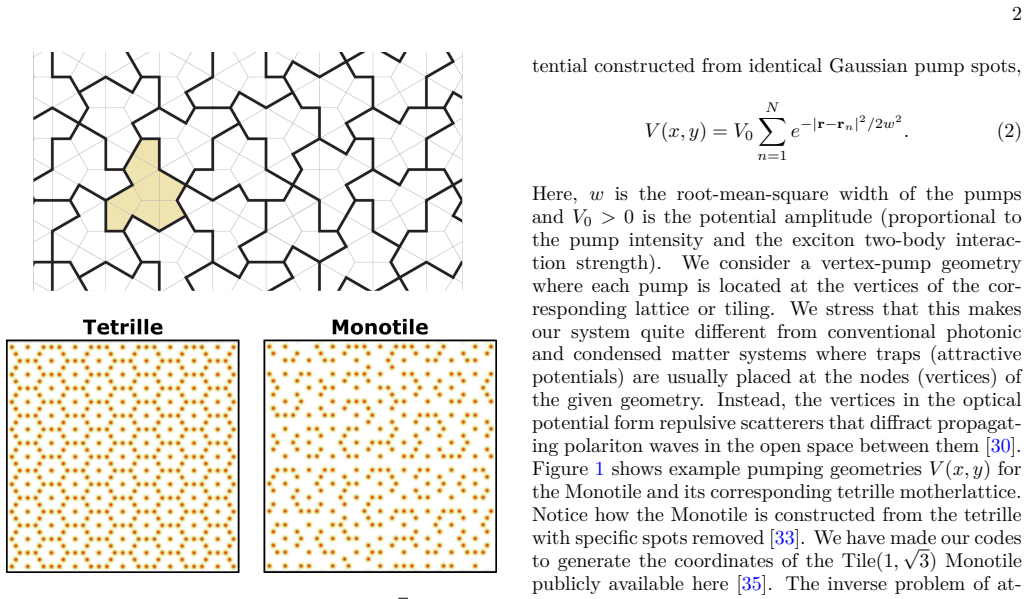
(Bottom) An example optically induced po- lariton potentialV(x,y)/V 0 for the tetrille motherlattice and the corresponding Monotile quasilattice
aperiodic monotile (thick edges) drawn on top of the [3.4.6.4] Laves tiling made from 6 equal kites in a hexagon illustrated with thin edges [33]. (Bottom) An example optically induced po- lariton potentialV(x,y)/V 0 for the tetrille motherlattice and the corresponding Monotile quasilattice. Potential maxima (red spots) are located at the vertices of the ...
-
[2]
participates
Monotile publicly available here [35]. The inverse problem of at- tractive potentialsV 0→−V0 can also be realized using e.g. coupled micropillars [36] or cavity mesas but would be more technically challenging to fabricate and lack in- situ tunability. We apply direct diagonalization and scaling-analysis techniques, commonly used to study disordered quantu...
2024
-
[3]
P. H. Jens-Boie Suck, Michael Schreiber,Quasicrystals: An Introduction to Structure, Physical Properties and Applications(Springer Berlin Heidelberg, 2002)
2002
-
[4]
Steurer, Twenty years of structure research on qua- sicrystals
W. Steurer, Twenty years of structure research on qua- sicrystals. part i. pentagonal, octagonal, decagonal and dodecagonal quasicrystals, Zeitschrift für Kristallogra- phie - Crystalline Materials219, 391–446 (2004)
2004
-
[5]
Hiramoto and S
H. Hiramoto and S. Abe, Dynamics of an electron in quasiperiodic systems. ii. harper’s model, Journal of the Physical Society of Japan57, 1365–1371 (1988)
1988
-
[6]
Roche, G
S. Roche, G. Trambly de Laissardière, and D. Mayou, Electronic transport properties of quasicrystals, Journal of Mathematical Physics38, 1794 (1997)
1997
-
[7]
Z.V.Vardeny, A.Nahata,andA.Agrawal,Opticsofpho- tonic quasicrystals, Nature Photonics7, 177–187 (2013)
2013
-
[8]
Viebahn, M
K. Viebahn, M. Sbroscia, E. Carter, J.-C. Yu, and U. Schneider, Matter-wave diffraction from a quasicrys- talline optical lattice, Phys. Rev. Lett.122, 110404 (2019)
2019
Show all 58 references
-
[9]
Sbroscia, K
M. Sbroscia, K. Viebahn, E. Carter, J.-C. Yu, A. Gaunt, and U. Schneider, Observing localization in a 2d qua- sicrystalline optical lattice, Phys. Rev. Lett.125, 200604 (2020)
2020
-
[10]
J.-C. Yu, S. Bhave, L. Reeve, B. Song, and U. Schneider, Observing the two-dimensional bose glass in an optical quasicrystal, Nature633, 338–343 (2024)
2024
-
[11]
Watanabe, V
S. Watanabe, V. S. Bhat, K. Baumgaertl, M. Hamdi, and D. Grundler, Direct observation of multiband trans- port in magnonic penrose quasicrystals via broadband and phase-resolved spectroscopy, Science Advances7, eabg3771 (2021)
2021
-
[12]
Verre, T
R. Verre, T. J. Antosiewicz, M. Svedendahl, K. Lodewi- jks, T. Shegai, and M. Käll, Quasi-isotropic surface plas- mon polariton generation through near-field coupling to a penrose pattern of silver nanoparticles, ACS Nano8, 9286–9294 (2014)
2014
-
[13]
Tsesses, P
S. Tsesses, P. Dreher, D. Janoschka, A. Neuhaus, K. Co- hen, T. C. Meiler, T. Bucher, S. Sapir, B. Frank, T. J. Davis, F. Meyer zu Heringdorf, H. Giessen, and G. Bar- tal, Four-dimensional conserved topological charge vec- tors in plasmonic quasicrystals, Science387, 644–648 (2025)
2025
-
[14]
Freedman, G
B. Freedman, G. Bartal, M. Segev, R. Lifshitz, D. N. Christodoulides, and J. W. Fleischer, Wave and defect dynamics in nonlinear photonic quasicrystals, Nature 440, 1166–1169 (2006)
2006
-
[15]
L. Levi, M. Rechtsman, B. Freedman, T. Schwartz, O. Manela, and M. Segev, Disorder-enhanced transport inphotonicquasicrystals,Science332,1541–1544(2011)
2011
-
[16]
Xu, X.-W
X.-Y. Xu, X.-W. Wang, D.-Y. Chen, C. M. Smith, and X.-M. Jin, Quantum transport in fractal networks, Na- ture Photonics15, 703–710 (2021)
2021
-
[17]
P. Wang, Q. Fu, V. V. Konotop, Y. V. Kartashov, and F. Ye, Observation of localization of light in linear pho- tonic quasicrystals with diverse rotational symmetries, Nature Photonics18, 224–229 (2024)
2024
-
[18]
A. Shi, Y. Peng, J. Jiang, Y. Peng, P. Peng, J. Chen, H. Chen, S. Wen, X. Lin, F. Gao, and J. Liu, Observation of topological corner state arrays in photonic quasicrys- tals, Laser & Photonics Reviews18, 2300956 (2024)
2024
-
[19]
M. S. Vitiello, M. Nobile, A. Ronzani, A. Tredicucci, F. Castellano, V. Talora, L. Li, E. H. Linfield, and A. G. Davies, Photonic quasi-crystal terahertz lasers, Nature Communications5, 10.1038/ncomms6884 (2014)
2014 doi
-
[20]
Arjas, J
K. Arjas, J. M. Taskinen, R. Heilmann, G. Salerno, and P. Törmä, High topological charge lasing in quasicrystals, Nature Communications15, 9544 (2024)
2024
-
[21]
Hendrickson, B
J. Hendrickson, B. C. Richards, J. Sweet, G. Khitrova, A. N. Poddubny, E. L. Ivchenko, M. Wegener, and H. M. Gibbs, Excitonic polaritons in fibonacci quasicrystals, Optics Express16, 15382 (2008)
2008
-
[22]
A. N. Poddubny, L. Pilozzi, M. M. Voronov, and E. L. Ivchenko, Exciton-polaritonic quasicrystalline and aperi- odic structures, Phys. Rev. B80, 115314 (2009)
2009
-
[23]
Baboux, E
F. Baboux, E. Levy, A. Lemaître, C. Gómez, E. Galopin, L. Le Gratiet, I. Sagnes, A. Amo, J. Bloch, and E. Akker- mans, Measuring topological invariants from generalized edge states in polaritonic quasicrystals, Phys. Rev. B95, 161114 (2017)
2017
-
[24]
T. J. Sturges, M. D. Anderson, A. Buraczewski, M. Navadeh-Toupchi, A. F. Adiyatullin, F. Jabeen, D. Y. Oberli, M. T. Portella-Oberli, and M. Stobińska, Ander- son localisation in steady states of microcavity polari- tons, Scientific Reports9, 19396 (2019)
2019
-
[25]
Alyatkin, K
S. Alyatkin, K. Sitnik, V. K. Daníelsson, Y. V. Kartashov, J. D. Töpfer, H. Sigurðsson, and P. G. Lagoudakis, Quantum fluids of light in 2D artificial re- configurable aperiodic crystals with tailored coupling, Science Advances11, eadz2484 (2025)
2025
-
[26]
G. Tosi, G. Christmann, N. G. Berloff, P. Tsotsis, T. Gao, Z. Hatzopoulos, P. G. Savvidis, and J. J. Baumberg, Sculpting oscillators with light within a nonlinear quan- tum fluid, Nature Physics8, 190–194 (2012)
2012
-
[27]
Ohadi, R
H. Ohadi, R. L.Gregory, T. Freegarde, Y. G.Rubo, A. V. Kavokin, N. G. Berloff, and P. G. Lagoudakis, Nontrivial phase coupling in polariton multiplets, Phys. Rev. X6, 031032 (2016)
2016
-
[28]
J. D. Töpfer, H. Sigurdsson, L. Pickup, and P. G. Lagoudakis, Time-delay polaritonics, Communications Physics3, 10.1038/s42005-019-0271-0 (2020)
2020 doi
-
[29]
H. Deng, H. Haug, and Y. Yamamoto, Exciton-polariton bose-einstein condensation, Rev. Mod. Phys.82, 1489 (2010)
2010
-
[30]
Boulier, M
T. Boulier, M. J. Jacquet, A. Maître, G. Lerario, F. Claude, S. Pigeon, Q. Glorieux, A. Amo, J. Bloch, A. Bramati, and E. Giacobino, Microcavity polaritons for quantum simulation, Advanced Quantum Technolo- gies3, 10.1002/qute.202000052 (2020)
2020 doi
-
[31]
Töpfer, P
N.G.Berloff, M.Silva, K.Kalinin, A.Askitopoulos, J.D. Töpfer, P. Cilibrizzi, W. Langbein,and P. G. Lagoudakis, 11 Realizing the classical XY hamiltonian in polariton sim- ulators, Nature Materials16, 1120–1126 (2017)
2017
-
[32]
Alyatkin, H
S. Alyatkin, H. Sigurdsson, A. Askitopoulos, J. D. Töpfer, and P. G. Lagoudakis, Quantum fluids of light in all-optical scatterer lattices, Nature Communications 12, 5571 (2021)
2021
-
[33]
Alyatkin, H
S. Alyatkin, H. Sigurðsson, Y. V. Kartashov, I. Gnusov, K. Sitnik, J. D. Töpfer, and P. G. Lagoudakis, All-optical triangular and honeycomb lattices of exciton–polaritons, Applied Physics Letters124, 062105 (2024)
2024
-
[34]
Alyatkin, Y
S. Alyatkin, Y. V. Kartashov, K. Sitnik, P. Grigoryev, andP.G.Lagoudakis,Observationofanaperiodicpolari- ton monotile (2026), arXiv:2605.13206 [cond-mat.quant- gas]
2026 arXiv
-
[35]
Smith, J
D. Smith, J. S. Myers, C. S. Kaplan, and C. Goodman- Strauss, An aperiodic monotile, Combinatorial Theory4, 10.5070/c64163843 (2024)
2024 doi
-
[36]
J. E. S. Socolar, Quasicrystalline structure of the hat monotile tilings, Phys. Rev. B108, 224109 (2023). [35]https://github.com/fixgoats/basichatmonotiler
2023
-
[37]
Goblot, A
V. Goblot, A. Štrkalj, N. Pernet, J. L. Lado, C. Dorow, A. Lemaître, L. Le Gratiet, A. Harouri, I. Sagnes, S. Ravets, A. Amo, J. Bloch, and O. Zilberberg, Emer- gence of criticality through a cascade of delocalization transitions in quasiperiodic chains, Nature Physics16, 832–...
2020
-
[38]
Evers and A
F. Evers and A. D. Mirlin, Anderson transitions, Rev. Mod. Phys.80, 1355 (2008)
2008
-
[39]
A. Saul, A. M. Llois, and M. Weissmann, Wavefunctions of one-dimensional incommensurate hamiltonians: the fractal dimension and its relationship with localisation, Journal of Physics C: Solid State Physics21, 2137–2151 (1988)
1988
-
[40]
N. Macé, A. Jagannathan, P. Kalugin, R. Mosseri, and F. Piéchon, Critical eigenstates and their properties in one- and two-dimensional quasicrystals, Phys. Rev. B96, 045138 (2017)
2017
-
[41]
Z. Zhu, S. Yu, D. Johnstone, and L. Sanchez-Palencia, Localization and spectral structure in two-dimensional quasicrystalpotentials,Phys.Rev.A109,013314(2024)
2024
-
[42]
C. W. Duncan, Critical states and anomalous mobility edges in two-dimensional diagonal quasicrystals, Phys. Rev. B109, 014210 (2024)
2024
-
[43]
Koga, Multifractality and hyperuniformity in qua- sicrystals, JPSJ News and Comments21, 10.7566/jp- sjnc.21.21 (2024)
A. Koga, Multifractality and hyperuniformity in qua- sicrystals, JPSJ News and Comments21, 10.7566/jp- sjnc.21.21 (2024)
2024 doi
-
[44]
R. P. A. Lima, F. A. B. F. de Moura, M. L. Lyra, and H. N. Nazareno, Critical wave-packet dynamics in the power-law bond disordered anderson model, Phys. Rev. B71, 235112 (2005)
2005
-
[45]
H. Q. Yuan, U. Grimm, P. Repetowicz, and M. Schreiber, Energy spectra, wave functions, and quantum diffusion for quasiperiodic systems, Phys. Rev. B62, 15569 (2000)
2000
-
[46]
Segev, Y
M. Segev, Y. Silberberg, and D. N. Christodoulides, An- derson localization of light, Nature Photonics7, 197–204 (2013)
2013
-
[47]
Ketzmerick, K
R. Ketzmerick, K. Kruse, S. Kraut, and T. Geisel, What determines the spreading of a wave packet?, Phys. Rev. Lett.79, 1959 (1997)
1959
-
[48]
J. X. Zhong and R. Mosseri, Quantum dynamics in quasiperiodic systems, Journal of Physics: Condensed Matter7, 8383–8404 (1995)
1995
-
[49]
Ketzmerick, G
R. Ketzmerick, G. Petschel, and T. Geisel, Slow decay of temporal correlations in quantum systems with cantor spectra, Phys. Rev. Lett.69, 695 (1992)
1992
-
[50]
Eichelkraut, R
T. Eichelkraut, R. Heilmann, S. Weimann, S. Stützer, F. Dreisow, D. N. Christodoulides, S. Nolte, and A. Sza- meit, Mobility transition from ballistic to diffusive trans- port in non-hermitian lattices, Nature Communications 4, 2533 (2013)
2013
-
[51]
Richard, J
M. Richard, J. Kasprzak, R. Romestain, R. André, and L. S. Dang, Spontaneous coherent phase transition of polaritons in cdte microcavities, Phys. Rev. Lett.94, 187401 (2005)
2005
-
[52]
Alyatkin, J
S. Alyatkin, J. D. Töpfer, A. Askitopoulos, H. Sigurds- son, and P. G. Lagoudakis, Optical control of couplings in polariton condensate lattices, Phys. Rev. Lett.124, 207402 (2020)
2020
-
[53]
G. Tosi, G. Christmann, N. Berloff, P. Tsotsis, T. Gao, Z. Hatzopoulos, P. Savvidis, and J. Baumberg, Geomet- rically locked vortex lattices in semiconductor quantum fluids, Nature Communications3, 10.1038/ncomms2255 (2012)
2012 doi
-
[54]
Wouters, I
M. Wouters, I. Carusotto, and C. Ciuti, Spatial and spectral shape of inhomogeneous nonequilibrium exciton- polariton condensates, Phys. Rev. B77, 115340 (2008)
2008
-
[55]
Zhong, R
J. Zhong, R. B. Diener, D. A. Steck, W. H. Oskay, M. G. Raizen, E. W. Plummer, Z. Zhang, and Q. Niu, Shape of the quantum diffusion front, Phys. Rev. Lett.86, 2485 (2001)
2001
-
[56]
del Valle Inclan Redondo, X
Y. del Valle Inclan Redondo, X. Xu, T. C. H. Liew, E. A. Ostrovskaya, A. Stegmaier, R. Thomale, C. Schnei- der, S. Dam, S. Klembt, S. Höfling, S. Tarucha, and M. D. Fraser, Non-reciprocal band structures in an ex- citon–polariton floquet optical lattice, Nature Photonics 18, 5...
2024
-
[57]
Schirmann, S
J. Schirmann, S. Franca, F. Flicker, and A. G. Grushin, Physical properties of an aperiodic monotile with graphene-like features, chirality, and zero modes, Phys. Rev. Lett.132, 086402 (2024)
2024
-
[58]
Smith, J
D. Smith, J. S. Myers, C. S. Kaplan, and C. Goodman- Strauss, A chiral aperiodic monotile, Combinatorial The- ory4, 10.5070/c64264241 (2024)
2024 doi
Reviewed June 29, 2026 · model on record in the stance chip above.
Discussion (0). Continue with ORCID to comment.