Non-Clifford Crosstalk Noise in Surface Codes Using Hybrid Stabilizer-Tensor Network Methods
Pith reviewed 2026-06-29 07:19 UTC · model grok-4.3
The pith
Coherent crosstalk during syndrome extraction increases logical error rates in surface codes and lowers the threshold.
A machine-rendered reading of the paper's core claim, the machinery that carries it, and where it could break.
Core claim
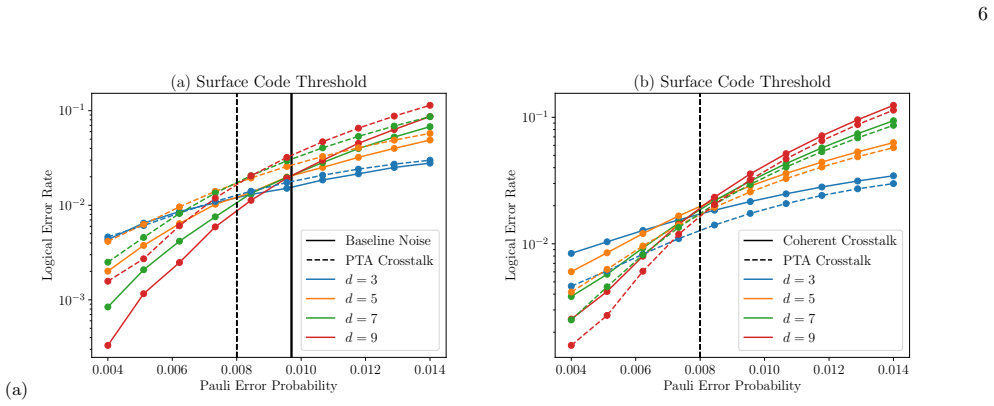
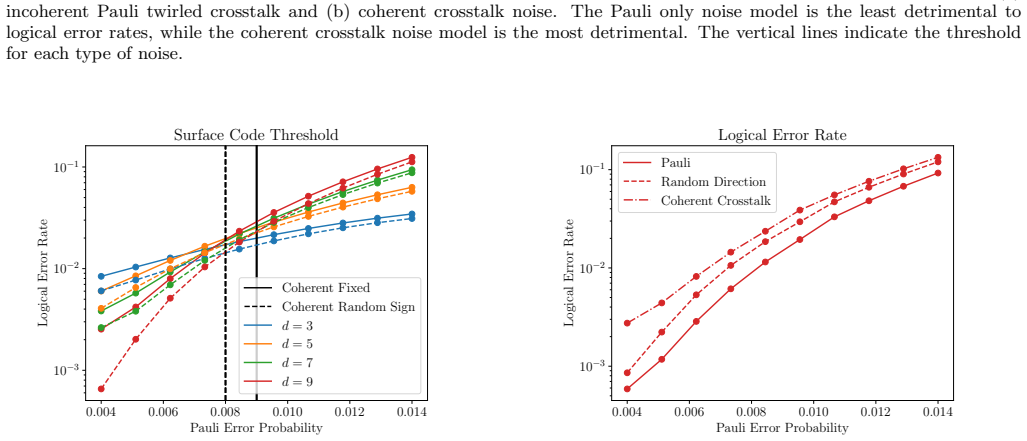
Using hybrid stabilizer-tensor network simulation techniques, we simulate coherent quantum crosstalk noise during syndrome extraction on a surface code. We show that the inclusion of coherence increases logical error rates and lowers the code threshold. In addition, we show that the specific distribution of the noise can quantitatively change logical error rates. The methods allow simulation of quantum error correction with noise models previously inaccessible to classical simulation.
What carries the argument
Hybrid stabilizer-tensor network simulation techniques that capture the full dynamics of coherent quantum crosstalk noise during syndrome extraction.
If this is right
- Incoherent noise models underestimate logical error rates when crosstalk is coherent.
- Code thresholds calculated under incoherent assumptions are higher than those found with coherent noise.
- The spatial distribution of crosstalk quantitatively changes logical error rates.
- Hybrid methods enable analysis of noise models that standard classical simulations cannot handle.
Where Pith is reading between the lines
- Hardware designs may need to prioritize suppression of coherent phases in crosstalk to preserve code performance.
- The simulation approach could be tested on other stabilizer codes such as color codes.
- Existing threshold estimates in the literature may require downward revision once coherent crosstalk is included.
Load-bearing premise
The hybrid stabilizer-tensor network simulation techniques accurately capture the full dynamics of coherent quantum crosstalk noise during syndrome extraction on a surface code.
What would settle it
An exact simulation on a small surface code patch with coherent crosstalk that shows different logical error rates than the hybrid method predicts.
Figures
read the original abstract
Scalable realisation of quantum computing is reliant on the development of fault tolerant devices. Analysis of quantum error correction protocols typically considers incoherent noise models or noise-free syndrome measurements. While this is simple to simulate classically and straightforward to compute analytically, these simplifications are unable to capture the full dynamics of a noisy quantum system. In this work we use advanced hybrid stabilizer-tensor network simulation techniques to simulate coherent quantum crosstalk noise during syndrome extraction on a surface code. We show that the inclusion of coherence increases logical error rates and lowers the code threshold. In addition, we show that the specific distribution of the noise can quantitatively change logical error rates. The methods in this work allow simulation of quantum error correction with noise models previously inaccessible to classical simulation, providing new insights on the effect of crosstalk noise on quantum error correction codes.
Editorial analysis
A structured set of objections, weighed in public.
Referee Report
Summary. The manuscript introduces hybrid stabilizer-tensor network methods to simulate coherent, non-Clifford crosstalk noise during syndrome extraction on surface codes. It claims that including coherence increases logical error rates and lowers the code threshold relative to incoherent models, and that the spatial distribution of the noise quantitatively alters these rates. The approach is presented as enabling simulation of previously inaccessible noise models.
Significance. If the simulations are shown to be faithful, the results would be significant for fault-tolerant quantum computing by demonstrating that coherent crosstalk effects cannot be safely approximated as incoherent and that noise distribution matters. This challenges common modeling assumptions and provides concrete guidance on threshold degradation.
major comments (1)
- [Methods section on hybrid stabilizer-tensor network simulation] Methods section on hybrid stabilizer-tensor network simulation: the central claim that coherence increases logical error rates and lowers thresholds rests on the method accurately capturing non-unitary coherent dynamics without truncation artifacts. The manuscript should include explicit validation, such as bond-dimension convergence tests or comparisons against exact methods on small lattices, to confirm that reported error rates and thresholds are not affected by approximation choices.
minor comments (1)
- [Results figures and tables] Figure captions and results tables should explicitly state the surface-code distances, number of syndrome rounds, and noise strengths used, to allow direct comparison with prior threshold studies.
Simulated Author's Rebuttal
We thank the referee for their careful review and constructive feedback on our manuscript. We appreciate the recognition of the potential significance of our results for fault-tolerant quantum computing. Below, we provide a point-by-point response to the major comment and outline the revisions we will make.
read point-by-point responses
-
Referee: Methods section on hybrid stabilizer-tensor network simulation: the central claim that coherence increases logical error rates and lowers thresholds rests on the method accurately capturing non-unitary coherent dynamics without truncation artifacts. The manuscript should include explicit validation, such as bond-dimension convergence tests or comparisons against exact methods on small lattices, to confirm that reported error rates and thresholds are not affected by approximation choices.
Authors: We concur that validating the hybrid stabilizer-tensor network method against truncation effects is essential to substantiate our findings on the impact of coherent crosstalk noise. Although the manuscript employs established techniques from tensor network simulations, we acknowledge that explicit checks were not detailed. In the revised version, we will add sections presenting bond-dimension convergence tests for representative noise parameters and comparisons to exact methods on small lattices (e.g., distance-3 surface codes) to demonstrate that the logical error rates and thresholds are converged and not artifacts of the approximation. revision: yes
Circularity Check
No significant circularity detected
full rationale
The paper's central results are obtained directly from hybrid stabilizer-tensor network simulations of coherent crosstalk noise on surface codes. These simulations produce the reported increases in logical error rates and threshold reductions as numerical outputs, without any load-bearing derivation that reduces a claimed prediction to a fitted parameter, self-definition, or self-citation chain. The abstract and described method treat the simulation technique as an independent computational tool whose validity rests on its ability to capture non-unitary dynamics, not on internal redefinition of its own outputs. No equations or steps in the provided material exhibit the enumerated circularity patterns.
Axiom & Free-Parameter Ledger
axioms (1)
- domain assumption Hybrid stabilizer-tensor network methods can simulate coherent crosstalk noise in surface-code syndrome extraction.
Forward citations
Cited by 1 Pith paper
-
QMCtwin: Master-Equation Simulation of Syndrome Statistics Beyond Pauli Noise
QMCtwin simulates master-equation syndrome statistics for a distance-7 surface code and reveals biases and correlations absent in Pauli-twirled models.
Reference graph
Works this paper leans on
-
[1]
The inclusion of coherent crosstalk noise increases logical error rates over the baseline Pauli noise model, while coherent crosstalk noise in random directions somewhat reduces logical error rates again. particular, crosstalk noise with a uniform coherent rota- tion angle is significantly more disruptive to logical error rates than coherent crosstalk noi...
2023
-
[2]
Google Quantum AI and Collaborators, Quantum error correction below the surface code threshold, Nature638, 920 (2025)
2025
-
[3]
Quantinuum, Helios: A 98-qubit trapped-ion quantum computer, https://arxiv.org/abs/2511.05465v1 (2025)
work page internal anchor Pith review Pith/arXiv arXiv 2025
-
[4]
Mandelbaum, Scaling for quantum advantage and beyond|IBM Quantum Computing Blog, https://www.ibm.com/quantum/blog/qdc-2025
R. Mandelbaum, Scaling for quantum advantage and beyond|IBM Quantum Computing Blog, https://www.ibm.com/quantum/blog/qdc-2025
2025
-
[5]
P. W. Shor, Scheme for reducing decoherence in quantum computer memory, Physical Review A52, R2493 (1995)
1995
-
[6]
Knill, R
E. Knill, R. Laflamme, and W. H. Zurek, Resilient Quan- tum Computation, Science279, 342 (1998)
1998
-
[7]
F Kam, S
J. F Kam, S. Gicev, K. Modi, A. Southwell, and M. Us- man, Detrimental non-Markovian errors for surface code memory, Quantum Science and Technology10, 035060 (2025)
2025
- [8]
-
[9]
Hakkaku, K
S. Hakkaku, K. Mitarai, and K. Fujii, Sampling-based quasiprobability simulation for fault-tolerant quantum error correction on the surface codes under coherent noise, Physical Review Research3, 043130 (2021)
2021
-
[10]
T. E. O’Brien, B. Tarasinski, and L. DiCarlo, Density- matrix simulation of small surface codes under current and projected experimental noise, npj Quantum Infor- mation3, 39 (2017)
2017
-
[11]
Manabe, Y
H. Manabe, Y. Suzuki, and A. S. Darmawan, Efficient simulation of leakage errors in quantum error correct- ing codes using tensor network methods, New Journal of Physics27, 114512 (2025)
2025
-
[12]
Bravyi, M
S. Bravyi, M. Englbrecht, R. K¨ onig, and N. Peard, Cor- recting coherent errors with surface codes, npj Quantum Information4, 55 (2018)
2018
-
[13]
A. S. Darmawan and D. Poulin, Tensor-Network Simula- tions of the Surface Code under Realistic Noise, Physical Review Letters119, 040502 (2017)
2017
- [14]
-
[15]
Katabarwa and M
A. Katabarwa and M. R. Geller, Logical error rate in the Pauli twirling approximation, Scientific Reports5, 14670 (2015)
2015
-
[16]
J. Behrends and B. B´ eri, The surface code beyond Pauli channels: Logical noise coherence, information-theoretic measures, and errorfield-double phenomenology, PRX Quantum6, 040350 (2025), arXiv:2412.21055 [quant-ph]
-
[17]
LeBlond, P
T. LeBlond, P. Groszkowski, J. G. Lietz, C. M. Seck, and R. S. Bennink, Logical error rates for the surface code under a mixed coherent and stochastic circuit-level noise model inspired by trapped ions, Physical Review Research7, 043184 (2025)
2025
-
[18]
Crosstalk In Contemporary Quantum Devices
S. Gicev, B. Harper, H. Kang, M. Usman, and M. Sev- ior, Crosstalk In Contemporary Quantum Devices (2026), arXiv:2605.26528 [quant-ph]
work page internal anchor Pith review Pith/arXiv arXiv 2026
-
[19]
Catelani, Quantum Error Correction Faces Another Hurdle, Physics19, 62 (2026)
G. Catelani, Quantum Error Correction Faces Another Hurdle, Physics19, 62 (2026)
2026
-
[20]
Gidney, Stim: A fast stabilizer circuit simulator, Quantum5, 497 (2021)
C. Gidney, Stim: A fast stabilizer circuit simulator, Quantum5, 497 (2021)
2021
-
[21]
Or´ us, A Practical Introduction to Tensor Networks: Matrix Product States and Projected Entangled Pair States, Annals of Physics349, 117 (2014)
R. Or´ us, A Practical Introduction to Tensor Networks: Matrix Product States and Projected Entangled Pair States, Annals of Physics349, 117 (2014)
2014
-
[22]
Harper, A
B. Harper, A. Nakhl, T. Quella, M. Sevior, and M. Us- man, GCAMPS: A Scalable Classical Simulator for Qudit Systems, inProceedings of the Supercomputing Asia and International Conference on High Performance Comput- ing in Asia Pacific Region, SCA/HPCAsia ’26 (Associ- ation for Computing Machinery, New York, NY, USA,
-
[23]
A. C. Nakhl, B. Harper, M. West, N. Dowling, M. Sevior, T. Quella, and M. Usman, Stabilizer Tensor Networks with Magic State Injection, Physical Review Letters134, 190602 (2025)
2025
-
[24]
Masot-Llima and A
S. Masot-Llima and A. Garcia-Saez, Stabilizer Tensor Networks: Universal Quantum Simulator on a Basis of Stabilizer States, Phys. Rev. Lett.133, 230601 (2024)
2024
-
[25]
Kissinger and J
A. Kissinger and J. van de Wetering, Simulating quan- tum circuits with ZX-calculus reduced stabiliser decom- positions, Quantum Science and Technology7, 044001 (2022). 8
2022
- [26]
-
[27]
Bombin and M
H. Bombin and M. A. Martin-Delgado, Optimal resources for topological two-dimensional stabilizer codes: Com- parative study, Physical Review A76, 012305 (2007)
2007
-
[28]
Higgott and C
O. Higgott and C. Gidney, Sparse Blossom: Correcting a million errors per core second with minimum-weight matching, Quantum9, 1600 (2025)
2025
-
[29]
S. Gicev, L. Hollenberg, and M. Usman, Fully convolu- tional 3D neural network decoders for surface codes with syndrome circuit noise, Quantum Science and Technol- ogy 10.1088/2058-9565/ae5fc9 (2026)
-
[30]
K. R. Ott, B. Het´ enyi, and M. E. Beverland, Decision- tree decoders for general quantum LDPC codes (2025)
2025
-
[31]
Aaronson and D
S. Aaronson and D. Gottesman, Improved simulation of stabilizer circuits, Physical Review A70, 052328 (2004)
2004
-
[32]
Sundaresan, I
N. Sundaresan, I. Lauer, E. Pritchett, E. Magesan, P. Ju- rcevic, and J. M. Gambetta, Reducing Unitary and Spec- tator Errors in Cross Resonance with Optimized Rotary Echoes, PRX Quantum1, 020318 (2020)
2020
-
[33]
J. J. Wesdorp, E. Hyypp¨ a, J. Andersson, J. Adam, R. Beriwal, V. Bergholm, S. Dahl, S. D. Fasciati, A. G. Friero, Z. Gao, D. Gusenkova, A. Guthrie, J. Heinsoo, T. Hiltunen, K. Holland, A. Hosseinkhani, S. Inel, J. Ikonen, S. W. Jolin, K. Juliusson, S.-G. Kim, A. Komlev, R. Kokkoniemi, O. Koskinen, J. Kylm¨ al¨ a, A. Landra, J. Lamprich, M. Lehmuskoski, N...
-
[34]
P. Zhao, P. Xu, D. Lan, J. Chu, X. Tan, H. Yu, and Y. Yu, High-Contrast$ZZ$Interaction Using Superconducting Qubits with Opposite-Sign Anharmonicity, Physical Re- view Letters125, 200503 (2020)
2020
-
[35]
Kandala, K
A. Kandala, K. X. Wei, S. Srinivasan, E. Magesan, S. Carnevale, G. A. Keefe, D. Klaus, O. Dial, and D. C. McKay, Demonstration of a High-Fidelity cnot Gate for Fixed-Frequency Transmons with Engineered$ZZ$Sup- pression, Physical Review Letters127, 130501 (2021)
2021
-
[36]
X. Qian, J. Huang, and M. Qin, Augmenting Density Matrix Renormalization Group with Clifford Circuits (2024)
2024
-
[37]
G. Lami, T. Haug, and J. De Nardis, Quantum State Designs with Clifford-Enhanced Matrix Product States, PRX Quantum6, 010345 (2025)
2025
-
[38]
G. A. L. White, C. D. Hill, F. A. Pollock, L. C. L. Hol- lenberg, and K. Modi, Demonstration of non-Markovian process characterisation and control on a quantum pro- cessor, Nature Communications11, 6301 (2020)
2020
-
[39]
Figueroa-Romero, K
P. Figueroa-Romero, K. Modi, R. J. Harris, T. M. Stace, and M.-H. Hsieh, Randomized Benchmarking for Non- Markovian Noise, PRX Quantum2, 040351 (2021)
2021
-
[40]
S.-B. B. Lee, H. R. Choi, D. D. Ohm, and S.-S. B. Lee, Scalable projected entangled-pair state representa- tion of random quantum circuit states, Physical Review Research7, 033252 (2025)
2025
-
[41]
Seitz, I
P. Seitz, I. Medina, E. Cruz, Q. Huang, and C. B. Mendl, Simulating quantum circuits using tree tensor networks, Quantum7, 964 (2023)
2023
-
[42]
Bravyi, A
S. Bravyi, A. W. Cross, J. M. Gambetta, D. Maslov, P. Rall, and T. J. Yoder, High-threshold and low- overhead fault-tolerant quantum memory, Nature627, 778 (2024)
2024
discussion (0)
Sign in with ORCID, Apple, or X to comment. Anyone can read and Pith papers without signing in.