Gated Graph Attention Networks with Learnable Temperature
Pith reviewed 2026-06-29 08:32 UTC · model grok-4.3
The pith
Gated graph attention and learnable temperature improve robustness and performance in graph attention networks.
A machine-rendered reading of the paper's core claim, the machinery that carries it, and where it could break.
Core claim
The paper claims that gated graph attention filters feature or message responses to reduce unreliable dimensions while learnable temperature dynamically adjusts attention sharpness, resulting in improved performance on graph tasks as verified by experiments and theoretical analysis under noise conditions.
What carries the argument
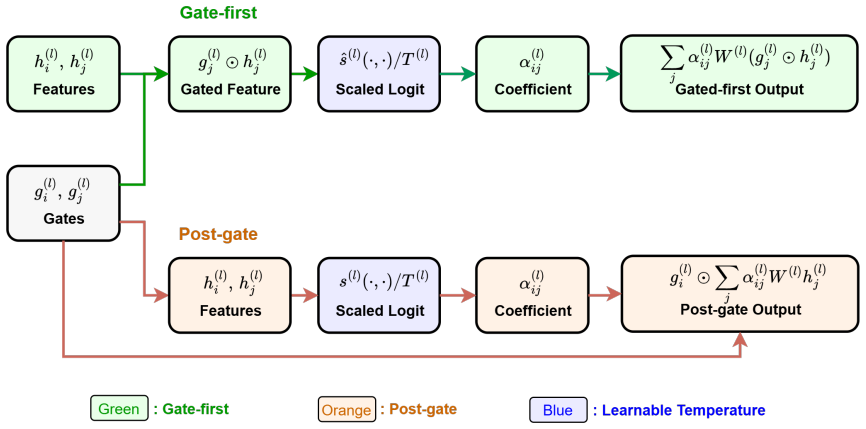
Gated graph attention that filters responses and learnable temperature that adjusts attention distribution sharpness.
If this is right
- The proposed variants improve base graph attention models on both homogeneous and heterophilic benchmarks.
- Gating provides robustness when only some feature coordinates are reliable.
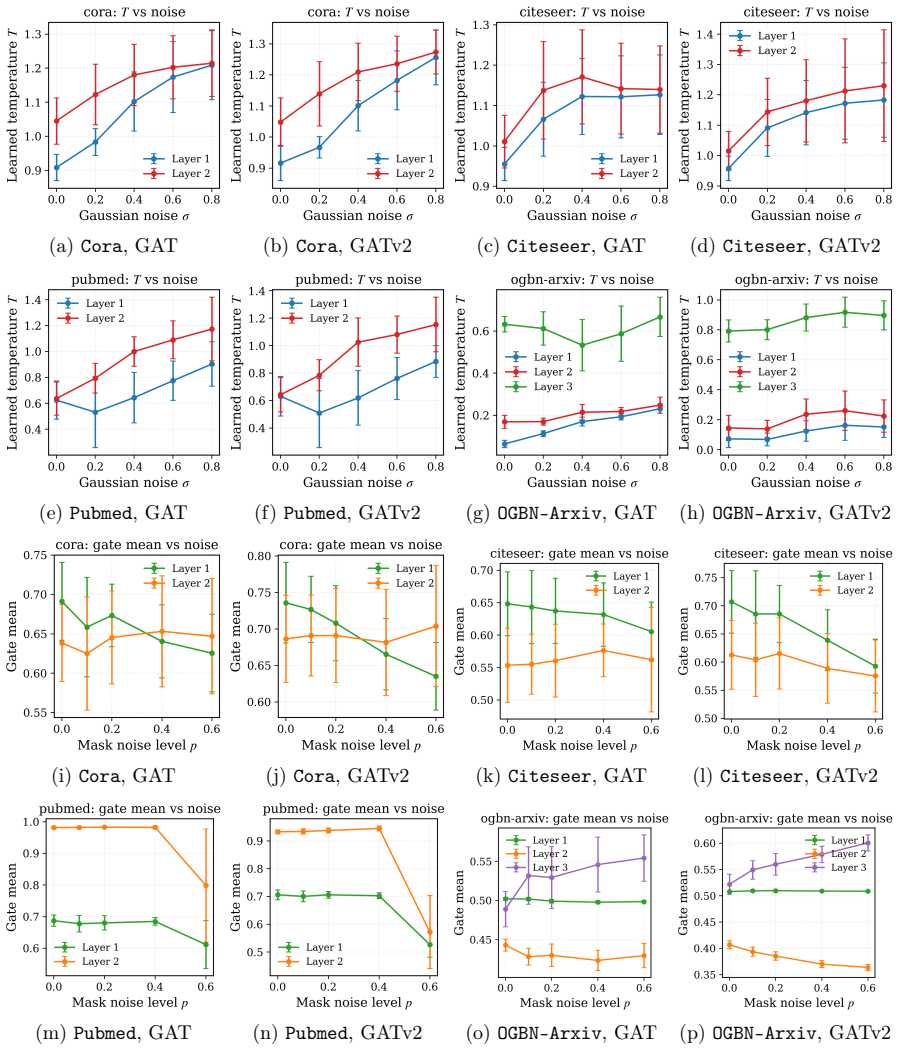
- Learnable temperature helps when global noise reduces feature discriminability.
- Controlled noise experiments confirm the mechanisms' effects under perturbations.
Where Pith is reading between the lines
- These techniques might apply to attention mechanisms in other domains like transformers.
- The gating could be extended to handle missing node features dynamically.
- Temperature learning may interact with other hyperparameters in complex ways not explored here.
Load-bearing premise
Improvements seen on the tested benchmarks and noise studies will hold for other graph datasets without needing specific tuning of the new mechanisms.
What would settle it
If adding the gated attention and learnable temperature to a base model fails to improve accuracy on a new graph dataset with feature noise, that would contradict the central claim.
Figures

read the original abstract
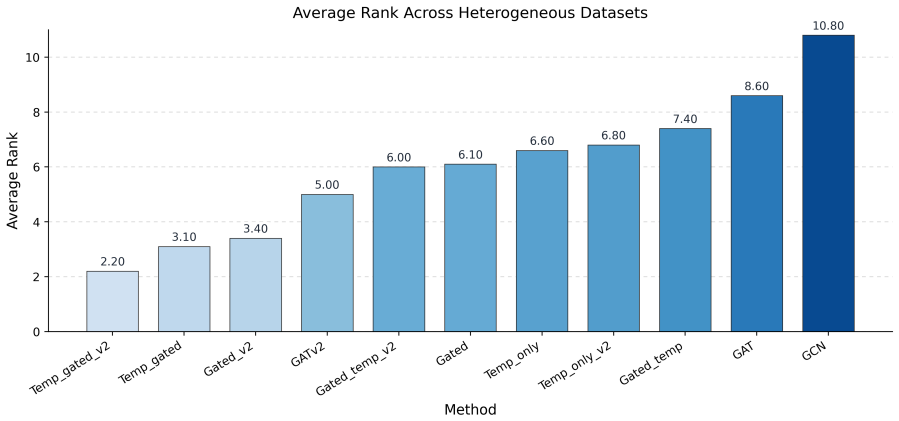
Graph attention networks learn neighbor importance through data-dependent coefficients, but standard layers lack explicit control over unreliable feature dimensions and use fixed sharpness of attention coefficient distributions. This paper proposes gated graph attention and learnable temperature for common graph attention mechanisms. Gated graph attention filters feature or message responses to reduce the influence of unreliable dimensions, while learnable temperature dynamically adjusts the sharpness of the attention coefficient distribution. Experiments on homogeneous and heterophilic heterogeneous benchmarks show that the proposed variants consistently improve the corresponding graph attention backbones, and controlled noise studies further verify their behavior under feature perturbations. Theoretical analysis explains these results by showing that gating improves robustness when only part of the feature coordinates are reliable, while temperature is beneficial when global noise weakens the discriminability of node features.
Editorial analysis
A structured set of objections, weighed in public.
Referee Report
Summary. The paper proposes gated graph attention (to filter unreliable feature or message dimensions) and learnable temperature (to dynamically control attention sharpness) as enhancements to standard graph attention mechanisms. It reports consistent empirical gains over GAT backbones on homogeneous and heterophilic benchmarks, verifies the mechanisms via controlled noise studies, and supplies theoretical analysis showing gating improves robustness under partial feature reliability while temperature helps when global noise reduces node-feature discriminability.
Significance. If the theoretical derivations and noise-isolation experiments hold, the work supplies a lightweight, interpretable way to improve robustness of attention-based graph models without dataset-specific retuning. The combination of controlled studies and separate theoretical analysis (rather than post-hoc fitting) would be a strength for the field.
major comments (1)
- [Abstract] Abstract and § (theoretical analysis): the central claim that the proposed mechanisms are validated by theory and controlled noise studies cannot be assessed because the full manuscript (derivations, exact gating/temperature formulations, experimental protocols, benchmark tables, and noise-study controls) is inaccessible; without these the support for the claims remains at the level of high-level assertions.
Simulated Author's Rebuttal
We thank the referee for their review and the opportunity to clarify. The major comment concerns accessibility of the full manuscript details supporting the claims. We address this point below.
read point-by-point responses
-
Referee: [Abstract] Abstract and § (theoretical analysis): the central claim that the proposed mechanisms are validated by theory and controlled noise studies cannot be assessed because the full manuscript (derivations, exact gating/temperature formulations, experimental protocols, benchmark tables, and noise-study controls) is inaccessible; without these the support for the claims remains at the level of high-level assertions.
Authors: We apologize if the full manuscript was inaccessible during review. The submitted version and the arXiv preprint (arXiv:2605.29803) contain the complete theoretical derivations for the gating mechanism (showing robustness under partial feature reliability) and learnable temperature (showing benefit under global noise reducing discriminability), the exact formulations of gated graph attention and temperature scaling, all experimental protocols, benchmark tables on homogeneous and heterophilic graphs, and the controlled noise-study setups with partial and global perturbations. These sections directly validate the claims beyond the abstract summary. We can supply specific excerpts or additional clarifications if needed. revision: no
Circularity Check
No circularity detected; claims rest on independent mechanisms and experiments
full rationale
The abstract describes new mechanisms (gated attention and learnable temperature) with theoretical analysis and controlled noise studies presented as separate validation. No equations, derivations, fitted parameters renamed as predictions, or self-citation chains are provided in the accessible text that would reduce any result to its inputs by construction. The derivation chain cannot be walked for circularity because no load-bearing steps reducing to self-definition or fitted inputs are exhibited.
Axiom & Free-Parameter Ledger
axioms (1)
- domain assumption Standard assumptions in graph neural network training and evaluation on benchmarks hold for the proposed variants.
Reference graph
Works this paper leans on
-
[1]
Quantizable Transformers: Removing Outliers by Helping Attention Heads Do Nothing
Yelysei Bondarenko, Markus Nagel, and Tijmen Blankevoort. Quantizable Transformers: Removing Outliers by Helping Attention Heads Do Nothing. InAdvances in Neural Infor- mation Processing Systems, volume 36, pages 75067–75096, 2023
2023
-
[2]
How Attentive are Graph Attention Networks? InInternational Conference on Learning Representations, 2022
Shaked Brody, Uri Alon, and Eran Yahav. How Attentive are Graph Attention Networks? InInternational Conference on Learning Representations, 2022
2022
-
[3]
Correia, Vlad Niculae, and André F
Gonçalo M. Correia, Vlad Niculae, and André F. T. Martins. Adaptively sparse trans- formers. InProceedings of the 2019 Conference on Empirical Methods in Natural Language Processing and the 9th International Joint Conference on Natural Language Processing, pages 2174–2184. Association for Computational Linguistics, 2019. 16
2019
-
[4]
Switchhead: Accel- erating transformers with mixture-of-experts attention.Advances in Neural Information Processing Systems, 37:74411–74438, 2024
Róbert Csordás, Piotr Piękos, Kazuki Irie, and Jürgen Schmidhuber. Switchhead: Accel- erating transformers with mixture-of-experts attention.Advances in Neural Information Processing Systems, 37:74411–74438, 2024
2024
-
[5]
Contextual stochastic block models
Yash Deshpande, Subhabrata Sen, Andrea Montanari, and Elchanan Mossel. Contextual stochastic block models. InAdvances in Neural Information Processing Systems, volume 31, 2018
2018
-
[6]
Graph neural networks for social recommendation
Wenqi Fan, Yao Ma, Qing Li, Yuan He, Eric Zhao, Jiliang Tang, and Dawei Yin. Graph neural networks for social recommendation. WWW ’19, page 417–426, New York, NY, USA, 2019. Association for Computing Machinery
2019
-
[7]
How powerful are k-hop message passing graph neural networks.Advances in Neural Information Processing Systems, 35:4776–4790, 2022
Jiarui Feng, Yixin Chen, Fuhai Li, Anindya Sarkar, and Muhan Zhang. How powerful are k-hop message passing graph neural networks.Advances in Neural Information Processing Systems, 35:4776–4790, 2022
2022
-
[8]
Rethinking gnns and missing features: Challenges, evaluation and a robust solution, 2026
Francesco Ferrini, Veronica Lachi, Antonio Longa, Bruno Lepri, Matono Akiyoshi, Andrea Passerini, Xin Liu, and Manfred Jaeger. Rethinking gnns and missing features: Challenges, evaluation and a robust solution, 2026. preprint
2026
-
[9]
Structure-based protein function prediction using graph convolutional networks
Vladimir Gligorijević, P Douglas Renfrew, Tomasz Kosciolek, Julia Koehler Leman, Daniel Berenberg, Tommi Vatanen, Chris Chandler, Bryn C Taylor, Ian M Fisk, Hera Vlamakis, et al. Structure-based protein function prediction using graph convolutional networks. Nature communications, 12(1):3168, 2021
2021
-
[10]
Siggate-gt: Taming over-smoothing in graph transformers via sigmoid-gated attention, 2026
Dongxin Guo, Jikun Wu, and Siu Ming Yiu. Siggate-gt: Taming over-smoothing in graph transformers via sigmoid-gated attention, 2026. preprint
2026
-
[11]
Inductive representation learning on large graphs.Advances in Neural Information Processing Systems, 30, 2017
Will Hamilton, Zhitao Ying, and Jure Leskovec. Inductive representation learning on large graphs.Advances in Neural Information Processing Systems, 30, 2017
2017
-
[12]
Query-Key Normalization for Transformers
Alex Henry, Prudhvi Raj Dachapally, Shubham Shantaram Pawar, and Yuxuan Chen. Query-Key Normalization for Transformers. InFindings of the Association for Compu- tational Linguistics: EMNLP 2020, pages 4246–4253. Association for Computational Lin- guistics, 2020
2020
-
[13]
Open graph benchmark: Datasets for machine learning on graphs.Advances in neural information processing systems, 33:22118–22133, 2020
Weihua Hu, Matthias Fey, Marinka Zitnik, Yuxiao Dong, Hongyu Ren, Bowen Liu, Michele Catasta, and Jure Leskovec. Open graph benchmark: Datasets for machine learning on graphs.Advances in neural information processing systems, 33:22118–22133, 2020
2020
-
[14]
Transformer Quality in Linear Time
Weizhe Hua, Zihang Dai, Hanxiao Liu, and Quoc Le. Transformer Quality in Linear Time. InProceedings of the 39th International Conference on Machine Learning, volume 162 of Proceedings of Machine Learning Research, pages 9099–9117. PMLR, 2022
2022
-
[15]
Look inside nodes: A novel intra- node attention mechanism for graph attention networks.Pattern Recognition, 174:112962, 2026
Yingjuan Jia, Tong Chen, Xinyu Liu, and Hanpu Wang. Look inside nodes: A novel intra- node attention mechanism for graph attention networks.Pattern Recognition, 174:112962, 2026
2026
-
[16]
Kipf and Max Welling
Thomas N. Kipf and Max Welling. Semi-Supervised Classification with Graph Convolu- tional Networks. InInternational Conference on Learning Representations, 2017
2017
-
[17]
When het- erophily meets heterogeneity: Challenges and a new large-scale graph benchmark
Junhong Lin, Xiaojie Guo, Shuaicheng Zhang, Yada Zhu, and Julian Shun. When het- erophily meets heterogeneity: Challenges and a new large-scale graph benchmark. InPro- ceedings of the 31st ACM SIGKDD Conference on Knowledge Discovery and Data Mining, pages 5607–5618, 2025. 17
2025
-
[18]
Forgetting transformer: Soft- max attention with a forget gate
Zhixuan Lin, Evgenii Nikishin, Xu He, and Aaron Courville. Forgetting transformer: Soft- max attention with a forget gate. InInternational Conference on Learning Representations, volume 2025, pages 69704–69738, 2025
2025
-
[19]
Mega: Moving Average Equipped Gated Atten- tion
Xuezhe Ma, Chunting Zhou, Xiang Kong, Junxian He, Liangke Gui, Graham Neubig, Jonathan May, and Luke Zettlemoyer. Mega: Moving Average Equipped Gated Atten- tion. InInternational Conference on Learning Representations, 2023
2023
-
[20]
Hyperspectral image classification using feature fusion hypergraph convolution neural network.IEEE Transactions on Geoscience and Remote Sensing, 60:1–14, 2022
Zhongtian Ma, Zhiguo Jiang, and Haopeng Zhang. Hyperspectral image classification using feature fusion hypergraph convolution neural network.IEEE Transactions on Geoscience and Remote Sensing, 60:1–14, 2022
2022
-
[21]
Graph Attention is Not Always Beneficial: A Theoretical Analysis of Graph Atten- tion Mechanism via Contextual Stochastic Block Models
Zhongtian Ma, Qiaosheng Zhang, Bocheng Zhou, Yexin Zhang, Shuyue Hu, and Zhen Wang. Graph Attention is Not Always Beneficial: A Theoretical Analysis of Graph Atten- tion Mechanism via Contextual Stochastic Block Models. InInternational Conference on Machine Learning, 2025
2025
-
[22]
Gated Attention for Large Language Models: Non-linearity, Sparsity, and Attention-Sink-Free
Zihan Qiu, Zekun Wang, Bo Zheng, Zeyu Huang, Kaiyue Wen, Songlin Yang, Rui Men, Le Yu, Fei Huang, Suozhi Huang, Dayiheng Liu, Jingren Zhou, and Junyang Lin. Gated Attention for Large Language Models: Non-linearity, Sparsity, and Attention-Sink-Free. InAdvances in Neural Information Processing Systems, volume 38, pages 100092–100118, 2025
2025
-
[23]
DropEdge: Towards Deep Graph Convolutional Networks on Node Classification
Yu Rong, Wenbing Huang, Tingyang Xu, and Junzhou Huang. DropEdge: Towards Deep Graph Convolutional Networks on Node Classification. InInternational Conference on Learning Representations, 2020
2020
-
[24]
High-frequency and low-frequency dual-channel graph attention network.Pattern Recognition, 156:110795, 2024
Yukuan Sun, Yutai Duan, Haoran Ma, Yuelong Li, and Jianming Wang. High-frequency and low-frequency dual-channel graph attention network.Pattern Recognition, 156:110795, 2024
2024
-
[25]
Gomez, Łukasz Kaiser, and Illia Polosukhin
Ashish Vaswani, Noam Shazeer, Niki Parmar, Jakob Uszkoreit, Llion Jones, Aidan N. Gomez, Łukasz Kaiser, and Illia Polosukhin. Attention Is All You Need. InAdvances in Neural Information Processing Systems, volume 30, pages 5998–6008, 2017
2017
-
[26]
Graph Attention Networks
Petar Veličković, Guillem Cucurull, Arantxa Casanova, Adriana Romero, Pietro Liò, and Yoshua Bengio. Graph Attention Networks. InInternational Conference on Learning Rep- resentations, 2018
2018
-
[27]
Heterophily-aware graph attention network.Pattern Recognition, 156:110738, 2024
Junfu Wang, Yuanfang Guo, Liang Yang, and Yunhong Wang. Heterophily-aware graph attention network.Pattern Recognition, 156:110738, 2024
2024
-
[28]
Heterogeneous graph attention network
Xiao Wang, Houye Ji, Chuan Shi, Bai Wang, Yanfang Ye, Peng Cui, and Philip S Yu. Heterogeneous graph attention network. WWW ’19, page 2022–2032, New York, NY, USA,
2022
-
[29]
Association for Computing Machinery
-
[30]
Graph neural networks in recommender systems: a survey.ACM Computing Surveys, 55(5):1–37, 2022
Shiwen Wu, Fei Sun, Wentao Zhang, Xu Xie, and Bin Cui. Graph neural networks in recommender systems: a survey.ACM Computing Surveys, 55(5):1–37, 2022
2022
-
[31]
A comprehensive survey on graph neural networks.IEEE Transactions on Neural Networks and Learning Systems, 32(1):4–24, 2020
Zonghan Wu, Shirui Pan, Fengwen Chen, Guodong Long, Chengqi Zhang, and Philip S Yu. A comprehensive survey on graph neural networks.IEEE Transactions on Neural Networks and Learning Systems, 32(1):4–24, 2020
2020
-
[32]
Missing visual modality graph transformer for multi-modal entity alignment.Pattern Recognition, 177:113320, 2026
Kai Yang, Wenqian Zhao, Junyan Guo, and Xiaobing Sun. Missing visual modality graph transformer for multi-modal entity alignment.Pattern Recognition, 177:113320, 2026. 18
2026
-
[33]
Do Transformers Really Perform Badly for Graph Representation? InAdvances in Neural Information Processing Systems, volume 34, pages 28877–28888, 2021
Chengxuan Ying, Tianle Cai, Shengjie Luo, Shuxin Zheng, Guolin Ke, Di He, Yanming Shen, and Tie-Yan Liu. Do Transformers Really Perform Badly for Graph Representation? InAdvances in Neural Information Processing Systems, volume 34, pages 28877–28888, 2021
2021
-
[34]
HopGAT:Amulti-hopgraphattentionnetwork with heterophily and degree awareness.Pattern Recognition, 172:112387, 2026
HanZhang, HuanWang, andMingjingHan. HopGAT:Amulti-hopgraphattentionnetwork with heterophily and degree awareness.Pattern Recognition, 172:112387, 2026
2026
-
[35]
GaAN: Gated attention networks for learning on large and spatiotemporal graphs
Jiani Zhang, Xingjian Shi, Junyuan Xie, Hao Ma, Irwin King, and Dit-Yan Yeung. GaAN: Gated attention networks for learning on large and spatiotemporal graphs. InProceedings of the Thirty-Fourth Conference on Uncertainty in Artificial Intelligence, pages 339–349. AUAI Press, 2018
2018
-
[36]
Beyond homophily in graph neural networks: Current limitations and effective designs
Jiong Zhu, Yujun Yan, Lingxiao Zhao, Mark Heimann, Leman Akoglu, and Danai Koutra. Beyond homophily in graph neural networks: Current limitations and effective designs. Advances in Neural Information Processing Systems, 33:7793–7804, 2020. A Dataset Statistics Dataset Graph type #Nodes #Edges #Features #Classes CoraCitation graph 2,708 10,556 1,433 7 Cite...
2020
discussion (0)
Sign in with ORCID, Apple, or X to comment. Anyone can read and Pith papers without signing in.