Electron Doping of La₃Ni₂O₇ Thin Films: Candidate Metal Dopants and Their Potential Impact on Superconductivity
Pith reviewed 2026-06-29 00:18 UTC · model grok-4.3
The pith
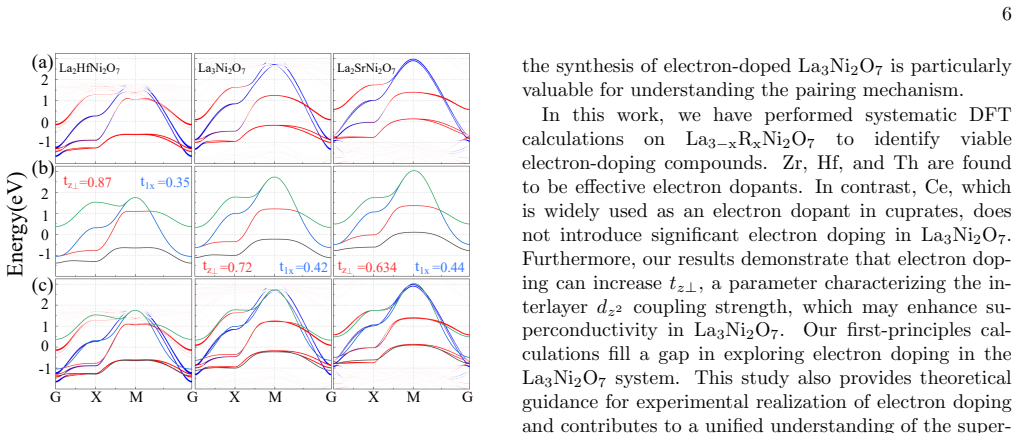
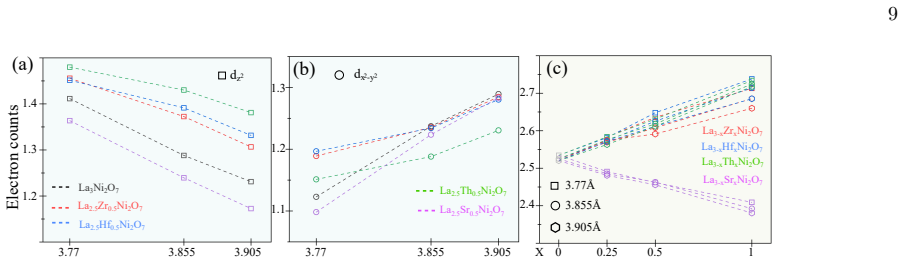
Zirconium, hafnium and thorium substitutions act as efficient electron dopants in La3Ni2O7 thin films and increase interlayer hopping between d_z2 orbitals.
A machine-rendered reading of the paper's core claim, the machinery that carries it, and where it could break.
Core claim
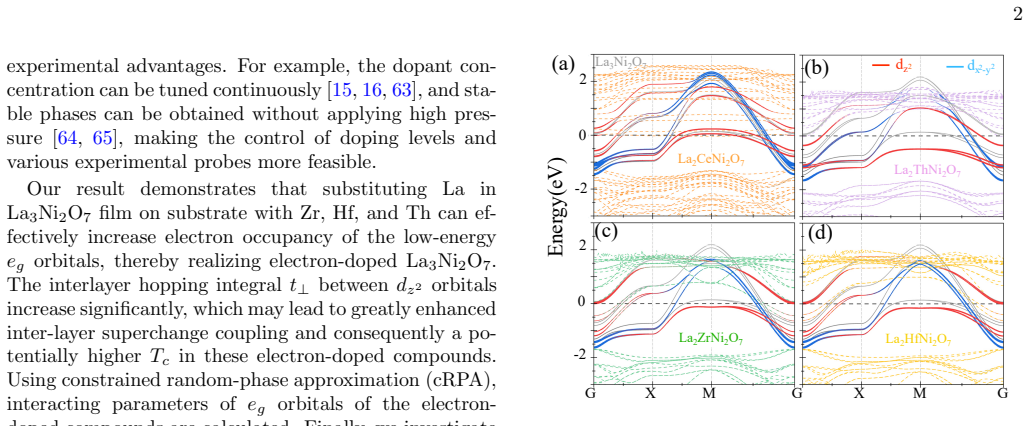
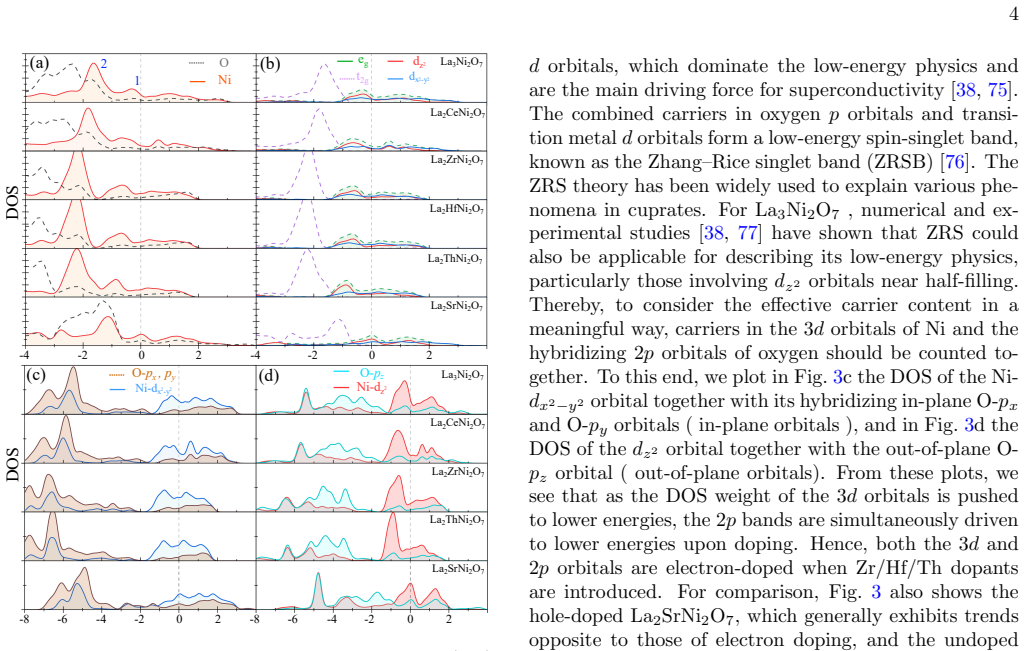
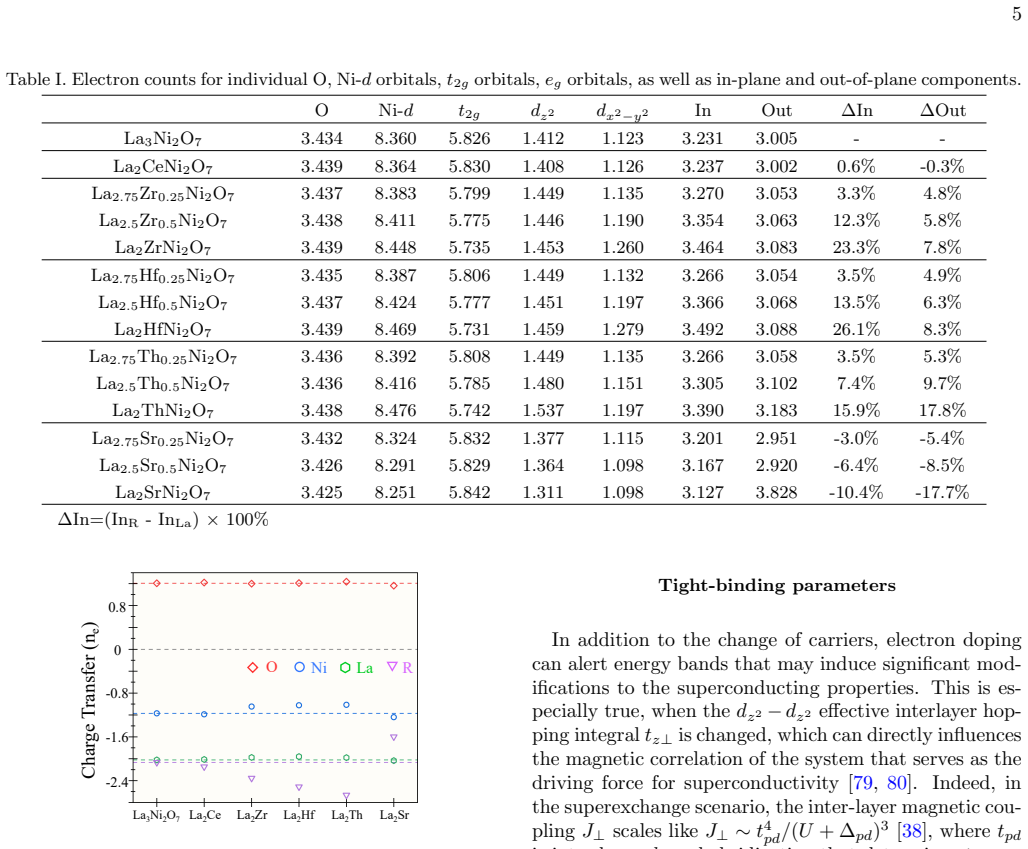
Unlike cerium, zirconium, hafnium and thorium substitutions introduce electrons into the low-energy bands of La3Ni2O7; the substitutions also raise the interlayer hopping t_perp between d_z2 orbitals, which is calculated to enhance the superexchange J_perp and thereby potentially increase Tc, as obtained from constrained random phase approximation evaluations of the interaction parameters.
What carries the argument
Tetravalent element substitution on the lanthanum site, which supplies electrons while modifying the interlayer hopping t_perp between nickel d_z2 orbitals.
If this is right
- Zr, Hf and Th provide candidate dopants for achieving electron-doped La3Ni2O7.
- The enhanced t_perp offers a route to stronger interlayer superexchange and possibly higher Tc.
- Electron doping via these elements can be used to distinguish between competing pairing mechanisms.
- The cRPA-evaluated interaction parameters supply concrete targets for future experimental doping studies.
Where Pith is reading between the lines
- Successful electron doping would enable direct comparison of electron-doped and hole-doped regimes within the same nickelate family.
- If Tc rises, the result would constrain theories that tie superconductivity primarily to hole doping or to specific Fermi-surface features.
- The same substitution strategy could be tested in other Ruddlesden-Popper nickelates to check whether t_perp enhancement is general.
Load-bearing premise
That the increase in t_perp produced by these substitutions will raise net J_perp and Tc without being cancelled by disorder, structural changes or shifts in other interaction parameters.
What would settle it
Measurement of Tc in epitaxial thin films grown with controlled Zr, Hf or Th substitution levels, or direct computation of J_perp showing no net gain after doping.
Figures
read the original abstract
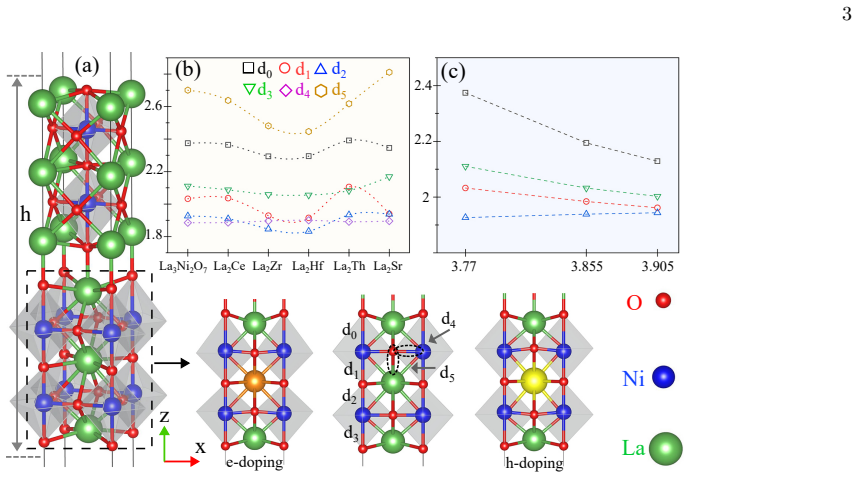
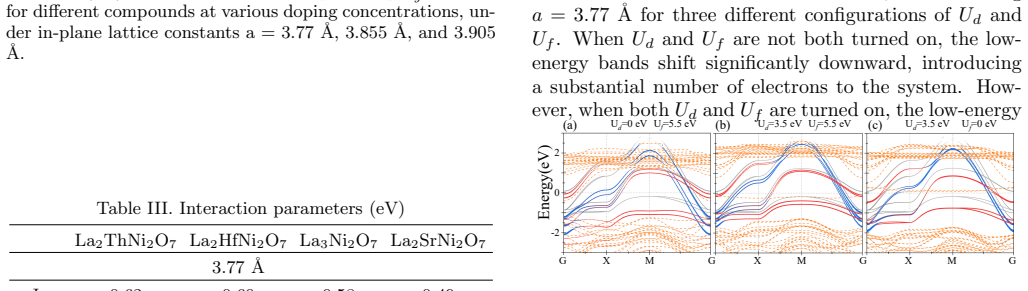
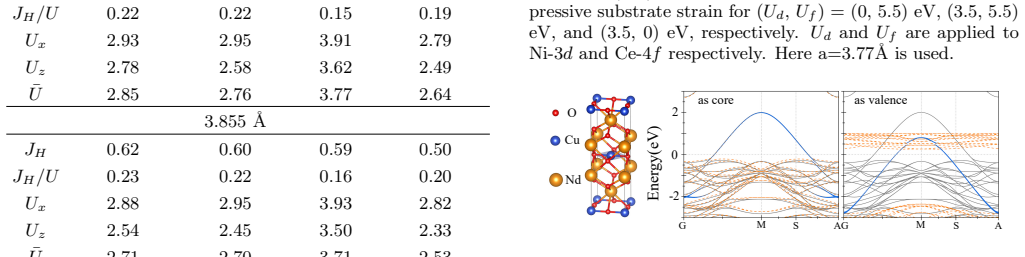
The bilayer Ruddlesden-Popper nickelate $\mathrm{La_3Ni_2O_7}$ has emerged as a promising platform for exploring and understanding high-temperature superconductivities. While most prior doping studies have focused on hole doping via strontium (Sr) substitution or by tuning oxygen content, electron doping remains largely unexplored. In this work,we systematically investigate electron doping in $\mathrm{La_3Ni_2O_7}$ thin films through tetravalent element substitution, employing first-principles density functional theory calculations. Our results reveal that, unlike in cuprates, $\mathrm{cerium}$ (Ce) doping is difficult to effectively introduce electron carriers into the low-energy bands. In contrast, zirconium (Zr), hafnium (Hf), and thorium (Th) can act as efficient electron dopants. These element substitutions can significantly increase the interlayer hopping $t_{\perp}$ between $d_{z^2}$ orbitals, which may lead to enhanced superexchange coupling $J_{\perp}$ , and thereby potentially elevated superconducting $T_c$. We evaluate the interaction parameters using constrained random phase approximation. Our results identify candidate dopants for achieving electron-doped $\mathrm{La_3Ni_2O_7}$, offering a route to clarify the ongoing debate on pairing mechanisms in this system.
Editorial analysis
A structured set of objections, weighed in public.
Referee Report
Summary. The manuscript uses DFT and cRPA calculations to explore electron doping of La3Ni2O7 thin films via tetravalent substitutions. It reports that Ce doping fails to introduce carriers into the low-energy bands, whereas Zr, Hf, and Th act as efficient dopants that increase the interlayer d_z2 hopping t_perp; this is argued to enhance J_perp and potentially raise Tc. Interaction parameters are obtained via constrained RPA, and the work positions these substitutions as a route to test pairing mechanisms in the bilayer nickelate.
Significance. If the computed trends in t_perp survive self-consistent relaxation and finite-concentration supercell checks, the identification of Zr/Hf/Th as viable electron dopants would supply a concrete experimental handle on the electron-doped side of La3Ni2O7, complementing existing hole-doping studies and helping discriminate among proposed pairing scenarios. The first-principles approach is a positive feature, but the absence of explicit validation of the undoped reference and of net J_perp changes limits the immediate impact.
major comments (2)
- [Abstract] Abstract: the central inference that Zr/Hf/Th substitutions raise t_perp and thereby J_perp (and potentially Tc) rests on the untested assumption that cRPA-derived interaction parameters remain valid after doping and structural relaxation; no explicit demonstration is supplied that the screened J_perp increases once the tetravalent ions are introduced and the lattice is allowed to relax.
- [Abstract] Abstract (methods description): the manuscript names DFT and cRPA but supplies no information on the exchange-correlation functional, Hubbard U values, k-point sampling, or convergence tests, nor does it report validation of the undoped La3Ni2O7 band structure or magnetic properties against experiment or prior literature; these omissions make it impossible to assess whether the reported t_perp changes are robust.
minor comments (1)
- [Abstract] Abstract: the phrase 'high-temperature superconductivities' is nonstandard; 'high-temperature superconductivity' is the conventional term.
Simulated Author's Rebuttal
We thank the referee for the careful reading and constructive comments. We respond point-by-point below and have revised the manuscript to improve clarity and address methodological transparency.
read point-by-point responses
-
Referee: [Abstract] Abstract: the central inference that Zr/Hf/Th substitutions raise t_perp and thereby J_perp (and potentially Tc) rests on the untested assumption that cRPA-derived interaction parameters remain valid after doping and structural relaxation; no explicit demonstration is supplied that the screened J_perp increases once the tetravalent ions are introduced and the lattice is allowed to relax.
Authors: We agree that the inference of enhanced J_perp relies on the observed rise in t_perp together with the superexchange scaling J_perp ~ 4t_perp^2/U. The manuscript reports cRPA parameters only for the pristine structure and does not recompute screened interactions after doping and relaxation. In the revised version we have added an explicit caveat stating that the J_perp increase is expected but remains to be confirmed by doped-system cRPA calculations, which are computationally intensive. The primary result—the identification of Zr/Hf/Th as effective electron dopants that enlarge t_perp—stands independently of this assumption. revision: partial
-
Referee: [Abstract] Abstract (methods description): the manuscript names DFT and cRPA but supplies no information on the exchange-correlation functional, Hubbard U values, k-point sampling, or convergence tests, nor does it report validation of the undoped La3Ni2O7 band structure or magnetic properties against experiment or prior literature; these omissions make it impossible to assess whether the reported t_perp changes are robust.
Authors: The full manuscript contains a Methods section that specifies the PBE functional, Hubbard U=3.5 eV on Ni d states, Gamma-centered k-meshes (0.03 Å^{-1} density), and convergence criteria, together with comparisons of the undoped band structure to earlier DFT work and available ARPES data. To make this information immediately accessible we have expanded the abstract with a concise methods statement and added a dedicated paragraph in the main text that summarizes the validation against literature. Additional convergence tests have been moved to the supplementary material. revision: yes
- Explicit cRPA recomputation of screened J_perp on doped and relaxed supercells
Circularity Check
No circularity; first-principles DFT+cRPA computations are independent of target observables.
full rationale
The paper computes band structures, hopping parameters t_perp, and screened interactions via constrained RPA directly from DFT for substituted structures. No parameters are fitted to Tc, J_perp, or superconductivity data; the suggestion that increased t_perp may raise J_perp and Tc is an explicit hypothesis, not a fitted or self-defined prediction. No self-citation chains or ansatze are load-bearing for the central results. The derivation chain remains self-contained against external benchmarks.
Axiom & Free-Parameter Ledger
free parameters (2)
- Doping level
- DFT exchange-correlation functional and U
axioms (2)
- domain assumption Standard DFT reliably predicts doping-induced changes in low-energy bands and interlayer hopping in La3Ni2O7
- ad hoc to paper Increased t_perp produces proportionally larger J_perp and higher Tc
Reference graph
Works this paper leans on
-
[1]
D. Li, K. Lee, B. Y. Wang, M. Osada, S. Crossley, H. R. Lee, Y. Cui, Y. Hikita, and H. Y. Hwang, Nature572, 624 (2019)
2019
-
[2]
H. Sun, M. Huo, X. Hu, J. Li, Z. Liu, Y. Han, L. Tang, Z. Mao, P. Yang, B. Wang, J. Cheng, D. X. Yao, G. M. Zhang, and M. Wang, Nature621, 493 (2023)
2023
-
[3]
Jiang, M
M. Jiang, M. Berciu, and G. A. Sawatzky, Physical Re- view Letters124, 207004 (2020)
2020
-
[4]
X. Ding, C. C. Tam, X. Sui, Y. Zhao, M. Xu, J. Choi, H. Leng, J. Zhang, M. Wu, H. Xiao, X. Zu, M. Garcia- Fernandez, S. Agrestini, X. Wu, Q. Wang, P. Gao, S. Li, B. Huang, K.-j. Zhou, and L. Qiao, Nature615, 50 (2023)
2023
-
[5]
J. Karp, A. S. Botana, M. R. Norman, H. Park, M. Zingl, and A. Millis, Physical Review X10, 021061 (2020). 7
2020
-
[6]
H. Lu, M. Rossi, A. Nag, M. Osada, D. Li, K. Lee, B. Wang, M. Garcia-Fernandez, S. Agrestini, Z. Shen, E. Been, B. Moritz, T. Devereaux, J. Zaanen, H. Hwang, K.-J. Zhou, and W. Lee, Science373, 213 (2021)
2021
-
[7]
F. Li, Z. Xing, D. Peng, J. Dou, N. Guo, L. Ma, Y. Zhang, L. Wang, J. Luo, J. Yang, J. Zhang, T. Chang, Y.-S. Chen, W. Cai, J. Cheng, Y. Wang, Y. Liu, T. Luo, N. Hi- rao, T. Matsuoka, H. Kadobayashi, Z. Zeng, Q. Zheng, R. Zhou, Q. Zeng, X. Tao, and J. Zhang, Nature649, 871 (2026)
2026
-
[8]
J. Li, D. Peng, P. Ma, H. Zhang, Z. Xing, X. Huang, C. Huang, M. Huo, D. Hu, Z. Dong, X. Chen, T. Xie, H. Dong, H. Sun, Q. Zeng, H.-k. Mao, and M. Wang, National Science Review , nwaf220 (2025)
2025
-
[9]
S. L. E. Chow, Z. Luo, and A. Ariando, Nature642, 58 (2025)
2025
-
[10]
N. Wang, G. Wang, X. Shen, J. Hou, J. Luo, X. Ma, H. Yang, L. Shi, J. Dou, J. Feng, Y. Shi, Z. Ren, H. Ma, P. Yang, Z. Liu, Y. Liu, H. Zhang, X. Dong, Y. Wang, K. Jiang, J. Hu, S. Nagasaki, K. Kitagawa, S. Calder, J. Yan, J. Sun, B. Wang, R. Zhou, Y. Uwatoko, and J. Cheng, Nature634, 579 (2024)
2024
- [11]
-
[12]
Q. Li, J. Sun, S. Boetzel, M. Ou, Z.-N. Xiang, F. Lecher- mann, B. Wang, Y. Wang, Y.-J. Zhang, J. Cheng, I. M. Eremin, and H.-H. Wen, arXiv preprint arXiv:2507.10399 (2025)
work page internal anchor Pith review Pith/arXiv arXiv 2025
-
[13]
G. Zhou, W. Lv, H. Wang, Z. Nie, Y. Chen, Y. Li, H. Huang, W. Q. Chen, Y. J. Sun, Q. K. Xue, and Z. Chen, Nature640, 641 (2025)
2025
-
[14]
Osada, C
M. Osada, C. Terakura, A. Kikkawa, M. Nakajima, H.-Y. Chen, Y. Nomura, Y. Tokura, and A. Tsukazaki, Com- munications Physics8, 251 (2025)
2025
-
[15]
B. Hao, M. Wang, W. Sun, Y. Yang, Z. Mao, S. Yan, H. Sun, H. Zhang, L. Han, Z. Gu, J. Zhou, D. Ji, and Y. Nie, Nature Materials24, 1756 (2025)
2025
-
[16]
M. Wang, B. Hao, W. Sun, S. Yan, S. Sun, H. Zhang, Z. Gu, and Y. Nie, Physical Review Letters136, 066002 (2026)
2026
-
[17]
Zhang, D
Y. Zhang, D. Su, Y. Huang, Z. Shan, H. Sun, M. Huo, K. Ye, J. Zhang, Z. Yang, Y. Xu, Y. Su, R. Li, M. Smid- man, M. Wang, L. Jiao, and H. Yuan, Nature Physics 20, 1269 (2024)
2024
-
[18]
Y. Zhu, D. Peng, E. Zhang, B. Pan, X. Chen, L. Chen, H. Ren, F. Liu, Y. Hao, N. Li, Z. Xing, F. Lan, J. Han, J. Wang, D. Jia, H. Wo, Y. Gu, Y. Gu, L. Ji, W. Wang, H. Gou, Y. Shen, T. Ying, X. Chen, W. Yang, H. Cao, C. Zheng, Q. Zeng, J. gang Guo, and J. Zhao, Nature 631, 531 (2024)
2024
-
[19]
X. Chen, J. Choi, Z. Jiang, J. Mei, K. Jiang, J. Li, S. Agrestini, M. Garcia-Fernandez, H. Sun, X. Huang, D. Shen, M. Wang, J. Hu, Y. Lu, K. J. Zhou, and D. Feng, Nature Communications15, 9597 (2024)
2024
-
[20]
Y. Meng, Y. Yang, H. Sun, S. Zhang, J. Luo, L. Chen, X. Ma, M. Wang, F. Hong, X. Wang, and X. Yu, Nature Communications15, 10408 (2024)
2024
-
[21]
K. Chen, X. Liu, J. Jiao, M. Zou, C. Jiang, X. Li, Y. Luo, Q. Wu, N. Zhang, Y. Guo, and L. Shu, Physical Review Letters132, 256503 (2024)
2024
-
[22]
D. Zhao, Y. Zhou, M. Huo, Y. Wang, L. Nie, Y. Yang, J. Ying, M. Wang, T. Wu, and X. Chen, Science Bulletin 70, 1239 (2025)
2025
-
[23]
F. Li, Y. Hao, N. Guo, D. Jia, D. Peng, G. Zhang, L. Xiao, J. Zhang, W. Zhou, Y. Huang, X. Wang, Z. Guo, M. Mezouar, J. E. F. S. Rodrigues, J. Luo, J. Yang, Q. Zeng, R. Zhou, H. Gou, Q. Zheng, G. Liu, and J. Zhang, Advanced Materials37, e07365 (2025)
2025
-
[24]
H. Wang, H. Huang, G. Zhou, W. Lv, C. Yue, L. Xu, X. Wu, Z. Nie, Y. Chen, Y.-J. Sun, W. Chen, H. Yuan, Z. Chen, and Q.-K. Xue, Electronic struc- tures across the superconductor-insulator transition at la2.85pr0.15ni2o7/srlaalo4 interfaces (2025)
2025
- [25]
-
[26]
J. Yang, H. Sun, X. Hu, Y. Xie, T. Miao, H. Luo, H. Chen, B. Liang, W. Zhu, G. Qu, C.-Q. Chen, M. Huo, Y. Huang, S. Zhang, F. Zhang, F. Yang, Z. Wang, Q. Peng, H. Mao, G. Liu, Z. Xu, T. Qian, D.-X. Yao, M. Wang, L. Zhao, and X. J. Zhou, Nature Communica- tions15, 4373 (2024)
2024
-
[27]
Z. Luo, X. Hu, M. Wang, W. Wu, and D. X. Yao, Physical Review Letters131, 126001 (2023)
2023
-
[28]
Christiansson, F
V. Christiansson, F. Petocchi, and P. Werner, Physical Review Letters131, 206501 (2023)
2023
-
[29]
X. Z. Qu, D. W. Qu, J. Chen, C. Wu, F. Yang, W. Li, and G. Su, Physical Review Letters132, 036502 (2024)
2024
-
[30]
Y.-f. Yang, G.-M. Zhang, and F.-C. Zhang, Physical Re- view B108, 10.1103/PhysRevB.108.L201108 (2023)
-
[31]
Y. B. Liu, J. W. Mei, F. Ye, W. Q. Chen, and F. Yang, Physical Review Letters131, 236002 (2023)
2023
-
[32]
C. Lu, Z. Pan, F. Yang, and C. Wu, Physical Review Letters132, 146002 (2024)
2024
-
[33]
Z. Luo, B. Lv, M. Wang, W. W´ u, and D.-X. Yao, npj Quantum Materials9, 61 (2024)
2024
-
[34]
Zheng and W
Y.-Y. Zheng and W. W´ u, Physical Review B111, 035108 (2025)
2025
-
[35]
Sakakibara, N
H. Sakakibara, N. Kitamine, M. Ochi, and K. Kuroki, Physical Review Letters132, 106002 (2024)
2024
-
[36]
Oh and Y.-H
H. Oh and Y.-H. Zhang, Physical Review B108, 174511 (2023)
2023
-
[37]
Lechermann, J
F. Lechermann, J. Gondolf, S. B¨ otzel, and I. M. Eremin, Physical Review B108, L201121 (2023)
2023
-
[38]
W. W´ u, Z. Luo, D.-X. Yao, and M. Wang, Science China Physics, Mechanics & Astronomy67, 117402 (2024)
2024
-
[39]
Jiang, J
R. Jiang, J. Hou, Z. Fan, Z.-J. Lang, and W. Ku, Physical Review Letters132, 126503 (2024)
2024
-
[40]
Zhang, L
Y. Zhang, L. F. Lin, A. Moreo, T. A. Maier, and E. Dagotto, Nature Communications15, 2470 (2024)
2024
-
[41]
S. Ryee, N. Witt, and T. O. Wehling, Physical Review Letters133, 096002 (2024)
2024
-
[42]
Jiang, Z
K. Jiang, Z. Wang, and F.-C. Zhang, Chinese Physics Letters41, 017402 (2024)
2024
-
[43]
Fan, J.-F
Z. Fan, J.-F. Zhang, B. Zhan, D. Lv, X.-Y. Jiang, B. Nor- mand, and T. Xiang, Physical Review B110, 024514 (2024)
2024
-
[44]
Y. Gu, C. Le, Z. Yang, X. Wu, and J. Hu, Physical Re- view B111, 174506 (2025)
2025
-
[45]
Ouyang, J.-M
Z. Ouyang, J.-M. Wang, J.-X. Wang, R.-Q. He, L. Huang, and Z.-Y. Lu, Physical Review B109, 115114 (2024)
2024
-
[46]
Z. Liao, L. Chen, G. Duan, Y. Wang, C. Liu, R. Yu, and Q. Si, Physical Review B108, 214522 (2023). 8
2023
- [47]
- [48]
- [49]
- [50]
-
[51]
Z. Chen, Y. Wang, K. Jiang, and J. Hu, Communications Physics8, 485 (2025)
2025
-
[52]
Zhong, W
Y. Zhong, W. W´ u, and D.-X. Yao, Chinese Physics Let- ters43, 030713 (2026)
2026
-
[53]
Huang and T
J. Huang and T. Zhou, Physical Review B112, 054506 (2025)
2025
-
[54]
X. Chen, P. Jiang, J. Li, Z. Zhong, and Y. Lu, Physical Review B111, 014515 (2025)
2025
-
[55]
Armitage, P
N. Armitage, P. Fournier, and R. Greene, Reviews of Modern Physics82, 2421 (2010)
2010
- [56]
-
[57]
J. Shen, G. Zhou, Y. Miao, P. Li, Z. Ou, Y. Chen, Z. Wang, R. Luan, H. Sun, Z. Feng, X. Yong, Y. Li, L. Xu, W. Lv, Z. Nie, H. Wang, H. Huang, Y.-j. Sun, Q.- k. Xue, J. He, and Z. Chen, Science , eadw8329 (2026)
2026
-
[58]
Y. Shen, M. Qin, and G.-M. Zhang, Chinese Physics Let- ters40, 127401 (2023)
2023
-
[59]
E. Berg, D. Orgad, and S. A. Kivelson, Physical Review B78, 094509 (2008)
2008
-
[60]
S. Fan, M. Ou, M. Scholten, Q. Li, Z. Shang, Y. Wang, J. Xu, H. Yang, I. M. Eremin, and H.-H. Wen, arXiv:2506.01788 [cond-mat.supr-con] 10.48550/arXiv.2506.01788 (2025)
work page internal anchor Pith review Pith/arXiv arXiv doi:10.48550/arxiv.2506.01788 2025
- [61]
-
[62]
J. A. Skinta, M.-S. Kim, T. R. Lemberger, T. Greibe, and M. Naito, Physical review letters88, 207005 (2002)
2002
- [63]
-
[64]
M. Xu, S. Huyan, H. Wang, S. L. Bud’ko, X. Chen, X. Ke, J. F. Mitchell, P. C. Canfield, J. Li, and W. Xie, Ad- vanced Electronic Materials10, 2400078 (2024)
2024
-
[65]
K. Fan, M. Shi, Z. Wang, H. Li, M. Du, and X. Chen, Sci- ence China Physics, Mechanics & Astronomy69, 247011 (2026)
2026
-
[66]
Kresse and J
G. Kresse and J. Hafner, Physical review B47, 558 (1993)
1993
-
[67]
Kresse and J
G. Kresse and J. Furthm¨ uller, Physical review B54, 11169 (1996)
1996
-
[68]
J. P. Perdew, K. Burke, and M. Ernzerhof, Physical re- view letters77, 3865 (1996)
1996
-
[69]
Aryasetiawan, M
F. Aryasetiawan, M. Imada, A. Georges, G. Kotliar, S. Biermann, and A. I. Lichtenstein, Physical Review B—Condensed Matter and Materials Physics70, 195104 (2004)
2004
-
[70]
E. K. Ko, Y. Yu, Y. Liu, L. Bhatt, J. Li, V. Thampy, C. T. Kuo, B. Y. Wang, Y. Lee, K. Lee, J. S. Lee, B. H. Goodge, D. A. Muller, and H. Y. Hwang, Nature638, 935 (2025)
2025
-
[71]
L. Shi, Y. Luo, W. Wu, and Y. Zhang, Chinese Physics B34, 077403 (2025)
2025
-
[72]
Z. Nie, Y. Li, W. Lv, L. Xu, Z. Jiang, P. Fu, G. Zhou, W. Song, Y. Chen, H. Wang, H. Huang, J. Lin, J.-F. Jia, D. Shen, P. Li, Q.-K. Xue, and Z. Chen, Nature , 1 (2026)
2026
-
[73]
E. H. da Silva Neto, R. Comin, F. He, R. Sutarto, Y. Jiang, R. L. Greene, G. A. Sawatzky, and A. Dam- ascelli, Science347, 282 (2015)
2015
-
[74]
H. Shi, Z. Huo, G. Li, H. Ma, T. Cui, D. Yao, and D. Duan, Chinese Physics Letters42, 080708 (2025)
2025
-
[75]
Kowalski, S
N. Kowalski, S. S. Dash, P. S´ emon, D. S´ en´ echal, and A.- M. Tremblay, Proceedings of the National Academy of Sciences118, e2106476118 (2021)
2021
-
[76]
Zhang and T
F. Zhang and T. Rice, Physical Review B37, 3759 (1988)
1988
-
[77]
Z. Dong, M. Huo, J. Li, J. Li, P. Li, H. Sun, L. Gu, Y. Lu, M. Wang, Y. Wang, and Z. chen, Nature630, 847 (2024)
2024
-
[78]
Henkelman, A
G. Henkelman, A. Arnaldsson, and H. J´ onsson, Compu- tational Materials Science36, 354 (2006)
2006
-
[79]
Y.-H. Tian, Y. Chen, J.-M. Wang, R.-Q. He, and Z.-Y. Lu, Physical Review B109, 165154 (2024)
2024
-
[80]
X.-W. Yi, W. Li, J.-Y. You, B. Gu, and G. Su, Physical Review B112, L140504 (2025)
2025
discussion (0)
Sign in with ORCID, Apple, or X to comment. Anyone can read and Pith papers without signing in.