Topological Phenomena Protected by Diabolical Textures
Pith reviewed 2026-06-29 05:14 UTC · model grok-4.3
The pith
Diabolical textures from adiabatically embedded charge pumps produce distinct gapped states separated by trap-scaling critical points.
A machine-rendered reading of the paper's core claim, the machinery that carries it, and where it could break.
Core claim
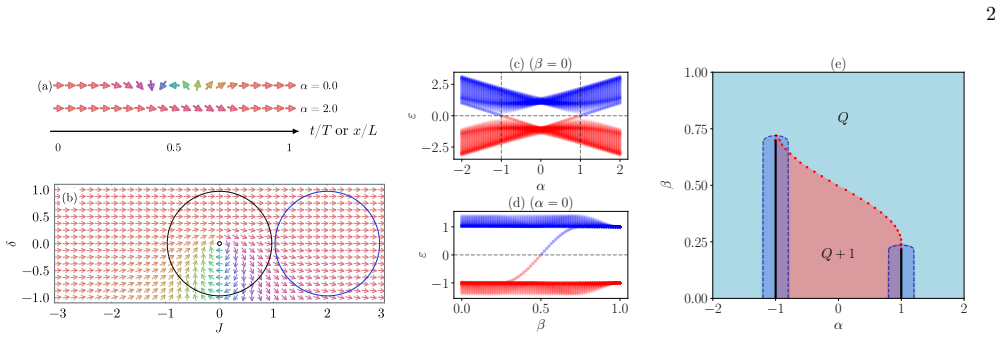
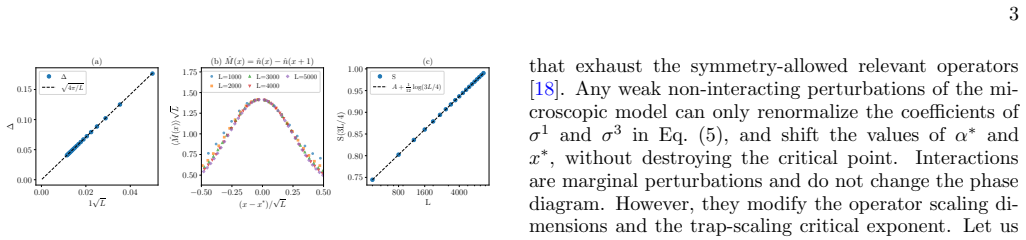
Each topologically distinct class of these diabolical textures gives rise to distinct gapped states that are separated by trap-scaling critical points. When the texture varies sufficiently rapidly in space, the critical line terminates abruptly, producing an unnecessary critical surface. This is demonstrated using a microscopic model of non-interacting fermions with a spatially embedded Thouless pump. The phase diagram is studied comprehensively and its stability to arbitrary perturbations, including interactions, is established in the vicinity of the critical regions. For systems in arbitrary spatial dimensions and global symmetries, classification of diabolical textures proceeds via Kitaev
What carries the argument
Diabolical textures, the adiabatic spatial embedding of parametrized families of quantum states such as charge pumps into a microscopic Hamiltonian.
If this is right
- Each topologically distinct diabolical texture class produces its own family of gapped states.
- These gapped states are separated by trap-scaling critical points.
- When the texture varies rapidly enough in space the critical line ends abruptly as an unnecessary critical surface.
- The gapped states and critical phenomena remain stable against arbitrary perturbations, including interactions, near the critical regions.
- The textures admit a systematic classification in any dimension and symmetry class via Kitaev's Ω spectrum conjecture.
Where Pith is reading between the lines
- Engineering spatial variations of pump parameters in real materials could realize the predicted gapped phases without requiring global homogeneity.
- The unnecessary critical surfaces may appear in other inhomogeneous settings whenever a parameter texture changes faster than the inverse correlation length.
- The same embedding construction could be applied to families beyond charge pumps, such as higher-order or fractional pumps, to generate additional texture classes.
Load-bearing premise
The adiabatic spatial embedding of parametrized families of quantum states into a microscopic model produces the described gapped states and critical phenomena that remain stable to arbitrary perturbations including interactions.
What would settle it
Compute or measure the phase diagram of the non-interacting fermion model with spatially embedded Thouless pump and check whether gapped regions are separated by trap-scaling critical points whose line terminates in an unnecessary critical surface under rapid texture variation.
Figures
read the original abstract
We present a new class of topological phenomena in inhomogeneous systems arising from the adiabatic spatial embedding of parametrized families of quantum states such as charge pumps and their generalizations. We demonstrate that each topologically distinct class of these "diabolical textures" gives rise to distinct gapped states that are separated by "trap-scaling" critical points. When the texture varies sufficiently rapidly in space, the critical line terminates abruptly, producing an "unnecessary critical" surface. We demonstrate our results using a microscopic model of non-interacting fermions with a spatially embedded Thouless pump. We study its phase diagram comprehensively and establish its stability to arbitrary perturbations, including interactions, in the vicinity of the critical regions. For systems in arbitrary spatial dimensions and global symmetries, we present a framework to systematically classify diabolical textures using Kitaev's $\Omega$ spectrum conjecture.
Editorial analysis
A structured set of objections, weighed in public.
Referee Report
Summary. The manuscript introduces a new class of topological phenomena called 'diabolical textures' arising from the adiabatic spatial embedding of parametrized families of quantum states, such as charge pumps. It claims that each topologically distinct class produces distinct gapped states separated by trap-scaling critical points; when the texture varies rapidly in space, the critical line terminates at an unnecessary critical surface. These results are demonstrated via a microscopic non-interacting fermion Hamiltonian with a spatially embedded Thouless pump, including a comprehensive phase diagram study, with asserted stability to arbitrary perturbations including interactions near the critical regions. A general classification framework for arbitrary dimensions and symmetries is proposed using Kitaev's Ω spectrum conjecture.
Significance. If the results hold, the work identifies a mechanism for topological protection and critical phenomena in inhomogeneous systems that extends Thouless-pump ideas to spatially textured settings, potentially enabling new gapped phases and controlled critical surfaces. The concrete microscopic model and phase-diagram analysis provide a tangible starting point, and the Kitaev-based classification offers a route to systematic generalization. The attempt to address stability near critical regions is a positive step, though its execution requires further substantiation.
major comments (3)
- [Abstract and stability discussion] The claim that stability to arbitrary perturbations, including interactions, is established 'in the vicinity of the critical regions' (abstract) is load-bearing for the general assertion that the gapped states and critical phenomena remain robust. No renormalization-group analysis, explicit interacting deformation preserving the diabolical texture, or check against relevant interaction operators is provided to support this beyond the non-interacting case.
- [Classification framework section] The framework for classifying diabolical textures in arbitrary dimensions and symmetries invokes Kitaev's Ω spectrum conjecture only for topological labeling. The dynamical stability of the trap-scaling critical points and unnecessary critical surfaces under interactions is not shown to follow from this conjecture, leaving a gap between the non-interacting demonstration and the general claim.
- [Phase diagram and model section] The central demonstration relies on adiabatic spatial embedding of the Thouless pump into a microscopic non-interacting fermion model. No explicit argument is given showing that the resulting gapped states and critical loci survive when the embedding is deformed by strong interactions while preserving the texture, which is required for the strongest claim.
minor comments (2)
- [Introduction] Notation for 'diabolical textures' and 'trap-scaling critical points' should be defined more explicitly on first use with reference to the underlying parametrized family.
- [Phase diagram] The manuscript would benefit from a table summarizing the distinct gapped states and their associated texture classes for the Thouless-pump example.
Simulated Author's Rebuttal
We thank the referee for the careful reading and constructive major comments. We respond point-by-point below, clarifying the scope of our non-interacting demonstration and indicating revisions where appropriate.
read point-by-point responses
-
Referee: [Abstract and stability discussion] The claim that stability to arbitrary perturbations, including interactions, is established 'in the vicinity of the critical regions' (abstract) is load-bearing for the general assertion that the gapped states and critical phenomena remain robust. No renormalization-group analysis, explicit interacting deformation preserving the diabolical texture, or check against relevant interaction operators is provided to support this beyond the non-interacting case.
Authors: We agree the abstract phrasing overstates the demonstrated scope. Stability is shown explicitly only within the non-interacting fermion model via the topological protection of the diabolical texture. We will revise the abstract to state that robustness to interactions is expected on topological grounds but not verified by RG analysis or explicit interacting deformations. revision: partial
-
Referee: [Classification framework section] The framework for classifying diabolical textures in arbitrary dimensions and symmetries invokes Kitaev's Ω spectrum conjecture only for topological labeling. The dynamical stability of the trap-scaling critical points and unnecessary critical surfaces under interactions is not shown to follow from this conjecture, leaving a gap between the non-interacting demonstration and the general claim.
Authors: The Ω-spectrum framework is used solely to label distinct texture classes by dimension and symmetry. Dynamical stability of the critical loci under interactions is not derived from the conjecture; it is conjectured to follow from the topological distinction but remains unproven beyond the non-interacting case. We will add clarifying text in the classification section. revision: partial
-
Referee: [Phase diagram and model section] The central demonstration relies on adiabatic spatial embedding of the Thouless pump into a microscopic non-interacting fermion model. No explicit argument is given showing that the resulting gapped states and critical loci survive when the embedding is deformed by strong interactions while preserving the texture, which is required for the strongest claim.
Authors: The manuscript presents a non-interacting microscopic model as the concrete demonstration. No explicit interacting deformation preserving the texture is constructed or analyzed, as this lies outside the scope of the present work. We will note this limitation explicitly and identify it as a direction for future study. revision: no
Circularity Check
No circularity: derivation relies on explicit model demonstration and external Kitaev conjecture
full rationale
The paper constructs its claims from a concrete microscopic non-interacting fermion Hamiltonian with spatially embedded Thouless pump, computes its phase diagram, and invokes Kitaev's Ω-spectrum conjecture (an external reference) for the general classification in arbitrary dimensions. No equation or claim reduces by definition to its own fitted parameters, renames a prior result as new, or depends on a load-bearing self-citation chain; the stability statement is presented as following from the model analysis rather than being presupposed. This satisfies the default expectation of a non-circular derivation.
Axiom & Free-Parameter Ledger
axioms (1)
- domain assumption Kitaev's Ω spectrum conjecture
invented entities (1)
-
diabolical textures
no independent evidence
Reference graph
Works this paper leans on
-
[1]
unnecessary criticality
For PBC, it introduces a defect near the link connect- ingx=Landx= 1 across which the parameters jump rapidly. Regardless of the boundary conditions, for sufficiently smallβthe distinction between the regions regions|α|< 1 and|α|>1 as well as the critical pointsα ∗ =±1 re- main stable, consistent with the above analysis. At the critical points, the effect...
-
[2]
All additional dataϱ k>0 correspond to the diabolical textures proper
Thenϱ 0 assigns the Hamiltonian to a connected com- ponent ofI d, which is precisely the familiar strong in- dex [24, 37]. All additional dataϱ k>0 correspond to the diabolical textures proper. For our Class A sys- tem in Eqs. (1) and (4) there are no non-trivial phases, π0(I1) = 1 and henceϱ 0 is trivial. The non-trivial in- variant isϱ 1 which pumps ad=...
-
[3]
F. D. M. Haldane, Nobel Lecture: Topological quantum matter, Rev. Mod. Phys.89, 040502 (2017)
2017
-
[4]
J. M. Kosterlitz, Nobel Lecture: Topological defects and phase transitions, Rev. Mod. Phys.89, 040501 (2017)
2017
-
[5]
A. P. Schnyder, S. Ryu, A. Furusaki, and A. W. W. Lud- wig, Classification of topological insulators and super- conductors in three spatial dimensions, Phys. Rev. B78, 195125 (2008)
2008
-
[6]
S. Ryu, A. P. Schnyder, A. Furusaki, and A. W. W. Lud- wig, Topological insulators and superconductors: tenfold way and dimensional hierarchy, New Journal of Physics 12, 065010 (2010)
2010
-
[7]
Kitaev, Periodic table for topological insulators and superconductors, AIP Conference Proceedings1134, 22 (2009)
A. Kitaev, Periodic table for topological insulators and superconductors, AIP Conference Proceedings1134, 22 (2009)
2009
-
[8]
Toward a topological classification of many- body quantum states with short-range entanglement,
A. Kitaev, “Toward a topological classification of many- body quantum states with short-range entanglement,” (2011), talk at Simons Center for Geometry and Physics http://scgp.stonybrook.edu/archives/1087
2011
-
[9]
On the classification of short-range entan- gled states,
A. Kitaev, “On the classification of short-range entan- gled states,” (2013), talk at Simons Center for Geometry and Physicshttp://scgp.stonybrook.edu/archives/ 16180
2013
-
[10]
Homotopy-theoretic approach to SPT phases in action: Z 16 classification of three- dimensional superconductors,
A. Kitaev, “Homotopy-theoretic approach to SPT phases in action: Z 16 classification of three- dimensional superconductors,” (2015), talk at Institute for Pure and Applied Mathematics https://www.ipam.ucla.edu/programs/workshops/ symmetry-and-topology-in-quantum-matter/
2015
-
[11]
arXiv preprint arXiv:2503.12618 , year=
Y. Kubota, Stable homotopy theory of invertible gapped quantum spin systems I: Kitaev’s Ω-spectrum (2025), arXiv:2503.12618 [math-ph]
-
[12]
C. Z. Xiong, Minimalist approach to the classification of symmetry protected topological phases, Journal of Physics A: Mathematical and Theoretical51, 445001 (2018)
2018
-
[13]
D. Gaiotto and T. Johnson-Freyd, Symmetry protected topological phases and generalized cohomology, Journal of High Energy Physics2019, 10.1007/jhep05(2019)007 (2019)
-
[14]
Kitaev, Differential forms on the space of statistical mechanics models (2019), talk at the conference in cel- ebration of Dan Freed’s 60th birthdayhttps://web.ma
A. Kitaev, Differential forms on the space of statistical mechanics models (2019), talk at the conference in cel- ebration of Dan Freed’s 60th birthdayhttps://web.ma. utexas.edu/topqft/talkslides/kitaev.pdf
2019
-
[15]
X. Wen, M. Qi, A. Beaudry, J. Moreno, M. J. Pflaum, D. Spiegel, A. Vishwanath, and M. Hermele, Flow of higher Berry curvature and bulk-boundary correspon- dence in parametrized quantum systems, Phys. Rev. B 108, 125147 (2023)
2023
-
[16]
P.-S. Hsin, A. Kapustin, and R. Thorngren, Berry phase in quantum field theory: Diabolical points and boundary phenomena, Phys. Rev. B102, 245113 (2020)
2020
-
[17]
Shiozaki, Adiabatic cycles of quantum spin systems, Phys
K. Shiozaki, Adiabatic cycles of quantum spin systems, Phys. Rev. B106, 125108 (2022)
2022
-
[18]
N. G. Jones, R. Thorngren, R. Verresen, and A. Prakash, Charge pumps, pivot Hamiltonians, and symmetry- protected topological phases, Phys. Rev. B112, 165123 (2025)
2025
-
[19]
Prakash and S
A. Prakash and S. A. Parameswaran, Charge pumps, boundary modes, and the necessity of unnecessary criti- cality, Phys. Rev. B112, L241117 (2025)
2025
-
[20]
Textured phase diagrams of featureless insulators
S. Singam, N. G. Jones, and A. Prakash, Tex- tured phase diagrams of featureless insulators (2026), arXiv:2605.20339 [cond-mat.str-el]
work page internal anchor Pith review Pith/arXiv arXiv 2026
-
[21]
In search of diabolical critical points
N. Manjunath and D. V. Else, In search of diabolical critical points (2026), arXiv:2601.10783 [cond-mat.str-el]
work page internal anchor Pith review Pith/arXiv arXiv 2026
-
[22]
M. J. Rice and E. J. Mele, Elementary Excitations of a Linearly Conjugated Diatomic Polymer, Phys. Rev. Lett. 49, 1455 (1982)
1982
-
[23]
Bi and T
Z. Bi and T. Senthil, Adventure in Topological Phase Transitions in 3 + 1-D: Non-Abelian Deconfined Quan- tum Criticalities and a Possible Duality, Phys. Rev. X9, 021034 (2019)
2019
-
[24]
Prakash, M
A. Prakash, M. Fava, and S. A. Parameswaran, Multi- versality and Unnecessary Criticality in One Dimension, Phys. Rev. Lett.130, 256401 (2023)
2023
-
[25]
D. J. Thouless, Quantization of particle transport, Phys. Rev. B27, 6083 (1983)
1983
-
[26]
Kane, Chapter 1 - Topological Band Theory and the Z2 Invariant, inTopological Insulators, Contemporary Concepts of Condensed Matter Science, Vol
C. Kane, Chapter 1 - Topological Band Theory and the Z2 Invariant, inTopological Insulators, Contemporary Concepts of Condensed Matter Science, Vol. 6, edited by M. Franz and L. Molenkamp (Elsevier, 2013) pp. 3–34
2013
-
[27]
S. L. Sondhi, A. Karlhede, S. A. Kivelson, and E. H. Rezayi, Skyrmions and the crossover from the integer to fractional quantum Hall effect at small Zeeman energies, Phys. Rev. B47, 16419 (1993)
1993
-
[28]
D. V. Else, Topological Goldstone phases of matter, Phys. Rev. B104, 115129 (2021)
2021
-
[29]
Manjunath and D
N. Manjunath and D. V. Else, Anomalous continuous symmetries and quantum topology of Goldstone modes, Phys. Rev. B111, 125151 (2025)
2025
-
[30]
Critical behavior and scaling in trapped systems
M. Campostrini and E. Vicari, Critical Behavior and Scaling in Trapped Systems, Physical Review Letters 102, 240601 (2009), arXiv:0903.5153 [cond-mat.stat- mech]
work page internal anchor Pith review Pith/arXiv arXiv 2009
-
[31]
Trap-size scaling in confined particle systems at quantum transitions
M. Campostrini and E. Vicari, Trap-size scaling in confined-particle systems at quantum transitions, Physi- cal Review A81, 023606 (2010), arXiv:0906.2640 [cond- 6 mat.stat-mech]
work page internal anchor Pith review Pith/arXiv arXiv 2010
-
[32]
Ceccarelli, C
G. Ceccarelli, C. Torrero, and E. Vicari, Critical parame- ters from trap-size scaling in systems of trapped particles, Physical Review B87, 024513 (2013)
2013
-
[33]
, See Supplementary Materials for more details
-
[34]
Cardy,Scaling and Renormalization in Statistical Physics, Cambridge Lecture Notes in Physics (Cam- bridge University Press, 1996)
J. Cardy,Scaling and Renormalization in Statistical Physics, Cambridge Lecture Notes in Physics (Cam- bridge University Press, 1996)
1996
-
[35]
Calabrese and J
P. Calabrese and J. Cardy, Entanglement entropy and quantum field theory, Journal of Statistical Mechanics: Theory and Experiment2004, P06002 (2004)
2004
-
[36]
Giamarchi,Quantum physics in one dimension, In- ternational series of monographs on physics (Clarendon Press, Oxford, 2004)
T. Giamarchi,Quantum physics in one dimension, In- ternational series of monographs on physics (Clarendon Press, Oxford, 2004)
2004
-
[37]
Mondal, A
S. Mondal, A. Agarwala, T. Mishra, and A. Prakash, Symmetry-enriched criticality in a coupled spin ladder, Phys. Rev. B108, 245135 (2023)
2023
-
[38]
Luttinger liq- uid
F. D. M. Haldane, Demonstration of the “Luttinger liq- uid” character of Bethe-ansatz-soluble models of 1-D quantum fluids, Physics Letters A81, 153 (1981)
1981
-
[39]
M. Z. Hasan and C. L. Kane, Colloquium: Topological insulators, Rev. Mod. Phys.82, 3045 (2010)
2010
-
[40]
H. C. Po, H. Watanabe, and A. Vishwanath, Fragile Topology and Wannier Obstructions, Phys. Rev. Lett. 121, 126402 (2018)
2018
-
[41]
unnecessary
C.-M. Jian and C. Xu, Generic “unnecessary” quantum critical points with minimal degrees of freedom, Phys. Rev. B101, 035118 (2020)
2020
-
[42]
R. Verresen, J. Bibo, and F. Pollmann, Quotient symmetry protected topological phenomena (2021), arXiv:2102.08967 [cond-mat.str-el]
-
[43]
P. K. Vishnu, A. Prakash, R. Narayanan, and T. Chanda, Two-DimensionalJ 1−J2 Clock Model: Enhanced Sym- metries, Emergent Orders, and Landau-Incompatible Transitions, Phys. Rev. Lett.135, 256703 (2025)
2025
-
[44]
Khalaf, W
E. Khalaf, W. A. Benalcazar, T. L. Hughes, and R. Queiroz, Boundary-obstructed topological phases, Phys. Rev. Res.3, 013239 (2021)
2021
-
[45]
unnecessary
Y. Zhang, X.-Y. Song, and T. Senthil, Dirac spin liquid as an “unnecessary” quantum critical point on square lattice antiferromagnets, SciPost Phys. Core8, 024 (2025)
2025
-
[46]
Zhang, X.-Y
Y. Zhang, X.-Y. Song, and T. Senthil, Unnecessary quan- tum criticality inSU(3) kagome magnets, SciPost Phys. 20, 082 (2026)
2026
-
[47]
Prakash and N
A. Prakash and N. G. Jones, Classical Origins of Landau- Incompatible Transitions, Phys. Rev. Lett.134, 097103 (2025)
2025
-
[48]
N. D. Mermin, The topological theory of defects in or- dered media, Rev. Mod. Phys.51, 591 (1979)
1979
-
[49]
Michel, Symmetry defects and broken symmetry
L. Michel, Symmetry defects and broken symmetry. Con- figurations Hidden Symmetry, Rev. Mod. Phys.52, 617 (1980)
1980
-
[50]
J. P. Ang and A. Prakash, On the classification of topo- logical defects and textures (2018), arXiv:1810.12964 [cond-mat.str-el]
work page internal anchor Pith review Pith/arXiv arXiv 2018
-
[51]
J. P. Ang and A. Prakash, Higher categorical groups and the classification of topological defects and textures (2018), arXiv:1810.12965 [math-ph]
work page internal anchor Pith review Pith/arXiv arXiv 2018
-
[52]
A physical manifes- tation of this is the action induced by encircling a point defect around a line defect in 3d nematic crystals [46]
There are additional subtleties concerning the action of one homotopy group on the other. A physical manifes- tation of this is the action induced by encircling a point defect around a line defect in 3d nematic crystals [46]. A mathematical framework that captures this directly can be found in Refs [48, 49]
-
[53]
Tantivasadakarn, R
N. Tantivasadakarn, R. Thorngren, A. Vishwanath, and R. Verresen, Pivot Hamiltonians as generators of symme- try and entanglement, SciPost Phys.14, 012 (2023)
2023
-
[54]
N. G. Jones, A. Prakash, and P. Fendley, Pivoting through the chiral-clock family, SciPost Phys.18, 094 (2025)
2025
-
[55]
Lohse, C
M. Lohse, C. Schweizer, O. Zilberberg, M. Aidelsburger, and I. Bloch, A Thouless quantum pump with ultracold bosonic atoms in an optical superlattice, Nature Physics 12, 350–354 (2015)
2015
-
[56]
Nakajima, T
S. Nakajima, T. Tomita, S. Taie, T. Ichinose, H. Ozawa, L. Wang, M. Troyer, and Y. Takahashi, Topological Thouless pumping of ultracold fermions, Nature Physics 12, 296–300 (2016)
2016
-
[57]
H.-I. Lu, M. Schemmer, L. M. Aycock, D. Genkina, S. Sugawa, and I. B. Spielman, Geometrical Pumping with a Bose-Einstein Condensate, Phys. Rev. Lett.116, 200402 (2016)
2016
-
[58]
Walter, Z
A.-S. Walter, Z. Zhu, M. G¨ achter, J. Minguzzi, S. Roschinski, K. Sandholzer, K. Viebahn, and T. Esslinger, Quantization and its breakdown in a Hub- bard–Thouless pump, Nature Physics19, 1471–1475 (2023)
2023
-
[59]
Y. Liu, Y.-R. Zhang, Y.-H. Shi, T. Liu, C. Lu, Y.-Y. Wang, H. Li, T.-M. Li, C.-L. Deng, S.-Y. Zhou, T. Liu, J.-C. Zhang, G.-H. Liang, Z.-Y. Mei, W.-G. Ma, H.-T. Liu, Z.-H. Liu, C.-T. Chen, K. Huang, X. Song, S. P. Zhao, Y. Tian, Z. Xiang, D. Zheng, F. Nori, K. Xu, and H. Fan, Interplay between disorder and topology in Thou- less pumping on a superconducti...
-
[60]
Y. E. Kraus, Y. Lahini, Z. Ringel, M. Verbin, and O. Zil- berberg, Topological States and Adiabatic Pumping in Quasicrystals, Phys. Rev. Lett.109, 106402 (2012)
2012
-
[61]
Verbin, O
M. Verbin, O. Zilberberg, Y. Lahini, Y. E. Kraus, and Y. Silberberg, Topological pumping over a photonic Fi- bonacci quasicrystal, Phys. Rev. B91, 064201 (2015)
2015
-
[62]
Y. Ke, X. Qin, F. Mei, H. Zhong, Y. S. Kivshar, and C. Lee, Topological phase transitions and Thouless pumping of light in photonic waveguide arrays, Laser & Photonics Reviews10, 995 (2016)
2016
-
[63]
A. Cerjan, M. Wang, S. Huang, K. P. Chen, and M. C. Rechtsman, Thouless pumping in disordered photonic systems, Light: Science & Applications9, 10.1038/s41377-020-00408-2 (2020)
-
[64]
I. H. Grinberg, M. Lin, C. Harris, W. A. Benalcazar, C. W. Peterson, T. L. Hughes, and G. Bahl, Robust temporal pumping in a magneto-mechanical topological insulator, Nature Communications11, 10.1038/s41467- 020-14804-0 (2020)
-
[65]
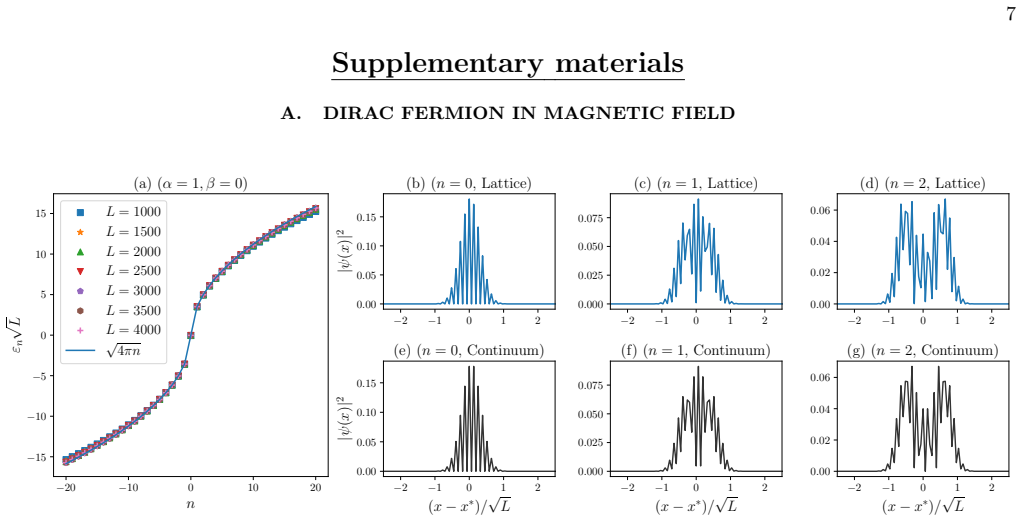
Y. Xia, E. Riva, M. I. N. Rosa, G. Cazzulani, A. Erturk, F. Braghin, and M. Ruzzene, Experimental Observation of Temporal Pumping in Electromechanical Waveguides, Phys. Rev. Lett.126, 095501 (2021). 7 Supplementary materials A. DIRAC FERMION IN MAGNETIC FIELD −20 −10 0 10 20 n −15 −10 −5 0 5 10 15 εn √ L (a) ( α = 1, β = 0) L = 1000 L = 1500 L = 2000 L = ...
2021
discussion (0)
Sign in with ORCID, Apple, or X to comment. Anyone can read and Pith papers without signing in.