Generating and Refining Dynamic Evaluation Rubrics for LLM-as-a-Judge
Pith reviewed 2026-06-29 07:19 UTC · model grok-4.3
The pith
A fine-tuned 14B rubric generator outperforms much larger proprietary models at creating evaluation rubrics for LLM judges.
A machine-rendered reading of the paper's core claim, the machinery that carries it, and where it could break.
Core claim
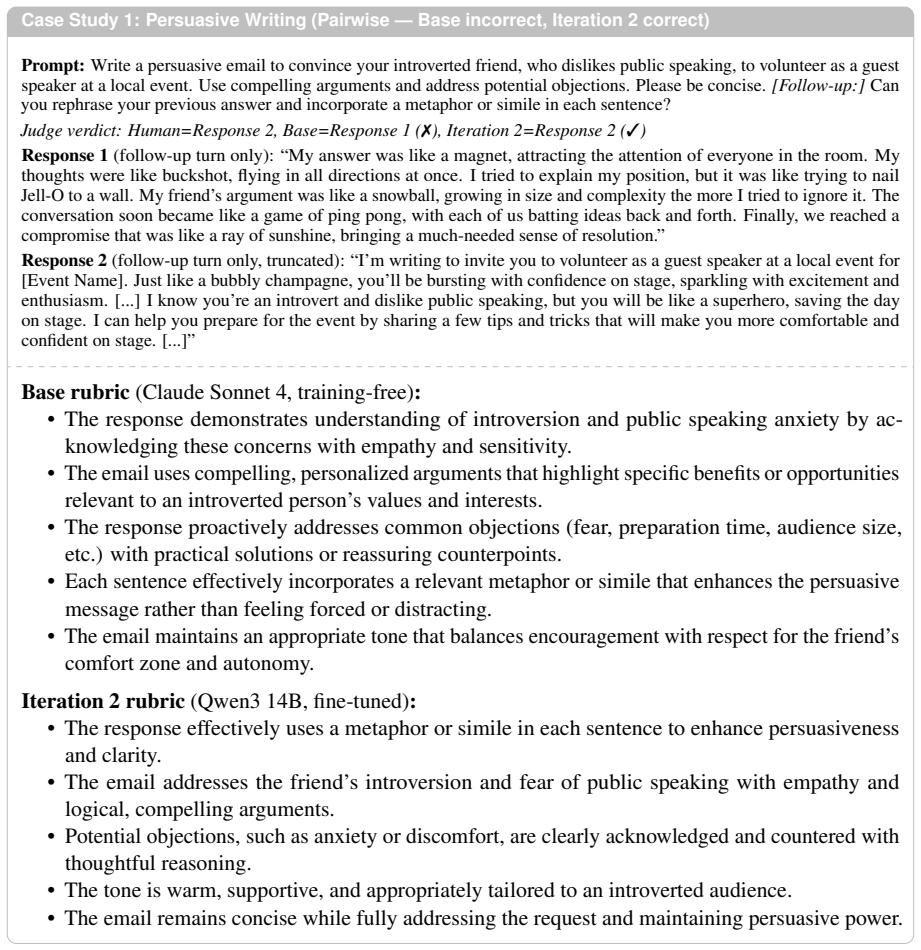
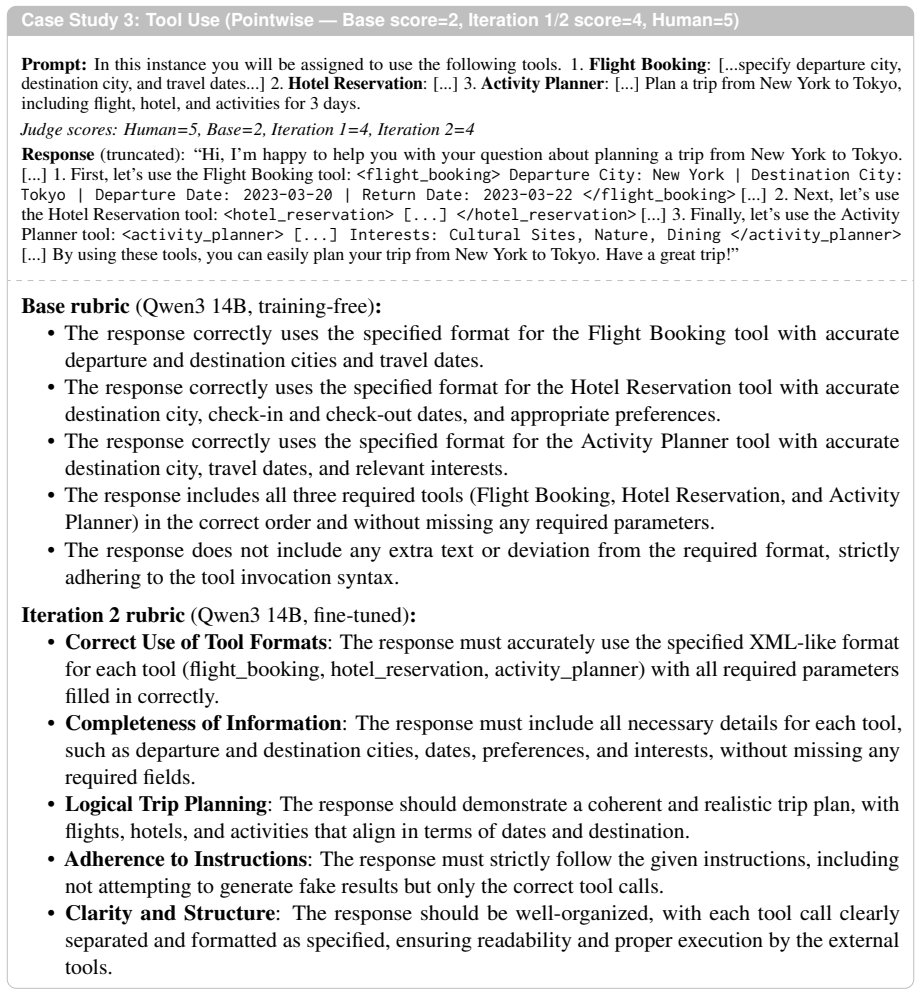
Rubrics for LLM-as-a-Judge evaluation can be generated and refined end-to-end without human annotation by first producing dataset- and instance-specific criteria in a training-free manner and then iteratively fine-tuning the generator itself through meta-judge reward signals, yielding a model that surpasses all existing baselines and even larger proprietary systems on pairwise and pointwise benchmarks.
What carries the argument
Iterative fine-tuning of a rubric generator model driven by meta-judge reward signals.
If this is right
- LLM evaluation scales without dependence on human-annotated reference answers or hand-crafted rubrics.
- A single fine-tuned generator improves both pairwise comparison and pointwise scoring accuracy across multiple benchmarks.
- Smaller open-weight models can exceed proprietary models specifically on the sub-task of rubric creation.
- Dataset-specific and instance-specific rubric granularity becomes feasible at low cost.
Where Pith is reading between the lines
- The same meta-judge refinement loop could be applied to other LLM generation tasks that currently rely on static prompts or human feedback.
- If the reward signals remain stable, the approach could eliminate the need for any human annotation when building evaluators for entirely new domains.
- Testing whether the generated rubrics transfer to judge models from different families would reveal the limits of the refinement process.
Load-bearing premise
Meta-judge reward signals from LLM judges provide reliable and unbiased feedback for iteratively improving the rubric generator model.
What would settle it
Human experts scoring the alignment of generated rubrics with actual human preference judgments find that the fine-tuned 14B model produces rubrics no better than those from the larger proprietary model or from prior baselines.
Figures



read the original abstract
LLM-as-a-Judge is a scalable alternative to human evaluation, yet existing rubric-based methods rely on human-annotated data such as reference answers or expert-crafted rubrics. We propose to automatically generate fine-grained evaluation rubrics without any human annotation. Our training-free method generates rubrics at dataset-specific and instance-specific granularities, achieving performance competitive with existing methods across four benchmarks. We further present a method that iteratively fine-tunes a rubric generator model via meta-judge reward signals. The fine-tuned generator outperforms all existing baselines in both pairwise and pointwise evaluation. Notably, a fine-tuned 14B rubric generator outperforms a much larger proprietary model at rubric generation, showing the effectiveness of our fine-tuning strategy.
Editorial analysis
A structured set of objections, weighed in public.
Referee Report
Summary. The paper proposes a training-free method to automatically generate fine-grained, dataset-specific and instance-specific evaluation rubrics for LLM-as-a-Judge without human annotations or reference answers, reporting competitive performance across four benchmarks. It further introduces an iterative fine-tuning procedure for a rubric generator model that uses reward signals from LLM meta-judges; the resulting fine-tuned 14B model is claimed to outperform all baselines and a much larger proprietary model in both pairwise and pointwise settings.
Significance. If the empirical claims hold after proper validation, the work would meaningfully reduce dependence on human-annotated rubrics and references in LLM evaluation pipelines. The result that a 14B fine-tuned generator surpasses larger proprietary models would be noteworthy for efficiency. The absence of any reported human validation of the meta-judge reward signals, however, leaves open the possibility that reported gains are artifacts of the training loop rather than genuine improvements in rubric quality.
major comments (2)
- [Abstract] Abstract: The headline claim that the fine-tuned 14B generator 'outperforms all existing baselines' and a larger proprietary model rests entirely on iterative refinement driven by meta-judge reward signals. No external human validation or inter-annotator agreement study of these signals against human-crafted rubrics is described, leaving open systematic bias, style preference, or circular reinforcement with the downstream LLM judges.
- [Abstract] Abstract: The reported competitive and superior performance on four benchmarks is presented without any mention of experimental controls, statistical significance tests, baseline re-implementations, or potential confounds (e.g., prompt sensitivity, judge model choice). These omissions make it impossible to assess whether the central empirical claims are load-bearing or reproducible.
Simulated Author's Rebuttal
We thank the referee for the constructive comments highlighting areas for improved rigor and transparency. We respond to each major comment below and indicate planned revisions.
read point-by-point responses
-
Referee: [Abstract] Abstract: The headline claim that the fine-tuned 14B generator 'outperforms all existing baselines' and a larger proprietary model rests entirely on iterative refinement driven by meta-judge reward signals. No external human validation or inter-annotator agreement study of these signals against human-crafted rubrics is described, leaving open systematic bias, style preference, or circular reinforcement with the downstream LLM judges.
Authors: We acknowledge that the manuscript does not include external human validation or inter-annotator agreement analysis of the meta-judge reward signals. This leaves the possibility of bias or circularity unaddressed by direct evidence. The downstream benchmark gains provide indirect support for the signals' effectiveness, but we agree this is insufficient to fully substantiate the claims. In revision we will add an explicit limitations subsection discussing reliance on LLM-based meta-judges, potential style biases, and the risk of reinforcement loops, while noting that a human validation study lies beyond the scope of the current experiments. revision: partial
-
Referee: [Abstract] Abstract: The reported competitive and superior performance on four benchmarks is presented without any mention of experimental controls, statistical significance tests, baseline re-implementations, or potential confounds (e.g., prompt sensitivity, judge model choice). These omissions make it impossible to assess whether the central empirical claims are load-bearing or reproducible.
Authors: We will revise both the abstract and the experimental sections to explicitly describe the controls employed: fixed prompt templates, the specific judge models used for all comparisons, and the re-implementation protocol for baselines. We will also add statistical significance testing (e.g., paired bootstrap or Wilcoxon tests) to the results and report variance across prompt variations to address sensitivity concerns. These changes will be incorporated in the next version to strengthen reproducibility. revision: yes
- Absence of any human validation or inter-annotator agreement study for the meta-judge reward signals
Circularity Check
No circularity; derivation relies on external benchmarks and prior literature
full rationale
The abstract describes a training-free rubric generation method competitive on four benchmarks, followed by iterative fine-tuning of a generator using meta-judge reward signals from LLM judges. No equations, self-citations, or fitted parameters are shown that reduce any claimed prediction or result to the inputs by construction. The central claims rest on performance against external baselines rather than internal re-labeling or self-referential loops. This matches the default expectation of a self-contained paper.
Axiom & Free-Parameter Ledger
axioms (1)
- domain assumption LLM-based meta-judges can generate reliable reward signals for improving a rubric generator without introducing systematic bias
Reference graph
Works this paper leans on
-
[1]
Rubrics as rewards: Reinforcement learning beyond verifiable domains. InThe Fourteenth Inter- national Conference on Learning Representations. Taneesh Gupta, Shivam Shandilya, Xuchao Zhang, Rahul Madhavan, Supriyo Ghosh, Chetan Bansal, Huaxiu Yao, and Saravan Rajmohan. 2025. CARMO: Dynamic criteria generation for context aware reward modelling. InFindings...
-
[2]
score": an integer from 1 to 5 -
Direct preference optimization: Your language model is secretly a reward model. InAdvances in Neural Information Processing Systems, volume 36, pages 53728–53741. Curran Associates, Inc. Michael J Ryan, Yanzhe Zhang, Amol Salunkhe, Yi Chu, Di Xu, and Diyi Yang. 2026. Autometrics: Approximate human judgments with automatically generated evaluators. InThe F...
-
[3]
Specificity: Are criteria concrete and testable (yes/no answerable), or vague and subjective?
-
[4]
Coverage: Do criteria address the key aspects an expert would check?
-
[5]
Discriminability: Can these criteria distinguish genuinely good responses from superficially good ones?
-
[6]
winner":
Domain-appropriateness: Do criteria reflect the expertise level the task requires? Output ONLY a JSON object: {"winner": "A" or "B", "reason": "brief explanation"} User:[Task Prompt] {prompt} [Rubric A] {rubric_a} [Rubric B] {rubric_b} Which rubric is better for evaluating responses to this task? Output only the JSON object. Rubric candidate generation (f...
2023
-
[7]
The response clearly ex- plains
using the judge model itself. For pairwise evalu- Hyperparameter Value Base models Llama 3.1 8B / Qwen3 14B LoRA rank 64 LoRAα128 LoRA dropout 0.05 Quantization 4-bit DPOβ0.1 Learning rate5×10 −6 Batch size (effective) 16 Epochs 3 Max sequence length 2048 Optimizer AdamW Table 5: Preference fine-tuning hyperparameters for the rubric generator. ation, each...
2048
discussion (0)
Sign in with ORCID, Apple, or X to comment. Anyone can read and Pith papers without signing in.