Vertex-transitive quantum graphs
Pith reviewed 2026-06-28 20:18 UTC · model grok-4.3
The pith
A complete classification of vertex-transitive quantum graphs in three-by-three complex matrices is given using a new polynomial invariant.
A machine-rendered reading of the paper's core claim, the machinery that carries it, and where it could break.
Core claim
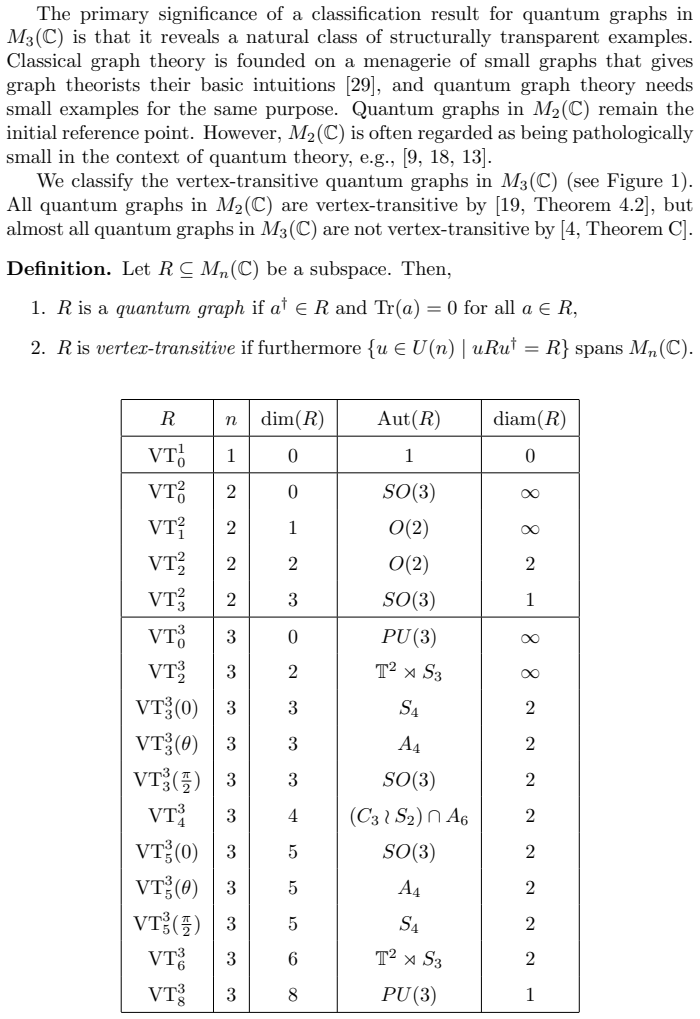
We define a quantum graph to be vertex-transitive if the join of its automorphism group is the maximum quantum relation on its quantum vertex set, in direct analogy with the classical case. All simple quantum graphs in M_2(C) are vertex-transitive, but many simple quantum graphs in M_3(C) are not vertex-transitive. We provide a complete classification of vertex-transitive quantum graphs in M_3(C) up to isomorphism. To do this, we introduce a polynomial invariant for quantum graphs in M_n(C), which we call the panoramic polynomial.
What carries the argument
The panoramic polynomial, a polynomial invariant for quantum graphs in M_n(C) used to distinguish isomorphism classes.
If this is right
- The vertex-transitive quantum graphs inside M_3(C) consist of finitely many isomorphism classes.
- The panoramic polynomial is unchanged by isomorphism and separates the classes appearing in the classification.
- Every simple quantum graph in M_2(C) meets the vertex-transitive condition by the given definition.
Where Pith is reading between the lines
- The panoramic polynomial may extend to produce partial lists in matrix sizes larger than three.
- The classification supplies concrete examples that could be used to test further properties such as quantum graph homomorphisms.
- The analogy between classical and quantum transitivity may link to symmetry questions in related operator-algebra structures.
Load-bearing premise
The definition of vertex-transitivity, requiring the automorphism group's join to equal the maximum quantum relation, correctly identifies the graphs with the intended symmetry.
What would settle it
An explicit quantum graph in M_3(C) whose automorphism group join equals the maximum relation yet lies outside the listed isomorphism classes, or two non-isomorphic graphs assigned the same value by the panoramic polynomial.
Figures
read the original abstract
We define a quantum graph to be vertex-transitive if the join of its automorphism group is the maximum quantum relation on its quantum vertex set, in direct analogy with the classical case. All simple quantum graphs in $M_2(\mathbb C)$ are vertex-transitive, but many simple quantum graphs in $M_3(\mathbb C)$ are not vertex-transitive. We provide a complete classification of vertex-transitive quantum graphs in $M_3(\mathbb C)$ up to isomorphism. To do this, we introduce a polynomial invariant for quantum graphs in $M_n(\mathbb C)$, which we call the panoramic polynomial.
Editorial analysis
A structured set of objections, weighed in public.
Referee Report
Summary. The paper defines a quantum graph to be vertex-transitive if the join of its automorphism group equals the maximum quantum relation on its quantum vertex set. It states that every simple quantum graph in M_2(C) is vertex-transitive while many in M_3(C) are not, and claims a complete classification of the vertex-transitive quantum graphs in M_3(C) up to isomorphism, obtained by introducing a new polynomial invariant called the panoramic polynomial for quantum graphs in M_n(C).
Significance. A verified classification of vertex-transitive quantum graphs in M_3(C) together with a new invariant would constitute a concrete contribution to the structure theory of quantum graphs in low dimensions, supplying explicit examples and a tool for distinguishing isomorphism classes that could be tested against other invariants in the literature.
major comments (1)
- The abstract states the classification result and the definition of the panoramic polynomial but supplies no proof details, derivations, or verification methods for either the M_3(C) classification or the claimed properties of the invariant; without these it is impossible to assess whether the central claims hold.
Simulated Author's Rebuttal
We thank the referee for their review. We address the single major comment below.
read point-by-point responses
-
Referee: The abstract states the classification result and the definition of the panoramic polynomial but supplies no proof details, derivations, or verification methods for either the M_3(C) classification or the claimed properties of the invariant; without these it is impossible to assess whether the central claims hold.
Authors: Abstracts are concise summaries by design and do not contain full proofs. The manuscript provides the complete classification of vertex-transitive quantum graphs in M_3(C), the definition and properties of the panoramic polynomial, and all supporting derivations and verifications in the body of the paper. revision: no
Circularity Check
No significant circularity; definition and invariant introduced independently
full rationale
The paper explicitly defines vertex-transitivity for quantum graphs as the join of the automorphism group equaling the maximum quantum relation, presented as a direct analogy to the classical case rather than derived from prior results or self-citations. It introduces the panoramic polynomial as a new invariant for classification in M_3(C). No equations reduce by construction to inputs, no fitted parameters are relabeled as predictions, and no load-bearing self-citations or uniqueness theorems from the same authors are invoked. The claims are self-contained with the new tools, consistent with the reader's assessment of no circular reasoning.
Axiom & Free-Parameter Ledger
Reference graph
Works this paper leans on
-
[1]
Bigalois extensions and the graph isomorphism game
Michael Brannan, Alexandru Chirvasitu, Kari Eifler, Samuel Harris, Vern Paulsen, Xiaoyu Su, and Mateusz Wasilewski. Bigalois extensions and the graph isomorphism game. Commun. Math. Phys. , 375(3):1777–1809, 2020
2020
-
[2]
Javier Alejandro Ch´ avez-Dom´ ınguez and Andrew T. Swift. Connectivity for quantum graphs. Linear Algebra Appl., 608:37–53, 2021
2021
-
[3]
So ltan, and Mateusz Wasilewski
Alexandru Chirvasitu, Piotr M. So ltan, and Mateusz Wasilewski. Quantum-rigid random quantum graphs. Preprint, arXiv:2510.21503 [math.QA] (2025), 2025
-
[4]
Random quantum graphs
Alexandru Chirvasitu and Mateusz Wasilewski. Random quantum graphs. Trans. Am. Math. Soc., 375(5):3061–3087, 2022
2022
-
[5]
Man-Duen Choi and Edward G. Effros. Injectivity and operator spaces. J. Funct. Anal., 24(2):156–209, 1977
1977
-
[6]
Quantum graphs: different perspectives, homomorphisms and quantum automorphisms
Matthew Daws. Quantum graphs: different perspectives, homomorphisms and quantum automorphisms. Commun. Am. Math. Soc., 4:117–181, 2024. 26
2024
-
[7]
Quantum graphs in infinite-dimensions: Hilbert–Schmidts and Hilbert modules
Matthew Daws. Quantum graphs in infinite-dimensions: Hilbert–Schmidts and Hilbert modules. Preprint, arXiv:2511.23121 [math.OA] (2025), 2025
-
[8]
Zero-error commu- nication via quantum channels, noncommutative graphs, and a quantum Lov´ asz number.IEEE Trans
Runyao Duan, Simone Severini, and Andreas Winter. Zero-error commu- nication via quantum channels, noncommutative graphs, and a quantum Lov´ asz number.IEEE Trans. Inf. Theory, 59(2):1164–1174, 2013
2013
-
[9]
Andrew M. Gleason. Measures on the closed subspaces of a Hilbert space. J. Math. Mech. , 6:885–893, 1957
1957
-
[10]
Quantum games and synchronicity
Adina Goldberg. Quantum games and synchronicity. Quantum, 10:1964, 60, 2026
1964
-
[11]
Gracia-Bond´ ıa, Joseph C
Jos´ e M. Gracia-Bond´ ıa, Joseph C. V´ arilly, and H´ ector Figueroa.Elements of noncommutative geometry. Boston, MA: Birkh¨ auser, 2001
2001
-
[12]
Some examples of quantum graphs
Daniel Gromada. Some examples of quantum graphs. Lett. Math. Phys. , 112(6):122, 49, 2022
2022
-
[13]
Mixed-state entanglement and distillation: Is there a “bound” entanglement in nature? Phys
Micha l Horodecki, Pawe l Horodecki, and Ryszard Horodecki. Mixed-state entanglement and distillation: Is there a “bound” entanglement in nature? Phys. Rev. Lett., 80(24):5239–5242, 1998
1998
-
[14]
Quasiorthogonality of commutative algebras, complex Hadamard matrices, and mutually unbiased measurements
Sooyeong Kim, David Kribs, Edison Lozano, Rajesh Pereira, and Sarah Plosker. Quasiorthogonality of commutative algebras, complex Hadamard matrices, and mutually unbiased measurements. Linear Algebra Appl. , 728:383–408, 2026
2026
-
[15]
Quantum sets
Andre Kornell. Quantum sets. J. Math. Phys. , 61(10):102202, 33, 2020
2020
-
[16]
Characterizations of homomorphisms among unital com- pletely positive maps
Andre Kornell. Characterizations of homomorphisms among unital com- pletely positive maps. Linear Algebra Appl., 709:314–330, 2025
2025
-
[17]
Quantum graphs of homomorphisms
Andre Kornell and Bert Lindenhovius. Quantum graphs of homomor- phisms. Preprint, arXiv:2601.09685 [quant-ph] (2026), 2026
work page internal anchor Pith review Pith/arXiv arXiv 2026
-
[18]
L. J. Landau and R. F. Streater. On Birkhoff’s theorem for doubly stochas- tic completely positive maps of matrix algebras. Linear Algebra Appl. , 193:107–127, 1993
1993
-
[19]
Classification of quantum graphs on M2 and their quantum automorphism groups
Junichiro Matsuda. Classification of quantum graphs on M2 and their quantum automorphism groups. J. Math. Phys. , 63(9):092201, 34, 2022
2022
-
[20]
Algebraic connectedness and bipartiteness of quantum graphs
Junichiro Matsuda. Algebraic connectedness and bipartiteness of quantum graphs. Commun. Math. Phys. , 405(8):185, 28, 2024
2024
-
[21]
A compositional approach to quantum functions
Benjamin Musto, David Reutter, and Dominic Verdon. A compositional approach to quantum functions. J. Math. Phys. , 59(8):081706, 42, 2018
2018
-
[22]
The Morita theory of quantum graph isomorphisms
Benjamin Musto, David Reutter, and Dominic Verdon. The Morita theory of quantum graph isomorphisms. Commun. Math. Phys. , 365(2):797–845, 2019. 27
2019
-
[23]
Complementarity in quantum systems
D´ enes Petz. Complementarity in quantum systems. Rep. Math. Phys. , 59(2):209–224, 2007
2007
-
[24]
Podle´ s and S
P. Podle´ s and S. L. Woronowicz. Quantum deformation of Lorentz group. Commun. Math. Phys. , 130(2):381–431, 1990
1990
-
[25]
A concise guide to complex Hadamard matrices
Wojciech Tadej and Karol ˙Zyczkowski. A concise guide to complex Hadamard matrices. Open Syst. Inf. Dyn. , 13(2):133–177, 2006
2006
-
[26]
Covariant quantum combinatorics with applications to zero-error communication
Dominic Verdon. Covariant quantum combinatorics with applications to zero-error communication. Commun. Math. Phys. , 405(2):51, 57, 2024
2024
-
[27]
Quantum relations
Nik Weaver. Quantum relations. In A von Neumann algebra approach to quantum metrics / Quantum relations , pages 81–140. Providence, RI: American Mathematical Society (AMS), 2012
2012
-
[28]
On orthogonal systems of matrix algebras
Mih´ aly Weiner. On orthogonal systems of matrix algebras. Linear Algebra Appl., 433(3):520–533, 2010
2010
-
[29]
Douglas B. West. Introduction to graph theory . Upper Saddle River, NJ: Prentice Hall, 1996. Department of Mathematics, University of Kansas Lawrence, KS 66045 E-mail address : machayes00@ku.edu Department of Mathematical Sciences, New Mexico State University Las Cruces, NM 88003 E-mail address : tkjess@nmsu.edu Department of Mathematical Sciences, New Me...
1996
-
[31]
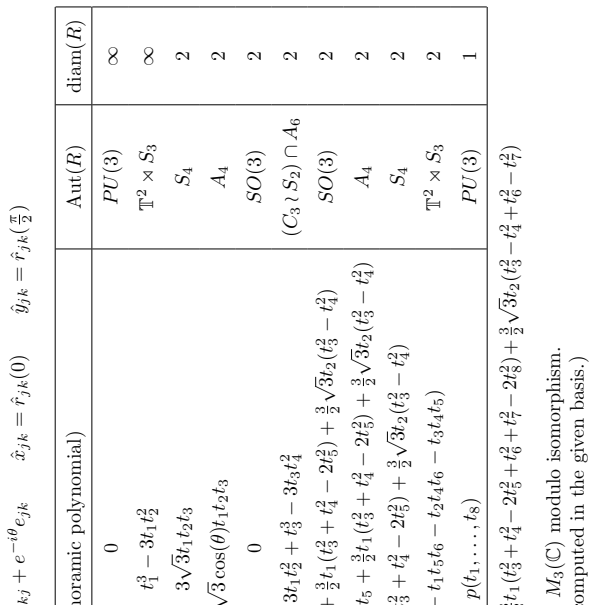
SO(3) 2 VT3 5(θ) {ˆv, ˆv2, ˆx12, ˆx23, ˆr31(θ)} t3 1 − 3t1t2 2 + 3 √ 3 cos(θ)t3t4t5 + 3 2 t1(t2 3 + t2 4 − 2t2
-
[33]
A4 2 VT3 5( π 2 ) {ˆv, ˆv2, ˆx12, ˆx23, ˆy31} t3 1 − 3t1t2 2 + 3 2 t1(t2 3 + t2 4 − 2t2
-
[34]
+ 3 2 √ 3t2(t2 3 − t2
-
[35]
, t8) P U(3) 1 p(t1,
S4 2 VT3 6 {ˆx12, ˆx23, ˆx31, ˆy12, ˆy23, ˆy31} 3 √ 3(t1t2t3 − t1t5t6 − t2t4t6 − t3t4t5) T2 ⋊ S3 2 VT3 8 {ˆv, ˆv2, ˆx12, ˆx23, ˆx31, ˆy12, ˆy23, ˆy31} p(t1, . . . , t8) P U(3) 1 p(t1, . . . , t8) = t3 1 −3t1t2 2 +3 √ 3(t3t4t5 −t3t7t8 −t4t6t8 −t5t6t7)+ 3 2 t1(t2 3 +t2 4 −2t2 5 +t2 6 +t2 7 −2t2 8)+ 3 2 √ 3t2(t2 3 −t2 4 +t2 6 −t2 7) Figure 4: The vertex-tran...
discussion (0)
Sign in with ORCID, Apple, or X to comment. Anyone can read and Pith papers without signing in.