REVIEW 2 major objections 2 minor 57 references
Matter influence on large-scale scalar dynamics
T0 review · 2 major / 2 minor · reviewed 2026-06-28 · grok-4.3
Pith's one-line read Matter modelled as a stochastic source produces stochastic noise and new interactions that modify the large-scale evolution of light scalar fields.
desk verdict The abstract sketches how stochastic matter sources could add noise and potential shifts to light scalar dynamics, but without derivations it's unclear if the corrections are robust or cutoff-dependent. read the letter →
The pith
A machine-rendered reading of the paper's core claim, the machinery that carries it, and where it could break.
The reading
What carries the argument
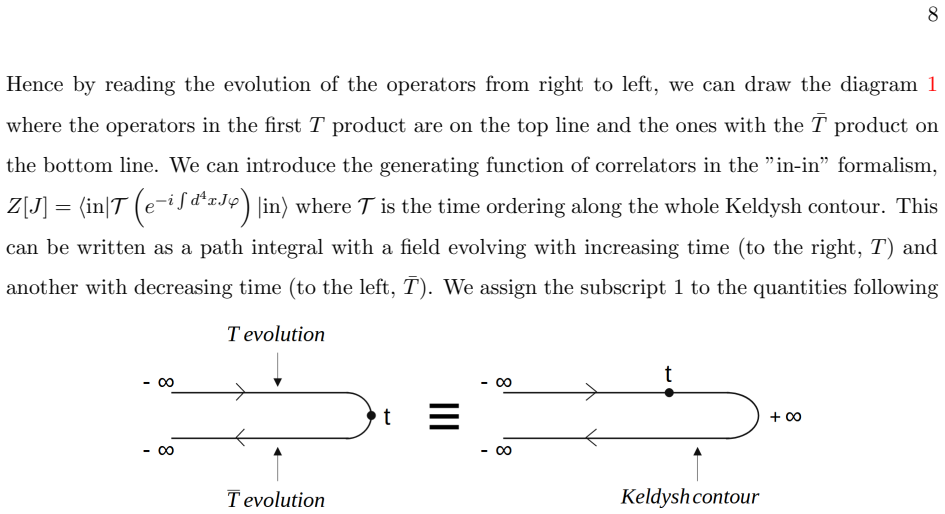
The Schwinger-Keldysh formalism applied to the effective field theory obtained by integrating out short-distance exchanges between matter (treated as a stochastic source) and light scalars, which generates both stochastic noise and new interactions.
What would settle it
An explicit evaluation of the integrated effective action that produces neither stochastic noise nor corrections to the scalar potential would show that matter does not influence large-scale scalar dynamics in the claimed way.
Extended reading notes
Core claim
After integrating out the short-distance dynamics of matter modelled as a stochastic source in the Schwinger-Keldysh formalism, the large-distance theory for light scalars includes a stochastic noise corresponding to exchanges between short and large scales and new interactions which can affect the time evolution of light scalars; in particular the resulting corrections to the scalar potential could lead to effects akin to dynamical dark energy, while screening of all substructures suppresses large-scale dynamics and produces a cosmic Meissner effect.
Load-bearing premise
Matter can be represented as a stochastic source whose short-distance exchanges with the scalar are integrated out without residual ultraviolet sensitivity or back-reaction on the matter itself.
Editorial extensions
If this is right
- Corrections to the Klein-Gordon equation arise from the new interactions generated by the integrated-out matter exchanges.
- These corrections can modify the scalar potential and produce effects similar to dynamical dark energy.
- Complete screening of all substructures suppresses the large-scale dynamics of the scalars.
- The suppression is described as a cosmic Meissner effect.
Reading between the lines
- Cosmological models of light scalars would need to incorporate back-reaction from the distribution of matter substructures.
- The effective theory offers a systematic route to include small-scale matter effects in calculations of scalar evolution on cosmic scales.
Editorial analysis
A structured set of objections, weighed in public.
Referee Report
Summary. The manuscript claims that modeling matter as a stochastic source and integrating out short-distance dynamics via the Schwinger-Keldysh formalism yields an effective theory for light scalars on large scales. This effective theory includes stochastic noise from scale exchanges and new interactions that modify the Klein-Gordon equation, producing corrections to the scalar potential that can resemble dynamical dark energy. In the fully screened limit, large-scale dynamics are suppressed, resulting in a cosmic Meissner effect.
Significance. If the integration procedure is free of cutoff artifacts and back-reaction issues, the work would demonstrate a concrete channel through which sub-horizon matter structures can influence the late-time evolution of light scalars, potentially linking small-scale clustering to apparent dark-energy behavior without additional fields. The systematic application of the Schwinger-Keldysh contour to derive both noise and induced interactions is a methodological strength that could be extended to other coupled systems.
major comments (2)
- [Schwinger-Keldysh integration and effective potential derivation] The central claim that the integrated corrections produce a potential shift 'akin to dynamical dark energy' (abstract and the paragraph following the SK construction) rests on the assumption that the stochastic source yields local, cutoff-independent operators after integration. No explicit demonstration is given that the matter two-point function or higher correlators do not generate non-local or divergent terms that survive the separation between short and large scales; if such terms remain, the effective potential depends on the arbitrary cutoff and the dark-energy analogy is not robust.
- [Screened limit discussion] The screened 'cosmic Meissner effect' (final paragraph) is presented as a qualitative suppression of large-scale dynamics, yet the manuscript provides neither the screening length scale nor the resulting modification to the scalar propagator or power spectrum. Without these, it is impossible to assess whether the effect is observationally distinguishable from standard screening mechanisms or consistent with existing bounds on scalar fifth forces.
minor comments (2)
- [Abstract] The abstract introduces the 'cosmic Meissner effect' without a brief parenthetical definition or reference to the analogy being drawn; a short clarifying phrase would improve accessibility.
- [Effective field theory section] Notation for the stochastic noise correlator and the induced interaction vertices is not introduced until after the SK contour is invoked; defining these symbols at first appearance would aid readability.
Simulated Author's Rebuttal
We thank the referee for their careful reading of the manuscript and for the constructive major comments. We respond to each point below, indicating planned revisions where appropriate.
read point-by-point responses
-
Referee: The central claim that the integrated corrections produce a potential shift 'akin to dynamical dark energy' (abstract and the paragraph following the SK construction) rests on the assumption that the stochastic source yields local, cutoff-independent operators after integration. No explicit demonstration is given that the matter two-point function or higher correlators do not generate non-local or divergent terms that survive the separation between short and large scales; if such terms remain, the effective potential depends on the arbitrary cutoff and the dark-energy analogy is not robust.
Authors: We agree that the manuscript does not contain an explicit calculation demonstrating that the integrated matter correlators produce strictly local, cutoff-independent operators in the effective potential. This omission weakens the robustness of the dynamical dark energy analogy. In the revised manuscript we will add a dedicated appendix deriving the leading correction from the matter two-point function on the Schwinger-Keldysh contour, showing that non-local contributions are suppressed by the short-distance cutoff and that any residual divergences are absorbed into a finite renormalization of the scalar mass and self-coupling, leaving the physical effective potential independent of the arbitrary scale separation. revision: yes
-
Referee: The screened 'cosmic Meissner effect' (final paragraph) is presented as a qualitative suppression of large-scale dynamics, yet the manuscript provides neither the screening length scale nor the resulting modification to the scalar propagator or power spectrum. Without these, it is impossible to assess whether the effect is observationally distinguishable from standard screening mechanisms or consistent with existing bounds on scalar fifth forces.
Authors: The cosmic Meissner effect is introduced as a limiting-case illustration rather than a quantitative prediction. The manuscript therefore supplies neither an explicit screening length nor the modified propagator. We will revise the final section to state explicitly that the discussion remains qualitative, to indicate how a screening length could be estimated once a concrete screening mechanism is specified, and to note that a comparison with fifth-force bounds lies outside the present scope. This clarification will be added without introducing new quantitative claims. revision: partial
Circularity Check
No significant circularity; derivation uses standard SK integration on stochastic source
full rationale
The paper constructs an EFT for light scalars by integrating short-distance matter dynamics via the Schwinger-Keldysh formalism, yielding stochastic noise and potential corrections as outputs of that procedure. No self-definitional loops, fitted inputs renamed as predictions, or load-bearing self-citations appear in the provided text. The central claim (corrections akin to dynamical dark energy) follows from the integration ansatz rather than presupposing the result. This is the expected non-circular outcome for a first-principles EFT derivation.
Assumptions & free parameters
assumptions (1)
- domain assumption Short-distance matter dynamics can be integrated out to yield a well-defined stochastic effective theory for the light scalar on large scales.
Cite this review
Pith. "Pith review of Matter influence on large-scale scalar dynamics." pith.science (2026). https://pith.science/paper/KIYMWRU6
@misc{pith2026260530926,
  author       = {Pith},
  title        = {Pith review of: Matter influence on large-scale scalar dynamics},
  year         = {2026},
  howpublished = {\url{https://pith.science/paper/KIYMWRU6}},
  note         = {Machine review of arXiv:2605.30926}
}
read the original abstract
Local structures in the Universe can influence the dynamics of light scalar fields when coupled to matter. We focus on light test fields evolving in matter modelled as a stochastic source. We describe the effective field theory for light scalars on large scales after integrating out the short distance dynamics. This is most conveniently performed in the Schwinger-Keldysh formalism where we find that the large distance theory involves a stochastic noise corresponding to the exchanges between short and large scales, and new interactions which can affect the time evolution of light scalars. We exemplify this back-reaction when the coupling between matter and scalars is small leading to corrections to the Klein-Gordon equation of the light scalars on large scales. In particular, the resulting corrections to the scalar potential could lead to effects akin to dynamical dark energy. We also consider the situation where all the substructures of the Universe are screened leading to the suppression of large scale dynamics and a cosmic Meissner effect. This highlights the potentially relevant effects of small scale structures on the cosmological dynamics of light scalar fields.
Figures
Reference graph
Works this paper leans on
-
[1]
At lowest order, the scalar perturbations on large scales obey the linear response theory
and a novel way of tackling the coincidence problem. At lowest order, the scalar perturbations on large scales obey the linear response theory. On the other hand, when all the structures of the 3 Universe are screened, the resulting dynamics on large scales are tightly determined to be that of a rapidly oscillating scalar at the background level and suppr...
-
[2]
This is useful as an illustration compared to the full complexity of the matter power spectrum deduced from the growth of cosmological perturbations
Time-local and translation invariant processes A simplifying and unrealistic assumption corresponds to taking that time and space translation invariance are respected by the matter distribution. This is useful as an illustration compared to the full complexity of the matter power spectrum deduced from the growth of cosmological perturbations. This hypothe...
-
[3]
In this context, ⃗kis just the usual comoving wavevector
The cosmological spectrum In the cosmological case that we consider here, we work in comoving coordinates in a spatially flat FRW universe. In this context, ⃗kis just the usual comoving wavevector. We normalise the scale factor toa(t 0) = 1 today, andP( ⃗k, t) should be understood as the matter power spectrum in these comoving coordinates at a given timet...
-
[4]
The unscreened case When no screening takes place, i.e. the local structures act only as perturbative corrections to the large scale dynamics, the cosmological field penetrates inside the local structures and serves as a background field everywhere in the Universe. This is a situation where the influence of the local matter density on the dynamics of the ...
-
[5]
Screening takes places when the Compton wavelength of the scalar field is much shorter than the size of the local matter over-densities
Screening When screening takes place locally, the short distance field is determined by the local matter density. Screening takes places when the Compton wavelength of the scalar field is much shorter than the size of the local matter over-densities. The field thus settles at the minimum of the effective potential and satisfies j>B′(¯Φ) +V ′(¯Φ) = 0.(60) ...
-
[6]
Unscreened short scales In the unscreened case, we can expand around the cosmological field and get Γ = X n≥0 Γ(n) (72) in powers of ¯Φ. We have for the leading term Γ(0)(ϕ+, ϕ−, ¯Φ) =− Z d4x√−g(∂ϕ −∂ϕ+ + V(ϕ + + ϕ− 2 )−V(ϕ + − ϕ− 2 ) + ¯J(B(ϕ + + ϕ− 2 )−B(ϕ + − ϕ− 2 ))) (73) and the corrections are given by Γ(n)(ϕ+, ϕ−, ¯Φ) =− Z d4x√−g( β mPl )n ¯Φn n! (...
-
[7]
This implies that A(L) =− iβ mPl Z |⃗ p|≥1 L /d3p P(⃗ p, ω(p))−P(⃗ p,−ω(p)) 2ω(p) (81) which depends onL
The correction to the Klein-Gordon equation: unscreened case Let us evaluate the coefficient of the leading correction to the long distance equation in the time-translation invariant case where A(L) = Z |⃗ p|≤1 L /dω/d3pei⃗ p.⃗ x−iωt⟨ Z /dω′/d3k ¯J(⃗k, ω′)¯Φ(⃗ p−⃗k, ω−ω ′)⟩.(78) Now using that space-time invariance is respected, we have ⟨j(⃗k, ω)j(⃗ p, ω′...
-
[8]
This can be written as Veff(¯ϕ) = 1 2 m2 ϕ(¯ϕ− ˆϕ)− 1 2 m2 ϕ ˆϕ2 (93) where ˆϕ=− βρ0 mPlm2 ϕ andm 2 ϕ =m 2 0 + β2 m2 Pl B2ρ0 is the mass squared of the cosmological field
Corrections to the potential The main effect of the short distance fluctuations on the large scale dynamics are encapsulated in the correction to the scalar potential (75) δV= β mPl A(L)B1(¯ϕ).(90) 21 When the model has a quadratic coupling to matter, the coefficientB 1(¯ϕ) is linear B1(¯ϕ) = 1 + β mPl B2 ¯ϕ.(91) A particularly interesting situation corre...
Show all 57 references
-
[9]
this large coupling between scalar and matter is the raison d’ˆ etre of screening and should be screened to avoid large effects of modified gravity
Screened short scales In the screened case, the large scale fields are perturbations of the short distance ¯Φ and we expand the effective action using B(ϕ+ Φ) = X n≥1 Bn(Φ) n! ( β mPl )nϕn (99) and the interaction potential V(ϕ+ Φ) = X n≥0 Vn(Φ) n! ( β mPl )nϕn.(100) We assume...
-
[10]
Unscreened The perturbed Klein-Gordon equation (76) reads □δϕ=W < ⋆((m 2 0 + ( β mPl )3A(L)B3(¯ϕ))δϕ+ β mPl B1(¯ϕ)δj< +ξ) (106) whereϕ= ¯ϕ+δϕandδj < =j < − ¯J0. The mass term is m2 0 =∂ 2 ϕ(V(ϕ) + ¯J0B(ϕ))|ϕ=¯ϕ.(107) 24 The full cosmological mass is corrected by the interactio...
-
[11]
This is the screening criterion guaranteeing that all substructures are screened
Screened In the screened case and from (102) we have directly in Fourier space δϕ= β mPl ⟨B1(¯Φ)⟩δj<(⃗k, ω) +ξ( ⃗k, ω) ω2 − ⃗k2 −M 2 1k≤ 1 L .(110) We now find that ifM≫Hthe quasi-static perturbations are strongly Yukawa suppressed by the large mass as δϕ(⃗ x, t)∼ −1 4π Z |⃗ x...
-
[12]
At this order we can then use the equivalence between Gaussian noises ξ(x)≡ β mPl B1(¯ϕ(t))j>(x) (121) relating the noise to the short distance random source
Unscreened dynamics In this case we have to leading order Γ− ⟨Γ⟩ ≃ β mPl Z d4x√−gj>B1(ϕ+)ϕ−.(115) This implies that the two-point function of the noise term is C2(Γ) 2 ≃ β2 2m2 Pl Z d4xd4y√−gx √−gyB1(ϕ+(x))B1(ϕ+(y))⟨j>(x)j>(y)⟩ϕ−(x)ϕ−(y) (116) leading to the two point function...
-
[13]
In (110) the noise contribution is potentially larger than the source coming from the large scale fluctuationsδj < contrary to the unscreened case
Screened dynamics In this case the leading order term is Γ− ⟨Γ⟩ ≃ β mPl Z d4x√−g∆ (V1(Φ) + ¯J B1(Φ) ϕ−.(123) Using the minimum equation we have Γ− ⟨Γ⟩ ≃ β mPl Z d4x√−gJ0∆(B1(Φ))ϕ− (124) implying that ⟨ξ(x)ξ(y)⟩ ≃( β mPl )2 ¯J0(t) ¯J0(t′)⟨∆B1(¯Φ)(x)∆B1(¯Φ)(y)⟩(125) As an order ...
-
[14]
E. J. Copeland, M. Sami, and S. Tsujikawa, Int. J. Mod. Phys. D15, 1753 (2006), hep-th/0603057
2006 arXiv
-
[15]
Joyce, B
A. Joyce, B. Jain, J. Khoury, and M. Trodden, Phys. Rept.568, 1 (2015), 1407.0059
2015 arXiv
-
[16]
Brax, Rept
P. Brax, Rept. Prog. Phys.81, 016902 (2018)
2018
-
[17]
A. G. Adame et al. (DESI) (2024), 2404.03002
2024 arXiv
- [18]
- [19]
-
[20]
T. M. C. Abbott et al. (DES) (2026), 2605.27221
2026 arXiv
- [21]
-
[22]
Brax, Phys
P. Brax, Phys. Rev. D112, 083544 (2025), 2507.16723
2025
-
[23]
Bertotti, L
B. Bertotti, L. Iess, and P. Tortora, Nature425, 374 (2003)
2003
-
[24]
Archidiacono, E
M. Archidiacono, E. Castorina, D. Redigolo, and E. Salvioni, JCAP10, 074 (2022), 2204.08484
2022
-
[25]
G´ omez-Valent, V
A. G´ omez-Valent, V. Pettorino, and L. Amendola, Phys. Rev. D101, 123513 (2020), 2004.00610
2020
-
[26]
S. Das, P. S. Corasaniti, and J. Khoury, Phys. Rev. D73, 083509 (2006), astro-ph/0510628
2006 arXiv
-
[27]
W. J. Wolf, P. G. Ferreira, and C. Garc´ ıa-Garc´ ıa, Phys. Rev. D111, L041303 (2025), 2409.17019
2025
-
[28]
Khoury, M.-X
J. Khoury, M.-X. Lin, and M. Trodden, Phys. Rev. Lett.135, 181001 (2025), 2503.16415
2025
-
[29]
Martin, C
J. Martin, C. Schimd, and J.-P. Uzan, Phys. Rev. Lett.96, 061303 (2006), astro-ph/0510208
2006 arXiv
-
[30]
P. Brax, S. Casas, H. Desmond, and B. Elder, Universe8, 11 (2021), 2201.10817
2021
- [31]
-
[32]
Khoury and A
J. Khoury and A. Weltman, Phys. Rev. Lett.93, 171104 (2004), astro-ph/0309300
2004 arXiv
- [33]
-
[34]
Hinterbichler and J
K. Hinterbichler and J. Khoury, Phys. Rev. Lett.104, 231301 (2010), 1001.4525
2010 arXiv
-
[35]
P. Brax, C. van de Bruck, A.-C. Davis, and D. Shaw, Phys. Rev. D82, 063519 (2010), 1005.3735
2010 arXiv
-
[36]
D. F. Mota and D. J. Shaw, Phys. Rev. Lett.97, 151102 (2006), hep-ph/0606204
2006 arXiv
-
[37]
C. P. Burgess,Introduction to Effective Field Theory(Cambridge University Press, 2020), ISBN 978- 1-139-04804-0, 978-0-521-19547-8
2020
-
[38]
Huterer, Astron
D. Huterer, Astron. Astrophys. Rev.31, 2 (2023), 2212.05003
2023
-
[39]
J. S. Schwinger, J. Math. Phys.2, 407 (1961)
1961
-
[40]
L. V. Keldysh, Zh. Eksp. Teor. Fiz.47, 1515 (1964)
1964
-
[41]
Colas, Z
T. Colas, Z. Qin, and X. Tong (2025), 2512.07941
2025
-
[42]
C. R. Contaldi and M. Pieroni (2026), 2603.23473
2026
-
[43]
S. Shao, B. Li, M. Cautun, H. Wang, and J. Wang, Mon. Not. Roy. Astron. Soc.489, 4912 (2019), 32 1907.02081
2019
-
[44]
L. D. Landau and E. M. Lifschitz,Statistical Physics(Pergamon press, 1969)
1969
-
[45]
Asgari, A
M. Asgari, A. J. Mead, and C. Heymans (2023), 2303.08752
2023
-
[46]
Ansari, A
A. Ansari, A. Banerjee, S. Jain, and S. Padhyegurjar, JCAP10, 018 (2025), 2406.17025
2025
-
[47]
Donath, M
Y. Donath, M. Lewandowski, and L. Senatore, Phys. Rev. D109, 123510 (2024), 2307.11409
2024
-
[48]
R. A. Porto, M. M. Riva, and Z. Yang (2024), 2409.05860
2024
-
[49]
Brax and E
P. Brax and E. Bruy` ere, Phys. Rev. D111, 064076 (2025), 2412.15092
2025
- [50]
- [51]
- [52]
-
[53]
Amoruso, G
R. Amoruso, G. Braga, A. Garoffolo, F. Lopez, N. Bartolo, and S. Matarrese (2026), 2604.15313
2026 arXiv
-
[54]
Donath and E
Y. Donath and E. Pajer, JHEP07, 064 (2024), 2402.05999
2024
-
[55]
Smith, P
A. Smith, P. Brax, C. van de Bruck, C. P. Burgess, and A.-C. Davis, Eur. Phys. J. C85, 1062 (2025), 2505.05450
2025
-
[56]
P. Brax, C. van de Bruck, A.-C. Davis, J. Khoury, and A. Weltman, Phys. Rev. D70, 123518 (2004), astro-ph/0408415
2004 arXiv
-
[57]
Kittel,Introduction to Solid State Physics(Wiley, 2004)
C. Kittel,Introduction to Solid State Physics(Wiley, 2004)
2004
Reviewed June 28, 2026 · model on record in the stance chip above.
Discussion (0). Sign in to comment.