Limits of the Non-Linear Generalized Langevin Equation: Cross-Correlations, Irreversibility and Desynchronization
Pith reviewed 2026-06-28 20:20 UTC · model grok-4.3
The pith
Non-linear forces induce cross-correlations in the GLE that make the noise position-dependent and irreversible, causing the equation to fail for strong non-linearities.
A machine-rendered reading of the paper's core claim, the machinery that carries it, and where it could break.
Core claim
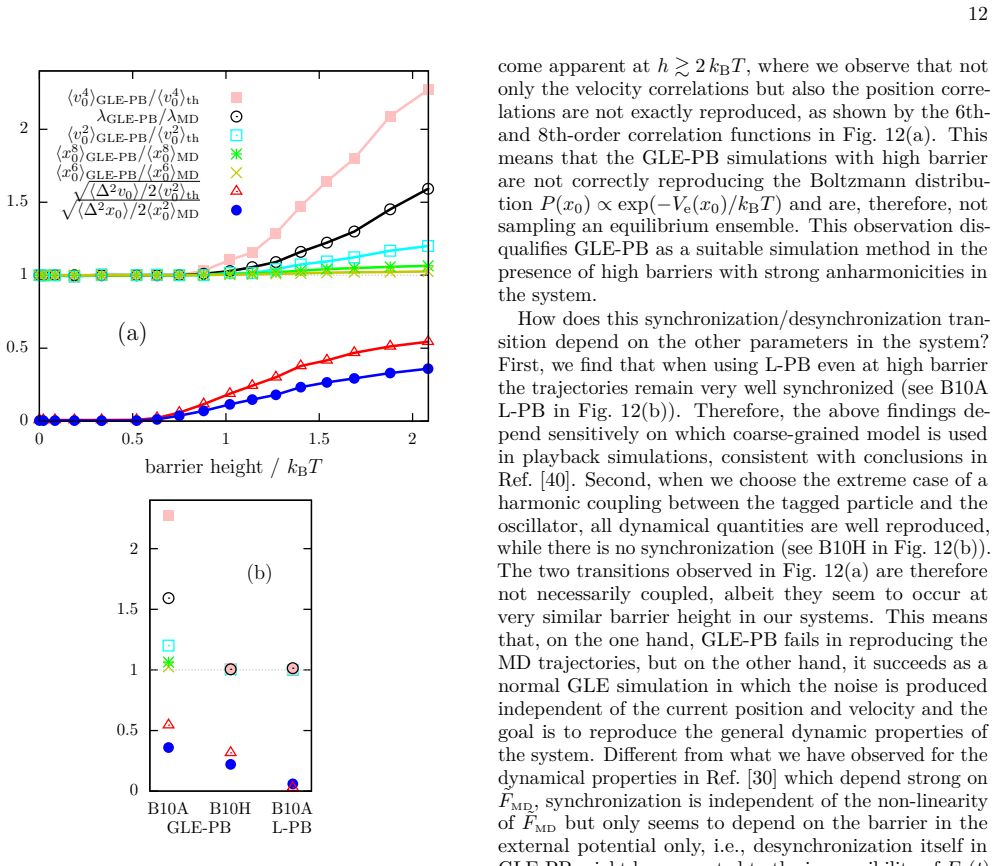
Non-linear forces generate cross-correlations with the noise, modifying the fluctuation-dissipation theorem and rendering the noise position-dependent and irreversible. This implies that the commonly assumed reversible Gaussian noise in GLE simulations fails to capture essential features of the microscopic fluctuations. For weak non-linearities, these issues can be partially resolved either by using an iterative optimization of memory or by using microscopically consistent noise, which synchronizes GLE trajectories with the underlying microscopic dynamics. For stronger non-linearities like high barriers or shoulders in the external potential, however, iterative reconstruction fails and desyn
What carries the argument
The cross-correlations between non-linear external forces and the random noise term in the generalized Langevin equation.
If this is right
- The fluctuation-dissipation theorem is modified by non-linear forces.
- Noise becomes position-dependent and irreversible.
- Iterative memory reconstruction works only for weak non-linearities.
- Consistent noise can synchronize trajectories for mild cases.
- Desynchronization signals failure of the non-linear GLE for strong potentials.
Where Pith is reading between the lines
- Researchers modeling systems with high energy barriers should consider alternatives to standard non-linear GLE.
- Explicit inclusion of position-dependent noise terms might extend the applicability of memory-based models.
- The observed desynchronization could be used as a diagnostic tool to check the validity of coarse-grained models.
Load-bearing premise
The practical numerical consequences observed in the simplified model accurately reflect the behavior in more complex soft-matter systems.
What would settle it
A direct comparison of GLE simulations with full microscopic dynamics for a potential with high barriers would show persistent desynchronization if the claim holds.
Figures


read the original abstract
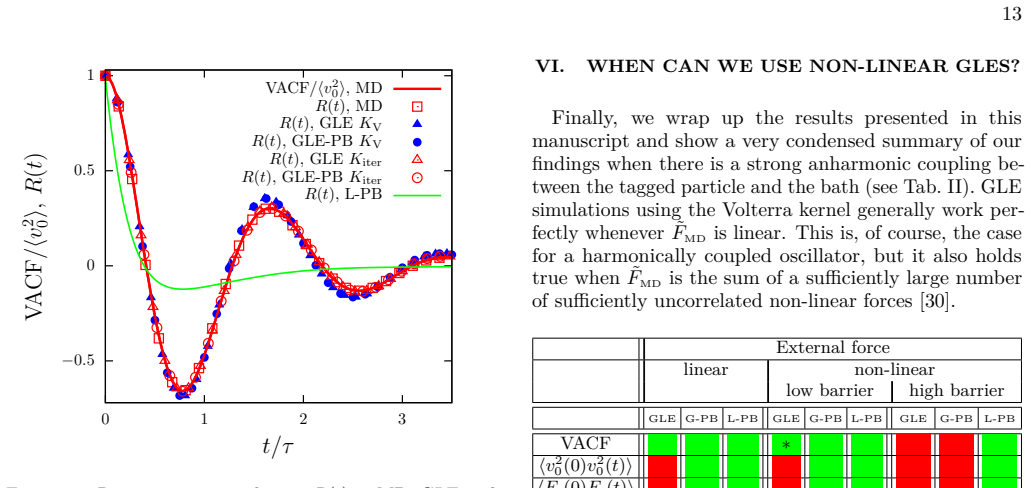
The generalized Langevin equation (GLE) is widely used to model complex soft-matter systems, including biomolecular dynamics, by incorporating memory effects and colored noise into coarse-grained descriptions. However, recent results suggest that combining memory with non-linear forces, ubiquitous in soft matter, introduces fundamental analytical inconsistencies. Here, using a simplified model, we investigate the practical numerical consequences of these analytical results. We show that non-linear forces generate cross-correlations with the noise, modifying the fluctuation-dissipation theorem and rendering the noise position-dependent and irreversible. This implies that the commonly assumed reversible Gaussian noise in GLE simulations fails to capture essential features of the microscopic fluctuations. For weak non-linearities, these issues can be partially resolved either by using an iterative optimization of memory or by using microscopically consistent noise, which unexpectedly synchronizes GLE trajectories with the underlying microscopic dynamics. For stronger non-linearities like high barriers or shoulders in the external potential, however, iterative reconstruction fails and we observe desynchronization, indicating that the non-linear GLE no longer correctly reproduces the microscopic dynamics. Our results show in which situations non-linear GLEs can be accurately applied and when they fail, thus providing practical guidance for their application to coarse-grain soft-matter systems.
Editorial analysis
A structured set of objections, weighed in public.
Referee Report
Summary. The paper investigates the practical numerical consequences of known analytical inconsistencies when combining memory with non-linear forces in the generalized Langevin equation (GLE), using a simplified model. It shows that non-linear forces generate cross-correlations with the noise, modifying the fluctuation-dissipation theorem and rendering the noise position-dependent and irreversible. For weak non-linearities, iterative memory optimization or microscopically consistent noise can partially resolve these issues and synchronize GLE trajectories with microscopic dynamics; for stronger non-linearities (high barriers or shoulders in the external potential), iterative reconstruction fails and desynchronization occurs, indicating that the non-linear GLE no longer reproduces the microscopic dynamics. The work provides practical guidance on when non-linear GLEs can be accurately applied in coarse-graining soft-matter systems.
Significance. If the numerical observations hold, the paper is significant for soft-matter modeling because it supplies concrete, falsifiable criteria (desynchronization under strong non-linearities) for when the standard reversible Gaussian noise assumption in GLE breaks down. The use of numerical experiments on a simplified model to illustrate the practical impact of analytical inconsistencies is a clear strength, as is the distinction between partial resolution for weak cases and outright failure for strong cases.
minor comments (1)
- [Abstract] Abstract: the long compound sentence describing the weak-nonlinearity resolution and the strong-nonlinearity failure could be split for readability.
Simulated Author's Rebuttal
We thank the referee for their supportive review, accurate summary of our findings, and recommendation for minor revision. We are pleased that the practical implications for soft-matter coarse-graining are recognized as significant.
Circularity Check
No significant circularity
full rationale
The paper investigates practical numerical consequences of known analytical inconsistencies in non-linear GLEs via simulations on a simplified model. Claims about cross-correlations, noise position-dependence, and desynchronization for strong non-linearities are grounded in direct numerical observations rather than any derivation that reduces to fitted inputs, self-definitions, or self-citation chains. No load-bearing steps match the enumerated circularity patterns; the work is self-contained against external benchmarks of the model dynamics.
Axiom & Free-Parameter Ledger
Reference graph
Works this paper leans on
-
[1]
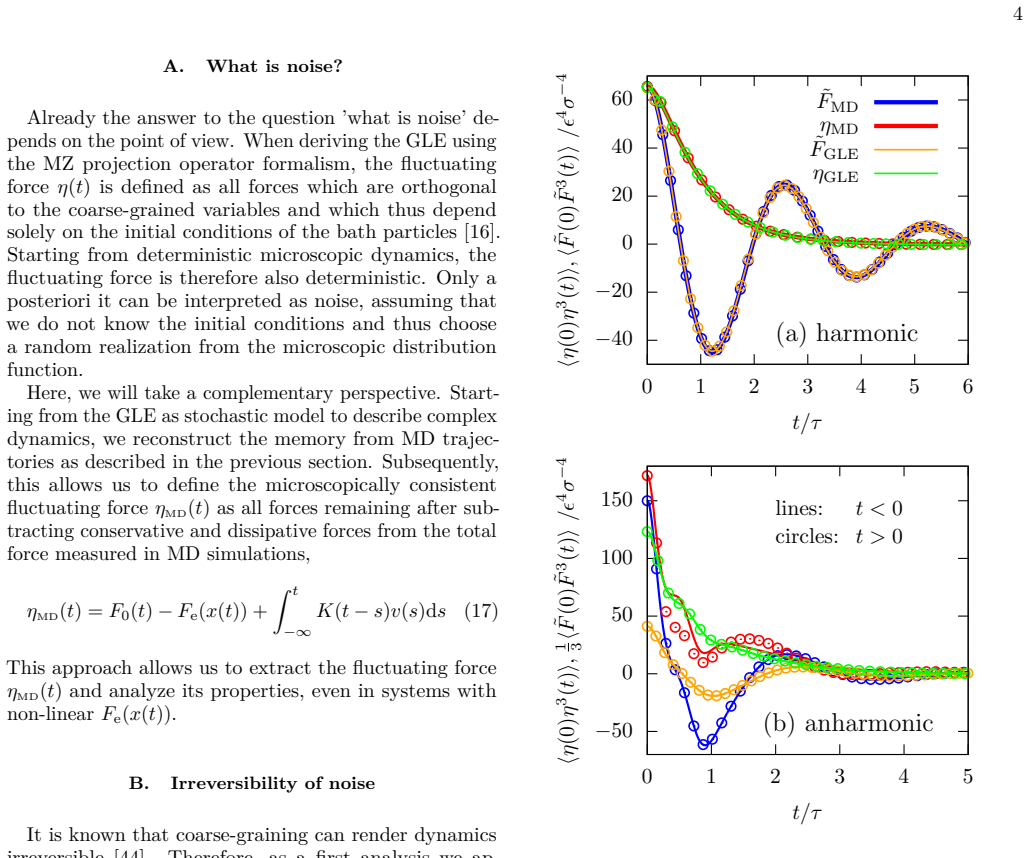
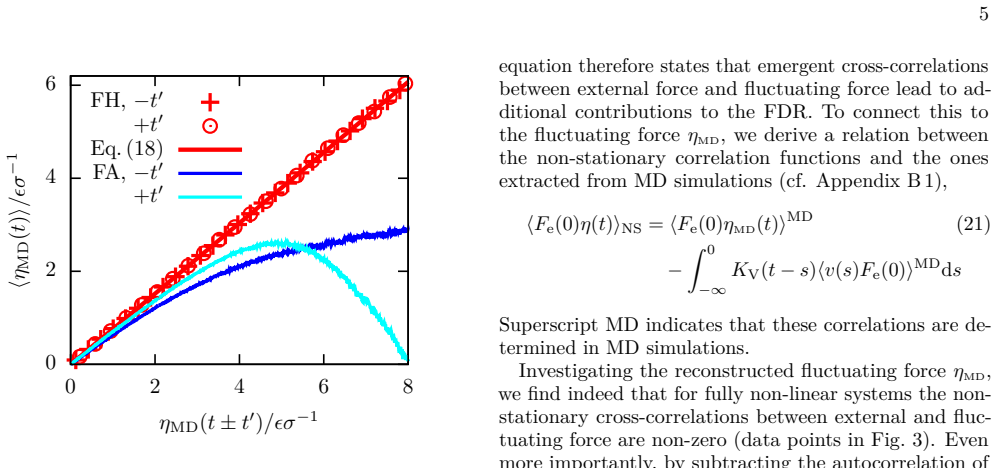
has shown that combining non-linear external forces with a position-independent memory kernel leads to a violation of the FDR in Eq. (4). Instead, the FDR con- tains additional terms corresponding to cross-correlations between the external force and the colored noise. Neglect- ing these cross-correlations leads to incorrect dynamics [35]. Numerically, it ...
-
[2]
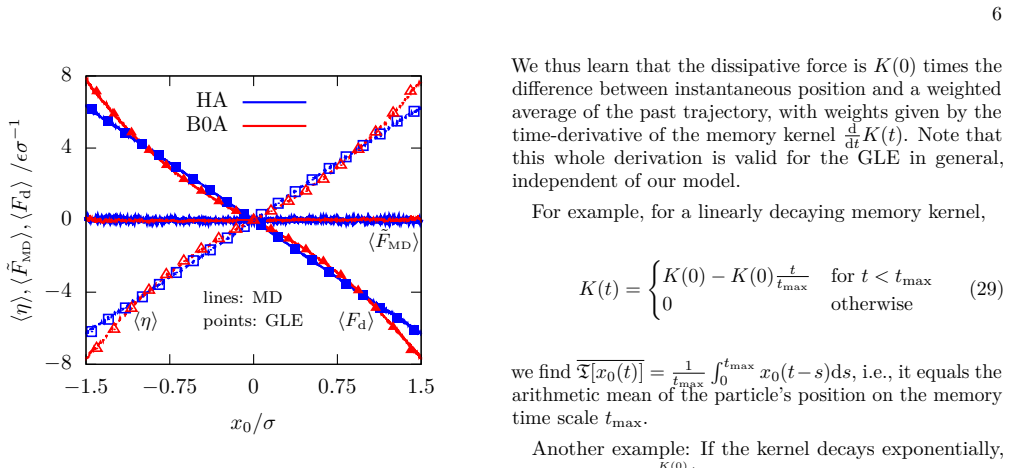
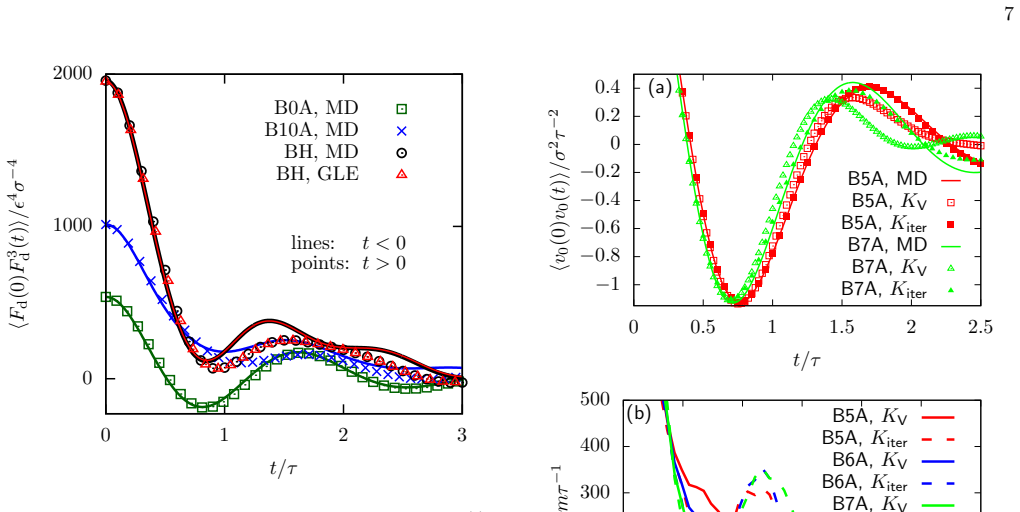
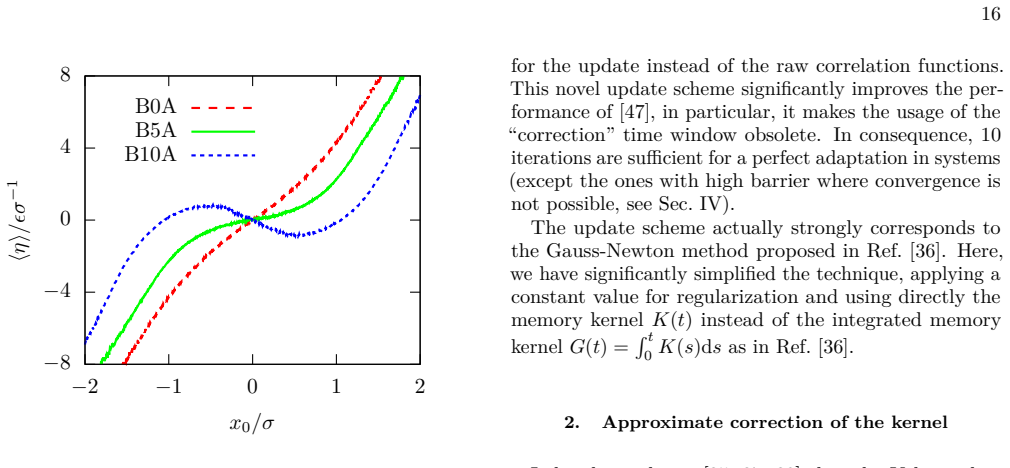
≡ ⟨ηMD⟩x′ 0 = T−1∫T 0 ηMD(t)δ(x′ 0−x0(t))dt, along an MD trajectory of lengthT , conditioned on the instantaneous positionx 0 of the tagged particle. We observe that the average value of the dissipative force⟨Fd⟩, calculated according to the GLE (Eq. (3)), de- pends on the instantaneous position of the particlex0 (see Fig. 4). The steeper the external pot...
-
[3]
(21) and discussion of Eq
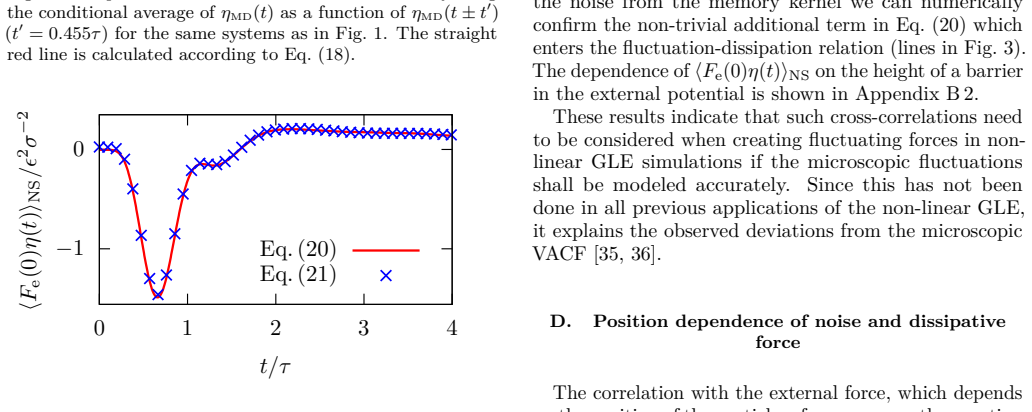
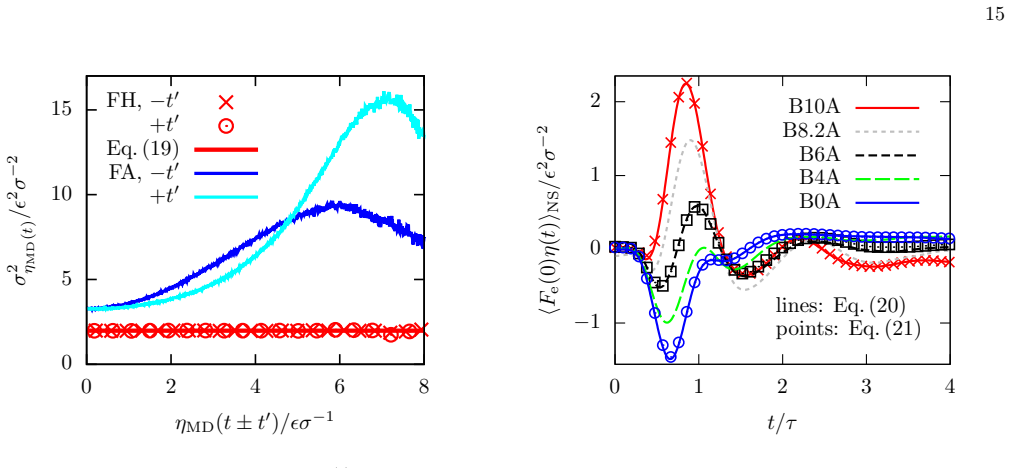
Derivation of Eq. (21) and discussion of Eq. (20) Eq. (20) has been shown in Ref. [29] for the non- stationary GLE where the convolution integral in the GLE starts att = 0.When performing coarse-grained simulations in stationary systems, which is basically al- ways the case, however, we want to start the convolution integral at t→ −∞.Here, we show how we ...
-
[4]
How- ever, when a barrier is introduced, a small positive peak develops next to the negative one
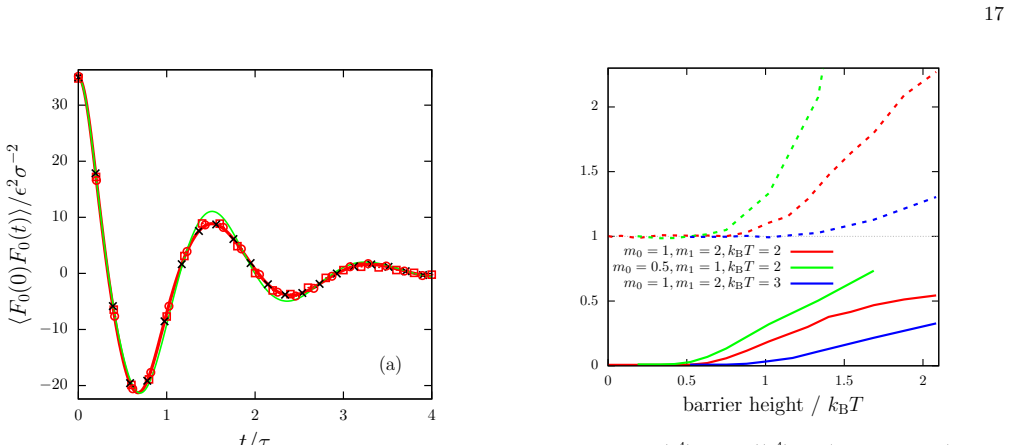
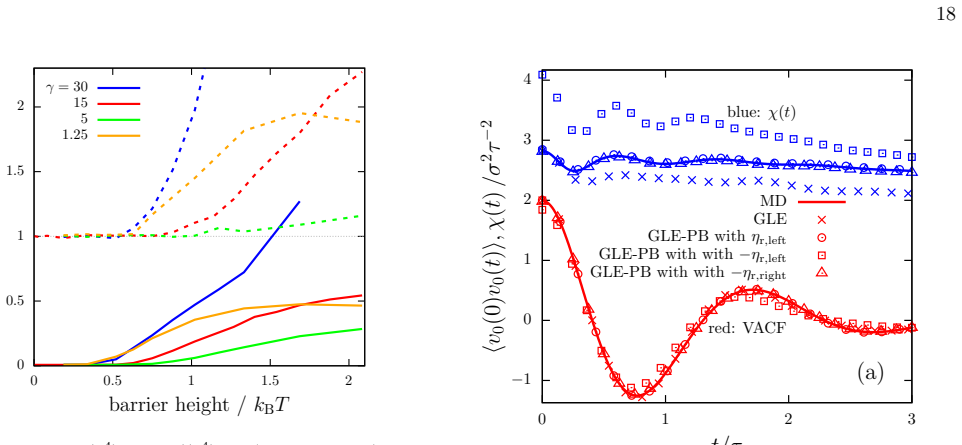
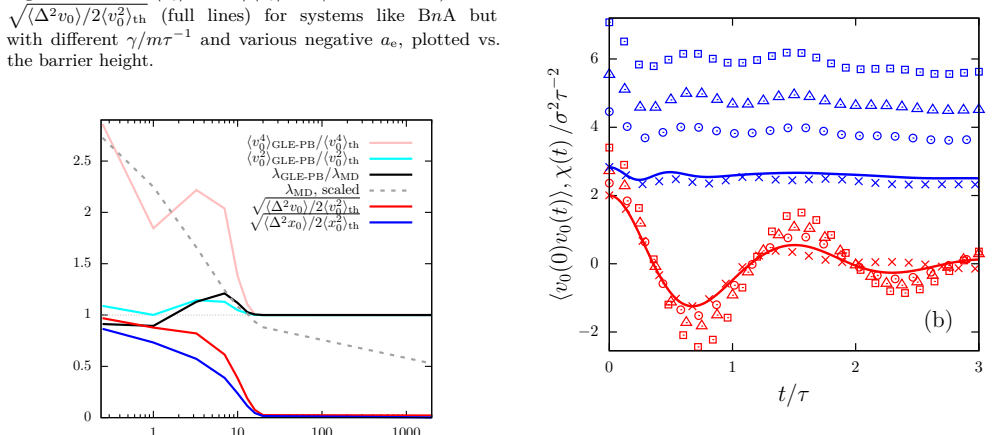
Growing barrier heights In systems without a barrier in the external potential, ⟨Fe(0)η(t)⟩NS exhibits a dominant negative peak. How- ever, when a barrier is introduced, a small positive peak develops next to the negative one. As the barrier increases, the negative peak shrinks and the positive grows. At a barrier heighth = 0.75kBT, they exhibit approxima...
-
[5]
IV we have used an iterative optimization to find memory kernels which correctly reproduce the VACF
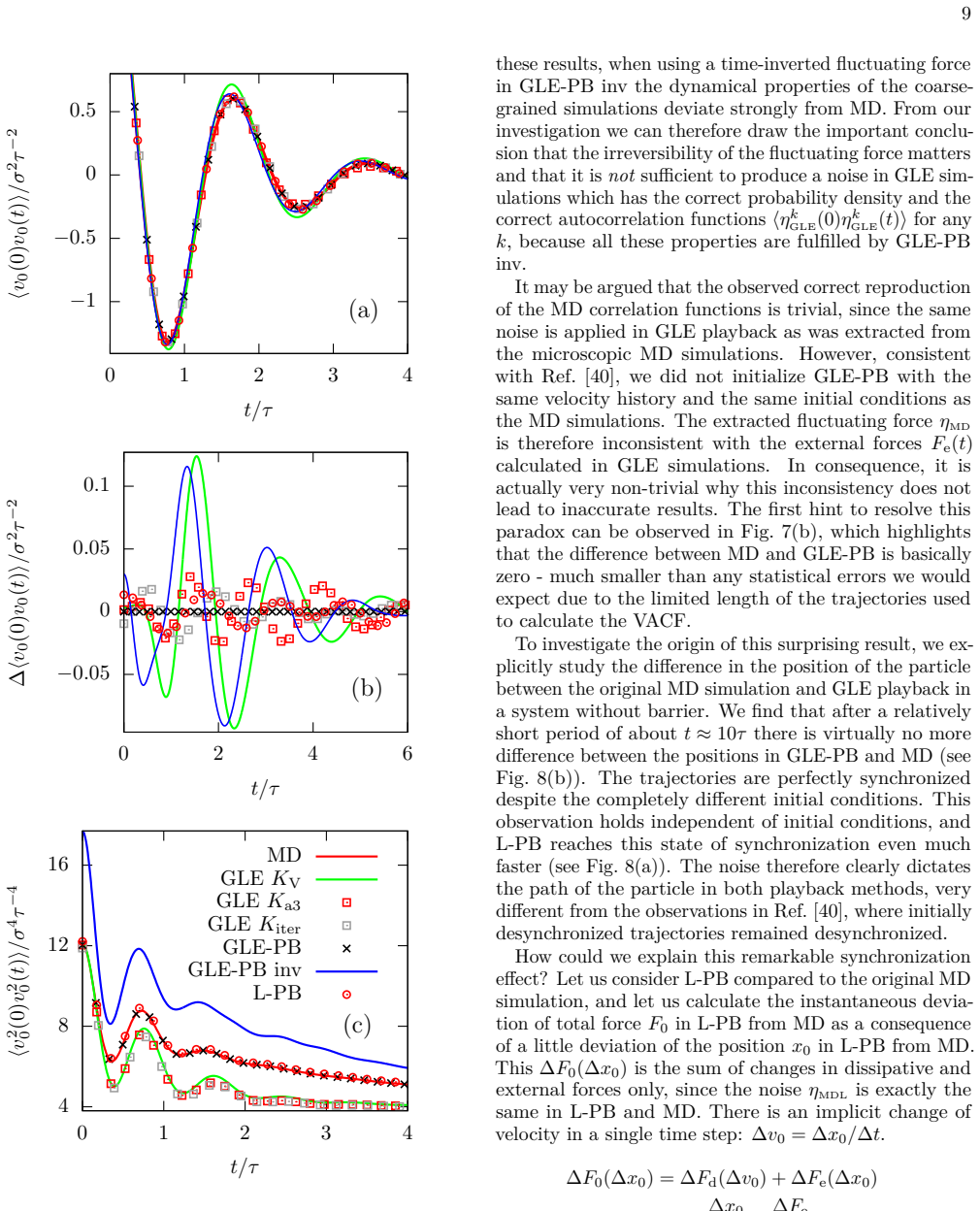
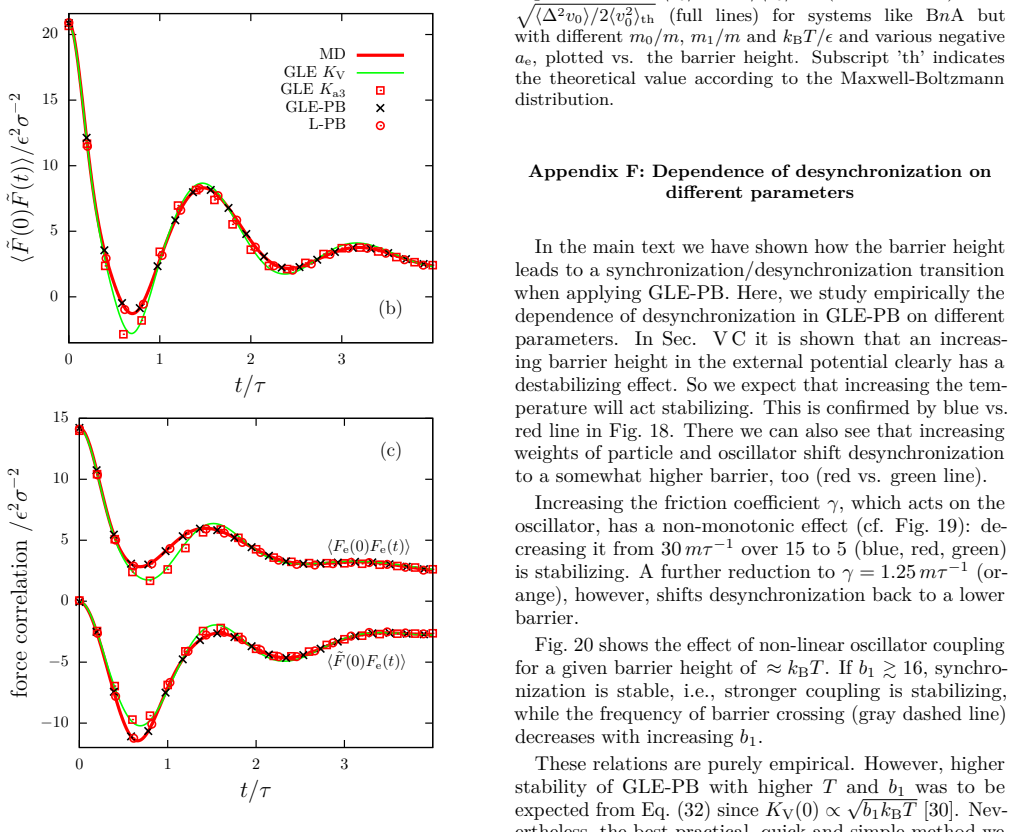
Iterative optimization of non-linear GLE In Sec. IV we have used an iterative optimization to find memory kernels which correctly reproduce the VACF. Here, we provide some details on the methodology. The iterative reconstruction we applied is a mixture of the original method presented in Ref. [47] and an improved update scheme proposed in Refs. [36, 37]. ...
-
[6]
Perform GLE simulations using the current optimal kernel Ki and Gaussian correlated noise with a correlation function proportional to the memory kernel
-
[7]
(16) using the GLE correla- tion functions with the only exception that instead of the oscillator force ˜FMD we use the total force F0
Extract the dynamic correlation functions from the GLE simulations and calculate the kernelˆKi.Here, ˆKi is evaluated from Eq. (16) using the GLE correla- tion functions with the only exception that instead of the oscillator force ˜FMD we use the total force F0
-
[8]
correction
Calculate the updated kernel, Ki+1 = Ki 1+ ˆKV 1+ ˆKi , where ˆKV is extracted using Eq. (16) based on the original MD correlation functions, again with the exception that the total forceF0 is used instead of ˜FMD. Different from the original iterative method [47], we in- clude a multiplicative correction and use the kernelˆK for the update instead of the...
-
[9]
This can be done either by iterative reconstruction of the kernel (see above) or by a simple approximation formula [35]: Ka2(t) =K V(t) +⟨Fe(0)η(t)⟩NS kBT (D1) For⟨η(t)Fe(0)⟩NS, cf
Approximate correction of the kernel It has been shown [35, 37, 38] that the Volterra ker- nel can be modified in such a way that the VACF will be correctly reproduced in GLE simulations of fully an- harmonic systems. This can be done either by iterative reconstruction of the kernel (see above) or by a simple approximation formula [35]: Ka2(t) =K V(t) +⟨F...
-
[10]
Robert Brown. XXVII. A brief account of microscopical observations made in the months of June, July and August 1827, ontheparticlescontainedinthepollenofplants; and on the general existence of active molecules in organic and inorganic bodies.The Philosophical Magazine, 4(21):161– 173, 1828
-
[11]
Über die von der molekularkinetischen Theorie der Wärme geforderte Bewegung von in ruhenden Flüssigkeiten suspendierten Teilchen.Annalen der Physik, 322(8):549–560, 1905
Albert Einstein. Über die von der molekularkinetischen Theorie der Wärme geforderte Bewegung von in ruhenden Flüssigkeiten suspendierten Teilchen.Annalen der Physik, 322(8):549–560, 1905
1905
-
[12]
Sur la théorie du mouvement brownien
Paul Langevin. Sur la théorie du mouvement brownien. Comptes-rendus de l’Académie des sciences, 146:530–533, 1908
1908
-
[13]
Long time atomistic polymer trajectories from coarse grained simulations: bisphenol-A polycarbonate
Berk Hess, Salvador León, Nico Van Der Vegt, and Kurt Kremer. Long time atomistic polymer trajectories from coarse grained simulations: bisphenol-A polycarbonate. Soft Matter, 2(5):409–414, 2006
2006
-
[14]
Ethylbenzene diffusion in polystyrene: united atom atomistic/coarse grained simulations and experiments.Macromolecules, 40(19):7026–7035, 2007
VA Harmandaris, NP Adhikari, Nico FA van der Vegt, Kurt Kremer, BA Mann, R Voelkel, H Weiss, and CheeChin Liew. Ethylbenzene diffusion in polystyrene: united atom atomistic/coarse grained simulations and experiments.Macromolecules, 40(19):7026–7035, 2007
2007
-
[15]
Systematic coarse- graining of the dynamics of entangled polymer melts: the road from chemistry to rheology.Journal of Physics: Condensed Matter, 23(23):233101, 2011
JT Padding and Willem J Briels. Systematic coarse- graining of the dynamics of entangled polymer melts: the road from chemistry to rheology.Journal of Physics: Condensed Matter, 23(23):233101, 2011
2011
-
[16]
Xu-Ze Zhang, Rui Shi, Ming-Ji Fang, Zhong-Yuan Lu, and Hu-Jun Qian. Topological dissipation as the miss- ing link in multiscale polymer dynamics.arXiv preprint arXiv:2508.12359, 2025
-
[17]
Diffusion models of protein folding.Physical Chemistry Chemical Physics, 13(38):16902–16911, 2011
Robert B Best and Gerhard Hummer. Diffusion models of protein folding.Physical Chemistry Chemical Physics, 13(38):16902–16911, 2011
2011
-
[18]
Mesoscopicmembranephysics: concepts, simulations, and selected applications.Macromolecular Rapid Communications, 30(9-10):752–771, 2009
MarkusDeserno. Mesoscopicmembranephysics: concepts, simulations, and selected applications.Macromolecular Rapid Communications, 30(9-10):752–771, 2009
2009
-
[19]
Viktor Klippenstein, Madhusmita Tripathy, Gerhard Jung, Friederike Schmid, and Nico F. A. van der Vegt. Introducing memory in coarse-grained molecular simula- tions.The Journal of Physical Chemistry B, 125(19):4931– 4954, 2021
2021
-
[20]
Fast protein folding is governed by memory-dependent fric- tion.Proceedings of the National Academy of Sciences, 120(31):e2220068120, 2023
Benjamin A Dalton, Cihan Ayaz, Henrik Kiefer, An- ton Klimek, Lucas Tepper, and Roland R Netz. Fast protein folding is governed by memory-dependent fric- tion.Proceedings of the National Academy of Sciences, 120(31):e2220068120, 2023
2023
-
[21]
Anal- ysis of the dynamics in linear chain models by means of generalized Langevin equations.Journal of Statistical Physics, 191(5):57, 2024
Fabian Koch, Suvendu Mandal, and Tanja Schilling. Anal- ysis of the dynamics in linear chain models by means of generalized Langevin equations.Journal of Statistical Physics, 191(5):57, 2024
2024
-
[22]
Chapman-Kolmogorov test for esti- mating memory length of two coupled processes.Scientific Reports, 15(1):11603, 2025
H Motahari, M Ghanbarzadeh Noudehi, Tayeb Jamali, and G Reza Jafari. Chapman-Kolmogorov test for esti- mating memory length of two coupled processes.Scientific Reports, 15(1):11603, 2025
2025
-
[23]
Memory effects in irreversible thermo- dynamics.Phys
Robert Zwanzig. Memory effects in irreversible thermo- dynamics.Phys. Rev., 124:983–992, 1961
1961
-
[24]
Transport, collective motion, and Brownian motion.Progress of Theoretical Physics, 33(3):423–455, 1965
Hazime Mori. Transport, collective motion, and Brownian motion.Progress of Theoretical Physics, 33(3):423–455, 1965
1965
-
[25]
Oxford University Press, 2001
Robert Zwanzig.Nonequilibrium statistical mechanics. Oxford University Press, 2001
2001
-
[26]
Projection operators in statistical mechanics: a pedagogical approach
Michael te Vrugt and Raphael Wittkowski. Projection operators in statistical mechanics: a pedagogical approach. European Journal of Physics, 41(4):045101, 2020
2020
-
[27]
The fluctuation-dissipation theorem.Re- ports on Progress in Physics, 29(1):255–284, 1966
Ryogo Kubo. The fluctuation-dissipation theorem.Re- ports on Progress in Physics, 29(1):255–284, 1966
1966
-
[28]
Martin Hanke. The second fluctuation-dissipation theo- rem for the generalized Langevin equation.arXiv preprint arXiv:2507.17350, 2025
-
[29]
Collective Langevin dynamics of conformational motions in proteins
Oliver F Lange and Helmut Grubmüller. Collective Langevin dynamics of conformational motions in proteins. The Journal of Chemical Physics, 124(21), 2006
2006
-
[30]
Equation of motion for coarse-grained simulation based on microscopic de- scription.Physical Review E—Statistical, Nonlinear, and Soft Matter Physics, 75(5):051109, 2007
Tomoyuki Kinjo and Shi-aki Hyodo. Equation of motion for coarse-grained simulation based on microscopic de- scription.Physical Review E—Statistical, Nonlinear, and Soft Matter Physics, 75(5):051109, 2007
2007
-
[31]
Zhen Li, Hee Sun Lee, Eric Darve, and George Em Kar- niadakis. Computing the non-Markovian coarse-grained interactions derived from the Mori–Zwanzig formalism in molecular systems: application to polymer melts.The Journal of Chemical Physics, 146(1), 2017
2017
-
[32]
Generalized Langevin dynamics: construction and numer- ical integration of non-Markovian particle-based models
Gerhard Jung, Martin Hanke, and Friederike Schmid. Generalized Langevin dynamics: construction and numer- ical integration of non-Markovian particle-based models. Soft Matter, 14(46):9368–9382, 2018
2018
-
[33]
General theory of the viscosity of liq- uids and solids from nonaffine particle motions.Physical Review E, 108:044101, 2023
Alessio Zaccone. General theory of the viscosity of liq- uids and solids from nonaffine particle motions.Physical Review E, 108:044101, 2023
2023
-
[34]
Chemically specific systematic coarse-grained polymer model with both consistently structural and dynamical properties.JACS Au, 4(3):1018–1030, 2024
Xu-Ze Zhang, Rui Shi, Zhong-Yuan Lu, and Hu-Jun Qian. Chemically specific systematic coarse-grained polymer model with both consistently structural and dynamical properties.JACS Au, 4(3):1018–1030, 2024
2024
-
[35]
Data- driven learning of the generalized Langevin equation with state-dependent memory.Physical Review Letters, 133(7):077301, 2024
Pei Ge, Zhongqiang Zhang, and Huan Lei. Data- driven learning of the generalized Langevin equation with state-dependent memory.Physical Review Letters, 133(7):077301, 2024
2024
-
[36]
Fabian Glatzel and Tanja Schilling. The interplay between memory and potentials of mean force: a discussion on the structure of equations of motion for coarse-grained observables.Europhysics Letters, 136(3):36001, 2021
2021
-
[37]
Position- dependent memory kernel in generalized Langevin equa- tions: theory and numerical estimation.The Journal of Chemical Physics, 156(24), 2022
Hadrien Vroylandt and Pierre Monmarché. Position- dependent memory kernel in generalized Langevin equa- tions: theory and numerical estimation.The Journal of Chemical Physics, 156(24), 2022
2022
-
[38]
On the derivation of the general- ized Langevin equation and the fluctuation-dissipation theorem.Europhysics Letters, 140(6):62003, 2022
Hadrien Vroylandt. On the derivation of the general- ized Langevin equation and the fluctuation-dissipation theorem.Europhysics Letters, 140(6):62003, 2022
2022
-
[39]
Dynamic coarse-graining of linear and non-linear systems: Mori–Zwanzig formal- ism and beyond.The Journal of Chemical Physics, 20 159(8):084110, 2023
Bernd Jung and Gerhard Jung. Dynamic coarse-graining of linear and non-linear systems: Mori–Zwanzig formal- ism and beyond.The Journal of Chemical Physics, 20 159(8):084110, 2023
2023
-
[40]
Sergei Izvekov. Mori-Zwanzig projection operator formal- ism: generalized Langevin equation dynamics of a classical system perturbed by an external generalized potential and far from equilibrium.Physical Review E, 111(3):034130, 2025
2025
-
[41]
Langevin equation with potential of mean force: the case of anchored bath.Journal of Statis- tical Mechanics: Theory and Experiment, 2026(1):013204, 2026
Alex V Plyukhin. Langevin equation with potential of mean force: the case of anchored bath.Journal of Statis- tical Mechanics: Theory and Experiment, 2026(1):013204, 2026
2026
-
[42]
Langevin equations with non-Gaussian thermal noise: valid but superfluous.Physical Review E, 113(1):014139, 2026
Alex V Plyukhin. Langevin equations with non-Gaussian thermal noise: valid but superfluous.Physical Review E, 113(1):014139, 2026
2026
-
[43]
Snap, crackle, and pop: this is why the potential of mean force clashes with the fluctuation dissipation relation.Euro- physics Letters, 154(5):57001, 2026
Fabian Koch, Tabita Wasmer, and Tanja Schilling. Snap, crackle, and pop: this is why the potential of mean force clashes with the fluctuation dissipation relation.Euro- physics Letters, 154(5):57001, 2026
2026
-
[44]
Viktor Klippenstein and Nico F. A. van der Vegt. Cross- correlation corrected friction in (generalized) Langevin models.The Journal of Chemical Physics, 154(19):191102, 2021
2021
-
[45]
Bottom-up informed and iteratively optimized coarse-grained non- Markovian water models with accurate dynamics.Journal of Chemical Theory and Computation, 19(4):1099–1110, 2023
ViktorKlippensteinandNicoFAvanderVegt. Bottom-up informed and iteratively optimized coarse-grained non- Markovian water models with accurate dynamics.Journal of Chemical Theory and Computation, 19(4):1099–1110, 2023
2023
-
[46]
Viktor Klippenstein, Niklas Wolf, and Nico F. A. van der Vegt. A Gauss–Newton method for iterative optimization of memory kernels for generalized Langevin thermostats in coarse-grained molecular dynamics simulations.The Journal of Chemical Physics, 160(20):204115, 2024
2024
-
[47]
Niklas Wolf, Viktor Klippenstein, and Nico F. A. van der Vegt. Cross-correlations in the fluctuation–dissipation relation influence barrier-crossing dynamics.The Journal of Chemical Physics, 162(5):054113, 2025
2025
-
[48]
Matching correlations matters: modeling friction in a hydrophobic folding transition.The Journal of Chemical Physics, 163(12), 2025
Niklas Wolf, Madhusmita Tripathy, and Nico FA van der Vegt. Matching correlations matters: modeling friction in a hydrophobic folding transition.The Journal of Chemical Physics, 163(12), 2025
2025
-
[49]
Henrik Kiefer, Benjamin J. A. Héry, Lucas Tepper, Ben- jamin A. Dalton, Cihan Ayaz, and Roland R. Netz. Analy- sis and simulation of generalized Langevin equations with non-Gaussian orthogonal forces.The Journal of Chemical Physics, 163(18):184114, 2025
2025
-
[50]
Fractional kinetics in Kac-Zwanzig heat bath models.Journal of Statistical Physics, 114(1/2):291– 326, 2004
Raz Kupferman. Fractional kinetics in Kac-Zwanzig heat bath models.Journal of Statistical Physics, 114(1/2):291– 326, 2004
2004
-
[51]
Implicit-solvent coarse-grained modeling for polymer solutions via Mori- Zwanzig formalism.Soft Matter, 15(38):7567–7582, 2019
Shu Wang, Zhen Li, and Wenxiao Pan. Implicit-solvent coarse-grained modeling for polymer solutions via Mori- Zwanzig formalism.Soft Matter, 15(38):7567–7582, 2019
2019
-
[52]
Brownian motion from molecular dynam- ics.Chemical Physics, 375(2-3):316–326, 2010
Hyun Kyung Shin, Changho Kim, Peter Talkner, and Eok Kyun Lee. Brownian motion from molecular dynam- ics.Chemical Physics, 375(2-3):316–326, 2010
2010
-
[53]
Asymmetry, abstraction, and autonomy: justifying coarse-graining in statistical mechanics.The British Journal for the Philosophy of Science, 71(2):547– 579, 2020
Katie Robertson. Asymmetry, abstraction, and autonomy: justifying coarse-graining in statistical mechanics.The British Journal for the Philosophy of Science, 71(2):547– 579, 2020
2020
-
[54]
Statistical features of systems driven by non-Gaussian processes: theory & practice.Jour- nal of Statistical Mechanics: Theory and Experiment, 2023(11):113202, 2023
Dario Lucente, Andrea Puglisi, Massimiliano Viale, and Angelo Vulpiani. Statistical features of systems driven by non-Gaussian processes: theory & practice.Jour- nal of Statistical Mechanics: Theory and Experiment, 2023(11):113202, 2023
2023
-
[55]
Thomas Franosch. Fundamental problems in sta- tistical physics XIV: Lecture on correlation and re- sponse functions in statistical physics.arXiv preprint arXiv:2603.29481, 2026
-
[56]
Iter- ative reconstruction of memory kernels.Journal of Chem- ical Theory and Computation, 13(6):2481–2488, 2017
Gerhard Jung, Martin Hanke, and Friederike Schmid. Iter- ative reconstruction of memory kernels.Journal of Chem- ical Theory and Computation, 13(6):2481–2488, 2017
2017
-
[57]
Generalized Langevin dynamics simulation with non- stationary memory kernels: how to make noise.The Journal of Chemical Physics, 157(19), 2022
Christoph Widder, Fabian Koch, and Tanja Schilling. Generalized Langevin dynamics simulation with non- stationary memory kernels: how to make noise.The Journal of Chemical Physics, 157(19), 2022
2022
-
[58]
Learn- ing stochastic dynamics with statistics-informed neural network.Journal of Computational Physics, 474:111819, 2023
Yuanran Zhu, Yu-Hang Tang, and Changho Kim. Learn- ing stochastic dynamics with statistics-informed neural network.Journal of Computational Physics, 474:111819, 2023
2023
-
[59]
Forced harmonic vibra- tion in a Duffing oscillator with negative linear stiffness and linear viscous damping
Stefano Lenci and Giuseppe Rega. Forced harmonic vibra- tion in a Duffing oscillator with negative linear stiffness and linear viscous damping. InThe Duffing Equation, chapter 7, pages 219–276. John Wiley & Sons, Ltd, 2011
2011
-
[60]
Fluctuation- dissipation relations far from equilibrium: a case study
Gerhard Jung and Friederike Schmid. Fluctuation- dissipation relations far from equilibrium: a case study. Soft Matter, 17(26):6413–6425, 2021
2021
-
[61]
Gian-Michele Cherchi, Alain Dequidt, Arnaud Guillin, Nicolas Martzel, Patrice Hauret, and Vincent Barra. ML- GLE: A machine learning enhanced generalized Langevin equation framework for transient anomalous diffusion in polymer dynamics.Journal of Computational Physics, 514:113210, 2024
2024
-
[62]
Force renormalization for probes immersed in an active bath
JeanineShea, GerhardJung, andFriederikeSchmid. Force renormalization for probes immersed in an active bath. Soft Matter, 20(8):1767–1785, 2024
2024
-
[63]
The influence of multi-dimensionality and off-diagonal non-Markovian friction coupling on coarse- grained dynamics.New Journal of Physics, 27(11):115004, 2025
Henrik Kiefer, Cihan Ayaz, Benjamin A Dalton, and Roland R Netz. The influence of multi-dimensionality and off-diagonal non-Markovian friction coupling on coarse- grained dynamics.New Journal of Physics, 27(11):115004, 2025
2025
-
[64]
Determining ex- tended Markov parameterizations for vector-valued gener- alized Langevin equations.Zeitschrift für Naturforschung A, 81(2):157–171, 2026
Niklas Bockius, Maximilian Braun, Kay Hofmann, Friederike Schmid, and Martin Hanke. Determining ex- tended Markov parameterizations for vector-valued gener- alized Langevin equations.Zeitschrift für Naturforschung A, 81(2):157–171, 2026
2026
-
[65]
Benjamin JA Héry, Lucas Tepper, Andrea Guljas, Artem Pavlov, Beate Koksch, Cecilia Clementi, and Roland R Netz. Non-equilibrium generalized Langevin equationformulti-dimensionalobservables.arXiv preprint arXiv:2603.09850, 2026
-
[66]
From generalized Langevin equations to Brownian dynamics and embedded Brownian dynamics.The Journal of Chemical Physics, 145(11), 2016
Lina Ma, Xiantao Li, and Chun Liu. From generalized Langevin equations to Brownian dynamics and embedded Brownian dynamics.The Journal of Chemical Physics, 145(11), 2016
2016
-
[67]
Mori-Zwanzig projection operator formalism for far-from-equilibrium systems with time-dependent Hamiltonians.Physical Review E, 99(6):062118, 2019
Michael Te Vrugt and Raphael Wittkowski. Mori-Zwanzig projection operator formalism for far-from-equilibrium systems with time-dependent Hamiltonians.Physical Review E, 99(6):062118, 2019
2019
-
[68]
Non-Markovian systems out of equilibrium: exact results for two routes of coarse graining.Journal of Physics: Condensed Matter, 34(20):204004, 2022
Gerhard Jung. Non-Markovian systems out of equilibrium: exact results for two routes of coarse graining.Journal of Physics: Condensed Matter, 34(20):204004, 2022
2022
-
[69]
Mobility, response and transport in non- equilibrium coarse-grained models.Journal of Physics A: Mathematical and Theoretical, 57(9):095004, 2024
Gerhard Jung. Mobility, response and transport in non- equilibrium coarse-grained models.Journal of Physics A: Mathematical and Theoretical, 57(9):095004, 2024
2024
-
[70]
Derivation of a generalized Langevin equation from a generic time- dependent Hamiltonian.Journal of Physics A: Mathe- matical and Theoretical, 57(50):505003, 2024
Benjamin JA Héry and Roland R Netz. Derivation of a generalized Langevin equation from a generic time- dependent Hamiltonian.Journal of Physics A: Mathe- matical and Theoretical, 57(50):505003, 2024
2024
-
[71]
Generalized Langevin equation with 21 a nonlinear potential of mean force and nonlinear memory friction from a hybrid projection scheme.Physical Review E, 105(5):054138, 2022
Cihan Ayaz, Laura Scalfi, Benjamin A Dalton, and Roland R Netz. Generalized Langevin equation with 21 a nonlinear potential of mean force and nonlinear memory friction from a hybrid projection scheme.Physical Review E, 105(5):054138, 2022
2022
-
[72]
Divya Jaganathan and Rahil N. Valani. Markovian em- bedding of nonlinear memory via spectral representation. Communications in Nonlinear Science and Numerical Sim- ulation, 154:109540, 2026
2026
-
[73]
General validity of the second fluctuation-dissipation theorem in the nonequilibrium steady state: theory and applications
Yuanran Zhu, Huan Lei, and Changho Kim. General validity of the second fluctuation-dissipation theorem in the nonequilibrium steady state: theory and applications. Physica Scripta, 98(11):115402, 2023
2023
discussion (0)
Sign in with ORCID, Apple, or X to comment. Anyone can read and Pith papers without signing in.