Toward Accessible Mobile Money: A Voice-Driven, Biometrically Secured USSD Automation Framework for Visually Impaired Users
Pith reviewed 2026-06-28 21:39 UTC · model grok-4.3
The pith
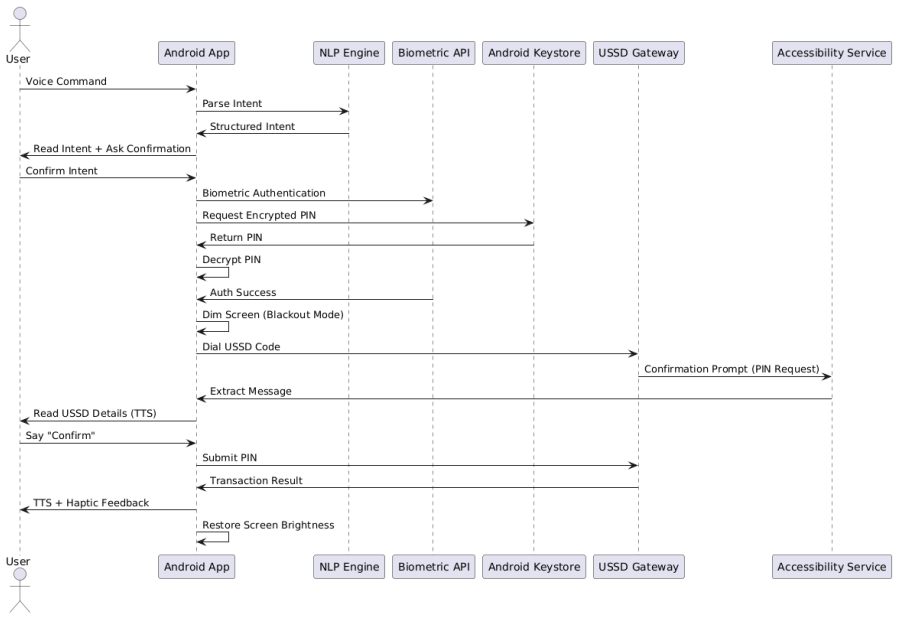
Android middleware automates USSD mobile money transactions for visually impaired users via voice input, biometric PIN injection, and screen blackout.
A machine-rendered reading of the paper's core claim, the machinery that carries it, and where it could break.
Core claim
The proposed Android-based intelligent middleware automates USSD transactions, integrates biometric-secured PIN injection, and introduces a privacy-preserving screen-dimming mechanism called Blackout Mode, enabling independent and secure voice-based mobile money access with task success rates above 90 percent and completion times of 12-15 seconds.
What carries the argument
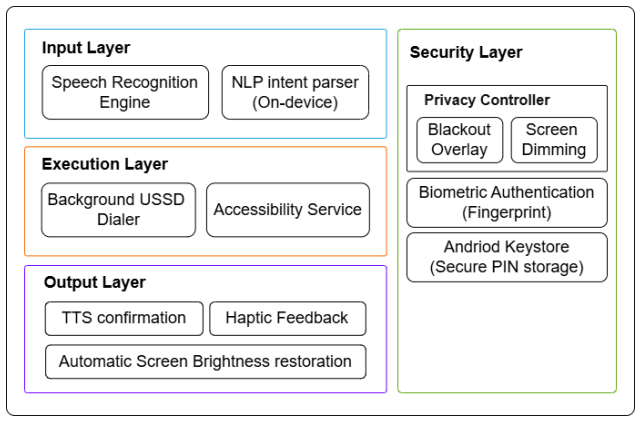
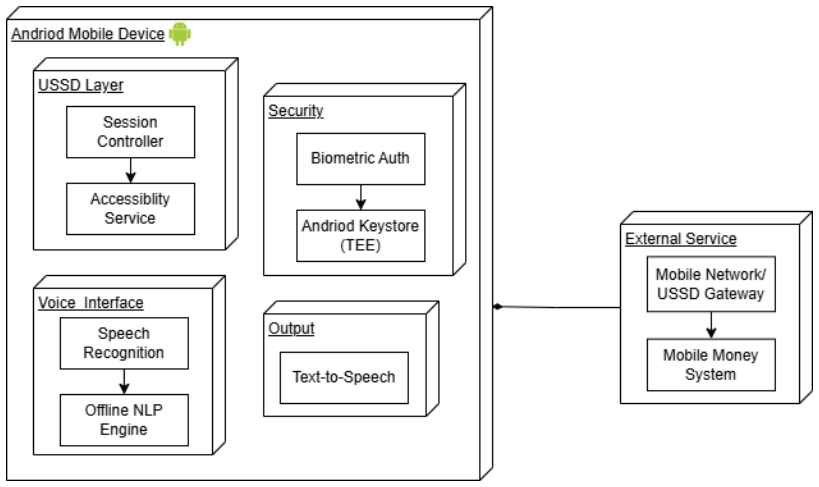
Android Accessibility Services driving USSD sessions together with hardware-backed Keystore for biometric PIN injection and on-device natural language parsing.
If this is right
- Users no longer need third-party assistance for PIN entry, lowering fraud exposure.
- Transaction success rates rise from the 65-75 percent range to above 90 percent.
- Average completion time drops from 40-60 seconds to 12-15 seconds.
- Perceived security improves through biometric confirmation instead of spoken or shared PINs.
- Voice-driven operation works on devices where screen readers are incompatible with USSD.
Where Pith is reading between the lines
- The same automation layer could be applied to other USSD services such as bill payments or airtime purchases in the same markets.
- Reducing reliance on sighted assistants may decrease social friction and stigma around financial transactions for visually impaired users.
- Blackout Mode could be extended to other sensitive input flows on Android beyond USSD.
Load-bearing premise
Android Accessibility Services can reliably drive USSD sessions to completion without timing out and target devices have functional biometric hardware whose Keystore integration works consistently for PIN injection.
What would settle it
A controlled test on standard Android devices in which the middleware either fails to complete a USSD session before timeout or cannot inject the PIN after biometric authentication.
Figures
read the original abstract
Financial inclusion has expanded significantly across Africa through mobile money services delivered primarily via USSD technology. However, visually impaired individuals continue to face accessibility and security barriers when conducting financial transactions. Current USSD systems are not designed for non-visual interaction, forcing users to rely on third-party assistance even for PIN entry, thereby increasing fraud exposure and reducing transaction confidence. Although alternative assistive technologies such as screen readers exist, they are not compatible with USSD operations, often causing sessions to time out before the user can complete a transaction. This paper presents an Android-based intelligent middleware that automates USSD transactions, integrates biometric-secured PIN injection, and introduces a privacy-preserving screen-dimming mechanism: Blackout Mode. The system leverages Android Accessibility Services, hardware-backed Keystore security, and on-device natural language parsing to enable independent, secure voice-based mobile money access. We show that the proposed solution improves task success rates from 65-75% to more than 90% and reduces transaction completion time from 40-60 seconds to 12-15 seconds, while also improving perceived security.
Editorial analysis
A structured set of objections, weighed in public.
Referee Report
Summary. The manuscript describes an Android middleware that automates USSD mobile-money sessions via Accessibility Services, adds hardware-backed Keystore biometric PIN injection, and includes a privacy-preserving Blackout Mode. It targets visually impaired users who currently rely on third-party assistance and reports that the system raises task success from 65-75% to >90% while cutting completion time from 40-60 s to 12-15 s.
Significance. If the performance numbers are shown to be reproducible, the work would address a concrete barrier to financial inclusion for visually impaired users in USSD-dominant markets by removing the need for sighted assistance during PIN entry.
major comments (2)
- [Abstract] Abstract: the quantitative claims (success rate >90 %, time 12-15 s) are presented without any description of participant count, study protocol, statistical tests, or baseline conditions, so the support for the central empirical result cannot be assessed.
- [Evaluation] No section supplies device-, network-, or provider-level benchmarks on USSD timeout rates, Accessibility Service reliability under realistic latency, or biometric Keystore consistency across Android versions/hardware; these untested premises directly underpin the reported improvements over screen-reader baselines.
minor comments (1)
- [Abstract] The abstract refers to 'on-device natural language parsing' without indicating the parser, grammar, or accuracy figures; a short methods paragraph would clarify the implementation.
Simulated Author's Rebuttal
We thank the referee for the detailed and constructive comments. We agree that the current presentation of the quantitative results requires additional methodological context and supporting benchmarks to allow proper assessment of the claims. We will revise the manuscript accordingly.
read point-by-point responses
-
Referee: [Abstract] Abstract: the quantitative claims (success rate >90 %, time 12-15 s) are presented without any description of participant count, study protocol, statistical tests, or baseline conditions, so the support for the central empirical result cannot be assessed.
Authors: We agree that the abstract presents the performance numbers without sufficient methodological context. In the revised manuscript we will expand the abstract with a concise description of the user study (participant count, within-subjects protocol comparing against screen-reader baseline, and statistical tests employed) while keeping the abstract within length limits. The full protocol and results will be elaborated in the Evaluation section. revision: yes
-
Referee: [Evaluation] No section supplies device-, network-, or provider-level benchmarks on USSD timeout rates, Accessibility Service reliability under realistic latency, or biometric Keystore consistency across Android versions/hardware; these untested premises directly underpin the reported improvements over screen-reader baselines.
Authors: We acknowledge that the manuscript currently lacks these specific reliability benchmarks. We will add a new subsection to the Evaluation section reporting device compatibility tests, USSD session timeout measurements under varying network latencies, Accessibility Service behavior under realistic conditions, and Keystore biometric consistency across multiple Android versions and hardware platforms. These additions will directly support the claimed improvements. revision: yes
Circularity Check
No circularity: system implementation with empirical evaluation claims
full rationale
The paper is a description of an Android middleware system using Accessibility Services, Keystore, and NLP for USSD automation. The central claims (success rate >90%, time 12-15s) are presented as measured outcomes from user testing rather than derived predictions or equations. No self-definitional loops, fitted inputs renamed as predictions, or load-bearing self-citations appear. The derivation chain is self-contained as an engineering artifact with external benchmarks possible via device testing.
Axiom & Free-Parameter Ledger
Reference graph
Works this paper leans on
-
[1]
Alajarmeh, N. (2021). Non-visual access to mobile devices: A survey of touchscreen accessibility for users who are visually impaired. Displays, 70:102081. Billah, S. M., Ashok, V., Porter, D. E., and Ramakr- ishnan, I. V. (2017). Ubiquitous accessibility for people with visual impairments: Are we there yet? In Proceedings of the 2017 CHI Conference on Hum...
2021
-
[2]
Low tech, high impact: USSD in the time of COVID-19 | mobile for development
GSMA (2020). Low tech, high impact: USSD in the time of COVID-19 | mobile for development. ht tps://www.gsma.com/solutions-and-impact/co nnectivity-for-good/mobile-for-development/u ncategorized/low-tech-high-impact-ussd-in-the -time-of-covid-19/ . Accessed: Nov. 10,
2020
-
[3]
Model ict accessibility policy report
International Telecommunication Union (2024). Model ict accessibility policy report. Accessed: 2026-04-16. Kibera, I. W. (2025). A framework for enhancing the accessibility of mobile banking applications for visually impaired customers in the kenyan banking sector. Master’s thesis, United States International University Africa. Muuo, S. W. et al. (2024). ...
2024
-
[4]
Oh, U., Joh, H., and Lee, Y. (2021). Image accessibil- ity for screen reader users: A systematic review and a road map. Electronics, 10(8). Safaricom (2017). Safaricom enhances M-PESA for visually impaired customers. https://www.safa ricom.co.ke/media-center-landing/press-release s/safaricom-enhances-m-pesa-for-visually-imp aired-customers. Accessed: Nov. 10,
2021
-
[5]
Mobile money in africa
Statista (2025). Mobile money in africa. https://ww w.statista.com/topics/6770/mobile-money-in-a frica/. Accessed: 2026-04-16. UNDP Rwanda (2021). Assessment of the impact of COVID-19 on persons with disabilities in Rwanda. Technical report, United Nations De- velopment Programme. World Bank Group (2022). Financial inclusion. https: //www.worldbank.org/ex...
2025
discussion (0)
Sign in with ORCID, Apple, or X to comment. Anyone can read and Pith papers without signing in.