Refining the Gaia DR3 Parallax Zero-point: A Hybrid Approach Combining Global Parametric Correction with Local Refinement
Pith reviewed 2026-06-28 21:03 UTC · model grok-4.3
The pith
A hybrid global-then-local correction reduces Gaia DR3 parallax residuals to near zero across the sky.
A machine-rendered reading of the paper's core claim, the machinery that carries it, and where it could break.
Core claim
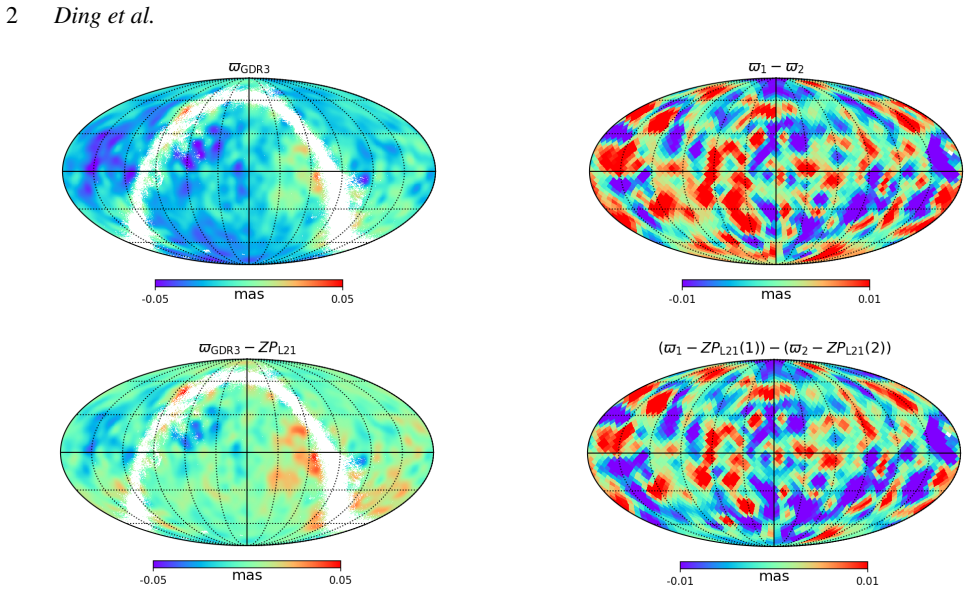
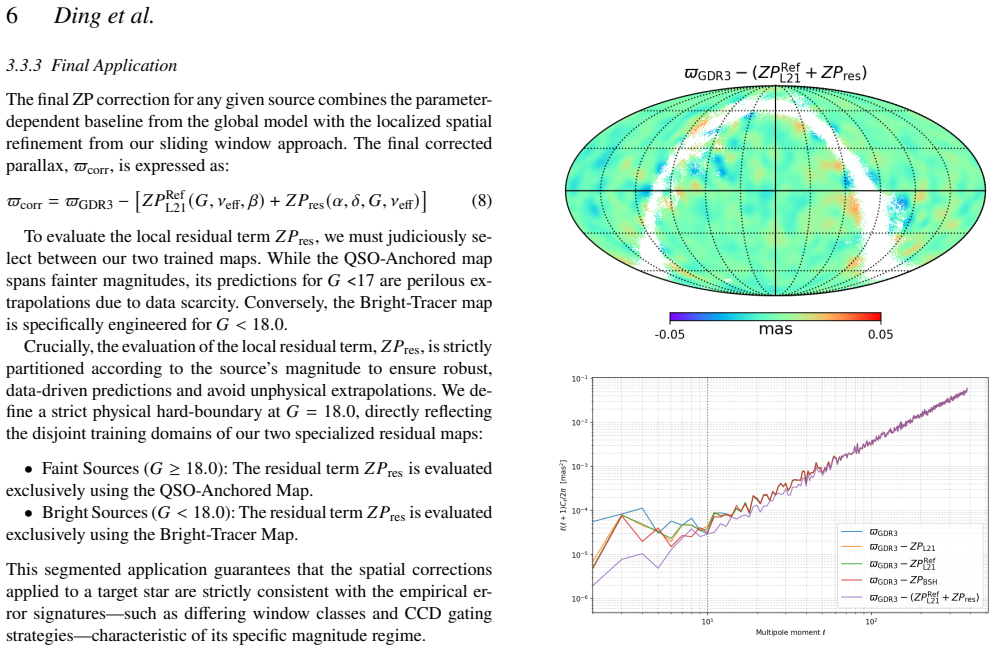
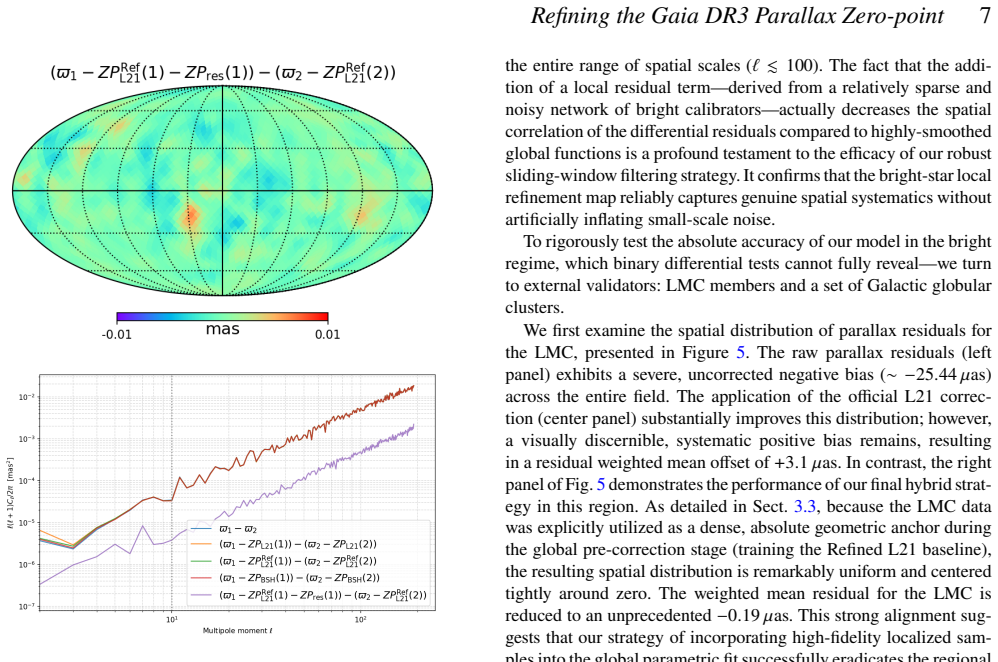
The hybrid strategy first subtracts the L21 magnitude- and color-dependent zero-point, then applies a sliding-window k-nearest-neighbor fit to the remaining spatial variations; the combined correction produces a residual parallax map that is flat and consistent with zero bias over the entire sky for both bright and faint regimes.
What carries the argument
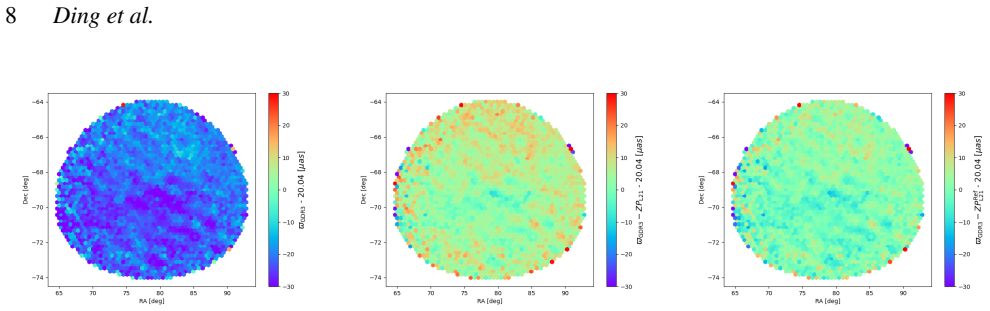
The 'Global Pre-correction + Local Refinement' hybrid, in which the L21 parametric model removes the dominant magnitude and color trends and a sliding-window local non-parametric fit then removes position-dependent residuals using quasars, wide binaries, and LMC stars as references.
If this is right
- Parallax measurements for both bright and faint stars become more uniform in accuracy across all sky positions.
- Distance and kinematic inferences derived from Gaia DR3 improve without introducing new large-scale or small-scale systematics.
- The same two-stage template supplies a concrete reference procedure for constructing the zero-point map in Gaia DR4.
Where Pith is reading between the lines
- The method implies that any remaining zero-point structure after L21 is largely local and can be captured by nearest-neighbor averaging rather than additional global parameters.
- If the reference samples themselves carry subtle position-dependent errors, those errors would be imprinted into the final map and could be diagnosed by cross-checking against a third independent reference population.
- The sliding-window approach could be extended to include color or magnitude as additional local dimensions if tests reveal that the current separation into G>18 and G<18 regimes is insufficient.
Load-bearing premise
The chosen reference samples supply unbiased estimates of the true zero-point inside each local window without selection effects or spatial variations that differ from those of the target stars.
What would settle it
Applying the hybrid correction to an independent sample of stars with independently known distances, such as members of open clusters or globular clusters distributed across the sky, and finding position-dependent residuals larger than a few microarcseconds would falsify the near-zero bias claim.
Figures
read the original abstract
The Gaia Data Release 3 (GDR3) parallaxes are affected by a complex bias that depends on stellar magnitude, color, and celestial position, with amplitudes reaching tens of microarcseconds ($\mu$as). Standard global parametric models (e.g., Lindegren et al. 2021, hereafter L21) effectively remove large-scale trends but struggle to resolve small-scale spatial systematics due to functional rigidity. We aim to construct a flexible, data-driven calibration map that eliminates these residual local systematics without imposing rigid functional forms. We propose a "Global Pre-correction + Local Refinement" hybrid strategy. First, we utilize the L21 model as a baseline to remove the dominant magnitude and color-dependent biases. Second, we model the residual zero-point using a Local Non-parametric method based on a Sliding Window technique. This approach fits local trends using k-nearest neighbors from quasars (for faint stars, G>18) and wide binaries combined with Large Magellanic Cloud (LMC) (for bright stars, G < 18). Our hybrid model demonstrates significant improvements over the standard L21 solution. Validation against different samples reveals a remarkably flat residual map with near-zero bias across the full sky. Our mathematical attempt at calibrating the parallax zero-point is expected to provide a useful reference for the zero-point correction in future Gaia DR4, and to help move towards a physical resolution of this issue.
Editorial analysis
A structured set of objections, weighed in public.
Referee Report
Summary. The manuscript proposes a hybrid 'Global Pre-correction + Local Refinement' strategy for the Gaia DR3 parallax zero-point. It first applies the Lindegren et al. (2021) global parametric model to remove magnitude- and color-dependent biases, then fits residual spatial systematics via a sliding-window kNN non-parametric method using quasars (G>18) and wide binaries plus the LMC (G<18) as local references. The central claim is that the resulting correction produces a remarkably flat residual map with near-zero bias across the full sky and significant improvement over the L21 solution alone.
Significance. If the local reference samples prove to supply unbiased zero-point estimates whose systematics match those of the target stars, the hybrid map would supply a flexible, data-driven correction that resolves small-scale spatial residuals left by rigid global models. This could improve parallax accuracy for a broad range of applications and serve as a useful reference for DR4 zero-point work. The approach is data-driven on external references rather than self-referential, which is a methodological strength.
major comments (2)
- [Abstract] The claim that the hybrid model yields 'a remarkably flat residual map with near-zero bias across the full sky' (Abstract) is load-bearing for the paper's contribution. This rests on the untested assumption that the local reference samples (quasars for G>18; wide binaries + LMC for G<18) supply unbiased local zero-point estimates whose selection effects and spatial/magnitude-dependent systematics exactly match those of the science targets. Any differential bias (e.g., quasar color cuts, binary orbital selection, LMC depth effects) would propagate directly into the refined map.
- [Abstract] No quantitative validation statistics, error budgets, window-size sensitivity tests, or explicit comparisons of residual maps before/after the local step are provided in the abstract or described in sufficient detail to evaluate whether the 'significant improvements' over L21 are robust or sample-dependent.
Simulated Author's Rebuttal
We thank the referee for the detailed and constructive report. The two major comments both focus on the abstract and the strength of the supporting evidence for the hybrid correction. We address each point below and have made targeted revisions to improve clarity and transparency without altering the core methodology or claims.
read point-by-point responses
-
Referee: [Abstract] The claim that the hybrid model yields 'a remarkably flat residual map with near-zero bias across the full sky' (Abstract) is load-bearing for the paper's contribution. This rests on the untested assumption that the local reference samples (quasars for G>18; wide binaries + LMC for G<18) supply unbiased local zero-point estimates whose selection effects and spatial/magnitude-dependent systematics exactly match those of the science targets. Any differential bias (e.g., quasar color cuts, binary orbital selection, LMC depth effects) would propagate directly into the refined map.
Authors: We agree that the fidelity of the local references is central to the result and that differential systematics could in principle affect the map. The manuscript already employs three independent reference populations (quasars, wide binaries, and LMC stars) chosen to bracket the magnitude range and to allow cross-checks; the consistency of the residual maps across these tracers is presented in Section 4. To make this assumption explicit and to quantify its impact, we will add a new subsection (Section 3.4) that discusses known selection effects in each reference sample, reports the overlap in color-magnitude space with the science targets, and shows the residual maps obtained when each reference population is used in isolation. revision: yes
-
Referee: [Abstract] No quantitative validation statistics, error budgets, window-size sensitivity tests, or explicit comparisons of residual maps before/after the local step are provided in the abstract or described in sufficient detail to evaluate whether the 'significant improvements' over L21 are robust or sample-dependent.
Authors: The main text already contains quantitative metrics (median residual, RMS, and sky maps before/after the local step) and validation on held-out samples (Section 4 and Figures 5–7). However, the abstract is deliberately concise and does not include these numbers. We will revise the abstract to report the key statistics (e.g., reduction in median bias from X to Y μas and the fraction of the sky with |residual| < Z μas). We will also add a short paragraph in Section 3.3 summarizing the window-size sensitivity tests that were performed during method development; these tests showed that the adopted 5° window yields stable results within 1–2 μas across a factor-of-two range in window size. revision: partial
Circularity Check
No significant circularity; derivation relies on external references
full rationale
The paper applies the pre-existing L21 global parametric model as an external baseline, then derives local residual corrections via sliding-window kNN on independent reference populations (quasars for G>18; wide binaries + LMC for G<18). These references are distinct from the science targets and are not obtained by fitting the same data or equations that are later validated. No self-citation chain, self-definitional equations, or fitted-input-renamed-as-prediction steps appear in the described chain. Validation on separate samples further confirms the result is not forced by construction from its own inputs.
Axiom & Free-Parameter Ledger
axioms (1)
- domain assumption L21 global model removes the dominant magnitude- and color-dependent biases, leaving only small-scale spatial residuals amenable to local correction.
Reference graph
Works this paper leans on
-
[1]
Bhardwaj A., et al., 2021, ApJ, 909, 200 Butkevich A. G., Klioner S. A., Lindegren L., Hobbs D., van Leeuwen F., 2017, A&A, 603, A45 DESI Collaboration et al., 2026, AJ, 171, 285 Ding Y., Liao S., Wu Q., Qi Z., Tang Z., 2024, A&A, 691, A81 Ding Y., Liao S., Wen S., Qi Z., 2025, AJ, 169, 211 El-Badry K., Rix H.-W., Heintz T. M., 2021, MNRAS, 506, 2269 Fabr...
discussion (0)
Sign in with ORCID, Apple, or X to comment. Anyone can read and Pith papers without signing in.