Can a spin-half particle ever give more than two spots in a Stern-Gerlach experiment? -- the subtle physics of effective Hamiltonians
Pith reviewed 2026-06-28 22:10 UTC · model grok-4.3
The pith
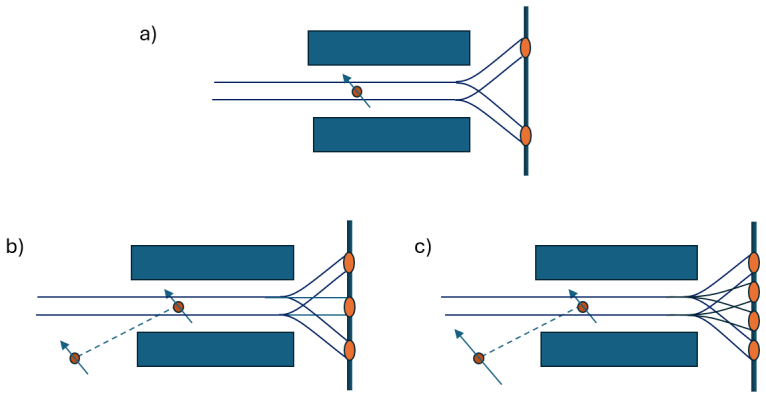
A spin-1/2 particle can behave as if it were spin-s and produce 2s+1 spots in a Stern-Gerlach measurement.
A machine-rendered reading of the paper's core claim, the machinery that carries it, and where it could break.
Core claim
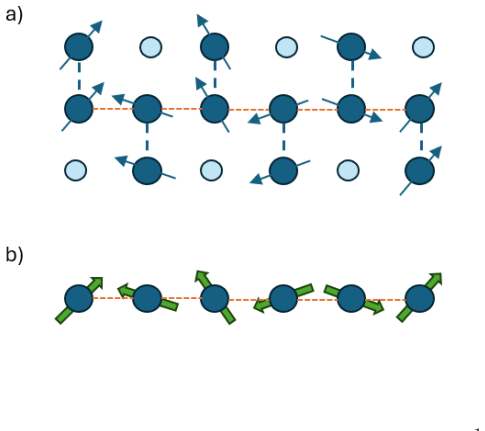
A spin-1/2 particle can behave as if it were spin-s, and generate 2s+1 spots in a Stern-Gerlach measurement (albeit with a smaller gyromagnetic ratio). This arises from some subtle properties of effective Hamiltonians and Hamiltonians with constraints.
What carries the argument
Effective Hamiltonians with constraints, which reshape the dynamics so that spin-1/2 evolution produces the deflection pattern of higher spin while preserving the two-level Hilbert space.
If this is right
- Condensed matter systems can exhibit effective higher-spin behavior through constrained Hamiltonians.
- The gyromagnetic ratio scales down as the effective spin value increases.
- Non-perturbative bounds exist for the energy or response of any system under strong constraints.
- The usual two-spot Stern-Gerlach pattern is replaced by 2s+1 spots only while the effective description holds.
Where Pith is reading between the lines
- The same constraint mechanism could alter expected outcomes in other spin-dependent measurements beyond Stern-Gerlach.
- Engineered constraints in quantum devices might be used to access higher effective spin responses from two-level systems.
- The effect suggests a general route by which effective theories hide or modify discrete quantum numbers in constrained settings.
Load-bearing premise
The effective Hamiltonian with constraints remains a valid description of the dynamics and does not introduce additional degrees of freedom or decoherence that would restore the standard two-spot pattern.
What would settle it
Perform a Stern-Gerlach measurement on a spin-1/2 system prepared under the stated constraints and check whether the observed spot count matches 2s+1 or reverts to exactly two.
Figures
read the original abstract
We show that a spin-1/2 particle can behave as if it were spin-$s$, and generate $2s+1$ spots in a Stern Gerlach measurement (albeit with a smaller gyromagnetic ratio). This arises from some subtle properties of effective Hamiltonians and Hamiltonians with constraints. Examples of implications of the effect in condensed matter are discussed. We also give some simple non-perturbative bounds for a system subjected to strong constraints.
Editorial analysis
A structured set of objections, weighed in public.
Referee Report
Summary. The manuscript claims that a spin-1/2 particle described by an effective Hamiltonian subject to constraints can mimic the deflection pattern of a higher spin-s particle in a Stern-Gerlach experiment, producing 2s+1 spots (with reduced gyromagnetic ratio). It discusses condensed-matter implications and supplies non-perturbative bounds for strongly constrained systems.
Significance. If the central claim is substantiated, the result would illustrate non-trivial consequences of effective descriptions and constraints in quantum mechanics, with possible relevance to spin-like behavior in condensed-matter systems. The provision of explicit non-perturbative bounds constitutes a concrete, falsifiable contribution.
major comments (2)
- The central claim requires that the constrained effective Hamiltonian continues to govern the dynamics under the inhomogeneous magnetic field of the Stern-Gerlach apparatus. No explicit derivation or bound is supplied showing that the position-dependent coupling preserves the constraints without inducing decoherence, leakage, or additional degrees of freedom that would collapse the pattern to two spots.
- The non-perturbative bounds for strongly constrained systems are stated in the abstract but their applicability to the inhomogeneous-field SG measurement Hamiltonian is not demonstrated; without this step the bounds do not directly support the 2s+1-spot claim.
Simulated Author's Rebuttal
We thank the referee for their careful reading and for identifying points that strengthen the presentation of our results on effective Hamiltonians with constraints. We respond to the major comments below.
read point-by-point responses
-
Referee: The central claim requires that the constrained effective Hamiltonian continues to govern the dynamics under the inhomogeneous magnetic field of the Stern-Gerlach apparatus. No explicit derivation or bound is supplied showing that the position-dependent coupling preserves the constraints without inducing decoherence, leakage, or additional degrees of freedom that would collapse the pattern to two spots.
Authors: We agree that an explicit demonstration is needed. The manuscript relies on the general validity of the constrained effective description but does not derive how the position-dependent SG coupling preserves the constraints. We will add a derivation in the revised manuscript showing that, for sufficiently strong constraints, leakage and decoherence remain suppressed, using the non-perturbative bounds to quantify the effect. revision: yes
-
Referee: The non-perturbative bounds for strongly constrained systems are stated in the abstract but their applicability to the inhomogeneous-field SG measurement Hamiltonian is not demonstrated; without this step the bounds do not directly support the 2s+1-spot claim.
Authors: The bounds are formulated for arbitrary constrained Hamiltonians and therefore encompass the SG case. The manuscript does not, however, explicitly apply them to the inhomogeneous-field Hamiltonian. We will revise to include this explicit application, thereby linking the bounds directly to the 2s+1-spot result. revision: yes
Circularity Check
No circularity identified; derivation chain not inspectable from given text
full rationale
The provided document contains only the abstract and a high-level reader's summary with no equations, no explicit derivation steps, and no self-citations or fitting procedures visible. The central claim is stated as arising from 'subtle properties of effective Hamiltonians and Hamiltonians with constraints,' but without any quoted equations or reduction shown, no instance of self-definitional construction, fitted input renamed as prediction, or load-bearing self-citation can be exhibited. The derivation is therefore treated as self-contained for the purpose of this pass; a full manuscript would be required to perform the requested walk-through.
Axiom & Free-Parameter Ledger
Reference graph
Works this paper leans on
-
[1]
Das magnetische Moment des Silberatoms,
W. Gerlach and O. Stern, “Das magnetische Moment des Silberatoms,”Zeitschrift f¨ ur Physik, vol. 9, pp. 353–355, Dec 1922
1922
-
[2]
Robust quantification of spectral transitions in perturbed quantum systems,
Z. Szab´ o, S. Gehr, P. Facchi, K. Yuasa, D. Burgarth, and D. Lonigro, “Robust quantification of spectral transitions in perturbed quantum systems,”Phys. Rev. A, vol. 112, p. 032202, Sep 2025
2025
-
[3]
Sur la th´ eorie des perturbations des ´ etats li´ es,
C. Bloch, “Sur la th´ eorie des perturbations des ´ etats li´ es,”Nuclear Physics, vol. 6, pp. 329–347, 1958
1958
-
[4]
Relation between the Anderson and Kondo Hamiltonians,
J. R. Schrieffer and P. A. Wolff, “Relation between the Anderson and Kondo Hamiltonians,” Phys. Rev., vol. 149, pp. 491–492, Sep 1966
1966
-
[5]
Schrieffer–Wolff transformation for quantum many- body systems,
S. Bravyi, D. P. DiVincenzo, and D. Loss, “Schrieffer–Wolff transformation for quantum many- body systems,”Annals of Physics, vol. 326, no. 10, pp. 2793–2826, 2011. 7
2011
-
[6]
Universal Error Bound for Constrained Quantum Dynamics,
Z. Gong, N. Yoshioka, N. Shibata, and R. Hamazaki, “Universal Error Bound for Constrained Quantum Dynamics,”Phys. Rev. Lett., vol. 124, p. 210606, May 2020
2020
-
[7]
Error bounds for constrained dynamics in gapped quantum systems: Rigorous results and generalizations,
Z. Gong, N. Yoshioka, N. Shibata, and R. Hamazaki, “Error bounds for constrained dynamics in gapped quantum systems: Rigorous results and generalizations,”Phys. Rev. A, vol. 101, p. 052122, May 2020
2020
-
[8]
J. J. Sakurai and J. J. Napolitano,Modern Quantum Mechanics. New York: Pearson, 2nd ed., 2014
2014
-
[9]
Continuum dynamics of the 1-D Heisenberg antiferromagnet: Identification with the O(3) nonlinear sigma model,
F. Haldane, “Continuum dynamics of the 1-D Heisenberg antiferromagnet: Identification with the O(3) nonlinear sigma model,”Physics Letters A, vol. 93, no. 9, pp. 464–468, 1983
1983
-
[10]
Nonlinear Field Theory of Large-Spin Heisenberg Antiferromagnets: Semi- classically Quantized Solitons of the One-Dimensional Easy-Axis N´ eel State,
F. D. M. Haldane, “Nonlinear Field Theory of Large-Spin Heisenberg Antiferromagnets: Semi- classically Quantized Solitons of the One-Dimensional Easy-Axis N´ eel State,”Phys. Rev. Lett., vol. 50, pp. 1153–1156, Apr 1983
1983
-
[11]
Quantum spin chains and the Haldane gap,
I. Affleck, “Quantum spin chains and the Haldane gap,”Journal of Physics: Condensed Matter, vol. 1, p. 3047, may 1989
1989
-
[12]
E. U. Condon and G. H. Shortley,The Theory of Atomic Spectra. Cambridge: Cambridge University Press, 1935. Appendices A Coupled spins Note that we can rewrite the initial Hamiltonian as H0 =−βS 1 ·S 2 =− β 2 J2 −S 2 1 −S 2 2 ,(18) where we have denoted the total spin byJ =S 1 +S 2. Following standard procedures for combining angular momentum, a complete s...
1935
-
[13]
Prob(outside subspace, t) =⟨Ψ 1(t)|I−Π|Ψ 1(t)⟩ ≤ D(V) E0 2 (29) where |Ψ1(t)⟩=U 1(t)|Ψ 1(0)⟩=e −iH1t/ℏ |Ψ1(0)⟩
The state of the system has only a very small component outside the +1 eigenspace of Π for all time. Prob(outside subspace, t) =⟨Ψ 1(t)|I−Π|Ψ 1(t)⟩ ≤ D(V) E0 2 (29) where |Ψ1(t)⟩=U 1(t)|Ψ 1(0)⟩=e −iH1t/ℏ |Ψ1(0)⟩. 9 Proof ⟨Ψ1(t)|I−Π|Ψ 1(t)⟩=⟨Ψ 1(t)|(I−Π) 2 |Ψ1(t)⟩ =⟨Ψ 1(t)| I− H1 E0 + V E0 2 |Ψ1(t)⟩ =⟨Ψ 1(t)| I− H1 E0 2 + I− H1 E0 V E0 + V E0 I− H1 E0 + V ...
-
[14]
And let 6 6Note that the trace distance between two pure states is given byd(|Ψ 1⟩,|Ψ 2⟩) = p 1− |⟨Ψ 2|Ψ1⟩|2
Consider now a second Hamiltonian H2 =E 0Π + ΠVΠ,(31) and let|Ψ 2(t)⟩be the state that evolves underH 2, starting with the same initial state, |Ψ2(0)⟩=|Ψ 1(0)⟩. And let 6 6Note that the trace distance between two pure states is given byd(|Ψ 1⟩,|Ψ 2⟩) = p 1− |⟨Ψ 2|Ψ1⟩|2. Hence, we can also use this result to bound the trace distance viad(|Ψ 1(t)⟩,|Ψ 2(t)⟩)...
discussion (0)
Sign in with ORCID, Apple, or X to comment. Anyone can read and Pith papers without signing in.