Constraints on the Phenomenology of Dissipative Cosmological Memory from BAO (BOSS + DESI 2024) and Pantheon+ Data
Pith reviewed 2026-06-28 21:08 UTC · model grok-4.3
The pith
BAO, DESI and Pantheon+ data show dissipative memory correction vanishes, matching Lambda CDM.
A machine-rendered reading of the paper's core claim, the machinery that carries it, and where it could break.
Core claim
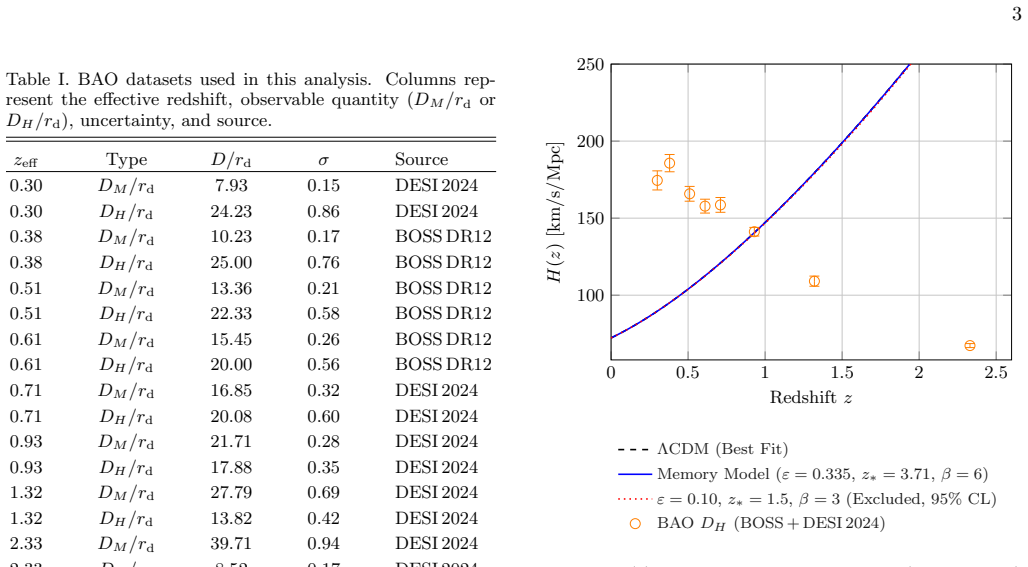
A global optimization of the joint dataset reveals that the best fit is identical to Lambda CDM, with the memory correction vanishing across z in [0.3, 2.3], Delta chi squared less than 0.01 with three extra parameters, Delta AIC equal to +6.0, and Delta BIC equal to +9.9. This establishes an upper bound on the memory amplitude epsilon less than 0.05 for z star less than 2 at 95 percent CL.
What carries the argument
The additional fluid component with amplitude epsilon, decay scale z star, and steepness beta, whose contribution to the expansion rate follows the Debye decay f(z) equals exp minus (z over z star) to the beta.
If this is right
- Standard Lambda CDM is preferred by AIC and BIC despite the three extra parameters.
- The memory correction produces no detectable change to the expansion rate in the observed redshift range.
- The analysis places an upper bound on the memory amplitude of 0.05 at 95% CL for z_* < 2.
- Any physical interpretation of dissipative memory must respect this constraint from late-time observations.
Where Pith is reading between the lines
- Independent probes such as the cosmic microwave background or large-scale structure might provide complementary constraints if the memory effect influences them differently.
- Extending the analysis to higher redshifts with future data could test larger decay scales z_*.
- Other possible functional forms for the memory decay, beyond the Debye law, remain unconstrained by this work.
Load-bearing premise
The dissipative memory effect, if present, takes the specific functional form of an additional fluid decaying as f(z) = exp[−(z/z_*)^β] and does not produce other observable signatures that would be captured differently by the chosen datasets.
What would settle it
Finding a dataset combination where including the memory parameters yields a substantially better fit than Lambda CDM, such as Delta chi squared greater than 10, would indicate the presence of the effect.
Figures
read the original abstract
We propose and test a phenomenological model of ``dissipative memory'' in the gravitational field, where early quantum gravitational processes leave a relic signature in the cosmic expansion rate. The model is parameterized by an additional fluid with amplitude $\epsilon$, decay scale $z_*$, and a steepness index $\beta$, decaying according to a Debye law $f(z) = \exp[{-(z/z_*)^\beta}]$. We perform a joint Bayesian analysis using baryon acoustic oscillation data from BOSS DR12 and DESI 2024, photometric distances from Pantheon$+$, and $H_0$ measurements (SHOES and Planck). A global optimization reveals that the best fit is identical to $\Lambda$CDM: the memory correction vanishes across the entire observable range $z \in [0.3,\,2.3]$ ($\Delta\chi^2 < 0.01$ with three extra parameters, $\Delta\mathrm{AIC}=+6.0$, $\Delta\mathrm{BIC}=+9.9$). This establishes an upper bound on the memory amplitude: $\epsilon < 0.05$ for $z_* < 2$ (95% CL). We discuss the physical interpretation of this constraint and point out observational channels where the memory effect could potentially manifest.
Editorial analysis
A structured set of objections, weighed in public.
Referee Report
Summary. The manuscript proposes a phenomenological model of dissipative cosmological memory as an additional fluid decaying according to the Debye law f(z) = exp[−(z/z_*)^β], with free parameters ε, z_*, β. It conducts a joint Bayesian analysis of BAO data from BOSS DR12 and DESI 2024, Pantheon+ supernova data, and H0 measurements, finding that the best-fit model is indistinguishable from ΛCDM with the memory term vanishing over z ∈ [0.3,2.3], resulting in Δχ² < 0.01, positive ΔAIC and ΔBIC, and an upper bound ε < 0.05 at 95% CL for z_* < 2.
Significance. If the result holds, it places a tight constraint on the amplitude of this specific form of dissipative memory effect using current cosmological data. The explicit use of information criteria to account for the three extra parameters is a methodological strength. The null result is consistent with the data not requiring the additional component. However, the physical motivation for the Debye-law form and the generality of the constraint to other possible memory phenomenologies remain limited.
major comments (2)
- [§3] The Bayesian analysis lacks explicit specification of the priors on the memory parameters ε, z_*, and β, as well as details on the construction of the joint covariance matrix from BAO and Pantheon+ datasets. These omissions hinder assessment of the reliability of the reported 95% CL bound on ε.
- [Abstract and §4] The upper bound on ε is derived exclusively for the assumed functional form f(z) = exp[−(z/z_*)^β]. No exploration of alternative decay laws is presented, making the constraint specific to this parametrization rather than a general limit on dissipative memory effects.
Simulated Author's Rebuttal
We thank the referee for their careful reading and constructive comments on our manuscript. We address each major comment point by point below and indicate the revisions we will make.
read point-by-point responses
-
Referee: [§3] The Bayesian analysis lacks explicit specification of the priors on the memory parameters ε, z_*, and β, as well as details on the construction of the joint covariance matrix from BAO and Pantheon+ datasets. These omissions hinder assessment of the reliability of the reported 95% CL bound on ε.
Authors: We agree that these details should have been included. In the revised manuscript we will explicitly specify the prior distributions and ranges adopted for ε, z_*, and β, and we will describe the construction of the joint covariance matrix from the BOSS DR12, DESI 2024, and Pantheon+ datasets. revision: yes
-
Referee: [Abstract and §4] The upper bound on ε is derived exclusively for the assumed functional form f(z) = exp[−(z/z_*)^β]. No exploration of alternative decay laws is presented, making the constraint specific to this parametrization rather than a general limit on dissipative memory effects.
Authors: The manuscript introduces and constrains a specific phenomenological model that employs the Debye-law form by definition. The reported bound therefore applies to this parametrization. We will revise the abstract and §4 to state this limitation more explicitly and to note that alternative decay laws lie outside the scope of the present work. revision: partial
Circularity Check
No circularity: bound obtained by direct fit of phenomenological model to external datasets
full rationale
The paper defines a three-parameter phenomenological extension (amplitude ε, scale z*, index β) with an explicit functional form f(z)=exp[−(z/z*)^β] and performs a standard Bayesian fit to independent observational data (BOSS+DESI BAO, Pantheon+, H0). The reported upper limit ε<0.05 follows from the likelihood comparison (Δχ²<0.01, information criteria) showing the extra parameters are not required. No step reduces a claimed prediction to a fitted input by construction, no self-citation chain is load-bearing, and the derivation chain is self-contained against external benchmarks.
Axiom & Free-Parameter Ledger
free parameters (3)
- ε
- z_*
- β
axioms (2)
- ad hoc to paper The memory effect can be represented by an additional fluid component whose influence decays according to the Debye law f(z) = exp[−(z/z_*)^β]
- domain assumption Standard FLRW background cosmology and the interpretation of BAO and supernova distances remain valid when the extra fluid is added
invented entities (1)
-
dissipative memory fluid
no independent evidence
Reference graph
Works this paper leans on
-
[1]
Asz→0:ρ I →ερ cr,0 — a non-vanishing contri- bution to the local expansion rate
-
[2]
Forz≫z ∗:ρ I →0 — a return to ΛCDM compat- ible with CMB physics; 3.∇ µT µν = 0 is satisfied, ensuring no violation of covariance. For a flat universe (k= 0), Condition 3 yields the continuity equation: ˙ρI + 3H(1 +w I)ρI = 0,(1) which integrates to: ρI(z) =ρ I,0 exp 3 Z z 0 1 +w I(z′) 1 +z ′ dz′ .(2) We parameterizew I(z) such thatρ I(z) decays accord- i...
Pith/arXiv arXiv 2026
-
[3]
This resolves a critical structural defect present in earlier formula- tions of the model
We introduced a covariant memory fluid with an equation of state that strictly preserves∇µT µν = 0, utilizing a Debye form factor (3). This resolves a critical structural defect present in earlier formula- tions of the model
-
[4]
The latest DESI data unam- biguously favor the standard ΛCDM model
A joint analysis of BAO (BOSS DR12 + DESI 2024), Pantheon+, and H0 priors demonstrates that: ∆χ2 <0.01,∆AIC = +6.0,∆BIC = +9.9 relative to ΛCDM. The latest DESI data unam- biguously favor the standard ΛCDM model
2024
-
[5]
We established a strict upper bound on the memory amplitude:ε <0.05 (95% CL) for a decay scale z∗ <2
-
[6]
The model leaves CMB physics completely unper- turbed (f(1100)<10 −8), ensuring full compatibil- ity with Planck results
-
[7]
In summary, background cosmology places tight con- straints on dissipative memory at redshiftsz <2.5
We identified specific observational channels that remain sensitive to memory effects atz ∗ >2, namely structure growth (f σ8 via Euclid), B-modes (LiteBIRD), and standard sirens (LIGO-India). In summary, background cosmology places tight con- straints on dissipative memory at redshiftsz <2.5. If a memory mechanism operates in our universe, its ob- servat...
-
[8]
Planck Collaboration, Planck 2018 results. vi. cosmolog- ical parameters, A&A641, A6 (2020)
2018
-
[9]
A. G. Riesset al., A comprehensive measurement of the local value of the hubble constant with 1 km s-1 mpc- 1 uncertainty from the hubble space telescope and the sh0es team, ApJL934, L7 (2022)
2022
-
[10]
Verde, T
L. Verde, T. Treu, and A. G. Riess, Tensions between the early and late universe, Nature Astronomy3, 891 (2019)
2019
-
[11]
Poulin, T
V. Poulin, T. L. Smith, T. Karwal, and M. Kamionkowski, Early dark energy can resolve the hubble tension, Phys. Rev. Lett.122, 221301 (2019)
2019
-
[12]
J. C. Hillet al., Early dark energy does not restore cos- mological concordance, Phys. Rev. D102, 043507 (2020)
2020
-
[13]
E. Di Valentinoet al., Interacting dark energy in the early 2020s: a promising solution to theh 0 and cosmic shear tensions, Phys. Dark Univ.30, 10.1016/j.dark.2020.100666 (2020)
-
[14]
Sol` a Peracauts, A
J. Sol` a Peracauts, A. G´ omez-Valent, and J. de Cruz P´ erez, Running vacuum against theh 0 andσ 8 tensions, EPL134, 19001 (2021)
2021
-
[15]
Debye, Zur theorie der spezifischen w¨ armen, Annalen der Physik344, 789 (1912)
P. Debye, Zur theorie der spezifischen w¨ armen, Annalen der Physik344, 789 (1912)
1912
-
[16]
K. L. Ngai,Relaxation and Diffusion in Complex Systems (Springer, New York, 2011)
2011
-
[17]
Christodoulou, Nonlinear nature of gravitation and gravitational-wave experiments, Phys
D. Christodoulou, Nonlinear nature of gravitation and gravitational-wave experiments, Phys. Rev. Lett.67, 1486 (1991)
1991
-
[18]
Penrose,Cycles of Time(Bodley Head, London, 2010)
R. Penrose,Cycles of Time(Bodley Head, London, 2010)
2010
-
[19]
Eckart, The thermodynamics of irreversible processes, Phys
C. Eckart, The thermodynamics of irreversible processes, Phys. Rev.58, 919 (1940)
1940
-
[20]
Maartens, Causal thermodynamics in relativity (1996), lectures at the H
R. Maartens, Causal thermodynamics in relativity (1996), lectures at the H. Rund Workshop on Relativ- ity and Thermodynamics, arXiv:astro-ph/9609119
Pith/arXiv arXiv 1996
-
[21]
Alamet al., The clustering of galaxies in the completed sdss-iii boss survey: : cosmological analysis of the dr12 galaxy sample, MNRAS470, 2617 (2017)
S. Alamet al., The clustering of galaxies in the completed sdss-iii boss survey: : cosmological analysis of the dr12 galaxy sample, MNRAS470, 2617 (2017)
2017
-
[22]
A. e. a. Adame, Desi 2024 vi: Cosmological constraints from the measurements of baryon acoustic oscillations, JCAP
2024
-
[23]
D. J. Eisenstein and W. Hu, Baryonic features in the matter transfer function, ApJ496, 605 (1998)
1998
-
[24]
D. e. a. Brout, The pantheon+ analysis: Cosmological constraints, ApJ938, 110 (2022)
2022
-
[25]
Storn and K
R. Storn and K. Price, Differential evolution – a simple and efficient heuristic for global optimization over con- tinuous spaces, J. Global Optim.11, 341 (1997)
1997
-
[26]
R. E. Kass and A. E. Raftery, Bayes factors, JASA90, 773 (1995)
1995
-
[27]
Foreman-Mackeyet al., emcee: The mcmc hammer, PASP125, 306 (2013)
D. Foreman-Mackeyet al., emcee: The mcmc hammer, PASP125, 306 (2013)
2013
-
[28]
Koehn, A
H. Koehn, A. Just, P. Berczik, and M. Tremmel, Dynam- ics of supermassive black hole triples in the romulus25 cosmological simulation, Astronomy & Astrophysics678, A11 (2023)
2023
-
[29]
LiteBIRD Collaboration, Probing cosmic inflation with the litebird cosmic microwave background polarization survey, PTEP2023, 042F01 (2023)
2023
-
[30]
Simons Observatory Collaboration, The simons observa- tory: Science goals and forecasts, JCAP2019, 056
-
[31]
R. A. et al, Constraints on the cosmic expansion history from gwtc–3, The Astrophysical Journal949, 76 (2023)
2023
-
[32]
Saleemet al., The science case for ligo-india, Class
M. Saleemet al., The science case for ligo-india, Class. Quantum Grav.39, 025004 (2022)
2022
-
[33]
C. R. Harriset al., Array programming with numpy, Na- ture585, 357 (2020)
2020
-
[34]
Virtanenet al., Scipy 1.0: Fundamental algorithms for scientific computing in python, Nature Methods17, 261 (2020)
P. Virtanenet al., Scipy 1.0: Fundamental algorithms for scientific computing in python, Nature Methods17, 261 (2020)
2020
-
[35]
Foreman-Mackey, corner.py: Scatterplot matrices in python, JOSS1, 24 (2016)
D. Foreman-Mackey, corner.py: Scatterplot matrices in python, JOSS1, 24 (2016)
2016
discussion (0)
Sign in with ORCID, Apple, or X to comment. Anyone can read and Pith papers without signing in.