Sequential chaotic oscillations in excitatory-inhibitory threshold-linear networks
Pith reviewed 2026-06-28 19:11 UTC · model grok-4.3
The pith
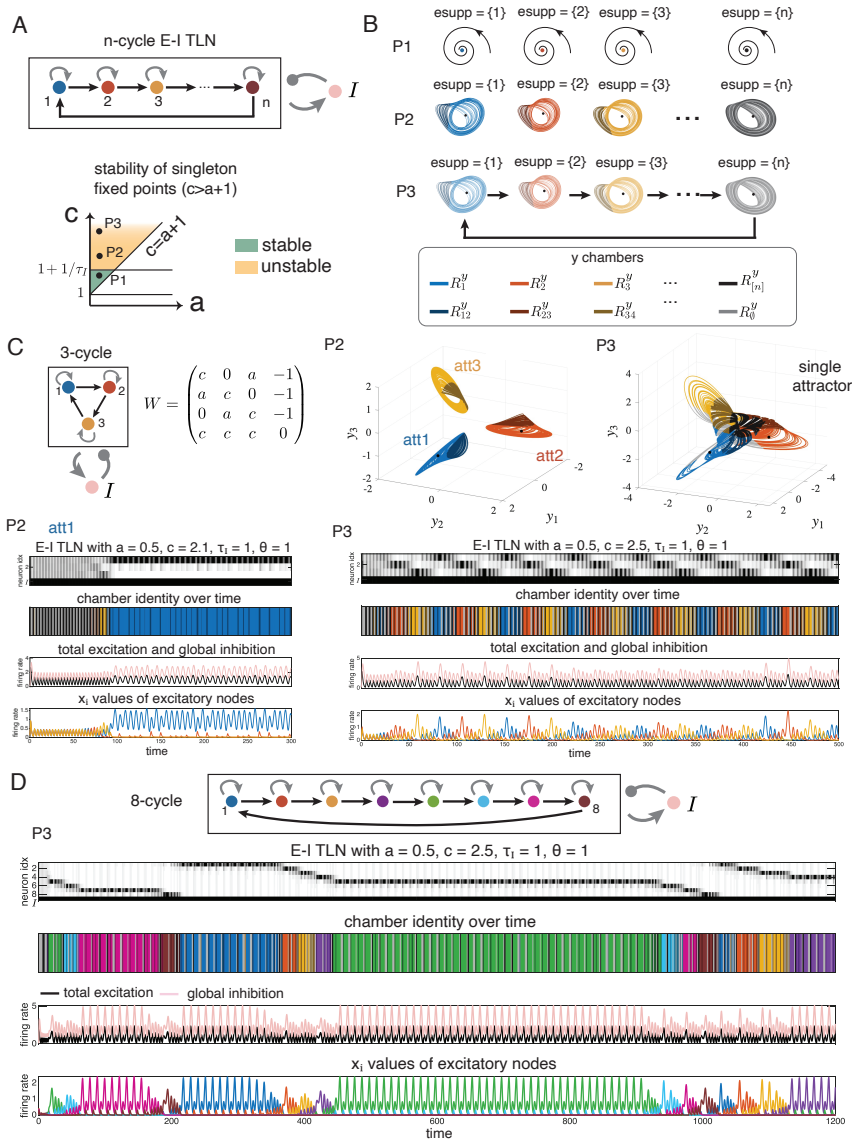
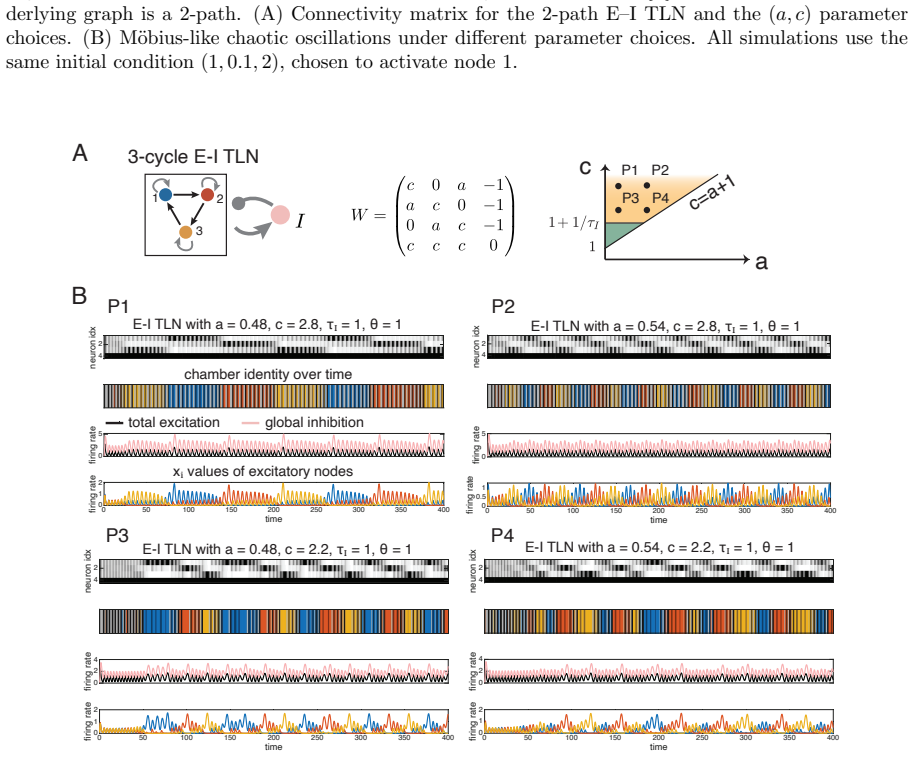
Excitatory-inhibitory threshold-linear networks generate sequential chaotic oscillations whose transition order follows the connection graph under constant input.
A machine-rendered reading of the paper's core claim, the machinery that carries it, and where it could break.
Core claim
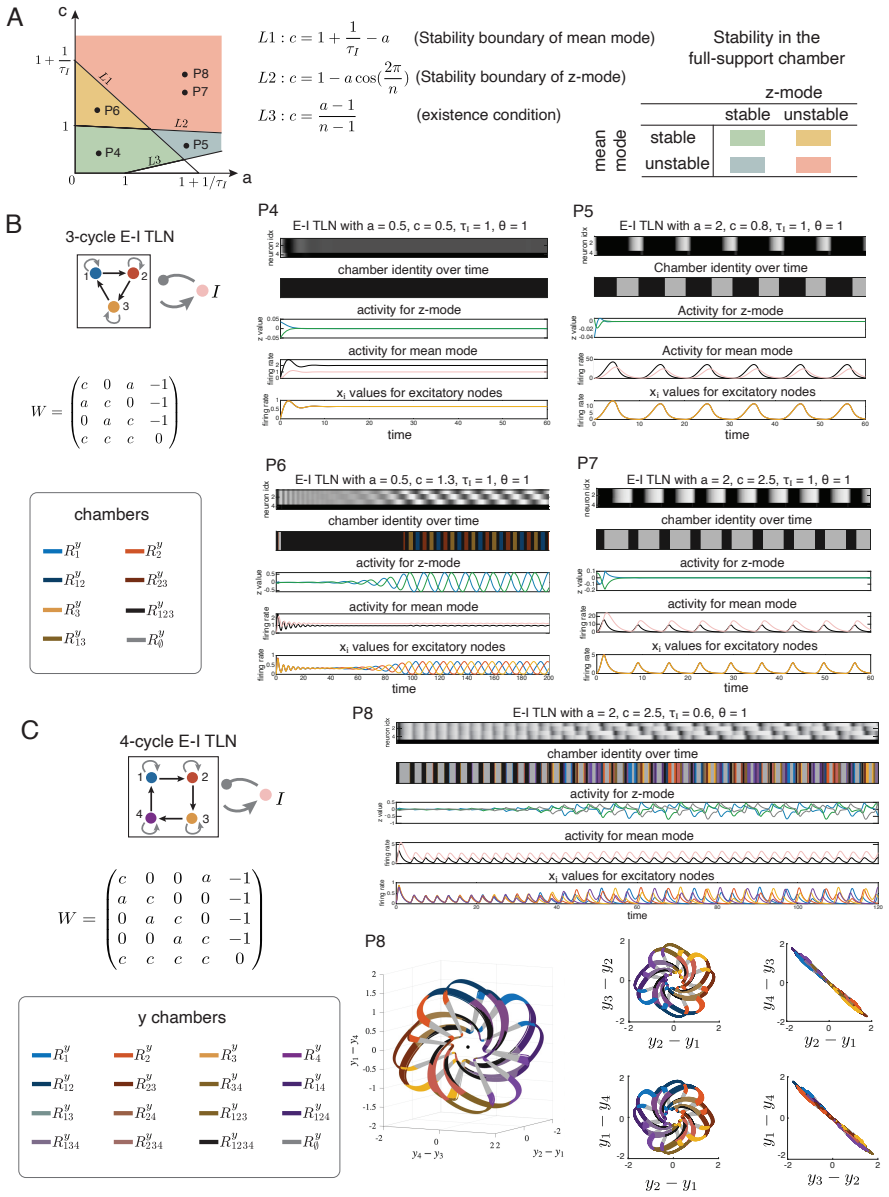
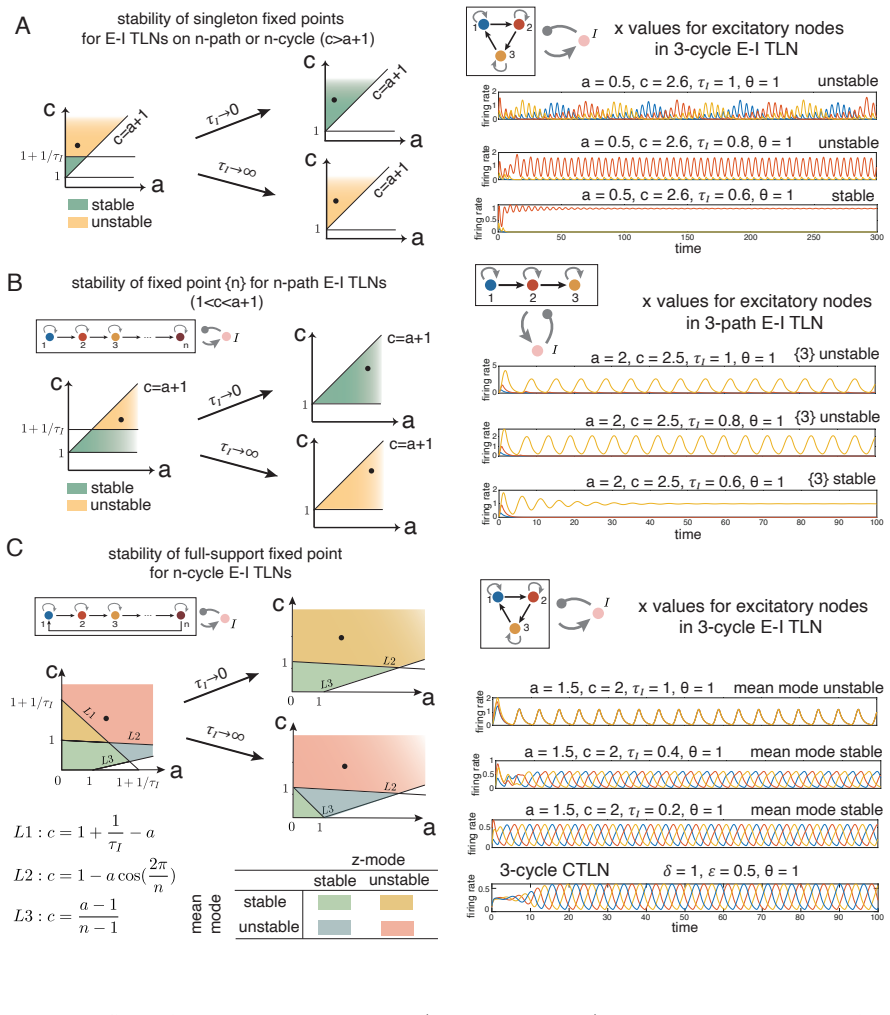
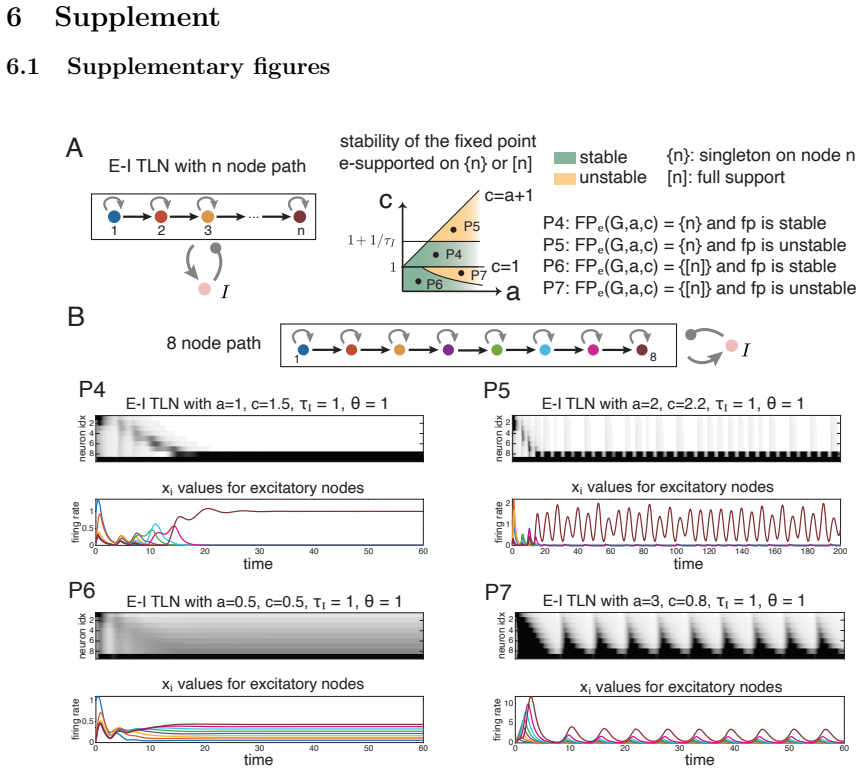
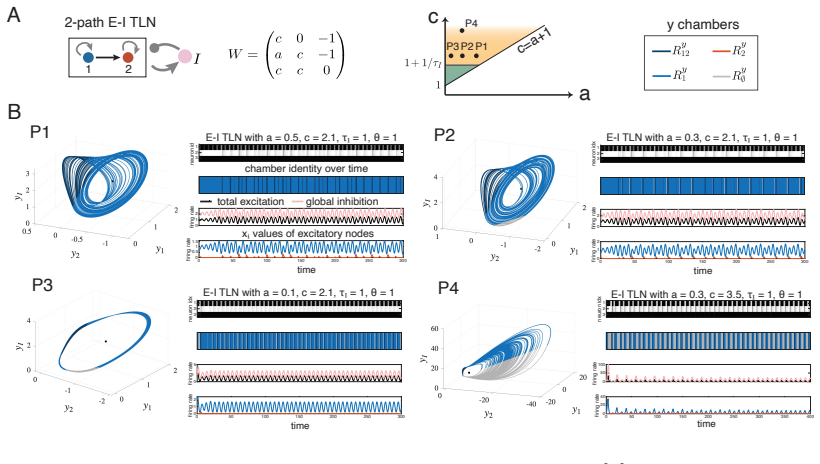
Sequential chaotic oscillations arise in E-I TLNs precisely when singleton fixed points are unstable and inhibition is sufficiently strong, producing a sequence of metastable states under constant input whose order is predicted by the underlying graph; this is established through new graph rules that characterize fixed points on paths and cycles, and the z-mode and mean-mode decomposition further separates attractors tied to the full-support fixed point on cycles.
What carries the argument
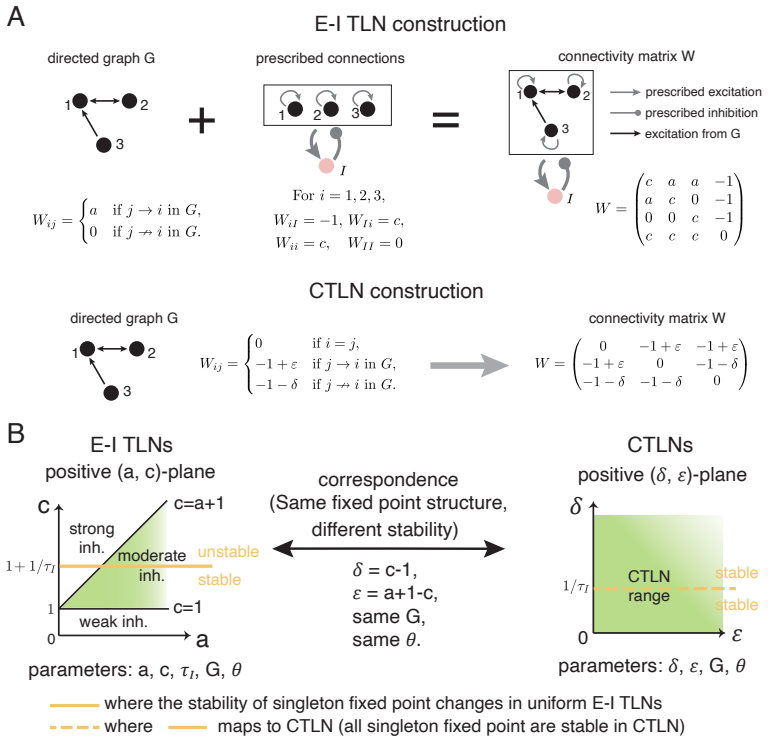
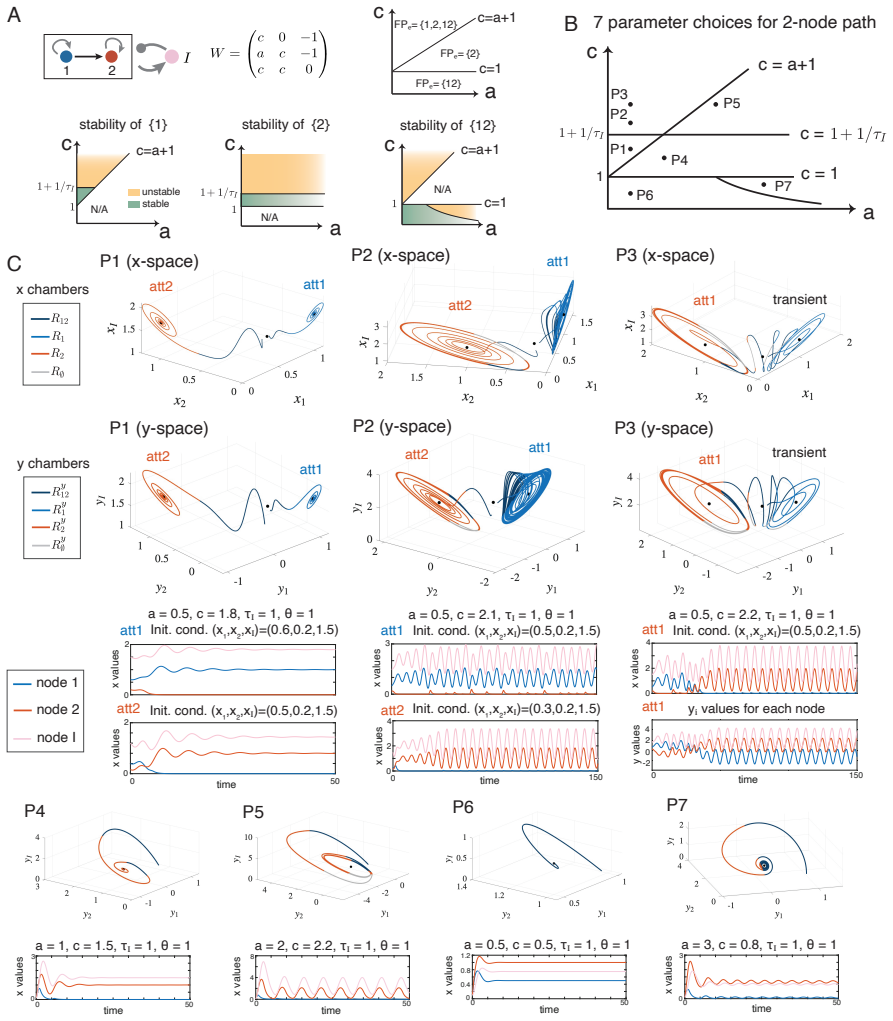
Graph rules for the fixed-point structure of E-I TLNs on paths and cycles that identify the parameter regime containing unstable singleton fixed points plus strong inhibition.
If this is right
- Transition order in the oscillations is predictable directly from the network graph.
- E-I oscillations do not require synchronization across the population.
- The z-mode and mean-mode decomposition distinguishes attractors associated with the full-support fixed point on cycles.
- SCOs occur under constant input without external drive changes.
Where Pith is reading between the lines
- If the graph rules generalize, the same mechanism could apply to networks with topologies beyond simple paths and cycles.
- Biological circuits matching the E-I TLN structure might produce predictable sequential activity patterns even when input remains fixed.
- The mode decomposition offers a way to test whether observed population activity aligns with the full-support fixed point or other attractors.
Load-bearing premise
The fixed-point structure of E-I TLNs on paths and cycles can be completely determined by the new graph rules.
What would settle it
A simulation or recording of an E-I TLN on a cycle with parameters yielding unstable singletons and strong inhibition, checked against whether the observed sequence of states matches or deviates from the transitions predicted by the graph rules.
Figures
read the original abstract
Metastable states, a phenomenon observed in brain dynamics and many other systems, have been proposed as a key feature of healthy brain function, reflecting a balance between integration and segregation. However, it remains unclear how to capture this behavior within a dynamical-systems framework. In this paper, we propose sequential chaotic oscillations (SCOs), arising in excitatory-inhibitory threshold-linear networks (E-I TLNs), as a candidate dynamical mechanism for sequential metastability. As a simple form of chaotic itinerancy, SCOs occur under constant input and consist of a sequence of metastable states whose transition order can be predicted by the underlying graph. To identify the parameter regime for SCOs, we develop new graph rules for E-I TLNs and use them to characterize the fixed point structure of E-I TLNs on paths and cycles. Our results show that the emergence of SCOs requires unstable singleton fixed points and sufficiently strong inhibition. In addition to SCOs, we find that E-I oscillations need not be synchronized. Motivated by this, we introduce a decomposition into the z-mode and the mean mode, which capture excitatory differences and overall network activity, respectively. These modes are then used to distinguish attractors associated with the full-support fixed point of E-I TLNs on cycles.
Editorial analysis
A structured set of objections, weighed in public.
Referee Report
Summary. The manuscript proposes sequential chaotic oscillations (SCOs) in excitatory-inhibitory threshold-linear networks (E-I TLNs) as a candidate dynamical mechanism for sequential metastability. SCOs arise under constant input as sequences of metastable states whose transition order is claimed to be predictable from the underlying graph. New graph rules are introduced to characterize the fixed-point structure of E-I TLNs specifically on paths and cycles; these rules identify the regime requiring unstable singleton fixed points together with sufficiently strong inhibition. The paper additionally introduces a z-mode/mean-mode decomposition to analyze attractors associated with the full-support fixed point on cycles and notes that E-I oscillations need not be synchronized.
Significance. If the fixed-point characterizations and SCO conditions hold, the work supplies an explicit, graph-structured example of chaotic itinerancy in E-I networks that could serve as a mechanistic model for sequential metastability observed in neural data. The mode decomposition offers a concrete analytic tool for distinguishing attractor types on cycles.
major comments (2)
- [Abstract] Abstract: the central claim that SCO transition order 'can be predicted by the underlying graph' rests on graph rules whose explicit construction and verification are stated to apply only to paths and cycles. No derivation or counter-example check is supplied for the required generalization to arbitrary graphs, which is load-bearing for the predictability assertion.
- [Results on fixed points] The fixed-point characterization (used to locate the SCO regime) is developed exclusively for paths and cycles; the manuscript does not demonstrate that the same rules correctly classify fixed points or predict transition order on graphs containing branches, multiple cycles, or higher connectivity, leaving the scope of the SCO mechanism unclear.
minor comments (2)
- [Mode decomposition] Notation for the z-mode and mean-mode decomposition should be introduced with explicit equations rather than descriptive prose only.
- [Abstract] The abstract states that SCOs require 'unstable singleton fixed points and sufficiently strong inhibition'; the precise threshold on inhibition strength (e.g., relative to the excitatory weights) should be stated quantitatively in the main text.
Simulated Author's Rebuttal
We thank the referee for the careful review and constructive comments on the scope of our results. We address the major comments point-by-point below and will make revisions to clarify the applicability of our findings.
read point-by-point responses
-
Referee: [Abstract] Abstract: the central claim that SCO transition order 'can be predicted by the underlying graph' rests on graph rules whose explicit construction and verification are stated to apply only to paths and cycles. No derivation or counter-example check is supplied for the required generalization to arbitrary graphs, which is load-bearing for the predictability assertion.
Authors: We agree that the explicit graph rules and verification are provided only for paths and cycles. The predictability claim is demonstrated in those cases. We will revise the abstract to state that transition order can be predicted from the graph for paths and cycles, removing any implication of generality to arbitrary graphs. revision: yes
-
Referee: [Results on fixed points] The fixed-point characterization (used to locate the SCO regime) is developed exclusively for paths and cycles; the manuscript does not demonstrate that the same rules correctly classify fixed points or predict transition order on graphs containing branches, multiple cycles, or higher connectivity, leaving the scope of the SCO mechanism unclear.
Authors: This observation is accurate. The fixed-point rules and SCO conditions are derived and illustrated only for paths and cycles. We will revise the results and discussion sections to explicitly limit the scope of the SCO mechanism and fixed-point characterizations to these graph classes, noting that extensions to more complex topologies remain open. revision: yes
Circularity Check
No circularity: new graph rules derived independently for paths/cycles
full rationale
The paper introduces new graph rules to characterize fixed-point structure of E-I TLNs specifically on paths and cycles, then uses these to identify the parameter regime (unstable singletons + strong inhibition) for SCOs. No step reduces a claimed prediction or central result to a fitted input, self-definition, or load-bearing self-citation chain. The abstract and derivation are framed as original mathematical characterization rather than renaming or smuggling prior ansatzes. The generalization to arbitrary graphs is noted as a proposal without explicit proof, but this is a limitation of scope, not circularity. The chain is self-contained against the stated constructions.
Axiom & Free-Parameter Ledger
Reference graph
Works this paper leans on
-
[1]
Transient dynamics for neural processing
Misha Rabinovich, Ramon Huerta, and Gilles Laurent. Transient dynamics for neural processing. Science, 321(5885):48–50, 2008
2008
-
[2]
Natural stimuli evoke dynamic sequences of states in sensory cortical ensembles.Proceedings of the National Academy of Sciences, 104(47):18772–18777, 2007
Lauren M Jones, Alfredo Fontanini, Brian F Sadacca, Paul Miller, and Donald B Katz. Natural stimuli evoke dynamic sequences of states in sensory cortical ensembles.Proceedings of the National Academy of Sciences, 104(47):18772–18777, 2007
2007
-
[3]
Dynamics of multistable states during ongoing and evoked cortical activity.Journal of Neuroscience, 35(21):8214–8231, 2015
Luca Mazzucato, Alfredo Fontanini, and Giancarlo La Camera. Dynamics of multistable states during ongoing and evoked cortical activity.Journal of Neuroscience, 35(21):8214–8231, 2015
2015
-
[4]
The thermodynamic scale of inorganic crystalline metastability.Science advances, 2(11):e1600225, 2016
Wenhao Sun, Stephen T Dacek, Shyue Ping Ong, Geoffroy Hautier, Anubhav Jain, William D Richards, Anthony C Gamst, Kristin A Persson, and Gerbrand Ceder. The thermodynamic scale of inorganic crystalline metastability.Science advances, 2(11):e1600225, 2016
2016
-
[5]
Elsevier Amsterdam, 2006
Jean-Pierre Fran¸ coise, Gregory L Naber, and Sheung Tsun Tsou.Encyclopedia of mathematical physics, volume 5. Elsevier Amsterdam, 2006
2006
-
[6]
Phase transitions and critical behavior in human bimanual coordination.American Journal of Physiology-Regulatory, Integrative and Comparative Physiology, 246(6):R1000–R1004, 1984
JA Kelso. Phase transitions and critical behavior in human bimanual coordination.American Journal of Physiology-Regulatory, Integrative and Comparative Physiology, 246(6):R1000–R1004, 1984
1984
-
[7]
MIT press, 1995
JA Scott Kelso.Dynamic patterns: The self-organization of brain and behavior. MIT press, 1995
1995
-
[8]
Metasta- bility demystified—the foundational past, the pragmatic present and the promising future.Nature Reviews Neuroscience, 26(2):82–100, 2025
Fran Hancock, Fernando E Rosas, Andrea I Luppi, Mengsen Zhang, Pedro AM Mediano, Joana Cabral, Gustavo Deco, Morten L Kringelbach, Michael Breakspear, JA Scott Kelso, et al. Metasta- bility demystified—the foundational past, the pragmatic present and the promising future.Nature Reviews Neuroscience, 26(2):82–100, 2025
2025
-
[9]
Heteroclinic binding.Dynamical Systems, 25(3):433–442, 2010
Mikhail I Rabinovich, Valentin S Afraimovich, and Pablo Varona. Heteroclinic binding.Dynamical Systems, 25(3):433–442, 2010
2010
-
[10]
Sequential dynamics of complex networks in mind: consciousness and creativity.Physics Reports, 883:1–32, 2020
Mikhail I Rabinovich, Michael A Zaks, and Pablo Varona. Sequential dynamics of complex networks in mind: consciousness and creativity.Physics Reports, 883:1–32, 2020
2020
-
[11]
Chaotic itinerancy.Chaos, 13(3):926–936, 2003
Kunihiko Kaneko and Ichiro Tsuda. Chaotic itinerancy.Chaos, 13(3):926–936, 2003
2003
-
[12]
Maxwell-bloch turbulence.Progress of The- oretical Physics Supplement, 99:295–324, 1989
Kensuke Ikeda, Kenju Otsuka, and Kenji Matsumoto. Maxwell-bloch turbulence.Progress of The- oretical Physics Supplement, 99:295–324, 1989
1989
-
[13]
Clustering, coding, switching, hierarchical ordering, and control in a network of chaotic elements.Physica D: Nonlinear Phenomena, 41(2):137–172, 1990
Kunihiko Kaneko. Clustering, coding, switching, hierarchical ordering, and control in a network of chaotic elements.Physica D: Nonlinear Phenomena, 41(2):137–172, 1990
1990
-
[14]
Globally coupled circle maps.Physica D: Nonlinear Phenomena, 54(1-2):5–19, 1991
Kunihiko Kaneko. Globally coupled circle maps.Physica D: Nonlinear Phenomena, 54(1-2):5–19, 1991
1991
-
[15]
Chaotic itinerancy as a dynamical basis of hermeneutics in brain and mind.World Futures: Journal of General Evolution, 32(2-3):167–184, 1991
Ichiro Tsuda. Chaotic itinerancy as a dynamical basis of hermeneutics in brain and mind.World Futures: Journal of General Evolution, 32(2-3):167–184, 1991
1991
-
[16]
Dynamic link of memory—chaotic memory map in nonequilibrium neural networks
Ichiro Tsuda. Dynamic link of memory—chaotic memory map in nonequilibrium neural networks. Neural networks, 5(2):313–326, 1992
1992
-
[17]
Graph rules for recurrent neural network dynamics.Notices of the American Mathematical Society, 70(04), 2023
Carina Curto and Katherine Morrison. Graph rules for recurrent neural network dynamics.Notices of the American Mathematical Society, 70(04), 2023
2023
-
[18]
Diversity of emergent dynamics in competitive threshold-linear networks.SIAM Journal on Applied Dynamical Systems, 23(1):855–884, 2024
Katherine Morrison, Anda Degeratu, Vladimir Itskov, and Carina Curto. Diversity of emergent dynamics in competitive threshold-linear networks.SIAM Journal on Applied Dynamical Systems, 23(1):855–884, 2024
2024
-
[19]
Carina Curto. On graphical domination for threshold-linear networks with recurrent excitation and global inhibition.arXiv preprint arXiv:2510.05098, 2025
-
[20]
Stable fixed points of combinatorial threshold-linear networks.Advances in applied mathematics, 154:102652, 2024
Carina Curto, Jesse Geneson, and Katherine Morrison. Stable fixed points of combinatorial threshold-linear networks.Advances in applied mathematics, 154:102652, 2024. 31
2024
-
[21]
Sequential attractors in combinatorial threshold-linear networks.SIAM journal on applied dynamical systems, 21(2):1597–1630, 2022
Caitlyn Parmelee, Juliana Londono Alvarez, Carina Curto, and Katherine Morrison. Sequential attractors in combinatorial threshold-linear networks.SIAM journal on applied dynamical systems, 21(2):1597–1630, 2022
2022
-
[22]
Dense inhibitory connectivity in neocortex.Neuron, 69(6):1188–1203, 2011
Elodie Fino and Rafael Yuste. Dense inhibitory connectivity in neocortex.Neuron, 69(6):1188–1203, 2011
2011
-
[23]
Diverse mean-field dynamics of clustered, inhibition- stabilized hawkes networks via combinatorial threshold-linear networks.PRX Life, 3(4):043004, 2025
Caitlin Lienkaemper and Gabriel Koch Ocker. Diverse mean-field dynamics of clustered, inhibition- stabilized hawkes networks via combinatorial threshold-linear networks.PRX Life, 3(4):043004, 2025
2025
-
[24]
Core motifs predict dynamic attractors in combinatorial threshold-linear networks.PloS one, 17(3):e0264456, 2022
Caitlyn Parmelee, Samantha Moore, Katherine Morrison, and Carina Curto. Core motifs predict dynamic attractors in combinatorial threshold-linear networks.PloS one, 17(3):e0264456, 2022
2022
-
[25]
Fixed points of competitive threshold-linear networks.Neural computation, 31(1):94–155, 2019
Carina Curto, Jesse Geneson, and Katherine Morrison. Fixed points of competitive threshold-linear networks.Neural computation, 31(1):94–155, 2019
2019
-
[26]
Deterministic nonperiodic flow 1
Edward N Lorenz. Deterministic nonperiodic flow 1. InUniversality in Chaos, 2nd edition, pages 367–378. Routledge, 2017
2017
-
[27]
An equation for continuous chaos.Physics Letters A, 57(5):397–398, 1976
Otto E R¨ ossler. An equation for continuous chaos.Physics Letters A, 57(5):397–398, 1976
1976
-
[28]
A rigorous ode solver and smale’s 14th problem.Foundations of Computational Mathematics, 2(1):53–117, 2002
Warwick Tucker. A rigorous ode solver and smale’s 14th problem.Foundations of Computational Mathematics, 2(1):53–117, 2002
2002
-
[29]
Gamma oscillation by synaptic inhibition in a hippocampal interneuronal network model.Journal of neuroscience, 16(20):6402–6413, 1996
Xiao-Jing Wang and Gy¨ orgy Buzs´ aki. Gamma oscillation by synaptic inhibition in a hippocampal interneuronal network model.Journal of neuroscience, 16(20):6402–6413, 1996
1996
-
[30]
Neurophysiological and computational principles of cortical rhythms in cognition
Xiao-Jing Wang. Neurophysiological and computational principles of cortical rhythms in cognition. Physiological reviews, 90(3):1195–1268, 2010
2010
-
[31]
Synchronization in networks of excitatory and inhibitory neurons with sparse, random connectivity.Neural computation, 15(3):509–538, 2003
Christoph B¨ orgers and Nancy Kopell. Synchronization in networks of excitatory and inhibitory neurons with sparse, random connectivity.Neural computation, 15(3):509–538, 2003
2003
-
[32]
Sparsely synchronized neuronal oscillations.Chaos: An Inter- disciplinary Journal of Nonlinear Science, 18(1), 2008
Nicolas Brunel and Vincent Hakim. Sparsely synchronized neuronal oscillations.Chaos: An Inter- disciplinary Journal of Nonlinear Science, 18(1), 2008
2008
-
[33]
Gamma oscillatory complexity conveys behavioral information in hippocampal networks.Nature Communications, 15(1):1849, 2024
Vincent Douchamps, Matteo Di Volo, Alessandro Torcini, Demian Battaglia, and Romain Goutagny. Gamma oscillatory complexity conveys behavioral information in hippocampal networks.Nature Communications, 15(1):1849, 2024
2024
-
[34]
Interdependence patterns of multifrequency oscillations predict visuomotor behavior.Network Neuroscience, 9(2):712, 2025
Jyotika Bahuguna, Antoine Schwey, Demian Battaglia, and Nicole Malfait. Interdependence patterns of multifrequency oscillations predict visuomotor behavior.Network Neuroscience, 9(2):712, 2025
2025
-
[35]
Flexible information routing by transient synchrony.Nature neuroscience, 20(7):1014–1022, 2017
Agostina Palmigiano, Theo Geisel, Fred Wolf, and Demian Battaglia. Flexible information routing by transient synchrony.Nature neuroscience, 20(7):1014–1022, 2017
2017
-
[36]
Itinerancy between attractor states in neural systems.Current opinion in neurobiology, 40:14–22, 2016
Paul Miller. Itinerancy between attractor states in neural systems.Current opinion in neurobiology, 40:14–22, 2016
2016
-
[37]
Attractor-based models for se- quences and pattern generation in neural circuits.Neural Computation, pages 1–35, 2026
Juliana Londono Alvarez, Katherine Morrison, and Carina Curto. Attractor-based models for se- quences and pattern generation in neural circuits.Neural Computation, pages 1–35, 2026
2026
-
[38]
Structural constraints on the emergence of oscillations in multi-population neural networks.Elife, 12:RP88777, 2024
Jie Zang, Shenquan Liu, Pascal Helson, and Arvind Kumar. Structural constraints on the emergence of oscillations in multi-population neural networks.Elife, 12:RP88777, 2024
2024
-
[39]
A neural manifold view of the brain.Nature Neuroscience, 28(8):1582–1597, 2025
Matthew G Perich, Devika Narain, and Juan A Gallego. A neural manifold view of the brain.Nature Neuroscience, 28(8):1582–1597, 2025
2025
-
[40]
Neural manifolds that orchestrate walking and stopping.bioRxiv, pages 2025–11, 2025
Salif Komi, Jaspreet Kaur, August Winther, Madelaine C Adamsson Bonfils, Grace A Houser, RJF Sørensen, Guanghui Li, Karen Sobriel, and Rune W Berg. Neural manifolds that orchestrate walking and stopping.bioRxiv, pages 2025–11, 2025. 32 6 Supplement 6.1 Supplementary figures neuron idx2 4 6 8 0 10 20 30 40 50 60 firing rate 0 5 10 neuron idx2 4 6 8 0 10 20 ...
2025
-
[41]
Since −I+W| {1,I} = 1, the corresponding fixed point is unique (if it exists) and given by (x ∗ 1, x∗ 2, x∗ I) = (θ,0, cθ)
esupp (x ∗) ={1}. Since −I+W| {1,I} = 1, the corresponding fixed point is unique (if it exists) and given by (x ∗ 1, x∗ 2, x∗ I) = (θ,0, cθ). This fixed point exists wheny 1(x∗)>0 andy 2(x∗)≤0, i.e., c≥a+ 1
-
[42]
Similar to{1}, −I+W| {2,I} = 1, and the unique fixed point is (x ∗ 1, x∗ 2, x∗ I) = (0, θ, cθ)
esupp (x ∗) ={2}. Similar to{1}, −I+W| {2,I} = 1, and the unique fixed point is (x ∗ 1, x∗ 2, x∗ I) = (0, θ, cθ). It exists wheny 1(x∗)≤0 andy 2(x∗)>0, i.e.,c≥1
-
[43]
By calculating −I+W| {1,2,I} =c 2 −ac−1, we find the E-I TLN in the chamberR 12 is degenerate whenc 2 −ac−1 = 0 and non-degenerate otherwise
esupp (x ∗) ={1,2}. By calculating −I+W| {1,2,I} =c 2 −ac−1, we find the E-I TLN in the chamberR 12 is degenerate whenc 2 −ac−1 = 0 and non-degenerate otherwise. Whenc 2 −ac−1 = 0,−I+W| {1,2,I} is degenerate and the fixed point condition requires x1 +cx 2 =θ, x 1 +cx 2 =cθ. These two equations hold only whenc= 1, which leads toa= 0 sincec 2 −ac−1 = 0. How...
discussion (0)
Sign in with ORCID, Apple, or X to comment. Anyone can read and Pith papers without signing in.