Machine Learning Enhanced Detection of Higgs Chain Decays in Vector Boson Fusion
Pith reviewed 2026-06-28 18:25 UTC · model grok-4.3
The pith
Deep learning applied to low-level calorimeter data can detect a heavy Higgs decaying to four bottom quarks in vector boson fusion with 4.5 sigma significance at 300 fb inverse.
A machine-rendered reading of the paper's core claim, the machinery that carries it, and where it could break.
Core claim
In the NMSSM a heavy CP-even Higgs h2 is produced in the vector boson fusion process qq to qq h2 and decays via the chain h2 to h1 h1 to b b-bar b b-bar; a deep learning classifier trained on simulated events and using only low-level calorimeter information separates the signal from background sufficiently well to yield a statistical significance of approximately 4.5 sigma for an integrated luminosity of 300 fb inverse at the LHC.
What carries the argument
Deep learning model applied to low-level calorimeter information to classify events containing two forward quarks and four b-jets from the h2 chain decay.
If this is right
- The described deep learning approach can achieve a statistical significance of approximately 4.5 sigma for the h2 to h1 h1 to four b-jets channel at 300 fb inverse.
- Only low-level calorimeter information is required; no high-level reconstructed objects are needed for the classification.
- The same methodology provides an illustrative template for searching other beyond-Standard-Model final states that produce multiple b-jets plus forward quarks.
- The analysis targets the specific NMSSM parameter space where the heavy Higgs is produced in vector boson fusion and decays through the stated chain.
Where Pith is reading between the lines
- The calorimeter-only deep learning strategy could be tested on other Higgs pair production modes or different beyond-Standard-Model decay topologies that yield similar jet multiplicities.
- Performance differences between simulation and data would need to be quantified with control regions before the method is used in a real search.
- At higher integrated luminosities expected from future LHC runs the same classifier architecture might yield correspondingly higher significance for the same signal process.
Load-bearing premise
A deep learning model trained on simulated events will retain its reported performance when applied to real collider data without large discrepancies from imperfect detector modeling or background processes.
What would settle it
Apply the trained classifier to actual LHC collision data corresponding to 300 fb inverse and measure whether the observed excess reaches or exceeds 4.5 sigma significance.
Figures
read the original abstract
Over the years, Vector Boson Fusion (VBF) has established itself as one of the most robust production channels for studying the Higgs boson, while also serving as a promising pathway for exploring potential signatures of physics Beyond the Standard Model (BSM) at the Large Hadron Collider (LHC). Following the discovery of a SM-like Higgs boson, new opportunities have arisen to also investigate heavy resonances that decay into SM-like Higgs boson pairs, $hh$, thereby offering valuable insights into the structure of the Higgs sector and the dynamics governing Electro-Weak Symmetry Breaking (EWSB). In this work, we analyze a final state involving, alongside 2 forward/backward light quarks, 4 $b$-quarks emerging from the chain decay $h_2\to h_1h_1\to b\bar b b\bar b$ wherein the heavy CP-even Higgs state $h_2$ is produced in the VBF process $qq\to qqh_2$ and belongs to the Next-to-Minimal Supersymmetric SM (NMSSM). This BSM scenario is used as an illustrative example of the potential of using only low-level calorimeter information enhanced by advanced Deep Learning (DL) methodologies in searching for this channel, which can achieve a statistical significance of approximately $4.5\sigma$, for an integrated luminosity of 300 fb$^{-1}$ at the CERN machine.
Editorial analysis
A structured set of objections, weighed in public.
Referee Report
Summary. The manuscript proposes a deep learning classifier trained on low-level calorimeter cell information to enhance sensitivity to vector boson fusion production of a heavy CP-even Higgs h2 in the NMSSM, with the chain decay h2 → h1 h1 → bbbb. It reports a statistical significance of approximately 4.5σ for an integrated luminosity of 300 fb^{-1} at 13 TeV, using this BSM scenario as an illustrative example of raw-detector DL methods.
Significance. If the performance on Monte Carlo samples translates to real data, the approach could provide a useful demonstration of how low-level calorimeter inputs combined with modern DL can improve reach for resonant Higgs-pair production in VBF channels, particularly in BSM scenarios with enhanced couplings.
major comments (2)
- [Abstract] Abstract: the quoted 4.5σ significance is obtained exclusively from Monte Carlo samples of signal and SM backgrounds; no information is supplied on background modeling, systematic uncertainties, cross-validation strategy, or data selection criteria, making it impossible to assess whether the quoted significance is supported by the analysis.
- [Abstract] The central claim relies on a calorimeter-cell DL classifier whose output is evaluated only on simulated events; no control-region comparison, data-driven background estimation, or systematic variation of detector response (jet energy scale, shower modeling, underlying event) is reported, leaving the sim-to-real gap unquantified and directly load-bearing for any real-data significance claim.
Simulated Author's Rebuttal
We thank the referee for the constructive comments on our Monte Carlo study. The work uses simulated events to demonstrate the potential of a deep learning classifier on low-level calorimeter information for a BSM VBF Higgs chain decay search, with the NMSSM scenario serving as an illustrative example. We will revise the abstract to more explicitly state the Monte Carlo scope and add clarifying details on methodology.
read point-by-point responses
-
Referee: [Abstract] Abstract: the quoted 4.5σ significance is obtained exclusively from Monte Carlo samples of signal and SM backgrounds; no information is supplied on background modeling, systematic uncertainties, cross-validation strategy, or data selection criteria, making it impossible to assess whether the quoted significance is supported by the analysis.
Authors: The quoted significance is computed from Monte Carlo samples of signal and SM backgrounds generated with standard tools. Background modeling follows conventional LHC simulation practices for the relevant processes. The DL classifier employs cross-validation during training, with event selection based on VBF topology and b-jet requirements as described in the methods. We will revise the abstract to state that the significance is obtained from Monte Carlo simulations and ensure the main text supplies the requested details on modeling, selection, and validation strategy. revision: yes
-
Referee: [Abstract] The central claim relies on a calorimeter-cell DL classifier whose output is evaluated only on simulated events; no control-region comparison, data-driven background estimation, or systematic variation of detector response (jet energy scale, shower modeling, underlying event) is reported, leaving the sim-to-real gap unquantified and directly load-bearing for any real-data significance claim.
Authors: This is a simulation-based demonstration study and does not claim results on real data; hence no control regions, data-driven background estimation, or detector systematic variations are included. The focus is the improvement achievable with low-level calorimeter inputs in Monte Carlo. We will revise the abstract to emphasize the Monte Carlo nature of the results and include a statement noting that the sim-to-real gap remains unquantified in this work. revision: partial
Circularity Check
No circularity: significance is direct MC evaluation
full rationale
The paper applies a DL classifier to Monte Carlo samples of a specific NMSSM VBF signal and SM backgrounds, reporting a 4.5σ significance at 300 fb^{-1} as the output of that evaluation. This is a standard sensitivity projection on simulated data with no mathematical derivation chain, no fitted parameters renamed as predictions, and no self-citation load-bearing steps. The abstract and described method contain no equations or reductions that equate outputs to inputs by construction; the result is the classifier performance on the input samples, which is self-contained and externally falsifiable via future data.
Axiom & Free-Parameter Ledger
Reference graph
Works this paper leans on
-
[1]
Observation of a new particle in the search for the standard model higgs boson with the atlas detector at the lhc.Physics Letters B, 716(1):1–29, 2012
G Aad, B Abbott, J Abdallah, et al. Observation of a new particle in the search for the standard model higgs boson with the atlas detector at the lhc.Physics Letters B, 716(1):1–29, 2012
2012
-
[2]
Observation of a new boson at a mass of 125 gev with the cms experiment at the lhc.Physics Letters B, 716(1):30–61, 2012
S Chatrchyan, V Khachatryan, AM Sirunyan, et al. Observation of a new boson at a mass of 125 gev with the cms experiment at the lhc.Physics Letters B, 716(1):30–61, 2012
2012
-
[3]
Supersymmetry, supergravity and particle physics.Physics Reports, 110(1– 2):1–162, 1984
Hans Peter Nilles. Supersymmetry, supergravity and particle physics.Physics Reports, 110(1– 2):1–162, 1984
1984
-
[4]
Joseph D. Lykken. Introduction to supersymmetry.arXiv preprint hep-th/9612114, 1996
work page internal anchor Pith review Pith/arXiv arXiv 1996
-
[5]
Princeton University Press, Princeton, NJ, second edition, 1992
Julius Wess and Jonathan Bagger.Supersymmetry and Supergravity. Princeton University Press, Princeton, NJ, second edition, 1992
1992
-
[6]
Daniel J. H. Chung, Lisa L. Everett, Gordon L. Kane, Steve F. King, Joseph D. Lykken, and Lian-Tao Wang. The soft supersymmetry-breaking lagrangian: Theory and applications. Physics Reports, 407(1–3):1–203, 2005
2005
-
[7]
Haber and Gordon L
Howard E. Haber and Gordon L. Kane. The search for supersymmetry: Probing physics beyond the standard model.Physics Reports, 117(2–4):75–263, 1985
1985
-
[8]
Stephen P. Martin. A supersymmetry primer. In Gordon L. Kane, editor,Perspectives on Supersymmetry, volume 18 ofAdvanced Series on Directions in High Energy Physics, pages 1–98. World Scientific, 1998. Updated version available as arXiv:hep-ph/9709356
work page internal anchor Pith review Pith/arXiv arXiv 1998
-
[9]
Godbole, and Probir Roy.Theory and Phenomenology of Sparti- cles: An Account of Four-Dimensional N=1 Supersymmetry in High Energy Physics
Manuel Drees, Rohini M. Godbole, and Probir Roy.Theory and Phenomenology of Sparti- cles: An Account of Four-Dimensional N=1 Supersymmetry in High Energy Physics. World Scientific, Singapore, 2005. 19
2005
-
[10]
Cambridge University Press, Cambridge, England, 2006
Howard Baer and Xerxes Tata.Weak Scale Supersymmetry: From Superfields to Scattering Events. Cambridge University Press, Cambridge, England, 2006
2006
-
[11]
The next-to-minimal supersymmetric extension of the standard model re- viewed.International Journal of Modern Physics A, 25(18):3505–3602, 2010
Markos Maniatis. The next-to-minimal supersymmetric extension of the standard model re- viewed.International Journal of Modern Physics A, 25(18):3505–3602, 2010
2010
-
[12]
Teixeira
Ulrich Ellwanger, Cyril Hugonie, and Ana M. Teixeira. The next-to-minimal supersymmetric standard model.Physics Reports, 496(1–2):1–77, 2010
2010
-
[13]
CRC Press, 2019
Stefano Moretti and Shaaban Khalil.Supersymmetry Beyond Minimality: From Theory to Experiment. CRC Press, 2019
2019
-
[14]
Dominant production of heavier Higgs bosons through vector boson fusion in the NMSSM.Phys
Debottam Das. Dominant production of heavier Higgs bosons through vector boson fusion in the NMSSM.Phys. Rev. D, 99(9):095035, 2019
2019
-
[15]
Gianotti et al
F. Gianotti et al. Physics potential and experimental challenges of the LHC luminosity upgrade. Eur. Phys. J. C, 39:293–333, 2005
2005
-
[16]
Fat b-jet analyses using old and new clustering algorithms in new Higgs boson searches at the LHC.Eur
Amit Chakraborty, Srinandan Dasmahapatra, Henry Day-Hall, Billy Ford, Shubhani Jain, and Stefano Moretti. Fat b-jet analyses using old and new clustering algorithms in new Higgs boson searches at the LHC.Eur. Phys. J. C, 83(4):347, 2023
2023
-
[17]
Hammad, S
A. Hammad, S. Moretti, and M. Nojiri. Multi-scale cross-attention transformer encoder for event classification.JHEP, 03:144, 2024
2024
-
[18]
Hammad, Raymundo Ramos, Amit Chakraborty, Pyungwon Ko, and Stefano Moretti
A. Hammad, Raymundo Ramos, Amit Chakraborty, Pyungwon Ko, and Stefano Moretti. Ex- plainingdataexcessesovertheNMSSMparameterspacewithDeepLearningtechniques.JHEP, 02:077, 2026
2026
-
[19]
Supergauge Invariant Extension of the Higgs Mechanism and a Model for the electron and Its Neutrino.Nucl
Pierre Fayet. Supergauge Invariant Extension of the Higgs Mechanism and a Model for the electron and Its Neutrino.Nucl. Phys. B, 90:104–124, 1975
1975
-
[20]
A Simple Solution to the Strong CP Problem with a Harmless Axion.Phys
Michael Dine, Willy Fischler, and Mark Srednicki. A Simple Solution to the Strong CP Problem with a Harmless Axion.Phys. Lett. B, 104:199–202, 1981
1981
-
[21]
Srednicki, and D
Hans Peter Nilles, M. Srednicki, and D. Wyler. Weak Interaction Breakdown Induced by Supergravity.Phys. Lett. B, 120:346, 1983
1983
-
[22]
J. M. Frere, D. R. T. Jones, and S. Raby. Fermion Masses and Induction of the Weak Scale by Supergravity.Nucl. Phys. B, 222:11–19, 1983
1983
-
[23]
J. P. Derendinger and Carlos A. Savoy. Quantum Effects and SU(2) x U(1) Breaking in Supergravity Gauge Theories.Nucl. Phys. B, 237:307–328, 1984
1984
-
[24]
Dedes, C
A. Dedes, C. Hugonie, S. Moretti, and K. Tamvakis. Phenomenology of a new minimal super- symmetric extension of the standard model.Phys. Rev. D, 63:055009, 2001
2001
-
[25]
Panagiotakopoulos and A
C. Panagiotakopoulos and A. Pilaftsis. Higgs scalars in the minimal nonminimal supersym- metric standard model.Phys. Rev. D, 63:055003, 2001
2001
-
[26]
R. D. Peccei and Helen R. Quinn. CP Conservation in the Presence of Instantons.Phys. Rev. Lett., 38:1440–1443, 1977. 20
1977
-
[27]
R. D. Peccei and Helen R. Quinn. Constraints Imposed by CP Conservation in the Presence of Instantons.Phys. Rev. D, 16:1791–1797, 1977
1977
-
[28]
Ya. B. Zeldovich, I. Yu. Kobzarev, and L. B. Okun. Cosmological Consequences of the Spon- taneous Breakdown of Discrete Symmetry.Zh. Eksp. Teor. Fiz., 67:3–11, 1974
1974
-
[29]
Panagiotakopoulos and K
C. Panagiotakopoulos and K. Tamvakis. Stabilized NMSSM without domain walls.Phys. Lett. B, 446:224–227, 1999
1999
-
[30]
Gunion, and Cyril Hugonie
Ulrich Ellwanger, John F. Gunion, and Cyril Hugonie. NMHDECAY: A Fortran code for the Higgs masses, couplings and decay widths in the NMSSM.JHEP, 02:066, 2005
2005
-
[31]
NMSPEC: A Fortran code for the sparticle and Higgs masses in the NMSSM with GUT scale boundary conditions.Comput
Ulrich Ellwanger and Cyril Hugonie. NMSPEC: A Fortran code for the sparticle and Higgs masses in the NMSSM with GUT scale boundary conditions.Comput. Phys. Commun., 177:399–407, 2007
2007
-
[32]
NMHDECAY 2.0: An Updated program for sparticle masses, Higgs masses, couplings and decay widths in the NMSSM.Comput
Ulrich Ellwanger and Cyril Hugonie. NMHDECAY 2.0: An Updated program for sparticle masses, Higgs masses, couplings and decay widths in the NMSSM.Comput. Phys. Commun., 175:290–303, 2006
2006
-
[33]
Teixeira
Debottam Das, Ulrich Ellwanger, and Ana M. Teixeira. NMSDECAY: A Fortran Code for Su- persymmetric Particle Decays in the Next-to-Minimal Supersymmetric Standard Model.Com- put. Phys. Commun., 183:774–779, 2012
2012
-
[34]
The automated computation of tree-level and next- to-leading order differential cross sections, and their matching to parton shower simulations
J Alwall, R Frederix, S Frixione, et al. The automated computation of tree-level and next- to-leading order differential cross sections, and their matching to parton shower simulations. Journal of High Energy Physics, 2014(7):79, 2014
2014
-
[35]
An introduction to pythia 8.2
Torbjorn Sjöstrand, Stefan Ask, Jesper R Christiansen, et al. An introduction to pythia 8.2. Computer Physics Communications, 191:159–177, 2015
2015
-
[36]
Delphes 3: a modular framework for fast simulation of a generic collider experiment.Journal of High Energy Physics, 2014(2):57, 2014
J de Favereau, C Delaere, P Demin, et al. Delphes 3: a modular framework for fast simulation of a generic collider experiment.Journal of High Energy Physics, 2014(2):57, 2014
2014
-
[37]
Soft-collinear radiation in nlo processes.Journal of High Energy Physics, 2015(5):123, 2015
Matteo Cacciari, Jonathan R Gaunt, Gavin P Salam, and Giulia Zanderighi. Soft-collinear radiation in nlo processes.Journal of High Energy Physics, 2015(5):123, 2015
2015
-
[38]
Fastjet user manual.Journal of High Energy Physics, 2010(4):49, 2010
Matteo Cacciari, Gavin P Salam, and Sebastian Sapeta. Fastjet user manual.Journal of High Energy Physics, 2010(4):49, 2010
2010
-
[39]
Optimisation and performance studies of the ATLASb-tagging algorithms for the 2017-18 LHC run. 7 2017
2017
-
[40]
Search for theHH→b ¯bb¯bprocess via vector-boson fusion production using proton-proton collisions at√s= 13TeV with the ATLAS detector.JHEP, 07:108, 2020
Georges Aad et al. Search for theHH→b ¯bb¯bprocess via vector-boson fusion production using proton-proton collisions at√s= 13TeV with the ATLAS detector.JHEP, 07:108, 2020. [Erratum: JHEP 01, 145 (2021), Erratum: JHEP 05, 207 (2021)]
2020
-
[41]
Higgs pair production in vector-boson fusion at the LHC and beyond.Eur
Fady Bishara, Roberto Contino, and Juan Rojo. Higgs pair production in vector-boson fusion at the LHC and beyond.Eur. Phys. J. C, 77(7):481, 2017
2017
-
[42]
Asymptotic formulae for likelihood- based tests of new physics.Eur
Glen Cowan, Kyle Cranmer, Eilam Gross, and Ofer Vitells. Asymptotic formulae for likelihood- based tests of new physics.Eur. Phys. J. C, 71:1554, 2011. [Erratum: Eur.Phys.J.C 73, 2501 (2013)]. 21
2011
-
[43]
Going deeper with convolutions
Christian Szegedy, Wei Liu, Yangqing Jia, Pierre Sermanet, Scott Reed, Dragomir Anguelov, Dumitru Erhan, Vincent Vanhoucke, and Andrew Rabinovich. Going deeper with convolutions. InProceedings of the IEEE conference on computer vision and pattern recognition, pages 1–9. IEEE, 2015
2015
-
[44]
Rethinking the inception architecture for computer vision
Christian Szegedy, Vincent Vanhoucke, Sergey Ioffe, Jonathon Shlens, and Zbigniew Wojna. Rethinking the inception architecture for computer vision. InProceedings of the IEEE confer- ence on computer vision and pattern recognition, pages 2818–2826. IEEE, 2016
2016
-
[45]
Dolan, and Nina Rajcic
James Barnard, Edmund Noel Dawe, Matthew J. Dolan, and Nina Rajcic. Parton Shower Uncertainties in Jet Substructure Analyses with Deep Neural Networks.Phys. Rev. D, 95(1):014018, 2017
2017
-
[46]
Jets with Variable R.JHEP, 06:059, 2009
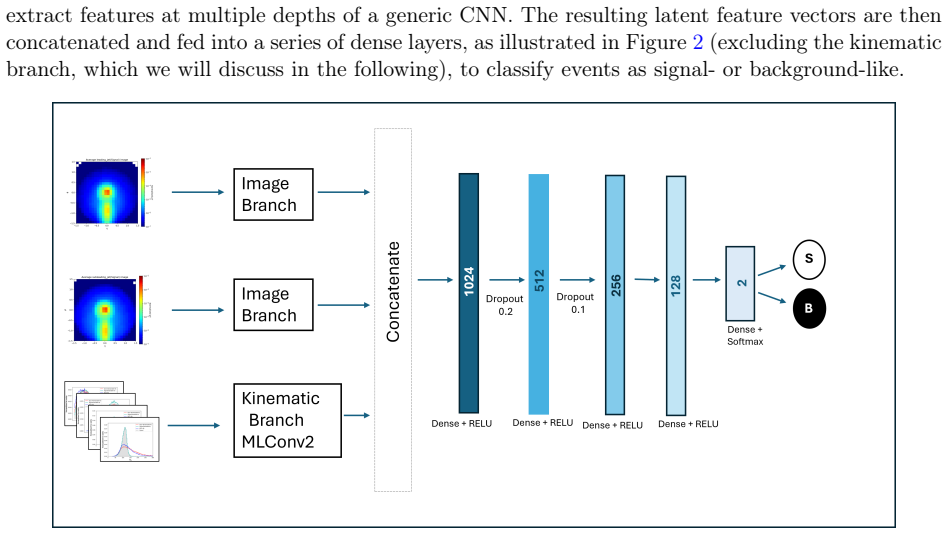
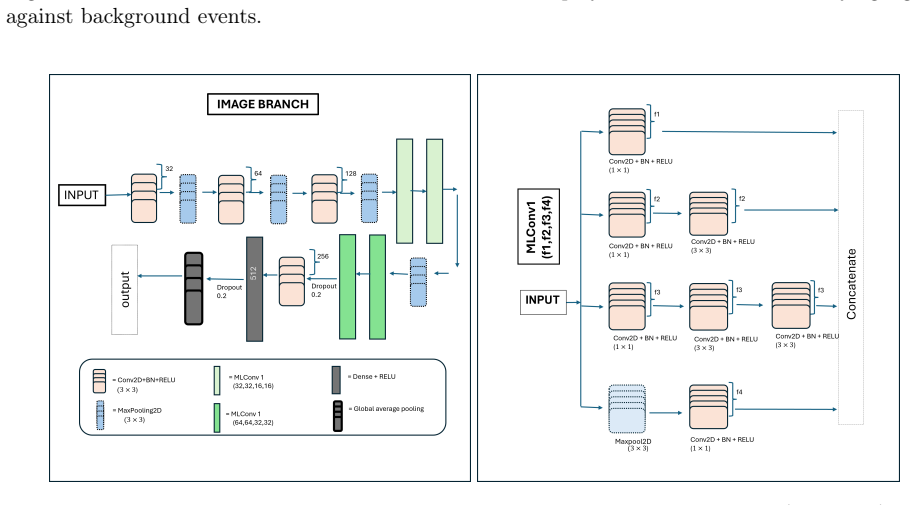
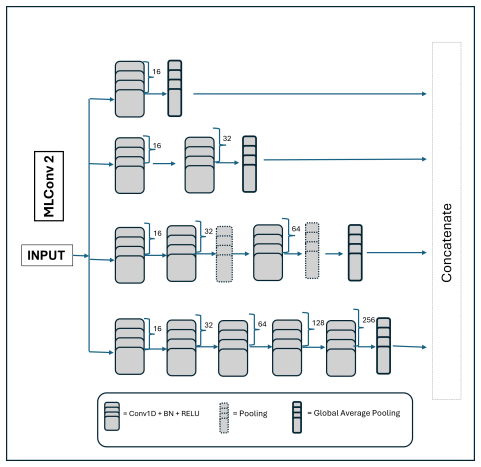
David Krohn, Jesse Thaler, and Lian-Tao Wang. Jets with Variable R.JHEP, 06:059, 2009. 22 6 Appendix 6.1 Architecture and Network Design The analysis employs a multi-layer DL NN architecture specifically designed to exploit complemen- tary information from jet images and high-level kinematic observables (Figure 2). The combined dataset of signal and backg...
2009
discussion (0)
Sign in with ORCID, Apple, or X to comment. Anyone can read and Pith papers without signing in.