Shortcut to Adiabatic Isomeric Population Transfer of the ²²⁹Th Nucleus via Hyperfine Electronic Bridge
Pith reviewed 2026-06-28 18:29 UTC · model grok-4.3
The pith
Stimulated Raman shortcut-to-adiabatic passage shortens thorium-229 isomeric population transfer via the hyperfine electronic bridge from hundreds of milliseconds to hundreds of microseconds at about 79.38 percent efficiency.
A machine-rendered reading of the paper's core claim, the machinery that carries it, and where it could break.
Core claim
The authors demonstrate that the stimulated Raman shortcut-to-adiabatic passage method, when applied to the hyperfine electronic bridge of the thorium-229 nucleus, achieves isomeric population transfer in hundreds of microseconds rather than hundreds of milliseconds while preserving a transfer efficiency of approximately 79.38 percent.
What carries the argument
Stimulated Raman shortcut-to-adiabatic passage applied through the hyperfine electronic bridge, which uses tailored laser pulses to accelerate population transfer between nuclear isomeric levels.
If this is right
- Operation time for isomeric population transfer is reduced from hundreds of milliseconds to hundreds of microseconds.
- Transfer efficiency remains approximately 79.38 percent under the shortcut protocol.
- Faster coherent control of the nuclear isomer becomes possible through the same hyperfine electronic bridge.
- The approach supplies a concrete route to more practical manipulation of the low-lying thorium-229 isomer.
Where Pith is reading between the lines
- Shorter transfer times could reduce the impact of decoherence during repeated nuclear-state operations.
- The same shortcut technique may extend to other nuclei that possess comparable electronic-nuclear bridges.
- Practical experiments would still need to verify that the modeled pulse shapes remain robust against real laboratory noise.
- The reduced timescale opens the possibility of incorporating such transfers into larger sequences of quantum operations on the nucleus.
Load-bearing premise
The hyperfine electronic bridge coupling and the chosen laser pulse parameters accurately model the real physical system and produce the stated transfer efficiency.
What would settle it
Apply the proposed laser pulses to trapped thorium-229 ions and directly measure the achieved population transfer time and final-state population to test whether the duration reaches hundreds of microseconds and the efficiency reaches 79.38 percent.
Figures
read the original abstract
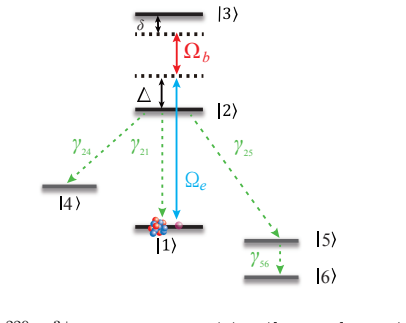
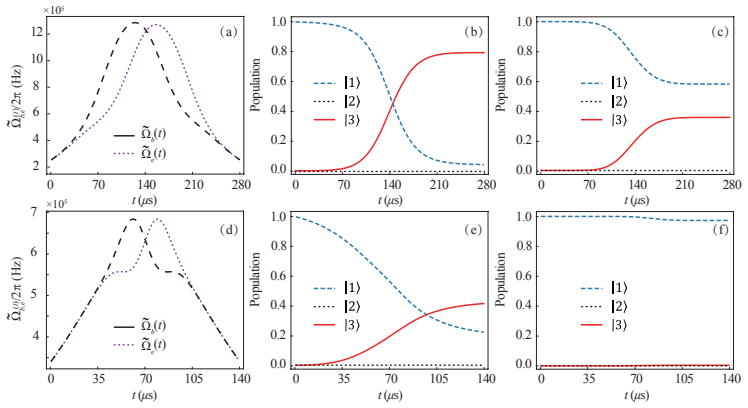
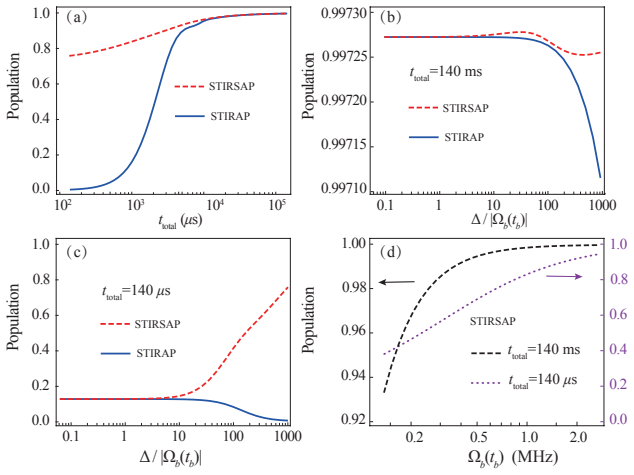
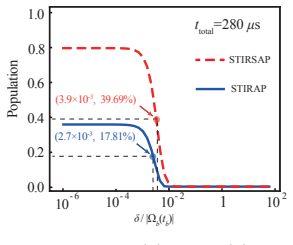
The $^{229}$Th nucleus is well known for its exceptionally low-lying nuclear isomeric level, which provides a unique platform for exploring electron-nucleus interactions and gives rise to a variety of rich physical phenomena. One such phenomenon is the hyperfine electronic bridge, which has recently been shown to enable efficient and precise manipulation of the nuclear isomeric levels of $^{229}$Th [W. Wang $et~ al.$, Phys. Rev. Lett. \textbf{133}, 223001 (2024)]. However, that study used the stimulated Raman adiabatic passage method, which requires relatively long operation times. In this work, we employ the stimulated Raman shortcut-to-adiabatic passage method, which dramatically shortens the operation time from the order of hundreds of milliseconds to hundreds of microseconds while maintaining a transfer efficiency of about $79.38\%$.
Editorial analysis
A structured set of objections, weighed in public.
Referee Report
Summary. The manuscript proposes applying the stimulated Raman shortcut-to-adiabatic passage (SR-STIRAP) technique to the hyperfine electronic bridge Hamiltonian of the ²²⁹Th nucleus. It claims that this shortens the isomeric population transfer time from hundreds of milliseconds (standard STIRAP) to hundreds of microseconds while achieving a numerical transfer efficiency of approximately 79.38%, obtained by solving the time-dependent Schrödinger equation with engineered laser pulses.
Significance. If the numerical results hold under the stated model, the work demonstrates a practical acceleration of nuclear-state control via a known shortcut-to-adiabaticity method. This could enable faster operations in nuclear quantum optics and related precision measurements, building directly on the recent hyperfine-bridge demonstration cited in the abstract.
minor comments (2)
- [Abstract] Abstract: the efficiency value 79.38% is stated without reference to the specific pulse shapes, counter-diabatic Hamiltonian term, or numerical integration parameters used; adding a short clause or citation to the relevant equation in the main text would improve clarity.
- The manuscript should explicitly state the basis set or truncation used for the hyperfine levels and confirm that the reported efficiency is robust against small variations in the laser detunings or Rabi frequencies.
Simulated Author's Rebuttal
We thank the referee for their careful reading and positive assessment of our manuscript, including the recognition of its potential to accelerate nuclear-state control via SR-STIRAP. We appreciate the recommendation for minor revision. No specific major comments were provided in the report, so we will incorporate any minor editorial or clarification points in the revised version while preserving the core numerical results and methodology.
Circularity Check
Minor self-citation to prior work on the hyperfine bridge; central efficiency is a numerical simulation result.
specific steps
-
self citation load bearing
[Abstract]
"which has recently been shown to enable efficient and precise manipulation of the nuclear isomeric levels of ^{229}Th [W. Wang et al., Phys. Rev. Lett. 133, 223001 (2024)]."
Citation is to prior work by co-author Wu Wang; however the citation only supplies the physical system and is not used to derive the SR-STIRAP speedup or efficiency figure, which are simulation outputs.
full rationale
The paper cites overlapping-author prior work only to establish the existence of the hyperfine electronic bridge Hamiltonian; the claimed time reduction and 79.38% efficiency are obtained by solving the time-dependent Schrödinger equation under SR-STIRAP pulses. No equation reduces to its input by definition, no fitted parameter is relabeled as a prediction, and the self-citation is not load-bearing for the new numerical claim. The derivation is therefore self-contained against external benchmarks.
Axiom & Free-Parameter Ledger
Reference graph
Works this paper leans on
-
[1]
Tiedau, M
J. Tiedau, M. V . Okhapkin, K. Zhang, J. Thielking, G. Zitzer, E. Peik, F. Schaden, T. Pronebner, I. Morawetz, L. Toscani De Col, F. Schneider, A. Leitner, M. Pressler, G. A. Kazakov, K. Beeks, T. Sikorsky, and T. Schumm. Laser excitation of the 229Thnucleus.Phys. Rev. Lett., 132:182501, Apr 2024
2024
-
[2]
Elwell, Christian Schneider, Justin Jeet, J
R. Elwell, Christian Schneider, Justin Jeet, J. E. S. Terhune, H. W. T. Morgan, A. N. Alexandrova, H. B. Tran Tan, Andrei Derevianko, and Eric R. Hudson. Laser excitation of the 229Th nuclear isomeric transition in a solid-state host.Phys. Rev. Lett., 133:013201, Jul 2024
2024
-
[3]
Higgins, Jack F
Chuankun Zhang, Tian Ooi, Jacob S. Higgins, Jack F. Doyle, Lars von der Wense, Kjeld Beeks, Adrian Leitner, Georgy A. Kazakov, Peng Li, Peter G. Thirolf, Thorsten Schumm, and Jun Ye. Frequency ratio of the 229mth nuclear isomeric transition and the 87sr atomic clock.Nature, 633(8028):63–70, Sep 2024
2024
-
[4]
Peik and Chr
E. Peik and Chr. Tamm. Nuclear laser spectroscopy of the 3.5 ev transition in th-229.Europhys. Lett., 61(2):181, jan 2003
2003
-
[5]
C. J. Campbell, A. G. Radnaev, A. Kuzmich, V . A. Dzuba, V . V . Flambaum, and A. Derevianko. Single-ion nuclear clock for metrology at the 19th decimal place.Phys. Rev. Lett., 108:120802, Mar 2012
2012
-
[6]
Thirolf, Sandro Kraemer, Daniel Moritz, and Kevin Scharl
Peter G. Thirolf, Sandro Kraemer, Daniel Moritz, and Kevin Scharl. The thorium isomer 229mth: Review of status and perspectives after more than 50 years of research.Eur . Phys. J. Spec. Top., 233:1113–1131, Jun 2024
2024
-
[7]
Searching for dark matter with the 229Th nuclear lineshape from laser spectroscopy.Phys
Elina Fuchs, Fiona Kirk, Eric Madge, Chaitanya Paranjape, Ekkehard Peik, Gilad Perez, Wolfram Ratzinger, and Johannes Tiedau. Searching for dark matter with the 229Th nuclear lineshape from laser spectroscopy.Phys. Rev. X, 15:021055, May 2025. 8
2025
-
[8]
E. Peik, T. Schumm, M. S. Safronova, A. Pálffy, J. Weitenberg, and P. G. Thirolf. Nuclear clocks for testing fundamental physics.Quantum Sci. Technol., 6(3):034002, apr 2021
2021
-
[9]
Exciting the isomeric229Th nuclear state via laser-driven electron recollision.Phys
Wu Wang, Jie Zhou, Boqun Liu, and Xu Wang. Exciting the isomeric229Th nuclear state via laser-driven electron recollision.Phys. Rev. Lett., 127:052501, Jul 2021
2021
-
[10]
Nuclear excitation of 229Th induced by laser-driven electron recollision.Phys
Xu Wang. Nuclear excitation of 229Th induced by laser-driven electron recollision.Phys. Rev. C, 106:024606, Aug 2022
2022
-
[11]
Quantum theory of isomeric excitation of 229Th in strong laser fields.Phys
Wu Wang and Xu Wang. Quantum theory of isomeric excitation of 229Th in strong laser fields.Phys. Rev. Res., 5:043232, Dec 2023
2023
-
[12]
V . L. Lyuboshitz, V . A. Onishchuk, and M. I. Podgoretskij. Some interference effects due to the mixing of quantum levels by external fields.Sov. J. Nucl. Phys., 3:420, 1966
1966
-
[13]
Szerypo, R
J. Szerypo, R. Barden, Ł Kalinowski, R. Kirchner, O. Klepper, A. Płochocki, E. Roeckl, K. Rykaczewski, D. Schardt, and J. ˙Zylicz. Low-lying levels in 4in and a problem of spin-mixing in hyperfine fields.Nuclear Physics A, 507(2):357–370, Feb 1990
1990
-
[14]
Wycech and J
S. Wycech and J. ˙Zylicz. Predictions for nuclear spin mixing in magnetic fields.Acta Phys. Pol. B, 24:637–647, 1993
1993
-
[15]
F. F. Karpeshin, S. Wycech, I. M. Band, M. B. Trzhaskovskaya, M. Pfützner, and J.˙Zylicz. Rates of transitions between the hyperfine-splitting components of the ground-state and the 3.5 ev isomer in 229th89+.Phys. Rev. C, 57:3085–3088, Jun 1998
1998
-
[16]
Pachucki, S
K. Pachucki, S. Wycech, J. ˙Zylicz, and M. Pfützner. Nuclear-spin mixing oscillations in 229th89+.Phys. Rev. C, 64:064301, Nov 2001
2001
-
[17]
K. Beloy. Hyperfine structure in 229gTh 3+ as a probe of the 229gTh→ 229m Th nuclear excitation energy.Phys. Rev. Lett., 112:062503, Feb 2014
2014
-
[18]
E. V . Tkalya and A. V . Nikolaev. Magnetic hyperfine structure of the ground-state doublet in highly charged ions 229Th89+,87+ and the bohr-weisskopf effect.Phys. Rev. C, 94:014323, Jul 2016
2016
-
[19]
V . M. Shabaev, D. A. Glazov, A. M. Ryzhkov, C. Brandau, G. Plunien, W. Quint, A. M. V olchkova, and D. V . Zinenko. Ground-state g factor of highly charged 229Th ions: An access to the m1 transition probability between the isomeric and ground nuclear states.Phys. Rev. Lett., 128:043001, Jan 2022
2022
-
[20]
Litvinov, Adriana Pálffy, Jonas Sommerfeldt, Andrey Surzhykov, Peter G
Junlan Jin, Hendrik Bekker, Tobias Kirschbaum, Yuri A. Litvinov, Adriana Pálffy, Jonas Sommerfeldt, Andrey Surzhykov, Peter G. Thirolf, and Dmitry Budker. Excitation and probing of low-energy nuclear states at high- energy storage rings.Phys. Rev. Res., 5:023134, May 2023
2023
-
[21]
Substantial nuclear hyperfine mixing effect in boronlike205Pb ions.Phys
Wu Wang and Xu Wang. Substantial nuclear hyperfine mixing effect in boronlike205Pb ions.Phys. Rev. Lett., 133:032501, Jul 2024
2024
-
[22]
Highly nonlinear light-nucleus interaction.Phys
Hanxu Zhang, Tao Li, and Xu Wang. Highly nonlinear light-nucleus interaction.Phys. Rev. Lett., 133:152503, Oct 2024
2024
-
[23]
Theory of nuclear excitation by electron capture for heavy ions.Phys
Adriana Pálffy, Werner Scheid, and Zoltán Harman. Theory of nuclear excitation by electron capture for heavy ions.Phys. Rev. A, 73:012715, Jan 2006
2006
-
[24]
Rzadkiewicz, M
J. Rzadkiewicz, M. Polasik, K. Słabkowska, Ł. Syrocki, J. J. Carroll, and C. J. Chiara. Novel approach to 93mMo isomer depletion: Nuclear excitation by electron capture in resonant transfer process.Phys. Rev. Lett., 127:042501, Jul 2021
2021
-
[25]
Isomeric excitation of 229Th in laser-heated clusters.Phys
Jintao Qi, Hanxu Zhang, and Xu Wang. Isomeric excitation of 229Th in laser-heated clusters.Phys. Rev. Lett., 130:112501, Mar 2023
2023
-
[26]
Keitel, and Yuanbin Wu
Jingyan Zhao, Adriana Pálffy, Christoph H. Keitel, and Yuanbin Wu. Efficient production of229mTh via nuclear excitation by electron capture.Phys. Rev. C, 110:014330, Jul 2024
2024
-
[27]
I. S. Batkin.Sov. J. Nucl. Phys., 29:464, 1979
1979
-
[28]
E. V . Tkalya. Excitation of low-lying isomer level of the nucleus 229th by optical photons.JETP Lett., 55:211, 1992
1992
-
[29]
S. G. Porsev, V . V . Flambaum, E. Peik, and Chr. Tamm. Excitation of the isomeric229mTh nuclear state via an electronic bridge process in 229Th+.Phys. Rev. Lett., 105:182501, Oct 2010
2010
-
[30]
R. A. Müller, A. V . V olotka, S. Fritzsche, and A. Surzhykov. Theoretical analysis of the electron bridge process in 229th3+.Nucl. Instrum. Methods Phys. Res., Sect. B, 408:84–88, 2017. 9
2017
-
[31]
P. V . Borisyuk, N. N. Kolachevsky, A. V . Taichenachev, E. V . Tkalya, I. Yu. Tolstikhina, and V . I. Yudin. Excitation of the low-energy 229mTh isomer in the electron bridge process via the continuum.Phys. Rev. C, 100:044306, Oct 2019
2019
-
[32]
Nickerson, Martin Pimon, Pavlo V
Brenden S. Nickerson, Martin Pimon, Pavlo V . Bilous, Johannes Gugler, Kjeld Beeks, Tomas Sikorsky, Peter Mohn, Thorsten Schumm, and Adriana Pálffy. Nuclear excitation of the 229Th isomer via defect states in doped crystals.Phys. Rev. Lett., 125:032501, Jul 2020
2020
-
[33]
A. Ya. Dzyublik. Excitation of 229mTh in the electron bridge via continuum, as a scattering process.Phys. Rev. C, 102:024604, Aug 2020
2020
-
[34]
Scheme for the excitation of thorium-229 nuclei based on electronic bridge excitation.Nucl
Lin Li, Zi Li, Chen Wang, Wen-Ting Gan, Xia Hua, and Xin Tong. Scheme for the excitation of thorium-229 nuclei based on electronic bridge excitation.Nucl. Sci. Tech., 34(2):24, Feb 2023
2023
-
[35]
Bilous, Hendrik Bekker, Julian C
Pavlo V . Bilous, Hendrik Bekker, Julian C. Berengut, Benedict Seiferle, Lars von der Wense, Peter G. Thirolf, Thomas Pfeifer, José R. Crespo López-Urrutia, and Adriana Pálffy. Electronic bridge excitation in highly charged 229Thions.Phys. Rev. Lett., 124:192502, May 2020
2020
-
[36]
C. J. Campbell, A. V . Steele, L. R. Churchill, M. V . DePalatis, D. E. Naylor, D. N. Matsukevich, A. Kuzmich, and M. S. Chapman. Multiply charged thorium crystals for nuclear laser spectroscopy.Phys. Rev. Lett., 102:233004, Jun 2009
2009
-
[37]
Isomeric population transfer of the 229Th nucleus via hyperfine electronic bridge.Phys
Wu Wang, Fen Zou, Stephan Fritzsche, and Yong Li. Isomeric population transfer of the 229Th nucleus via hyperfine electronic bridge.Phys. Rev. Lett., 133:223001, Nov 2024
2024
-
[38]
Ibáñez, Xi Chen, E
S. Ibáñez, Xi Chen, E. Torrontegui, J. G. Muga, and A. Ruschhaupt. Multiple schrödinger pictures and dynamics in shortcuts to adiabaticity.Phys. Rev. Lett., 109:100403, Sep 2012
2012
-
[39]
Experimental realization of stimulated raman shortcut-to-adiabatic passage with cold atoms.Nat
Yan-Xiong Du, Zhen-Tao Liang, Yi-Chao Li, Xian-Xian Yue, Qing-Xian Lv, Wei Huang, Xi Chen, Hui Yan, and Shi-Liang Zhu. Experimental realization of stimulated raman shortcut-to-adiabatic passage with cold atoms.Nat. Commun., 7:12479, Aug 2016
2016
-
[40]
Nuclear hyperfine mixing effect in highly charged 205pb ions.Atoms, 13(1):2, 2025
Wu Wang, Yong Li, and Xu Wang. Nuclear hyperfine mixing effect in highly charged 205pb ions.Atoms, 13(1):2, 2025
2025
-
[41]
Search for variations of the fine-structure constant via the hyperfine electronic bridge in highly charged 229Thions.Phys
Wu Wang, Stephan Fritzsche, and Yong Li. Search for variations of the fine-structure constant via the hyperfine electronic bridge in highly charged 229Thions.Phys. Rev. A, 112:022811, Aug 2025
2025
-
[42]
Highly charged 229th6+ ions as the candidate platform for nuclear clock.Chin
Shi-Cheng Yu, Xia Hua, Xin Tong, Cheng-Bin Li, and Lei She. Highly charged 229th6+ ions as the candidate platform for nuclear clock.Chin. Phys. Lett., 42(12):120302, nov 2025
2025
-
[43]
U. I. Safronova, W. R. Johnson, and M. S. Safronova. Excitation energies, polarizabilities, multipole transition rates, and lifetimes inTh IV.Phys. Rev. A, 74:042511, Oct 2006
2006
-
[44]
Lizuain, A
Xi Chen, I. Lizuain, A. Ruschhaupt, D. Guéry-Odelin, and J. G. Muga. Shortcut to adiabatic passage in two- and three-level atoms.Phys. Rev. Lett., 105:123003, Sep 2010
2010
-
[45]
Chapter 2 - shortcuts to adiabaticity
Erik Torrontegui, Sara Ibáñez, Sofía Martínez-Garaot, Michele Modugno, Adolfo del Campo, David Guéry-Odelin, Andreas Ruschhaupt, Xi Chen, and Juan Gonzalo Muga. Chapter 2 - shortcuts to adiabaticity. In Ennio Arimondo, Paul R. Berman, and Chun C. Lin, editors,Advances in Atomic, Molecular , and Optical Physics, volume 62, pages 117–169. Academic Press, 2013
2013
-
[46]
M. V . Berry. Transitionless quantum driving.J. Phys. A: Math. Theor ., 42:365303, 2009
2009
-
[47]
Demirplak and S
M. Demirplak and S. A. Rice. Adiabatic population transfer with control fields.J. Phys. Chem. A, 107:9937, 2003
2003
-
[48]
Mustafa Demirplak and Stuart A. Rice. Assisted adiabatic passage revisited.J. Phys. Chem. B, 109:6838–6844, Apr 2005
2005
-
[49]
N. V . Vitanov and S. Stenholm. Analytic properties and effective two-level problems in stimulated raman adiabatic passage.Phys. Rev. A, 55:648–660, Jan 1997
1997
-
[50]
Shortcut to adiabatic population transfer in quantum three-level systems: Effective two-level problems and feasible counterdiabatic driving.Phys
Yi-Chao Li and Xi Chen. Shortcut to adiabatic population transfer in quantum three-level systems: Effective two-level problems and feasible counterdiabatic driving.Phys. Rev. A, 94:063411, Dec 2016
2016
-
[51]
Physically feasible three-level transitionless quantum driving with multiple schrödinger dynamics.Phys
Xue-Ke Song, Qing Ai, Jing Qiu, and Fu-Guo Deng. Physically feasible three-level transitionless quantum driving with multiple schrödinger dynamics.Phys. Rev. A, 93:052324, May 2016
2016
-
[52]
Alexandre Baksic, Hugo Ribeiro, and Aashish A. Clerk. Speeding up adiabatic quantum state transfer by using dressed states.Phys. Rev. Lett., 116:230503, Jun 2016. 10
2016
discussion (0)
Sign in with ORCID, Apple, or X to comment. Anyone can read and Pith papers without signing in.