From Performance to Viability: A Bootstrap Framework for Latent-Space Representation Learning in Adaptive Biological Systems
Pith reviewed 2026-06-28 17:36 UTC · model grok-4.3
The pith
Observable performance in adaptive biological systems is insufficient to distinguish organizations or predict trajectories, requiring a five-level bootstrap to latent viability and internal predictive models.
A machine-rendered reading of the paper's core claim, the machinery that carries it, and where it could break.
Core claim
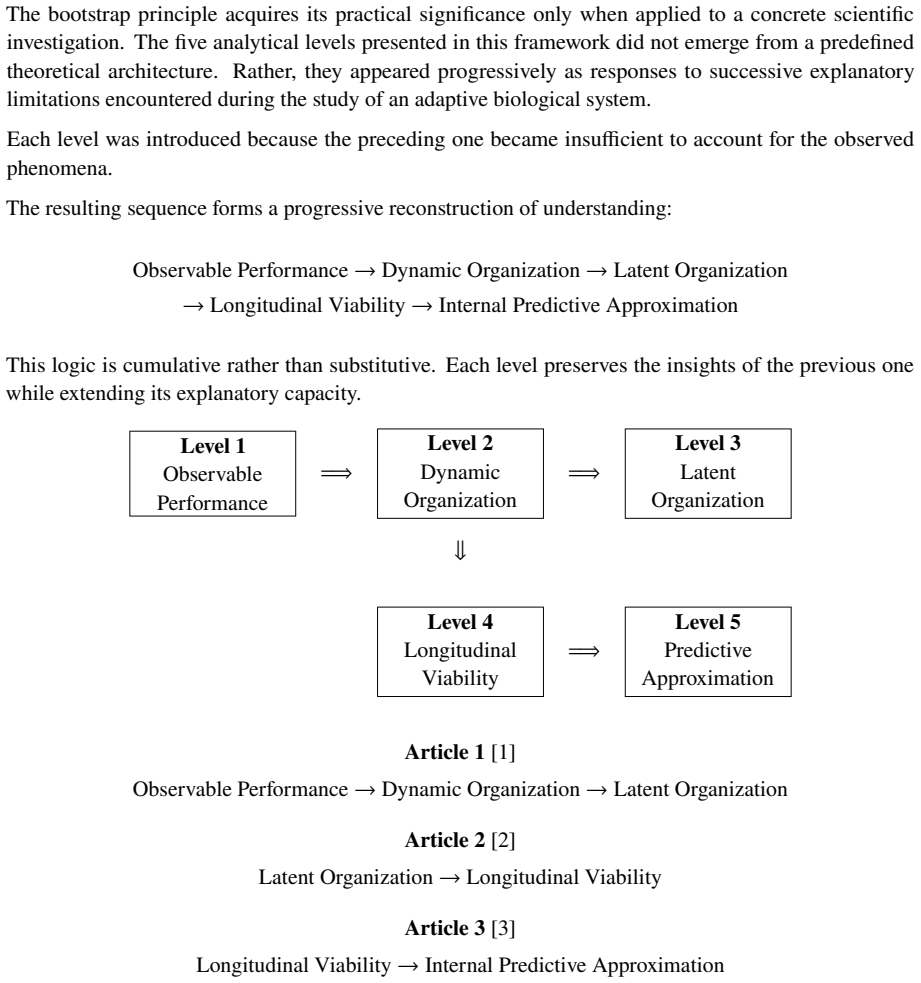
The framework formalizes how performance analysis leads to latent organization, how static latent organization leads to longitudinal viability, and how observed viability leads to internal predictive approximation, describing a bootstrap process in which new levels are added precisely when preceding representations become insufficient to account for observed adaptive dynamics.
What carries the argument
The five-level bootstrap progression (observable performance, dynamic organization, latent organization, longitudinal viability, internal predictive approximation) that introduces each new analytical level when the prior representation cannot account for the adaptive dynamics.
If this is right
- Similar observable performances in adaptive systems can arise from distinct underlying organizations.
- Configurations that appear comparable at one time can follow different longitudinal trajectories.
- Static latent organization must be extended to longitudinal viability to capture adaptive trajectories.
- Once viability is observed, internal predictive approximation becomes the next required level.
Where Pith is reading between the lines
- The same bootstrap logic could be tested on non-biological adaptive systems such as recurrent neural networks trained on time-series data.
- Viability metrics derived at the fourth level might serve as an evaluation criterion for representation quality in other domains.
- Formalizing the transition rules between levels as explicit criteria could allow automated triggering of new levels in data pipelines.
Load-bearing premise
Performance-based interpretation is inherently limited for adaptive systems, so a bootstrap through these five specific levels is required to reach adequate representations without a complete mechanistic model in advance.
What would settle it
A demonstration that performance metrics alone, without advancing through the later levels, can fully distinguish organizations and predict trajectories in the gait-occlusion data would falsify the necessity of the bootstrap framework.
Figures
read the original abstract
Observable performance is commonly used to characterize biological systems. In adaptive systems, however, similar performances may arise from distinct organizations, and configurations that appear comparable at a given time may follow different longitudinal trajectories. This limitation motivates a methodological framework for moving beyond performance-based interpretation without assuming a complete mechanistic model in advance. This article proposes a bootstrap framework for latent-space representation learning in adaptive biological systems. Here, bootstrap is used in a methodological and epistemological sense: new analytical levels are introduced when the preceding representation becomes insufficient to account for observed adaptive dynamics. The framework is organized around five levels: observable performance, dynamic organization, latent organization, longitudinal viability, and internal predictive approximation. The framework is illustrated by three previously reported gait--occlusion studies, used here only as a methodological case sequence and not as new experimental evidence. The article formalizes how performance analysis led to latent organization, how static latent organization led to longitudinal viability, and how observed viability led to internal predictive approximation. The contribution is not a new learning algorithm, clinical protocol, or dataset, but a bootstrap framework for latent-space representation learning describing how increasingly informative representations can emerge from observational insufficiencies in adaptive biological data.
Editorial analysis
A structured set of objections, weighed in public.
Referee Report
Summary. The manuscript proposes a methodological bootstrap framework for latent-space representation learning in adaptive biological systems. It defines five levels—observable performance, dynamic organization, latent organization, longitudinal viability, and internal predictive approximation—where each new level is introduced when the prior representation becomes insufficient to account for observed adaptive dynamics. The framework is illustrated exclusively by post-hoc mapping of three previously published gait-occlusion studies onto the levels; the paper explicitly states that it contributes neither a new algorithm, dataset, nor experimental evidence.
Significance. If operationalized with explicit transition criteria and tested on independent data, the framework could offer a structured conceptual approach for developing representations that capture longitudinal and predictive aspects of adaptive systems beyond static performance metrics. As presented, however, the contribution reduces to a narrative reinterpretation of existing case studies without demonstrated improvement in representation quality or predictive power.
major comments (3)
- [Abstract] Abstract and framework description: the bootstrap process is both motivated by and illustrated solely with the same three gait-occlusion studies, so the claimed progression from performance to internal predictive approximation reduces to a re-description of those cases rather than an independent derivation or general method.
- [Framework description] Framework section: no general criterion is supplied for detecting when a representation has become 'insufficient,' no transition operator or objective function is defined for moving to the next level, and no equations or pseudocode formalize the bootstrap process or the latent-space representations at each level.
- [Illustration with gait-occlusion studies] Illustration section: because the five-level sequence is constructed by mapping the identical three studies that motivated the framework, the central claim that the levels yield 'increasingly informative representations' lacks an independent test or falsifiable prediction.
minor comments (1)
- [Abstract and title] The abstract states the contribution 'is not a new learning algorithm' yet the title refers to a 'Framework for Latent-Space Representation Learning'; this tension should be resolved for clarity.
Simulated Author's Rebuttal
We thank the referee for the constructive comments. We respond to each major comment below, emphasizing that the manuscript presents a conceptual bootstrap framework rather than an algorithmic or empirical contribution.
read point-by-point responses
-
Referee: [Abstract] Abstract and framework description: the bootstrap process is both motivated by and illustrated solely with the same three gait-occlusion studies, so the claimed progression from performance to internal predictive approximation reduces to a re-description of those cases rather than an independent derivation or general method.
Authors: The framework is motivated by the limitations observed in performance data from adaptive systems, with the gait-occlusion studies serving as illustrative examples of how the bootstrap process unfolds. The contribution is the articulation of this five-level progression as a general methodological approach for deriving more informative latent representations, not an independent derivation from new data. This structured description allows researchers to recognize similar patterns in other systems. revision: no
-
Referee: [Framework description] Framework section: no general criterion is supplied for detecting when a representation has become 'insufficient,' no transition operator or objective function is defined for moving to the next level, and no equations or pseudocode formalize the bootstrap process or the latent-space representations at each level.
Authors: The framework is epistemological in nature, where the transition to a new level occurs when the current representation fails to account for observed adaptive dynamics, as determined by the analyst. We do not provide a general criterion or formal operator because the framework is designed to be applicable without assuming a specific model or objective function. Formal equations or pseudocode would suggest a computational procedure, which is not the intent of this conceptual contribution. revision: no
-
Referee: [Illustration with gait-occlusion studies] Illustration section: because the five-level sequence is constructed by mapping the identical three studies that motivated the framework, the central claim that the levels yield 'increasingly informative representations' lacks an independent test or falsifiable prediction.
Authors: We agree that the illustration uses the same studies that motivated the framework, and the manuscript explicitly notes that these are not new experimental evidence. The claim is that the levels represent a possible sequence of increasing informativeness based on the bootstrap logic, rather than a validated empirical result. A falsifiable test would require operationalizing the framework on new data, which we position as an opportunity for future research. revision: no
Circularity Check
Bootstrap framework reduces to post-hoc re-labeling of three gait-occlusion studies
specific steps
-
renaming known result
[Abstract]
"The framework is illustrated by three previously reported gait--occlusion studies, used here only as a methodological case sequence and not as new experimental evidence. The article formalizes how performance analysis led to latent organization, how static latent organization led to longitudinal viability, and how observed viability led to internal predictive approximation."
The bootstrap progression (performance → dynamic organization → latent organization → longitudinal viability → internal predictive approximation) is presented as the framework's core result, yet is obtained exclusively by assigning the five levels to the existing sequence of the three studies; no independent operator, insufficiency criterion, or derivation is given, so the framework equals a renaming of the known empirical progression in those cases.
full rationale
The paper explicitly states it contributes a methodological framework illustrated solely by mapping three prior studies onto five levels, with no new data, algorithm, equations, or general transition criterion supplied. The claimed emergence of representations from 'observational insufficiencies' is therefore equivalent to re-describing the sequence already present in those studies rather than deriving an independent procedure.
Axiom & Free-Parameter Ledger
axioms (1)
- domain assumption Observable performance is insufficient to characterize adaptive biological systems without assuming a complete mechanistic model in advance.
Forward citations
Cited by 1 Pith paper
-
Bootstrap Theory of Representational Emergence: Explanatory Insufficiency as a Driver of Representation Learning and World Models
TBER describes representational emergence as a five-stage bootstrap process triggered by explanatory insufficiency in AI, biology, and science.
Reference graph
Works this paper leans on
-
[1]
Raynal J, Slangen P, Margerit J. Observable Performance Does Not Fully Reflect System Or- ganization: A Multi-Level Analysis of Gait Dynamics Under Occlusal Constraint. arXiv. 2026. doi:10.48550/arXiv.2605.00778
work page internal anchor Pith review Pith/arXiv arXiv doi:10.48550/arxiv.2605.00778 2026
-
[2]
From Organization to Viability: A Multi-Level Analysis of Gait Dynamics Under Occlusal Constraint
Raynal J, Slangen P, Raynal E, Margerit J. From Organization to Viability: A Multi-Level Analysis of Gait Dynamics Under Occlusal Constraint. arXiv. 2026. doi:10.48550/arXiv.2605.13893
work page internal anchor Pith review Pith/arXiv arXiv doi:10.48550/arxiv.2605.13893 2026
-
[3]
Raynal J, Slangen P, Raynal E, Margerit J. From Observed Viability to Internal Predictive Approx- imation: A Single-Subject Latent-Space Analysis of Gait Dynamics Under Occlusal Constraint. arXiv. 2026. doi:10.48550/arXiv.2605.15862
work page internal anchor Pith review Pith/arXiv arXiv doi:10.48550/arxiv.2605.15862 2026
-
[4]
Viability Theory
Aubin JP. Viability Theory. Boston: Birkhäuser; 1991
1991
-
[5]
Principles of Biological Autonomy
Varela FJ. Principles of Biological Autonomy. New York: Elsevier; 1979
1979
-
[6]
The Origins of Order: Self-Organization and Selection in Evolution
Kauffman SA. The Origins of Order: Self-Organization and Selection in Evolution. Oxford: Oxford University Press; 1993
1993
-
[7]
Dynamic Patterns: The Self-Organization of Brain and Behavior
Kelso JAS. Dynamic Patterns: The Self-Organization of Brain and Behavior. Cambridge (MA): MIT Press; 1995
1995
-
[8]
Constraints on the development of coordination
Newell KM. Constraints on the development of coordination. In: Wade MG, Whiting HTA, editors. MotorDevelopmentinChildren: AspectsofCoordinationandControl.Dordrecht: MartinusNijhoff
-
[9]
Jolliffe IT, Cadima J. Principal component analysis: A review and recent developments. Philos Trans A Math Phys Eng Sci. 2016;374(2065):20150202. doi:10.1098/rsta.2015.0202
-
[10]
Bengio Y, Courville A, Vincent P. Representation learning: A review and new perspectives. IEEE Trans Pattern Anal Mach Intell. 2013;35(8):1798–1828. doi:10.1109/TPAMI.2013.50
-
[11]
How to Make Our Ideas Clear
Peirce CS. How to Make Our Ideas Clear. Popular Science Monthly. 1878;12:286–302. 24
discussion (0)
Sign in with ORCID, Apple, or X to comment. Anyone can read and Pith papers without signing in.