Extensible Fluxonium Architecture Using Tunable Couplers with Low Shunt Capacitance
Pith reviewed 2026-06-28 14:33 UTC · model grok-4.3
The pith
Fluxonium qubits scale to 2D grids via low-shunt-capacitance tunable couplers based on quarton or fluxonium circuits.
A machine-rendered reading of the paper's core claim, the machinery that carries it, and where it could break.
Core claim
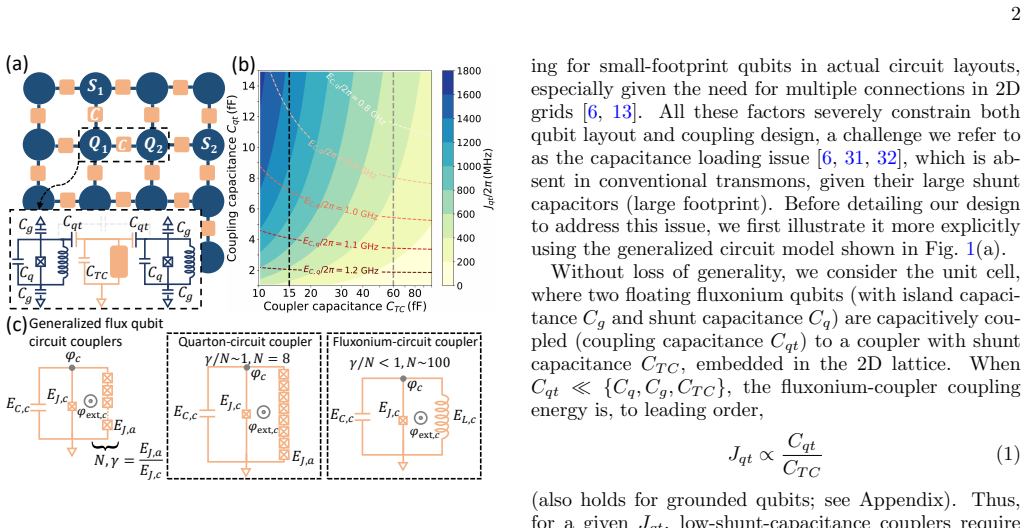
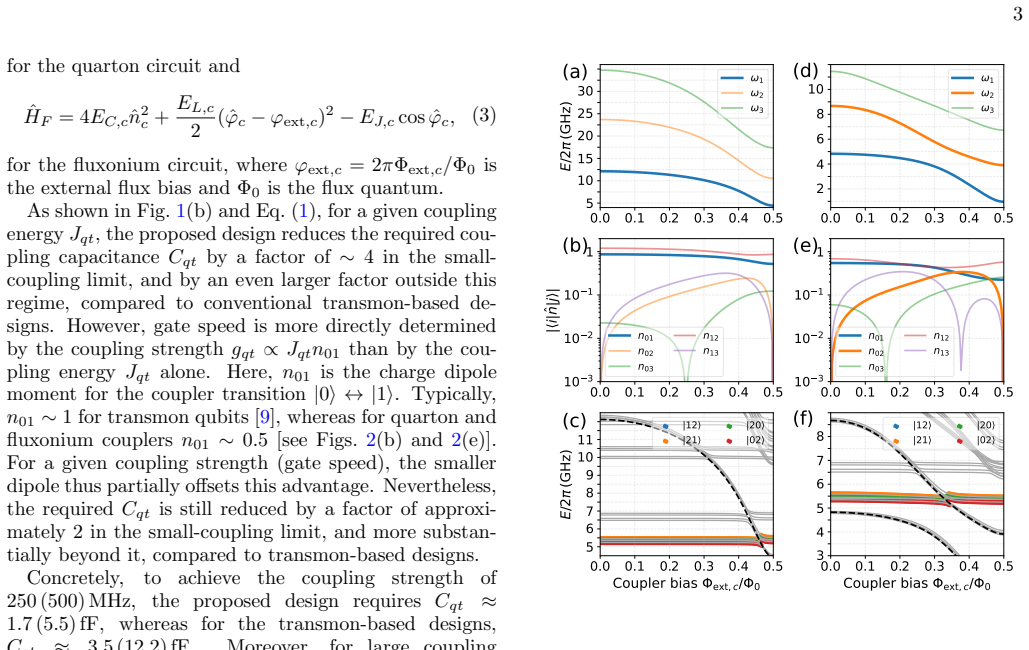
Embedding low-shunt-capacitance couplers realized as generalized flux qubits into 2D square lattices yields large tunable couplings even with modest coupling capacitances, thereby supporting multiple connections within the available capacitance budget and enabling fast, high-fidelity two-qubit gates with low spectator errors.
What carries the argument
Low-shunt-capacitance tunable couplers (quarton and fluxonium realizations) that mediate controllable interactions between fluxonium qubits while preserving capacitance budget for multiple 2D connections.
If this is right
- Large coupling strengths become reachable with coupling capacitances small enough to allow four or more neighbors per qubit.
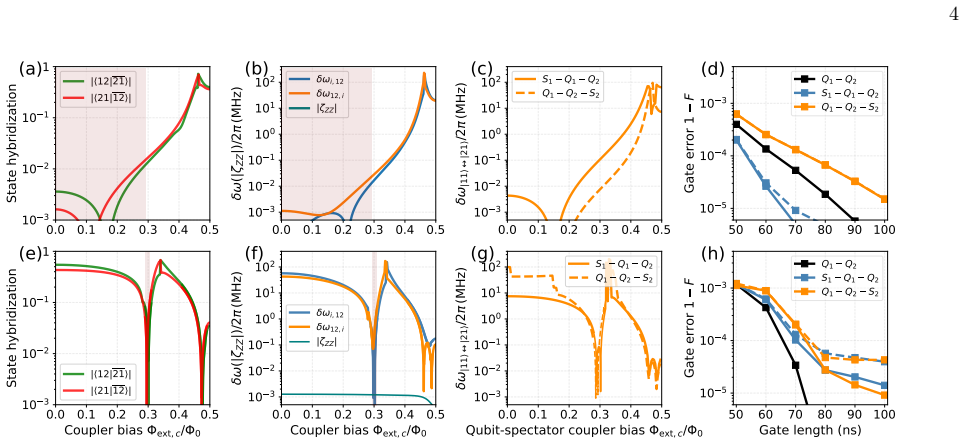
- Both quarton and fluxonium coupler designs produce fast gates while keeping spectator errors low.
- The architecture supports multiple connections on 2D grids without exhausting the shunt-capacitance allowance.
- Tunable interactions remain controllable even when the qubit footprint is kept small.
Where Pith is reading between the lines
- The same coupler approach could relax wiring density requirements in larger superconducting processors by moving control to the coupler lines.
- Small lattices built this way could serve as testbeds to quantify crosstalk growth before scaling to 10-by-10 arrays.
- If the couplers add negligible decoherence, the architecture might combine with existing fluxonium coherence advantages to reach error rates suitable for error-corrected logical qubits.
- Frequency crowding limits could be probed by simulating or measuring spectra of 3-by-3 patches with realistic fabrication spreads.
Load-bearing premise
The coupler circuits themselves can be fabricated and operated without introducing decoherence, frequency crowding, or control overhead that would spoil the claimed gate fidelities and spectator-error levels in a real array.
What would settle it
Fabricate and measure a 2-by-2 fluxonium array using the proposed couplers and check whether two-qubit gate fidelities remain above 99 percent while spectator-qubit error rates stay below 0.1 percent and coherence times match single-qubit benchmarks.
Figures
read the original abstract
Fluxonium qubits have demonstrated high-fidelity operations and long coherence times in small-scale systems, highlighting their promise for quantum computing. However, large-scale integration into a high-performance two-dimensional (2D) qubit array remains the central challenge for practical applications. In this work, we introduce an extensible architecture for scaling up fluxonium qubits in 2D grids. To address the key challenges, namely achieving controllable strong interaction and high connectivity for qubits featuring small shunting capacitors (footprints), we propose using low-shunt-capacitance couplers to enable tunable interactions between fluxonium qubits. When embedded into 2D square lattices, large couplings can be achieved even with relatively small coupling capacitances, thus enabling multiple connections with sufficient capacitance budget. We further propose coupler realizations based on generalized flux qubit circuits, specifically the quarton and the fluxonium, and demonstrate that both enable fast, high-fidelity gates with low spectator errors, while supporting multiple connections on 2D grids.
Editorial analysis
A structured set of objections, weighed in public.
Referee Report
Summary. The manuscript proposes an extensible architecture for scaling fluxonium qubits into 2D square lattices by employing tunable couplers with low shunt capacitance, realized via generalized flux-qubit circuits (quarton and fluxonium). The central claims are that this design achieves large tunable couplings even with small coupling capacitances (enabling multiple connections within the capacitance budget) and that both coupler types support fast, high-fidelity gates with low spectator errors.
Significance. If the simulation results hold under realistic multi-coupler conditions, the work would address a key integration barrier for fluxonium qubits by relaxing the shunt-capacitance constraint while preserving high connectivity. The explicit proposal of quarton- and fluxonium-based couplers, together with the reported gate-fidelity and spectator-error metrics, constitutes a concrete design contribution that could be tested experimentally.
major comments (1)
- [Gate performance and simulation sections] The gate-fidelity and spectator-error results (presumably obtained via circuit simulations or Hamiltonian diagonalization) are presented for isolated qubit-coupler pairs or minimal clusters. No quantitative analysis of cumulative capacitive loading, frequency crowding, or cross-talk arising from multiple simultaneous couplers in a dense 2D lattice is provided; this directly bears on the claim that the architecture remains extensible with low spectator errors.
minor comments (1)
- [Abstract] The abstract contains a minor grammatical issue: 'namely achieving controllable strong interaction' should be rephrased for clarity.
Simulated Author's Rebuttal
Thank you for the opportunity to respond to the referee's report. We address the major comment point by point below.
read point-by-point responses
-
Referee: [Gate performance and simulation sections] The gate-fidelity and spectator-error results (presumably obtained via circuit simulations or Hamiltonian diagonalization) are presented for isolated qubit-coupler pairs or minimal clusters. No quantitative analysis of cumulative capacitive loading, frequency crowding, or cross-talk arising from multiple simultaneous couplers in a dense 2D lattice is provided; this directly bears on the claim that the architecture remains extensible with low spectator errors.
Authors: We thank the referee for highlighting this important point. Our gate performance results are indeed based on simulations of isolated qubit-coupler pairs and minimal clusters, as full simulations of a complete 2D lattice with multiple active couplers would require significant additional computational resources. The manuscript focuses on demonstrating the core advantages of the low-shunt-capacitance coupler design, including the ability to achieve strong couplings with small capacitances that permit multiple connections in a 2D grid, as shown in our capacitance budget analysis. Spectator errors are quantified in configurations that include neighboring couplers, indicating low cross-talk in those setups. We believe these results provide a solid foundation for the extensibility claim, though we agree that more comprehensive lattice-scale simulations would be valuable for future work. No changes to the manuscript are planned in response to this comment, as the current scope is clearly stated. revision: no
Circularity Check
No circularity: proposal grounded in standard circuit-QED principles
full rationale
The manuscript is an architectural proposal for embedding fluxonium qubits into 2D lattices via low-shunt-capacitance tunable couplers (quarton and fluxonium realizations). No derivation chain, fitted parameters, or first-principles predictions appear in the provided text. Claims rest on standard capacitive-coupling and Hamiltonian-simulation methods without self-referential definitions, fitted-input renamings, or load-bearing self-citations that reduce the central result to its own inputs. The absence of equations or quantitative fits in the abstract and summary precludes any of the enumerated circularity patterns.
Axiom & Free-Parameter Ledger
Reference graph
Works this paper leans on
-
[1]
Jiang, C
Y.-Y. Jiang, C. Deng, H. Fan, B.-Y. Li, L. Sun, X.-S. Tan, W. Wang, G.-M. Xue, F. Yan, H.-F. Yu, Y.-S. Zhang, Y.-R. Zhang, and C.-L. Zou, Advancements in supercon- ducting quantum computing, Natl. Sci. Rev.12, nwaf246 (2025)
2025
-
[2]
V. E. Manucharyan, J. Koch, L. I. Glazman, and M. H. Devoret, Fluxonium: Single Cooper-pair circuit free of charge offsets, Science326, 113 (2009)
2009
-
[3]
L. B. Nguyen, Y.-H. Lin, A. Somoroff, R. Mencia, N. Grabon, and V. E. Manucharyan, High-coherence fluxo- nium qubit, Phys. Rev. X9, 041041 (2019)
2019
-
[4]
Somoroff, Q
A. Somoroff, Q. Ficheux, R. A. Mencia, H. Xiong, R. Kuzmin, and V. E. Manucharyan, Millisecond coherence in a superconducting qubit, Phys. Rev. Lett.130, 267001 (2023)
2023
-
[5]
D. A. Rower, L. Ding, H. Zhang, M. Hays, J. An, P. 6 M. Harrington, I. T. Rosen, J. M. Gertler, T. M. Haz- ard, B. M. Niedzielski, M. E. Schwartz, S. Gustavsson, K. Sernia, J. A. Grover, and W. D. Oliver, Suppress- ing Counter-Rotating Errors for Fast Single-Qubit Gates with Fluxonium, PRX Quantum5, 040342 (2024)
2024
-
[6]
L. Ding, M. Hays, Y. Sung, B. Kannan, J. An, A. Di Paolo, A. H. Karamlou, T. M. Hazard, K. Azar, D. K. Kim, B. M. Niedzielski, A. Melville, M. E. Schwartz, J. L. Yoder, T. P. Orlando, S. Gustavsson, J. A. Grover, K. Serniak, and W. D. Oliver, High-fidelity, frequency- flexible two-qubit fluxonium gates with a transmon cou- pler, Phys. Rev. X13, 031035 (2023)
2023
-
[7]
Zhang, C
H. Zhang, C. Ding, D. Weiss, Z. Huang, Y. Ma, C. Guinn, S. Sussman, S. P. Chitta, D. Chen, A. A. Houck, J. Koch, and D. I. Schuster, Tunable inductive coupler for high- fidelity gates between fluxonium qubits, PRX Quantum 5, 020326 (2024)
2024
-
[8]
W.-J. Lin, H. Cho, Y. Chen, M. G. Vavilov, C. Wang, and V. E. Manucharyan, 24 Days-Stable CNOT Gate on Fluxonium Qubits with Over 99.9% Fidelity, PRX Quantum6, 010349 (2025)
2025
-
[9]
J. Koch, T. M. Yu, J. Gambetta, A. A. Houck, D. I. Schuster, J. Majer, A. Blais, M. H. Devoret, S. M. Girvin, and R. J. Schoelkopf, Charge-insensitive qubit design de- rived from the cooper pair box, Phys. Rev. A76, 042319 (2007)
2007
-
[10]
P. Zhao, G. Zhao, S. Li, C. Zha, and M. Gong, Scalable fluxonium qubit architecture with tunable interactions between non-computational levels, Phys. Rev. Appl.25, 044072 (2026)
2026
-
[11]
P. Zhao, P. Xu, and Z.-Y. Xue, Scalable native multiqubit gates via engineered noncomputational-state interactions in superconducting fluxonium qubits, Phys. Rev. A113, 022604 (2026)
2026
-
[12]
M. F. S. Zwanenburg and C. K. Andersen, Crosstalk in Multi-Qubit Fluxonium Architectures with Transmon Couplers, arXiv:2603.09870
-
[13]
Z. Zhan, Z. Li, F. Wang, W. Lan, Xi. Pan, L. Xiang, X. Dou, R. Gao, G. Gong, Y. Guoet al., Scalable Fluxonium Quantum Processors via Tunable-Coupler Architecture, arXiv:2604.13363
-
[14]
G. X. Chan, W. Lan, T. Wang, X. Ma, C. Deng, and L. Jin, System-Level Design of Scalable Fluxonium Quantum Processors with Double-Transmon Couplers, arXiv:2604.26373
-
[15]
K. N. Nesterov, I. V. Pechenezhskiy, C. Wang, V. E. Manucharyan, and M. G. Vavilov, Microwave-activated controlled-Zgate for fixed-frequency fluxonium qubits, Phys. Rev. A98, 030301 (2018)
2018
-
[16]
L. B. Nguyen, G. Koolstra, Y. Kim, A. Morvan, T. Chis- tolini, S. Singh, K. N. Nesterov, C. J¨ unger, L. Chen, Z. Pedramrazi, B. K. Mitchell, J. M. Kreikebaum, S. Puri, D. I. Santiago, and I Siddiqi, Blueprint for a High-Performance Fluxonium Quantum Processor, PRX Quantum3, 037001 (2022)
2022
-
[17]
V. D. Moreno, N. D. Dimitrov, V. E. Manucharyan, and M. G. Vavilov, CNOT gates in inductively coupled multi- fluxonium systems, arXiv:2512.11756
-
[18]
A. A. Kugut, G. S. Mazhorin, and I. A. Simakov, Interaction-Resilient Scalable Fluxonium Architecture with All-Microwave Gates, arXiv:2512.21189
-
[19]
E. Y. Huang and C. K. Andersen, Exploration of Fluxo- nium Parameters for Capacitive Cross-Resonance Gates, arXiv:2603.17936
-
[20]
Brink, J
M. Brink, J. M. Chow, J. Hertzberg, E. Magesan, and Sami Rosenblatt, Device challenges for near term superconducting quantum processors: frequency colli- sions, 2018 IEEE Int. Electron Devices Meeting (IEDM), (2018)
2018
-
[21]
Malekakhlagh, E
M. Malekakhlagh, E. Magesan, and D. C. McKay, First- principles analysis of cross-resonance gate operation, Phys. Rev. A102, 042605 (2020)
2020
-
[22]
Zhao, Mitigation of quantum crosstalk in cross- resonance-based qubit architectures, Phys
P. Zhao, Mitigation of quantum crosstalk in cross- resonance-based qubit architectures, Phys. Rev. Appl. 20, 054033 (2023)
2023
-
[23]
K. Heya, M. Malekakhlagh, S. Merkel, N. Kanazawa, and E. Pritchett, Floquet analysis of frequency collisions, Phys. Rev. Appl.21, 024035 (2024)
2024
-
[24]
I. N. Moskalenko, I. S. Besedin, I. A. Simakov, and A. V. Ustinov, Tunable coupling scheme for implementing two-qubit gates on fluxonium qubits, Appl. Phys. Lett. 119, 194001 (2021)
2021
-
[25]
I. N. Moskalenko, I. A. Simakov, N. N. Abramov, A. A. Grigorev, D. O. Moskalev, A. A. Pishchimova, N. S. Smirnov, E. V. Zikiy, I. A. Rodionov, and I. S. Besedin, High fidelity two-qubit gates on fluxoniums using a tun- able coupler, npj Quantum Inf.8, 130 (2022)
2022
-
[26]
Y. Chen, C. Neill, P. Roushan, N. Leung, M. Fang, R. Barends, J. Kelly, B. Campbell, Z. Chen, and B. Chiaro et al., Qubit architecture with high coherence and fast tunable coupling, Phys. Rev. Lett.113, 220502 (2014)
2014
-
[27]
F. Yan, P. Krantz, Y. Sung, M. Kjaergaard, D. L. Campbell, T. P. Orlando, S. Gustavsson, and W. D. Oliver, Tunable Coupling Scheme for Implementing High-Fidelity Two-Qubit Gates, Phys. Rev. Appl.10, 054062 (2018)
2018
-
[28]
Goto, Double-Transmon Coupler: Fast Two-Qubit Gate with No Residual Coupling for Highly Detuned Superconducting Qubits, Phys
H. Goto, Double-Transmon Coupler: Fast Two-Qubit Gate with No Residual Coupling for Highly Detuned Superconducting Qubits, Phys. Rev. Appl.18, 034038 (2022)
2022
-
[29]
D. L. Campbell, A.a Kamal, L. Ranzani, M. Senatore, and M. D. LaHaye, Modular Tunable Coupler for Super- conducting Circuits, Phys. Rev. Appl.19, 064043 (2023)
2023
-
[30]
Miyanaga, A
T. Miyanaga, A. Tomonaga, H. Ito, H. Mukai, and J.S. Tsai, Ultrastrong Tunable Coupler Between Supercon- ducting LC Resonators, Phys. Rev. Appl.16, 064041 (2021)
2021
-
[31]
P. Zhao, P. Xu, and Z.-Y. Xue, Long-range tunable coupler for modular fluxonium quantum processors, arXiv:2604.12261
-
[32]
E. L. Rosenfeld, C. T. Hann, D. I. Schuster, M. H. Ma- theny, and A. A. Clerk, High-Fidelity Two-Qubit Gates between Fluxonium Qubits with a Resonator Coupler, PRX Quantum5, 040317 (2024)
2024
-
[33]
F. Yan, Y. Sung, P. Krantz, A. Kamal, D. K. Kim, J. L. Yoder, T. P. Orlando, S. Gustavsson, and W. D. Oliver, Engineering Framework for Optimizing Superconducting Qubit Designs, arXiv:2006.04130
arXiv 2006
-
[34]
Ficheux, L
Q. Ficheux, L. B. Nguyen, A. Somoroff, H. Xiong, K. N. Nesterov, M. G. Vavilov, and V. E. Manucharyan, Fast logic with slow qubits: Microwave-activated controlled- Z gate on low-frequency fluxoniums, Phys. Rev. X11, 021026 (2021)
2021
-
[35]
I. A. Simakov, G. S. Mazhorin, I. N. Moskalenko, N. N. Abramov, A. A. Grigorev, D. O. Moskalev, A. A. Pishchi- mova, N. S. Smirnov, E. V. Zikiy, I. A. Rodionov, and I. S. Besedin, Coupler Microwave-Activated Controlled- Phase Gate on Fluxonium Qubits, PRX Quantum4, 7 040321 (2023)
2023
-
[36]
P. Zhao, P. Xu, and Z.-Y. Xue, Fast entangling gates on fluxoniums via parametric modulation of plasmon inter- action, arXiv:2509.04762
-
[37]
J. M. Chow, J. M. Gambetta, A. W. Cross, S. T. Merkel, C. Rigetti, and M. Steffen, Microwave-activated conditional-phase gate for superconducting qubits, New J. Phys.15, 115012 (2013)
2013
-
[38]
A. O. Niskanen, K. Harrabi, F. Yoshihara, Y. Nakamura, S. Lloyd, and J. S. Tsai, Quantum coherent tunable cou- pling of superconducting qubits, Science316, 723 (2007)
2007
-
[39]
Mundada, G
P. Mundada, G. Zhang, T. Hazard, and A. Houck, Sup- pression of Qubit Crosstalk in a Tunable Coupling Super- conducting Circuit, Phys. Rev. Appl.12, 054023 (2019)
2019
-
[40]
DiCarlo, J
L. DiCarlo, J. M. Chow, J. M. Gambetta, L. S. Bishop, B. R. Johnson, D. I. Schuster, J. Majer, A. Blais, L. Frunzio, S. M. Girvin, and R. J. Schoelkopf, Demonstration of two-qubit algorithms with a superconducting quantum processor, Nature (London)460, 240 (2009)
2009
-
[41]
Krinner, S
S. Krinner, S. Lazar, A. Remm, C.K. Andersen, N. Lacroix, G. J. Norris, C. Hellings, M. Gabureac, C. Eich- ler, and A. Wallraff, Benchmarking Coherent Errors in Controlled-Phase Gates due to Spectator Qubits, Phys. Rev. Appl.14, 024042 (2020)
2020
-
[42]
Cai, X.-Y
T.-Q. Cai, X.-Y. Han, Y.-K. Wu, Y.-L. Ma, J.-H. Wang, Z.-L. Wang, H.-Y. Zhang, H.-Y. Wang, Y.-P. Song, and L.-M. Duan, Impact of Spectators on a Two-Qubit Gate in a Tunable Coupling Superconducting Circuit, Phys. Rev. Lett.127, 060505 (2021)
2021
-
[43]
Motzoi, J
F. Motzoi, J. M. Gambetta, P. Rebentrost, and F. K. Wilhelm, Simple Pulses for Elimination of Leakage in Weakly Nonlinear Qubits, Phys. Rev. Lett.103, 110501 (2009)
2009
-
[44]
L. H. Pedersen, N. M. Møller, and K. Mølmer, Fidelity of quantum operations, Phys. Lett. A367, 47 (2007)
2007
-
[45]
[24, 25], which is limited by the weak transition dipole in the qubit subspace, we in- stead focus on interactions involving non-computational states
Unlike the tunable control of computational-state inter- actions demonstrated in Refs. [24, 25], which is limited by the weak transition dipole in the qubit subspace, we in- stead focus on interactions involving non-computational states
-
[46]
N. P. Breuckmann and J. N. Eberhardt, Quantum Low- Density Parity-Check Codes, PRX Quantum2, 040101 (2021)
2021
-
[47]
Bravyi, A
S. Bravyi, A. W. Cross, J. M. Gambetta, D. Maslov, P. Rall, and T. J. Yoder, High-threshold and low-overhead fault-tolerant quantum memory, Nature627, 778 (2024)
2024
-
[48]
Marxer, A
F. Marxer, A. Veps¨ al¨ ainen, S. W. Jolin, J. Tuorila, A. Landra, C. Ockeloen-Korppi, W. Liu, O. Ahonen, A. Aueret al., Long-Distance Transmon Coupler with CZ- Gate Fidelity above 99.8%, PRX Quantum4, 010314 (2023)
2023
-
[49]
Liang, X.-H
G.-H. Liang, X.-H. Song, C.-L. Deng, X.-Y. Gu, Y. Yan, Z.-Y. Mei, S.-L. Zhao, Y.-Z. Bu, Y.-X. Xiaoet al., Tunable-coupling architectures with capacitively con- necting pads for large-scale superconducting multiqubit processors, Phys. Rev. Appl.20, 044028 (2023)
2023
-
[50]
F.-M. Liu, C. Wang, M.-C. Chen, H. Chen, S.-W. Li, Z.- X. Shang, C. Ying, J.-W. Wang, Y.-H. Huo, C.-Z. Peng, X. Zhu, C.-Y. Lu, and J.-W. Pan, Quantum computer- aided design for advanced superconducting qubit: Plas- monium, Sci. Bull.68, 1625 (2023)
2023
-
[51]
K. Azar, L. Ateshian, M. T. Randeria, R. DePencier Pi˜ nero, J. M. Gertler, J. An, F. Contipelli, L. Ding, M. Gingras, K. Grossklauset al., Characterization and Comparison of Energy Relaxation in Fluxonium Qubits, arXiv:2603.23636
-
[52]
T. Abad, Y. Schattner, A. F. Kockum, and G. Johansson, Impact of decoherence on the fidelity of quantum gates leaving the computational subspace, Quantum9, 1684 (2025)
2025
-
[53]
J. M. Gambetta, C. E. Murray, Y.-K.-K. Fung, D. T. McClure, O. Dial, W. Shanks, J. W. Sleight, and M. Stef- fen, Investigating surface loss effects in superconducting transmon qubits, IEEE Trans. Appl. Supercond.27, 1 (2016)
2016
discussion (0)
Sign in with ORCID, Apple, or X to comment. Anyone can read and Pith papers without signing in.