Return-to-Baseline Testing via Empirically Calibrated e-processes
Pith reviewed 2026-06-28 13:28 UTC · model grok-4.3
The pith
A sequential distribution-free test detects when monitoring data returns to its pre-intervention baseline using an empirically calibrated e-process.
A machine-rendered reading of the paper's core claim, the machinery that carries it, and where it could break.
Core claim
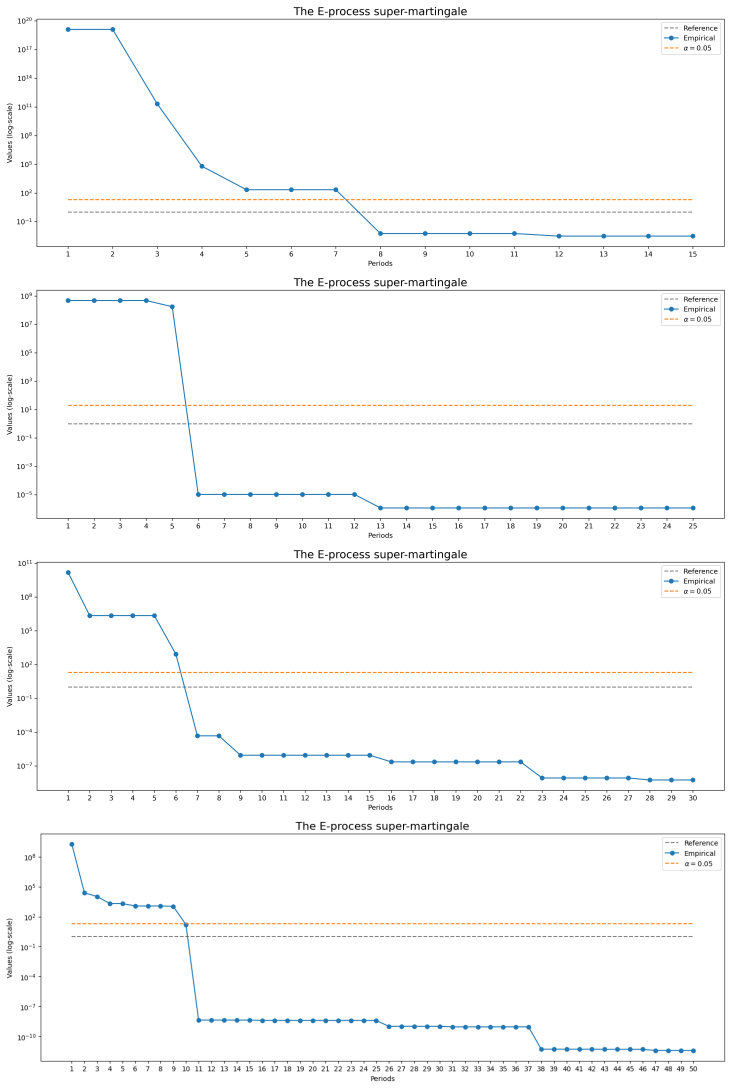
The central claim is that an e-process formed by empirically calibrating a super-martingale of a universal-inference discrepancy measure, using only the subject-specific baseline data, supplies a sequential, distribution-free test for return to baseline that controls error at every stopping time.
What carries the argument
Empirically calibrated e-process obtained by aggregating a universal-inference discrepancy measure into a non-negative super-martingale and tuning it with baseline observations.
If this is right
- Detection of the return time is possible without ever specifying a null distribution.
- Error control remains valid no matter when the test is stopped.
- Calibration is performed once on the baseline data and is therefore tailored to each subject or series.
- Finite-sample guarantees on calibration error hold without asymptotic approximations.
Where Pith is reading between the lines
- The same calibration step could be applied to other sequential problems where only a reference sample is available.
- The procedure might be combined with existing alert systems to flag return events in real time.
- Extensions to multivariate or dependent observations would require checking whether the non-parametric bound still applies.
Load-bearing premise
The observations obey a flexible non-parametric condition that lets the calibration error be bounded in finite samples.
What would settle it
A sequence of observations in which the calibrated e-process crosses its threshold while the post-intervention distribution still differs from the baseline (or fails to cross when the distributions match), under the stated non-parametric condition.
Figures
read the original abstract
We consider the problem of detecting a Return to Baseline (RtB) in high-frequency monitoring data preceding and following an intervention, where the aim is to identify the time at which the data-generating distribution realigns with its pre-intervention distribution. We propose a sequential, distribution-free testing procedure that does not rely on specifying a null model and provides anytime-valid error control. The method relies on ideas from universal inference to define a discrepancy measure that is aggregated into a non-negative super-martingale, and is then empirically cal- ibrated to form an e-process. The calibration is performed using the baseline data, and is thus subject-specific. We establish finite-sample bounds for the calibration error (under a flexible non-parametric assumption), discuss the impact of tuning parameters and computational complexity, and illustrate through simulations and a clinical case study that the procedure accurately detects RtB from monitoring data.
Editorial analysis
A structured set of objections, weighed in public.
Referee Report
Summary. The manuscript proposes a sequential, distribution-free procedure for detecting return-to-baseline (RtB) in high-frequency monitoring data. It defines a discrepancy measure via universal inference, aggregates it into a non-negative super-martingale, and empirically calibrates the result (using subject-specific baseline data) to obtain an e-process with claimed anytime-valid error control. Finite-sample bounds on calibration error are established under a flexible non-parametric assumption; the paper also discusses tuning parameters and computational complexity, and provides illustrations via simulations and a clinical case study.
Significance. If the supermartingale property is preserved after subject-specific calibration and the finite-sample bounds hold, the procedure would supply a practical, distribution-free tool for anytime-valid sequential testing without requiring a parametric null model. The use of external baseline data for calibration is a strength for individualized applications such as clinical monitoring. Reproducible simulation code and explicit finite-sample guarantees would further strengthen the contribution if supplied.
major comments (2)
- [§4] §4 (Finite-sample calibration bounds): the central validity claim rests on these bounds under the stated non-parametric assumption; the manuscript must explicitly verify that the assumption accommodates possible serial dependence between baseline and post-intervention periods, or provide a counter-example showing when the bound fails.
- [§3.2] §3.2 (Super-martingale construction after calibration): it is not immediately clear from the aggregation step whether the empirical calibration factor is a predictable process with respect to the filtration; if it is not, the supermartingale property (and thus anytime-valid control) may require an additional argument beyond the universal-inference discrepancy.
minor comments (3)
- The abstract states that tuning-parameter impact is discussed, yet the main text would benefit from a dedicated sensitivity table or figure showing how the detection time changes with the primary tuning constants.
- Notation for the calibrated e-process (e.g., the exact functional form of the calibration multiplier) should be introduced once and used consistently; currently it appears to vary between the method and simulation sections.
- Figure captions for the clinical case study should state the exact sample sizes and the value of the tuning parameter used, to allow direct replication.
Simulated Author's Rebuttal
We thank the referee for their careful reading and constructive feedback on our manuscript. We address each major comment below and indicate the revisions made to strengthen the presentation of our results.
read point-by-point responses
-
Referee: [§4] §4 (Finite-sample calibration bounds): the central validity claim rests on these bounds under the stated non-parametric assumption; the manuscript must explicitly verify that the assumption accommodates possible serial dependence between baseline and post-intervention periods, or provide a counter-example showing when the bound fails.
Authors: The non-parametric assumption is that baseline observations are i.i.d. from the pre-intervention distribution and post-intervention observations are i.i.d. from their time-specific distributions, with the bound derived via concentration inequalities that depend only on the marginal empirical measures. This formulation imposes no restriction on dependence between the baseline and post-intervention periods. We have revised §4 to include an explicit verification that the finite-sample bound continues to hold under arbitrary serial dependence across the two periods, together with a brief discussion of the assumption's scope. revision: yes
-
Referee: [§3.2] §3.2 (Super-martingale construction after calibration): it is not immediately clear from the aggregation step whether the empirical calibration factor is a predictable process with respect to the filtration; if it is not, the supermartingale property (and thus anytime-valid control) may require an additional argument beyond the universal-inference discrepancy.
Authors: The empirical calibration factor is computed exclusively from the subject-specific baseline data, which is fully observed prior to the intervention and the commencement of sequential monitoring. It is therefore a fixed, F_0-measurable quantity and hence predictable with respect to the filtration generated by the post-intervention observations. The supermartingale property of the aggregated process follows directly from the corresponding property of the universal-inference discrepancy without further conditions. We have added a clarifying remark in §3.2 to make this predictability explicit. revision: yes
Circularity Check
No significant circularity detected
full rationale
The derivation relies on universal inference to construct a discrepancy measure aggregated into a supermartingale, followed by subject-specific empirical calibration using external baseline data and finite-sample bounds under a non-parametric assumption. No quoted step reduces a claimed result to a fitted parameter or self-citation by construction; the anytime-valid control follows directly from the supermartingale property plus the stated calibration bounds, which are independent of the target RtB detection outcome.
Axiom & Free-Parameter Ledger
free parameters (1)
- tuning parameters
axioms (1)
- domain assumption flexible non-parametric assumption
Reference graph
Works this paper leans on
-
[1]
Early Human Development , volume=
The influence of betamethasone on fetal heart rate variability, obtained by non-invasive fetal electrocardiogram recordings , author=. Early Human Development , volume=. 2018 , publisher=
2018
-
[2]
IEEE Transactions on Information Theory , volume=
A Sequential Non-Parametric Multivariate Two-Sample Test , author=. IEEE Transactions on Information Theory , volume=. 2018 , publisher=
2018
-
[3]
IEEE Transactions on Information Theory , volume=
Nonparametric two-sample testing by betting , author=. IEEE Transactions on Information Theory , volume=. 2023 , publisher=
2023
-
[4]
Advances in neural information processing systems , volume=
Sequential predictive two-sample and independence testing , author=. Advances in neural information processing systems , volume=
-
[6]
Obstetrical & gynecological survey , volume=
The influence of corticosteroids on fetal heart rate variability: a systematic review of the literature , author=. Obstetrical & gynecological survey , volume=. 2013 , publisher=
2013
-
[7]
BMJ open , volume=
Continuous non-invasive electrophysiological monitoring in high-risk pregnancies: study protocol of a cohort intervention random sampling study in a tertiary obstetrical care centre in the Netherlands (NIEM-O study) , author=. BMJ open , volume=. 2025 , publisher=
2025
-
[8]
Signal processing , volume=
Selective review of offline change point detection methods , author=. Signal processing , volume=. 2020 , publisher=
2020
-
[9]
, date-added =
Shewhart, Walter A. , date-added =. Economic control of quality of manufactured product , year =
-
[10]
Sequential Analysis , year =
Wald, Abraham , date-added =. Sequential Analysis , year =
-
[11]
Copula processes , volume =
Wilson, Andrew G and Ghahramani, Zoubin , journal =. Copula processes , volume =
-
[12]
2025 , bdsk-url-1 =
statsmodels 0.14.5 , url =. 2025 , bdsk-url-1 =
2025
-
[13]
Introduction to statistical quality control , year =
Montgomery, Douglas C , publisher =. Introduction to statistical quality control , year =
-
[14]
Economic quality control of manufactured product 1 , volume =
Shewhart, Walter Andrew , journal =. Economic quality control of manufactured product 1 , volume =
-
[15]
Continuous inspection schemes , volume =
Page, Ewan S , journal =. Continuous inspection schemes , volume =
-
[16]
Universal Inference for Incomplete Discrete Choice Models , year =
Kaido, Hiroaki and Zhang, Yi , journal =. Universal Inference for Incomplete Discrete Choice Models , year =
-
[17]
Game-theoretic statistics and safe anytime-valid inference , volume =
Ramdas, Aaditya and Gr. Game-theoretic statistics and safe anytime-valid inference , volume =. Statistical Science , number =
-
[18]
Estimating means of bounded random variables by betting , volume =
Waudby-Smith, Ian and Ramdas, Aaditya , journal =. Estimating means of bounded random variables by betting , volume =
-
[19]
The numeraire e-variable and reverse information projection , year =
Larsson, Martin and Ramdas, Aaditya and Ruf, Johannes , journal =. The numeraire e-variable and reverse information projection , year =
-
[20]
Robust universal inference , year =
Park, Beomjo and Balakrishnan, Sivaraman and Wasserman, Larry , journal =. Robust universal inference , year =
-
[21]
Universal inference with composite likelihoods , year =
Nguyen, Hien Duy , journal =. Universal inference with composite likelihoods , year =
-
[22]
On universal inference in Gaussian mixture models , year =
Shi, Hongjian and Drton, Mathias , journal =. On universal inference in Gaussian mixture models , year =
-
[23]
Multiple Testing in Generalized Universal Inference , year =
Dey, Neil and Martin, Ryan and Williams, Jonathan P , journal =. Multiple Testing in Generalized Universal Inference , year =
-
[24]
False discovery rate control with e-values , volume =
Wang, Ruodu and Ramdas, Aaditya , journal =. False discovery rate control with e-values , volume =
-
[25]
Controlling the false discovery rate: a practical and powerful approach to multiple testing , volume =
Benjamini, Yoav and Hochberg, Yosef , journal =. Controlling the false discovery rate: a practical and powerful approach to multiple testing , volume =
-
[26]
Bayes factors , volume =
Kass, Robert E and Raftery, Adrian E , journal =. Bayes factors , volume =
-
[27]
Statistical analysis and the illusion of objectivity , volume =
Berger, James O and Berry, Donald A , journal =. Statistical analysis and the illusion of objectivity , volume =
-
[28]
A new interpretation of information rate , volume =
Kelly, John L , journal =. A new interpretation of information rate , volume =
-
[29]
Group sequential methods for the Mann-Whitney parameter , volume =
Nowak, Claus P and M. Group sequential methods for the Mann-Whitney parameter , volume =. Statistical Methods in Medical Research , number =
-
[30]
Optimal two-stage group sequential designs based on Mann-Whitney-Wilcoxon test , volume =
Park, Yeonhee , journal =. Optimal two-stage group sequential designs based on Mann-Whitney-Wilcoxon test , volume =
-
[31]
Wald , doi =
A. Wald , doi =. The Annals of Mathematical Statistics , number =. 1945 , bdsk-url-1 =
1945
-
[32]
Optimum character of the sequential probability ratio test , year =
Wald, Abraham and Wolfowitz, Jacob , journal =. Optimum character of the sequential probability ratio test , year =
-
[33]
Some properties of generalized sequential probability ratio tests , year =
Kiefer, Jack and Weiss, Lionel , journal =. Some properties of generalized sequential probability ratio tests , year =
-
[34]
Testing by betting: A strategy for statistical and scientific communication , volume =
Shafer, Glenn , journal =. Testing by betting: A strategy for statistical and scientific communication , volume =
-
[35]
Hypothesis testing with e-values , year =
Ramdas, Aaditya and Wang, Ruodu , journal =. Hypothesis testing with e-values , year =
-
[36]
Etude critique de la notion de collectif , volume =
Ville, Jean , publisher =. Etude critique de la notion de collectif , volume =
-
[37]
Generic e-variables for exact sequential k-sample tests that allow for optional stopping , volume =
Turner, Rosanne J and Ly, Alexander and Gr. Generic e-variables for exact sequential k-sample tests that allow for optional stopping , volume =. Journal of Statistical Planning and Inference , pages =
-
[38]
Time-uniform, nonparametric, nonasymptotic confidence sequences , volume =
Howard, Steven R and Ramdas, Aaditya and McAuliffe, Jon and Sekhon, Jasjeet , journal =. Time-uniform, nonparametric, nonasymptotic confidence sequences , volume =
-
[39]
Statistical Science , pages=
Test martingales, Bayes factors and p-values , author=. Statistical Science , pages=. 2011 , publisher=
2011
-
[40]
Admissible anytime-valid sequential inference must rely on nonnegative martingales , year =
Ramdas, Aaditya and Ruf, Johannes and Larsson, Martin and Koolen, Wouter , journal =. Admissible anytime-valid sequential inference must rely on nonnegative martingales , year =
-
[41]
The ASA statement on p-values: context, process, and purpose , volume =
Wasserstein, Ronald L and Lazar, Nicole A , journal =. The ASA statement on p-values: context, process, and purpose , volume =
-
[42]
Statistical tests, P values, confidence intervals, and power: a guide to misinterpretations , volume =
Greenland, Sander and Senn, Stephen J and Rothman, Kenneth J and Carlin, John B and Poole, Charles and Goodman, Steven N and Altman, Douglas G , journal =. Statistical tests, P values, confidence intervals, and power: a guide to misinterpretations , volume =
-
[43]
Universal inference , volume =
Wasserman, Larry and Ramdas, Aaditya and Balakrishnan, Sivaraman , journal =. Universal inference , volume =
-
[44]
Ethnic variation in return to baseline values of patient-reported outcomes in older prostate cancer patients , volume =
Jayadevappa, Ravishankar and Johnson, Jerry C and Chhatre, Sumedha and Wein, Alan J and Malkowicz, S Bruce , journal =. Ethnic variation in return to baseline values of patient-reported outcomes in older prostate cancer patients , volume =
-
[45]
Erectile function recovery after nerve-sparing radical prostatectomy for prostate cancer: is back to baseline status enough for patient satisfaction? , volume =
Rossi, Martina Sofia and Moschini, Marco and Bianchi, Marco and Gandaglia, Giorgio and Fossati, Nicola and Dell'Oglio, Paolo and Schiavina, Riccardo and Brunocilla, Eugenio and Farina, Elena and Picozzi, Marta and others , journal =. Erectile function recovery after nerve-sparing radical prostatectomy for prostate cancer: is back to baseline status enough...
-
[46]
A prospective study of symptom distress and return to baseline function after open versus laparoscopic radical prostatectomy , volume =
Dahl, Douglas M and Barry, Michael J and McGovern, Francis J and Chang, Yuchaio and Walker-Corkery, Elizabeth and McDougal, W Scott , journal =. A prospective study of symptom distress and return to baseline function after open versus laparoscopic radical prostatectomy , volume =
-
[47]
Lunshof, Simone and Boer, Kees and Wolf, Hans and van Hoffen, Gerdien and Bayram, Neriman and Mirmiran, Majid , journal =. Fetal and maternal diurnal rhythms during the third trimester of normal pregnancy: Outcomes of computerized analysis of continuous twenty-four---hour fetal heart rate recordings , volume =
-
[48]
Discharging select patients without an escort after ambulatory anesthesia: identifying return to baseline function , volume =
Walsh, Michael T , journal =. Discharging select patients without an escort after ambulatory anesthesia: identifying return to baseline function , volume =
-
[49]
Analysis of Average Daily Temperature and Precipitation on the Territory of Belarus Using Quantile Regression , volume =
Loginov, VF and Khitrykau, MA , journal =. Analysis of Average Daily Temperature and Precipitation on the Territory of Belarus Using Quantile Regression , volume =
-
[50]
A novel regression model for fractiles: Formulation, computational aspects, and applications to medical data , volume =
Leiva, V. A novel regression model for fractiles: Formulation, computational aspects, and applications to medical data , volume =. Fractal and Fractional , number =
-
[51]
Quantile trend regression and its application to central England temperature , volume =
Haupt, Harry and Fritsch, Markus , journal =. Quantile trend regression and its application to central England temperature , volume =
-
[52]
Cyclostationarity: Half a century of research , volume =
Gardner, William A and Napolitano, Antonio and Paura, Luigi , journal =. Cyclostationarity: Half a century of research , volume =
-
[53]
Time-uniform Chernoff bounds via nonnegative supermartingales , year =
Howard, Steven R and Ramdas, Aaditya and McAuliffe, Jon and Sekhon, Jasjeet , doi =. Time-uniform Chernoff bounds via nonnegative supermartingales , year =. Probability Surveys , number =
-
[54]
E-values: Calibration, combination and applications , volume =
Vovk, Vladimir and Wang, Ruodu , journal =. E-values: Calibration, combination and applications , volume =
-
[55]
The language of betting as a strategy for statistical and scientific communication , year =
Shafer, Glenn , journal =. The language of betting as a strategy for statistical and scientific communication , year =
-
[56]
Spline functions: basic theory , year =
Schumaker, Larry , publisher =. Spline functions: basic theory , year =
-
[57]
Noncrossing quantile regression curve estimation , volume =
Bondell, Howard D and Reich, Brian J and Wang, Huixia , journal =. Noncrossing quantile regression curve estimation , volume =
-
[58]
Quantile regression , volume =
Koenker, Roger , publisher =. Quantile regression , volume =
-
[59]
Quantile regression , volume =
Koenker, Roger and Hallock, Kevin F , journal =. Quantile regression , volume =
-
[60]
Differential effects of betamethasone on the fetus between morning and afternoon recordings , volume =
De Heus, Roel and Mulder, Eduard JH and Derks, Jan B and Koenen, Steven V and Visser, Gerard HA , journal =. Differential effects of betamethasone on the fetus between morning and afternoon recordings , volume =
-
[61]
Testing exchangeability: Fork-convexity, supermartingales and e-processes , volume =
Ramdas, Aaditya and Ruf, Johannes and Larsson, Martin and Koolen, Wouter M , date-added =. Testing exchangeability: Fork-convexity, supermartingales and e-processes , volume =. International Journal of Approximate Reasoning , pages =
-
[63]
Bergeron, Jeremy J and Sercia, Quentin P and Drager, Justin and Pelet, St. Return to baseline physical activity after bone--patellar tendon--bone versus hamstring tendon autografts for anterior cruciate ligament reconstruction: a systematic review and meta-analysis of randomized controlled trials , volume =. The American Journal of Sports Medicine , number =
-
[64]
Discharge before return to respiratory baseline in children with neurologic impairment , volume =
Steuart, Rebecca and Tan, Rachel and Melink, Katherine and Chinchilla, Sofia and Warniment, Amanda and Shah, Samir S and Thomson, Joanna , date-added =. Discharge before return to respiratory baseline in children with neurologic impairment , volume =. Journal of Hospital Medicine , number =
-
[65]
Selective review of offline change point detection methods , volume =
Truong, Charles and Oudre, Laurent and Vayatis, Nicolas , date-added =. Selective review of offline change point detection methods , volume =. Signal Processing , pages =
-
[66]
When Does a Patient's Postoperative Activity Return to Baseline? , volume =
Overbey, Douglas M and Carmichael, Heather and Chapman, Brandon C and Jones, Edward L and Jones, Teresa S and Robinson, Thomas N and others , date-added =. When Does a Patient's Postoperative Activity Return to Baseline? , volume =. Journal of the American College of Surgeons , number =
-
[67]
A survey of methods for time series change point detection , volume =
Aminikhanghahi, Samaneh and Cook, Diane J , date-added =. A survey of methods for time series change point detection , volume =. Knowledge and information systems , number =
-
[68]
Erectile function after radical prostatectomy: Do patients return to baseline? , volume =
Fode, Mikkel and Frey, Anders and Jakobsen, Henrik and S. Erectile function after radical prostatectomy: Do patients return to baseline? , volume =. Scandinavian journal of urology , number =
-
[69]
Health-related quality of life: return to baseline after major and minor liver resection , volume =
Martin, Robert CG and Eid, Sebastian and Scoggins, Charles R and McMasters, Kelly M , date-added =. Health-related quality of life: return to baseline after major and minor liver resection , volume =. Surgery , number =
-
[70]
arXiv preprint arXiv:0710.3742 , title =
Adams, Ryan Prescott and MacKay, David JC , date-added =. arXiv preprint arXiv:0710.3742 , title =
-
[71]
An online kernel change detection algorithm , volume =
Desobry, Fr. An online kernel change detection algorithm , volume =. IEEE Transactions on Signal Processing , number =
-
[72]
Adaptive filtering and change detection , volume =
Gustafsson, Fredrik and Gustafsson, Fredrik , date-added =. Adaptive filtering and change detection , volume =
-
[73]
Detection of abrupt changes: theory and application , volume =
Basseville, Michele and Nikiforov, Igor V and others , date-added =. Detection of abrupt changes: theory and application , volume =
-
[74]
Journal of the American Statistical Association , number =
Barry, Daniel and Hartigan, John A , date-added =. Journal of the American Statistical Association , number =
-
[75]
Electroencephalography and Clinical Neurophysiology , number =
Barlow, JS and Creutzfeldt, OD and Michael, D and Houchin, J and Epelbaum, H , date-added =. Electroencephalography and Clinical Neurophysiology , number =
-
[76]
Procedures for reacting to a change in distribution , year =
Lorden, Gary , date-added =. Procedures for reacting to a change in distribution , year =. The Annals of Mathematical Statistics , pages =
-
[77]
A test for a change in a parameter occurring at an unknown point , volume =
Page, ES , date-added =. A test for a change in a parameter occurring at an unknown point , volume =. Biometrika , number =
-
[78]
A sequential detection theory for statistically periodic random processes , year =
Banerjee, Taposh and Gurram, Prudhvi and Whipps, Gene , booktitle =. A sequential detection theory for statistically periodic random processes , year =
-
[79]
Bayesian quickest detection of changes in statistically periodic processes , year =
Banerjee, Taposh and Gurram, Prudhvi and Whipps, Gene , booktitle =. Bayesian quickest detection of changes in statistically periodic processes , year =
-
[80]
Quickest change detection in statistically periodic processes with unknown post-change distribution , volume =
Oleyaeimotlagh, Yousef and Banerjee, Taposh and Taha, Ahmad and John, Eugene , journal =. Quickest change detection in statistically periodic processes with unknown post-change distribution , volume =
-
[81]
Quickest joint detection and classification of faults in statistically periodic processes , year =
Banerjee, Taposh and Padhy, Smruti and Taha, Ahmad and John, Eugene , booktitle =. Quickest joint detection and classification of faults in statistically periodic processes , year =
-
[82]
Minimax asymptotically optimal quickest change detection for statistically periodic data , volume =
Banerjee, Taposh and Gurram, Prudhvi and Whipps, Gene , journal =. Minimax asymptotically optimal quickest change detection for statistically periodic data , volume =
discussion (0)
Sign in with ORCID, Apple, or X to comment. Anyone can read and Pith papers without signing in.