Spin Dynamics from Niu-Kleinman Adiabatic Approach and Slave Boson Mean Field Theory
Pith reviewed 2026-06-28 12:58 UTC · model grok-4.3
The pith
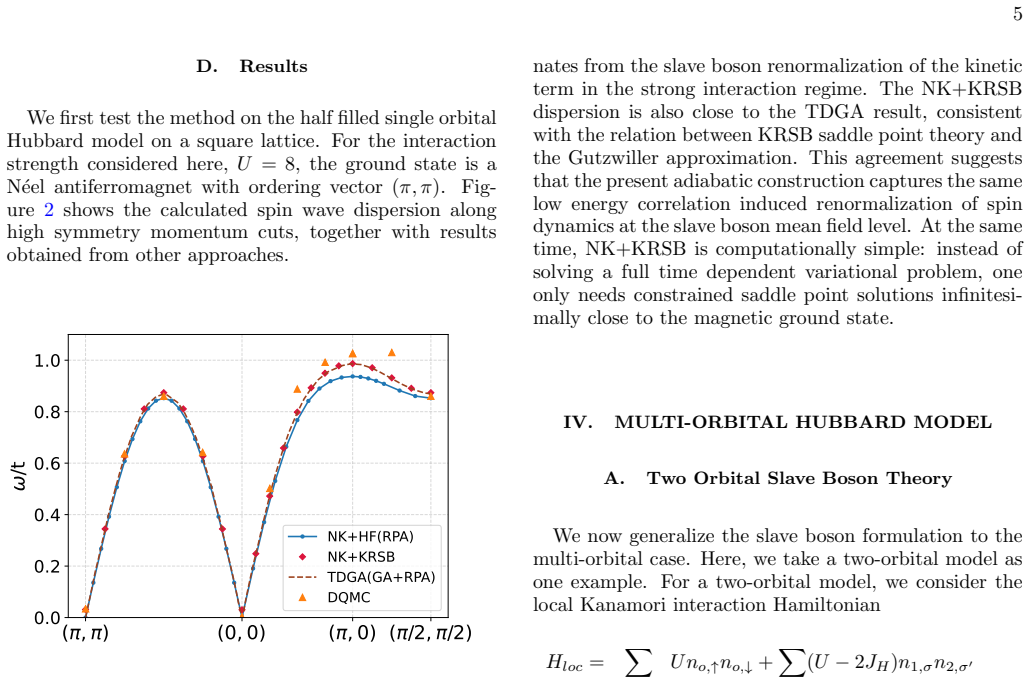
Niu-Kleinman adiabatic spin dynamics combined with slave-boson mean-field theory produces spin-wave dispersions in the Hubbard model that match determinant quantum Monte Carlo results more closely than random phase approximation.
A machine-rendered reading of the paper's core claim, the machinery that carries it, and where it could break.
Core claim
By combining the Niu-Kleinman formalism with Kotliar-Ruckenstein slave-boson theory, an adiabatic theory of spin dynamics is constructed in which the constrained slave-boson saddle point is solved self-consistently for each frozen spin configuration. This directly supplies the Berry-curvature matrix and energy Hessian for the linearized adiabatic equations of motion. Applied to the half-filled single-orbital Hubbard model, the resulting spin-wave dispersion shows substantially improved agreement with determinant quantum Monte Carlo benchmarks compared with the random phase approximation and closely approaches results from the time-dependent Gutzwiller approximation. The method is further ext
What carries the argument
Constrained slave-boson saddle point solved self-consistently for each frozen spin configuration, which supplies the Berry-curvature matrix and energy Hessian for the Niu-Kleinman linearized adiabatic equations of motion.
If this is right
- Spin-wave dispersions in the half-filled Hubbard model agree more closely with determinant quantum Monte Carlo data than those from random phase approximation.
- The method extends directly to multi-orbital models such as the two-orbital description of La2NiO4.
- Strong-correlation effects are incorporated while computational cost stays low because only saddle-point solutions near the ground state are required.
- Low-energy spin excitations in correlated quantum materials can be studied beyond conventional weak-coupling descriptions.
Where Pith is reading between the lines
- The same saddle-point extraction of Berry curvature and Hessian could be applied to doped Hubbard models to address spin dynamics in high-temperature superconductors.
- Direct numerical comparisons on small clusters with exact diagonalization or dynamical mean-field theory would provide independent checks on accuracy.
- The adiabatic setup could be extended to include damping or finite-temperature effects without changing the core extraction procedure.
Load-bearing premise
The constrained slave-boson saddle point solved self-consistently for each frozen spin configuration accurately supplies the Berry-curvature matrix and energy Hessian that enter the linearized adiabatic equations of motion.
What would settle it
A calculation of the spin-wave dispersion for the half-filled single-orbital Hubbard model that deviates substantially from determinant quantum Monte Carlo benchmarks would falsify the claim of improved agreement.
Figures



read the original abstract
Spin-wave excitations provide a central probe of magnetic order and electronic correlations in strongly correlated materials. In this work, we develop an adiabatic theory of spin dynamics by combining the Niu-Kleinman formalism with Kotliar-Ruckenstein slave-boson theory (NK+KRSB). For each frozen spin configuration, the constrained slave-boson saddle point is solved self-consistently, allowing the Berry-curvature matrix and energy Hessian entering the linearized adiabatic equations of motion to be extracted directly. Applied to the half-filled single-orbital Hubbard model, the resulting spin-wave dispersion shows substantially improved agreement with determinant quantum Monte Carlo benchmarks compared with the random phase approximation and closely approaches results from the time-dependent Gutzwiller approximation. We further extend the method to a two-orbital model of $\mathrm{La}_2\mathrm{NiO}_4$, demonstrating its applicability to realistic multi-orbital correlated systems. Because the approach only requires saddle-point solutions near the magnetic ground state, it remains computationally efficient while incorporating strong-correlation effects beyond conventional weak-coupling descriptions, providing a practical framework for studying low-energy spin excitations in correlated quantum materials.
Editorial analysis
A structured set of objections, weighed in public.
Referee Report
Summary. The manuscript develops an adiabatic theory of spin dynamics by combining the Niu-Kleinman formalism with constrained Kotliar-Ruckenstein slave-boson mean-field theory (NK+KRSB). For each frozen spin configuration the self-consistent saddle-point solution supplies the Berry-curvature matrix and energy Hessian that enter the linearized equations of motion. Applied to the half-filled single-orbital Hubbard model the resulting spin-wave dispersion shows substantially improved agreement with DQMC benchmarks relative to RPA and approaches the time-dependent Gutzwiller approximation; the method is further applied to a two-orbital model of La2NiO4.
Significance. If the numerical benchmarks hold, the approach supplies a computationally efficient route to spin excitations that incorporates strong-correlation effects beyond RPA while remaining cheaper than full DQMC or TDGA. The explicit use of saddle-point solutions near the magnetic ground state and the extension to multi-orbital systems are concrete strengths.
minor comments (3)
- §3, paragraph following Eq. (12): the statement that the Berry curvature is 'directly extracted' would be clearer if the precise finite-difference stencil or analytic derivative used for the curvature matrix were stated explicitly.
- Figure 2 caption: the DQMC error bars are not described; adding the number of independent samples or the reported statistical uncertainty would allow direct assessment of the claimed 'substantial improvement'.
- §4.2: the two-orbital La2NiO4 parameters (U, J, hopping ratios) are listed but the precise values of the constrained slave-boson Lagrange multipliers at the saddle point are not tabulated; a short table would aid reproducibility.
Simulated Author's Rebuttal
We thank the referee for the positive summary, significance assessment, and recommendation of minor revision. No major comments were provided in the report.
Circularity Check
No significant circularity detected
full rationale
The paper combines the external Niu-Kleinman adiabatic formalism with the standard Kotliar-Ruckenstein slave-boson mean-field approach. Self-consistent saddle-point solutions for frozen spin configurations supply the Berry curvature and Hessian that enter the linearized equations of motion; the resulting spin-wave dispersion is then computed and benchmarked against independent DQMC data. No step reduces a claimed prediction to a fitted parameter by construction, no load-bearing self-citation chain is invoked, and the central result remains an independent numerical outcome rather than a tautology.
Axiom & Free-Parameter Ledger
Reference graph
Works this paper leans on
-
[1]
At the saddle point, the bosons are treated as con- densed classical fields
Then, the constraints must be imposed to project back to the physical subspace: e†e+p † 0p0 +p † xpx +p † ypy +p † zpz +d †d= 1,(10) X σ f † σfσ = X µ∈{0,x,y,z} p† µpµ + 2d†d,(11) X σ,σ′ f † σ′⃗ τσ,σ′fσ =p † 0⃗ p+⃗ p†p0 + i⃗ p† ×⃗ p.(12) Within the constrained Hilbert space, the physical electron operators are represented by pseudo fermions dressed by sla...
-
[2]
The spin wave configuration ⃗S(r) is controlled by the parametersxin the HamiltonianH(x), which are slave bosons and Lagrangian multipliers
Berry Curvature Expressed By Eigen Vectors In the main text, the ansatz of|Ψ[ ⃗S(r)]⟩are con- structed from slave boson mean field ground states, which are Gaussian states. The spin wave configuration ⃗S(r) is controlled by the parametersxin the HamiltonianH(x), which are slave bosons and Lagrangian multipliers. So the derivatives with respect toS α j in ...
-
[3]
It’s not a trivial task since there’s a large gauge redundancy to define a functionu n(x), especially when there’s degener- acy
Derivative of Eigen Vectors Before using Eq.E4 we still need to know how to ex- press the first derivative of eigen vectoru n(x). It’s not a trivial task since there’s a large gauge redundancy to define a functionu n(x), especially when there’s degener- acy. First let’s assume there exists continuous and derivable functions ofx,ϵ n(x) andu n(x). We havehu...
-
[4]
Manousakis, The spin-1/2 heisenberg antiferromagnet on a square lattice and its application to the cuprous oxides, Rev
E. Manousakis, The spin-1/2 heisenberg antiferromagnet on a square lattice and its application to the cuprous oxides, Rev. Mod. Phys.63, 1 (1991)
1991
-
[5]
Auerbach,Interacting Electrons and Quantum Mag- netism(Springer, 1994)
A. Auerbach,Interacting Electrons and Quantum Mag- netism(Springer, 1994)
1994
-
[6]
Imada, A
M. Imada, A. Fujimori, and Y. Tokura, Metal-insulator transitions, Rev. Mod. Phys.70, 1039 (1998)
1998
-
[7]
P. A. Lee, N. Nagaosa, and X.-G. Wen, Doping a mott in- sulator: Physics of high-temperature superconductivity, Rev. Mod. Phys.78, 17 (2006)
2006
-
[8]
D. J. Scalapino, A common thread: The pairing inter- action for unconventional superconductors, Rev. Mod. Phys.84, 1383 (2012)
2012
-
[9]
Keimer, S
B. Keimer, S. A. Kivelson, M. R. Norman, S. Uchida, and J. Zaanen, From quantum matter to high-temperature superconductivity in copper oxides, Nature518, 179 (2015)
2015
-
[10]
J. M. Tranquada, H. Woo, T. G. Perring, H. Goka, G. D. Gu, G. Xu, M. Fujita, and K. Yamada, Quantum mag- netic excitations from stripes in copper oxide supercon- ductors, Nature429, 534 (2004)
2004
-
[11]
M. P. M. Dean, Insights into the high temperature super- conducting cuprates from resonant inelastic x-ray scat- tering, J. Magn. Magn. Mater.376, 3 (2015)
2015
-
[12]
P. W. Anderson, Antiferromagnetism. theory of superex- change interaction, Phys. Rev.79, 350 (1950)
1950
-
[13]
A. H. MacDonald, S. M. Girvin, and D. Yoshioka,t/U expansion for the hubbard model, Phys. Rev. B37, 9753 (1988)
1988
-
[14]
Holstein and H
T. Holstein and H. Primakoff, Field dependence of the intrinsic domain magnetization of a ferromagnet, Phys. Rev.58, 1098 (1940)
1940
-
[15]
J. R. Schrieffer, X. G. Wen, and S. C. Zhang, Dynamic spin fluctuations and the bag mechanism of high-T c su- perconductivity, Phys. Rev. B39, 11663 (1989)
1989
-
[16]
Bulut, D
N. Bulut, D. W. Hone, D. J. Scalapino, and N. E. Bick- ers, Knight shifts and nuclear-spin-relaxation rates for two-dimensional models of CuO2, Phys. Rev. B41, 1797 (1990)
1990
-
[17]
Knolle, I
J. Knolle, I. Eremin, and R. Moessner, Multiorbital spin susceptibility in a magnetically ordered state: Orbital versus excitonic spin density wave scenario, Phys. Rev. B83, 224503 (2011)
2011
-
[18]
Blankenbecler, D
R. Blankenbecler, D. J. Scalapino, and R. L. Sugar, Monte Carlo calculations of coupled boson-fermion sys- tems. I, Phys. Rev. D24, 2278 (1981)
1981
-
[19]
J. E. Hirsch, D. J. Scalapino, R. L. Sugar, and R. Blankenbecler, Efficient Monte Carlo Procedure for Systems with Fermions, Phys. Rev. Lett.47, 1628 (1981)
1981
-
[20]
D. J. Scalapino and R. L. Sugar, Method for Perform- ing Monte Carlo Calculations for Systems with Fermions, Phys. Rev. Lett.46, 519 (1981)
1981
-
[21]
Shao and A
H. Shao and A. W. Sandvik, Progress on stochastic ana- lytic continuation of quantum Monte Carlo data, Physics Reports1003, 1 (2023)
2023
-
[22]
Y. F. Kung, E. A. Nowadnick, C. J. Jia, S. Johnston, B. Moritz, R. T. Scalettar, and T. P. Devereaux, Doping evolution of spin and charge excitations in the Hubbard model, Phys. Rev. B92, 195108 (2015)
2015
-
[23]
Y. F. Kung, C. Bazin, K. Wohlfeld, Y. Wang, C.-C. Chen, C. J. Jia, S. Johnston, B. Moritz, F. Mila, and T. P. De- vereaux, Numerically exploring the 1D-2D dimensional crossover on spin dynamics in the doped Hubbard model, Phys. Rev. B96, 195106 (2017)
2017
-
[24]
E. W. Huang, C. B. Mendl, S. Liu, S. Johnston, H.-C. Jiang, B. Moritz, and T. P. Devereaux, Numerical evi- dence of fluctuating stripes in the normal state of high-Tc cuprate superconductors, Science358, 1161 (2017)
2017
-
[25]
E. W. Huang, C. B. Mendl, H.-C. Jiang, B. Moritz, and T. P. Devereaux, Stripe order from the perspective of the Hubbard model, npj Quantum Materials3, 22 (2018)
2018
-
[26]
Y. Y. Peng, E. W. Huang, R. Fumagalli, M. Mi- nola, Y. Wang, X. Sun, Y. Ding, K. Kummer, X. J. Zhou, N. B. Brookes, B. Moritz, L. Braicovich, T. P. Devereaux, and G. Ghiringhelli, Dispersion, damping, and intensity of spin excitations in the monolayer 12 (Bi,Pb)2(Sr,La)2CuO6+δ cuprate superconductor family, Phys. Rev. B98, 144507 (2018)
2018
-
[27]
A. W. Sandvik, Stochastic method for analytic continu- ation of quantum Monte Carlo data, Phys. Rev. B57, 10287 (1998)
1998
-
[28]
Jeckelmann, Dynamical density-matrix renormalization-group method, Phys
E. Jeckelmann, Dynamical density-matrix renormalization-group method, Phys. Rev. B66, 045114 (2002)
2002
-
[29]
T. D. K¨ uhner and S. R. White, Dynamical correla- tion functions using the density matrix renormalization group, Phys. Rev. B60, 335 (1999)
1999
-
[30]
A. J. Daley, C. Kollath, U. Schollw¨ ock, and G. Vidal, Time-dependent density-matrix renormalization-group using adaptive effective Hilbert spaces, J. Stat. Mech. 2004, P04005 (2004)
2004
-
[31]
S. R. White and A. E. Feiguin, Real-Time Evolution Us- ing the Density Matrix Renormalization Group, Phys. Rev. Lett.93, 076401 (2004)
2004
-
[32]
Haegeman, J
J. Haegeman, J. I. Cirac, T. J. Osborne, I. Piˇ zorn, H. Ver- schelde, and F. Verstraete, Time-Dependent Variational Principle for Quantum Lattices, Phys. Rev. Lett.107, 070601 (2011)
2011
-
[33]
Haegeman, C
J. Haegeman, C. Lubich, I. Oseledets, B. Vandereycken, and F. Verstraete, Unifying time evolution and optimiza- tion with matrix product states, Phys. Rev. B94, 165116 (2016)
2016
-
[34]
P. E. Dargel, A. Honecker, R. Peters, R. M. Noack, and T. Pruschke, Adaptive Lanczos-vector method for dy- namic properties within the density matrix renormaliza- tion group, Phys. Rev. B83, 161104 (2011)
2011
-
[35]
P. E. Dargel, A. W¨ ollert, A. Honecker, I. P. McCulloch, U. Schollw¨ ock, and T. Pruschke, Lanczos algorithm with matrix product states for dynamical correlation func- tions, Phys. Rev. B85, 205119 (2012)
2012
-
[36]
Holzner, A
A. Holzner, A. Weichselbaum, I. P. McCulloch, U. Schollw¨ ock, and J. von Delft, Chebyshev matrix prod- uct state approach for spectral functions, Phys. Rev. B 83, 195115 (2011)
2011
-
[37]
R. Chi, Y. Liu, Y. Wan, H.-J. Liao, and T. Xiang, Spin Excitation Spectra of Anisotropic Spin-1/2 Triangular Lattice Heisenberg Antiferromagnets, Phys. Rev. Lett. 129, 227201 (2022)
2022
-
[38]
Seibold and J
G. Seibold and J. Lorenzana, Time-Dependent Gutzwiller Approximation for the Hubbard Model, Phys. Rev. Lett.86, 2605 (2001)
2001
-
[39]
Seibold, F
G. Seibold, F. Becca, and J. Lorenzana, Inhomogeneous Gutzwiller approximation with random phase fluctua- tions for the Hubbard model, Phys. Rev. B67, 085108 (2003)
2003
-
[40]
Seibold, F
G. Seibold, F. Becca, P. Rubin, and J. Lorenzana, Time- dependent Gutzwiller theory of magnetic excitations in the Hubbard model, Phys. Rev. B69, 155113 (2004)
2004
-
[41]
Seibold, F
G. Seibold, F. Becca, and J. Lorenzana, Time-dependent Gutzwiller theory of pairing fluctuations in the Hubbard model, Phys. Rev. B78, 045114 (2008)
2008
-
[42]
B¨ unemann, M
J. B¨ unemann, M. Capone, J. Lorenzana, and G. Sei- bold, Linear-response dynamics from the time-dependent Gutzwiller approximation, New J. Phys.15, 053050 (2013)
2013
-
[43]
Lavagna, Functional-integral approach to strongly correlated Fermi systems: Quantum fluctuations beyond the Gutzwiller approximation, Phys
M. Lavagna, Functional-integral approach to strongly correlated Fermi systems: Quantum fluctuations beyond the Gutzwiller approximation, Phys. Rev. B41, 142 (1990)
1990
-
[44]
T. Li, Y. S. Sun, and P. W¨ olfle, Dynamic response func- tions of Hubbard model in Gutzwiller approximation, Z. Phys. B: Condens. Matter82, 369 (1991)
1991
-
[45]
Arrigoni, Correct continuum limit of the functional- integral representation for the four-slave-boson approach to the Hubbard model: Paramagnetic phase, Phys
E. Arrigoni, Correct continuum limit of the functional- integral representation for the four-slave-boson approach to the Hubbard model: Paramagnetic phase, Phys. Rev. B52, 2428 (1995)
1995
-
[46]
Zimmermann, R
W. Zimmermann, R. Fr´ esard, and P. W¨ olfle, Spin and charge structure factor of the two-dimensional Hubbard model, Phys. Rev. B56, 10097 (1997)
1997
-
[47]
Riegler, M
D. Riegler, M. Klett, T. Neupert, R. Thomale, and P. W¨ olfle, Slave-boson analysis of the two-dimensional Hubbard model, Phys. Rev. B101, 235137 (2020)
2020
-
[48]
Seufert, D
J. Seufert, D. Riegler, M. Klett, R. Thomale, and P. W¨ olfle, Breakdown of charge homogeneity in the two- dimensional Hubbard model: Slave-boson study of mag- netic order, Phys. Rev. B103, 165117 (2021)
2021
-
[49]
Slave-boson Formalism for Superconducting Pairing at Strong Coupling
S. Mazumdar, J. Issing, J. Seufert, D. Riegler, P. W¨ olfle, R. Thomale, and M. Klett, Slave-boson Formalism for Superconducting Pairing at Strong Coupling (2026), arXiv:2605.26233 [cond-mat.supr-con]
work page internal anchor Pith review Pith/arXiv arXiv 2026
-
[50]
Niu and L
Q. Niu and L. Kleinman, Spin-Wave Dynamics in Real Crystals, Phys. Rev. Lett.80, 2205 (1998)
1998
-
[51]
Q. Niu, X. Wang, L. Kleinman, W.-M. Liu, D. M. C. Nicholson, and G. M. Stocks, Adiabatic Dynamics of Lo- cal Spin Moments in Itinerant Magnets, Phys. Rev. Lett. 83, 207 (1999)
1999
-
[52]
Gebauer and S
R. Gebauer and S. Baroni, Magnons in real materials from density-functional theory, Phys. Rev. B61, R6459 (2000)
2000
-
[53]
D. M. Bylander, Q. Niu, and L. Kleinman, Fe magnon dispersion curve calculated with the frozen spin-wave method, Phys. Rev. B61, R11875 (2000)
2000
-
[54]
S. Ren, J. Bonini, M. Stengel, C. E. Dreyer, and D. Vanderbilt, Adiabatic Dynamics of Coupled Spins and Phonons in Magnetic Insulators, Phys. Rev. X14, 011041 (2024)
2024
-
[55]
Y. Lin, X. Liu, and J. Feng, Assessing the atomic mo- ment picture of spin dynamics with ab initio magnon wavefunctions, Phys. Rev. B111, 054419 (2025)
2025
-
[56]
X. Liu, J. Feng, Z. Qiao, and Q. Niu, Fully first-principles approach in studying topological magnons, Phys. Rev. B 113, 184423 (2026)
2026
-
[57]
Qian and G
Z. Qian and G. Vignale, Spin Dynamics from Time- Dependent Spin-Density-Functional Theory, Phys. Rev. Lett.88, 056404 (2002)
2002
-
[58]
Kotliar and A
G. Kotliar and A. E. Ruckenstein, New Functional In- tegral Approach to Strongly Correlated Fermi Systems: The Gutzwiller Approximation as a Saddle Point, Phys. Rev. Lett.57, 1362 (1986)
1986
-
[59]
M. C. Gutzwiller, Effect of correlation on the ferromag- netism of transition metals, Phys. Rev. Lett.10, 159 (1963)
1963
-
[60]
W. F. Brinkman and T. M. Rice, Application of Gutzwiller’s Variational Method to the Metal-Insulator Transition, Phys. Rev. B2, 4302 (1970)
1970
-
[61]
T. Li, P. W¨ olfle, and P. J. Hirschfeld, Spin-rotation- invariant slave-boson approach to the Hubbard model, Phys. Rev. B40, 6817 (1989)
1989
-
[62]
Fr´ esard and P
R. Fr´ esard and P. W¨ olfle, Unified slave boson represen- tation of spin and charge degrees of freedom for strongly correlated fermi systems, Int. J. Mod. Phys. B06, 685 (1992)
1992
-
[63]
Jiang, S
K. Jiang, S. Zhou, and Z. Wang, Textured electronic states of the triangular-lattice hubbard model and 13 NaxCoO2, Phys. Rev. B90, 165135 (2014)
2014
-
[64]
Jiang, S
K. Jiang, S. Zhou, X. Dai, and Z. Wang, Antiferromag- netic chern insulators in noncentrosymmetric systems, Phys. Rev. Lett.120, 157205 (2018)
2018
-
[65]
Lorenzana, G
J. Lorenzana, G. Seibold, and R. Coldea, Sum rules and missing spectral weight in magnetic neutron scattering in the cuprates, Phys. Rev. B72, 224511 (2005)
2005
-
[66]
Lechermann, A
F. Lechermann, A. Georges, G. Kotliar, and O. Parcol- let, Rotationally invariant slave-boson formalism and mo- mentum dependence of the quasiparticle weight, Phys. Rev. B76, 155102 (2007)
2007
-
[67]
B¨ unemann, W
J. B¨ unemann, W. Weber, and F. Gebhard, Multiband gutzwiller wave functions for general on-site interactions, Phys. Rev. B57, 6896 (1998)
1998
-
[68]
A. Koga, N. Kawakami, T. M. Rice, and M. Sigrist, Orbital-selective mott transitions in the degenerate hub- bard model, Phys. Rev. Lett.92, 216402 (2004)
2004
- [69]
-
[70]
X. Deng, X. Dai, and Z. Fang, Lda + gutzwiller method for correlated electron systems, Europhys. Lett.83, 37008 (2008)
2008
-
[71]
X. Deng, L. Wang, X. Dai, and Z. Fang, Local density approximation combined with gutzwiller method for cor- related electron systems: Formalism and applications, Phys. Rev. B79, 075114 (2009)
2009
-
[72]
Lanat` a, H
N. Lanat` a, H. U. R. Strand, X. Dai, and B. Hells- ing, Efficient implementation of the gutzwiller variational method, Phys. Rev. B85, 035133 (2012)
2012
-
[73]
L. Du, L. Huang, and X. Dai, Metal-insulator transition in three-band hubbard model with strong spin-orbit in- teraction, Eur. Phys. J. B86, 94 (2013)
2013
-
[74]
Huang, L
L. Huang, L. Du, and X. Dai, Complete phase diagram for three-band hubbard model with orbital degeneracy lifted by crystal field splitting, Phys. Rev. B86, 035150 (2012)
2012
-
[75]
de’ Medici, S
L. de’ Medici, S. R. Hassan, M. Capone, and X. Dai, Orbital-selective mott transition out of band degeneracy lifting, Phys. Rev. Lett.102, 126401 (2009)
2009
-
[76]
A. N. Petsch, N. S. Headings, D. Prabhakaran, A. I. Kolesnikov, C. D. Frost, A. T. Boothroyd, R. Coldea, and S. M. Hayden, High-energy spin waves in the spin-1 square-lattice antiferromagnet La 2NiO4, Phys. Rev. Re- search5, 033113 (2023)
2023
-
[77]
Lenzing, A
N. Lenzing, A. I. Lichtenstein, and M. Potthoff, Emer- gent non-Abelian gauge theory in coupled spin-electron dynamics, Phys. Rev. B106, 094433 (2022)
2022
discussion (0)
Sign in with ORCID, Apple, or X to comment. Anyone can read and Pith papers without signing in.