The Diocotron Instability in the Trapped Electrons Experiment T-REX and its Relevance to Electron Clouds in Gyrotron Guns
Pith reviewed 2026-06-28 12:23 UTC · model grok-4.3
The pith
The diocotron instability produces periodic collapse and rotating modes in electron clouds that match T-REX measurements and 3D simulations.
A machine-rendered reading of the paper's core claim, the machinery that carries it, and where it could break.
Core claim
In the T-REX coaxial geometry with radial electric fields up to 2 MV/m and axial magnetic fields below 0.31 T, the diocotron instability causes the electron cloud to collapse and reform periodically while generating rotating modes whose frequencies and direction are captured by the 3D FENNECS code.
What carries the argument
The diocotron instability acting on a non-neutral electron cloud in crossed radial electric and axial magnetic fields, producing observable rotating structures and periodic cloud collapse.
If this is right
- The collapse frequency depends on the local plasma conditions inside the cloud.
- Current signals on the outer electrode and top flange directly register the rotating modes.
- Validation of the 3D simulation against these signals supports its use for predicting behavior in similar MIG geometries.
Where Pith is reading between the lines
- Adjusting electrode spacing or surface potentials in actual MIGs could shift the instability threshold and reduce trapped-electron currents.
- The same diagnostic approach of fast current-probe arrays could be applied to monitor cloud activity during gyrotron commissioning.
- If the instability threshold scales with the radial electric field strength, tighter control of the MIG voltage profile might suppress cloud formation entirely.
Load-bearing premise
The T-REX electrode geometry, vacuum conditions, and applied fields sufficiently replicate the electron cloud dynamics inside real gyrotron magnetron injection guns.
What would settle it
A clear mismatch between measured and simulated cloud build-up/collapse frequency or between the observed and predicted rotation direction of the modes would show that the instability does not control the behavior as claimed.
Figures
read the original abstract
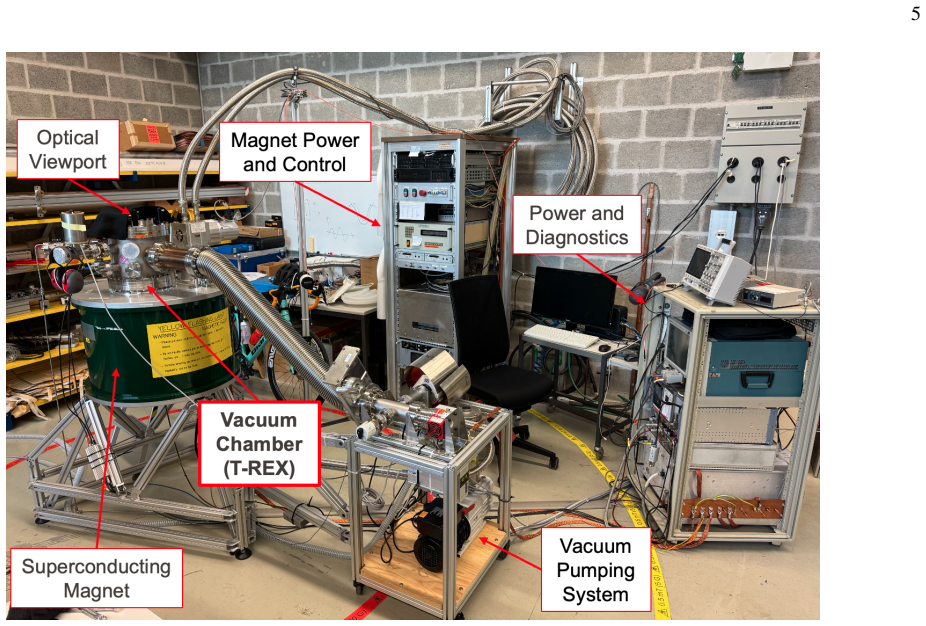
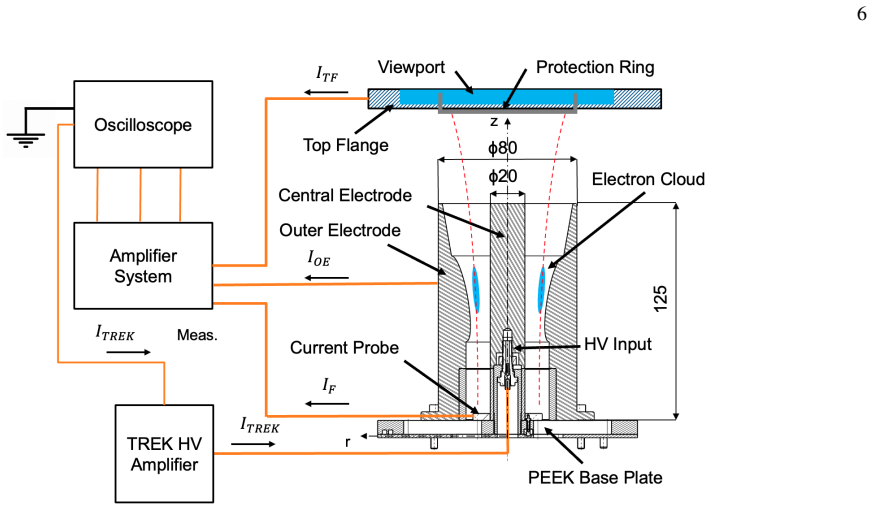
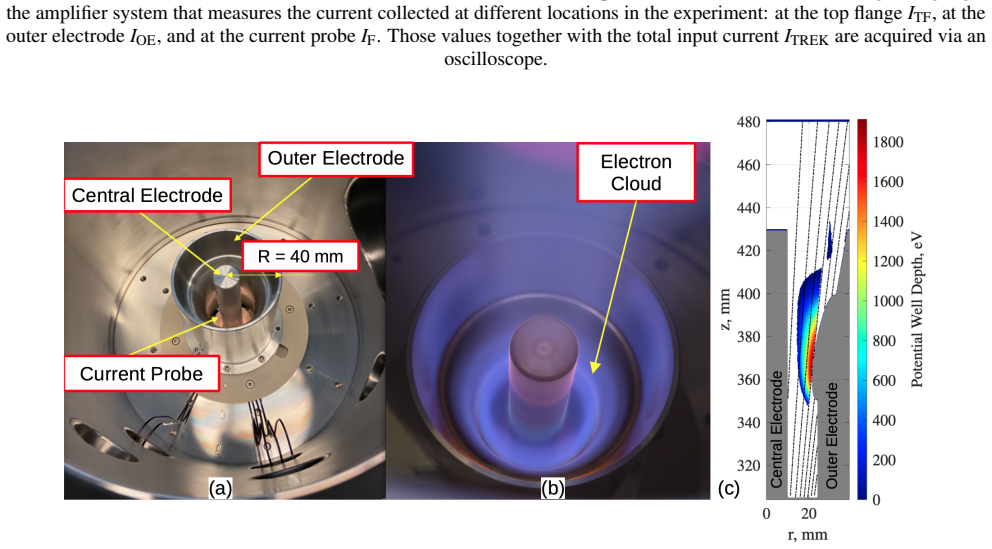
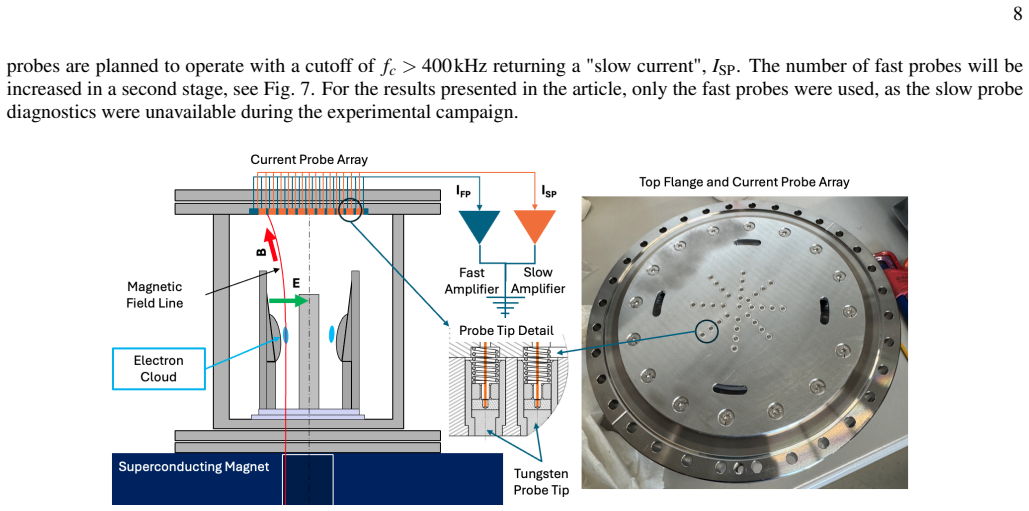
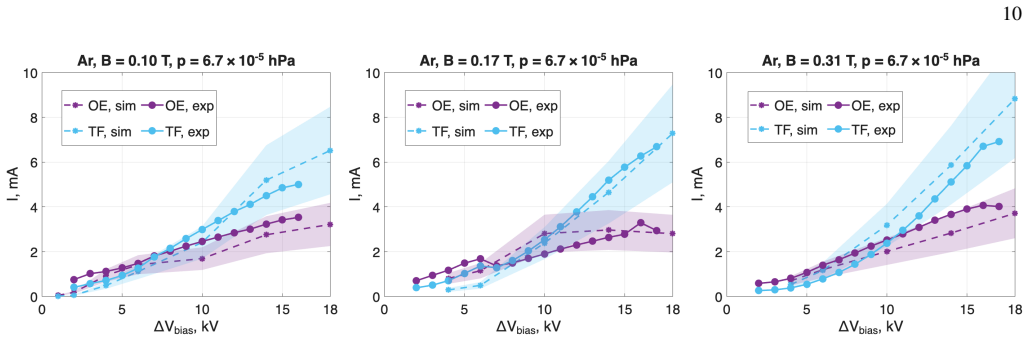
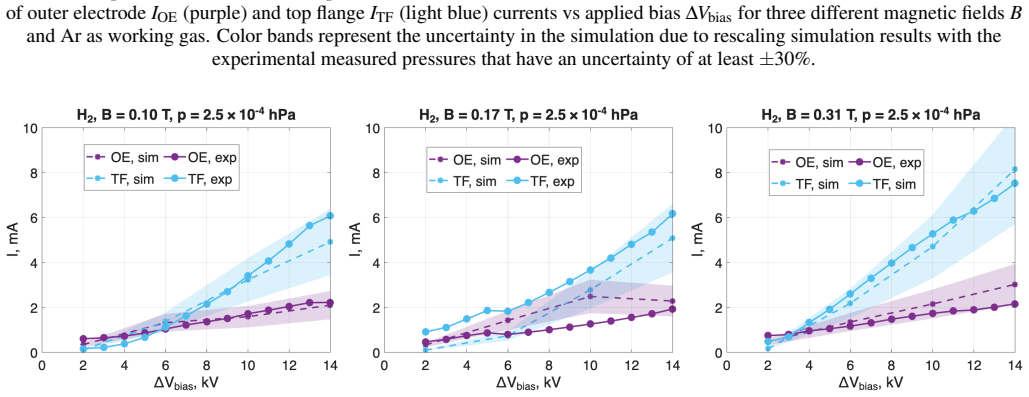
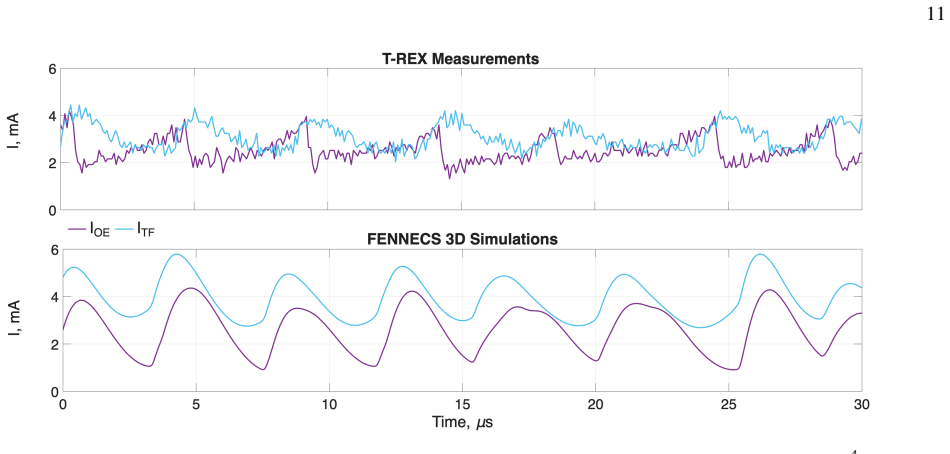
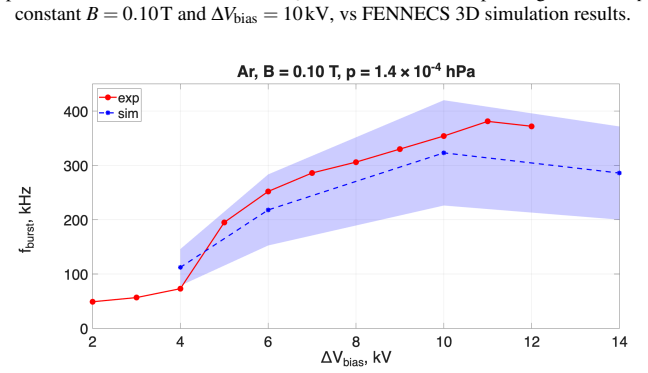
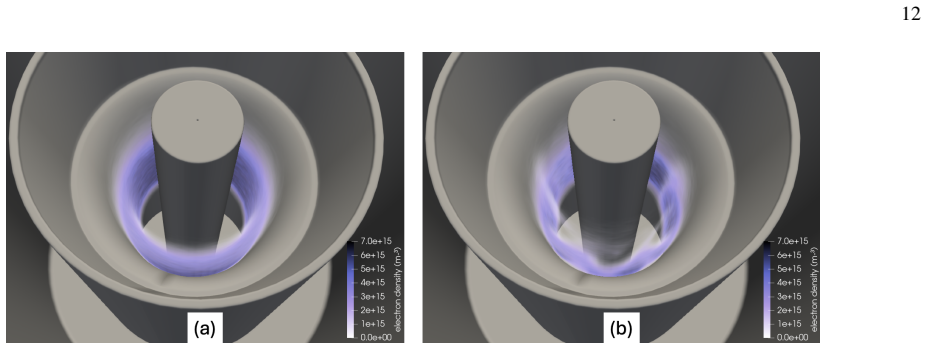
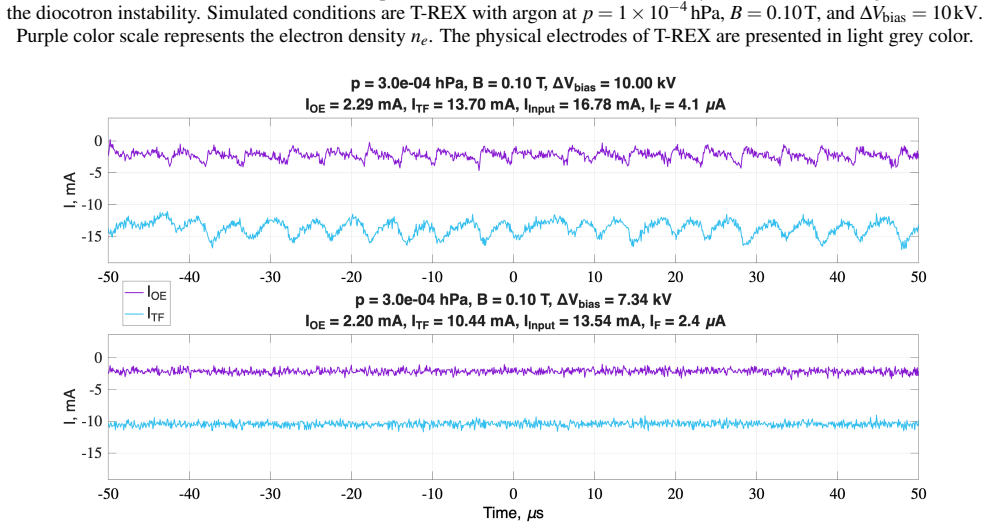
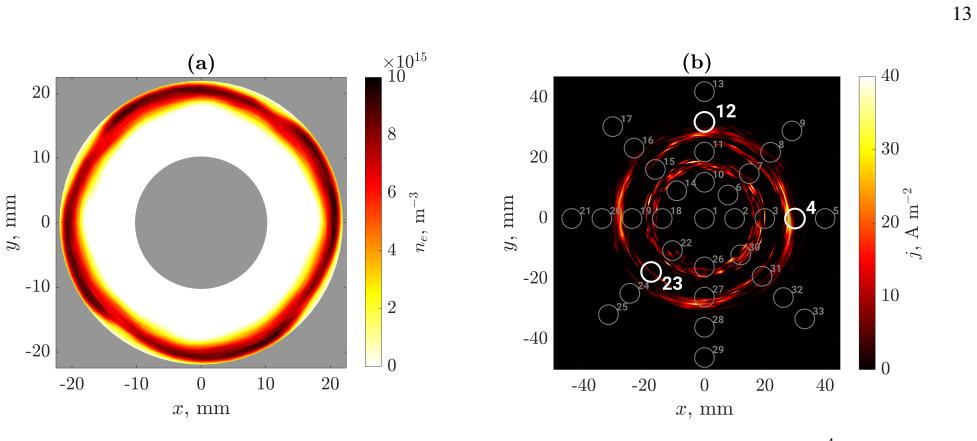
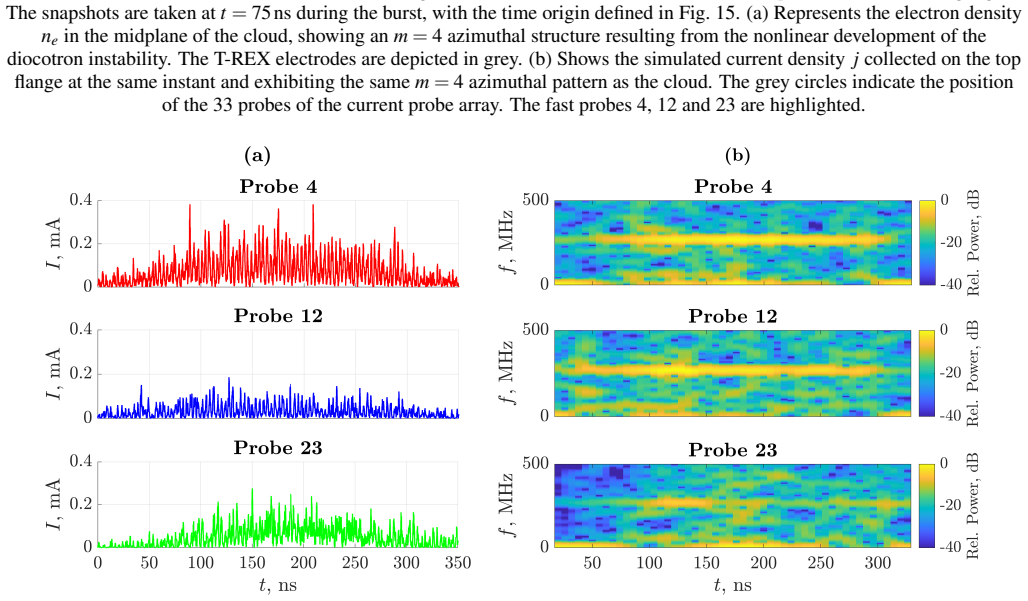
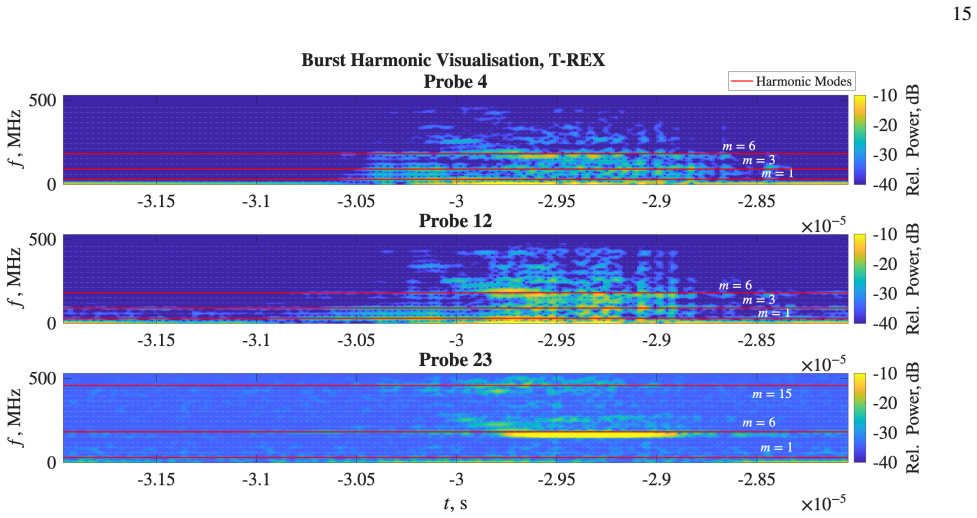
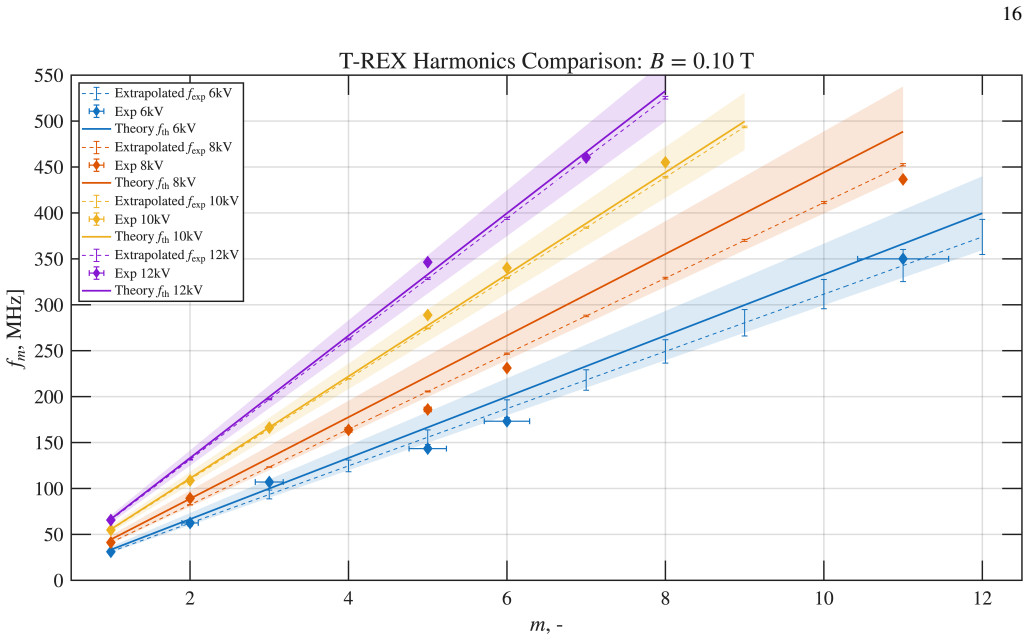
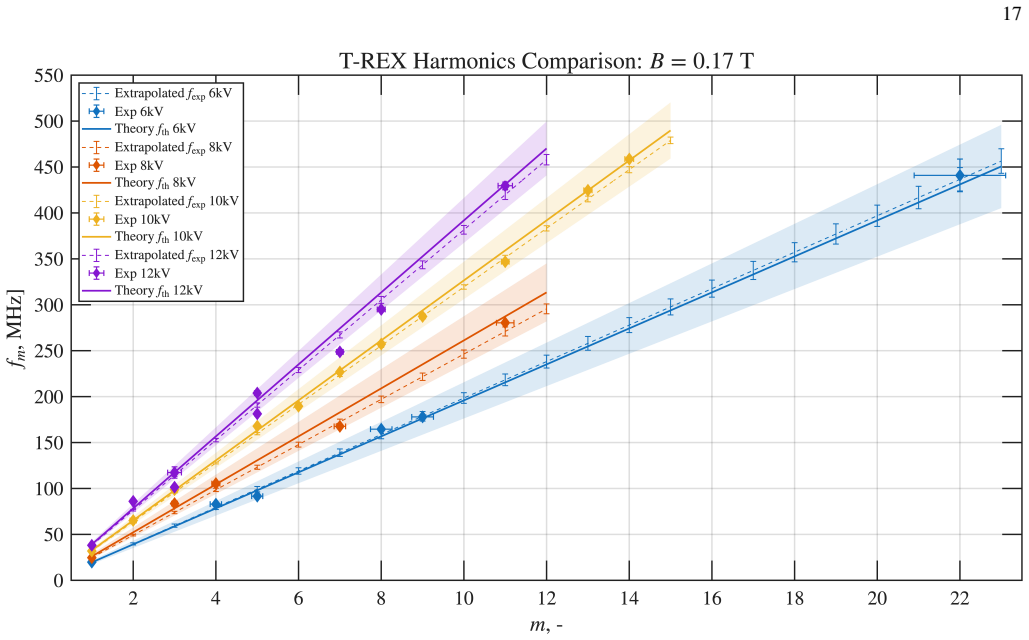
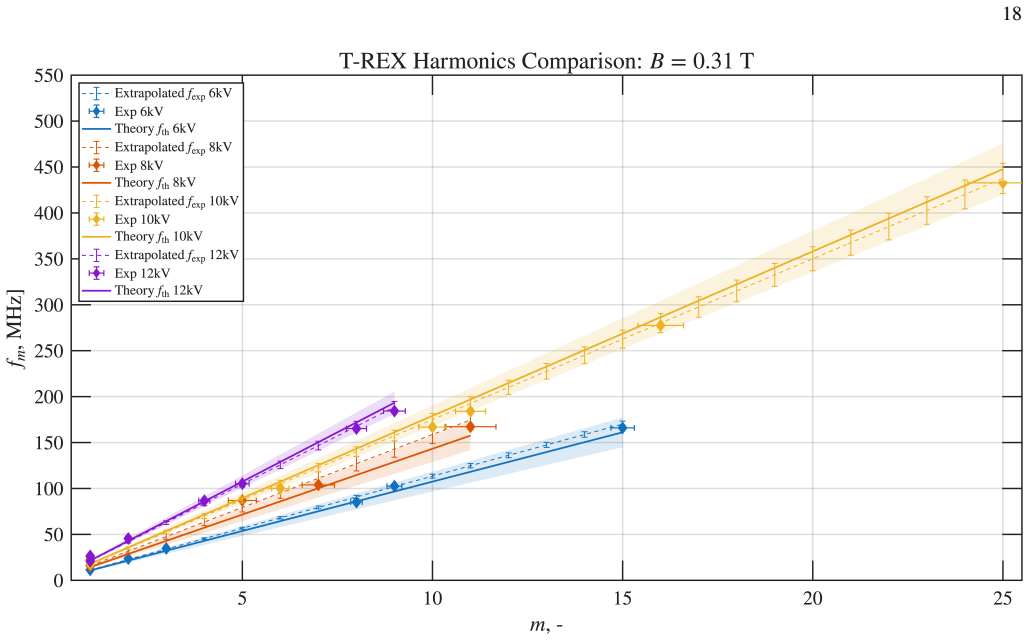
Gyrotrons are essential for electron cyclotron resonance heating (ECRH) in fusion reactors, making their efficient operation crucial for fusion energy. Past experiments revealed instability issues due to trapped electrons in the magnetron injection gun (MIG) region, causing undesired currents and operational failures. To address this, tight manufacturing tolerances are required for the MIG geometry~\cite{pago2}. We present findings of the TRapped Electrons eXperiment (T-REX) at the Swiss Plasma Center, designed to understand electron cloud physics in gyrotron MIGs. T-REX replicates MIG geometries, electric and magnetic fields, and is supported by the 3D FENNECS code. The setup includes two coaxial electrodes in a vacuum chamber atop a superconducting magnet; a central electrode is biased to negative DC voltages and an outer one is grounded, creating a radial electric field up to 2 MV/m and an axial magnetic field B < 0.31 T. Initial discrepancies between experiments and simulations were linked to the diocotron instability, leading to FENNECS being upgraded to 3D and a dedicated set of diagnostics for T-REX. This instability causes the electron cloud to collapse and reform at a frequency depending on plasma conditions. Within this article, time-resolved current measurements on the outer electrode and top flange are presented. Further, a fast current probe array installed at the top flange is detailed. Measurements highlight rotating structures in the electron cloud resulting from the diocotron instability. Simulations show remarkable agreement with experiments, especially regarding the cloud's build-up/collapse frequency, and the rotation frequency and direction of the modes. These results improve our understanding of non-neutral plasmas in environments mimicking a real gyrotron MIG, paving the way for better gyrotron reliability.
Editorial analysis
A structured set of objections, weighed in public.
Referee Report
Summary. The manuscript describes the T-REX experiment at the Swiss Plasma Center, which uses two coaxial electrodes in a vacuum chamber with radial E up to 2 MV/m and axial B < 0.31 T to replicate electron cloud physics in gyrotron magnetron injection guns (MIGs). It presents time-resolved current measurements on the outer electrode and top flange, plus a fast current probe array, that reveal rotating structures attributed to the diocotron instability; 3D FENNECS simulations are reported to show remarkable agreement with experiment on the cloud build-up/collapse frequency and on the rotation frequency and direction of the modes.
Significance. If the claimed quantitative agreement between T-REX measurements and 3D simulations is robust and the setup's parameters produce the same non-neutral plasma equilibria and instability dynamics as in real MIGs, the work would provide a controlled testbed for understanding trapped-electron effects that cause operational failures in gyrotrons for fusion ECRH, potentially informing geometry tolerances and mitigation strategies.
major comments (2)
- [Abstract] Abstract: the central claim of 'remarkable agreement' between experiment and simulation on build-up/collapse frequency and mode rotation frequency and direction supplies no numerical values, error bars, statistical measures, or tabulated comparisons, preventing assessment of whether the match is within experimental uncertainty or merely qualitative.
- [Abstract] Abstract (relevance claim): the assertion that T-REX replicates MIG electron-cloud dynamics is load-bearing for the paper's motivation, yet the manuscript does not demonstrate matching of diocotron scaling (ω_d ∝ n_e/B) or dimensionless groups such as the Brillouin ratio or normalized E×B drift, given the factor-of-3–10 lower B-field (<0.31 T versus 1–5 T typical in MIGs) and the simplified coaxial geometry versus the complex cathode-anode shaping of actual guns.
Simulated Author's Rebuttal
We thank the referee for their careful reading of the manuscript and for highlighting these important points regarding the abstract. We address each major comment below.
read point-by-point responses
-
Referee: [Abstract] Abstract: the central claim of 'remarkable agreement' between experiment and simulation on build-up/collapse frequency and mode rotation frequency and direction supplies no numerical values, error bars, statistical measures, or tabulated comparisons, preventing assessment of whether the match is within experimental uncertainty or merely qualitative.
Authors: We agree that the abstract would be strengthened by the inclusion of quantitative measures. In the revised manuscript we will update the abstract to report the specific build-up/collapse frequencies and mode rotation frequencies (with directions) obtained from both the T-REX measurements and the 3D FENNECS simulations, together with the relative differences and any available uncertainties or repeatability statistics from the data sets. revision: yes
-
Referee: [Abstract] Abstract (relevance claim): the assertion that T-REX replicates MIG electron-cloud dynamics is load-bearing for the paper's motivation, yet the manuscript does not demonstrate matching of diocotron scaling (ω_d ∝ n_e/B) or dimensionless groups such as the Brillouin ratio or normalized E×B drift, given the factor-of-3–10 lower B-field (<0.31 T versus 1–5 T typical in MIGs) and the simplified coaxial geometry versus the complex cathode-anode shaping of actual guns.
Authors: The referee is correct that the current text does not explicitly demonstrate the diocotron scaling or the matching of dimensionless groups. We will add a concise discussion (and, if space permits, a short table) in the revised manuscript that (i) recalls the expected ω_d ∝ n_e/B dependence, (ii) shows that the Brillouin ratio and normalized E×B drift in T-REX lie within the range accessible in MIGs by appropriate choice of density, and (iii) clarifies the intentional geometric simplifications while noting their limitations for direct extrapolation to shaped cathodes. This will make the relevance claim more quantitative while acknowledging the B-field difference. revision: yes
Circularity Check
No significant circularity; experiment-simulation comparison is independent
full rationale
The paper's central claims rest on direct comparison of T-REX time-resolved current measurements (outer electrode, top flange, fast probe array) against independent 3D FENNECS simulations. No equations, fitted parameters, or self-citations are shown that would reduce the reported build-up/collapse frequencies or rotation frequencies to inputs by construction. The cited prior work (pago2) addresses manufacturing tolerances and is external to the present authors. The derivation chain therefore remains self-contained against external benchmarks.
Axiom & Free-Parameter Ledger
Reference graph
Works this paper leans on
-
[2]
F. Romano, G. Le Bars, J. Loizu, M. Nöel, J.-P. Hogge, S. Alberti, J. Genoud, S. Antonioni, L. Naux, P. Giroud-Garampon, S. Couturier, T. Leresche, and D. Fasel, Review of Scientific Instruments95(2024), 10.1063/5.0212127
-
[3]
G. Le Bars, J.-P. Hogge, J. Loizu, S. Alberti, F. Romano, and A. Cerfon, Physics of Plasmas29(2022), 10.1063/5.0098567, 082105
-
[4]
Le Bars, J
G. Le Bars, J. Loizu, J.-P. Hogge, S. Alberti, F. Romano, J. Genoud, and I. G. Pagonakis, Physics of Plasmas30, 030702 (2023)
2023
-
[5]
G. M. Le Bars,Modelling of nonneutral plasmas trapped by electric and magnetic fields relevant to gyrotron electron guns, Ph.D. thesis, EPFL, 10.5075/epfl-thesis-10444, Lausanne (2023)
-
[6]
Le Bars, J
G. Le Bars, J. Loizu, S. Guinchard, J.-P. Hogge, A. Cerfon, S. Alberti, F. Romano, J. Genoud, and P. Kami ´nski, Computer Physics Communications303, 109268 (2024)
2024
-
[7]
Giroud-Garampon, F
P. Giroud-Garampon, F. Romano, J. Loizu, J.-P. Hogge, G. Le Bars, S. Alberti, J. Genoud, F. Braunmüller, M. Podestà, and T. Goodman, Physics of Plasmas32, 053903 (2025)
2025
-
[8]
H. Laqua, J. Baldzuhn, H. Braune, S. Bozhenkov, K. Brunner, Y . Kazakov, S. Marsen, D. Moseev, T. Stange, R. Wolf, M. Zanini, and W.-X. Team, inEPJ Web Conf., V ol. 203 (2019) p. 02002, 10.1051/epjconf/201920302002
-
[9]
C. Darbos, B. Beaumont, D. Boilson, M. Henderson, and C. Rotti, in2020 45th International Conference on Infrared, Millimeter, and Terahertz Waves (IRMMW-THz)(2020) pp. 1–2, 10.1109/IRMMW-THz46771.2020.9370668
-
[10]
Leggieri, F
A. Leggieri, F. Albajar, S. Alberti, A. Allio, K. A. Avramidis, D. Bariou, W. Bin, A. Bruschi, I. G. Chelis, R. Difonzo, F. Fanale,et al., 2022 23rd International Vacuum Electronics Conference (IVEC) , 118 (2022)
2022
-
[11]
Glyavin, G
M. Glyavin, G. Denisov, E. Tai, and A. Litvak, in2023 24th International Vacuum Electronics Conference (IVEC)(2023) pp. 1–2
2023
-
[12]
M. Tran, P. Agostinetti, G. Aiello, K. Avramidis, B. Baiocchi, M. Barbisan, V . Bobkov, S. Briefi, A. Bruschi, R. Chavan,et al., Fusion Engineering and Design180, 113159 (2022)
2022
-
[13]
I. G. Pagonakis, J.-P. Hogge, T. Goodman, S. Alberti, B. Piosczyk, S. Illy, T. Rzesnicki, S. Kern, and C. Lievin, in2009 34th International Conference on Infrared, Millimeter, and Terahertz Waves(2009) pp. 1–2, 10.1109/ICIMW.2009.5324625
-
[14]
S. Alberti, J. Genoud, T. Goodman, J.-P. Hogge, L. Porte, M. Silva, T.-M. Tran, M.-Q. Tran, K. Avramidis, I. Pagonakis,et al., inEPJ Web Conf., V ol. 157 (2017) p. 03001, 10.1051/epjconf/201715703001
-
[15]
Hogge, T
J.-P. Hogge, T. P. Goodman, S. Alberti, F. Albajar, K. A. Avramides, P. Bénin, S. Bethuys, W. Bin, T. Bonicelli, A. Bruschi,et al., Fusion Science and Technology55, 204 (2009)
2009
-
[16]
R. C. Davidson,Physics of Nonneutral Plasmas(1991)
1991
-
[17]
I. G. Pagonakis, B. Piosczyk, J. Zhang, S. Illy, T. Rzesnicki, J.-P. Hogge, K. Avramidis, G. Gantenbein, M. Thumm, and J. Jelonnek, Physics of Plasmas23, 023105 (2016)
2016
-
[18]
Piosczyk, G
B. Piosczyk, G. Dammertz, O. Dumbrajs, M. Kartikeyan, M. Thumm, and X. Yang, IEEE Transactions on Plasma Science32, 853 (2004)
2004
-
[19]
D. L. Eggleston, Physics of Plasmas29, 082103 (2022)
2022
-
[20]
J. R. Danielson, D. H. E. Dubin, R. G. Greaves, and C. M. Surko, Rev. Mod. Phys.87, 247 (2015)
2015
-
[21]
Giroud-Garampon, F
P. Giroud-Garampon, F. Romano, , J. L. J.-P. Hogge, G. Scimone, J. Genoud, F. Braunmüller, M. Podesta, and T. Goodman, submitted to Physics of Plasmas (2026)
2026
-
[22]
Giroud-Garampon, J
P. Giroud-Garampon, J. Loizu, F. Romano, G. L. Bars, and J.-P. Hogge, to be submitted (2026)
2026
-
[23]
Birdsall and A
C. Birdsall and A. Langdon,Plasma Physics via Computer Simulation(CRC Press, 2018)
2018
-
[24]
J. P. Boris, Proceeding of Fourth Conference on Numerical Simulations of Plasmas (1970)
1970
-
[25]
Birdsall, IEEE Transactions on Plasma Science19, 65 (1991)
C. Birdsall, IEEE Transactions on Plasma Science19, 65 (1991)
1991
-
[26]
Hasselkamp, H
D. Hasselkamp, H. Rothard, K.-O. Groeneveld, J. Kemmler, P. Varga, and H. Winter,Particle Induced Electron Emission II, V ol. 123 (Springer Berlin Heidelberg, 1992)
1992
-
[27]
Höllig, U
K. Höllig, U. Reif, and J. Wipper, SIAM Journal on Numerical Analysis39, 442 (2001)
2001
-
[28]
J. H. Malmberg and J. S. deGrassie, Phys. Rev. Lett.35, 577 (1975)
1975
-
[29]
J. S. deGrassie and J. H. Malmberg, Phys. Rev. Lett.39, 1077 (1977)
1977
-
[30]
J. H. Malmberg and C. F. Driscoll, Phys. Rev. Lett.44, 654 (1980)
1980
-
[31]
Ikeda, T
R. Ikeda, T. Shinya, S. Yajima, T. Nakai, T. Ohgo, M. Tsuneyama, H. Yamazaki, T. Kobayashi, and K. Kajiwara, Nuclear Fusion63, 066028 (2023)
2023
-
[32]
Terentyev, M
D. Terentyev, M. Wirtz, T. Morgan, T. Nozawa, A. Zinovev, C. Chang, K. Poleshchuk, and J. Elenbaas, Fusion Engineering and Design 200, 114200 (2024)
2024
-
[33]
Gruber, A
O. Gruber, A. Sips, R. Dux, T. Eich, J. Fuchs, A. Herrmann, A. Kallenbach, C. Maggi, R. Neu, T. Pütterich, J. Schweinzer, J. Stober, and the ASDEX Upgrade Team, Nuclear Fusion49, 115014 (2009). [34]Biagi-v8.9 database, www.lxcat.net(Retrieved on September 10, 2024)
2009
-
[34]
R. K. Janev, W. D. Langer, K. J. Evans, and D. E. J. Post,Elementary processes in hydrogen-helium plasmas: cross sections and reaction rate coefficients(Springer Science & Business Media, 2012)
2012
-
[35]
Leonardo supercomputer, CINECA,
EuroHPC Joint Undertaking, “Leonardo supercomputer, CINECA,”https://leonardo-supercomputer.cineca.eu/
discussion (0)
Sign in with ORCID, Apple, or X to comment. Anyone can read and Pith papers without signing in.