Is the most random pattern random? Maximizing localization in a two-dimensional lattice with engineered disorder
Pith reviewed 2026-06-28 13:56 UTC · model grok-4.3
The pith
Carefully chosen on-site energies produce stronger localization than random distributions in two-dimensional lattices.
A machine-rendered reading of the paper's core claim, the machinery that carries it, and where it could break.
Core claim
The central claim is that maximizing a localization-quantifying parameter by choosing specific on-site energies leads to significantly higher localization than that obtained from random distributions, and this approach can be adapted from the single-particle model to identify optimal idle-state settings in qubit lattices for maximum decoupling.
What carries the argument
Maximization of a localization-quantifying parameter via numerical optimization of on-site energies, refined by perturbation theory.
If this is right
- Engineered on-site energy patterns produce localization that exceeds the average from random distributions in the single-particle model.
- An improved cost function derived from perturbation theory yields enhanced localization in both single-particle and full Hilbert space calculations.
- Results from the single-particle tight-binding model can be adapted to identify optimal settings for qubit lattice systems.
- Spatial patterns of on-site energies relate directly to localization efficiency.
Where Pith is reading between the lines
- The optimization procedure could be tested on actual quantum hardware to check whether the small-system decoupling improvements persist at scale.
- The same maximization approach might apply to other lattice geometries or to systems with different interaction strengths.
- If the single-particle model reliably predicts full-space behavior, it could simplify the search for idle-state parameters on processors with many qubits.
Load-bearing premise
A localization-quantifying parameter exists whose maximization produces useful decoupling in both the single-particle model and the full qubit Hilbert space, with small-system results transferring to larger processors.
What would settle it
A direct numerical comparison on a larger qubit lattice showing that random on-site energies achieve equal or greater decoupling than the optimized patterns would falsify the transfer claim.
Figures
read the original abstract
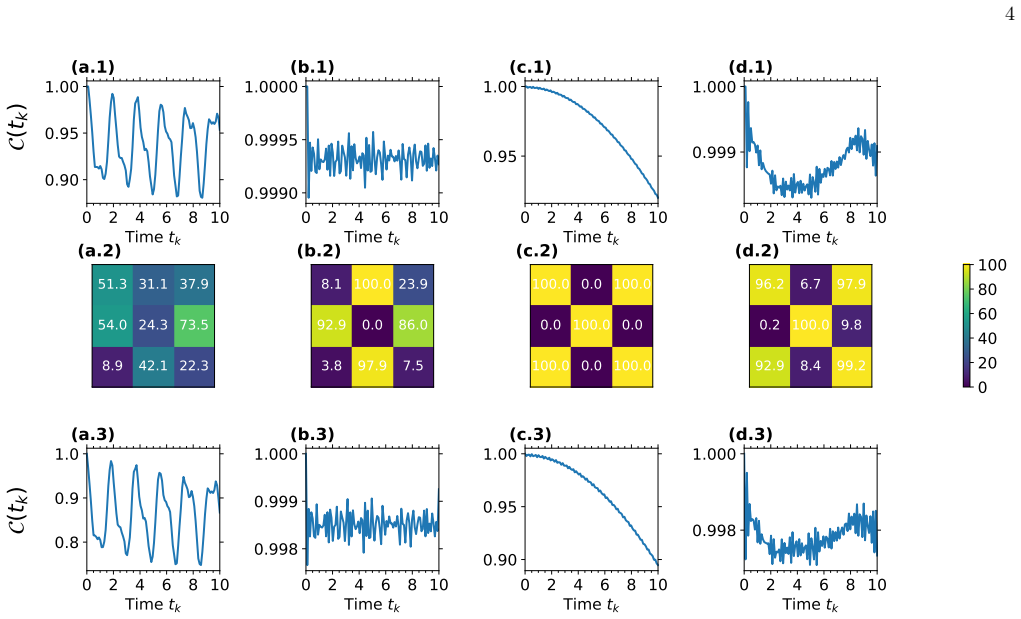
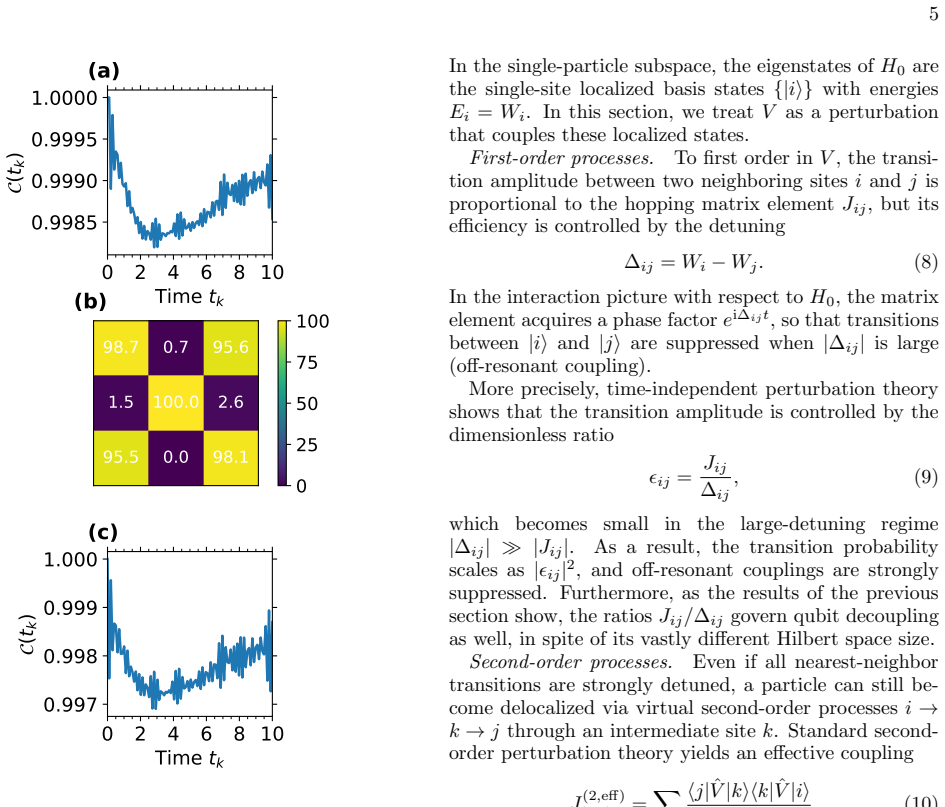
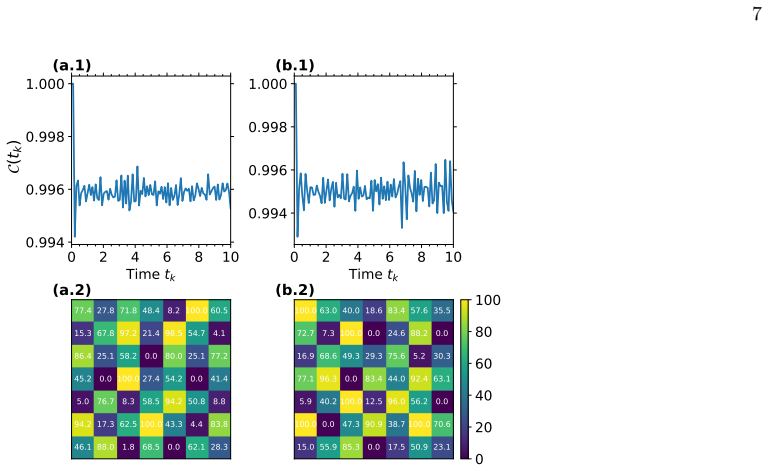
We investigate localization in two models: a single particle in a two-dimensional square lattice described by the tight binding Hamiltonian, and a two-dimensional square qubit lattice. It is well-known that Anderson localization occurs under suitable conditions in which the system parameters are chosen randomly from some statistical distribution. We propose a situation in which the parameters, specifically the on-site energies, are carefully chosen in such a way that a localization-quantifying parameter is maximized. We demonstrate the optimization procedure with numerical calculations in which the engineered localization significantly exceeds the average localization caused by a random distribution of the on-site energies. We explore the relation between spatial patterns and localization efficiency. Furthermore, we use perturbation theory to gain insight into the localization mechanism and obtain an improved cost function for optimization calculations, leading to enhanced localization in both the single-particle and full Hilbert spaces. Although large-scale simulations for qubit lattices are computationally infeasible, we use small-system simulations to demonstrate that results obtained using the single-particle tight binding model can be adapted to identify optimal settings for qubit lattice systems to achieve maximum decoupling between the qubits, which can be valuable for optimizing the idle-state settings on a quantum processor.
Editorial analysis
A structured set of objections, weighed in public.
Referee Report
Summary. The manuscript examines Anderson localization in a two-dimensional square lattice for both a single-particle tight-binding model and a qubit lattice. The authors propose engineering the on-site energies to maximize a localization-quantifying parameter rather than selecting them randomly from a distribution. Numerical optimizations show that the engineered disorder achieves significantly higher localization than the average for random disorder. Perturbation theory is used to derive an improved cost function, enhancing localization in both models. Small-system simulations suggest that the single-particle optimizations can be transferred to identify settings for maximum decoupling in qubit systems, with potential applications to quantum processor idle states.
Significance. If the central numerical results hold after controls, the work provides a concrete method for surpassing random disorder in localization and qubit decoupling via engineered on-site energies. The perturbation-theory refinement of the cost function is a methodological strength that demonstrably improves outcomes in the reported calculations.
major comments (2)
- [Qubit lattice section / abstract] The transfer from single-particle tight-binding optimizations to decoupling in the full qubit Hilbert space is demonstrated only via small-system simulations (as noted in the abstract). No scaling analysis or larger-lattice evidence is provided to establish that the engineered advantage over random disorder persists with increasing system size, where localization-length scaling or boundary effects could reduce or eliminate the gain. This is load-bearing for the claimed utility in quantum-processor idle-state optimization.
- [Optimization procedure] The localization-quantifying parameter is both the optimization target and the reported performance metric. The manuscript should explicitly verify (e.g., via an independent diagnostic such as participation ratio or inverse participation ratio computed separately) that the procedure does not reduce to tautological maximization of the same quantity used for evaluation.
minor comments (2)
- [Figures] Figure captions and axis labels should explicitly state the system size (N×N) and the precise definition of the localization parameter being plotted to allow direct comparison with the random-disorder baseline.
- [Abstract] The abstract states that 'large-scale simulations for qubit lattices are computationally infeasible' yet reports small-system results; a brief statement of the largest feasible qubit-lattice size used would improve transparency.
Simulated Author's Rebuttal
We thank the referee for their careful reading of the manuscript and for the constructive comments. We address each major point below and indicate where revisions will be made.
read point-by-point responses
-
Referee: [Qubit lattice section / abstract] The transfer from single-particle tight-binding optimizations to decoupling in the full qubit Hilbert space is demonstrated only via small-system simulations (as noted in the abstract). No scaling analysis or larger-lattice evidence is provided to establish that the engineered advantage over random disorder persists with increasing system size, where localization-length scaling or boundary effects could reduce or eliminate the gain. This is load-bearing for the claimed utility in quantum-processor idle-state optimization.
Authors: The manuscript already states that large-scale qubit-lattice simulations are computationally infeasible. The small-system results demonstrate transferability of the single-particle optimizations to the full Hilbert space. In revision we will expand the discussion of this limitation, including remarks on possible scaling behavior inferred from the single-particle model and the relevance of small-system results to near-term quantum-processor idle-state tuning. revision: partial
-
Referee: [Optimization procedure] The localization-quantifying parameter is both the optimization target and the reported performance metric. The manuscript should explicitly verify (e.g., via an independent diagnostic such as participation ratio or inverse participation ratio computed separately) that the procedure does not reduce to tautological maximization of the same quantity used for evaluation.
Authors: We agree that an independent diagnostic is required. In the revised manuscript we will compute the inverse participation ratio (IPR) on the optimized configurations and on random-disorder ensembles, reporting the comparison explicitly to confirm that localization is enhanced under a separate metric. revision: yes
Circularity Check
Maximization of localization parameter yields higher localization than random by construction
specific steps
-
self definitional
[Abstract]
"We propose a situation in which the parameters, specifically the on-site energies, are carefully chosen in such a way that a localization-quantifying parameter is maximized. We demonstrate the optimization procedure with numerical calculations in which the engineered localization significantly exceeds the average localization caused by a random distribution of the on-site energies."
The optimization explicitly maximizes the localization-quantifying parameter; the subsequent claim that the engineered case exceeds random averages is then evaluated using that same parameter. The reported superiority is therefore guaranteed by the maximization step itself and does not constitute a non-trivial derivation or prediction.
full rationale
The paper defines a localization-quantifying parameter, optimizes on-site energies to maximize it, and then reports that the resulting engineered localization exceeds the average for random distributions. This comparison uses the identical parameter as both optimization target and evaluation metric, making the superiority result true by definition rather than an independent empirical finding. The qubit-lattice adaptation relies on the same single-particle optimization transferred via small-system numerics without additional independent validation.
Axiom & Free-Parameter Ledger
Reference graph
Works this paper leans on
-
[1]
The notation⟨i, j⟩in- dicates that we take the sum over nearest-neighbor pairs of sites
tight binding Hamiltonian We consider the tight binding Hamiltonian that de- scribes particles hopping between the sites of a periodic lattice: ˆH= nX i=1 Wiˆa† i ˆai + X ⟨i,j⟩ Jij(ˆa† jˆai + h.c.),(1) where ˆai annihilates a particle at sitei, ˆa † i is the hermi- tian conjugate of ˆai and hence creates a particle at sitei, Wi is the energy of sitei,J ij...
-
[2]
(1) is the single-particle An- derson localization of a single particle[29]
Maximization of localization in the single-particle sector One type of localization that arises under the tight binding Hamiltonian of Eq. (1) is the single-particle An- derson localization of a single particle[29]. The single- particle Hilbert space has dimensionnwith basisB 1p = {|1,0, . . . ,0⟩,|0,1,0, . . . ,0⟩, . . . ,|0, . . . ,0,1⟩}. To quantify si...
-
[3]
In this case, we consider the Hilbert space in which each site can contain zero or one particle, repre- senting the qubit states|0⟩and|1⟩
Maximization of localization in a qubit lattice The second type of localization that we analyze in this work is that of an arbitrary-particle-number quantum states in a qubit lattice, which is relevant to quantum processors. In this case, we consider the Hilbert space in which each site can contain zero or one particle, repre- senting the qubit states|0⟩a...
2000
-
[4]
P. W. Anderson, Physical Review109, 1492 (1958)
1958
-
[5]
Abrahams, P
E. Abrahams, P. W. Anderson, D. C. Licciardello, and T. V. Ramakrishnan, Physical Review Letters42, 673 (1979)
1979
-
[6]
Anderson, 50 Years Of Anderson Localization
P. Anderson, 50 Years Of Anderson Localization. Edited by PW Anderson. Published by World Scientific Publish- ing Co. Pte. Ltd (2010)
2010
-
[7]
D. M. Basko, I. L. Aleiner, and B. L. Altshuler, Annals of Physics321, 1126 (2006)
2006
-
[8]
A. Z. Genack and N. Garcia, Phys. Rev. Lett.66, 2064 (1991)
2064
-
[9]
Ashhab and M
S. Ashhab and M. E. Madjet, Computational Materials Science155, 534 (2018)
2018
-
[10]
Billy, V
J. Billy, V. Josse, Z. Zuo, A. Bernard, B. Hambrecht, P. Lugan, D. Cl´ ement, L. Sanchez-Palencia, P. Bouyer, and A. Aspect, Nature453, 891 (2008)
2008
-
[11]
N. W. Ashcroft and N. D. Mermin,Solid State Physics (Thomson Learning, Toronto, 1976)
1976
-
[12]
Madelung,Introduction to Solid-State Theory (Springer-Verlag, Berlin Heidelberg, 1978)
O. Madelung,Introduction to Solid-State Theory (Springer-Verlag, Berlin Heidelberg, 1978)
1978
-
[13]
Jaksch and P
D. Jaksch and P. Zoller, Annals of Physics315, 52 (2005)
2005
-
[14]
Gurarie, L
V. Gurarie, L. Pollet, N. V. Prokof’ev, B. V. Svistunov, and M. Troyer, Physical Review B80, 214519 (2009)
2009
-
[15]
Berke, E
C. Berke, E. Varvelis, S. Trebst, A. Altland, and D. P. DiVincenzo, Nature Communications13, 2495 (2022)
2022
-
[16]
Madronero, A
J. Madronero, A. Ponomarev, A. R. Carvalho, S. Wim- berger, C. Viviescas, A. Kolovsky, K. Hornberger, P. Schlagheck, A. Krug, and A. Buchleitner, Advances In Atomic, Molecular, and Optical Physics53, 33 (2006)
2006
-
[17]
Evers and A
F. Evers and A. Mirlin, Physical review letters84, 3690 (2000)
2000
-
[18]
W. S. Bakr, J. I. Gillen, A. Peng, S. F¨ olling, and M. Greiner, Nature462, 74 (2009)
2009
-
[19]
Megrant and Y
A. Megrant and Y. Chen, Nature Electronics8, 549 (2025)
2025
-
[20]
Sanchez-Palencia and M
L. Sanchez-Palencia and M. Lewenstein, Nature Physics 6, 87 (2010)
2010
-
[21]
Izrailev and A
F. Izrailev and A. Krokhin, Physical review letters82, 4062 (1999)
1999
-
[22]
F. A. B. F. de Moura and M. L. Lyra, Physical Review Letters81, 3735 (1998)
1998
-
[23]
D. H. Dunlap, H.-L. Wu, and P. W. Phillips, Physical Review Letters65, 88 (1990)
1990
-
[24]
Ashhab, Physical Review A92, 062305 (2015)
S. Ashhab, Physical Review A92, 062305 (2015)
2015
-
[25]
M. Heyl, P. Hauke, and P. Zoller, Science advances5, eaau8342 (2019)
2019
-
[26]
P. V. Klimov and J. S. Kelly, Optimizing qubit operating frequencies (2018), uS Patent US20220300847A1
2018
-
[27]
P. V. Klimov, J. Kelly, J. M. Martinis, and H. Neven, arXiv preprint arXiv:2006.04594 (2020). 8
arXiv 2006
-
[28]
P. V. Klimov, A. Bengtsson, C. Quintana, A. Bourassa, S. Hong, A. Dunsworth, K. J. Satzinger, W. P. Liv- ingston, V. Sivak, M. Y. Niu, T. I. Andersen, Y. Zhang, D. Chik, Z. Chen, C. Neill, C. Erickson, A. G. Dau, A. Megrant, P. Roushan, A. N. Korotkov, J. Kelly, V. Smelyanskiy, Y. Chen, and H. Neven, Nature Com- munications15, 2442 (2024)
2024
-
[29]
G. Q. AI and Collaborators, Hilbert space signatures of non-ergodic glassy dynamics (2026), arXiv:2601.01309 [quant-ph]
Pith/arXiv arXiv 2026
-
[30]
M. P. Fisher, P. B. Weichman, G. Grinstein, and D. S. Fisher, Physical Review B40, 546 (1989)
1989
-
[31]
Kjaergaard, M
M. Kjaergaard, M. E. Schwartz, J. Braum¨ uller, P. Krantz, J. I.-J. Wang, S. Gustavsson, and W. D. Oliver, Annual Review of Condensed Matter Physics11, 369 (2020)
2020
-
[32]
Nandkishore and D
R. Nandkishore and D. A. Huse, Annu. Rev. Condens. Matter Phys.6, 15 (2015)
2015
-
[33]
Evers and A
F. Evers and A. D. Mirlin, Reviews of Modern Physics 80, 1355 (2008)
2008
-
[34]
S. Inoue, S. Shirai, S. Tamate, S. Watanabe, K. Mat- suura, R. Li, and Y. Nakamura, Systematic frequency- collision analysis of the cross-resonance gate outside the straddling regime (2026), arXiv:2605.07868 [quant-ph]
Pith/arXiv arXiv 2026
-
[35]
Zhang, P
Z. Zhang, P. Gokhale, and J. M. Larson, Physical Review A111, 012619 (2025)
2025
-
[36]
Morvan, L
A. Morvan, L. Chen, J. M. Larson, D. I. Santiago, and I. Siddiqi, Physical Review Research4, 023079 (2022)
2022
-
[37]
E. McKinney, I. G. Yusuf, G. Falstin, G. Agarwal, M. Ha- tridge, and A. K. Jones, arXiv preprint arXiv:2409.18262 (2024), arXiv:2409.18262 [quant-ph]
arXiv 2024
discussion (0)
Sign in with ORCID, Apple, or X to comment. Anyone can read and Pith papers without signing in.